Meta Data Management: Your 2026 Playbook
|
8
min read

You're in a meeting, someone asks why yesterday's dashboard doesn't match today's numbers, and three people give three different definitions of the same metric. The data is in the warehouse, the pipeline ran, and yet nobody trusts the output enough to make a call. That's where metadata management stops being a background task and becomes the thing holding the whole data operation together.
Table of Contents
Why Metadata Management Matters Now
A broken dashboard usually does not fail with drama. It starts returning the wrong answer after a column name changes, a source shifts, or a transformation is updated without anyone noticing. The BI team keeps the report alive, the analyst keeps exporting to Excel, and the business slowly loses trust in the data.
The shift from documentation to operational control
That quiet failure is why metadata has moved from documentation into operational infrastructure. A market study estimated the global metadata management market at USD 2.84 billion in 2025 and projected it to reach USD 27.97 billion by 2035 with a 25.7% CAGR. The same study says North America held more than 39.15% share, data catalogs and discovery tools accounted for 58.4% of global share, and the U.S. market reached USD 1.01 billion in 2025. Those figures point to a simple reality, metadata now sits in the core data stack, as shown in the Market.us metadata management market report.
The pressure behind that shift is practical. When metadata is weak, data scientists can spend up to 80% of their time cleaning data, which leaves less time for modeling, testing, and delivery. That kind of drag is hard to ignore in organizations trying to support analytics, compliance, and AI at the same time. Market.us metadata management market report
Why business teams care too
Older metadata programs often lived inside IT. The business only touched them when a glossary needed a new term or a report needed to be signed off. That model no longer works because metadata consumers are often business users, and a widely cited survey found nearly 80% of metadata consumers fell into that group, while two-thirds of respondents said metadata mattered more in 2020 than it had 10 years earlier. The same survey also shows how broad the need has become across roles that depend on shared definitions and trustworthy context. Dataversity metadata management survey
That research also shows why the conversation changed. The most common sources were data warehouses, relational databases, data models, and business glossaries, and the most desired future asset was big data platforms. In practice, metadata became a business-facing control layer for governance, analytics, and auditability, much like a control room that shows what is running, what changed, and who should respond. Teams that need a plain-language entry point can also understand Llama 3.1 access before they decide how much metadata context belongs in shared systems.
A data catalog gives that control layer a usable front end, because it helps people find assets, inspect context, and trace ownership without digging through multiple tools. That is the operational value that matters most. If a business user cannot tell what a field means, who owns it, and whether it is safe to use, the metadata layer is not doing its job.
Core Components of Metadata Management
Good meta data management starts with a simple definition. Metadata management is the systematic process of creating, storing, organizing, and maintaining metadata across an organization's data assets. IBM describes it as organizing, optimizing, and using metadata to improve accessibility and quality, while Snowflake frames it as the practices, policies, and tools that govern how metadata is created, maintained, enriched, and made usable. IBM metadata management overview, Snowflake metadata management overview
The six metadata types that matter in practice
A useful enterprise taxonomy breaks metadata into technical, descriptive, structural, administrative, operational, and quality metadata. Technical metadata covers schemas and data types. Descriptive metadata carries business terms and definitions. Structural metadata shows relationships between elements. Administrative metadata includes access rights and retention. Operational metadata tracks lineage and transformations. Quality metadata covers completeness and freshness. Atlan metadata types
That breakdown matters because each type answers a different question. If a BI developer wants to know whether a metric is built on the right fields, technical and structural metadata help. If a governance lead needs retention and access context, administrative metadata is the source of truth. If an analyst is debugging a report, operational and quality metadata tell them where the data came from and whether it changed in a way that should be trusted.
The U.S. National Institutes of Health quotes the National Information Standards Organization definition of metadata as “Structured information that describes, explains, locates, or otherwise makes it easier to retrieve, use, or manage an information resource.” That definition is useful because it ties metadata directly to retrieval, use, and management, not just search. NIH metadata fundamentals workbook
How the pieces work together
A catalog is the front door. Lineage is the map. Stewardship is the ownership model. Schema versioning is the change log. None of them works well on its own. When definitions live in one tool, lineage in another, and quality scores somewhere else, teams lose the ability to trace a problem end to end. That fragmentation is exactly what makes dashboard breakage hard to diagnose and cross-system consistency hard to preserve. EWSolutions on metadata silos
A helpful way to think about the process is to separate what gets defined from where it lives and how people find it. A data catalog organizes terms. A repository stores the metadata. Ownership and versioning keep it current. Discovery makes it usable for the people who need it.
A useful reference for teams building that front door is understand Llama 3.1 access, since it shows how metadata and access patterns often get discussed together in real implementation work. For a practical enterprise view of the catalog layer, digna's overview of what is a data catalog is also worth reading.

Integration with Data Quality and Observability
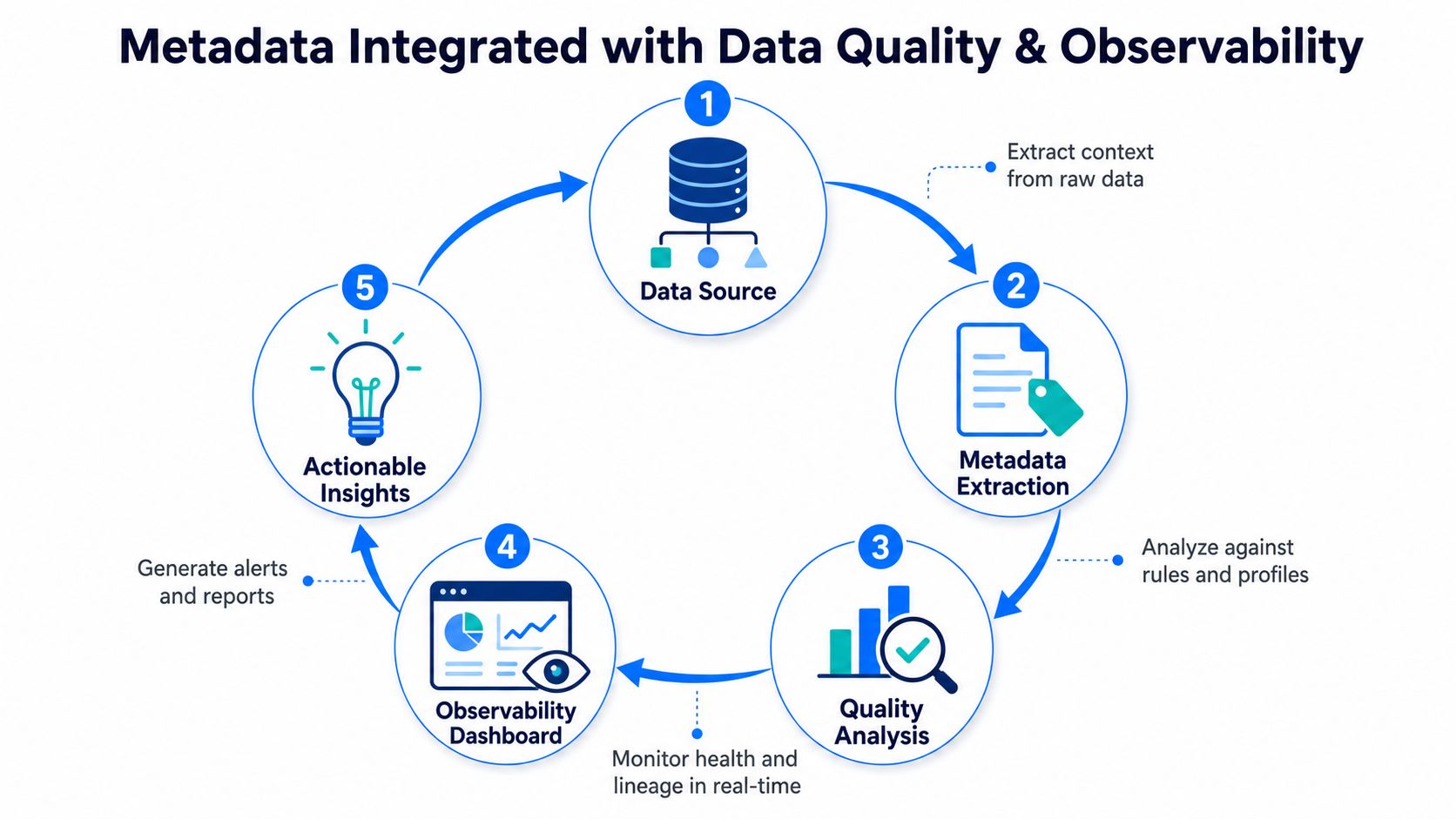
Metadata becomes operational when it feeds quality checks and observability workflows. A catalog that only tells people what a table is called helps with discovery. A catalog that also shows when that table changed, who depends on it, and whether the last load looked normal helps engineers prevent incidents before they spread.
From passive context to active signals
The practical shift is to place metadata beside validation and monitoring, rather than treating it as background reference material. Modern guidance says metadata management should include lineage, ownership, sensitivity, usage, and quality signals, because teams need to know which dashboards are used and whether the data is behaving as expected. A 2025 MIT CDOIQ survey cited in the verified data found only 12% of companies reported strongly integrated metadata management across technical, business, and operational layers. MIT CDOIQ survey video
That gap matters because disconnected metadata creates blind spots. If schema tracking is isolated from quality monitoring, an analyst may see a failed dashboard long after the upstream issue started. If lineage is separated from runtime alerts, a team can see that something changed without knowing what it broke. Observability turns metadata into a live control surface, which helps teams trace symptoms back to source systems instead of leaving them in a static document store.
digna's platform is relevant here because it combines in-database execution, AI-driven anomaly detection, continuous schema tracking, and timeliness monitoring inside the customer's own environment. That setup fits the operating pattern many teams want, where metadata, quality, and monitoring support the same incident workflow instead of sitting in separate tools. For teams that want a practical view of the connection between metadata and quality checks, digna's guide on metadata and data quality gives a useful starting point.
Operational insight: if the metadata layer can't explain a broken report in terms of source, transformation, and consumer impact, it still leaves too much guesswork in the process.
What good integration looks like
A practical workflow usually starts with the source system. Metadata extraction captures schemas, owners, and lineage. Quality rules evaluate the data against expected patterns. Observability surfaces the anomaly or delay. The action item lands with the right team because the metadata points to the affected asset and its downstream consumers.
That chain matters in everyday work. A schema change should tell the BI developer which dashboard might fail. A freshness issue should tell the operations analyst whether the delay is new or recurring. A validation failure should give the governance lead enough context to assess whether the issue is local or systemic. For teams building stronger controls around data quality and observability, the article on IT governance frameworks for UK projects offers a useful adjacent perspective.
Governance and Security Considerations
A metadata catalog can look harmless at first glance because it does not contain the raw customer record or the finance transaction itself. That view misses the operational risk. Metadata reveals structure, ownership, access patterns, retention rules, and business logic, which can expose how sensitive systems work and who can see what.
Keeping metadata accurate and current
The first governance question is freshness. At enterprise scale, metadata becomes harder to maintain because search, retrieval, update, and reconciliation all get heavier as the volume and variety of records grow. IBM notes that large distributed environments need automation and governance because manual updates quickly create stale or obsolete entries. IBM metadata management overview
That problem shows up in compliance work. Stale metadata weakens evidence, slows root-cause analysis, and makes it harder to show what changed when auditors ask. The fix is operational, not cosmetic. Capture metadata at pipeline execution, assign ownership, and version the changes so the metadata moves with the data rather than trailing behind it.
Lineage and provenance need the same discipline. A clear lineage trail shows where an asset came from, how it changed, and where it is used, while provenance helps explain the origin and history of the data itself. Teams that need a sharper distinction can use this explanation of data provenance versus data lineage as a reference point when they design controls and audit trails.
Balancing completeness with overload
There is another trap, and it is easy to miss. Too much metadata can be as problematic as too little. Recent guidance recommends defining required versus optional fields and auditing obsolete entries so catalogs stay useful instead of bloated. That matters in environments that span warehouses, lakes, SaaS tools, and AI models, where schema drift and constant change can quickly turn a catalog into clutter. Datagalaxy metadata management guide
Security needs the same discipline. Metadata should be protected with access controls, role-based stewardship, and change approvals that match the sensitivity of the data it describes. If metadata reveals retention policy exceptions or business-rule logic, it deserves governance just like the asset it documents.
For teams building formal controls, IT governance frameworks for UK projects offers a useful reference point for structuring accountability and oversight around data programs.

Implementation Roadmap and Checklist
A metadata program succeeds when it starts with the mess you already have, not a theoretical future state. Most organizations don't need a grand design on day one. They need a clear inventory of what exists, who owns it, and which datasets cause the most pain when they drift.
Start with the highest-friction data
The first pass should focus on critical domains, the tables, reports, and pipelines that trigger the most questions, incidents, or manual reconciliation. That's where metadata creates visible value fastest. If the team can't see lineage, freshness, or ownership for those assets, the rest of the catalog won't save them.
Then define the minimum metadata fields that must exist for every high-value asset. Keep the required list short. Ask for the business name, technical location, owner, description, and the most important operational signals. Everything else can be added later if it serves a real decision or control.
Build for automation early
Manual metadata maintenance collapses at scale. Sources describing metadata operations note that distributed environments need automation because manual processes create stale, inconsistent, or obsolete records. The practical answer is to harvest metadata from orchestration, warehouse, and transformation layers automatically, then update it at the point of change. IBM metadata management overview
A simple checklist helps teams stay honest:
Assess current state: inventory the main sources, catalogs, glossaries, and ownership gaps.
Define governance rules: decide who can edit, approve, or retire metadata entries.
Select the platform: choose tools that can connect to the systems you already run.
Pilot a critical domain: start with one business area that feels the cost of bad metadata every week.
Measure and improve: review freshness, adoption, and the volume of unresolved metadata issues.
The best implementations don't treat metadata as a separate cleanup project. They wire it into pipeline execution, validation, and alerting so schema changes and quality signals travel together. That makes the metadata useful at the moment someone needs to act, not a day later after the incident review.

Real-World Enterprise Examples
Metadata management looks abstract until it saves a team from a bad decision. In practice, the same patterns show up across finance, healthcare, telecom, and the public sector, because each of those environments depends on traceability, timeliness, and confidence in downstream reporting.
Finance and regulated reporting
In financial services, teams use metadata to track regulatory reporting data, validate critical business rules, and detect unusual patterns before they affect compliance. The stakes are obvious. A reporting issue that hides a lineage break or a stale definition can become an audit problem fast. Metadata gives risk and governance teams a way to answer what changed, where it changed, and who needs to know.
Healthcare and operational reliability
Healthcare teams rely on metadata to keep clinical and operational data trustworthy. Schema changes, delayed delivery, and incomplete records can affect patient reporting and internal operations long before anyone spots the root cause. Continuous tracking helps those teams see whether a change is isolated or part of a broader problem in the data flow.
Telecom and public sector operations
Telecommunications teams work with high-volume customer and network data, so unexpected changes can spread quickly. Metadata helps them catch structural shifts and validate critical records before downstream systems amplify the problem. Public sector organizations use similar controls to improve reliability, traceability, and audit readiness across government data programs.
A screenshot of digna's observability interface shows how this kind of operational view can bring together incidents, data status, and change tracking in one place. That matters because engineers and analysts need the same evidence when they're trying to decide whether a problem is technical, business-related, or both.

Key Takeaways and Next Steps
Metadata management is no longer just about cataloging fields. It's the operating layer that helps teams discover data, explain it, govern it, and trust it when it moves through systems. The strongest programs connect metadata to quality, observability, and ownership so problems surface early and the right people can act on them.
Start with a narrow set of critical datasets, define the metadata fields that matter, and automate capture wherever possible. Then tighten governance so metadata stays current, secure, and usable instead of sprawling into clutter. The teams that treat metadata as a living system tend to spend less time arguing about definitions and more time improving the data itself.
digna helps teams monitor data behavior, schema changes, timeliness, and validation inside their own environment, which makes it a natural fit for metadata-aware quality and observability work. If you're building a more reliable metadata layer for analytics or AI, visit digna and see how its platform supports data teams that need control, traceability, and continuous monitoring.
Frequently asked questions
Why has metadata management become urgent?
Because metadata has moved from documentation into operational infrastructure. A broken dashboard usually does not fail with drama, and it is that quiet failure which turns metadata from a nice-to-have record into the thing you need to diagnose it.
What does the classic symptom look like?
Three people giving three different definitions of the same metric while someone asks why yesterday's dashboard does not match today's numbers. The disagreement is the metadata gap becoming visible.
How fast is the market growing?
A market study estimated global metadata management at USD 2.84 billion in 2025 and projected USD 27.97 billion by 2035, a 25.7% CAGR. Growth at that rate reflects a shift in what metadata is expected to do, not just more spending.
What is the difference between documentation and operational control?
Documentation records what data should mean; operational control uses that record to decide something. Metadata that no pipeline, alert or access decision consults is a description rather than a control.
Where should a metadata programme start?
With the definitions that people already argue about. Those arguments identify the metrics whose meaning is contested, which is exactly where a shared definition changes an outcome rather than filling a catalog.