10 Free Data Validation Tools for Modern Data Stacks
|
6
min read

A dashboard breaks right before the weekly exec review. An ML model starts drifting, but nobody notices until predictions look wrong in production. A revenue report lands with nonsense figures because a source column changed type three jobs upstream. Data teams know this pattern well. Bad data usually fails subtly first, then publicly later.
Manual checks don't scale. They also don't survive team growth, handoffs, or pipeline sprawl. At the same time, a full platform can feel excessive when you just need to validate DataFrames in Python, add warehouse tests to dbt, or catch schema drift in an ML pipeline. That's the gap many organizations sit in right now.
This guide focuses on free data validation tools that solve real problems without forcing a platform decision too early. It covers what each tool is good at, where it gets awkward, and when the free path stops being efficient. If you're building an early quality layer, that's often enough to prevent the most common failures and restore trust in the pipeline.
To find the right fit, it helps to choose by execution layer instead of feature checklist. The most common buckets are in-code and DataFrame validation for Python workflows, warehouse and pipeline-centric validation for SQL and transformation stacks, and ML or big data validation for Spark and feature pipelines. If you also need a broader analytics context, this founder's roadmap to data analytics is a useful companion.
Table of Contents
1. GX (formerly Great Expectations)
GX is still one of the most complete free data validation tools if you want a serious expectation-based framework instead of a few ad hoc assertions. It fits warehouse pipelines, notebooks, files, Spark jobs, and CI workflows. The open-source core gives you the validation engine. The paid cloud layer is where collaboration and governance move up a level.
What makes GX useful in practice is its breadth. You can validate schema, null behavior, uniqueness, ranges, patterns, and custom business rules, then publish readable Data Docs for humans instead of burying failures in logs. For teams that need structured validation artifacts, that's a meaningful advantage over simpler code-only libraries.
Where GX works best
GX is strongest when data quality is becoming a shared engineering concern rather than a notebook-side habit. It works well when you want tests versioned, reviewable, and attached to deployment gates.
Expectation depth: Built-in expectations cover common checks well, and custom expectations let you codify business logic.
Readable outputs: Data Docs help analysts and engineers inspect failures without reading raw tracebacks.
Integration range: SQL systems, files, Spark, and Databricks are all common deployment targets.
A good technical overview of why validity checker tools matter in modern pipelines is in this guide to mastering data validation.
Practical rule: Choose GX when you need a framework, not just a library. If your team wants reviewable expectations, documented outputs, and pipeline actions on failure, GX fits. If you only need to validate one pandas DataFrame inside a script, it's usually too heavy.
The trade-off is setup friction. GX has concepts, project structure, and configuration that feel substantial for small jobs. I wouldn't reach for it to validate a single CSV import. I would reach for it when the validation layer needs to survive onboarding, code review, CI, and handoff across multiple engineers.
Use the product site here: GX
2. Soda Core
Soda Core is a cleaner starting point for teams that like declarative checks and don't want the scaffolding that comes with GX. The checks live in SodaCL, which is YAML-based and approachable for warehouse engineers, analytics engineers, and platform teams running validation in CI.
The practical appeal is speed to first useful test. You can stand up null checks, schema checks, freshness checks, and distribution-oriented checks without building much framework around them. That makes Soda Core one of the better free data validation tools for Git-based workflows.
Why teams pick Soda Core
Soda Core works best when the team wants lightweight policy files instead of Python-heavy validation logic. It also fits well when validation needs to sit close to deployment automation.
Simple authoring model: YAML checks are easy to review in pull requests.
Warehouse-friendly execution: It connects to common warehouses, data lakes, and file-based sources.
CI fit: The CLI model makes it straightforward to run checks during build or release flows.
If you're trying to separate point-in-time tests from broader monitoring, this data observability vs. data quality comparison is worth reading.
Soda Core does have limits. The open-source path is solid for tests and automation, but richer collaboration and alerting lean toward the cloud product. Compared with larger expectation catalogs, Soda's syntax feels lighter but sometimes narrower.
Use Soda Core when the team prefers declarative test files and fast adoption. Skip it if you need a deep Python-native validation framework with extensive custom expectation patterns.
Start from the docs: Soda Core documentation
3. Amazon Deequ

Deequ makes sense the minute your validation problem becomes a Spark problem. It was built for large-scale datasets and gives you declarative constraints, profiling, and constraint suggestion on top of Spark. If you already run data engineering workloads in the JVM ecosystem, Deequ feels native.
This isn't a general-purpose beginner tool. It's a big-data validation library for teams that already think in Spark jobs, distributed metrics, and scalable profiling. In that environment, Deequ is one of the most practical free options available.
Where Deequ earns its keep
Deequ is strongest when dataset size makes row-by-row or notebook-centric validation unrealistic. It lets you declare checks like completeness, uniqueness, and numeric constraints while profiling the data for additional signal.
What I like most is the constraint suggestion workflow. On unfamiliar datasets, bootstrapping quality rules is often the slow part. Deequ can help you derive the first pass instead of writing everything from scratch.
Its rough edges are predictable. It is JVM and Spark first, reporting is more code-centric than business-friendly, and it doesn't give you the polished presentation layer some teams expect from modern tooling.
If your data lives in Spark and your engineers already manage cluster jobs, Deequ is a strong default. If your team lives in SQL, dbt, or pandas, you'll spend too much time bending the workflow to fit.
Official site: Amazon Deequ
4. PyDeequ
PyDeequ exists for a very specific team shape. Python-heavy engineers want Deequ's Spark-scale checks, but they don't want to move their daily interface into Scala. If that's your stack, PyDeequ is the bridge.
It exposes Deequ concepts through a Python API while still relying on Spark under the hood. That means you keep access to constraints, profiling, and metric-history-driven checks without giving up the Python-centric project structure many data teams prefer.
Best fit for Python Spark teams
PyDeequ is useful when your pipeline code, orchestration glue, and validation setup all live in Python, but your actual data volume demands Spark execution. It also helps mixed-skill teams where not everyone wants to author validation logic in the JVM ecosystem.
A few realities matter before you adopt it:
Spark is still required: PyDeequ doesn't remove infrastructure complexity.
Wrapper lag happens: Python wrappers can trail underlying Deequ releases.
Outputs stay technical: You'll get code-oriented results, not a polished UI.
This is a good tool for engineering-led validation, not stakeholder-facing data health communication. If your consumers are data engineers reading logs and metrics, that isn't a problem. If analysts need readable failure narratives, you'll probably want another layer around it.
Use the docs here: PyDeequ documentation
5. TensorFlow Data Validation (TFDV)
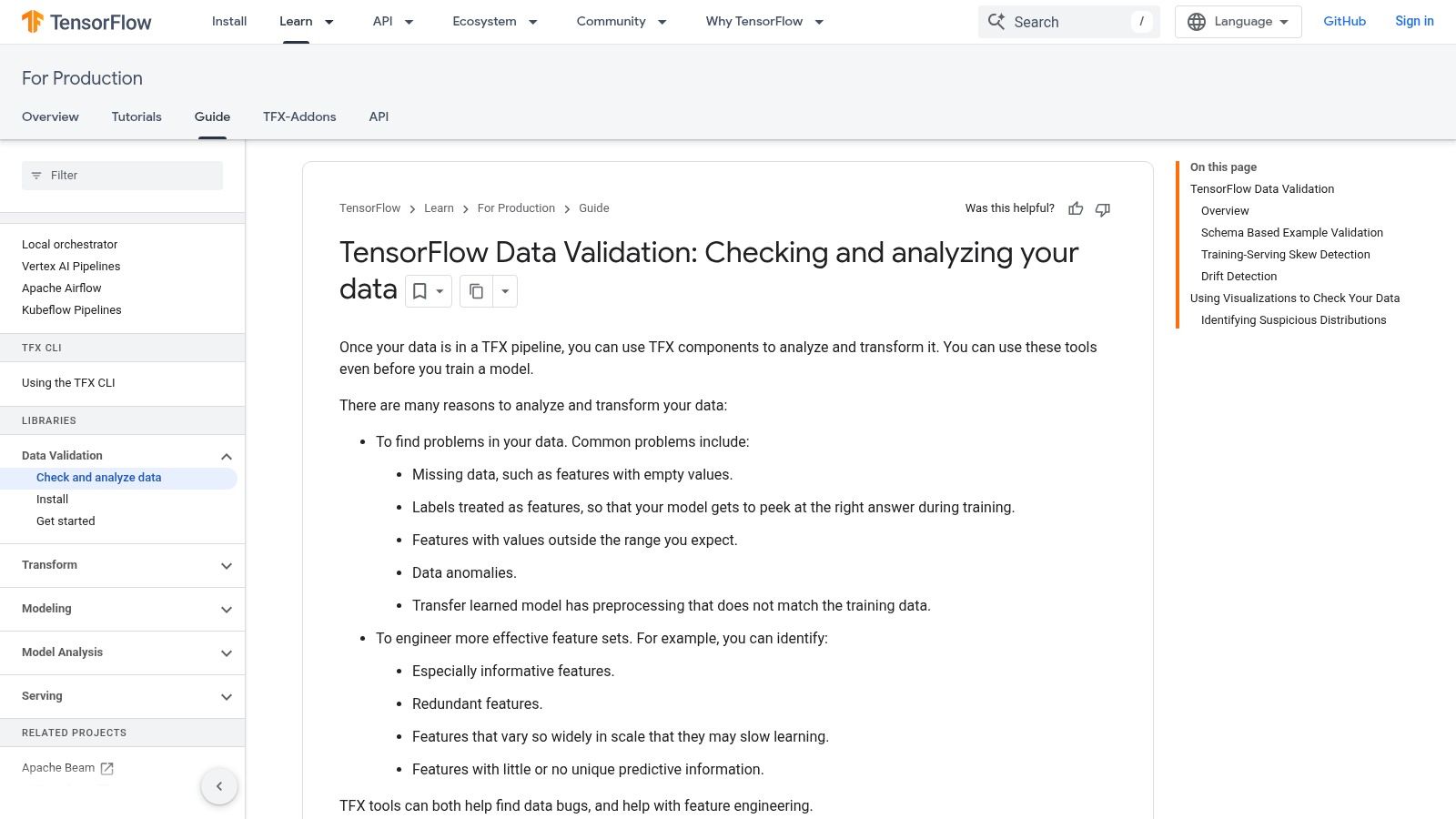
TFDV is purpose-built for ML data, and that focus matters. A warehouse test can tell you a column is null too often. It usually won't tell you whether feature distributions between training and serving have diverged in a way that threatens model reliability. TFDV was built for that class of problem.
Inside TFX-style workflows, TFDV profiles data, infers schemas, and flags anomalies, drift, and skew. It can also scale with Apache Beam, which makes it viable for larger ML pipelines instead of staying confined to notebook inspection.
What TFDV catches that SQL tests miss
TFDV is a better fit than general free data validation tools when the core risk sits in features, not tables. Training-serving skew, feature drift, and schema mismatches hit model quality directly, and TFDV is built to inspect those patterns.
AI anomaly detection systems can learn normal behavior, including seasonality and trends, and use dynamic thresholds that reduce false positives by 30 to 50 percent compared with static rule-based methods, according to digna's overview of AI anomaly detection techniques. That principle is especially relevant in ML pipelines where static cutoffs often age badly.
The downside is stack weight. If you aren't already in the TensorFlow and TFX world, TFDV can feel like too much machinery for a small team. It isn't the tool I'd choose for SQL-first analytics engineering.
Product page: TensorFlow Data Validation
6. Frictionless Framework
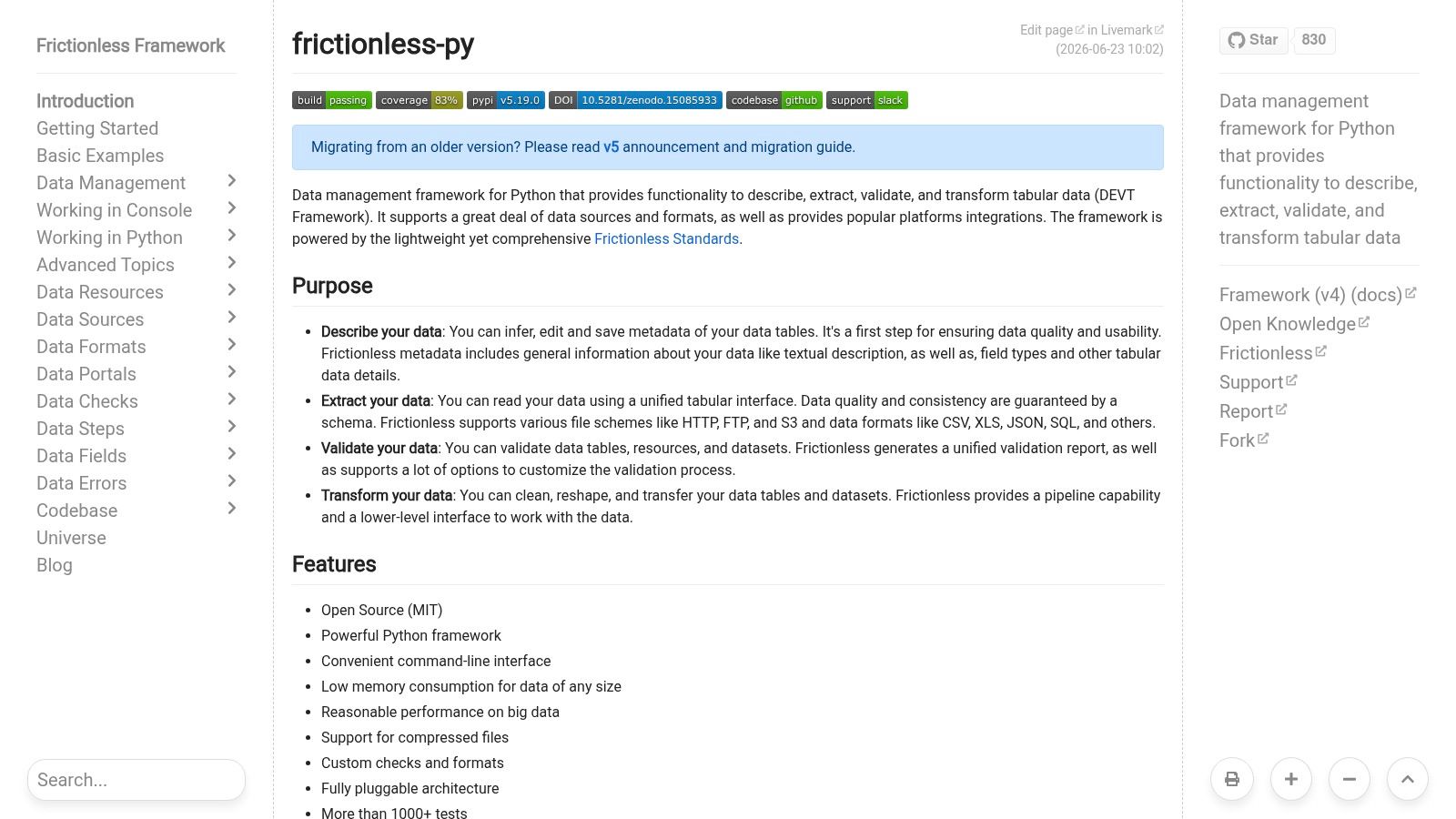
Frictionless is the tool I reach for when the data quality problem is really a tabular packaging problem. CSVs arrive from vendors. Excel files move between teams. JSON payloads need to match a documented schema. In those situations, Frictionless is fast, practical, and much less opinionated than warehouse-centric frameworks.
Its strength is standards. Table Schema and Data Package conventions make data exchange more repeatable, which is useful when governance matters as much as engineering. For file-heavy workflows, that standards orientation is a real advantage.
Best for file exchange and tabular contracts
Frictionless gives you a CLI and Python API for validating files and tabular datasets across formats like CSV, Excel, JSON, and SQL-backed tables. It's easy to adopt because the mental model is simple: define schema and metadata, then validate against them.
This kind of standards-first capability is a common requirement in open-source data quality tool evaluations, especially when data moves across organizational boundaries.
Where it falls short is complex relational logic. If you need cross-table business rules, warehouse-scale freshness enforcement, or richer visual reporting, Frictionless won't replace a broader validation layer.
The fastest win with Frictionless is at the boundary. Validate inbound files before they enter the pipeline. That's where bad headers, broken types, and malformed rows are cheapest to catch.
Official site: Frictionless Framework
7. dbt Core tests
If your transformations already run in dbt, adding another validation runtime is often unnecessary. dbt Core's built-in tests cover the basics well: not_null, unique, relationships, and accepted_values. Combined with custom SQL tests and packages like dbt_utils or dbt_expectations, you can build a strong warehouse-native quality layer.
The big advantage is operational simplicity. Tests live next to transformation code, share the same version control process, and run in the same deployment workflow. For analytics engineering teams, that tight coupling is usually more valuable than flashy reporting.
The right way to use dbt tests
dbt tests are best when they guard model contracts and warehouse assumptions. They shouldn't become a dumping ground for every possible quality concern. Keep them close to the transformation boundary and use custom SQL only where built-ins stop short.
A few practices work well:
Test model guarantees: Use built-ins for primary key behavior, null intolerance, accepted dimensions, and referential integrity.
Version quality with transformations: Keep tests in the same review process as schema and business logic changes.
Escalate carefully: Complex behavioral checks can become hard to maintain if every edge case turns into macro logic.
If freshness is a recurring issue in your warehouse, this dbt source freshness guide covers where dbt helps and where you may need more active monitoring.
dbt Core tests don't give you a complete observability layer. They tell you whether declared conditions passed when the tests ran. They don't automatically build a broad picture of changing distributions, unusual volumes, or late-arriving patterns across the platform.
Product docs: dbt documentation
8. Pandera

Pandera is one of the best free data validation tools for Python teams that spend their time in pandas, Dask, or Polars. It treats DataFrames as typed, testable objects and lets you declare schema and checks in a way that feels natural to engineers already writing Python unit tests.
This is a very different workflow from warehouse validators. Pandera belongs inside scripts, libraries, notebooks, and test suites. If your data transformations happen before the warehouse, or outside it, Pandera is often the cleaner choice.
Where Pandera is strongest
Pandera shines when you want tight feedback inside code. You can define column types, nullable behavior, statistical checks, and custom validators, then fail early before bad frames move further down the pipeline.
That early feedback matters because cheaper tools often involve trade-offs. In a benchmark of nine data validation tools on a standardized set of 500 records, free or low-cost tiers ranged from 65 percent to 99 percent in accuracy, while execution speed varied from 2 to 60 seconds per record, according to this comparison of data validation tools. The lesson isn't that every tool should be benchmarked against Pandera directly. It's that free tools differ a lot in what they optimize for.
Pandera's trade-off is scope. It isn't a warehouse orchestrator, and its outputs are built for developers rather than broad stakeholder review. That's fine if your validation consumer is the engineer writing the pipeline.
Use the docs here: Pandera documentation
9. whylogs
whylogs takes a different route from assertion-heavy frameworks. Instead of leading with pass/fail tests, it focuses on lightweight statistical profiles that you can compare over time. That makes it valuable in production data monitoring, especially for ML and streaming-adjacent systems where drift matters as much as strict schema validity.
This profiling-first model is useful when you don't yet know the right hard thresholds. You capture summaries, track change over time, and then decide which deviations deserve escalation.
Profiling first, assertions second
whylogs is a strong fit when data changes continuously and you care about trends, ranges, and shifts rather than only deterministic rules. It works across structured and unstructured inputs, and the profiling overhead is low enough to fit into recurring workflows.
AI-based anomaly detection typically follows a pattern of collecting and normalizing data from sources like logs, sensors, and network traffic, training a baseline on normal behavior, evaluating new data in real time against learned thresholds, and then interpreting flagged deviations in context, as outlined in Plixer's explanation of AI-powered anomaly detection. whylogs isn't the same thing as a full observability platform, but that lifecycle is a useful mental model for profile-driven monitoring.
what doesn't work well with whylogs is expecting it to behave like classic assertion tooling. You don't reach for it first when you need strict business-rule enforcement on a table load. You reach for it when your team needs continuous profiling and drift awareness.
Docs: whylogs documentation
10. Pydantic (v2)
Pydantic is the right answer surprisingly often, even though many teams don't think of it as a data validation tool first. If your main problem is validating records, payloads, configs, and ingestion objects before they hit downstream systems, Pydantic is hard to beat.
Its model-based approach is simple. Define typed fields, enforce strictness where needed, add custom validators, and reject invalid inputs close to the application boundary. For API-fed pipelines and event-driven ingestion, that's exactly where you want quality checks.
Best for record-level gates
Pydantic (v2) is best when each object matters more than aggregate table properties. That's common in ingestion services, CDC consumers, orchestration configs, and ML service inputs.
Use it when you need:
Typed validation: Enforce structure on records before they land in storage.
Custom logic: Add validators for domain rules that type hints alone can't express.
Fast adoption: Python teams can introduce it without redesigning the entire stack.
The limitation is obvious. Pydantic doesn't validate warehouse state, table freshness, or distribution drift across large datasets. It validates objects. That's why it complements pipeline and warehouse tools instead of replacing them.
The market for data quality tooling keeps expanding as teams adopt more automated validation and observability layers. Fortune Business Insights projects the global data quality tools market to reach USD 15.96 billion by 2034 from USD 3.94 billion in 2026, with a CAGR of over 17 percent, according to its data quality tools market analysis. That's a market-level signal, but the engineering takeaway is simpler: validation is no longer optional infrastructure.
Product site: Pydantic
Top 10 Free Data Validation Tools, Feature Comparison
Tool | Core capability | Target audience 👥 | Unique strength ✨/🏆 | UX quality ★ | Pricing/value 💰 |
|---|---|---|---|---|---|
GX (Great Expectations) | Expectation‑based table & record validation; human‑readable Data Docs | Data engineers, QA, governance teams 👥 | Rich expectations catalog + Data Docs; pipeline gating 🏆✨ | ★★★★, mature, governance‑focused | 💰 Open‑source Core; GX Cloud paid |
Soda Core | YAML checks for schema, nulls, freshness; CI‑friendly | Git‑centric engineers, SREs 👥 | Lightweight YAML & easy CI integration ✨ | ★★★, easy start, smaller catalog | 💰 Open‑source; Soda Cloud paid for UI/alerts |
Amazon Deequ | Declarative column constraints, profiling at Spark scale | Big‑data Spark teams 👥 | Scales on Spark; constraint suggestion 🏆 | ★★★★, strong for high‑volume jobs | 💰 Open‑source; runs on your infra |
PyDeequ | Python wrapper to run Deequ constraints on Spark DataFrames | Python + Spark teams 👥 | Brings Deequ to Python workflows ✨ | ★★★, useful but Spark/runtime dependent | 💰 Open‑source; requires Spark |
TensorFlow Data Validation (TFDV) | ML feature profiling, schema inference, drift/skew detection | ML engineers, TFX users 👥 | Train/serving drift detection at scale 🏆 | ★★★★, powerful for ML, heavier stack | 💰 Open‑source; Beam/TFX infra needed |
Frictionless Framework | File/tabular validation via Table Schema & Data Packages | Data exchange, governance & file teams 👥 | Standards‑oriented, fast adoption ✨ | ★★★, excellent for files, limited viz | 💰 Open‑source; lightweight |
dbt Core tests | Declarative SQL/YAML tests versioned with transformations | Warehouse/analytics engineers using dbt 👥 | Tests live with code and CI gating 🏆 | ★★★★, integrated with transformation workflow | 💰 dbt Core free; dbt Cloud paid tiers |
Pandera | Declarative DataFrame schemas & checks for pandas/Dask/Polars | Data scientists, ETL devs, unit testers 👥 | Pythonic schemas + test integration ✨ | ★★★★, developer‑friendly ergonomics | 💰 Open‑source; in‑memory focused |
whylogs | Lightweight dataset profiling and time‑series summaries | MLOps & monitoring teams, streaming data 👥 | Low‑overhead profiles for drift & anomaly detection ✨ | ★★★, great for profiling, no native UI | 💰 Open‑source; integrates with tooling |
Pydantic (v2) | High‑performance typed record & payload validation (Rust core) | Python apps, ETL record validation, engineers 👥 | Fast runtime validation and wide adoption 🏆 | ★★★★, fast, strong docs & community | 💰 Open‑source; record‑level focus |
When to Upgrade to a Data Observability Platform
Open-source and free tools are excellent when the validation surface is narrow and the owner is clear. A Python team can use Pandera or Pydantic effectively. A dbt team can get far with built-in tests. A Spark-heavy platform group can cover a lot of ground with Deequ or PyDeequ. The trouble starts when these pockets of validation grow independently.
At that point, the cost shifts. The issue isn't whether the tools work. It's whether the team can still operate them efficiently. Tests pile up across notebooks, YAML files, dbt models, Spark jobs, and CI steps. Somebody has to maintain them, explain failures, route alerts, suppress noise, and figure out which incident matters. That's usually the moment teams realize they don't have a validation problem anymore. They have a coordination problem.
Another common failure mode is alert fatigue. Static rules age badly in live systems. Data volumes shift, seasonality appears, source timing changes, and thresholds that looked sensible during setup become noisy or blind later. Engineers then spend time tuning rules instead of building products. Worse, business users still end up being the first people to notice broken dashboards or stale reports. That's the clearest sign the current stack isn't giving enough visibility.
A platform like digna becomes useful when you need one system for anomaly detection, timeliness, schema tracking, and record-level validation instead of separate tools for each layer. digna is designed to run analyses inside the customer's database environment, which matters for privacy-sensitive teams that can't move production data into another vendor-controlled system. It also gives engineers and business users a shared interface for trends, delivery timing, schema changes, and validation outcomes.
The practical difference is that you stop relying only on predefined assertions. digna learns baseline behavior and flags unusual changes in freshness, volume, and distributions without forcing you to hand-write every rule first. That matters in large data estates where unknown failure modes are often more dangerous than the known ones. A record-level rule can catch a bad value. It won't necessarily catch a subtle distribution shift or an unexpectedly late arrival pattern across a critical dataset.
This doesn't mean free data validation tools are a dead end. They aren't. They're the right starting point for many teams, and in some environments they'll remain the right long-term fit. But there is a clear maturity threshold. If your team spends more time maintaining tests than shipping data products, if quality context is fragmented across tools, or if stakeholders still lack a central view of data health, you've outgrown a tool-by-tool approach.
That's when a broader observability platform stops being "nice to have" and becomes operational infrastructure. If you want a practical complement to this discussion, these Surnex dashboard implementation tips are useful for thinking about how monitored data quality supports trusted analytics delivery.
digna fits teams that have moved beyond isolated checks and need one operational system for data anomalies, timeliness, schema tracking, and record-level validation. If your current stack catches some issues but still leaves engineers chasing noisy alerts and business users discovering failures first, explore digna as the next step.
See how digna does this in practice: data quality management platform.
Whichever tool you choose, make sure it covers relationships between tables, not only single columns. Here is how to set up a referential integrity check step by step.
Frequently asked questions
What are the best free data validation tools?
The most widely used open-source options are GX (formerly Great Expectations), Soda Core, Amazon Deequ and PyDeequ, and TensorFlow Data Validation, each strongest in a different stack — Python, Spark or SQL.
Are free data validation tools enough for enterprise use?
They work well for defined, code-owned checks inside a pipeline. What they generally do not provide is learned baselines, cross-platform coverage, alert management and the operational reporting an enterprise data team needs around them.
What is the difference between data validation and data quality monitoring?
Validation answers a question you already know to ask — a column must not be NULL, a value must match a format. Monitoring watches for changes nobody wrote a rule for, such as a table quietly losing a third of its rows.
Which free tool works best with Spark?
Deequ and PyDeequ are built for Spark workloads, while TensorFlow Data Validation fits machine learning pipelines. Soda Core and GX are more commonly used where SQL and Python dominate.
What is the hidden cost of free validation tools?
Maintenance. Rules, thresholds and test suites have to be written and kept current for every dataset, and that effort grows with each new table added to the platform.