10 Examples of Data Governance Policies
|
0
min. Lesezeit

A policy document can exist while its data remains effectively ungoverned. Industry survey data reports that only 23% of organizations use formal data governance or quality frameworks, while 55% don't continuously maintain a sensitive data inventory, 70% lack a unified strategy connecting data and identity visibility, and only 39% can classify all their data. These findings show why a list of policy titles isn't enough. A useful policy translates a principle into an observable control, assigns a person to operate it, records evidence, and defines what happens when the control fails. Industry survey findings on data governance adoption
The ten examples of data governance policies below are written as operational templates rather than static definitions. Each one connects a control objective to its owner, trigger, evidence, escalation path, and measurable outcome. The examples apply to financial services, healthcare, telecommunications, and public administration, but the same logic works for critical datasets, regulated reporting, analytics pipelines, and AI systems.
A policy should also reflect the organization's legal context. The EU Data Governance Act was adopted by the European Parliament on 6 April 2022, entered into force on 23 June 2022, and became applicable on 24 September 2023 after a 15-month transitional period, creating a legal framework for data reuse, intermediaries, and data altruism across EU markets. EU Data Governance Act timeline and implications That progression illustrates the practical pressure on enterprises to move from policy design to enforceable controls, particularly when data crosses jurisdictions.
Table of Contents
1. Data Quality Standards and Validation Policy
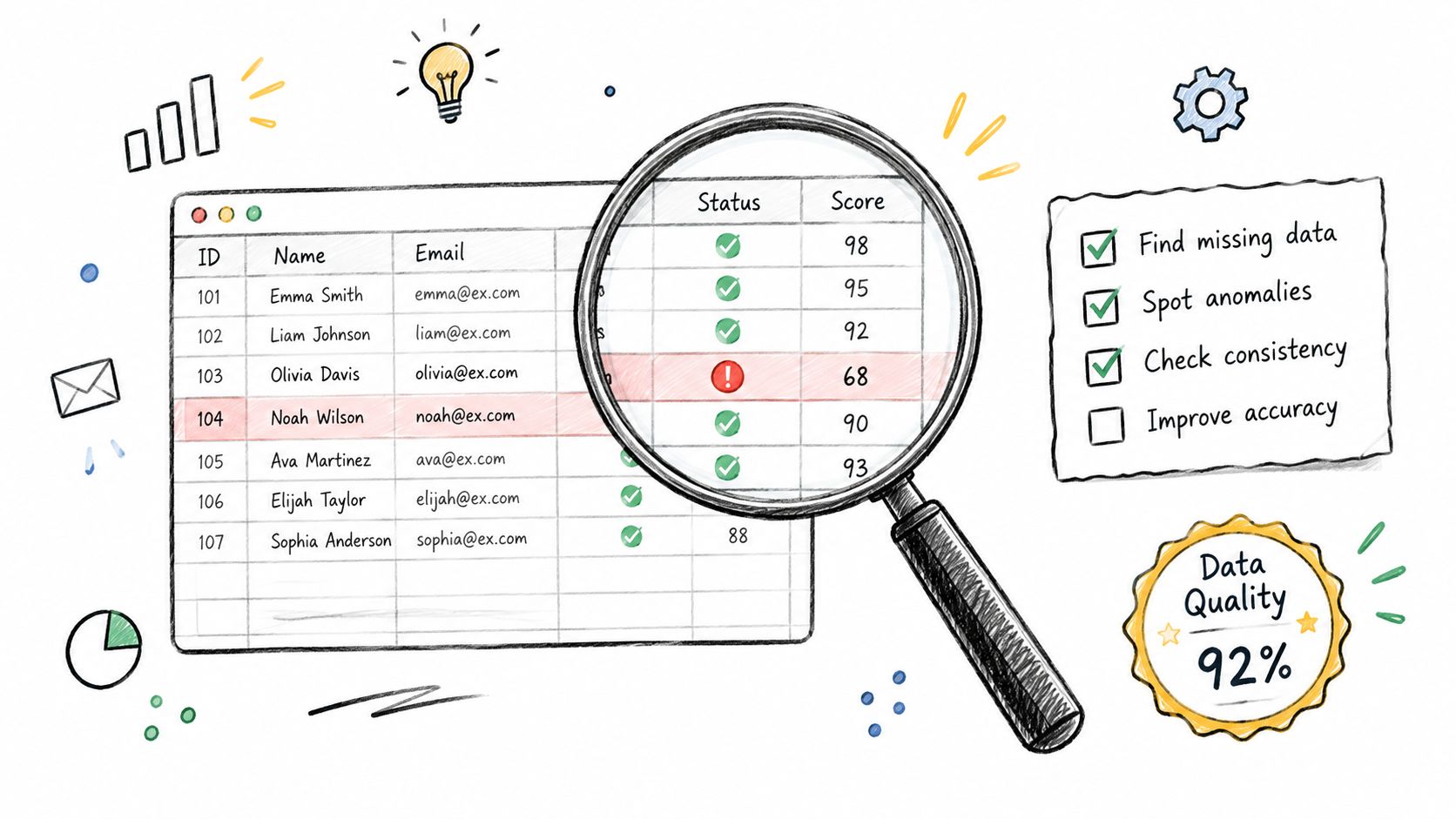
A data quality policy defines the minimum condition a record must meet before downstream systems treat it as usable. Its control objective is fitness for purpose, not abstract perfection. A transaction record might need a valid amount, an identifiable party, and required regulatory fields. A clinical record might require internally consistent measurements and identifiers. A telecom account may need coherent billing and customer attributes before revenue reporting runs.
The data owner approves the business meaning of each rule. A data steward maintains the rule register, while data engineers implement checks in the relevant pipeline or database. The trigger is a scheduled load, an ingestion event, or a business-process handoff. Evidence should include the rule definition, business rationale, execution timestamp, affected records, pass and fail results, remediation status, and approval history.
Practical rule: A validation rule is only governable when someone can explain why it exists, what it checks, and who acts when it fails.
Deterministic validation is different from behavioral monitoring. A rule such as “transaction amount must be present and numeric” produces a repeatable result. An anomaly monitor, by contrast, evaluates whether behavior has departed from an expected pattern. Both belong in a quality program, but they answer different questions.
How to implement it
Start with the datasets that carry the greatest business, regulatory, or operational risk. Ask data engineers, analysts, and business stakeholders to define rules together, then document the rationale so future maintainers understand the intended control.
Owner: A business data owner approves thresholds and exceptions.
Trigger: Each relevant load or record-level processing event.
Evidence: Rule versions, execution logs, failed records, remediation notes, and sign-off.
Escalation: The steward investigates first, then routes unresolved issues to the owner and affected consumers.
Outcome: Critical datasets have visible validation coverage and a documented response to failures.
Teams can use digna's data quality standards and its record-level validation module to enforce deterministic business checks without relying on manual review. Rules should be reviewed quarterly or semi-annually, especially after changes to products, reporting obligations, or source systems. For additional context, consult AutoProv's data quality standards guide.
2. Data Anomaly Detection and Baseline Learning Policy
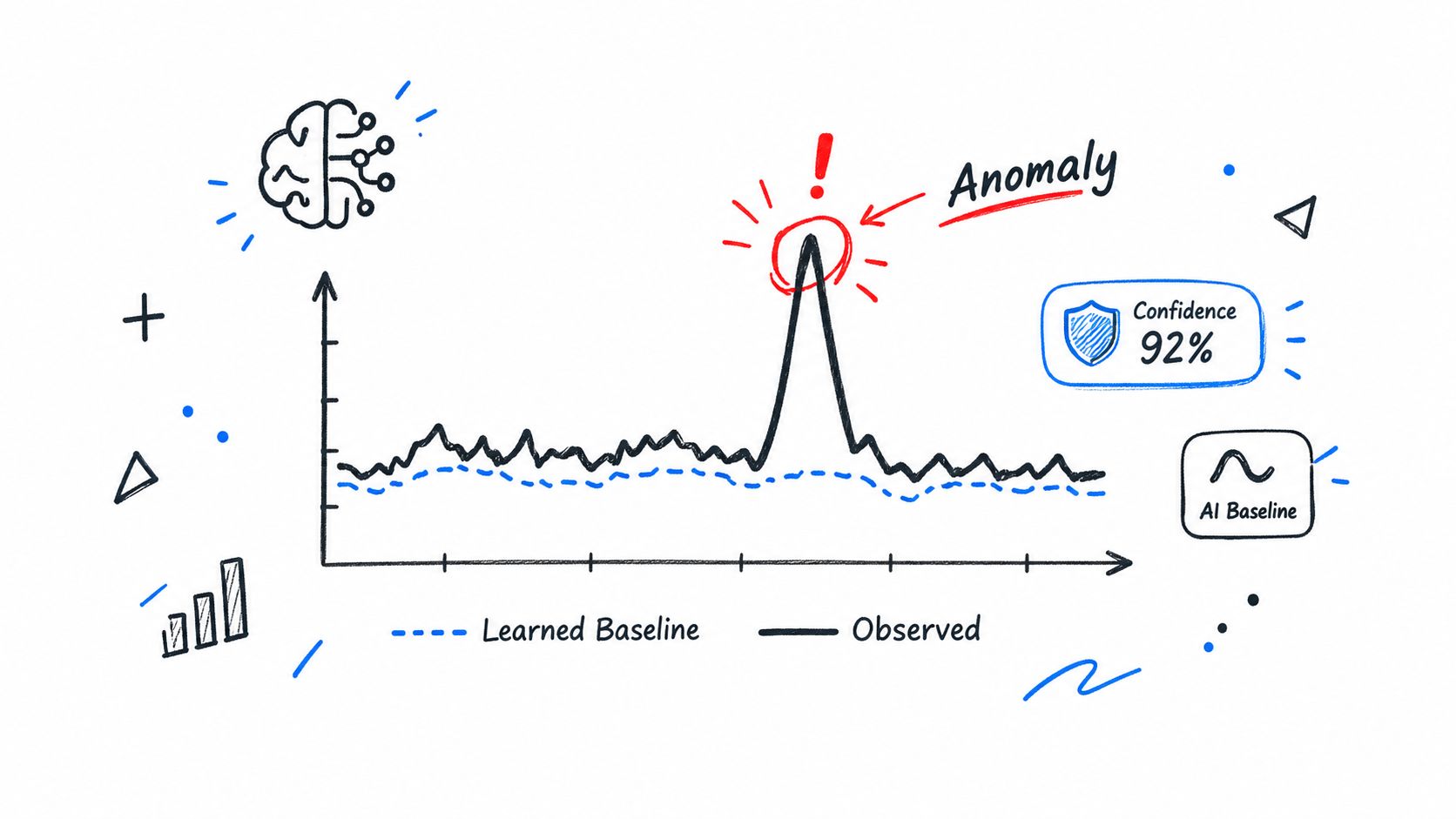
A dataset can satisfy every static validation rule and still become unreliable when its behavior shifts. An anomaly detection policy controls that gap by defining which patterns to monitor, how normal behavior is learned, who investigates deviations, and what evidence supports the final decision.
The monitoring owner selects the dataset, business context, and monitored dimensions. A data scientist or platform engineer configures baseline learning. The data steward records confirmed anomalies, causes, and dispositions. Triggers may include changes in volume, distribution, frequency, or another defined behavior.
The control must separate a statistical signal from a confirmed incident. Financial services teams may investigate unusual trading volumes or fraud-related patterns. Healthcare teams could examine unexpected changes in admissions or clinical measurement distributions. Public agencies might review abnormal benefit distributions or filing activity. These cases require context before an alert becomes an operational incident.
Behavioral monitoring identifies deviation. Human review determines whether the deviation is a defect, a legitimate business event, or an emerging risk.
Controls for behavioral monitoring
Let the model learn historical behavior before alerts become operational. The implementation design specifies a 2 to 4 week learning period, allowing ordinary cycles and recurring patterns to shape the baseline. This duration belongs to this policy's implementation design, not a general industry benchmark.
Owner: The monitoring owner assigns triage responsibility and the response SLA.
Trigger: A defined deviation in volume, distribution, frequency, or another monitored dimension.
Evidence: Preserve the baseline period, comparison window, alert details, severity, investigation notes, root cause, disposition, and remediation.
Learning loop: Record confirmed anomalies and false positives so the model and thresholds can be tuned.
Escalation: Route high-impact or unresolved anomalies to the data owner and the incident response process.
Outcome: Analysts can distinguish expected variation from data defects, improving confidence in reporting and AI inputs.
Teams can use digna's data anomaly detection for Python workflows to support baseline learning and continuous monitoring. Its analytics capability also helps examine historical anomaly patterns instead of treating every alert as an isolated event.
Implementation should proceed in sequence: select high-risk datasets, define monitored behavior, establish the learning period, test alert severity, assign triage ownership, then review confirmed cases. The policy should be revised when business processes or data behavior changes.
3. Data Timeliness and Delivery Monitoring Policy
A timely dataset is an operational dependency, not merely a quality attribute. A feed can contain accurate values and still miss the decision window for end-of-day settlement, invoice generation, same-day clinical operations, or regulatory reporting. The policy should convert “fresh enough” into an agreed delivery expectation, an observable trigger, and a defined response.
Start with the consumer need. Finance, operations, reporting, and clinical stakeholders may use the same table at different points in the day, so the data producer owns delivery execution while the consumer defines the required window. The platform team investigates orchestration, infrastructure, and dependency failures.
Record the consumer, use case, accepted delivery window, and consequence of delay. A valid trigger can be a missed arrival, an early load that violates downstream assumptions, or delivery outside the agreed service window. The evidence package should preserve expected and actual arrival times, delivery history, pipeline status, dependency information, incident records, and the decision on whether the SLA was breached.
Make delivery expectations observable
AI-learned schedules can identify normal delivery behavior without requiring engineers to maintain brittle manual time windows. digna's guide to data timeliness definitions and metrics explains how to monitor missing, delayed, and early arrivals and calculate expected delivery time.
Implement the control in sequence:
Define the consumer deadline and consequence of delay.
Establish expected delivery behavior from observed history.
Set an alert when the predicted arrival passes without the expected data, or when delivery behavior changes.
Assign the producer as the first escalation point.
Route deadline threats to the platform owner and business consumer.
Preserve expected time, actual time, delay duration, dependency state, and owner response.
The outcome is diagnostic clarity. Teams can separate a late source from a failed pipeline or a downstream infrastructure problem, rather than treating every missed delivery as the same incident.
Review timeliness trends monthly. A recurring delay may indicate a process problem, while a reliable feed may no longer meet the needs of a newly introduced consumer. Those findings should update the delivery window, ownership, or escalation rule.
4. Schema Change Detection and Structural Governance Policy
A schema change can invalidate trusted outputs before a value-level check detects anything. Removing a column, changing a data type, or altering a constraint may break a report, model, or transformation at ingestion. This policy therefore governs structural change visibility and impact, with deterministic comparison against an approved schema baseline.
The control begins with a registered schema and a named schema owner. Automated detection compares each deployed version with that baseline and records additions, removals, type changes, and constraint changes. The trigger is any unapproved structural deviation. A change reviewer assesses affected consumers, while platform engineers manage deployment, notification, and rollback.
Evidence must make the decision auditable:
Before-and-after schema and detected timestamp.
Change request, rationale, and risk tier.
Impact assessment and affected lineage.
Approval, deployment result, and rollback decision.
A financial institution could detect a removed field used in regulatory calculations. A healthcare organization could catch a type change in a clinical measurement before it reaches decision support. A public agency may need to align audit systems when a government dataset changes structure. In each case, the measurable outcome is earlier detection and fewer silent failures in reporting, analytics, or AI pipelines.
Turn detection into a proportionate review
Known downstream consumers should receive notice before production impact. That requirement depends on current lineage, so the policy should test whether the impact map is complete before approval. A review board can approve, reject, or postpone a change, while risk tiers prevent low-impact evolution from creating a manual bottleneck.
Owner: Dataset or domain owner.
Trigger: Structural deviation from the registered schema.
Evidence: Schema diff, rationale, approvals, impact map, and deployment record.
Escalation: Send unapproved or high-impact changes to the review board and incident process.
Outcome: Consumers receive actionable notice before structural drift becomes a silent failure.
digna's explanation of schema drift and structural change describes continuous structural monitoring for this control. Its Schema Tracker establishes a baseline for additions, removals, and data type changes, helping teams block or review changes before they reach consumers.

5. Data Ownership and Stewardship Accountability Policy
Ownership is an operating control, not a label in a catalog. The policy assigns responsibility for data quality, timeliness, access expectations, definitions, and issue resolution across critical datasets. It must also show who can decide, who performs the work, and what evidence proves that responsibility is active.
The data owner accepts business risk and approves definitions, quality expectations, and exceptions. The data steward converts those decisions into metadata, rules, monitoring, and issue handling. Producers remain accountable for creating and delivering data. Platform engineers maintain technical controls, while consumers report defects that affect analytics, reporting, or AI use.
A new critical dataset, material ownership change, or unresolved governance issue triggers review. The owner confirms scope and risk, the steward records operating rules, and affected teams receive a route for escalation. Cross-domain disputes go to the designated decision-maker rather than remaining in an unassigned queue.
Make accountability auditable
An ownership registry should connect every critical dataset to its owner, steward, producer, consumers, sensitivity, decision rights, and escalation path. Keep it where incident investigators, engineering, analytics, and business teams can access the same record.
Control evidence: Approved definitions, quality expectations, access rules, exception decisions, and ownership changes.
Operating evidence: Steward actions, assigned issues, remediation notes, review records, and current registry entries.
Escalation evidence: Missed response commitments, unresolved conflicts, risk acceptance, and executive decisions.
Outcome measure: Each important dataset has an accountable person who can explain its meaning, acceptable use, and response when controls fail.
This data steward definition distinguishes business accountability from operational coordination. Stewardship meetings held weekly or bi-weekly where appropriate can review incidents, overdue actions, and recurring quality patterns. The meeting is useful only when participants work from shared evidence and record decisions, owners, and due dates. That record connects governance activity to more reliable reporting, analytics, and AI outputs.
6. Business Metric Monitoring and KPI Reliability Policy
KPI reliability is an operational control, not a dashboard feature. It protects planning, reporting, and shareholder communications by detecting when a business metric moves unexpectedly and testing whether the cause is business activity or data failure.
The metric owner, usually a business leader, approves the definition, interpretation, and acceptable use of each KPI. Analytics engineering maintains the calculation and dependencies. A data steward coordinates investigation when source data or business rules change. The trigger can be unusual movement in revenue, customer activity, volumes, portfolio risk, churn, treatment outcomes, or operational performance.
Each KPI record should include its approved definition, source data, calculation logic, owner, review context, and known seasonal or operational factors. Financial services teams may monitor net revenue, acquisition cost, and portfolio risk. Healthcare teams may track admissions, outcomes, and operational efficiency. Telecom teams may watch churn, average revenue per user, and network availability.
A KPI alert requires evidence before escalation. A large change may result from a late load, schema modification, changed filter, definition update, or genuine business event. Connect monitoring to the quality, timeliness, anomaly, and schema controls described elsewhere in the governance program.
Start with the 3 to 5 most critical business metrics, as specified in the implementation approach. Expand coverage only when owners can investigate and respond consistently. The operating sequence is:
Definition check: Confirm that the approved definition and calculation remain unchanged.
Data check: Review freshness, volume, completeness, and structural evidence.
Business check: Record an event or operating condition that explains the movement.
Escalation check: Determine whether the KPI affects a formal report, business decision, or external communication.
The owner records the alert, evidence reviewed, conclusion, action, and due date. Unresolved issues move to the steward, business decision-maker, or reporting authority according to impact. The measurable outcome is a KPI that can be reproduced, explained, and trusted by analysts, executives, and AI systems.
digna's Business Monitoring solution can examine unusual changes in revenue, volumes, customer activity, and operational metrics. Monthly reviews with business leadership test whether alerts still represent meaningful business risk and whether thresholds require adjustment.
7. Data Lineage and Impact Analysis Policy
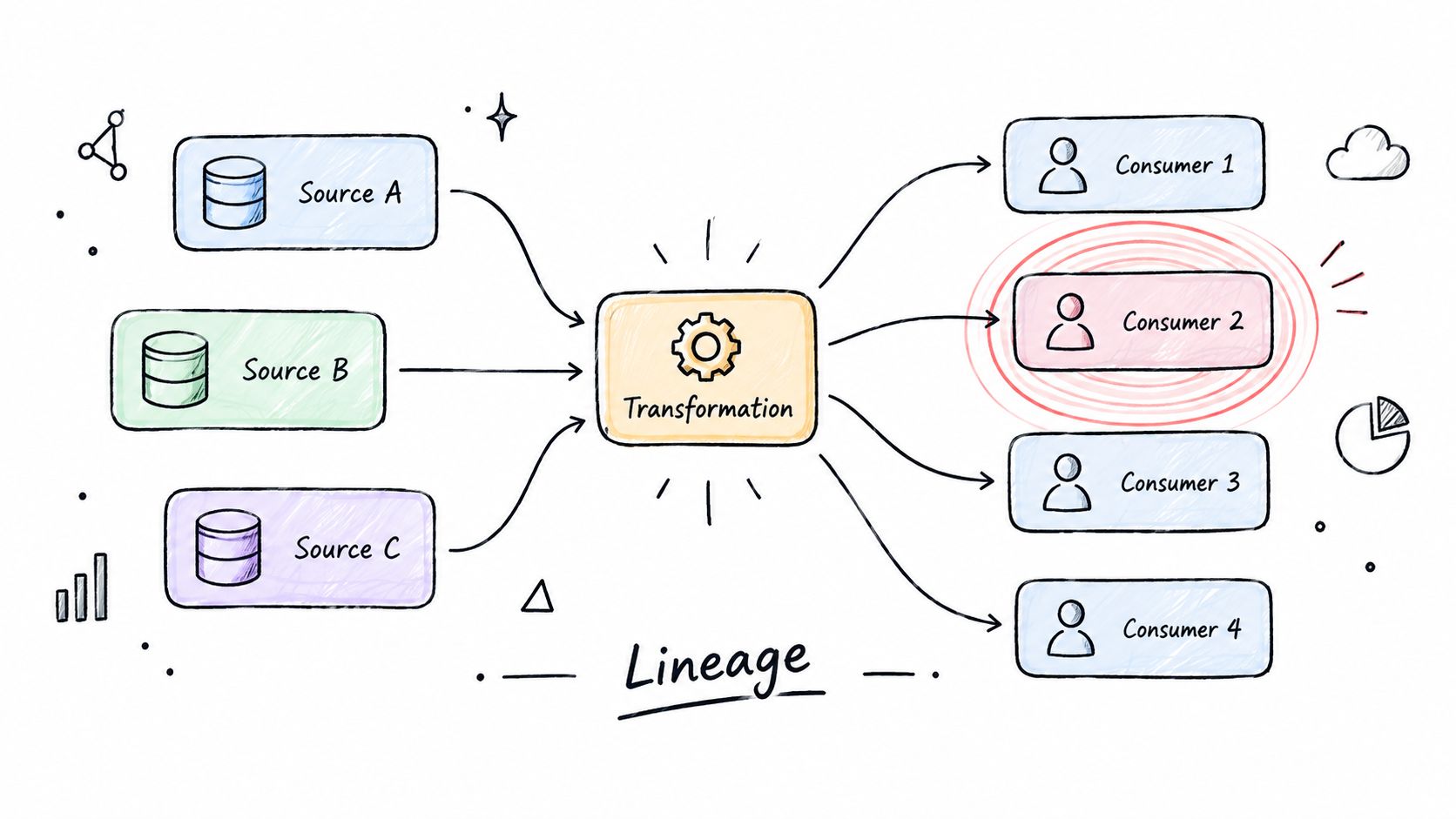
Lineage turns a data dependency into an operational control. It connects a reported number or model input to its source, transformations, destinations, and consumers. The policy objective is to establish the affected scope before a defect, structural change, or audit finding triggers remediation.
The data owner classifies critical assets and approves their business use. Data engineers capture pipeline and transformation dependencies, while stewards verify that technical relationships reflect business meaning. A new critical flow, material pipeline change, quality incident, model deployment, or audit request starts the control.
Evidence should include source and destination assets, transformation logic, dependency relationships, a versioned lineage map, review date, and impacted consumers. The operating sequence is:
Register the flow and its owner.
Capture technical dependencies and transformation versions.
Confirm business definitions and critical consumers.
Assess impact when a source, rule, or destination changes.
Escalate missing or ambiguous relationships to the data owner and platform architect.
A bank can use this record to identify risk models affected by a broken feed. A healthcare organization can map clinical data flows for audit and compliance, while a public agency can show how source data reaches reporting systems. For AI systems, lineage provides evidence of which inputs a model consumed and how those inputs changed.
Lineage is a structural control, not a static diagram.
Manual diagrams decay as systems evolve. Automated capture from pipeline tools provides a stronger operating base, but a steward must still review whether dependencies are complete and whether high-impact consumers are represented. The measurable outcome is faster, evidence-based impact analysis, with remediation prioritized by affected reports, models, and decisions rather than manual searches.
digna includes a data catalog that can support lineage documentation and shared understanding. A visual audit trail can also show what happened and when, an evidence requirement relevant to audit trail software for UK fleet compliance.
8. Data Access and Security Governance Policy
Access governance is an operating control, not a permission list. It specifies who may view or change each data domain, which business purpose justifies that access, how permissions are granted or removed, and what evidence supports the decision. The control objective is authorized use of sensitive and critical data. Restrictive rules can delay legitimate analysis, while weak review increases exposure and makes responsibility difficult to establish.
The data owner defines domain access rules and approves exceptions. Identity and access management teams provision permissions, security teams maintain authentication and logging, and stewards test whether access still matches current responsibilities. A request, role change, transfer, termination, privilege escalation, or scheduled recertification triggers the workflow.
A defensible record connects the request to its approver, role mapping, permission state, grant and revocation timestamps, access events, exception rationale, and review result. Unresolved conflicts go to security and the accountable owner, with access suspended or restricted where policy requires it.
Purpose limitation also shapes the control. EU GDPR guidance states that personal data should be collected for specified, explicit, and legitimate purposes and not reused incompatibly. European Commission guidance on GDPR principles A user may therefore receive access for a defined operational task without permission to repurpose the same data for unrelated analysis, reporting, or AI development.
Build the review trail into implementation
Use role-based access tied to job responsibilities rather than informal team membership. Connect the policy to identity systems where possible, then run quarterly access reviews so owners can remove permissions that no longer have a documented purpose.
Owner: Business data owner.
Trigger: Request, role change, departure, privilege change, or quarterly review.
Evidence: Approval workflow, permission state, access event, revocation, and exception.
Escalation: Security team and accountable owner for unresolved conflicts.
Outcome: Access remains authorized, explainable, reviewable, and reversible.
digna's in-database execution and private cloud or on-premises deployment options can support controls while data remains within the customer's environment. The technology records and enforces decisions, but the organization must determine who needs access, why it is needed, and when it should end.
9. Data Incident Response and Escalation Policy
Data incidents require an operating control, not only a ticket. The policy should cover quality failures, late or missing deliveries, schema changes, unreliable KPIs, and access concerns. Its objective is to detect the issue, limit its effect on analytics, reporting, or AI workflows, document decisions, and prevent recurrence.
The incident owner directs the response. The dataset owner assesses business impact and approves acceptable remediation. Platform engineers examine technical causes, stewards maintain the record, and affected consumers receive updates. Triggers include failed validation, anomaly alerts, missed delivery, unauthorized structural change, or an unexplained business metric.
Severity determines the response path. An incident affecting regulatory reporting, trading operations, or patient safety warrants faster escalation and clearer stakeholder communication than a low-impact internal dataset issue.
Make resolution auditable
The record should retain the alert, notification, investigation, root cause, corrective action, restoration approval, and post-incident review. That evidence distinguishes a corrected source failure from a temporary workaround.
Detection: Capture the signal, timestamp, affected dataset, and initial scope.
Notification: Contact the owner, steward, consumers, and on-call responders.
Investigation: Establish impact, cause, dependencies, and containment.
Resolution: Correct, roll back, quarantine, or communicate the data limitation.
Prevention: Assign follow-up work and verify that the control changed.
Escalation should be triggered by business impact, not alert volume alone.
The owner closes the incident only after evidence supports restored use or an explicit limitation. A searchable knowledge base should preserve root causes, decisions, and exceptions. Monthly post-incident reviews can identify recurring process or platform weaknesses that individual tickets conceal.
digna's alerting and user-centric dashboard can provide engineers, analysts, and stakeholders with a shared view of incidents and trends. The implementation sequence is to define severity criteria, connect detection signals, assign response roles, require evidence at closure, then review recurring causes. The measurable outcome is a response history that supports reliable reporting and safer downstream AI use.

10. Data Governance Continuous Improvement and Metrics Policy
Governance needs its own operating metrics. A continuous improvement policy defines how the organization measures control coverage, reviews performance, prioritizes gaps, and changes policy when business or regulatory conditions shift. It prevents governance from becoming a document review exercise detached from actual data behavior.
The governance council sets the measurement framework. Domain owners interpret results, stewards coordinate remediation, and platform teams provide execution evidence. The trigger is a scheduled governance review, a material incident, a new regulated workflow, or a significant change in the data estate.
Useful measures include:
Classification coverage: The share of data assets with an assigned classification.
Ownership coverage: The share of critical datasets with named owners.
Lineage coverage: The share of critical data elements with documented lineage.
Access responsiveness: The share of access requests approved within the agreed SLA.
Recertification completion: The share of quarterly access reviews completed on time.
These measures come from an implementation guide that recommends tracking operational coverage rather than relying on policy documents alone. The same guide reports average access approval time falling to 1.3 days from 5.2 days before the policy, with scheduled quality checks reaching 97% execution and retention compliance reaching 88%. Implementation metrics for data governance policy controls
Use benchmarks without outsourcing judgment
The UNSC/Global Data Governance Mapping work created a 26-indicator framework across six governance attributes for comparing governance implementation across organizations and jurisdictions. Global Data Governance Mapping framework A benchmark can expose missing ownership, metadata, access, lineage, or issue-management controls, but it can't decide which risk matters most to a particular business.
Select 5 to 7 key metrics that connect to business value, review them quarterly, and publish improvement work transparently. digna's Data Analytics module can support historical analysis of observability metrics, while resources on tools for safe, auditable AI deployment provide a relevant perspective on evidence requirements in AI-heavy environments.
Comparison of 10 Data Governance Policies
Policy | 🔄 Implementation Complexity | ⚡ Resource Requirements | 📊 Expected Outcomes | Ideal Use Cases | ⭐ Key Advantages |
|---|---|---|---|---|---|
Data Quality Standards and Validation Policy | High, extensive rule definition & governance | Medium–High, data engineers, SMEs, validation tooling | Consistent data fitness, audit trails, fewer downstream errors | Regulated industries, ML pipelines, enterprise reporting | Prevents bad data, enforces consistency, supports compliance |
Data Anomaly Detection and Baseline Learning Policy | Medium, model setup and monitoring pipelines | Medium, historical data, ML/observability resources | Early detection of data shifts, adaptive alerts, scalable monitoring | Fraud detection, high-volume time series, operational metrics | Auto-detects novel issues, reduces manual tuning, scales easily |
Data Timeliness and Delivery Monitoring Policy | Medium, SLA definition & schedule learning | Medium, pipeline instrumentation, observability | Improved on-time delivery, SLA compliance, fewer downstream delays | Billing, regulatory cutoffs, time-sensitive pipelines | Proactive delay alerts, SLA evidence, pipeline reliability insights |
Schema Change Detection and Structural Governance Policy | Medium–High, continuous structural tracking & impact analysis | Medium, lineage mapping, downstream consumer mapping | Rapid detection of breaking changes, reduced downstream failures | Evolving schemas, multi-team data platforms, contract validation | Prevents silent failures, enables coordinated rollbacks, audit trails |
Data Ownership and Stewardship Accountability Policy | Medium, role definitions and org processes | Medium, designated stewards, governance cadence, dashboards | Clear accountability, faster investigations, sustained ownership | Large orgs, regulated environments, distributed data teams | Improves resolution speed, clarifies responsibilities, preserves knowledge |
Business Metric Monitoring and KPI Reliability Policy | Medium, metric definitions and BI integration | Medium, business stakeholders, analysts, BI tooling | Reliable KPIs, early business-impact alerts, decision confidence | Executive reporting, product/finance metrics, investor-facing KPIs | Prevents bad decisions, links metrics to root causes, supports strategy |
Data Lineage and Impact Analysis Policy | High, end-to-end lineage capture & maintenance | High, cataloging tools, automation, integration effort | Fast blast-radius assessments, shorter investigations, governance evidence | Complex pipelines, audits, multi-system dependencies | Enables rapid impact analysis, reduces triage time, supports compliance |
Data Access and Security Governance Policy | Medium, RBAC and IAM integration | Medium, IAM, logging, access review processes | Controlled access, audit-ready logs, reduced insider risk | Sensitive/regulated data (PII, PHI, financial) | Protects sensitive data, ensures auditability, enforces least privilege |
Data Incident Response and Escalation Policy | Medium, incident playbooks, SLAs & on-call setup | Medium–High, on-call teams, incident tooling, postmortem processes | Reduced MTTD/MTTR, documented remediation, continuous learning | Mission-critical data services, regulatory reporting pipelines | Structured response, faster resolution, organizational learning |
Data Governance Continuous Improvement and Metrics Policy | Medium, metric selection & maturity processes | Medium, analytics, stakeholder reviews, historical metrics | Measured governance progress, prioritized improvement roadmap | Organizations maturing governance, ROI justification needs | Provides evidence of impact, drives continuous optimization, aligns stakeholders |
Turn Policy Text Into Operating Controls
The strongest governance programs don't begin by writing every possible policy. They begin with a small set of high-risk datasets and make accountability visible. That approach also addresses a central implementation problem: formal governance remains incomplete across many organizations, so broad documentation can create the appearance of maturity without delivering control coverage.
Start by selecting datasets that support regulated reporting, material financial decisions, clinical operations, customer billing, or AI and analytics workflows. Assign a business owner and an operational steward before defining detailed controls. The owner should decide what “fit for use” means, which consumers matter, and what level of risk the organization accepts. The steward should maintain rules, evidence, issue records, and escalation activity.
Then define quality and delivery evidence. A quality policy should produce validation results, failed-record details, and remediation history. A timeliness policy should show expected and actual delivery behavior, not merely whether a pipeline completed. These controls work together because a successful pipeline can still deliver incomplete or late data, while a timely load can contain invalid records.
Add access and structural controls next. Access governance should connect purpose, role, approval, provisioning, revocation, and review evidence. The GDPR data minimization principle requires personal data to be adequate, relevant, and limited to what's necessary for the processing purpose. UK ICO guidance on data minimization That principle gives access and collection decisions a practical boundary. Retention policies also need a defensible basis. NIST SP 800-63B says cloud service providers must follow applicable records retention requirements and, where retention isn't mandatory, use a risk-management process that considers privacy and security risks and informs the subscriber of the retention policy. NIST SP 800-63B records retention guidance
Governance becomes credible when every important requirement produces evidence that a named person can interpret and act on.
Connect incidents to escalation paths rather than sending alerts into an unowned queue. Define severity, on-call responsibilities, communication recipients, containment options, root-cause expectations, and post-incident review. The owner should be able to approve a business response, while engineers and stewards provide the technical and operational evidence needed to support it.
Finally, review trends regularly. Measure classification and ownership coverage, lineage for critical elements, access SLA performance, recertification completion, quality execution, timeliness, anomaly patterns, and incident recurrence. The benchmark approach developed through the Global Data Governance Mapping work demonstrates why structured indicators are more useful for comparison than narrative maturity statements. Governance teams can adapt that logic without treating an external framework as a substitute for their own risk decisions.
ISO/IEC 38505-1 frames data governance as a governing-body responsibility to evaluate, direct, and monitor the handling and use of data. It also recognizes accountability for privacy breaches, record-keeping legislation, and non-compliance with mandated standards. ISO/IEC 38505-1 data governance responsibilities That perspective changes the role of governance technology. Tools can execute checks, preserve evidence, and make incidents visible, but leadership remains responsible for decisions, interpretation, exceptions, and accountability.
digna can support this operating model through in-database validation, AI-driven anomaly detection, timeliness monitoring, schema tracking, shared incident visibility, a data catalog, and historical analysis. Its private cloud and on-premises deployment options allow the platform to run inside the customer's environment, while the organization retains responsibility for policy design and control ownership.
Adopt the policies in sequence, measure whether they operate, and revise them when the business changes. A template is a starting point. A functioning governance program is the combination of decision rights, executable controls, evidence, human response, and recurring review.
digna combines record-level validation, anomaly detection, timeliness monitoring, schema tracking, business monitoring, and historical analytics in a platform that runs inside the customer's environment. Visit digna to see how its modules can help turn data governance policies into observable controls for analytics and AI.