Data Steward Definition, Role, and Skills Explained
|
8
min read

You're usually not looking for a grand theory when you search for a data steward definition. You're staring at a broken dashboard, an analyst is asking why the metric changed again, and someone in operations wants to know who's responsible before the next meeting starts. That's the moment stewardship becomes visible, because the job isn't to “own data” in the abstract, it's to make sure the data people rely on is still fit for use, understandable, and controlled across its lifecycle, as described in the Conference of European Statisticians definition and the public-sector stewardship guidance cited in the UNECE preprint (UNECE stewardship definition and lifecycle framing).
A lot of job ads blur that into generic “data management.” That's too vague to be useful. A data steward is the person, or sometimes the team, that turns governance rules into daily practice, so the business can trust definitions, quality checks, metadata, lineage, and access decisions when the pressure is on.
Table of Contents
What a Data Steward Actually Does
A dashboard goes red, three teams notice it at once, and nobody can agree on whether the problem is a bad source system, a late load, or a definition that drifted weeks ago. That's the kind of mess a data steward steps into. The job is to identify what changed, confirm what the data is supposed to mean, and push the right follow-through so the issue doesn't become a permanent reporting habit.
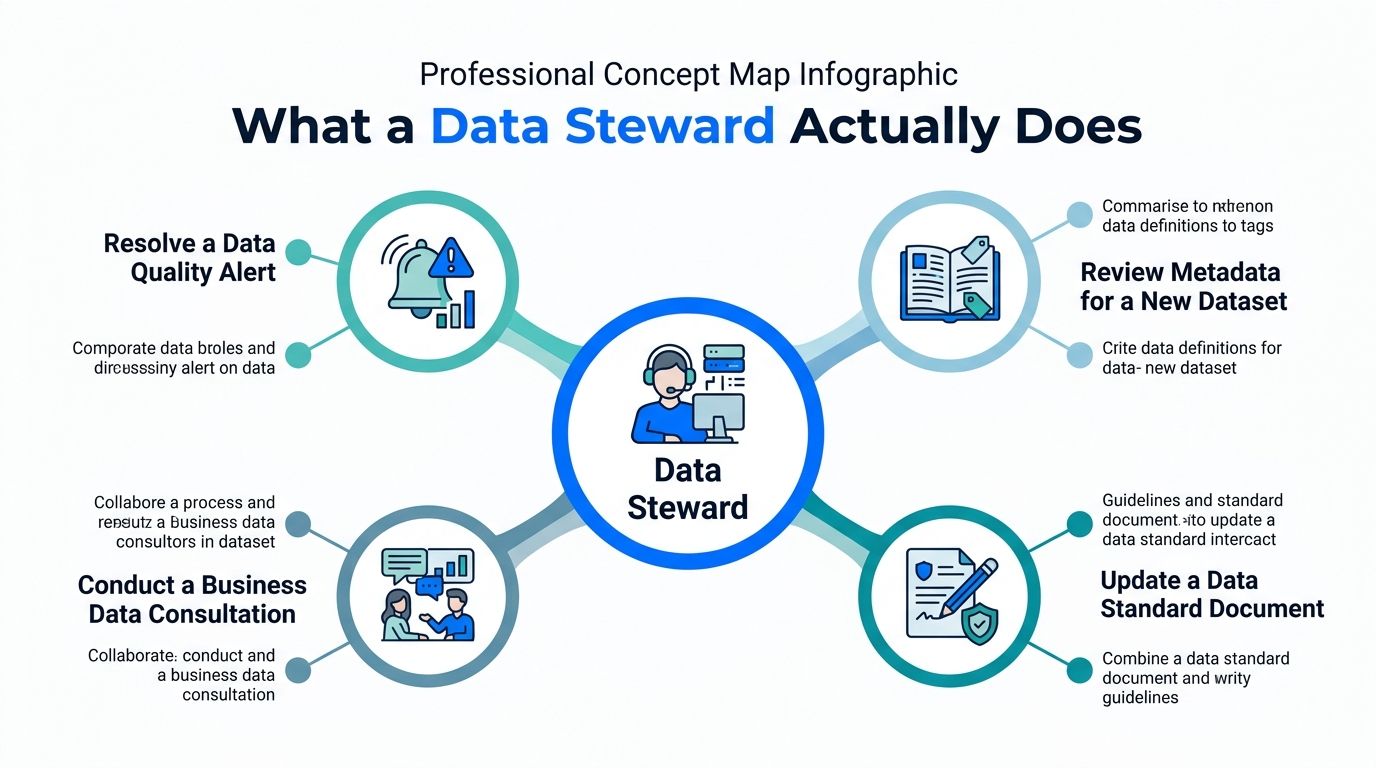
The working definition that holds up in practice
A useful data steward definition is simple enough to repeat and specific enough to act on. The steward is the operational role that turns governance policy into day-to-day controls, things like standards, metadata management, lineage documentation, quality checks, and issue remediation (Snowflake's governance overview). That's why the role sits closer to execution than strategy.
The easiest way to think about it is this, a steward doesn't just describe data, the steward makes sure data can be used. That means the work reaches into business definitions, sensitive-data handling, compliance requirements, and the little judgment calls that determine whether an analyst can trust a table today.
Practical rule: if the task is about making a dataset understandable, trustworthy, and usable for real decisions, it belongs in stewardship.
Why this isn't the same as generic data management
People often say “data management” when they mean a bundle of responsibilities spread across many roles. Stewardship is narrower and more accountable. It focuses on who resolves ambiguity, who documents business meaning, and who closes the loop when a data issue shows up in production.
If you're trying to understand where this fits in the wider ecosystem, browse the company and role examples in StartupSubmit directory listings, then come back to the stewardship question with a sharper eye. You'll notice that the best descriptions aren't about storage, they're about ownership of decisions around data use.
In regulated or large-scale environments, that distinction matters. Data moves through intake, storage, processing, and transmission steps, and it has to stay protected against quality and security risks across that path (UNECE stewardship lifecycle framing). A steward is the person keeping watch over that path, not the person provisioning the server.
How the Data Steward Role Evolved
The modern steward role didn't appear because someone wanted a new title for the org chart. It emerged because organizations needed a named accountability point for definitions, quality, and access decisions. Early public and academic writing already framed stewards as leaders or teams that could create public value by reusing organizational data and expertise, which pushed the role beyond simple record-keeping and into cross-functional coordination (Government & Technology Laboratory paper).
That shift became more formal as data programs matured. Industry guidance described stewardship as aligning data content and metadata with policies, standards, and business rules for effective use, while other operational definitions split the work cleanly, governance sets policy, stewardship carries out the tactical implementation (GovLab synthesis). This is the core reason the role stuck. Someone had to be accountable when policy met messy reality.
Public-sector stewardship made the role harder to ignore
Public institutions helped turn stewardship into a working model instead of a loose ideal. Statistics Canada's 2020 introduction describes stewardship as making sure data are fit for use and compliant with policies, directives, and regulations (UNECE source summarizing Statistics Canada). The Australian Public Service Commission's 2024 role statement goes one step further, saying data stewards handle the day-to-day management of data assets so governance and policy requirements are met in practice (UNECE source summarizing APSC).
That public-sector framing matters because it shows why stewardship is no longer optional housekeeping. In regulated industries, the role connects policy, operations, and business meaning in one accountable function. Without that, organizations end up spreading responsibility across too many hands, and no one can tell who should answer when a dataset drifts out of spec.
Core Responsibilities and Mechanics
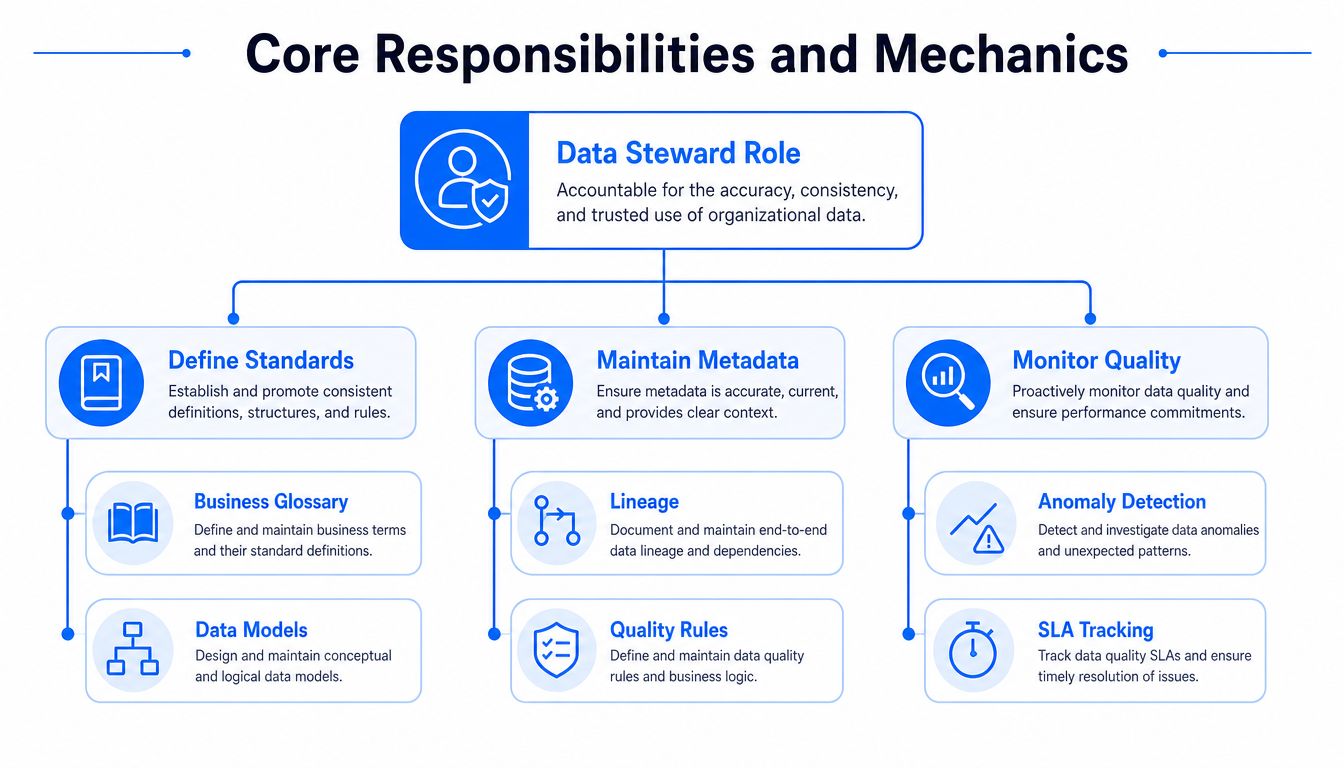
The easiest way to spot a real steward is to look for outputs, not job titles. A steward leaves behind documents, decisions, issue logs, standards, and follow-up actions. The role is practical, not ceremonial.
The mechanics that show up on a real calendar
A steward defines data standards, which is where the business stops arguing in circles and starts using the same terms. That might mean approving a new warehouse metric definition, writing down what a customer status field means, or updating a reference rule so everyone maps values the same way. Guidance from Actian describes stewardship responsibilities in exactly those operational terms, including standards, metadata, quality monitoring, issue resolution, and compliance support (Actian data steward guidance).
The same person usually keeps metadata current, because context is what keeps a table from becoming a mystery object. That includes lineage, business definitions, and notes about why a column changed. TechTarget's description of stewardship also makes the policy-versus-execution split clear, governance sets the rule, stewardship carries it out and tracks the practical details (TechTarget data stewardship definition).
A few responsibilities tend to recur across finance, healthcare, and public-sector teams:
Define standards: write or approve business definitions, naming rules, and allowable values.
Maintain metadata: keep glossary entries, lineage notes, and classifications accurate.
Monitor quality: watch for missing, duplicate, late, or inconsistent data.
Resolve issues: triage tickets, route root causes, and verify fixes.
Support compliance: help ensure access, retention, and handling rules match internal and regulatory requirements.
What stewardship looks like across the lifecycle
Independent guidance treats stewardship as a lifecycle discipline, not a one-time review. That lifecycle includes creating, preparing, using, storing, archiving, and deleting data (Informatica stewardship lifecycle article). That's useful because it stops teams from treating stewardship as a glossary-cleanup exercise.
A steward's value shows up when the data moves, not when it sits still.
A finance team might rely on stewardship to keep revenue definitions stable through close. A healthcare team might need it to protect sensitive classifications and document who can access what. A public-sector team may need it to preserve sharing rules and legal obligations. The pattern is the same, the steward keeps the data usable while the system around it keeps changing.
Data Steward Versus Data Owner, Custodian, and Engineer
Confusion starts when people use “steward” to mean every data role at once. That's when programs stall. The cleaner model is to separate accountability, execution, technical care, and build work so each role has a distinct lane.
Role | Primary Accountability | Typical Outputs | Daily Focus |
|---|---|---|---|
Data Owner | Business value and policy decisions for a data asset | Approvals, access decisions, escalation support | What the data should be used for |
Data Steward | Operational enforcement of governance rules | Standards, metadata, lineage notes, issue triage | Making policy real in day-to-day use |
Data Custodian | Technical environment and controlled storage | System access, backups, platform administration | Keeping the environment safe and available |
Data Engineer | Pipelines and data movement | Ingestion jobs, transformations, orchestration | Building and maintaining the flow of data |
If you want a fuller look at how ownership differs from stewardship, the internal guide on data owner responsibilities is the clearest companion piece.
Who decides what, and when
The data owner usually decides the business policy. The data steward translates that policy into operational rules and checks. The data custodian handles the technical environment where the data lives. The data engineer builds the pipelines that move, shape, and serve the data.
That separation matters because a steward is often blamed for things outside the role's control. If a pipeline fails, the engineer fixes the job. If access policy is unclear, the owner makes the call. If the business meaning of a field has drifted, the steward documents the correct definition and pushes the change through the system.
The practical test
When a task lands on your desk, ask one question, “Is this about policy, execution, infrastructure, or transformation?” If it's about policy, the owner should decide. If it's about execution and data meaning, the steward should handle it. If it's about the platform, the custodian owns it. If it's about moving or shaping records, the engineer is the right person.
That simple separation keeps stewardship from turning into an inbox for every unresolved data complaint. It also gives analysts a faster path to the right person instead of a long chain of forwards.
If everyone owns the data, nobody owns the issue.
KPIs and Skills That Make the Role Stick
A stewardship program can look busy and still accomplish very little. That usually happens when nobody measures whether the role is reducing friction. The KPIs below tell you whether the steward is improving how data behaves.
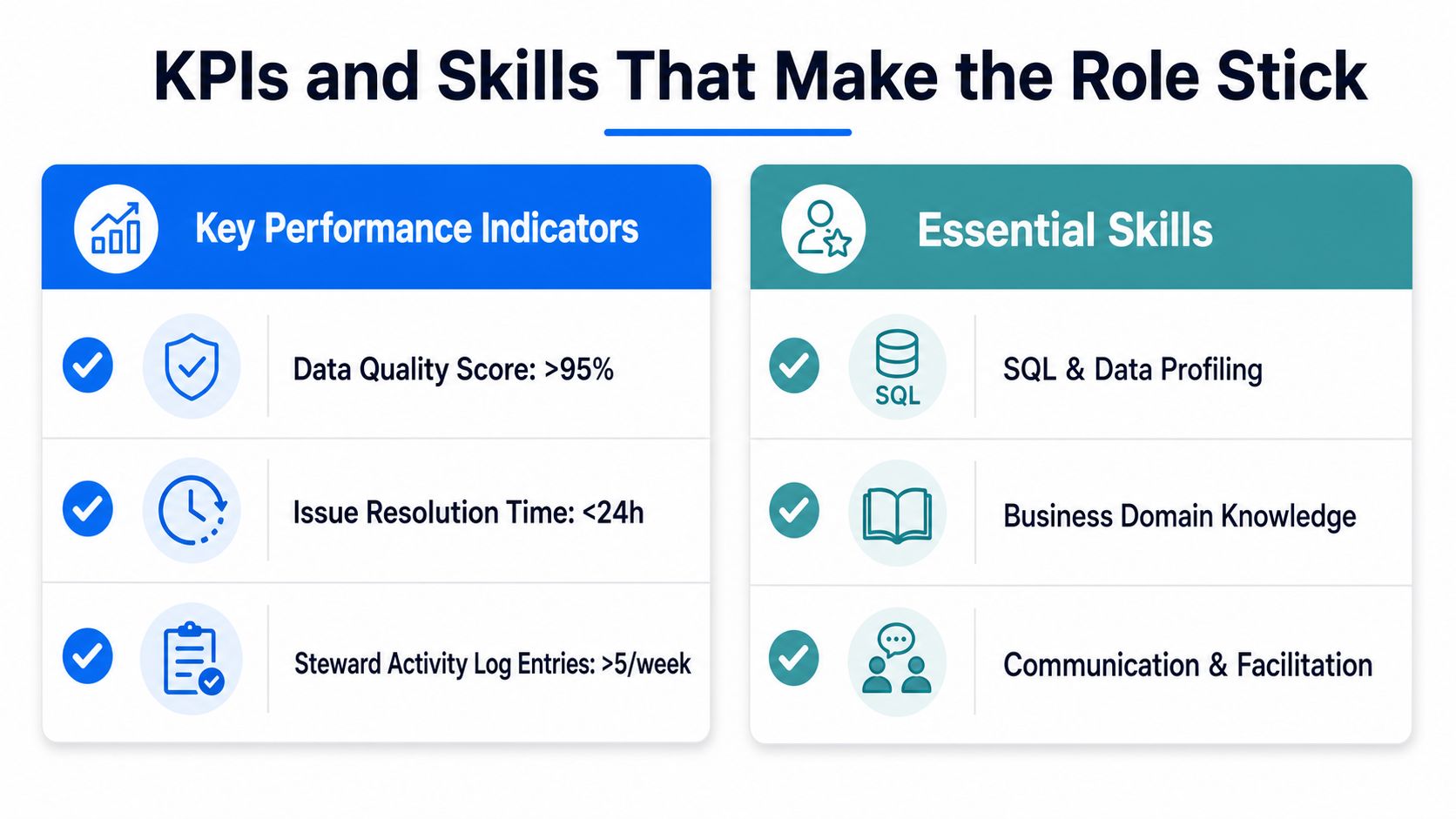
The KPIs worth watching
Data quality incident rate: fewer repeat issues usually means the steward is closing root causes instead of just logging them.
Mean time to detect and resolve issues: the shorter the cycle, the less damage a bad dataset does.
Lineage coverage: if people can't trace where a number came from, stewardship is incomplete.
Metadata completeness: missing definitions are a signal that the glossary isn't maintained.
Stakeholder response time: if business teams wait too long for answers, the role is too slow to be useful.
Policy adherence: access, retention, and handling rules should show up in actual behavior, not only in documentation.
The skills that make those KPIs possible
A strong steward knows the business domain well enough to spot nonsense quickly. They also need metadata fluency, because terms, lineage, and classifications are the raw materials of the role. Communication matters just as much, since the steward spends a lot of time translating between business users and technical teams.
Regulatory awareness helps too, especially in sectors where access, privacy, and retention are essential. Comfort with monitoring tools matters because a steward can't manage what they can't see. That's why the role often sits between governance, analytics, and engineering, rather than living cleanly inside one of them.
A good candidate doesn't need to be the deepest engineer in the room. They do need to know how to ask the right questions, read the right signals, and push the right people to act. The best stewards are organized, calm under pressure, and direct when a dataset has gone off course.
A Typical Workflow and Sample Job Description
A steward's day usually starts with an alert, not a meeting. The alert says something changed, but it doesn't say whether the problem is real. The steward checks the signal, looks at lineage, and decides whether the issue belongs to the source system, the pipeline, or the business definition.

A realistic flow from alert to closure
The first move is triage. A steward logs the issue, confirms the scope, and checks whether the anomaly is new or part of a known pattern. Then the steward pulls the lineage, identifies the upstream owner, and coordinates with the right engineering or business contact.
After that comes the coordination work. The steward doesn't need to build the fix, but they do need to keep the issue moving, explain the data impact in plain language, and verify that the correction restored the expected result. Once the problem is closed, the steward documents the decision so the same confusion doesn't return next week.
Sample job description shape
A useful job description for this role usually includes five parts:
Purpose: maintain data definitions, quality, and governance controls for assigned domains.
Responsibilities: monitor quality, maintain metadata, triage issues, document business rules, and support access or retention decisions.
Skills: domain knowledge, clear communication, SQL familiarity, and comfort with governance tools.
Success measures: fewer open issues, clearer definitions, faster response, and better policy adherence.
Reporting structure: usually aligned with data governance, analytics enablement, or a domain team.
The key boundary is authority. A steward should be able to identify, escalate, document, and verify. They should not become the catch-all for every technical problem in the warehouse. If the job description implies they'll fix pipelines, rewrite every dashboard, and police every user request, the role is already overloaded.
How Observability Platforms Like digna Enable the Role
Manual stewardship breaks down when the data changes too quickly for people to watch it by hand. That's where observability tools help. They don't replace the steward, they reduce the amount of repetitive checking the steward has to do.
How the tools map to stewardship tasks
digna Data Anomalies learns normal behavior with AI and continuously detects unexpected changes without manual rule maintenance, while digna Timeliness monitors data arrival against learned patterns and user schedules, including expected delivery time and delay detection. That matters because a steward's first question is often, “Did the data change, or is this just a late load?” Those two capabilities help answer that faster.
The rest of the platform maps cleanly to the stewardship workflow. digna Data Validation supports record-level rules, digna Schema Tracker flags structural changes such as added or removed columns, and digna Data Analytics helps teams inspect trends and statistical patterns over time. digna also executes analyses inside the customer's database, which keeps data resident in the customer environment and fits private cloud or on-prem deployment needs.
After the alerting and diagnostics are in place, the steward still has to interpret the business impact. That's where human judgment stays in charge. Tools can spot the signal, but a steward decides whether the signal matters to the domain, who should act on it, and how it should be documented.
If you want a deeper view of the operating model, the internal guide on data observability gives the broader context. For teams also thinking about content workflows around the role, a resource like LinkedIn content creation tool can help explain stewardship to stakeholders who don't live in the data stack every day.
The useful mental model is simple. Observability handles the repetitive watching. The steward handles the judgment, the follow-up, and the accountability chain that turns signals into action.
Getting Started With a Stewardship Program
Start small. Pick two or three critical data assets, name a steward or steward pair, and define a handful of measurable KPIs that match the business pain you have. Connect a monitoring platform such as digna to those tables, write down the escalation path, and make sure the lineage is visible before the first issue lands.
The common mistake is trying to cover every dataset at once. The second mistake is treating stewardship like documentation work instead of an operating role. The third is skipping lineage, which guarantees every investigation starts from scratch.
A simple maturity ladder helps people stay honest: ad hoc ownership, named stewardship for critical assets, measurable monitoring and escalation, then broader domain coverage with consistent policy enforcement. Many organizations are somewhere in the middle, and that's fine. What matters is whether someone can answer quickly when the dashboard breaks and the business needs a straight answer.
If you want to see how this role works with continuous monitoring instead of manual chasing, visit digna and look at how it supports anomaly detection, validation, timeliness, and schema tracking inside your own environment. It's a practical way to give stewards the signals they need without turning them into full-time firefighters.
When a steward's first question is whether the data changed or simply arrived late, digna Timeliness monitors arrival against learned patterns and schedules to answer it faster.
Frequently asked questions
What is a data steward?
A data steward is the operational role that turns governance policy into day-to-day controls: standards, metadata management, lineage documentation, quality checks and issue remediation. Rather than owning data in the abstract, the steward keeps data fit for use, understandable and controlled across its lifecycle, from creation through archiving to deletion.
What is the difference between a data steward and a data owner?
The data owner decides business policy, approves access and is accountable for a data asset's value. The data steward turns that policy into operational rules, standards, metadata and issue triage. Custodians run the technical environment and engineers build pipelines, so ask whether a task concerns policy, execution, infrastructure or transformation.
What does a data steward do day to day?
Most days start with an alert rather than a meeting. The steward logs the issue, confirms scope, checks whether the anomaly is new or a known pattern, pulls lineage and contacts the upstream owner. They coordinate the fix without building it, verify that the correction restored the expected result, and document the decision.
Which KPIs measure data steward performance?
Six KPIs are worth watching: data quality incident rate, mean time to detect and resolve issues, lineage coverage, metadata completeness, stakeholder response time and policy adherence. Fewer repeat incidents show the steward is closing root causes rather than just logging them, while missing definitions signal that the glossary is not maintained.
How do you start a data stewardship program?
Start small: pick two or three critical data assets, name a steward or steward pair, and define a handful of measurable KPIs tied to real business pain. Connect monitoring to those tables, write down the escalation path, and make lineage visible before the first issue lands, then widen domain coverage gradually.