Data Integrity Checker: 10 Tools and Approaches
|
0
min. Lesezeit

Many teams start with the wrong definition of a data integrity checker. They treat it as a pass-or-fail test suite that confirms null counts, keys, and accepted values. Those checks matter, but they won't tell you whether a pipeline delivered data late, whether a schema changed without warning, whether a metric has moved outside its normal behavior, or whether an audit team can reconstruct what happened.
Reliable coverage usually combines deterministic business rules, in-database checks, checksums or value comparisons, freshness monitoring, schema tracking, anomaly detection, and operational context. The right choice depends on the failure mode, not on how many checks a product advertises. Poor data quality already functions as a material business risk. IBM's 2025 discussion of the cost of poor data quality cites a report in which 43% of chief operations officers identified data quality issues as their most significant data priority, while more than a quarter of organizations estimated annual losses above USD 5 million.
The comparison below looks at what each resource detects, where it runs, how much engineering work it needs, and which environments it suits. Some options are narrow and excellent at one job. Others provide broad observability, but may bring heavier deployment, procurement, or operating requirements.
Table of Contents
1. digna
digna is the strongest fit when privacy, modularity, and data remaining in place matter as much as detection coverage. It runs inside your private cloud, VPC, or on-premises environment, and its checks execute in-database. Raw production data doesn't leave your systems, and the vendor doesn't access production data.
The platform combines AI-driven baseline learning with statistical methods to surface anomalies without requiring teams to author every rule manually. Its modules cover Anomalies, Analytics, Timeliness, Data Validation, and Schema Tracker, so one deployment can identify unusual behavior, measure freshness, validate records, and flag added, removed, renamed, or type-changed columns.

Where digna works best
digna is particularly relevant for finance, healthcare, telecommunications, and public sector teams that need operational monitoring alongside governance evidence. Record-level validation can enforce equality checks, thresholds, ranges, reference lists, lookups, cross-column consistency, null handling, and referential integrity. Timeliness monitoring learns expected delivery behavior and flags delays, missing loads, or early deliveries, while Schema Tracker watches structural changes continuously.
The modular model lets a team begin with one capability and expand. Licensing uses a base fee plus per-active-table, per-module pricing, with no API, scan, or alert-volume charges. That makes usage easier to forecast, although large estates still need careful table and module budgeting.
Practical rule: Choose digna when the checker must inspect sensitive data without moving it, and when anomaly, timeliness, validation, and schema coverage need to live in one operating model.
Installation to initial insights takes under two hours according to the product positioning, which supports a fast evaluation. The trade-off is that private deployment and in-database execution still require internal infrastructure ownership, installation work, and ongoing operations. Explore digna's enterprise data quality and observability platform when those controls outweigh the convenience of a vendor-hosted architecture.
2. Monte Carlo Data
Monte Carlo Data is built for organizations that need broad observability across warehouses, data lakes, BI layers, and pipeline dependencies. It monitors freshness, volume, schema, nulls, and distribution behavior, while custom rules cover requirements that generic monitors can't express.
Its major advantage is investigation context. End-to-end and column-level lineage help teams trace an incident from an affected dashboard or table toward an upstream source. Incident workflows, SLA management, and integrations with tools such as ServiceNow and Slack make it useful for organizations that already operate a formal data incident process.

Trade-offs for enterprise teams
The platform suits large data organizations with many producers and consumers, especially when reducing investigation time matters more than keeping the stack minimal. Agent-based capabilities support automated coverage of critical tables and pipelines at scale, but broad coverage also creates a governance challenge. Teams must decide which assets deserve strict SLAs, which alerts need routing, and which anomalies are informational.
Pricing follows a credit or consumption model, and public budgeting can be difficult without a sales conversation. Smaller teams may also find the platform heavier than needed if they only need a handful of SQL assertions or freshness checks.
Teams comparing platform fit should distinguish observability from simulation and modeling concerns. The Monte Carlo simulation comparison addresses a different problem from production data integrity monitoring, so don't use the name alone as a reason to group the tools together.
3. Bigeye
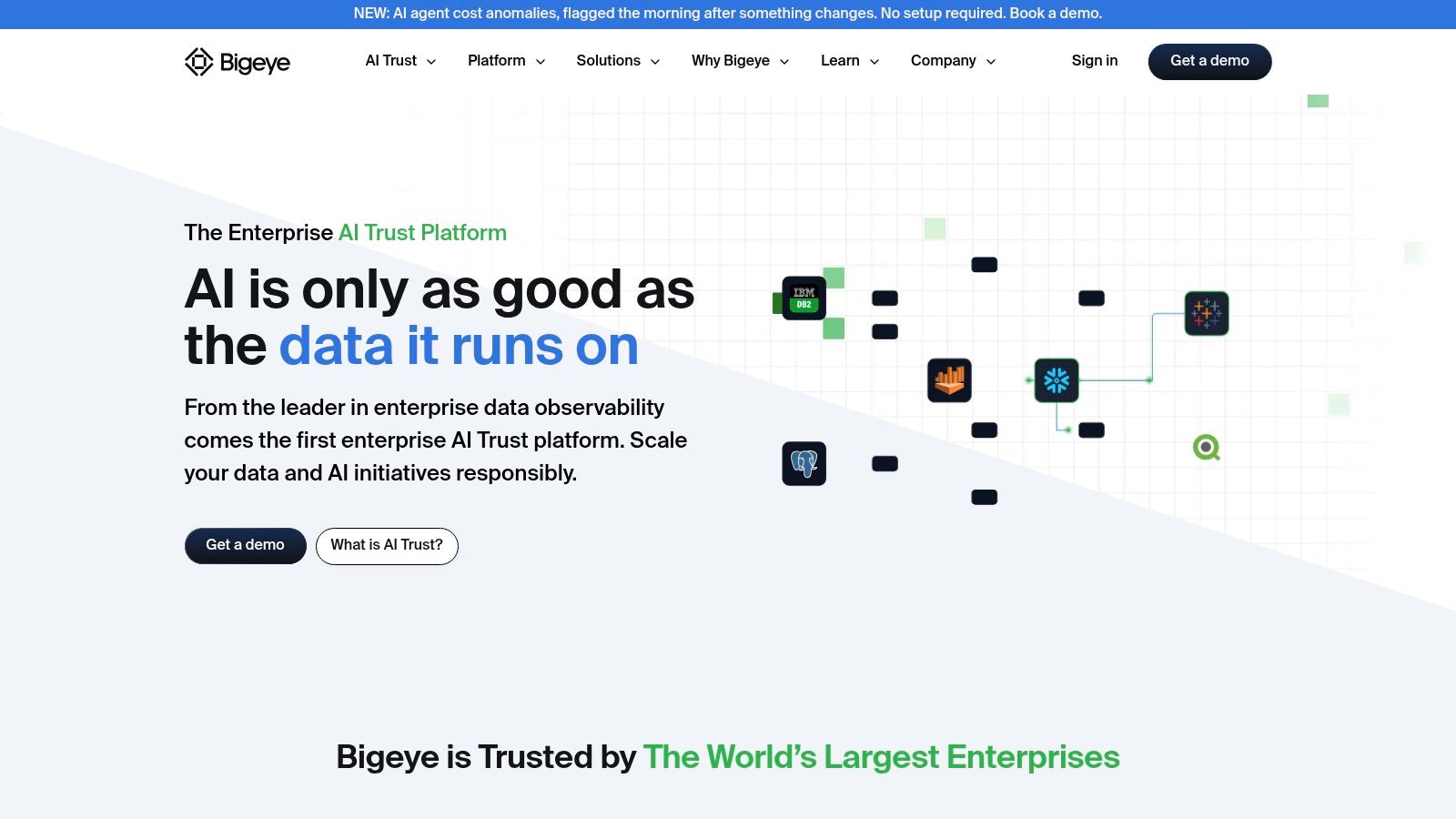
Bigeye focuses on automated data observability and what it presents as AI Trust. It monitors tables and metrics for common integrity dimensions, learns unusual behavior, and adds policy-driven controls for analytics and machine-learning datasets.
The practical benefit is quick coverage of core datasets. Teams can combine automated monitors with lineage-enabled investigations, then use sensitive-data identification and policy controls to focus attention on data that carries higher business or privacy risk. That makes Bigeye a reasonable candidate for model-centric organizations where data quality and AI governance overlap.
What to verify before adoption
Bigeye's interface is oriented toward fast onboarding, but lineage quality will influence how useful investigations become. If metadata coverage is incomplete across the stack, the platform may detect an anomaly without giving investigators enough downstream impact or upstream cause.
Public pricing isn't listed, so procurement will follow an enterprise sales process. That isn't automatically a problem, but it makes a scoped proof of value important. Test representative datasets, sensitive-data policies, lineage completeness, and alert usefulness rather than relying on a product tour.
For teams evaluating adjacent products, this Bigeye alternatives guide is useful for comparing deployment and coverage priorities. Bigeye is most compelling when AI data risk is a first-class requirement. It may be more platform than a smaller engineering group needs for deterministic validation alone.
4. Anomalo
Anomalo takes a baseline-first approach. It uses unsupervised machine learning to learn the expected behavior of each table and identify anomalies without forcing engineers to write an exhaustive rule set before monitoring starts.
That design is useful for large estates where manual coverage doesn't scale. It supports record-level validation, timeliness and schema checks, automated lineage context, dashboarding, and monitoring for unstructured documents or data. Teams can therefore combine behavioral detection with explicit controls instead of choosing between the two.
Where the black box needs attention
The fast initial value comes with a calibration responsibility. A model can flag a legitimate seasonal shift, a planned backfill, or a known operational event as unusual. Engineers need enough context to suppress, tune, or explain those alerts, especially when a regulated process requires a deterministic reason for acceptance.
Anomalo is enterprise-focused, and public pricing details are limited. Its scalability makes it attractive for organizations with high table counts, but buyers should examine onboarding, lineage configuration, historical data requirements, alert tuning, and ownership of investigation workflows.
Use Anomalo when the central question is, “What changed unexpectedly?” Pair it with explicit validation when the question is, “Did every record satisfy this contractual business rule?” Machine learning is valuable for discovering unknown failure modes, but it shouldn't replace controls that auditors or domain owners can read and approve.
5. Soda
Soda combines Soda Core, an open-source checks-as-code framework, with Soda Cloud for managed automation, collaboration, and observability workflows. That split gives engineering teams more control over where checks live while giving governance and analytics users a shared place to review issues.
The approach works well when an organization wants checks versioned alongside code. Data contracts, anomaly detection, record-level diagnostics, remediation flows, and deep integrations extend the model beyond simple test execution. Role-based workflows can help engineers, analysts, and governance teams work from the same quality signals without giving every user direct access to implementation details.

The operational boundary
Soda Core is flexible, but flexibility shifts responsibility to the team. Engineers still need to schedule checks, manage environments, handle failures, and decide how results become actionable. Soda Cloud supplies the collaboration and automation layer, but enterprise capabilities require that managed component and follow a sales-led pricing model.
Data contracts and automated remediation can produce strong outcomes when data producers accept clear ownership. They won't fix an organization that hasn't agreed on who defines quality, who approves exceptions, or who responds to failed checks.
The Soda alternatives comparison is relevant for teams weighing checks-as-code against in-database and modular observability. Soda is a good choice when engineering control and collaborative workflows are central. It isn't the lowest-effort path if the team wants automatic behavioral coverage with minimal rule authoring.
6. Great Expectations
Great Expectations, specifically GX Core, is a strong option for deterministic validation and audit-friendly documentation. Engineers define Expectations against data assets, run them through API or CLI workflows, and produce validation results with human-readable Data Docs.
That makes the framework especially useful for explicit requirements such as accepted values, uniqueness, completeness, ranges, and business-specific conditions. Broad connector support and extensible custom validations let teams adapt it to different backends and domain rules without surrendering control to an opaque detection model.
Open source doesn't mean zero operating cost
GX Core has no license cost, but enterprise operation still requires engineering. Teams must integrate it with orchestration, establish ownership for failed validations, preserve results, manage test changes, and make documentation available to the people who need it.
The product ecosystem also needs careful interpretation. GX Cloud was acquired by FICO, and its public service ended on June 1, 2026. The open-source project continues under Fivetran stewardship, so buyers should distinguish the continuing framework from the discontinued public cloud service.
GX Core is usually the right answer when a rule must be transparent, reviewable, and repeatable. It is less suited to discovering unknown distribution changes or freshness deviations unless the team builds and maintains those monitoring patterns. This open-source data quality and observability tools guide provides useful context for that build-versus-platform decision.
7. Datafold
Datafold addresses a narrower but costly integrity problem: did a code change, migration, or refactor alter values unexpectedly? Its Data Diff capability compares values across databases, warehouses, or lakes, giving developers a way to inspect changes before they reach production.
That makes it different from a conventional observability platform. A freshness monitor may tell you that today's table arrived. Datafold helps answer whether the transformed table still agrees with the prior version or reference system at the value level.
Best fit for change management
Datafold integrates with developer workflows, dbt, and CI/CD processes. Pre-deployment and post-deployment comparisons can expose subtle regressions while a change is still under review, when remediation is cheaper and ownership is clear.
The limitation is scope. Datafold isn't primarily an incident-management or platform-operations suite, so teams needing continuous freshness, schema, behavioral, and business monitoring will likely need complementary controls. The open-source data-diff project has been archived, which places the main value in the commercial platform rather than a self-managed open-source route.
Use it for migrations, warehouse refactors, and high-risk transformation changes. Don't select it as the only data integrity checker for an always-on production estate. For teams clarifying the difference between comparison and broader reconciliation, this explanation of data reconciliation meaning is a useful starting point.
8. IBM Data Observability by Databand
IBM Data Observability by Databand concentrates on pipelines, runs, tasks, and upstream operational health. It captures pipeline and warehouse metadata, identifies anomalies, and provides contextual alerts for triage.
That upstream emphasis fills a gap left by table-level checks. A dataset can fail because an orchestration task stopped, a dependency arrived late, a warehouse job ran with an unexpected duration, or a source system delivered an incomplete load. Databand helps teams investigate those execution and dependency conditions rather than inspecting only the final table.
A strong enterprise operating model
IBM brings enterprise support, services, and deployment options, which can matter for organizations already standardized on IBM procurement, security, or platform practices. Integrations across orchestration and data platforms help connect operational alerts to the systems teams already use.
The trade-off is coverage depth. Compared with products centered on table-level statistical monitoring, Databand places less emphasis on deep in-table anomaly analysis. It can therefore complement a data integrity checker that validates records, distributions, or business metrics.
Pricing and procurement are sales-led, and the platform may feel heavyweight for smaller teams. Select it when upstream pipeline diagnosis is the primary pain, particularly in a larger enterprise that values vendor services and deployment flexibility.
9. Acceldata
Acceldata combines data reliability, pipeline health, lineage, infrastructure visibility, and spend or cost intelligence across hybrid and multi-cloud environments. Its data reliability policies cover quality checks, schema drift, volume changes, and freshness, while lineage views support root-cause analysis.
The broad scope is useful for platform teams that don't want separate tools for data behavior and operational consumption. Dashboards can connect a quality incident with pipeline activity, platform conditions, and data-operation costs. That context helps teams decide whether a failure is isolated to a dataset or reflects a wider platform problem.
Breadth requires a rollout plan
Acceldata offers on-premises, cloud, and hybrid deployment options, which suits complex estates. It also supports reconciliation, policy-driven controls, end-to-end lineage, alerting, and relationship views for troubleshooting.
The same breadth can slow adoption if the team tries to enable everything at once. Start with a defined set of critical datasets, pipeline paths, and platform metrics. Establish ownership before adding spend intelligence, because cost signals without accountable action tend to become another dashboard rather than an operational control.
Public pricing isn't listed, and the buying process is enterprise-led. Acceldata is a strong candidate when data reliability and platform economics belong in the same operating conversation. It may be excessive for a team seeking only deterministic validation or a lightweight freshness monitor.
10. Metaplane
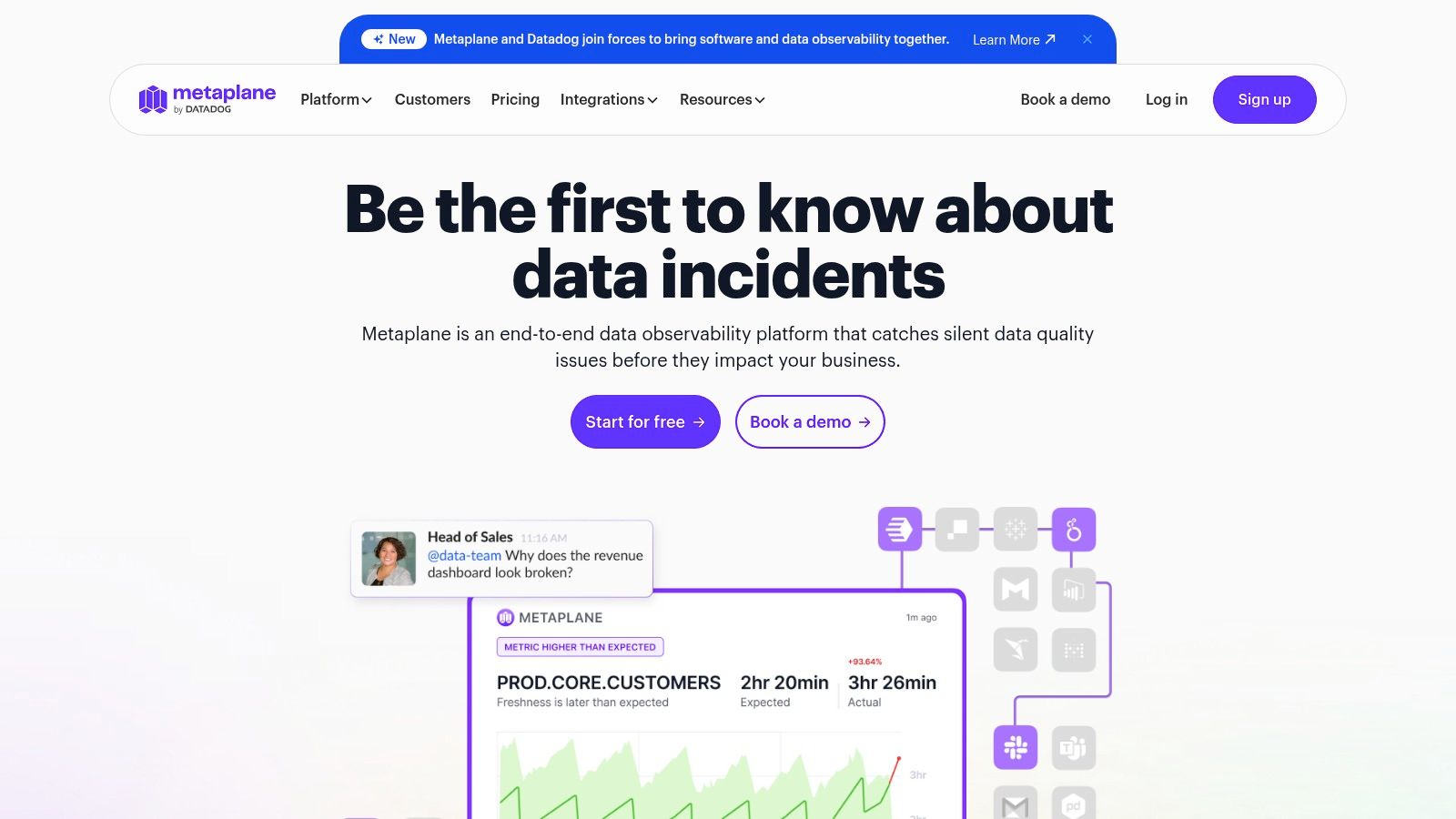
Metaplane provides warehouse and lake observability with monitors for freshness, volume, schema, nulls, uniqueness, and distributions. Custom SQL supports organization-specific rules, while column-level lineage helps teams understand affected assets.
Its onboarding model is approachable for modern data stacks. Connectors include Snowflake, BigQuery, Databricks, Redshift, SQL Server, Postgres, and MySQL. Alert destinations include Slack, Teams, PagerDuty, and webhooks, so a small data team can connect detection to existing response channels without designing a large incident system first.
A practical starting point
Metaplane publishes a transparent tier structure, including a free plan for coverage of up to 10 tables. That makes it easier to test the workflow with real assets before committing to a broader rollout.
The platform's trade-off is depth at the largest enterprise scale. Some advanced capabilities, such as data impact or test previews and spend monitoring, are additional features, and larger organizations may need stronger controls than the core experience provides.
Metaplane is a sensible choice when a team wants fast setup, conventional observability monitors, and visible pricing. It won't replace a migration-focused diff tool, a full pipeline operations platform, or a private in-database architecture when those requirements are essential.
Top 10 Data Integrity Checkers, Feature Comparison
Solution | Core capabilities (✨) | Target audience (👥) | Quality (★) | Pricing & value (💰) |
|---|---|---|---|---|
🏆 digna | ✨ In‑database checks; AI baseline anomaly detection, timeliness, record validation, schema tracking; modular | 👥 Enterprises & regulated industries (finance, healthcare, telco, public sector) | ★★★★★ Enterprise‑grade; rapid time‑to‑value | 💰 Transparent: base + per‑active‑table per‑module; no API/scan/alert fees |
Monte Carlo Data | ✨ Automated freshness/volume/schema monitors; end‑to‑end & column lineage; incident workflows | 👥 Large analytics orgs, data ops/incident teams | ★★★★☆ Strong lineage & RCA | 💰 Consumption/credits model, opaque (sales) |
Bigeye | ✨ Automated anomaly monitoring, lineage‑enabled investigations, AI/ML data guardrails, sensitive‑data ID | 👥 Model‑centric teams & analytics engineers | ★★★★☆ Fast coverage; clear UI | 💰 Enterprise sales (not public) |
Anomalo | ✨ Unsupervised ML baseline detection; validation, timeliness, schema checks; auto lineage | 👥 Large enterprises with high table volumes | ★★★★☆ Scales to millions of tables | 💰 Enterprise sales (opaque) |
Soda (Core + Cloud) | ✨ Checks‑as‑code (OSS) + managed automation, data contracts, remediation flows | 👥 Engineering + governance teams adopting checks‑as‑code | ★★★★☆ Flexible OSS + managed UX | 💰 OSS free + Soda Cloud (sales‑led) |
Great Expectations (GX Core) | ✨ Deterministic Expectations, Data Docs for auditability, extensible validations | 👥 Engineers, compliance/audit teams | ★★★★☆ Deterministic, audit‑friendly (OSS) | 💰 Free open‑source (GX Cloud public service ended) |
Datafold | ✨ Fast value‑level data diff for refactors/migrations; CI/dbt integrations; pre/post‑deploy checks | 👥 Developers, dbt users, migration/refactor teams | ★★★★☆ Excellent for change‑management | 💰 Commercial (sales‑led) |
IBM Data Observability (Databand) | ✨ Pipeline/run/task monitoring; anomaly detection; upstream failure triage & integrations | 👥 Enterprises in IBM ecosystem; ops/platform teams | ★★★☆☆ Strong enterprise support & services | 💰 Sales‑led enterprise pricing |
Acceldata | ✨ Data + platform observability, lineage, policy checks, spend/cost intelligence | 👥 Data platform & ops teams at large orgs | ★★★★☆ Broad coverage across data + infra | 💰 Sales‑led enterprise pricing |
Metaplane | ✨ Monitors for freshness/volume/schema/nulls/distributions; column lineage; multiple connectors | 👥 Modern‑stack teams, SMBs to mid‑market | ★★★★☆ Fast onboarding; sensible defaults | 💰 Transparent tiers + free plan (up to 10 tables) |
Choose the Checker That Matches the Failure Mode
A good data integrity checker starts with the failure you need to prevent. Custom SQL and Great Expectations are the best tools when the requirement is explicit and deterministic. If the rule says a value must belong to a reference list, a total must equal the sum of component fields, or a key must be unique, a version-controlled assertion gives engineers and auditors a clear answer.
Database constraints belong at the foundation where possible. Adobe's explanation of data integrity describes accuracy, completeness, consistency, and the absence of unauthorized alteration as core properties, and recommends primary key, foreign key, and check constraints at the database layer. Those controls are close to the data, reliable, and inexpensive to maintain compared with discovering the same failure downstream.
Use checksums and data-diff methods for migration validation, replication checks, and point-in-time reconciliation. A checksum can confirm that content hasn't changed between two locations, but it doesn't explain whether the content is semantically correct. Datafold is more useful when you need row or value-level comparisons around a code change. Neither method replaces freshness, schema, or behavioral monitoring after deployment.
Pipeline observability belongs upstream. IBM Data Observability by Databand is suited to failed tasks, broken dependencies, and execution anomalies. Acceldata and Monte Carlo Data provide broader views when lineage, incident routing, platform health, or hybrid environments matter. Metaplane offers a more approachable entry point for teams that need common monitors and fast onboarding. Bigeye and Anomalo are attractive when automated anomaly detection and AI-oriented data risk are central, though teams should plan for calibration and lineage quality.
Continuous checking is justified because data failures recur. A 2023 Bigeye survey report reported a median of 5 to 10 data quality incidents every three months across organizations. The same review summarized historical evidence that customer data can degenerate by about 2% per month, or roughly 25% annually. Periodic cleanup can't reliably control a data environment that keeps changing.
The final trade-off is between engineering control, coverage, deployment model, investigation context, and pricing. Open-source frameworks maximize control but require operational ownership. Consumption-priced platforms can provide broad coverage and rich lineage, but forecasting may be harder. Hosted tools simplify adoption, while private and in-database platforms better suit sensitive or regulated data.
digna is the relevant option when teams need modular monitoring, private deployment, in-database execution, and anomaly, timeliness, validation, and schema coverage in one platform. It also addresses the less visible requirement of proving integrity continuously. The 2026 State of Validation study reports that audit readiness ranked as the leading challenge for the third consecutive year, while data integrity remained among the top three challenge categories from 2024 through 2026. Detection is only half the job. Teams also need traceability, evidence, and inspection-ready reporting.
AI raises the bar further. A 2026 data integrity and AI readiness report found that leaders continue to identify privacy and security, data quality, and integration as persistent integrity issues, while many organizations have started AI quality initiatives without fully executing them. A checker that only validates syntax won't establish whether data carries the right business meaning for training, inference, risk, or compliance.
Choose the narrowest tool that solves the immediate failure, then test whether it can support the evidence and operating model you'll need later. That approach prevents overbuying while avoiding the more expensive mistake of treating integrity as a one-time test run.
digna combines in-database anomaly detection, timeliness monitoring, record-level validation, analytics, and schema tracking inside your own private cloud, VPC, or on-premises environment. Visit digna to evaluate a modular data integrity checker that keeps sensitive data in place and helps your team move from isolated checks to continuous, defensible observability.