Data Warehousing Schemas: Patterns, Tradeoffs, and Evolution
|
9
min read

You've probably seen this happen. A team adds what looks like a harmless column to a customer table, a dashboard keeps running, and nobody notices that a downstream join key changed until finance asks why revenue went negative in a report that used to be stable. That kind of failure doesn't come from a bad chart, it comes from data warehousing schemas that weren't treated like a contract.
The hard truth is that schema choice is never just a modeling preference. It shapes how analysts query data, how platform engineers monitor change, and how quickly a warehouse can absorb new source behavior without breaking downstream work. The common patterns, star, snowflake, normalized, wide-table, and data vault, each make a different promise about speed, storage, governance, and change tolerance. A useful warehouse starts when those promises are made deliberately, not by accident.
If you want a quick visual reference while reading, the basic schema families are outlined in this guide to types of schema.
Table of Contents
Why the Schema Behind Your Warehouse Matters More Than You Think
A practical way to think about it
Star and Snowflake Schemas Explained Through a Sales-Orders Example
The star version
The snowflake version
Normalized, Wide-Table, and Data Vault Patterns Compared
Normalized 3NF for integrity
Wide tables for read speed
Data Vault for auditable evolution
Choosing Between Schema Patterns on Real Tradeoffs
Side-by-side tradeoffs
How Schema Choice Shapes Observability and Reliability
What to watch in each pattern
Where digna fits
Schema Drift, Evolution, and Which Changes to Auto-Accept
A simple policy that actually works
What to instrument
A Hybrid Schema Strategy for Regulated Analytics Workloads
How that looks in practice
Why this hybrid is worth the overhead
Putting It Together and Your Schema Design Checklist
Why the Schema Behind Your Warehouse Matters More Than You Think
A small schema change can look harmless in a pull request and still create a report incident two days later. A customer dimension gets a new field, someone renames a key to match a source system, and a finance dashboard keeps rendering because the view layer still compiles. The numbers are wrong anyway, because the join no longer lands on the same business entity.
That's why schema design belongs in governance conversations, not just data modeling reviews. The warehouse isn't only a place to store facts, it's a place where downstream consumers depend on stable structure, predictable keys, and clear ownership of change. If your team treats every table as a mutable implementation detail, you eventually pay for it in broken reports, confused analysts, and emergency fixes.
A practical way to think about it
The best schema is the one that matches the way people use the data. Analysts want simple joins and understandable filters. Platform engineers want observability signals that tell them when a schema is drifting, not after a dashboard is already wrong.
Practical rule: if a schema change can silently alter a business metric, it needs governance, lineage, and a clear approval path before it lands.
The rest of this guide walks through the major warehouse patterns and the tradeoffs that matter in real systems. It also connects the modeling choice to an operational question many teams skip, which changes should be auto-accepted, which should go to human review, and which should be blocked until consumers are migrated. That framing is useful whether you're designing from scratch or trying to stabilize a messy warehouse that already has too many special cases.
Star and Snowflake Schemas Explained Through a Sales-Orders Example
Start with one familiar dataset, sales orders. A fact_orders table sits in the center and records measurable events like order count, quantity, and revenue. Around it sit dimension tables that describe who bought, what was bought, and when it happened.

The star version
In a star schema, the customer dimension stays wide and denormalized. A single dim_customer table holds customer identity plus descriptive attributes such as city, region, and country, and fact_orders joins to it directly through a foreign key. Microsoft's guidance on star schemas describes this as a design where the fact table's dimensionality and granularity are set by the dimension keys, which is why teams usually lock the grain first and then hang dimensions off stable business entities (Microsoft star schema guidance).
That simplicity is why BI tools like star schemas. Fewer joins means fewer surprises for analysts, and the predicates stay predictable because each dimension is already in the shape the query engine expects. Ralph Kimball's dimensional modeling work, published in 1996, helped make this pattern the standard mental model for analytics warehouses, building on earlier warehouse methodology work from Inmon in 1990 (Kimball and warehouse schema history).
The snowflake version
In a snowflake schema, the same customer description gets split into related sub-dimensions. You might keep dim_customer for the core entity, then normalize geography into dim_region and dim_country, or a city and region chain if the hierarchy is deeper. That's the defining tradeoff, less redundancy, more joins. Exasol's overview captures that normalization cleanly, snowflake schemas reduce duplication but add join complexity because dimensions are no longer stored in one flat table (Exasol on snowflake schemas).
Snowflake tends to help when hierarchical attributes are large, shared, or likely to change. Star tends to help when analysts need speed and clarity more than compactness. Both can be right, but they fail in different places. Snowflake can create join fan-out across deep hierarchies, while star can become bloated when dimension attributes churn frequently.
If you want the short version, use star when query simplicity matters most, and snowflake when the dimension hierarchy itself is the thing you need to manage carefully. A more detailed comparison of the two patterns is available in this explanation of star and snowflake schema.
Normalized, Wide-Table, and Data Vault Patterns Compared
A sales-orders warehouse can serve three different goals, and the schema choice shows which one matters most. A normalized layout keeps business entities separate. A wide-table layout flattens them into one row per business event. A Data Vault layout keeps history explicit and traceable, which makes it easier to see how the warehouse changed over time.
Normalized 3NF for integrity
In a 3NF warehouse, orders, order_lines, customers, products, and addresses sit in separate tables with clear dependencies. Each entity appears once, so update logic stays clean and redundancy stays low. That suits operational reporting and warehouses that act more like governed extensions of source systems than query-first marts.
The tradeoff is analyst effort. Every question needs more joins, and those joins become part of day-to-day usage. If the main goal is source alignment and reuse across downstream models, this structure is strong. If the main goal is fast self-service analysis, it often feels heavy.
Wide tables for read speed
A wide-table design takes the opposite route. One denormalized row per order can carry customer, product, channel, and date attributes together, which keeps dashboard scans simple and fast to read. That works well for feature pipelines and reporting layers where low-friction retrieval matters more than relational purity.
The maintenance cost shows up fast. When an attribute changes, the same value may need to be refreshed across many rows or rebuilt in the pipeline. Querying is easy. Keeping the table tidy takes discipline.
Data Vault for auditable evolution
Data Vault 2.0 splits the warehouse into hubs, links, and satellites. Hubs hold business keys, links capture relationships, and satellites store descriptive history with load timestamps. Data Vault's hub-link-satellite structure requires teams to model around business keys and load timestamps upfront, which adds implementation complexity but eliminates retrospective schema changes.
That upfront design choice matters in regulated or fast-changing environments. It gives governance teams a clear trail for change capture, but it also asks engineers to think in a more prescriptive way from the start. The model is better for controlled evolution than for casual ad hoc querying.
Pattern | Core Tables | Update Model | Read Pattern | Best Fit |
|---|---|---|---|---|
Normalized 3NF | Separate entity tables for orders, customers, products, addresses | Update in place with strong dependencies | Many joins, source-aligned queries | Operational reporting and governed reuse |
Wide table | One flattened order table with embedded attributes | Rebuild or overwrite denormalized rows | Single-table scans, simple filters | Dashboards and feature retrieval |
Data Vault | Hubs, links, satellites | Insert-friendly, history-preserving | Requires modeled access layer | Auditable enterprise evolution |
For a broader modeling reference, see warehouse data modeling.
Choosing Between Schema Patterns on Real Tradeoffs
A schema choice should follow the risk you are willing to carry. One team may accept more joins because governance and source alignment matter most. Another may prefer simpler reads because analysts need fast access and fewer failure points.
Side-by-side tradeoffs
Schema pattern | Query Performance | Storage Cost | Join Complexity | Change Resilience | Best Fit |
|---|---|---|---|---|---|
Star | Strong for BI queries | Moderate redundancy in dimensions | Low | Moderate | Dashboards and analytics marts |
Snowflake | Good, but join-heavy | Lower redundancy | Higher | Moderate to strong for hierarchies | Large or hierarchical dimensions |
Normalized 3NF | Weaker for analytics, strong for operational reuse | Efficient | High | Strong for source-aligned change | Governance-heavy warehouses |
Wide table | Very strong for scan-heavy reads | Higher duplication | Very low | Lower if attributes churn | Feature stores and fast dashboards |
Data Vault | Not built for direct BI speed | Higher metadata footprint | High | Strong for auditable history | Enterprise hubs and regulated change capture |
The table helps, but the decision usually comes from the team mix around the warehouse. Finance may accept 3NF in a core ledger because traceability matters more than convenience. Product analytics may want a wide table because repeatable feature retrieval matters more than normalized design. BI teams often stay with star schema because analysts need a model they can query without learning the source system's join graph.
That mix is normal. Mature warehouses rarely use one pattern everywhere. They use different patterns by domain, then add governance rules around the boundaries so changes do not surprise downstream users.
A useful way to separate choices is by downstream risk. Low-risk changes, such as adding a new descriptive column to a layer that few consumers touch, can usually be auto-accepted. Changes that alter keys, join paths, or semantics deserve review, because they can break shared models. Changes that would rewrite meaning across many consumers should be blocked until owners sign off and tests pass.
That is why schema design is also an observability decision. Teams need to know which models can absorb drift, which ones need human review, and which ones should stop the change before it reaches production. For people comparing how these tradeoffs show up in day-to-day work, find data engineer roles with LatoJobs is a practical reference.
How Schema Choice Shapes Observability and Reliability
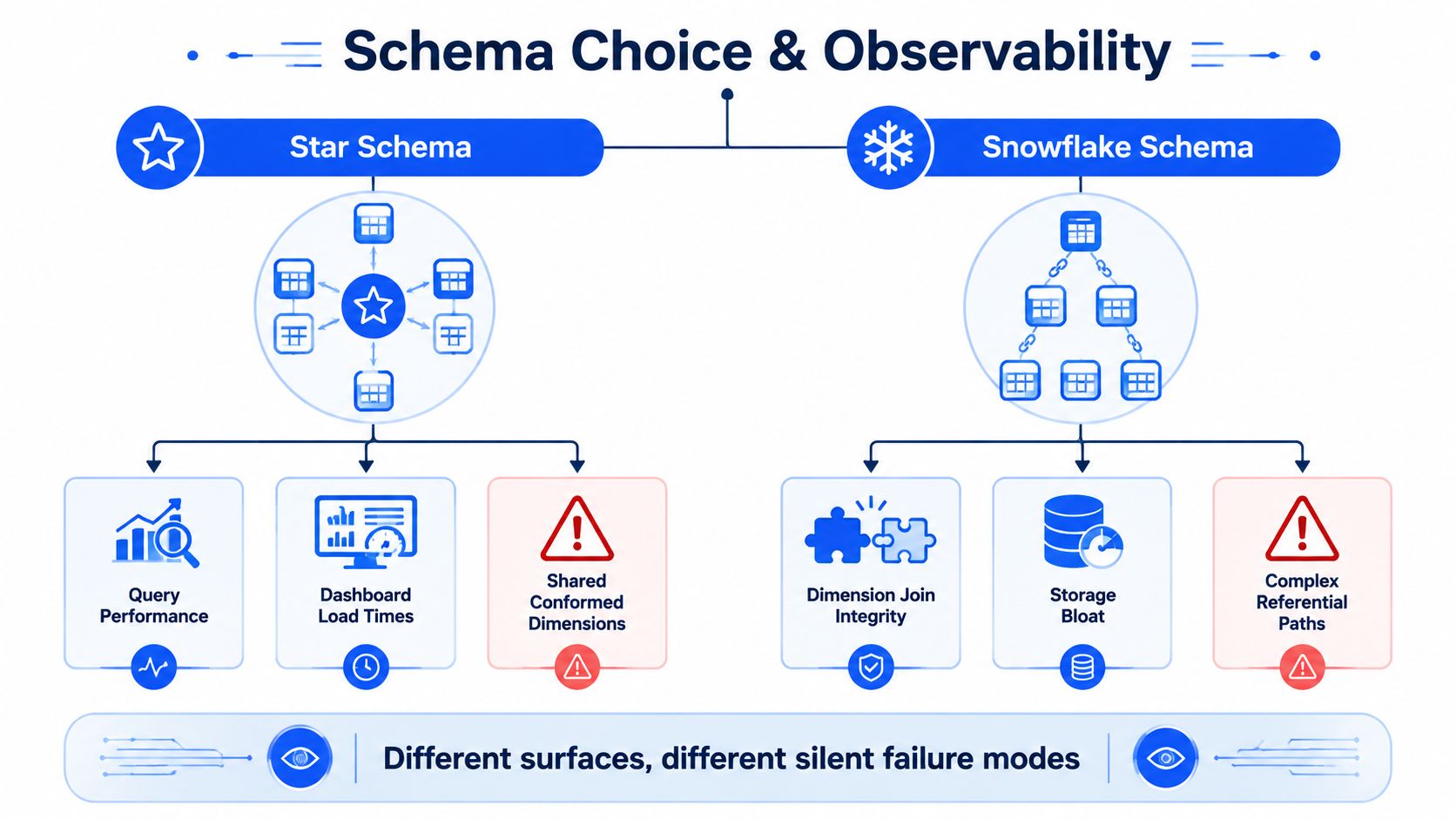
Every schema pattern creates a different observability surface. Star and snowflake concentrate risk in shared dimensions, wide tables surface issues through distributions and nulls, and Data Vault exposes lineage through keys and timestamps. The point is not just how data is modeled, it's what can fail without being noticed and what your monitoring stack needs to notice first.
What to watch in each pattern
In a star or snowflake model, a single bad change in a conformed dimension can affect many downstream models at once. That makes freshness SLAs on dimension tables and null-rate alerts on key attributes load-bearing. It also makes cardinality drift on join keys a useful warning sign when a dimension suddenly stops behaving like the business entity everyone expects.
Wide tables shift the monitoring problem. Joins stop being the main failure mode, but column-level behavior becomes much more important. If a customer attribute changes shape, you may see it first in null rates, value distributions, or feature skew rather than a broken join.
Data Vault gives you better visibility into structural change because hubs, links, and satellites keep lineage more explicit. The tradeoff is more metadata to manage and more tables to track. That usually means schema events, load timestamps, and table-level freshness checks matter more than whether the consumer query is elegant.
Operational insight: monitor the shape of the data where the model is weakest, not where it already looks clean in a dashboard.
Where digna fits
A platform like digna can sit inside the customer environment and continuously track schema changes, timeliness, anomalies, and validation without moving data out of place. Its schema tracking is relevant here because schema drift is often the first visible sign that a warehouse contract changed under an analyst's feet.
The monitoring backlog should include schema-event streams for added, renamed, and dropped columns, plus column lineage on the tables that matter most. That combination gives platform teams a way to connect modeling choice to incident response, instead of learning about drift only after a stakeholder notices a wrong number.
Schema Drift, Evolution, and Which Changes to Auto-Accept
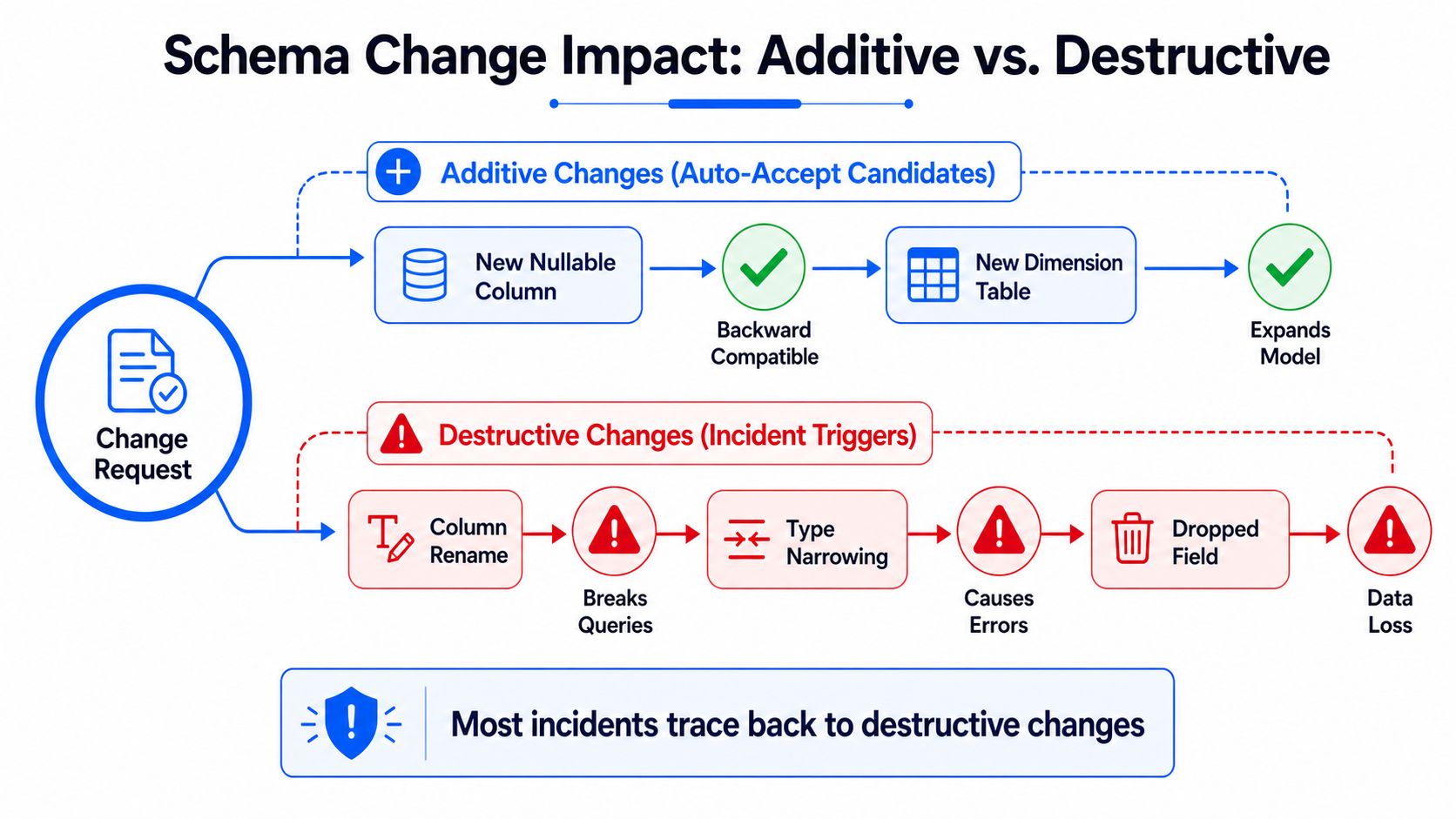
Schema drift is not one problem. It's a family of changes, and the risk depends on what changed and who consumes it. An added nullable column is usually easy to absorb. A renamed key can break a report without throwing a loud error.
A simple policy that actually works
A practical governance policy can use three tiers.
Auto-accept additive changes when they're backward compatible and have no downstream consumer risk. A new nullable discount_percent column on fact_orders fits here if nothing reads it yet.
Require human review when the change touches a column consumed by many downstream objects, or when it appears in a regulated report. If a new field will affect finance close, risk reporting, or shared marts, someone should inspect lineage before promotion.
Block destructive changes until consumers migrate. A rename from customer_id to account_id, a type narrowing, or a dropped field is not just a refactor, it's a contract change.
Whaling through source tables without a policy is how teams end up with silent failures. Whaly's documentation on schema drift describes common changes as added columns, deleted columns, and type changes, and even notes that a type change can result in a new destination column while older values remain in the previous one (schema drift behavior). That's exactly the sort of edge case that makes schema evolution a governance issue, not just an engineering nuisance.
What to instrument
Schema diffs between snapshots so changes are visible before they spread.
Column-level lineage so you know which dashboards, models, and exports depend on a field.
Contract tests on the most consumed tables so destructive changes fail fast.
Deprecation windows with shadow columns when a rename or semantic change is unavoidable.
The important thing is to classify the change before it reaches production. Governance gets faster when reviewers know which changes are safe to absorb and which ones need a person in the loop. For a detailed breakdown of structural changes and pipeline breakage, see schema drift explained structural changes break data pipelines.
A Hybrid Schema Strategy for Regulated Analytics Workloads
Regulated teams rarely need one canonical schema for everything. They need a rigid core for auditability and a flexible access layer for analysts. The core keeps the governed record stable, while versioned semantic views sit on top for reporting and BI.
How that looks in practice
For quarterly revenue close, the ledger table should remain immutably modeled so the accounting record does not shift under a report. If upstream systems add columns or widen a type, the core can stay stable while versioned views absorb the change and preserve downstream compatibility. Analysts continue using the view layer, while governance stays anchored to the audited tables underneath.
That separation matters because consumer risk is not the same across the warehouse. A finance close process wants stable history and predictable mappings. A dashboard can usually tolerate a versioned view as long as field names and semantics stay consistent.
Layer | Governance | Change Cadence | Consumer |
|---|---|---|---|
Core fact and dimension tables | Strict, audited, immutable where required | Slow and controlled | Finance, healthcare, compliance |
Versioned semantic views | Contracted and backward compatible | Moderate | Analysts, BI tools |
Sandbox or exploration layer | Lightweight and exploratory | Fast | Data analysts, prototyping users |
Why this hybrid is worth the overhead
Contract tests between the core and view layers catch silent breakage before promotion. Change approvals can route through both the governance committee and the observability platform, so policy does not live only in slide decks. The result is a warehouse that can change without turning every schema update into a crisis.
This model works best in finance, healthcare, and public-sector analytics. It respects the fact that some tables serve as immutable records rather than convenience views, while still letting downstream users work with stable, readable interfaces.
Putting It Together and Your Schema Design Checklist
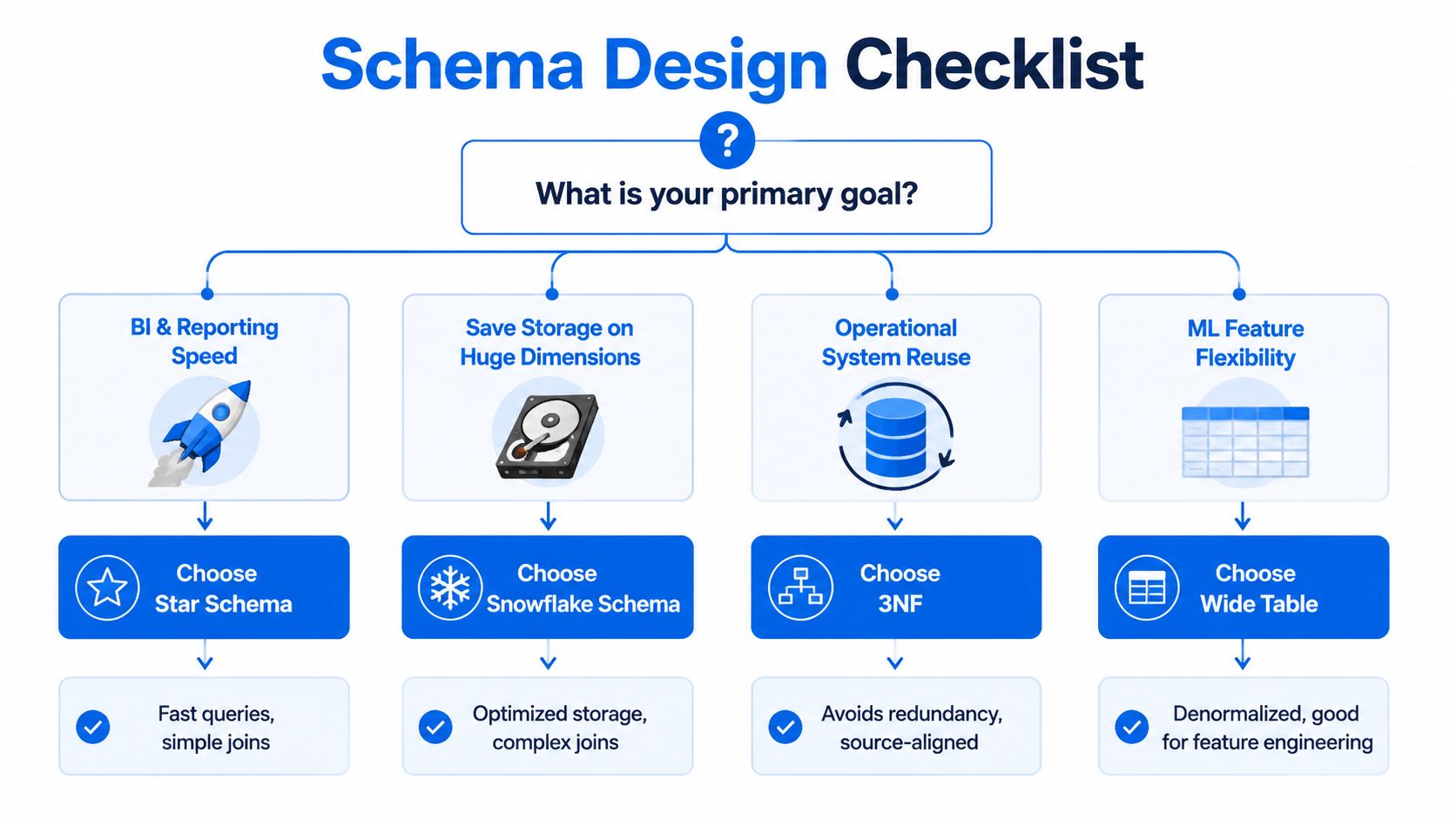
The pattern choice gets simpler when you reduce it to the primary goal. Star schema is the default when BI speed and simple joins matter. Snowflake makes sense when huge dimensions or hierarchical reference data justify the added joins. Normalized 3NF is the right fit for operational reuse and governance-heavy source-aligned models. Wide-table works when your main concern is fast feature retrieval or single-table reads. Data Vault belongs where auditable history and controlled evolution matter most.
The change policy should be just as explicit. Auto-accept additive nullables when there's no downstream consumer risk. Review renames and type changes against lineage before they ship. Block destructive drops if anything active still reads the field.
The first observability signals to wire up are simple: schema diffs, freshness per table, null-rate anomalies, and contract-test failures. Those four checks give you a baseline that maps directly to the failure modes discussed above.
If you want a checklist you can paste into a repo comment or architecture doc, use this:
Choose star when analysts need fast, readable BI queries.
Choose snowflake when storage savings and hierarchy management matter more than join simplicity.
Choose 3NF when the warehouse is serving operational reuse or strict governance needs.
Choose wide-table when the consumer is mostly scan-heavy dashboards or ML feature retrieval.
Choose data vault when auditability and change capture are central requirements.
Auto-accept additive, backward-compatible changes with no active consumer risk.
Review changes that touch heavily used or regulated fields.
Block destructive changes until consumers migrate and tests pass.
If schema drift, freshness, and contract changes are starting to feel harder to manage than the transformations themselves, digna gives teams a way to monitor schema changes, timeliness, anomalies, and validation inside their own environment. Visit digna to see how that kind of observability can help your warehouse stay stable while the schema keeps evolving.
Frequently asked questions
Which warehouse schema should you choose?
The one that matches the way people use the data. Star, snowflake, normalized, wide-table and data vault each trade modeling purity against query ergonomics, and schema choice is never just a modeling preference.
Why does schema design belong in governance?
Because a small schema change can look harmless in a pull request and still create a report incident two days later. If a change can silently alter a business metric, it needs governance, lineage and a clear approval path before it lands.
What separates star from snowflake?
How far the dimensions are normalized. A star keeps dimensions flat and wide for simpler joins, while a snowflake normalizes them into related tables, trading some query simplicity for reduced redundancy and tighter control of dimension attributes.
When does a wide table make sense?
When read patterns are predictable and join cost dominates. Denormalizing into one wide table removes joins at the price of duplication and of a schema that is harder to evolve without touching every consumer at once.
Why do schema decisions outlive the team that made them?
Because consumers accumulate around them. Every dashboard, model and downstream table written against a schema becomes a reason not to change it, which is exactly why the initial choice deserves more scrutiny than it usually gets.