Data Quality vs Data Governance: A Practical 2026 Guide
|
6
min read

Popular advice treats data quality and data governance like separate workstreams, then wonders why teams still drown in broken dashboards, inconsistent definitions, and audit noise. In practice, buyers don't experience them that way. They experience one operational problem, data trust, and they need the rules, the measurements, and the enforcement to work together inside the pipeline.
That split matters because governance can exist on paper while quality collapses in production. A 2024 global survey found that 64% of respondents named data quality their top data-integrity challenge, while 51% named data governance, and 71% said their organization already had a governance program (Precisely). That is the core pattern in modern data stacks: policy adoption rises, but the operational pain still shows up at the record and pipeline level.
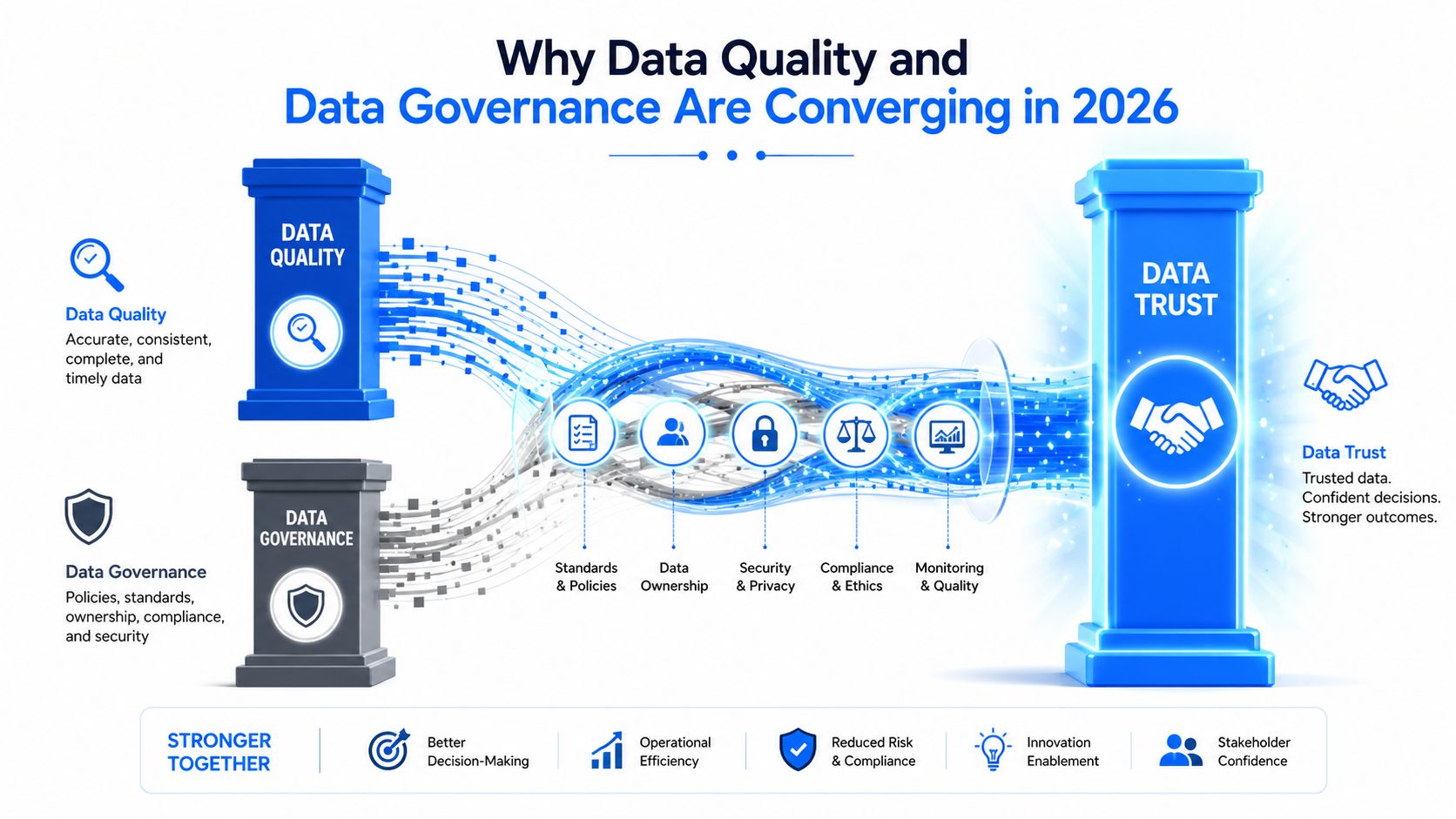
Table of Contents
Why Data Quality and Data Governance Are Converging in 2026
The old framing says data quality lives with engineers and analysts, while data governance lives with policy teams and stewards. That sounds clean on paper, but it breaks down as soon as a pipeline changes, a certified dataset feeds an executive dashboard, or an AI workflow depends on a field that nobody validated at runtime.
The market evidence points to convergence, not separation. In the same 2024 survey, 64% of organizations called data quality their top data-integrity challenge and 51% named data governance, while 62% said lack of governance was the primary obstacle to AI readiness (Bigeye trend coverage). That tells you buyers aren't shopping for two disconnected toolsets. They're trying to solve a single reliability problem across catalogs, pipelines, and downstream decisions.
Governance only matters when it changes behavior
A policy that never reaches the pipeline is shelfware. A check that fails without any ownership context is just noise. The convergence in 2026 is driven by the fact that organizations need governance to become a measurable signal, not a static document layer.
Practical rule: if a rule can't be enforced where data moves, it doesn't reduce risk.
That's why lineage, policy enforcement, and continuous validation now sit closer together. Standards like ISO 8000 explicitly tie data quality to data governance, data quality management, and maturity assessment, and emphasize that quality must be measurable and verifiable through description, provenance, and lossless exchange (ISO 8000-1). The practical implication is simple. Policy has to be expressed in the same operational system that catches missing fields, stale loads, and schema drift.
For teams comparing observability and governance programs, the boundary often gets clearer when you look at controls versus signals. The distinction between those two shows up in practice in the data observability vs data quality guide, where the question is less “which team owns it?” and more “where does the control become executable?”
What Data Quality Actually Means in Practice
Data quality is not a vibe and it is not a catalog field. It is the measurable condition of a dataset at a point in time, judged by whether records satisfy concrete rules. The operational dimensions that matter most are accuracy, completeness, consistency, timeliness, uniqueness, and validity.
Microsoft's cloud-scale analytics guidance gives those dimensions useful working definitions. It treats completeness as the share of non-nulls and non-blanks, uniqueness as the share of nonduplicate values, consistency as pattern compliance, validity as reference matching, and accuracy as successful reproduction of intended values (Microsoft cloud-scale analytics guidance). Government guidance also separates timeliness from the other dimensions by focusing on whether data reflects the period it represents and whether the lag before availability is appropriate for use (government data quality framework).
Six core dimensions in the field
Dimension | Failure Example | Detection Method |
|---|---|---|
Accuracy | A customer address is stored incorrectly | Reconciliation against a trusted source or downstream system |
Completeness | A required field arrives blank | Non-null rule or missing-field rate check |
Consistency | Two tables disagree on the same status code | Cross-field or cross-table validation |
Timeliness | A revenue feed lands too late for close | Freshness check against expected arrival time |
Uniqueness | The same invoice appears twice | Duplicate detection on the business key |
Validity | A value falls outside the allowed format or reference set | Schema, regex, or reference validation |
The University of Oklahoma's guideline lists accuracy, completeness, consistency, timeliness, and validity, then describes completed rules as a way to alert stewards to suspect records needing remediation (OU data quality guideline). That's the operative point. Quality lives in rules, checks, baselines, and exceptions, not in documentation alone.
If you're building this into an operating model, engineering leaders usually need a more implementation-oriented reference than a glossary. A useful guide for engineering leaders can help teams think about where quality checks belong in warehouse and pipeline design. The right mental model is structural quality plus semantic quality. Structural quality asks whether a field exists, is typed correctly, and lands on time. Semantic quality asks whether the value makes sense for the business process it represents.
For a deeper breakdown of how these dimensions map to daily controls, the dimensions of data quality guide is a practical companion. The key is to keep the vocabulary operational. SLAs, data contracts, and observability signals only matter if they point to record-level behavior you can test.
What Data Governance Actually Means in Practice
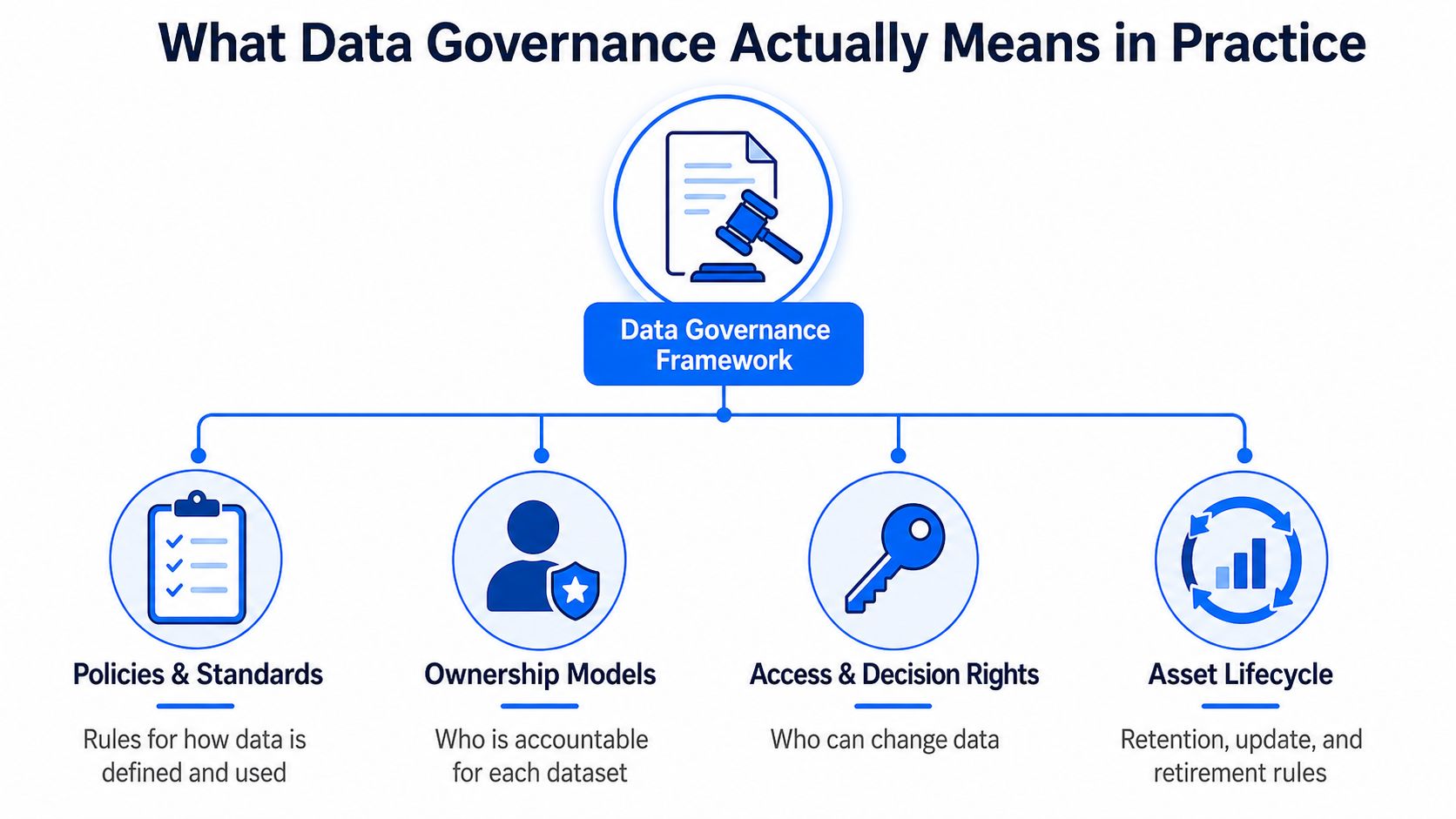
Data governance is the control system around data, the policies, ownership models, standards, and decision rights that determine who can define, change, access, and retire data assets. If quality asks whether a dataset is trustworthy, governance asks whether the organization can prove control, accountability, and policy enforcement across the estate.
In practice, that becomes a set of artifacts people can point to. A catalog entry names the asset. A glossary term defines business meaning. A stewardship assignment makes someone accountable. An access policy defines who can see or use the asset. A retention rule says how long it stays. A data contract sets the conditions under which producers and consumers can rely on it.
Documentation is not the same as control
The gap between governance theater and governance that works is huge. A catalog full of terms doesn't stop a bad load. A quarterly review doesn't catch a schema change that breaks a finance report at 7 a.m. Modern buyers increasingly expect governance to operate as an enforceable layer, not a document library.
Governance gets real when it governs access, definitions, and lifecycle decisions that teams actually feel in production.
That's why lineage and policy-as-code matter so much. A governance model that can't show where a field came from, who approved it, and what rules apply to it is too weak for modern cloud and AI stacks. The practical reference point is often domain-based ownership, where a finance, customer, or product domain has explicit stewards and review paths instead of a generic enterprise committee.
If you're comparing governance approaches in regulated environments, the Bridge Global healthcare data governance guide is a useful example of how access, accountability, and lifecycle rules show up in a real industry context. The same logic applies outside healthcare, just with different domain boundaries and evidence requirements.
For strategy work, the data governance strategy guide is useful because it keeps the focus on operating model, not slogans. Governance is strongest when it sets the rules of the road and then proves those rules are being followed through audit-ready evidence. That's the line between a program people mention and a control layer people depend on.
Data Quality vs Data Governance Compared Side by Side
The fastest way to separate the two is to compare how they behave in real operations. Governance defines the boundaries, quality checks the bytes. Governance answers who owns the asset and what rules apply, while quality answers whether the data passed those rules on this run.
Dimension | Data Governance | Data Quality |
|---|---|---|
Scope | Definitions, policies, lineage, access, lifecycle | Measurement, validation, anomaly detection, remediation |
Ownership | Stewardship councils, CDO-led programs, domain owners | Analytics engineers, data platform teams, pipeline owners |
Primary metrics | Catalog coverage, policy coverage, lineage coverage, access review completion, audit-ready evidence | Freshness, completeness, validity, uniqueness, accuracy, duplicate rate, missing-field rate |
Tooling category | Catalogs, lineage graphs, policy engines, access tools | Data observability, profiling, validation frameworks, contract tests |
Cadence | Periodic review cycles, often quarterly or annual for policy changes | Continuous, embedded in CI/CD and pipeline runs |
Governance usually starts with design-time questions. Who can change the table. What counts as the source of truth. Which domains need approval before a field is retired. Quality starts at run time. Did the record arrive, did it pass validation, did the distribution shift, did the load miss its window.
A common mistake is to ask governance tools to do quality work. A catalog can tell you the owner of a table, and a lineage graph can show the blast radius, but neither one proves the invoice ID is unique tonight. The banking case study referenced in the research notes shows the complementary pattern clearly. Governance mechanisms such as performance measurement, compliance monitoring, and training helped mitigate data-quality issues, but the core quality work still depended on operational checks, not metadata alone (White Rose research).
Where the overlap actually sits
The overlap is in SLAs, data contracts, and incident response. Governance defines the expectation, quality enforces it, and both get pulled into the same escalation path when an asset fails. In a mature stack, the boundary is visible but not rigid.
The practical difference also shows up in evidence. Governance produces policy records, lineage traces, and access approvals. Quality produces pass rates, exception counts, and unresolved-issue aging. One is a control plane, the other is a detection plane, and modern teams need both.
Roles, Metrics, and Processes That Connect the Two
The cleanest bridge between governance and quality is the person who owns the definition and the person who writes the test. A data steward decides what an acceptable value looks like. An analytics engineer or data engineer encodes that decision as an executable rule. A data product owner stays accountable for the full reliability of the domain dataset. The platform team supplies the shared monitoring layer.
That division of labor matters because the work moves at different speeds. Governance work includes policy authoring, catalog enrichment, lineage verification, access certifications, and review of regulated processing. Quality work includes schema checks, statistical profiling, anomaly scoring, freshness monitoring, and incident triage. They're separate tasks, but they need the same asset identity.
The connective tissue is the contract
A data contract is where the two disciplines meet without hand-waving. Governance specifies the contract, quality enforces it, and the platform measures whether the contract is holding. The KPI set should reflect that shared reality, with contract compliance rate, mean time to detect, and mean time to resolve rolling up to a single executive view of data trust.
Practical rule: if a steward defines a threshold, the pipeline should test it automatically and the on-call path should know who owns the asset.
A simple worked example makes the point. A steward sets a null threshold for customer.email. An analytics engineer turns that threshold into a test, using a framework such as Soda or dbt. The platform sends a Slack alert, opens a Jira ticket, and attaches both to the governed asset in the catalog. That's not just an alerting workflow. It's governance becoming executable.
If you want a role-level reference for this split, the data quality roles and responsibilities guide gives the right kind of operational language. It's especially useful when teams are deciding which responsibilities belong to stewards, engineers, and platform owners.
The important conclusion is that governance metrics and quality metrics don't compete. They stack. Governance proves the control environment exists, quality proves the controls are catching bad data before it moves into reporting, models, or board materials.
A Real-World Scenario Where Both Matter
A monthly revenue close is one of the fastest ways to expose the difference between policy and execution. The finance domain is certified. The revenue table has a documented owner. Lineage traces from Stripe to the warehouse to Tableau. Access is restricted to a named group. On the quality side, there's a uniqueness test on invoice_id, a freshness SLA of 4 hours, and a non-null check on settlement_amount.
Then Stripe changes its API shape. The settlement_amount field drops out of the feed. Freshness slips to 6 hours. The uniqueness check starts failing because duplicate invoice IDs arrive in a retry path. None of that is abstract. It's the kind of failure that shows up in the middle of close.
How the incident moves through both layers
The observability tool fires an alert to the on-call analytics engineer. The lineage graph shows the downstream revenue dashboard is affected. Because the asset is certified, the data steward gets paged too. The incident is logged in the governance catalog with owner, severity, and remediation timeline. After the fix, the post-mortem updates the contract and adds a schema-drift check.
That sequence matters more than the individual alerts. Quality found the break. Governance determined who had to care, what the evidence trail needed to look like, and how the asset's status changed while the issue was open.
The operational risk is not theoretical. A duplicate invoice inflated ARR by 1.2 percent, which would have been reported to the board without intervention. In a finance workflow, that is exactly why the disciplines can't be separated. One protects the measurement. The other protects the accountability trail around it.
A short checklist for this kind of pipeline is straightforward.
Confirm ownership: assign the steward and the technical owner before the next close.
Bind the contract: capture required fields, freshness windows, and uniqueness rules.
Wire the alert path: make sure alerts create incidents, not just notifications.
Link to lineage: show which dashboard, model, or report consumes the asset.
Record remediation: log the fix, the evidence, and the contract update in the governed system.
The teams that do this well stop arguing about whether the issue was a governance problem or a quality problem. They treat it as one incident with two control surfaces.
Implementation Steps, Checklists, and the Tooling Fit
The right implementation sequence is boring in the best possible way. Start with the assets that matter, define ownership, then automate the checks before you spend time polishing policy language. If the controls don't exist in production, the governance framework won't save you later.
Five phases that work together
Inventory critical data assets. Identify the tables, feeds, metrics, and models that affect reporting, operations, or AI.
Define ownership and SLAs. Assign stewards, technical owners, freshness expectations, and escalation paths.
Instrument automated quality checks. Add validation, anomaly detection, schema tracking, and timeliness monitoring.
Codify governance policies. Capture access rules, lineage expectations, lifecycle decisions, and certification criteria.
Embed feedback loops. Route incidents into the catalog, update contracts after remediation, and review exceptions routinely.
Starter checklist for the first rollout
Metadata completeness: every critical asset has an owner, description, domain, and consumer group.
Schema validation: structural changes are detected before downstream consumers break.
Lineage capture: each important field can be traced to its source and its major consumers.
Access reviews: named users and groups are reviewed against policy on a repeatable schedule.
Incident routing: alerts open tracked incidents tied to the governed asset and the current SLA.
When buyers compare platforms, they usually care about five things more than marketing claims. Lineage depth, anomaly detection precision, policy enforcement, catalog coverage, and time-to-value tell you more than generic feature lists. The table below frames those criteria against the tools people typically evaluate.
Evaluation Criterion | Traditional Quality Tool | Governance Catalog | digna |
|---|---|---|---|
Lineage depth | Usually limited or external | Strong for documentation and relationships | Includes lineage-aware operational monitoring within the customer environment |
Anomaly detection precision | Good when rules are tuned manually | Not a core function | AI-driven baseline learning and continuous anomaly detection |
Policy enforcement | Usually indirect | Strong on policy definition and approvals | Supports validation, schema tracking, and timeliness monitoring in the execution layer |
Catalog coverage | Often minimal | Strong metadata coverage | Includes scheduler, catalog, integrations, and collaboration features |
Time-to-value | Fast for a narrow set of checks | Slower for control design | Installed and producing initial insights in under two hours, according to product materials |
For teams comparing options, the data quality implementation guide is a useful way to think about rollout sequencing and operational fit. The key decision is not whether to buy “quality” or “governance” first. It's whether your pain is mostly design-time control or runtime reliability.
If your biggest issue is policy clarity, audit evidence, and ownership across many domains, a governance-first foundation makes sense. If your biggest issue is broken feeds, stale dashboards, and noisy pipelines, quality-first instrumentation is the faster win. Most enterprises end up needing an integrated stack, because the same critical data assets need both control and detection. That's where a platform like digna fits, since it monitors anomalies, timeliness, validation, and schema change in the customer's own environment while supporting the governance evidence trail around those checks.
If you're trying to turn governance into something your pipelines can enforce, digna gives you a practical way to do it without splitting control from detection. Visit digna to see how its data validation, schema tracking, timeliness monitoring, and observability features fit into a single operational workflow for data trust.
Frequently asked questions
Why are quality and governance converging in 2026?
Because organizations need governance to become a measurable signal rather than a static document layer. The old framing put quality with engineers and analysts and governance with policy teams and stewards, and that split lets governance exist on paper while quality collapses in production.
What does the survey evidence show?
A 2024 global survey found 64% of respondents named data quality their top data-integrity challenge, 51% named data governance, and 71% said their organization already had a governance program. Having a program and having control are clearly two different things.
How does governance connect to AI readiness?
Directly. In the same 2024 survey, 62% said lack of governance was the primary obstacle to AI readiness, which puts governance ahead of model choice and tooling in the list of things blocking AI work.
When does a governance rule actually reduce risk?
Only when it can be enforced where data moves. A policy that never reaches the pipeline is shelfware, which is why lineage, policy enforcement and continuous validation now sit closer together than they used to.
Do standards support this convergence?
Yes. ISO 8000 explicitly ties data quality to data governance, data quality management and maturity assessment, and emphasises that quality must be measurable and verifiable through description, provenance and lossless exchange.