Data Quality Operating Model: A Practical Enterprise Guide
|
7
min read

A regional forecasting team opened its revenue dashboard at quarter close and saw a number that looked plausible, but the underlying customer population had doubled. A source-system migration had merged active and inactive accounts, nobody owned the merge logic, and no alert surfaced the row-count change early enough to stop the decision. A pricing decision was reversed, an audit flagged the lineage gap, and engineers rebuilt the same pipeline three times before a data steward finally blocked the source.
That kind of incident gets described as a tooling failure. Usually, it isn't. The organization had pipelines, dashboards, engineers, and probably plenty of validation code. What it lacked was a clear answer to four operational questions: who defines acceptable quality, who owns the defect, who can quarantine the data, and who decides when the issue is closed?
A data quality operating model supplies that missing decision structure. It connects validation, observability, timeliness, ownership, and escalation so quality becomes a recurring operating capability rather than a collection of disconnected rules. The need is becoming harder to ignore. One 2026 market estimate valued the global data quality management market at USD 2.66 billion in 2025 and projected USD 4.95 billion by 2030, at a 13.2% CAGR (Global Data Quality Market Report). The commercial growth matters, but the operating question matters more: can your organization act on a quality signal before it changes a business decision?
Table of Contents
Why Data Quality Keeps Breaking in Mature Data Teams
What a Data Quality Operating Model Actually Is
The five components that make it operational
The Four Operating Model Patterns and How to Choose
A decision aid for selecting the starting pattern
Maturity Levels and KPIs You Can Measure
Integrating Observability, Validation, and Timeliness
Validation catches explicit violations
Observability catches behavior rules miss
Timeliness deserves its own control
Implementation Roadmap From Pilot to Enterprise Scale
Foundation
Pilot Domain
Expansion
Enterprise Scale
Industry-Specific Considerations Across Regulated Sectors
Common Misconceptions and Your Next-Week Checklist
Five actions for next week
Why Data Quality Keeps Breaking in Mature Data Teams
The forecasting incident had all the outward signs of a mature data environment. The migration was approved, the pipeline ran successfully, and the dashboard refreshed on schedule. Yet the team had no control that asked whether the account population still represented the intended business population.
The failure began upstream, but it became an enterprise problem. The forecasting team trusted the inflated revenue view and reversed a pricing decision at quarter close. During the audit, reviewers found that lineage stopped at the migrated source and didn't explain how active and inactive accounts had been combined. Engineers then rebuilt the pipeline three times, each attempt addressing a downstream symptom rather than the unresolved ownership question.
The data steward eventually blocked the source. That action fixed the immediate risk, but it also exposed the missing operating mechanics. No one had been accountable for the merge logic, no escalation path existed for an abnormal row-count change, and no agreed metric identified the population drift as a release-blocking event.
Practical rule: A successful pipeline run proves that software executed. It doesn't prove that the resulting data still fits the business decision.
This pattern appears in organizations that already have capable engineers. They often add more tests after an incident, but the new rules become another maintenance burden when nobody owns their definitions, thresholds, or exceptions. A review of structural reasons data quality projects fail makes the same operational distinction: quality work fails when organizations treat it as a project or tool rollout instead of changing how teams make decisions.
Independent governance research explains why this gap persists. In a survey of 825 respondents, 75% said data quality was a top goal, while another study found only 10% rated their data excellent and 30% rated it good, meaning 40% viewed quality positively overall (Precisely governance research). Teams also often don't know where data comes from, how reliable it is, or who resolves defects.
The operating model exists to prevent that ambiguity. It assigns decision rights before the next migration, defines the signal that triggers intervention, and gives a named person authority to stop unsafe data from moving downstream.
What a Data Quality Operating Model Actually Is
A data quality operating model is the codified system of decision rights, roles, processes, controls, and metrics that determines how quality issues are detected, owned, escalated, and resolved across the data lifecycle. It describes the work people perform repeatedly, not just the standards they publish.
A governance policy states intent. A rules library stores tests. An observability platform detects changes in system or dataset behavior. None of those components, alone, answers who approves a threshold, who accepts an exception, or who has authority to quarantine a failing feed. The operating model connects those components to accountable human actors.
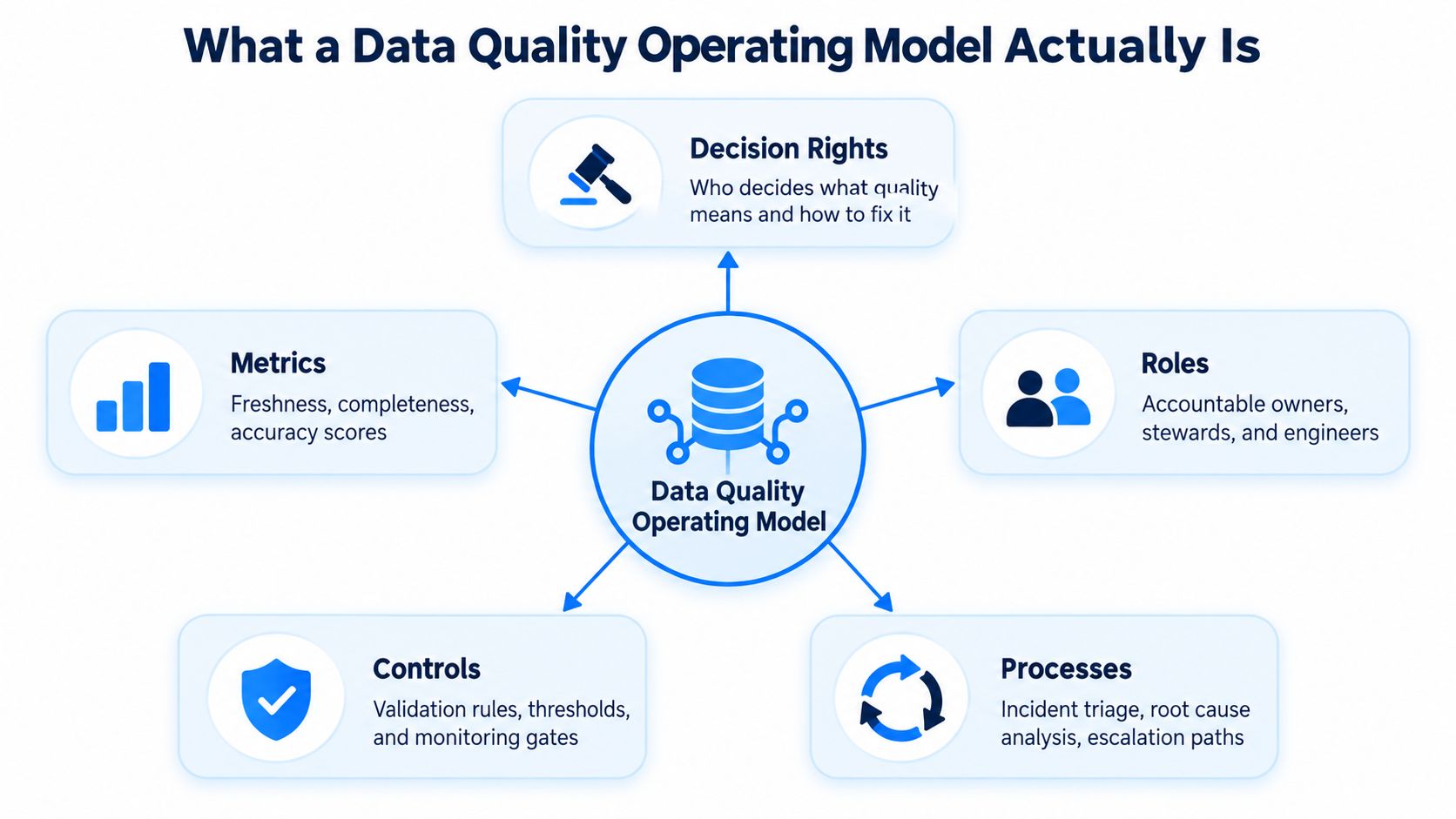
The five components that make it operational
Ownership and accountability identify the business owner, data steward, producer, platform team, and incident responder for each critical data product or element. The accountable owner approves what “fit for use” means. The steward manages definitions and exceptions. Engineers implement and operate the controls.
Standards and rules translate business expectations into measurable requirements. These may cover completeness, validity, uniqueness, referential integrity, accuracy, timeliness, and structural stability. Each rule needs an owner and a documented response when it fails.
Detection and controls combine validation with observability. Validation checks whether values meet explicit business or structural criteria. Observability watches for unexpected behavior such as volume shifts, freshness gaps, distribution changes, and schema evolution.
Issue management workflow defines triage, severity, quarantine, root-cause analysis, escalation, remediation, and closure. A detected anomaly isn't a completed control. The workflow must record who adjudicated it and why.
Measurement and feedback tracks whether controls prevent business harm. Useful measures include rule performance, incident response, owner coverage, recurring defects, and rework. The metrics should feed planning and product reviews, not sit in a dashboard nobody uses.
A practical data quality management overview can help teams align terminology, but terminology isn't the deliverable. The deliverable is a working agreement that tells teams what happens when data fails.
The Four Operating Model Patterns and How to Choose
Enterprise practice usually settles into one of four patterns. The right choice depends less on organizational fashion than on risk, domain complexity, engineering capability, and the governance foundation already in place.
Pattern | Decision Rights | Accountability Location | Common Failure Mode |
|---|---|---|---|
Centralized team | A central data quality or CDO function defines standards and prioritizes remediation | Central quality team, with producers responsible for fixes | The center becomes a bottleneck and business teams wait for permission |
Federated domains | Domain teams define fitness criteria for the data they produce, within shared standards | Domain owners and stewards | Definitions and thresholds drift across domains |
Embedded engineers | Product or platform squads own checks as part of delivery and operations | Engineering and product teams | Business meaning gets underrepresented in technical tests |
Hybrid hub-and-spoke | A center of excellence provides standards, tooling, and enablement while domains own outcomes | Shared accountability between central and domain teams | The hub publishes guidance, but no one enforces adoption |
A centralized model works when regulatory interpretation must be consistent or domain engineering capacity is limited. It struggles when one team must understand every business context. A federated model puts decisions closer to the data, but it needs a strong common vocabulary, change control, and escalation mechanism. Embedded ownership makes quality part of delivery, although engineers shouldn't be left to infer the business definition of accuracy.
The hybrid pattern is often the most practical enterprise starting point. A central team owns the control framework, shared tooling, and reporting. Domain owners decide fitness for use, producers fix upstream causes, and platform teams operate common infrastructure. That is the operating logic behind federated data governance, where standards can remain consistent without forcing every decision into a central queue.
A decision aid for selecting the starting pattern
Regulated domains: Multiple regulated domains favor a central or hybrid model because approval, evidence, and escalation need consistent treatment.
Engineering maturity: Strong product squads can support embedded or federated ownership. Teams without reliable delivery practices need more central enablement.
Governance investment: Existing councils, catalogs, and stewardship routines make hybrid adoption easier. Little governance investment calls for a focused central pilot before federation.
Don't copy the model used by a larger company. Choose the smallest structure that gives every critical defect an owner, a response path, and a decision-maker with authority.
Maturity Levels and KPIs You Can Measure
A maturity label has value only when it changes daily decisions. “Advanced governance” means little if consumers still find defects first, owners are unclear, or engineers repeatedly repair the same upstream failure. Use a data quality maturity model to connect operating behavior with measurable outcomes.
Maturity Level | Observable Signals | Key KPIs |
|---|---|---|
Ad Hoc | Checks vary by team, ownership is informal, and users discover defects in reports | Named owners for critical assets, active control count |
Reactive | Incidents are recorded after failure, priorities are informal, and firefighting repeats | MTTD, MTTR, incident backlog |
Defined | Critical datasets have documented rules, owners, severity levels, and escalation paths | First-pass validation yield, critical assets with owners |
Measured | Quality metrics appear in operational reviews, and teams analyze recurring causes | MTTD and MTTR trends, recurring incident rate, rework hours |
Optimized | Controls affect releases, contracts, budgets, and improvement priorities | Cost of poor quality, exception age, control coverage, business KPI impact |
At the Ad Hoc level, avoid building a composite score. Start with an inventory and mark the assets that support revenue, risk management, regulatory reporting, or operational decisions. The first useful KPI may be simple: can someone with decision authority be reached when a critical control fails?
Reactive teams need response discipline. Mean time to detect and mean time to remediate, MTTD and MTTR, show whether monitoring and ownership are improving. Pair them with incident recurrence. A quick workaround does not demonstrate that the underlying defect was fixed.
At the Defined level, measure whether documented controls run consistently and whether critical assets have accountable owners. First-pass validation yield shows how often data clears validation without intervention. At the Measured level, recurring incident rate and rework hours expose the cost of weak root-cause management. Cost of poor quality connects those failures to capacity and budget discussions.
KPIs should support decisions, not decorate a dashboard. A control with high pass rates may still protect an unimportant field, while a lower pass rate on a decision-critical dataset may require immediate investment.
The mature program measures whether controls protect business decisions and whether teams learn from failure. EY's 2025 FP&A trends research reported that only 16% of organizations had good-quality data that was easy to analyze, while 25% described their data as poor or low quality (EY FP&A trends research). The practical implication is to connect DQ measures with how analysts use data and how accountable owners respond, rather than optimizing technical pass rates alone.
Integrating Observability, Validation, and Timeliness
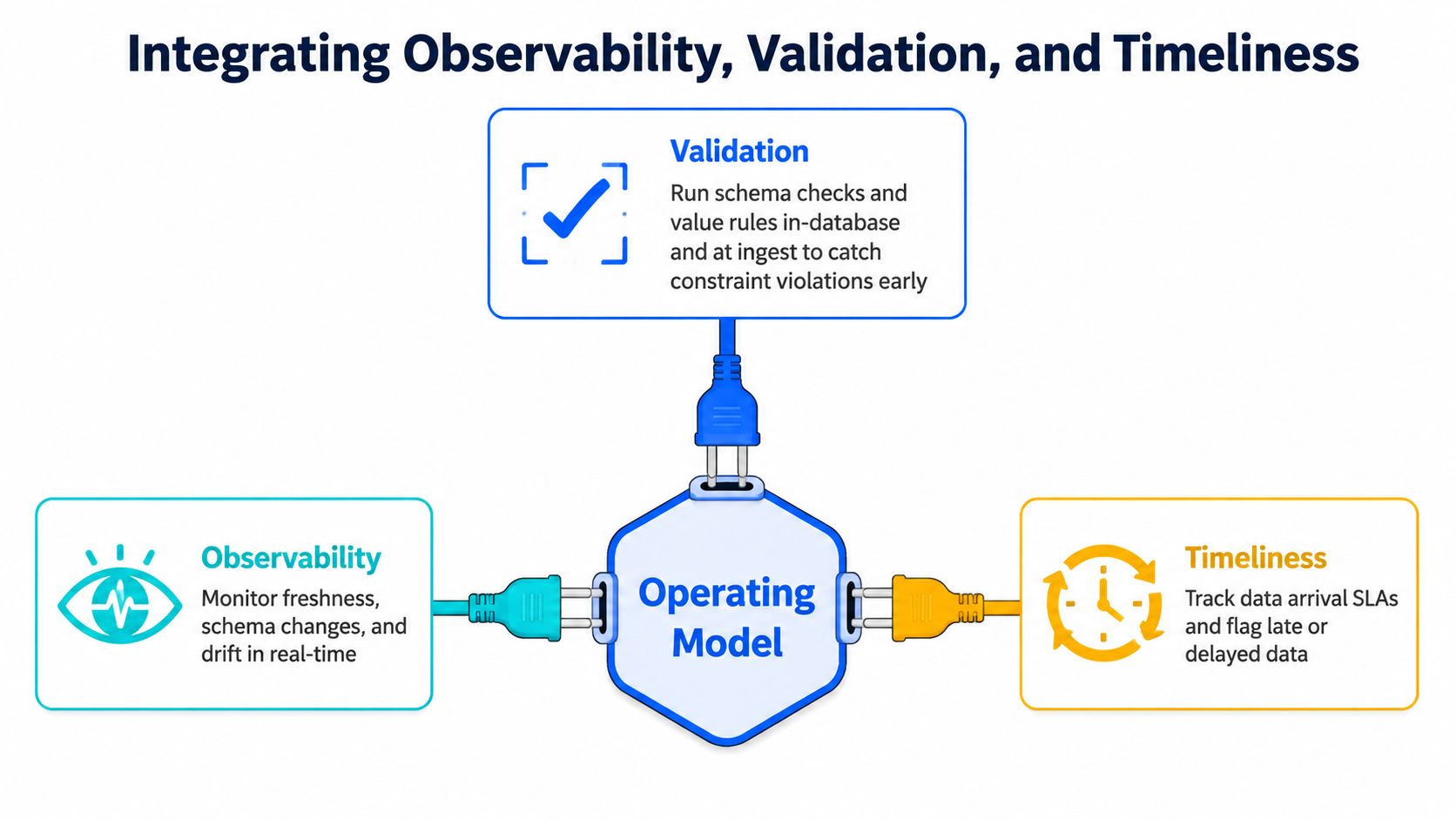
These controls should not become three parallel toolchains with three alert queues. They are complementary layers in one operating model, and each layer needs a clear owner, response severity, and hand-off.
Validation catches explicit violations
Validation checks whether a record or dataset meets a defined requirement. At the warehouse layer, a NOT NULL constraint on customer IDs and a referential integrity check against the customer dimension can catch invalid records at write time. The data producer owns the source correction, the steward owns the rule meaning, and the platform engineer owns reliable execution.
Use hard gates for failures that make downstream use unsafe. Use soft gates or quarantine paths when the business can tolerate controlled exceptions. The decision belongs to the accountable data owner, not to whichever engineer happens to receive the alert.
Observability catches behavior rules miss
Observability watches how data systems and datasets behave over time. It can identify unexpected volume, distribution, freshness, workload, and schema changes even when every row passes a static rule. A sudden transaction-volume anomaly may indicate a missing source partition, a duplicate load, or a business event that requires investigation.
The response must connect the signal to context. Metadata should identify affected data products, downstream reports, and the producer responsible for the upstream process. Without that context, an observability platform can produce alerts without improving decisions. The central enablement team can maintain the monitoring pattern, while the domain owner adjudicates whether the change is an incident.
Timeliness deserves its own control
Timeliness asks whether values still correspond to the current state of the real-world objects they represent. Operational teams commonly measure it through latency from creation to availability, so instrument event_time, processed_time, and available_time to distinguish capture, processing, and availability delays (research on timeliness in data quality).
A freshness threshold should become an enforceable service-level objective for the data product. Automated age checks can flag records that exceed the accepted aging limit, turning overdue data into an incident rather than a passive dashboard note (timeliness monitoring guidance). The owner then decides whether to block consumption, publish a warning, or activate a fallback.
Validation asks, “Is this value acceptable?” Observability asks, “Is behavior unusual?” Timeliness asks, “Did the data arrive while it was still useful?” The operating model assigns each answer to a person and a response path. Teams evaluating data observability should therefore assess workflow and ownership alongside detection capability.
Implementation Roadmap From Pilot to Enterprise Scale
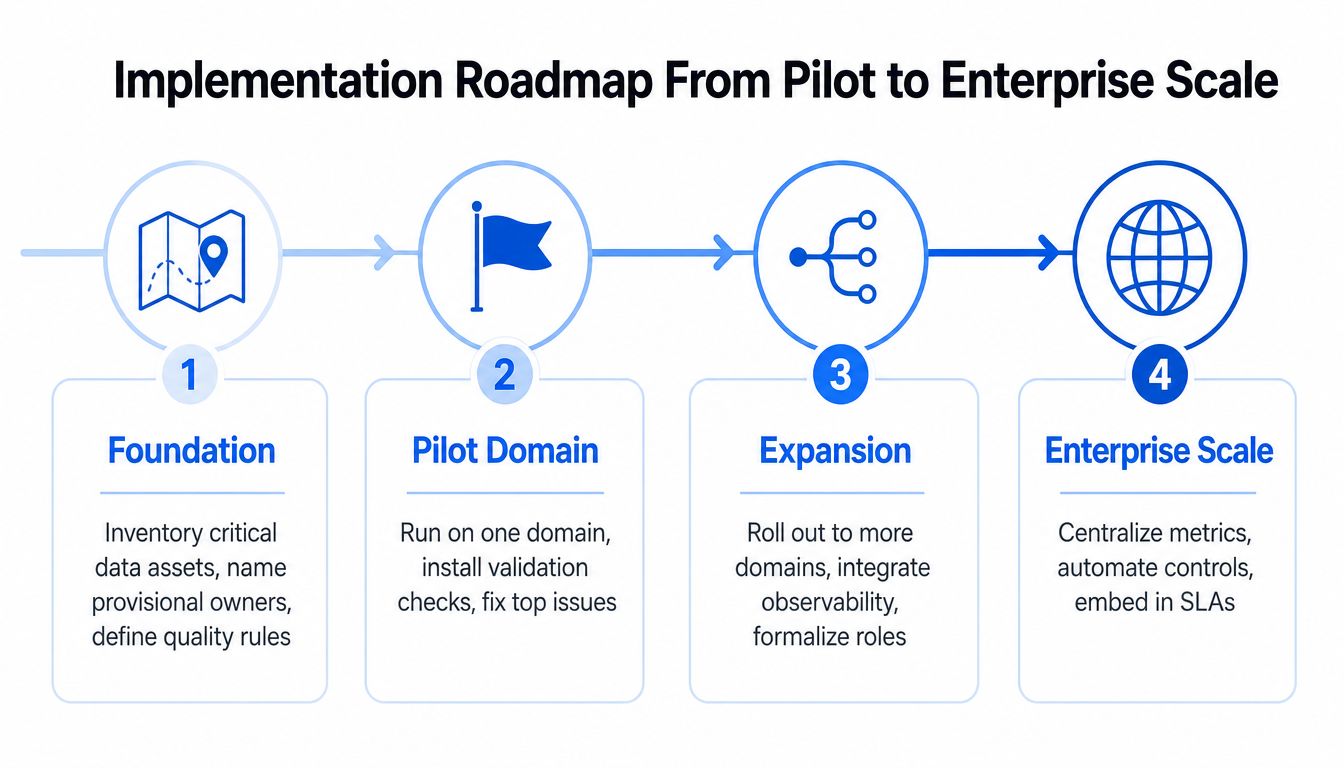
A reliable rollout starts with a narrow business risk and expands only after the ownership loop works. Broad inventories and large rule libraries look productive, but they often create unowned findings that weaken confidence in the program.
Foundation
Inventory critical data assets and map the consumers, producers, owners, and known failure modes. Name provisional business owners and stewards, define one severity taxonomy, and publish one incident workflow covering detection, triage, quarantine, escalation, remediation, and closure.
The governance lead owns the operating design. A platform lead owns the execution path, while domain leaders confirm which assets matter. The exit condition is practical: every selected critical asset has a provisional owner and every incident has a documented route.
Pilot Domain
Choose one high-value domain such as revenue or customer 360. Define the first data contracts, implement focused validation and timeliness controls, and connect one observability signal to the on-call process. The domain owner adjudicates failures, the producer fixes source logic, and the platform team maintains the control runtime.
The pilot is complete when the team can demonstrate detection, assignment, root-cause analysis, remediation, and closure on the same operating path. Don't judge the pilot by the number of rules shipped. Judge it by whether accountability survives a real failure.
Expansion
Replicate the pattern across several domains, introduce a DQ council, and standardize the minimum control and metadata requirements. The council should resolve cross-domain disputes, approve shared definitions, and review recurring defects. Domain teams still own their data outcomes.
Useful exit criteria include MTTD under 24 hours and 80% of critical assets with documented owners. Those targets must be treated as local operating objectives, not universal benchmarks. If teams can't meet them, inspect the hand-offs and escalation authority before adding more automation.
Enterprise Scale
Embed DQ measures in data product scorecards, release reviews, service-level agreements, and budget conversations. Track cost of poor quality through rework hours, recurring remediation, and delayed decisions. The central function becomes an enablement and assurance layer, while domains retain accountability for the data they produce.
Continuous improvement means retiring ineffective rules, adjusting thresholds when use cases change, and reviewing whether controls prevent business harm. Enterprise scale isn't a larger dashboard. It's a repeatable system that makes quality decisions visible in everyday delivery.
Industry-Specific Considerations Across Regulated Sectors
The operating model's spine stays stable across regulated sectors, but the decision rights and evidence requirements change. Finance needs lineage proof for BCBS 239 and SOX-relevant reports, with ownership assigned close to the ledger rather than only to a broad dataset. Healthcare needs clinical safety stewards who can halt a pipeline when reference data changes, while completeness and accuracy controls connect to HIPAA breach risk.
Telecom teams should connect CDR quality to revenue assurance. Network operations belongs in the DQ council because dropped or malformed records can affect billing and service analysis. Public-sector teams need controls for citizen-facing data, where timeliness and accessibility support FOIA obligations and equity commitments.
For organizations working across clinical research, regulatory, and commercial functions, directories of biotech executive leaders can provide useful context about the stakeholders who may need representation in quality decisions. The point isn't to create four separate governance programs. It's to preserve one accountability mechanism while adapting the evidence, owners, and escalation thresholds to each risk environment.
Industry | Ownership Emphasis | Primary KPI Driver | Unique Control Layer |
|---|---|---|---|
Finance | Ledger and report owners | Lineage completeness and reporting fitness | BCBS 239 and SOX evidence |
Healthcare | Clinical safety and data stewards | Completeness, accuracy, and patient-use reliability | Safety-oriented pipeline intervention |
Telecom | Network operations and revenue assurance | Record integrity and billing reliability | CDR validation and reconciliation |
Public sector | Program, accessibility, and records owners | Timeliness, accessibility, and public-service reliability | FOIA and equity-sensitive controls |
A centralized policy can support all four sectors, but local owners must retain authority over what constitutes an unacceptable failure. That balance is what makes the model modular without making it vague.
Common Misconceptions and Your Next-Week Checklist
A software purchase doesn't create an operating model. A platform can detect anomalies or run validation, but people still need to define ownership, approve thresholds, resolve exceptions, and escalate failures.
Data stewards also can't repair every upstream defect. If a steward lacks authority to change a source system, assigning the incident to that person only hides the accountability gap. The producer must own corrective action, while the steward maintains meaning and the governance forum resolves conflicts.
Green dashboards don't prove that quality is finished. A dataset can pass its tested rules while an unmonitored source changes, a freshness commitment fails, or a business metric moves outside expected behavior. More rules can make this worse when they create noise, duplicate logic, or encourage teams to optimize pass rates instead of decision safety.
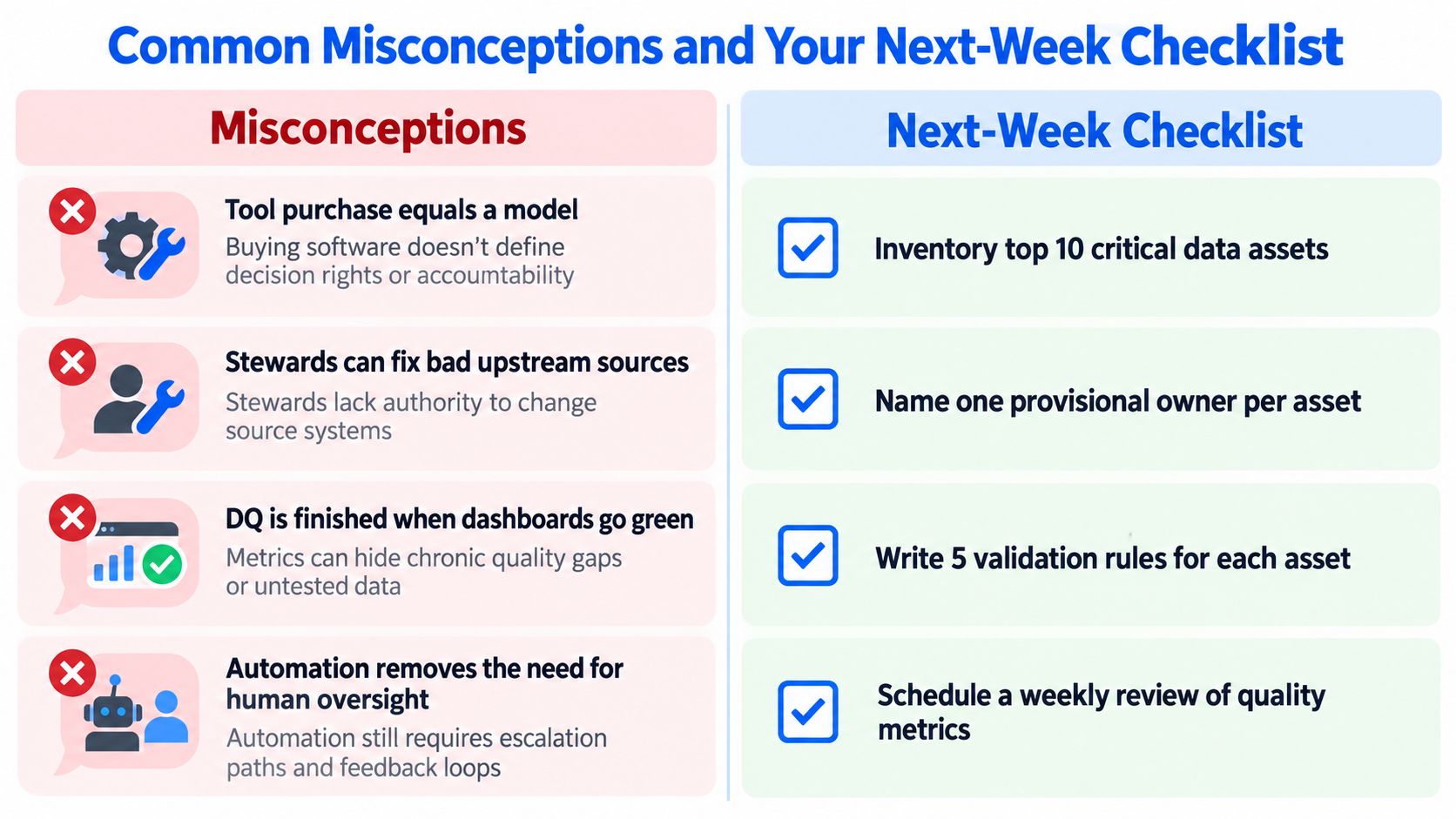
Five actions for next week
Name the owner: Confirm one accountable DQ owner for every critical data element or asset.
Document quarantine rights: Write down who can block, quarantine, or release data when a critical control fails.
Connect one signal to on-call: Wire one observability alert into an existing engineering or operations rotation.
Retire one unused rule: Remove a check nobody reviews or cannot explain, then record the decision.
Publish one freshness KPI: Put a timeliness measure in a leadership forum where someone can act on it.
A practical data governance operating model needs decision rights, roles, forums, routines, hand-offs, performance assessment, change control, and an implementation roadmap. Keep that standard in view when reviewing your checklist. If a task doesn't identify who decides and what happens next, it isn't an operating control yet.
digna helps data teams connect in-database validation, anomaly detection, timeliness monitoring, and schema-change tracking to a shared incident view inside their own environment. Visit digna to see how the platform can support a data quality operating model built around accountable owners, measurable controls, and actionable escalation.
See how digna does this in practice: data quality monitoring across your platforms.
Frequently asked questions
What is a data quality operating model?
A data quality operating model is the structure that turns quality from a series of projects into day-to-day operations. It defines who is accountable for which data, which controls run, how results are measured, and what happens when something breaks.
What are the components of a data quality operating model?
Five make it operational: ownership and accountability, defined controls across validation, observability and timeliness, KPIs that show whether quality is improving, the tooling that runs the controls, and the routines — triage, escalation, review — that keep it alive.
Should data quality be centralized or federated?
It depends on where accountability already sits. A central team works while the estate is small; a federated model suits organisations with strong domain ownership; most enterprises end up hybrid, with central standards and tooling and domain-owned execution.
Which KPIs measure data quality operations?
The useful ones are coverage of critical datasets, mean time to detect and mean time to resolve, incident frequency and recurrence, and the share of issues found by monitoring rather than reported by a business user.
How long does it take to implement a data quality operating model?
The practical sequence is foundation, pilot domain, expansion, then enterprise scale. A focused pilot usually produces measurable detection improvements within a quarter, and that evidence is what makes the expansion fundable.