10 Best Data Quality Monitoring Tools of 2026
|
6
min read

You already know the pattern. A dashboard breaks on Monday morning, the executive team asks whether revenue is down or the pipeline is late, and your team spends the next few hours proving whether the problem is in the data, the transformation logic, or the reporting layer. That's the moment organizations often start shopping for data quality monitoring tools.
The problem is that the category is crowded and uneven. Academic researchers identified 667 distinct software tools dedicated specifically to data quality and then narrowed that collection to a smaller set for deeper evaluation, noting that continuous monitoring has become a core enterprise requirement. In practice, that means feature lists alone don't help much. Plenty of products can profile a table or alert on a null spike. Far fewer can support continuous monitoring, business-rule validation, timeliness checks, and usable incident workflows without creating new operational drag.
The market is also moving fast. Mordor Intelligence projects the global data quality tools market will grow from USD 2.78 billion in 2025 to USD 7.39 billion by 2031, at a 17.7% CAGR. That growth is tied to a real shift in buyer expectations. Teams want automated anomaly detection, fewer brittle hand-written rules, and coverage across warehouses, lakes, and BI outputs.
This list focuses on practical trade-offs. Which tools are strongest for privacy-sensitive environments. Which ones fit modern cloud estates. Which ones are easier to roll out than they look. And where digna stands out if your organization can't accept unnecessary data movement.
Table of Contents
1. digna
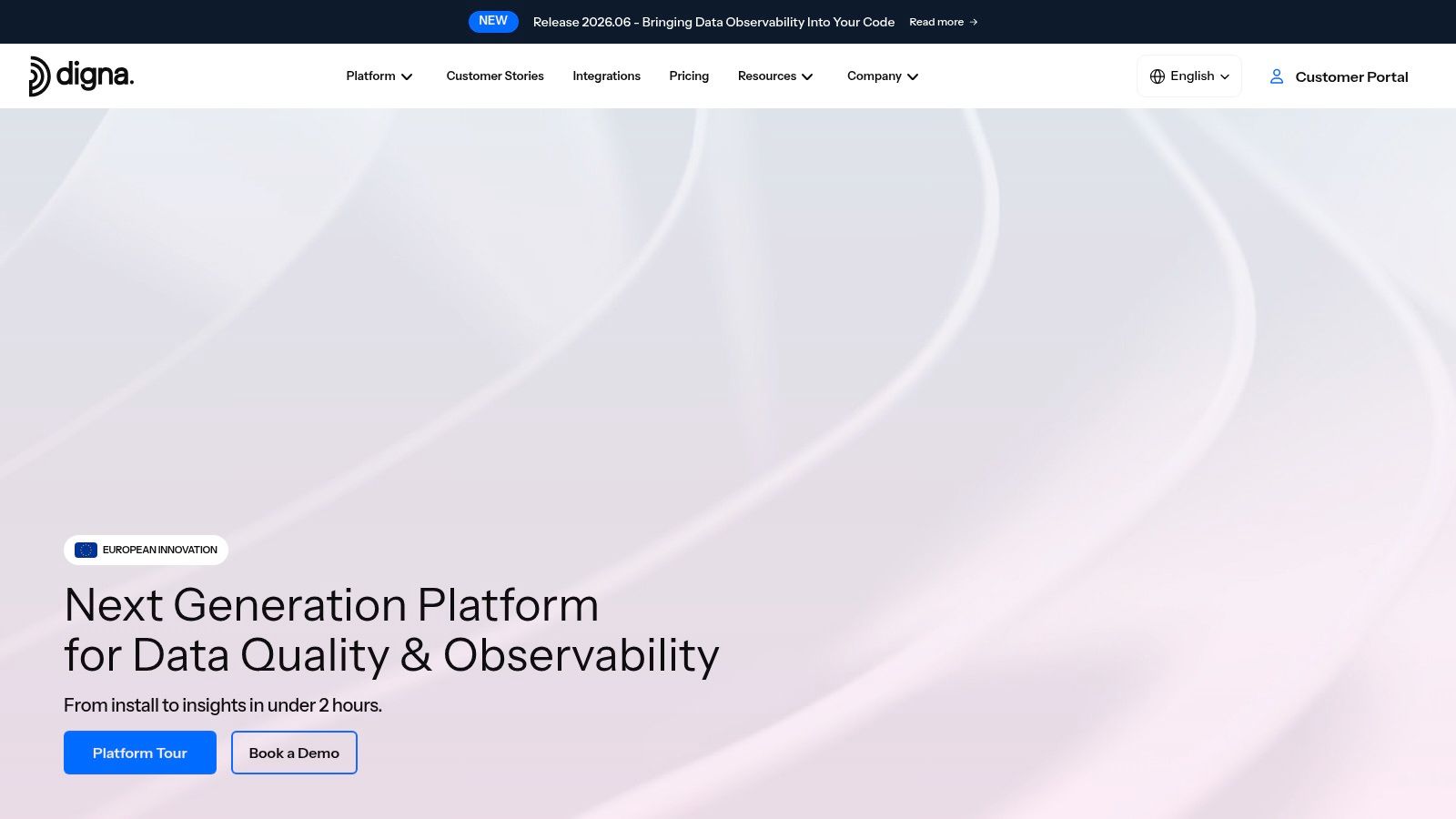
A common enterprise buying scenario looks like this. The data team wants automated anomaly detection across warehouse tables and pipelines. Security and legal then stop the evaluation once they realize the tool needs broad vendor-side access to production data. digna is one of the few products in this group that addresses that problem at the architecture level, because it runs analysis inside the customer's own warehouse, lake, private cloud, or on-prem environment.
That distinction is important because deployment model changes the actual cost of operating a data quality tool. Externalized monitoring can introduce data movement, extra review cycles, and security exceptions that slow procurement long before the platform reaches production. OvalEdge makes a similar point in its discussion of data quality monitoring tools, especially for regulated environments that cannot accept broad third-party access to live datasets.
Why digna stands out
digna combines data observability and data quality in one platform. The feature set covers AI-based anomaly detection, statistical baselining, timeliness checks, trend analysis, record-level validation, and schema tracking. For enterprise teams trying to rationalize the stack, that is a practical design choice. It reduces the need to operate one product for alerts, another for rules, and a growing set of custom checks that nobody wants to maintain six months later.
Its monitoring model also fits how mature teams usually evolve. Early programs can get by with hand-built thresholds. At scale, static rules become expensive to tune and easy to ignore. Industry commentary on modern data quality tool categories increasingly separates ML-driven anomaly detection from classic rule engines for exactly that reason. digna follows that approach with automatic baseline learning rather than forcing every condition into manually authored logic.
One practical filter helps here.
Practical rule: If legal, security, or platform engineering will not approve sending production data to a vendor-operated service, remove those vendors from the shortlist before the proof of concept starts.
digna also appears designed for mixed audiences, not just data engineers. The interface is intended to support technical and business users, which matters in enterprises where stewardship, operations, and analytics teams all need to interpret the same incidents. For a closer product view, the clearest reference point is digna's overview of data quality monitoring in private environments.
Best fit and trade-offs
In a 10-tool evaluation, digna stands out most for privacy-conscious organizations. Financial services, healthcare, telecom, government, and large B2B companies with strict customer-data controls are the clearest fit. These teams often need one platform that can monitor timeliness, validate records, and stay within existing security boundaries.
The trade-offs are straightforward.
Primary advantage: In-environment execution keeps data resident in your stack, which can simplify compliance reviews and reduce data movement.
Operational strength: Timeliness and expected-arrival monitoring are useful in production, especially for catching late loads before stale dashboards trigger executive escalations.
Main limitation: Pricing is not public, so commercial evaluation starts with a sales process.
Implementation reality: AI-driven monitoring still needs baseline burn-in, alert review, and tuning during rollout.
For enterprise buyers using architecture as a hard selection criterion, digna deserves a serious look. It is not the default choice for every team. It is a strong fit when privacy, deployment control, and operational coverage all need to be decided together rather than as separate tool purchases.
2. Monte Carlo
A common enterprise scenario looks like this. The data team owns Snowflake, dbt, Airflow, and BI across dozens of domains, but no one can answer a simple question during an incident: where did the break start, what downstream assets are affected, and who needs to respond first? Monte Carlo is built for that operating model.
Monte Carlo is one of the most established vendors in data observability. Its appeal is breadth. It automates monitoring across freshness, volume, schema, lineage, and pipeline behavior, which makes it a serious option for companies that need one platform to watch a large portion of the stack instead of stitching together narrower tools.
That matters in this 10-tool comparison because Monte Carlo represents the classic enterprise observability buy. It is strongest when centralized visibility is the priority and the organization is willing to invest in platform operations to support it. That is a different buying posture from privacy-first products like digna, where deployment boundaries may drive the decision earlier than feature breadth.
Where Monte Carlo fits best
Monte Carlo fits best in cloud-first environments with a lot of upstream and downstream complexity. Large analytics engineering teams, centralized data platform groups, and companies with formal incident management processes usually get the most from it. Lineage is a major part of the value proposition, especially when the full cost of an issue is not the broken table itself, but the uncertainty it creates across dashboards, models, and business workflows.
The deployment options also matter. Agent-based and VPC patterns give security and infrastructure teams more room to work with than a purely external model. For some enterprises, that flexibility is enough. For others, especially those with stricter data residency or private-environment requirements, deployment architecture still becomes the deciding factor.
The trade-off is operational weight.
Monte Carlo tends to make the most sense when the company already has enough scale, enough data producers, and enough incident volume to justify a dedicated observability layer. Smaller teams can buy a lot of coverage and still struggle to turn alerts into action if ownership is unclear or data contracts are weak. Broad monitoring does not fix weak operating discipline. It exposes it faster.
Cost is another real consideration. In large estates, coverage expands quickly across warehouses, orchestrators, transformation layers, and environments. That can be the right trade if the business impact of bad data is high and the team needs faster triage across many systems. If the program is still early and the main gaps are a handful of business-critical tests, Monte Carlo can feel heavier than necessary.
3. Anomalo
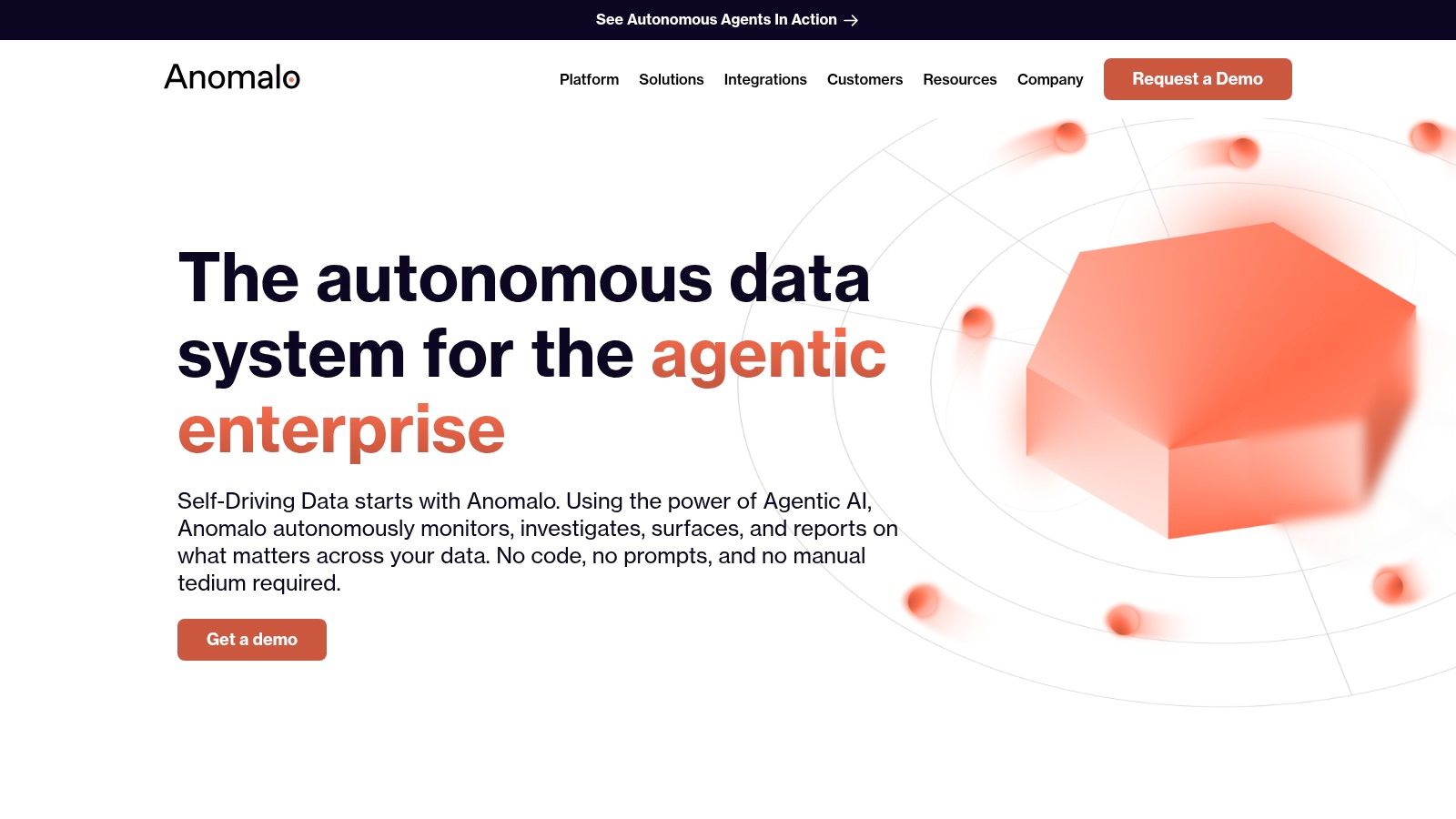
Anomalo is a practical option for teams that want machine learning-driven anomaly detection without giving up rule-based checks. That combination matters because pure anomaly detection can miss obvious business logic constraints, while pure rules create maintenance debt fast.
Its strongest appeal is speed to value. Anomalo is well suited to teams that want table-level and column-level monitoring up quickly, especially when they don't want to handcraft dozens of thresholds before seeing useful signals.
What Anomalo does well
The product's unsupervised approach lines up with how anomaly detection works best in data operations. Monte Carlo's explanation of anomaly detection methods notes that techniques like Z-Score and Interquartile Range are effective for identifying outliers and distribution anomalies when enough historical data exists to establish a baseline. In practice, that means tools like Anomalo work best when they can observe enough history to distinguish a real shift from normal volatility.
Anomalo also gives buyers deployment flexibility. SaaS works for teams that want speed, while in-VPC deployment is a better answer when data-residency concerns enter the discussion. Availability through AWS Marketplace can also make procurement easier in enterprises that prefer standardized cloud purchasing paths.
Here's the trade-off. Anomalo is attractive because it reduces manual rule authoring, but that convenience can create less control over scan behavior and cost in some configurations. Teams with very large estates should validate how monitoring scope is defined before rollout. Otherwise, a fast pilot can turn into a slower cost optimization exercise later.
Best for: Fast anomaly detection across modern cloud data assets.
Watch for: Cost governance and scan scope in larger deployments.
Strong complement: Catalog integrations that surface quality signals where users already browse data.
4. Bigeye

Bigeye tends to appeal to organizations that want enterprise observability with a security-conscious deployment story. The platform offers automated monitoring, lineage-aware triage, and deployment flexibility through agentless and agent-based approaches. That makes it easier to align with stricter internal security standards.
Bigeye also fits buyers that want a vendor with structured onboarding and professional services. Some teams dismiss that as enterprise fluff until they hit their first cross-domain rollout and realize the tool itself isn't the hard part. Process alignment is.
Why teams shortlist Bigeye
A lot of observability projects fail in the same place. The product detects issues, but nobody has clean ownership or enough context to assess blast radius. Bigeye's lineage-aware triage helps there because it gives platform teams a more direct path from detection to impact analysis.
Its security posture is also a practical plus for larger enterprises. If your procurement, security, and compliance groups need formal answers before approving a platform, Bigeye is easier to defend than tools that only present a lightweight startup-style deployment model.
Buyer warning: If your team is still early in data platform maturity, a heavyweight enterprise observability rollout can outpace your operating model.
The downside is fit. Bigeye is better for larger organizations with enough data complexity and enough budget to justify a broader observability program. Smaller teams can absolutely use it, but they may not capture enough value from the heavier enterprise machinery.
5. Soda
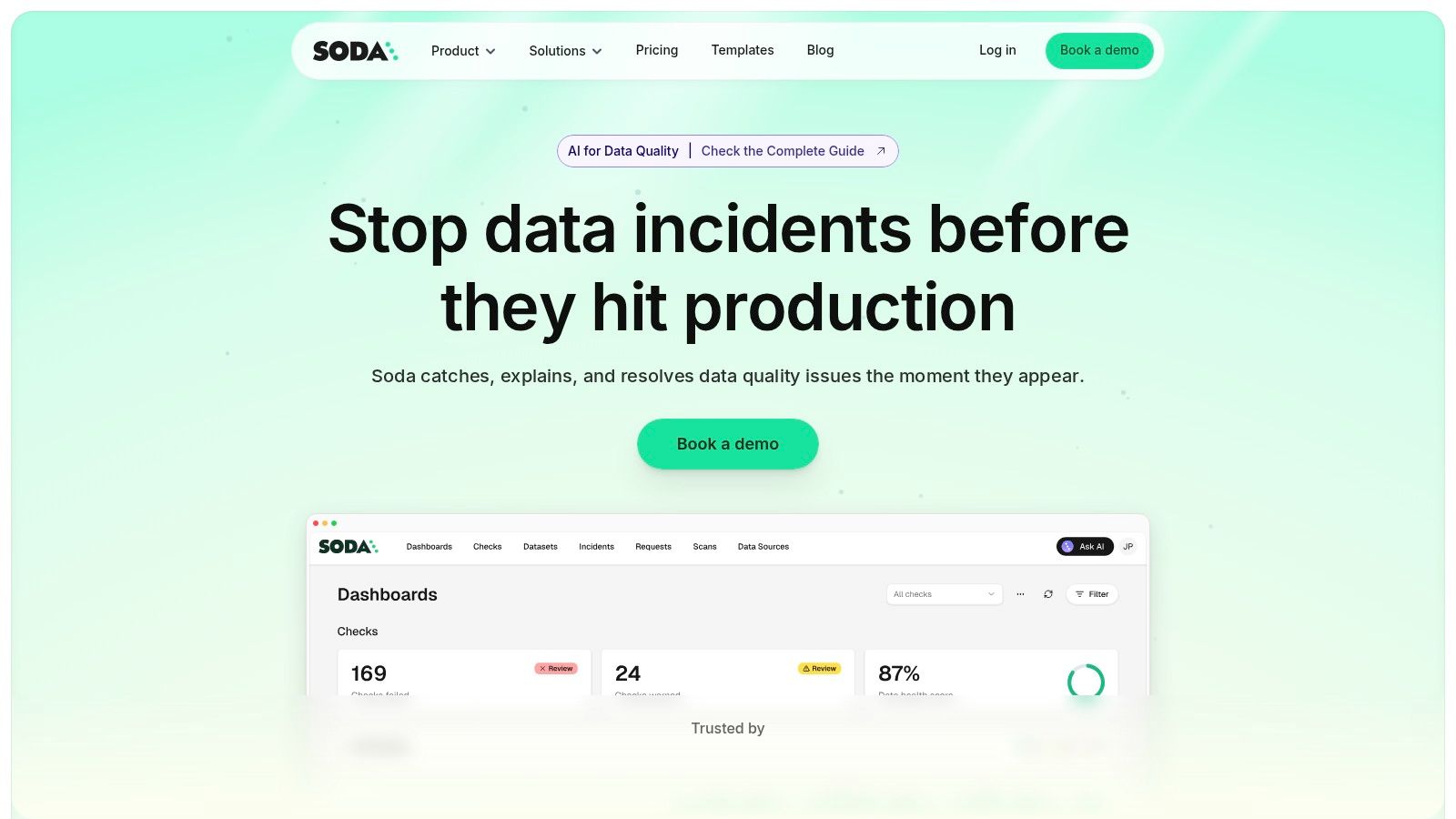
Soda sits in a useful middle ground. It isn't just a classic rule engine, and it isn't trying to be observability theater either. It combines rule-based checks, collaborative data contracts, and managed cloud workflows in a way that works well for modern data teams that still want direct control over quality logic.
That matters because a lot of enterprise data quality work still comes down to explicit business requirements. “This field can't be empty” and “this ID must be unique within this domain” don't need fancy anomaly detection. They need reliable execution and good workflows.
Where Soda works best
Soda is strongest when engineering and analytics teams share responsibility for quality. The platform supports no-code onboarding into Soda Cloud, but it also gives technical teams libraries and agents to run checks across the stack. That flexibility makes it easier to support both centralized governance and hands-on DataOps practices.
The product is especially attractive to teams that want data contracts as part of the same operating model. In practice, that can reduce friction between data producers and downstream consumers because expectations are made explicit earlier.
A few trade-offs come with that balance.
What works well: Rules, contracts, and observability-style monitoring can coexist without feeling bolted together.
What to validate early: Enterprise pricing and operating boundaries for larger deployments.
Who gets the most value: Teams that want collaboration between data engineers, analytics engineers, and governance stakeholders.
Soda is often a better fit than buyers expect when they've outgrown basic tests but don't want the full cost and complexity of the biggest observability suites.
6. Acceldata
Acceldata is less narrowly framed as a pure data quality tool and more as an operational reliability platform for data systems. That distinction matters. Some platform teams don't need another point product for null checks. They need one place to understand reliability, performance, and cost across hybrid and multi-cloud environments.
If that sounds like your world, Acceldata is worth serious attention.
Operational strengths
Acceldata's real appeal is that it speaks the language of platform engineering. It doesn't just ask whether data looks wrong. It asks whether pipelines are healthy, whether infrastructure decisions are affecting reliability, and whether data operations are creating avoidable spend.
That makes it attractive for centralized platform teams supporting multiple business units. In those environments, quality incidents often sit alongside runtime issues, orchestration failures, and warehouse cost concerns. A tool that can connect those threads is usually more useful than a narrower validator.
The trade-off is scope. Smaller teams can find Acceldata broader than they need, and sales-led packaging means you'll need a real buying process rather than a quick self-serve trial mindset.
Some organizations need quality tooling. Others need an operating layer for the data platform. Acceldata makes more sense in the second case.
If your leadership team asks platform engineering to own reliability and spend at the same time, this product aligns with that mandate better than many category peers.
7. Metaplane
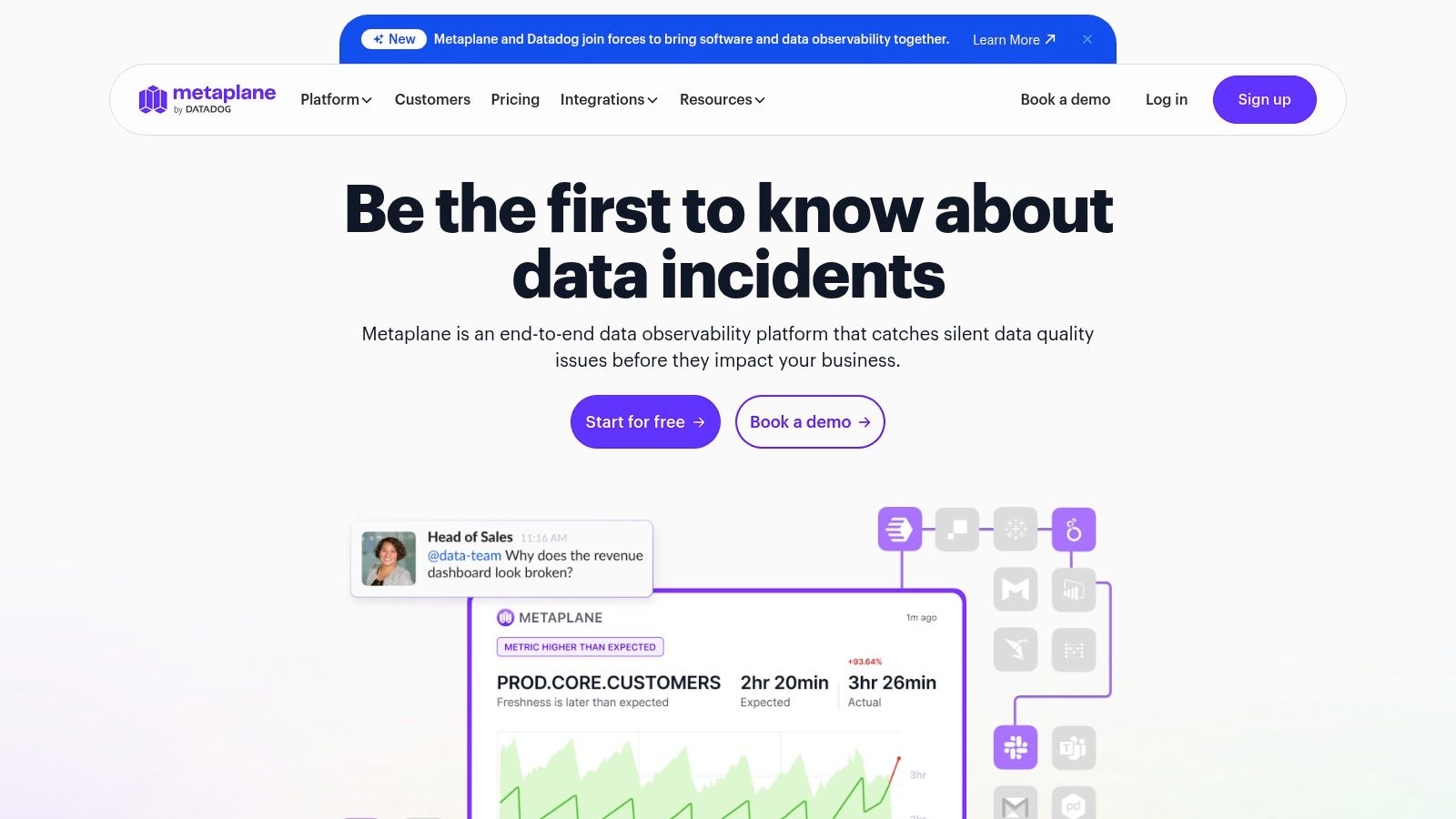
Metaplane is one of the easier platforms to recommend to lean teams and mid-market organizations. It monitors freshness, volume, and schema changes across modern warehouses, and its pricing model is more approachable than many enterprise-first competitors.
That doesn't make it small. It makes it focused.
Why smaller teams like it
Metaplane's strength is clarity. Teams can understand what they're buying, how monitors are applied, and how pricing scales. That matters when your company isn't ready for a long enterprise procurement cycle and doesn't want to discover six months later that observability has become a budget debate.
The platform also tends to be easier to roll out in common warehouse-centric stacks. If your world is centered on modern cloud analytics rather than extensively federated enterprise data environments, that simplicity is a feature, not a limitation.
There is a ceiling, though. Very large estates with complex governance, broad lineage demands, and multiple deployment constraints may outgrow Metaplane's lighter shape. For those organizations, a heavier platform may provide better organizational fit even if the initial setup is slower.
Strongest fit: Lean platform and analytics teams that want predictable pricing.
Main advantage: Fast setup and clear UX.
Main limitation: Less feature depth for very large enterprise environments.
8. Collibra Data Quality & Observability
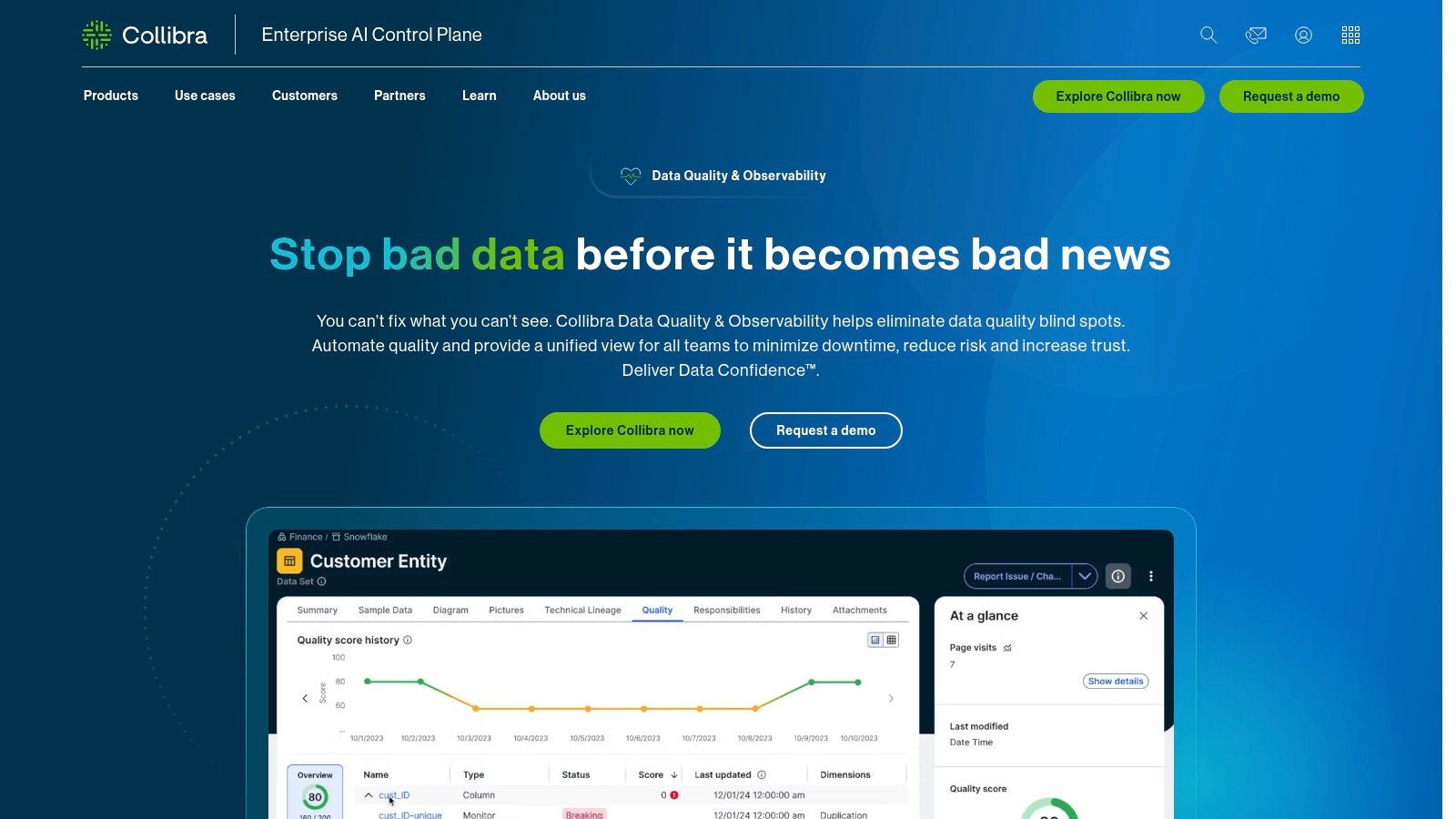
Collibra Data Quality & Observability is usually the right answer when governance, stewardship, and policy alignment drive the buying decision more than engineering convenience. If your organization already runs Collibra as a catalog and governance backbone, extending into quality and observability is a logical move.
That's the core reason to choose it. Not because it's the lightest or fastest product, but because it can connect quality signals to governed assets, ownership models, and policy structures already in place.
Best for governance-heavy environments
There's a practical distinction between data observability and data quality that buyers often blur. Observability helps teams understand system behavior and incident impact. Data quality focuses more directly on whether the data is accurate, complete, timely, and fit for use. If your team needs a sharper way to think about that boundary, this explainer on data observability vs data quality lays it out well.
Collibra is strongest when that distinction needs to be operationalized across governance programs. Rule reuse, policy linkage, and support for cloud, Kubernetes, and on-prem deployment patterns make it viable in large enterprises with formal data management structures.
The trade-offs are familiar. Implementation can be heavier, administrative overhead can be higher, and pricing is sales-led. But in organizations where governance isn't optional, those aren't necessarily disqualifiers. They're often the cost of fitting into a broader control framework.
9. Google Cloud Dataplex Knowledge Catalog Data Quality
Google Cloud Dataplex is the native choice for teams that are already committed to BigQuery and the broader Google Cloud stack. It provides profiling, rule definition, reusable data quality rules, automated scans, and alerting inside a managed GCP model.
For the right buyer, native usually wins. Fewer moving parts, fewer connectors to defend, and fewer separate platforms to manage.
Strong choice for GCP-native teams
Dataplex is compelling because it turns data quality into a platform service rather than an additional vendor relationship. Reusable rules in the Knowledge Catalog help standardize checks across teams, which is especially useful when multiple domains are building analytics on top of shared cloud infrastructure.
The trade-off is equally clear. If your stack isn't centered on GCP, the product's advantages shrink quickly. And even for BigQuery-centric teams, usage-based pricing means you need discipline around scan frequency, rule complexity, and data volume. Native doesn't automatically mean cheap.
One more practical point. Dataplex is better for organizations that prefer rule-driven quality management than for those seeking a broad, cross-platform observability layer. It can absolutely support serious quality operations, but it's most natural inside a GCP-first operating model.
10. IBM Databand
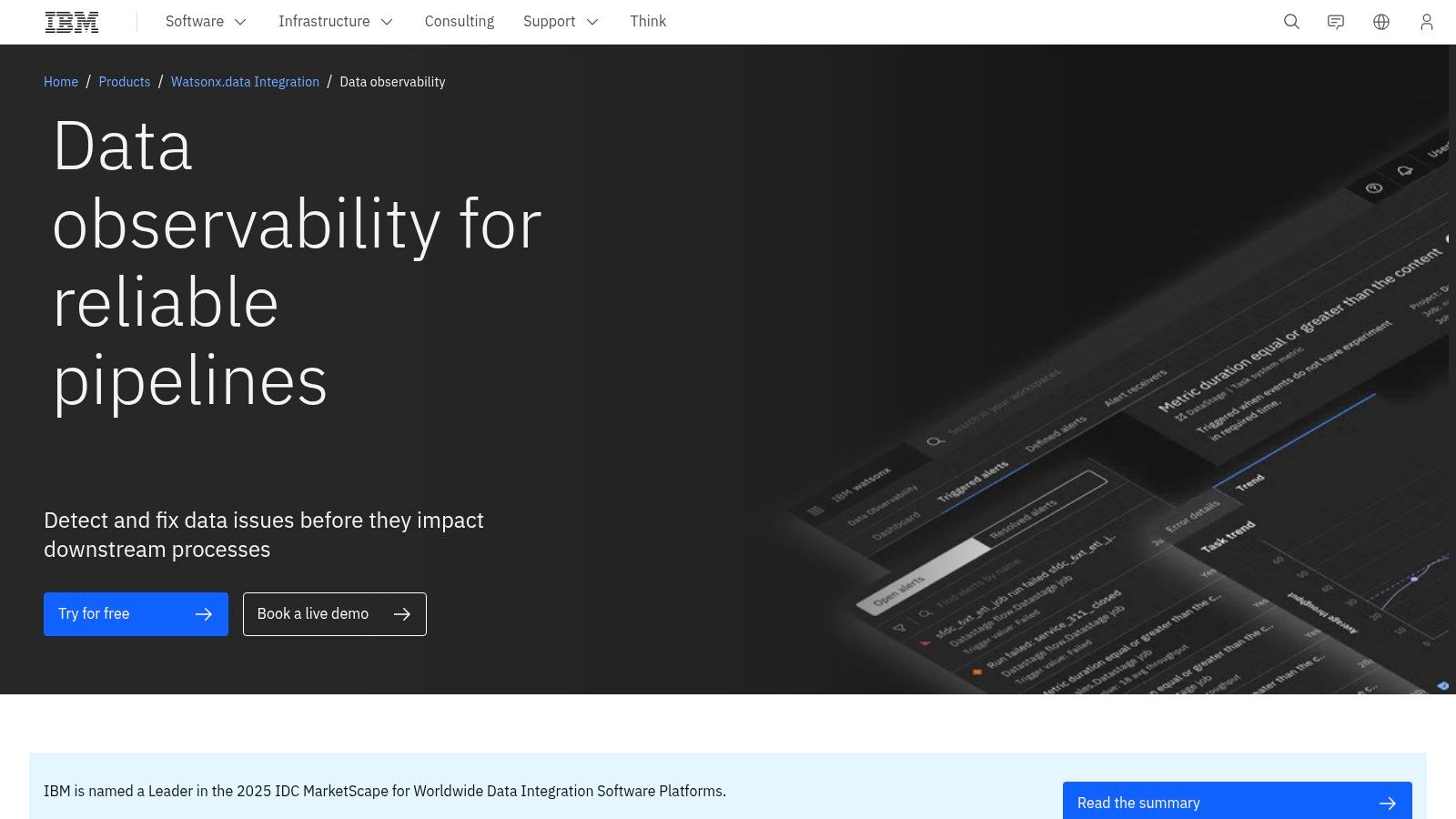
IBM Databand is the tool on this list that most clearly starts from pipeline reliability and SLA management rather than broad warehouse-centric quality coverage. That's useful because many data incidents are really timeliness incidents. The data isn't wrong. It's late, missing, or partially processed.
If your biggest pain is failed jobs, delayed refreshes, and missed delivery expectations, Databand is built for that problem.
Best when pipeline SLAs drive the buying decision
Databand uses self-learning baselines, anomaly detection, dashboards, and SLA tracking to surface risk before an SLA is missed. That aligns with how AI-powered anomaly detection is increasingly described across operational monitoring categories. Plixer's overview explains that AI-powered anomaly detection systems learn normal behavior from raw data and evaluate real-time data against learned baselines rather than relying on static thresholds. That same pattern is useful for pipeline health because timing drift often shows up before a hard failure does.
The strength here is focus. Databand can complement warehouse-level data quality tooling by protecting the delivery layer and helping operations teams triage issues early.
The limitations are also straightforward. If you need deep business-rule validation, catalog-centric workflows, or broad quality management across many domains, Databand won't replace every other category tool. It's strongest as a reliability and timeliness layer for pipeline-heavy environments.
Top 10 Data Quality Monitoring Tools Comparison
Platform | Core capabilities | UX & reliability ★ | Pricing/value 💰 | Target audience 👥 | Distinctive strengths ✨ |
|---|---|---|---|---|---|
digna 🏆 | AI anomaly detection, record‑level validation, timeliness, schema tracker, in‑database analytics | ★★★★★, unified UI; fast install (≤2h) | 💰 Sales-led (contact), enterprise ROI | 👥 Regulated enterprises & data/analytics teams | ✨ In‑database execution; baseline learning; production data never leaves customer env. |
Monte Carlo | Freshness, volume, schema, lineage; agent/VPC deployment | ★★★★☆, broad adoption & analyst recognition | 💰 Enterprise, sales-led; higher TCO possible | 👥 Large, complex data estates | ✨ Strong lineage, wide ecosystem presence |
Anomalo | Unsupervised ML anomalies + rule checks; in‑VPC; catalog integrations | ★★★★☆, fast time‑to‑value | 💰 SaaS & in‑VPC; AWS Marketplace procurement | 👥 Teams needing quick anomaly coverage | ✨ Unsupervised ML + rule checks; marketplace procurement |
Bigeye | Automated monitors, lineage-aware triage, agent/agentless, enterprise security | ★★★★☆, mature onboarding & services | 💰 Sales-led; enterprise pricing | 👥 Large, data‑mature organizations | ✨ Blast‑radius triage; SOC2/ISO compliance |
Soda | Observability + data contracts, rule checks, Cloud + agents | ★★★★☆, collaborative UX; docs & integrations | 💰 Public entry price; enterprise plans via sales | 👥 Teams balancing rules, contracts & observability | ✨ Data contracts + ticketing/catalog integrations |
Acceldata | Reliability, pipeline health, cost governance across hybrid/multi‑cloud | ★★★★☆, platform‑centric dashboards | 💰 Sales-led; marketplace SKUs for enterprises | 👥 Platform & ops teams managing cost/reliability | ✨ Combined reliability + cost governance focus |
Metaplane | Freshness, volume, schema monitoring; table‑based pricing | ★★★★☆, lightweight, clear UX; fast setup | 💰 Usage/table‑based, predictable | 👥 Lean & mid‑market analytics teams | ✨ Predictable pricing; fast onboarding for warehouses |
Collibra Data Quality & Observability | Automated anomaly detection, rule reuse, governance linkage | ★★★☆☆, governance‑centric; higher admin overhead | 💰 Sales-led; enterprise licensing | 👥 Organizations using Collibra catalog/governance | ✨ Tight integration with governance & policies |
Google Cloud Dataplex (Knowledge Catalog) Data Quality | Profiling, reusable rules, automated scans tied to Knowledge Catalog | ★★★★☆, fully managed native GCP experience | 💰 Usage-based (scan volume), costs scale with scans | 👥 BigQuery / GCP-centric teams | ✨ Native GCP integration; centralized DQ rules |
IBM Databand | Baselining, anomaly detection, SLA tracking, pipeline triage | ★★★☆☆, powerful but UI can be dense | 💰 Tiered SaaS / marketplace options, confirm with IBM | 👥 Pipeline/platform & enterprise teams | ✨ SLA-focused pipeline observability; tiered self‑service options |
Final Thoughts
Teams often don't need “the best” data quality monitoring tool. They need the tool that matches their operating model. That sounds obvious, but it's where many evaluations go wrong. Buyers compare feature grids, not deployment realities. They ask whether a vendor can monitor schema drift, freshness, and anomalies, but they don't ask where computation happens, who owns incidents, or whether the platform fits their compliance boundaries.
That last point matters more now than it used to. The category is expanding quickly, and buyers are clearly rewarding automation. Coherent Market Insights projects the global data quality tools market will grow from USD 3.50 billion in 2026 to USD 10.80 billion by 2033 at a 17.5% CAGR. Growth is being pushed by AI-powered automation for anomaly detection and predictive cleansing. In plain terms, teams no longer want to hand-maintain endless rules if a system can learn normal behavior and flag meaningful drift automatically.
But automation alone isn't enough. The academic survey cited earlier is useful because it highlights what mature enterprise buyers should test. Continuous monitoring, profiling, measurement, storage of results, and visualization over time are not nice extras. They're the baseline for running data quality as an operational discipline rather than a cleanup project. What still separates tools is whether they support end-to-end workflows cleanly enough for real production use.
That's why these ten products land in different lanes:
Choose digna when privacy, private deployment, in-database execution, timeliness monitoring, and unified observability plus data quality matter most.
Choose Monte Carlo or Bigeye when broad enterprise observability coverage and lineage-aware troubleshooting are the main drivers.
Choose Anomalo when you want fast ML-driven anomaly detection with the option to keep some rule-based controls.
Choose Soda when your team wants collaborative quality checks, contracts, and developer-friendly workflows.
Choose Acceldata when platform reliability and cost governance sit alongside quality concerns.
Choose Metaplane when a lean team needs straightforward monitoring and predictable pricing.
Choose Collibra when governance structure and policy alignment dominate the buying process.
Choose Dataplex when your stack is firmly GCP-native and you want managed rule execution inside that environment.
Choose IBM Databand when pipeline SLAs and timeliness are the central operational risk.
If I were advising an enterprise with strict privacy requirements, mixed technical and business stakeholders, and a mandate to reduce tool sprawl, digna would be the most distinctive option on this list. Not because every team needs private in-database execution, but because the teams that do usually discover very quickly that most vendors weren't built around that constraint.
For everyone else, the decision comes down to one question. Do you need a monitoring tool, an observability layer, a governance extension, or a platform reliability system? Once you answer that accurately, the shortlist gets much smaller.
If your team needs data quality monitoring without exposing production data to a vendor-managed environment, digna is worth a closer look. It combines anomaly detection, record-level validation, timeliness monitoring, trend analysis, and schema tracking in a private, in-database platform built for enterprise environments. Book a demo to see whether its approach fits your warehouse, lake, and compliance requirements.
See how digna does this in practice: data quality monitoring where your data lives.
Monitoring volumes and freshness will not tell you when rows stop matching their parents. For that, add checks for referential integrity on the joins your reports depend on.
Frequently asked questions
What does a data quality monitoring tool do?
It watches the data itself rather than the systems around it: volumes, distributions, null rates, freshness and schema changes, alerting when a dataset stops behaving the way it normally does.
What should you compare when choosing a data quality tool?
Detection method (static rules versus learned baselines), where computation happens and whether data leaves your environment, coverage across your platforms, alert noise, and the effort needed to onboard each new dataset.
What is the difference between data quality monitoring and data observability?
Data quality monitoring focuses on whether the data is correct and complete. Observability is broader and includes pipeline and system health. In practice most teams need both, because a pipeline can be healthy while the data it delivers is wrong.
Do data quality tools need to copy my data?
Not necessarily. Some platforms, digna included, calculate metrics inside your own environment and keep only the resulting metrics and metadata, which matters when data residency or privacy rules apply.
How much rule writing does a data quality tool require?
It depends on the approach. Rule-based tools require an explicit rule per expectation, which does not scale past a few hundred datasets. Tools that learn each dataset's normal behaviour cover the unknown cases without a rule being written first.