Data Quality Compliance: A 2026 Audit Guide
|
7
min read

Poor data quality costs organizations an average of USD 12.9 million per year according to the benchmark cited in market research, and that's before anyone gets to the audit finding, the remediation ticket, or the report that no one trusts. In regulated environments, that cost stops being an efficiency problem and becomes a control problem, because the same weak records that slow analysts down also weaken regulatory, financial, and audit evidence.
I've seen the pattern repeat in warehouses and pipelines that looked fine on the surface. Reports matched last month's numbers, alerts were noisy but familiar, and then a compliance review exposed the core issue, no one could prove how the data had been validated, traced, or defended. That's the gap this guide focuses on, turning continuous data quality checks into audit evidence that stands up under scrutiny.
Table of Contents
Why Data Quality Compliance Is a Board-Level Issue
A weak data control stack creates board-level risk long before it becomes an audit finding. A widely cited benchmark puts the average cost of poor data quality at USD 12.9 million per year, and the same research estimates losses as high as USD 3.1 trillion annually for the U.S. economy market research summary. Those numbers matter because they show how quickly validation gaps become financial exposure, not just cleanup work for the data team.
The operational cost shows up in the control room first. When revenue reports depend on inconsistent datasets, when audit records are incomplete, or when teams cannot explain how a figure was produced, the issue stops being a tooling problem and becomes an ownership problem. The same research body links poor data quality to 31% of business revenue being negatively affected and says data teams can spend up to 80% of their time cleaning and preparing data instead of analyzing it market research summary. That is a direct hit to both oversight and execution.
Practical rule: if a dataset cannot be validated, traced, and defended, the dashboard is only cosmetic.
Measurement is the next fault line. One industry survey found that 59% of organizations do not measure data quality at all market research summary. In regulated sectors like financial services, healthcare, telecom, and public operations, that gap creates audit friction because unmeasured data cannot be consistently defended when someone asks for evidence.
For teams defining the baseline, what data compliance means in practice gives a useful starting point. Legal and operational owners also depend on governance and compliance procedures, because the actual failure is usually not one bad field. It is the absence of a control system that can prove how data was checked, corrected, and retained.
How Poor Data Quality Triggers Compliance Failures
Compliance failures rarely look like a clean system outage. They usually surface as inconsistent reports, a missed filing deadline, or an audit trail that cannot prove the numbers were checked. That is why they are hard to catch early. Teams often notice the problem only after someone asks how a figure was produced, long after the pipeline drift started.
The regulatory pressure is already real. The digital regulation overview notes that the EU Data Governance Act applies from 24 September 2023, and that businesses already providing data intermediary services on 23 June 2022 had until 24 September 2025 to comply with the relevant intermediary provisions. Governance is no longer an internal preference. It is being written into law, and weak data controls become legal exposure.
Where the failures usually start
The failure point is often operational, not technical. A control breaks at the handoff between source systems, a team uses inconsistent definitions, or manual validation gets treated as enough because the monthly review usually passes. In the same regulatory overview, one survey reported 58% of organizations saying poor data quality caused significant compliance issues, with 45% reporting poor or inconsistent data governance frameworks.
Data quality becomes a compliance problem when nobody can show the control operated at the right time, on the right data, with the right result.
The business impact follows the same pattern. the business impact of poor data quality shows how weak data moves beyond analytics and into operational decisions, where errors are harder to defend and harder to unwind. A separate market study cited in the same regulatory overview says 78% of large enterprises experienced significant data quality issues within the past 12 months, and 54% said those issues directly affected revenue, regulatory compliance, or operational efficiency. If the input data is unstable, the compliance evidence is unstable too.
From Periodic Audits to Continuous Compliance Controls
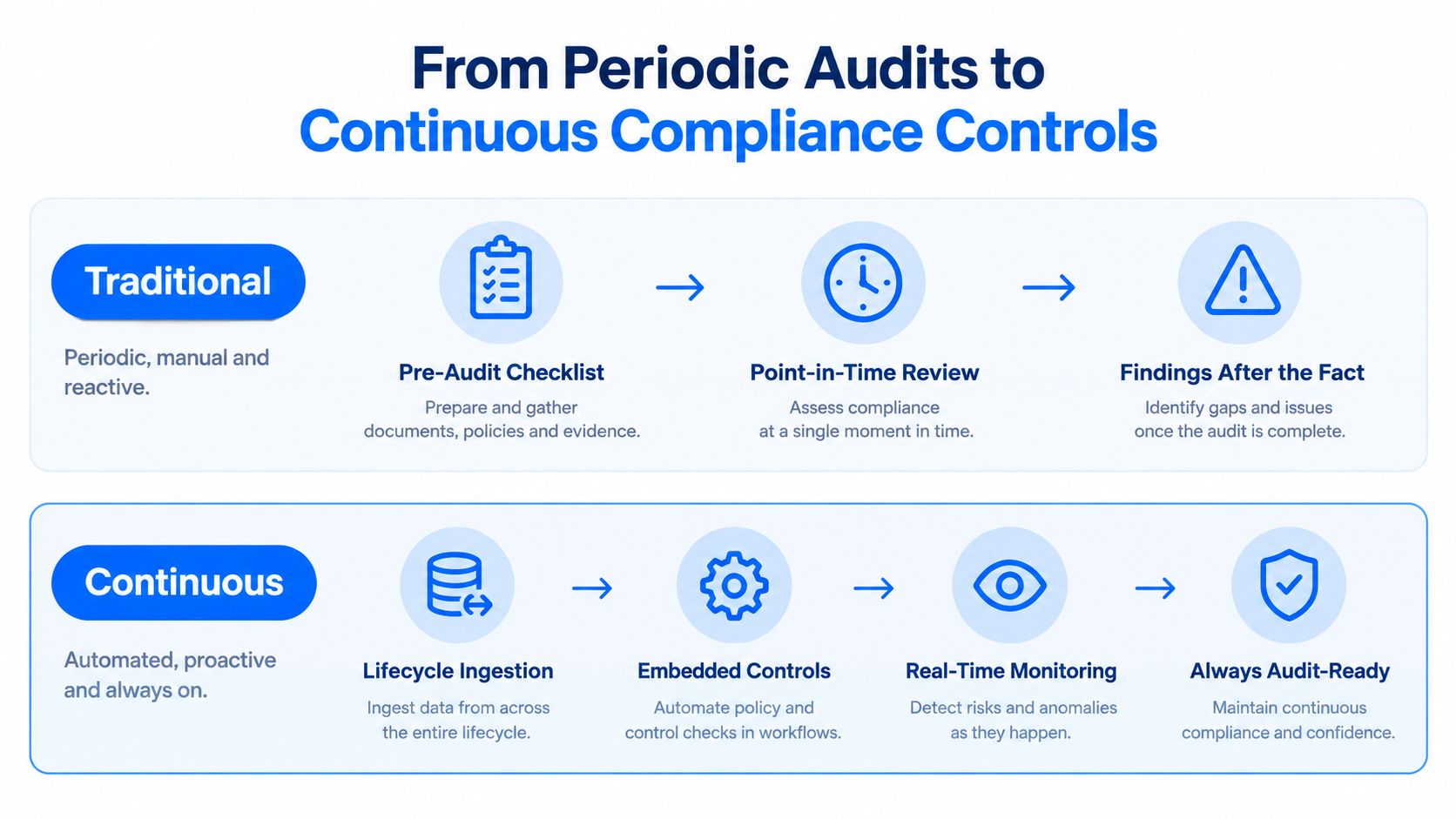
Periodic audits still matter, but they're too slow to be the only line of defense. By the time an audit finds a broken check, the bad data has already moved through ingestion, transformation, and reporting. That's why modern data quality compliance depends on continuous controls embedded into the lifecycle, not on a once-a-quarter review.

The shift sounds abstract until you map it to work your team already does. Continuous monitoring watches freshness, completeness, and structural changes as the data moves. Automated validation applies the same logic every time, which matters because auditors care less about whether a rule exists and more about whether it was enforced consistently. Lineage documentation closes the loop by showing where the data came from, how it changed, and what checks touched it.
What changes operationally
In a periodic model, governance is something you prepare for. In a continuous model, governance is something the platform produces every day. That difference reduces the gap between control design and control operation, because the evidence is generated as part of normal processing instead of reconstructed after the fact.
Practical rule: if a control only exists during audit prep, it's not a control, it's a memory aid.
The best part of this model is that it fits how regulated pipelines behave. Data arrives late, schemas drift, and source systems change without much warning. When the checks are embedded into the workflow, the team sees those failures early enough to fix them before they become reporting defects.
One useful implementation pattern is to route those checks into compliance reporting automatically, which is where compliance reporting automation becomes operationally relevant. It cuts the manual packaging that usually slows audit response down.
Mapping Data Quality Dimensions to Regulatory Standards
Compliance frameworks and data engineering teams often use different vocabularies for the same problem. A regulator asks whether the record is fit for use, while an engineer asks whether the column passed validation. The gap closes when you map quality dimensions to recognized standards instead of treating them as separate conversations.
The Canadian government's Data Quality Guidance defines nine dimensions, access, accuracy, coherence, completeness, consistency, interpretability, relevance, reliability, and timeliness Canadian government guidance. The Australian National Archives identifies ISO 8000-110:2021 as a global standard for data quality and enterprise master data, and it lists common dimensions such as accuracy, completeness, consistency, integrity, timeliness, uniqueness/deduplication, and validity Australian National Archives guidance.
What auditors can actually work with
These frameworks matter because they give teams a language that maps directly to controls. If a policy says customer data must be accurate and timely, the technical team can translate that into validation rules, latency checks, and reconciliation logic. If the policy says the data must be reliable, the evidence should show how and when it was tested.
The U.S. Administration for Community Living's Data Governance Primer says enterprise data should be tested periodically against defined quality standards and calls out data access, data definition, privacy policies, security standards, and data quality standards as governance topics ACL primer. The Government of New South Wales adds a useful operational detail, data quality management is a continuous process across the full data lifecycle, and agencies should define requirements tied to business needs, including standards for availability, metrics, and goals NSW data quality module.
That combination is the practical model. Standards define the dimensions, governance defines responsibility, and operations define how the evidence is produced.
For teams turning those categories into a working control map, dimensions of data quality is a helpful reference point. It's easiest to audit what you can name clearly.
Why Rule-Based Validation Falls Short for Modern Compliance
Rule-based validation still has a place, but it breaks down fast once pipelines get larger, faster, and more interdependent. Hard-coded checks work when the data model is stable and the exceptions are rare. They don't work well when schema changes, source systems evolve, or the same rule needs to be maintained in half a dozen places.
The maintenance problem is the real problem
A rule can tell you something failed. It can't tell you whether the failure matters in context, whether the data changed shape, or whether the same behavior is normal for one source and suspicious for another. That's why teams end up with alert fatigue, brittle SQL scripts, and controls that drift away from reality. The operational cost isn't just runtime overhead, it's knowledge loss when one engineer leaves and the rule logic leaves with them.
The compliance gap is bigger than accuracy, completeness, and timeliness. Recent regulatory shifts require evidence, not just rules. That means demonstrable lineage, traceability, documented training-data sources, and measurable quality metrics. The EU AI Act high-risk requirements emphasize documenting training data sources, transformations, and usage, while ETSI's 2026 framework formalizes 18 data quality metrics including usability, lineage, traceability, and timeliness regulatory and standards overview.
A static rule set can prove that a condition was checked. It can't prove that the broader control environment stayed trustworthy.
That's where observability matters. Continuous monitoring catches drift, watches for context changes, and preserves the operational record that auditors need. It also helps teams avoid the common trap of treating compliance as a checklist instead of a living control system.
For warehouses still relying on hand-built validations, a direct comparison is available in manually defined technical data quality rules. In practice, the question isn't whether rules should exist. It's whether they're enough on their own. They usually aren't.
Building Audit-Ready Evidence Through Continuous Monitoring
The difference between passing an audit and failing one often comes down to proof. If a validation check happened, but there's no durable record of the dataset, rule settings, timestamp, and outcome, the control is hard to defend. That's why I treat audit-ready evidence as a first-class design goal, not a side effect.
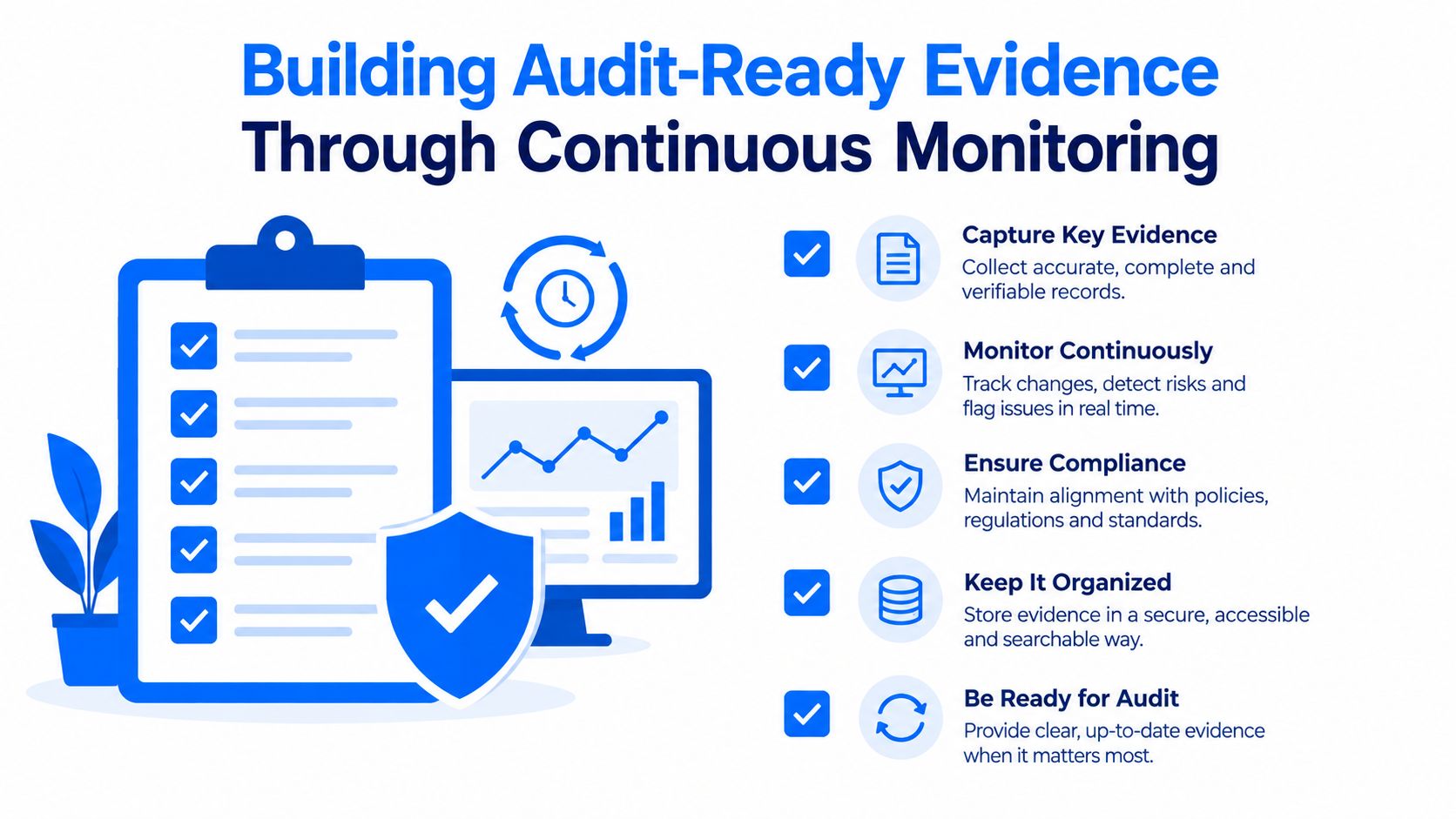
The practical pattern is straightforward. Log every validation event immutably, and make the log granular enough to answer the questions auditors really ask. That means dataset identity, column identity, rule parameters, timestamps, pass/fail outcome, error counts, and resolution history audit trail guidance. Once that exists, teams can reconstruct what was checked, when it ran, and how the control behaved before and after rule changes.
What that evidence buys you
It shortens investigations when schema drift or late-arriving data affects downstream reporting. It also preserves historical thresholds, which matters when a rule changes but the audit team still needs to know what happened under the previous setting. In regulated pipelines, that's the difference between “we think it was fine” and “here's the exact control state at the time.”
The technical benefit is just as important. When validation results are logged consistently, teams can quantify quality at the moment of validation instead of after the data has already moved. That makes root-cause analysis much faster, because the evidence points back to the specific control event rather than a vague pipeline symptom.
The supporting workflow doesn't need to slow delivery down. Done right, it runs inside the pipeline, stores the control record alongside the event, and exports it on demand when compliance needs it. That's the model I trust, because it survives both operational pressure and audit review.
There's also a practical demonstration video for teams that want to see how this looks in action.
Case Study Replacing 9000 Manual Rules With AI-Driven Observability
ITSV, the IT backbone of Austria's social insurance, is a useful example because the scale forced a real decision. The team was managing data quality with 9000 hand-crafted rules in its data warehouse, and that model no longer fit the volume or the maintenance burden. Their environment processed 50GB per day from 30-plus sources in 500-plus structures, which made constant rule tuning unsustainable case study details.
The old setup had the usual symptoms. Knowledge got lost when people left, documentation lagged behind the rules, and no single team really owned the framework end to end. Over 140 daily alerts filled inboxes, most of them ignored because the meaning wasn't clear, and only 25% of relevant data quality cases were covered case study details.
What changed when the controls moved
As early as September 2021, ITSV began replacing the rule-based framework with digna Data Anomalies and digna Data Timeliness. The analysis stayed inside ITSV's own infrastructure, which aligned with their privacy needs, and the team didn't have to tune thresholds or maintain rules manually. Data Timeliness learned arrival patterns and flagged late or missing data, while Data Anomalies learned normal behavior across the warehouse and flagged deviations case study details.
That matters because the case isn't really about a tool swap. It's about replacing fragile maintenance work with evidence-producing observability. The controls became easier to defend because they were both continuous and traceable, and the team got back time that had been spent triaging noise.
I've seen similar migrations work for one reason, they move ownership from human memory to system behavior. The controls don't depend on someone remembering which rule was supposed to be updated last quarter. They run, log, and escalate on their own.
Operationalizing Data Quality Compliance Across Teams
Even strong observability won't fix a governance gap. The hardest part of data quality compliance is often ownership, because the failures usually sit between teams rather than inside one system. Recent survey data shows 44% of respondents say ownership is shared across multiple teams, 61% still rely on manual checks or SQL-based validation, and only 14% enforce SLAs organization-wide, even though 39% track SLAs for key pipelines survey report.
That tells you where the work is. The problem isn't that teams don't care about quality. It's that they've distributed responsibility without distributing enforcement. If nobody owns the control end to end, alerts get triaged informally, incidents get routed by habit, and audit evidence gets assembled too late.
A practical operating model
Start with a named owner for each critical dataset, then define what gets measured, how often it's checked, and where incidents go when the check fails. Make the logging immutable, keep lineage attached to the record, and ensure the escalation path is explicit. If a control failure can't be routed to a person, it isn't operational yet.
A second requirement is consistency across teams. Engineering, analytics, and governance need to use the same definitions for freshness, completeness, and schema change. If one group is reporting on a metric while another is validating a different interpretation of the same field, the audit trail will look coherent only until someone asks questions.
Practical rule: compliance becomes continuous only when ownership, monitoring, and escalation are all automated enough to survive a busy week.
One option for teams building that operating model is digna, which monitors data behavior inside the customer's own environment and supports validation, timeliness monitoring, schema tracking, and audit-ready evidence. If your goal is to make controls easier to defend without turning your team into a manual rule factory, it's worth looking at how the platform fits your warehouse and pipeline stack.
If you want to see how the learned-baseline approach from the ITSV case works without writing or tuning thresholds, digna Data Anomalies shows how it models normal behavior across every table and flags deviations automatically.
Frequently asked questions
What is data quality compliance?
Data quality compliance means being able to prove that regulated data was validated, traced and defended, not just checked. The post argues a control only counts if evidence shows it operated at the right time, on the right data, with the right result, rather than being reconstructed during audit prep.
Why are rule-based data quality checks not enough for compliance?
Hard-coded rules prove a condition was checked, but they cannot show the wider control environment stayed trustworthy. They break as schemas drift and sources change, create alert fatigue, and lose knowledge when engineers leave. Regulations like the EU AI Act and ETSI's 18 data quality metrics now demand lineage and traceability as well.
What should an audit trail for data validation include?
Every validation event should be logged immutably with dataset identity, column identity, rule parameters, timestamp, pass or fail outcome, error count and resolution history. With that record, teams can reconstruct exactly what ran and how a control behaved before and after a threshold or rule changed.
Which data quality dimensions map to regulatory standards?
Canada's Data Quality Guidance names nine dimensions, including accuracy, completeness, coherence, reliability and timeliness. ISO 8000-110:2021, cited by the Australian National Archives, adds integrity, uniqueness and validity. Mapping these to validation rules, latency checks and reconciliation logic gives auditors and engineers a shared vocabulary.
How did ITSV replace 9000 manual data quality rules?
Starting in September 2021, ITSV swapped its hand-crafted rule framework for digna Data Anomalies and Data Timeliness, running inside its own infrastructure. The warehouse ingests 50GB a day from 30-plus sources, and the old setup produced over 140 daily alerts while covering only 25% of relevant cases.