Data Operations Engineer: Your Complete 2026 Guide
|
5
min read

At 8:12 a.m., the finance dashboard says revenue dipped overnight. By 8:19, the executive team is asking whether the drop is real. By 8:27, an analyst finds that one upstream table arrived late, a model feature store has stale values, and nobody can say with confidence whether the numbers are wrong, late, or both.
That's the moment organizations often realize they don't have a tooling problem alone. They have an ownership problem. The pipeline might be “up” while the data is unusable. The warehouse might be healthy while the dashboard is lying. The model might still be scoring while its inputs have drifted off the rails.
A Data Operations Engineer sits in that gap. This role exists to make data systems dependable under production pressure, not only to keep jobs running, but to make sure the data that arrives is timely, structurally sound, and fit for downstream use.
Table of Contents
The Unseen Hero of the Modern Data Stack
A broken dashboard is rarely just a broken dashboard.
Most incidents start as a vague symptom. Sales numbers don't reconcile. A churn model starts behaving strangely. A product team sees yesterday's event volume in today's report. The pipeline orchestration UI still shows green, so the first instinct is to blame the analyst, the SQL, or the BI layer. That's usually wasted time.
The core problem sits lower. Data arrived late. A schema changed without warning. A null spike slipped through. A feature table refreshed, but one join key shifted semantics upstream. Once teams depend on warehouses, streaming pipelines, feature stores, and SaaS connectors at the same time, failures stop being clean.
The painful part isn't only the outage. It's the period when nobody knows whether they can trust the data.
That's where the Data Operations Engineer becomes the unseen hero. This person acts like a first responder for the data platform. They trace symptoms across ingestion, transformation, timeliness, schema behavior, validation logic, and downstream expectations. They don't stop at “the job succeeded.” They ask whether the result is usable.
This specialization matters because the market has moved far beyond simple pipeline construction. The global data engineering job market is projected to grow from USD 29.1 billion in 2023 to USD 175 billion by 2030, with a 23% growth outlook for data-related roles through 2032, compared with 4% for other occupations, according to LinkedIn's data engineering job market analysis.
That growth doesn't mean every team needs more people writing one-off ETL jobs. It means companies have more critical data assets in production, more AI workloads depending on stable inputs, and more business decisions tied to datasets that must be correct on time.
Why firefighting keeps repeating
Teams usually fail in one of two ways:
They assign reliability as a side job. A platform engineer owns orchestration, a data engineer owns transformations, and an analyst owns the report. When an incident hits, everyone owns a piece and nobody owns the whole.
They monitor infrastructure but not data behavior. CPU, memory, and task duration look fine while duplicates, stale loads, or invalid values flow straight into production.
What this role changes
A data operations engineer shifts the operating model from reactive to preventive.
They define what “healthy data” means. They build checks around timeliness, completeness, correctness, and schema stability. They create escalation paths that start with evidence instead of guesswork. Over time, they reduce the number of mornings that start with a trust crisis.
What Is a Data Operations Engineer
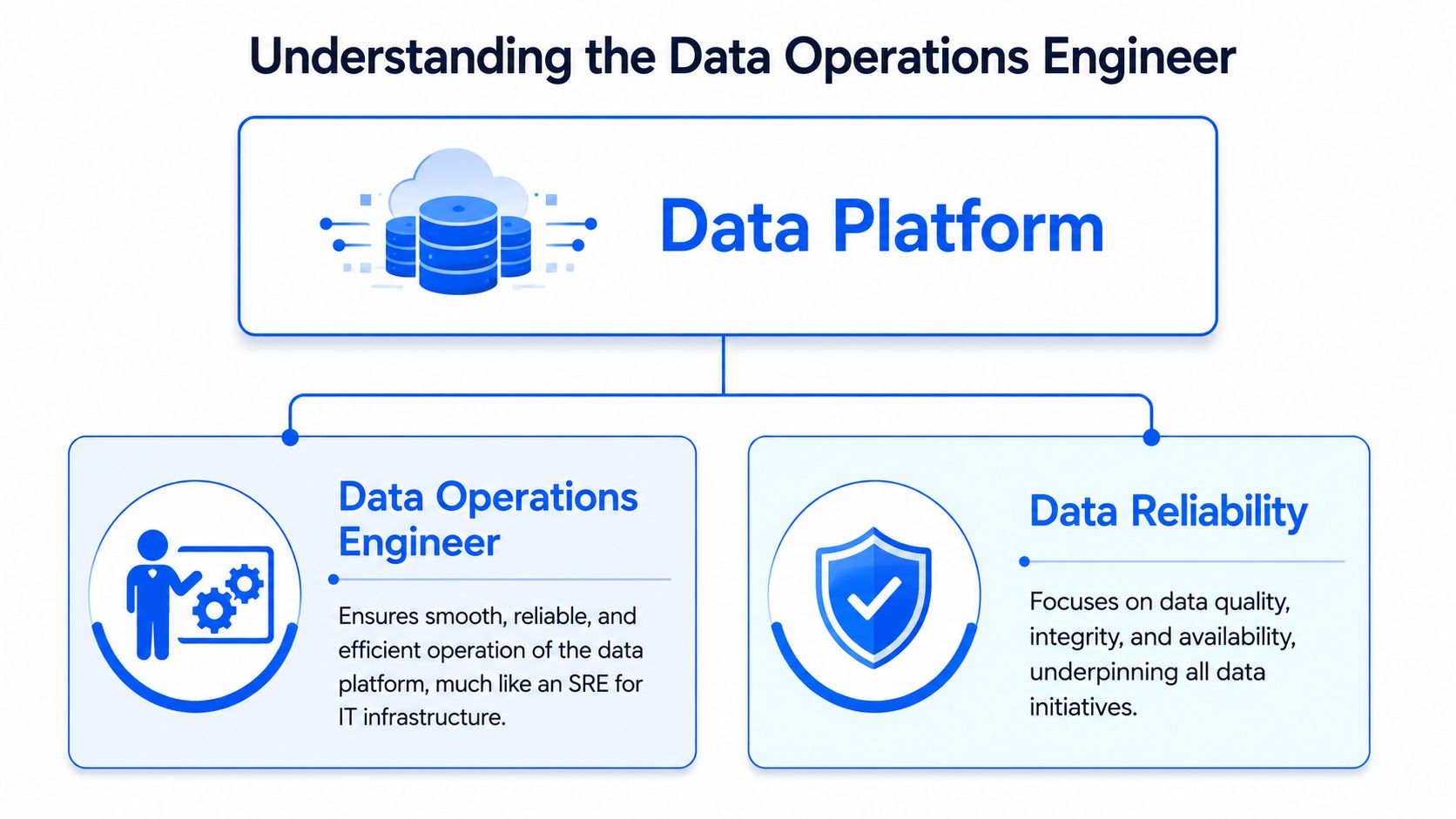
A Data Operations Engineer is the engineer responsible for the operational reliability of data systems. The cleanest analogy is this: they are to the data platform what an SRE is to an application stack.
Builders create new pipelines, new transformations, and new data products. Operators make sure those assets behave predictably in production, under load, during schema drift, during source instability, and during downstream pressure from analytics and ML consumers.
A useful primer on the broader operating model is this overview of DataOps.
The SRE analogy actually fits
The SRE comparison isn't just branding. It maps well to the work.
An application SRE cares about uptime, latency, error budgets, rollback safety, and incident response. A data operations engineer cares about similar concerns, but for data assets:
Focus area | Application SRE | Data Operations Engineer |
|---|---|---|
Availability | Service reachable | Dataset or pipeline available |
Latency | Request response time | Data freshness and delivery time |
Correctness | Error-free responses | Valid, complete, trustworthy records |
Change safety | Deploy without outage | Release schema and pipeline changes safely |
Incident response | Restore service | Restore confidence in data |
The important distinction is that pipeline uptime is not enough. A perfectly scheduled job can still produce bad data. That's why this role sits on the boundary between observability and quality.
Where the role sits in practice
Typically, the role bridges three groups:
Upstream engineering that builds ingestion, transformation, and storage layers
Downstream consumers such as analytics engineers, BI developers, and data scientists
Governance and platform leads who need auditable, stable operations
That middle position changes how incidents get handled. Instead of debating whether the issue belongs to platform, analytics, or ML, the data operations engineer establishes a reliability layer across all of them.
Practical rule: If your team can tell whether a job ran but can't tell whether the output should be trusted, you already need data operations ownership.
Traditional data engineering versus operational ownership
A traditional data engineer often gets measured on throughput. Can they build the connector, land the data, ship the transformation, and support the product roadmap?
A data operations engineer gets measured on stability. Can they prevent silent breakage, reduce noisy failures, make deployments safer, and shorten the time from alert to verified root cause?
That sounds subtle. In practice, it changes daily priorities.
A builder might ask, “How do we add this new source by Friday?” An operator asks, “What happens when this source shifts types, misses a load, duplicates records, or backfills late?”
Both mindsets are necessary. Problems start when one team is expected to do both at full speed all the time. Under delivery pressure, operational work gets postponed first. Then the incident queue fills up, trust drops, and every new pipeline adds another place for silent failure.
A mature team doesn't treat this as support work. It treats it as production engineering for data.
Core Responsibilities and Daily Workflows
The daily work isn't glamorous. It's repetitive in the right places, investigative in the hard places, and disciplined all the way through.
A strong data operations engineer starts the day by scanning health signals before reading Slack. Freshness exceptions, delayed loads, schema changes, abnormal row count movement, failed validations, and high-risk deploys matter more than anecdotal bug reports because they show what changed first.
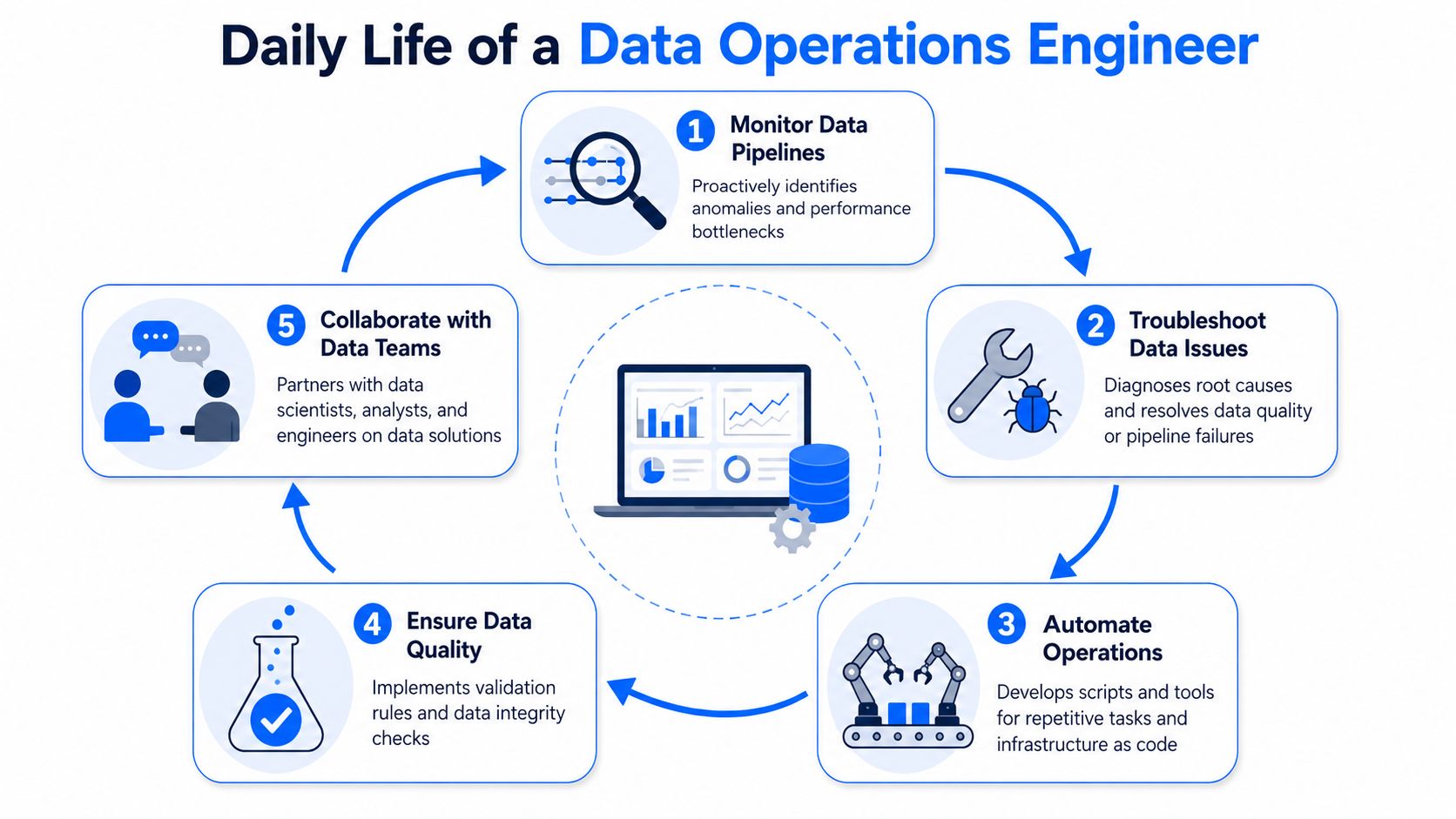
Start with health checks, not tickets
Over-reliance on downstream users to detect issues is a common problem. That's backwards. By the time an executive or analyst reports a problem, the blast radius is already wider than it should be.
A better operating rhythm looks like this:
Freshness review first. Check which critical datasets are late, incomplete, or missing expected partitions.
Schema review second. Look for added columns, dropped fields, renamed attributes, or changed types that can subtly break transformations.
Behavior review third. Scan anomaly signals for row counts, null rates, distribution shifts, and sudden pattern changes.
The line between observability and quality becomes tangible. Observability says a table landed late. Quality says the table landed on time but key values are malformed. Operations owns both because the user impact is the same. The data can't be trusted.
Incident response means proving what failed
When an alert fires, good operators don't jump straight into code changes. They narrow the class of failure first.
A basic triage path usually looks like this:
Confirm impact. Which datasets, dashboards, models, or business processes consume the affected asset?
Classify the incident. Is it a freshness problem, a schema problem, a content anomaly, or a business rule violation?
Localize the break. Source system, ingestion connector, transformation layer, orchestration, warehouse, or downstream semantic model?
Contain it. Pause propagation, hold dependent jobs, or mark data as untrusted before bad outputs spread.
Recover with evidence. Backfill, patch, rerun, or roll forward only after the team knows why the incident occurred.
That discipline matters because many “pipeline failures” are really semantic failures. The code executes. The data is still wrong.
The workflow that changes everything
The biggest leap in operational maturity comes from moving checks left into development and deployment. In modern DataOps frameworks, embedding automated semantic validation and CI/CD for pipelines can reduce production errors by 40–60% by catching issues such as model drift or schema changes earlier, according to DASCA's article on the evolving role of the data engineer.
That doesn't happen from one linter or one test suite. It comes from a workflow that treats data changes like production software releases.
What works
Schema-aware CI checks that fail builds when incompatible changes appear
Semantic tests that validate business meaning, not just types and nullability
Staged rollouts for sensitive datasets instead of big-bang production releases
Runbooks that define who responds, how severity is assigned, and when downstream teams are notified
What doesn't
Green DAGs as the only signal
Manual spot checks in BI tools
Validation owned only by analysts
Documentation created after an incident
Teams also underestimate how much time gets lost in poor operational handoff. When alert logic, expected schedules, owner mappings, and dependency notes live in tribal memory, incident response slows down immediately. For teams wrestling with that part of the process, this piece on solving documentation requirements problems is useful because it focuses on making operational documentation durable instead of decorative.
If you can't answer “what changed, who owns it, and what depends on it” within minutes, the incident process is already too fragile.
A good day closes uneventfully. Pipelines run. A few alerts get triaged and dismissed. One risky schema change gets blocked before release. Nothing dramatic happens, and that's the point.
The Data Operations Engineer's Toolkit
The tooling stack for a data operations engineer isn't one product category. It's a layered system. Each layer solves a different operational failure mode, and confusion starts when teams expect one tool to handle all of them.
A practical map of the broader tooling environment appears in this guide to data engineer tools.
Four tool layers matter
Start with infrastructure and move upward.
Infrastructure as code
Terraform and CloudFormation matter because repeatable environments reduce hidden differences between dev, staging, and production. If warehouse resources, networking, secrets handling, and execution environments drift across environments, reliability work turns into archaeology.
CI and automation
Jenkins and GitLab CI are common because data changes need promotion gates. This layer runs unit tests, integration checks, schema compatibility checks, and deployment workflows. Without it, teams rely on trust and timing.
Orchestration
Airflow and Dagster coordinate dependencies, schedules, retries, and backfills. They answer whether jobs ran in the right order and whether expected tasks completed. They are critical, but they are not observability on their own.
Observability and quality
This layer is frequently underspecified. It should answer questions like:
Did the data arrive when expected?
Did its shape change?
Did behavior shift outside a learned norm?
Did records violate explicit business rules?
Observability tells you what changed
Observability is about visibility into system and data behavior. It helps engineers detect unusual movement before consumers report impact.
The methods vary. Statistical techniques such as Z-Score and IQR are common ways to identify outliers in distributions, as described in Monte Carlo's overview of data quality anomaly detection. On top of statistical methods, some platforms use learned baselines to track seasonality, volatility, and normal variance over time.
The usefulness of AI-assisted detection becomes apparent. digna is one example of a platform that uses Isolation Forests and autoencoders to learn normal data behavior, set adaptive thresholds in-database, and flag anomalies without requiring Python coding or ML expertise, according to digna's explanation of its AI anomaly detection techniques.
That matters because manual thresholding breaks down fast in production. Static rules are brittle when daily patterns shift by weekday, billing cycle, region, or source behavior.
Quality tells you whether the data is acceptable
Observability can tell you that something looks unusual. Quality decides whether the data is acceptable for business use.
That usually requires explicit validation logic. Examples include:
Need | Observability signal | Quality control |
|---|---|---|
Timeliness | Table arrived later than expected | Block dependent report generation |
Schema stability | Column type changed | Fail deployment or quarantine data |
Distribution health | Null rate jumped | Validate required fields at record level |
Business correctness | Revenue values look odd | Enforce business rules against known logic |
This distinction is where role boundaries often get blurred. Some teams expect operations engineers to keep jobs alive only. Others expect them to own business validation too. In reality, the most effective data operations engineers don't write every business rule themselves, but they do own the operational framework that makes those rules executable, monitored, and actionable.
Observability without validation tells you something changed. Validation without observability tells you only what you thought to check.
The practical toolkit, then, is not a shopping list. It's a reliability system. Infrastructure makes environments predictable. CI makes change safer. Orchestration makes execution repeatable. Observability and quality make outputs trustworthy.
High-Impact Use Cases and Business Value
The business value of a data operations engineer becomes obvious when data failure has consequences beyond inconvenience. Reports become decision inputs. Feature tables become model inputs. Validation logs become audit evidence.
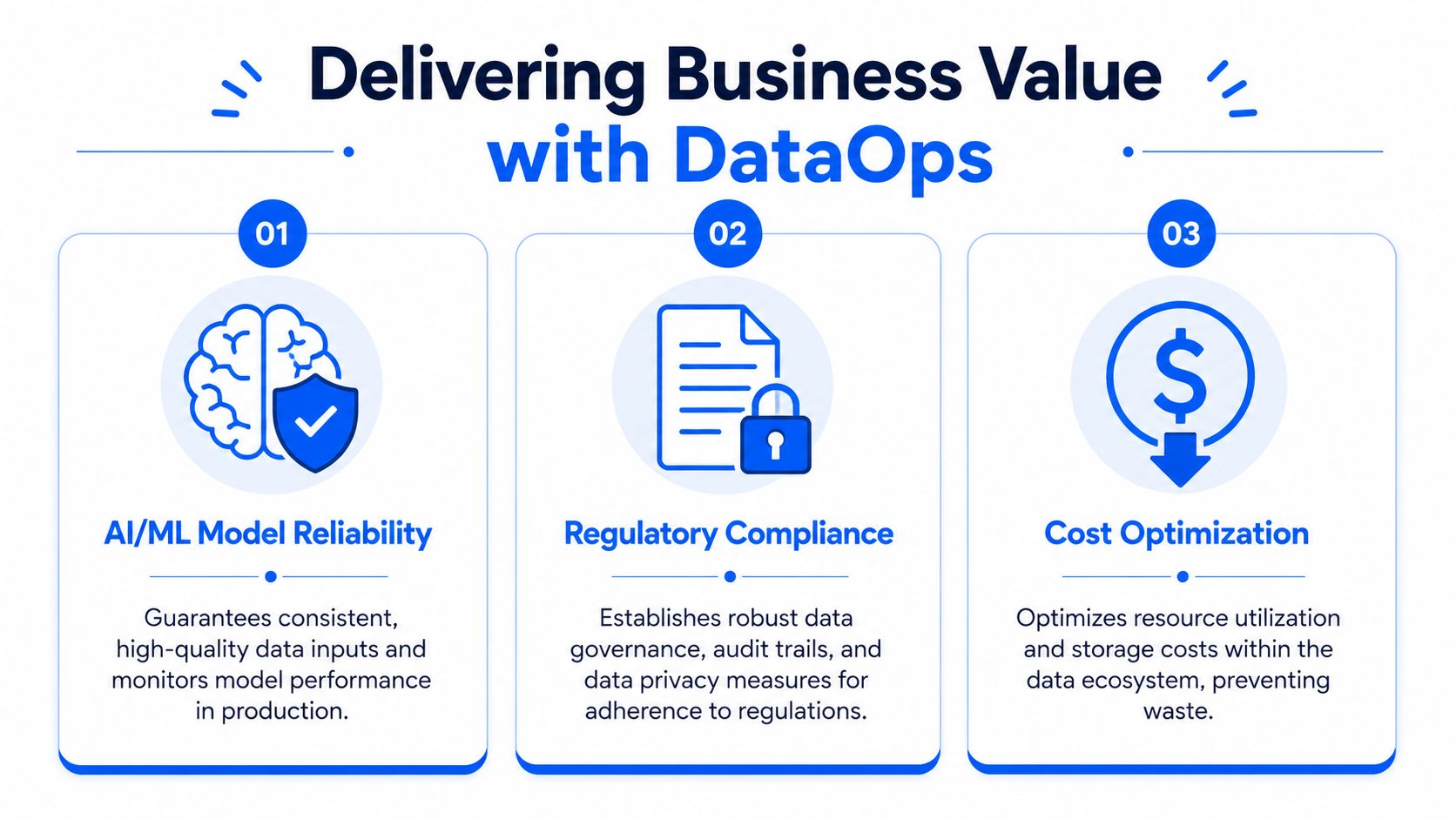
Protecting model inputs in production
ML systems rarely fail with a dramatic crash. They degrade subtly. A categorical field shifts values. One upstream join starts dropping coverage. A feature arrives on time but reflects a new source behavior the model was never trained on.
This is operational work, not just MLOps branding. The data operations engineer monitors the health of model inputs, not only the feature pipeline execution. That means watching for drift, schema movement, null spikes, and freshness breaks before the model output becomes untrustworthy.
The payoff is simple. Teams stop treating model incidents as mysterious algorithm problems when the actual issue is unstable source data.
Keeping regulated reporting defensible
Finance and healthcare teams care about a different failure mode. They need to prove that data was complete, timely, and governed at the point of use.
For those environments, in-database processing matters. By implementing in-database metric computation, data operations engineers can reduce data movement by 70–85%, which is important for private cloud or on-prem deployments, and can enable up to 50% faster root-cause analysis for data incidents, according to Amazon's description of in-database metric computation and timeliness monitoring.
That design changes operations in regulated environments because the team can inspect health signals without exporting sensitive data into another vendor-controlled system. It also tightens the incident loop. If the metrics, baselines, and timeliness checks run where the data already lives, engineers can investigate faster with less movement and less governance friction.
Cutting waste in private environments
A lot of platform waste comes from hidden movement. Data gets copied for monitoring, copied again for testing, exported for secondary checks, and shuffled across tools that overlap.
A data operations engineer looks at that sprawl and asks harder questions:
Which checks can run inside the warehouse?
Which duplicate observability and quality tools can be consolidated?
Which alerts point to real failure instead of noise?
Which pipelines run because they always have, not because anyone still needs them?
This is one reason the role has become strategically important in private cloud and on-prem estates. The value isn't only reliability. It's operational discipline around where data lives, who touches it, and how fast a team can diagnose issues without broadening exposure.
Business leaders usually notice this role after an incident. Mature teams notice it earlier, when they see that stable reporting, reliable AI, and controlled platform cost all depend on the same thing: trustworthy operations.
Career Path, Salary, and How to Hire for This Role
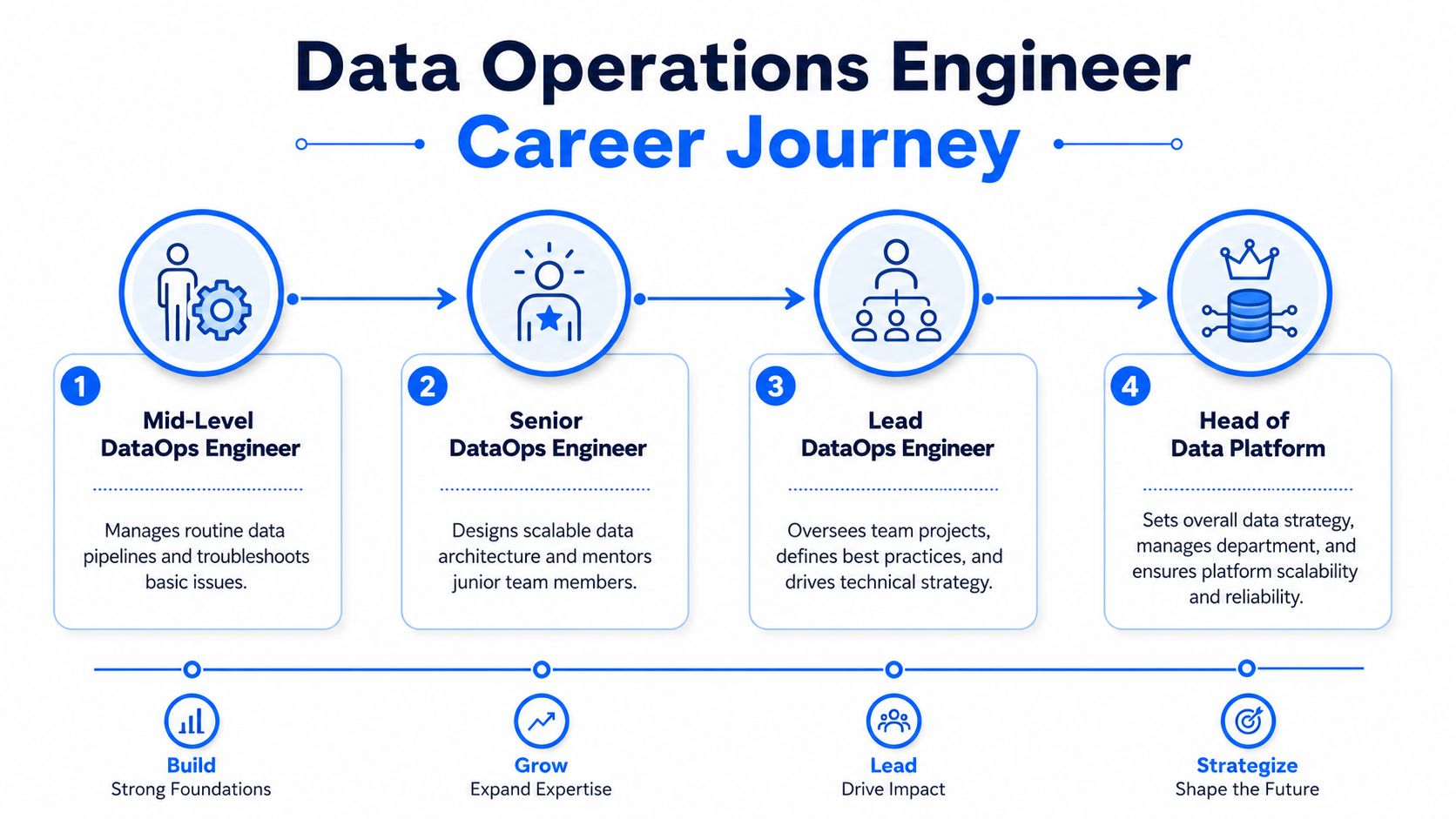
The fear around operations-heavy roles is predictable. Engineers worry that once they become “the reliability person,” they'll get trapped in support work and miss the path to architecture or leadership.
That fear isn't irrational. Some companies absolutely misuse operational talent that way. But when the role is designed correctly, it creates broad system visibility that many feature-focused engineers never get.
Why this role is not a career dead end
Operations engineers see the entire platform under stress. They learn dependency mapping, incident command, service design, release safety, audit constraints, cross-team negotiation, and technical trade-offs between speed and control. That's leadership training, even when the title doesn't say “manager.”
The ambiguity in the market is real. There are 81,590 interview questions listed for “Data Operations Engineer” on Glassdoor, yet there's little longitudinal clarity about whether the role leads more cleanly into platform leadership or remains a specialist track, as reflected in Glassdoor's Data Operations Engineer interview page. That lack of career-path clarity is one reason candidates hesitate.
My view is practical. If the role owns reliability frameworks, deployment standards, incident process, and data trust across teams, it is not a side path. It is a path toward staff, lead, and head-of-platform responsibilities. If the role is limited to after-hours alert handling, it will stall.
Compensation and market reality
The salary market tells a clear story about demand. In 2026, senior data operations engineers in the USA can earn up to $179,024, reflecting demand for engineers who can handle complexity, observability, and CI/CD for data, according to Motion Recruitment's data engineering salary guide.
That premium exists because companies need people who can stabilize growing platforms now. They are hiring less for basic point-to-point ETL work and more for engineers who can operate hybrid estates, manage risk, and support AI-era data dependencies.
What to hire for and how to onboard
Hiring managers often make the same mistake. They interview for tool familiarity instead of operational judgment.
Look for evidence of these habits on a resume:
Incident ownership: The candidate describes how they diagnosed, contained, and prevented repeated failures.
Testing discipline: They've implemented CI checks, validation layers, or release controls for data assets.
System thinking: They understand dependencies between source systems, warehouse models, dashboards, and ML consumers.
Communication under pressure: They can explain business impact and recovery choices clearly.
A few interview prompts separate builders from operators fast:
A critical dashboard is wrong, but all orchestrator tasks are green. What do you check first?
A schema change is technically backward compatible, but analysts say their metrics shifted. How do you investigate?
When should a bad dataset be quarantined instead of passed through with a warning?
What belongs in a data incident runbook?
For candidates looking for reliability-oriented teams, job boards aren't enough. I'd also look at companies building AI-heavy internal operations, including opportunities like Join our AI employee team, because those environments often value engineers who can keep complex data systems dependable.
A useful onboarding model is a simple 30-60-90 plan.
Timeframe | Focus | Expected outcome |
|---|---|---|
First 30 days | Learn critical datasets, owners, and incident history | Can identify high-risk assets and common failure patterns |
First 60 days | Add health checks, validation gates, and runbook updates | Improves detection and response clarity |
First 90 days | Standardize release controls and severity handling | Establishes a repeatable operating model |
That plan works for new hires and for teams creating the function for the first time.
How to Build Your Data Operations Function
Start small, but start with ownership.
Most organizations don't need a large standalone team on day one. They need one engineer or a small pod with explicit responsibility for data reliability across critical assets. The key is that this responsibility must be real. Not “help when there's time,” and not “everyone owns quality,” which usually means nobody does.
A practical 30-60-90 runbook
First 30 days
Map the systems that matter most. List critical datasets, dashboards, models, source dependencies, refresh expectations, and owners. Identify where incidents currently get discovered and where handoffs break.
First 60 days
Define a baseline operating model. Set priorities for freshness, schema monitoring, anomaly detection, and record-level validation. Create incident severity levels and lightweight runbooks so responders don't improvise during pressure.
First 90 days
Move checks closer to deployment and make recovery repeatable. Add CI gates for high-risk changes, standardize alert routing, and establish a review loop for noisy alerts and repeated incidents. At this point, the function should be reducing uncertainty, not just generating more notifications.
Build the function around the data products that can hurt the business fastest when they fail. Don't start with broad coverage. Start with consequence.
The strategic shift is simple. Stop treating reliability as leftover work for the same engineers already racing to ship new pipelines. A dedicated data operations function turns fragile systems into production systems. That's the difference between hoping your data is fine and knowing when it isn't.
If your team needs a way to monitor timeliness, schema changes, anomalies, and record-level validation inside your own environment, digna is worth evaluating as part of a practical data operations stack.