Collibra Alternatives for Audit-Ready Data Quality
|
6
min read

You're probably sitting on the same problem I see in regulated data teams all the time. The catalog is full, the lineage looks tidy, and the stewardship workflow is in place, but the audit team still wants proof that critical records are accurate, timely, and structurally stable at the point of use. That gap is why many Collibra alternatives conversations are really about compliance evidence, not catalog cosmetics.
The market around governance keeps expanding, which helps explain why teams are rethinking the old “catalog equals control” assumption. Independent forecasts put the data governance market at USD 4.60 billion in 2026 and USD 9.68 billion by 2031, with a 16.05% CAGR, and another outlook places Asia Pacific as the fastest-growing region (Mordor Intelligence forecast). Buyers aren't just shopping for a better UI anymore, they're choosing architectures that can survive audits, support sovereignty, and keep production data in place.
Table of Contents
Why Data Catalogs Fall Short of Regulatory Audits
A data catalog can tell you what exists. An auditor wants to know whether the data is correct, current, and controlled. Those are different questions, and the distinction matters the moment a finance, healthcare, or public-sector review gets serious.
Documentation is not evidence
Catalogs are good at inventory, classification, ownership, and lineage references. They fall short when the control objective is operational proof, because a registry of assets doesn't prove that a payment record met a business rule, that a claims feed arrived on time, or that a downstream schema stayed stable long enough to support reporting. In practice, auditors ask for artifacts that tie policy to execution, not just a list of fields and stewards.
That's where observability-first platforms change the conversation. Instead of treating metadata as the end state, they turn runtime behavior into evidence, then keep that evidence attached to the data in its own environment. The practical question becomes whether the system can validate the data where it lives, not whether someone remembered to document it.
The most useful test is simple. If a control can be described as “this dataset must always satisfy this rule before it reaches the report or model,” a catalog alone won't enforce it. If you need operational proof, you need validation, timeliness checks, and schema monitoring that run continuously inside the warehouse or database.
Practical rule: If the audit finding would say “show me the control in action,” a catalog entry is support material, not the control itself.
Governance workflows still matter, but they're not enough
A modern option like digna's catalog and collaboration layer fits into a broader compliance posture. The useful pattern isn't “replace governance with observability,” it's to connect stewardship ownership to live evidence so reviewers can trace a control from policy to execution to incident history. That's the part legacy catalogs rarely do well on their own.
For regulated buyers, the mistake is overvaluing static completeness. A perfect glossary with weak runtime validation can still fail an audit when the actual issue is data drift, late delivery, or a silent structural break. The strongest alternatives to Collibra are the ones that prove control effectiveness, not just control design.
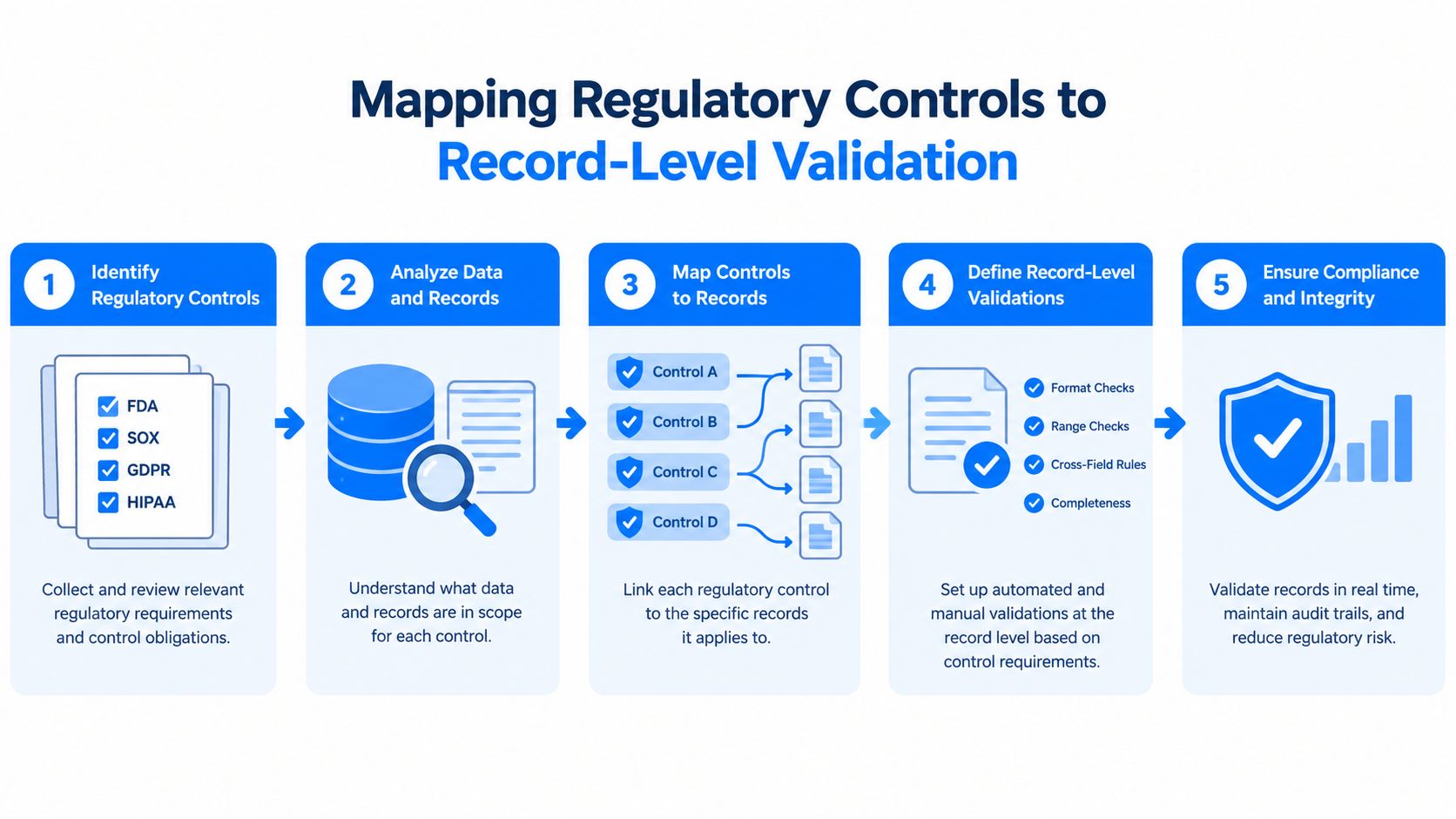
Mapping Regulatory Controls to Record-Level Validation
Most compliance teams already know the intent of the rule. The hard part is translating that intent into checks that machines can run without ambiguity. A useful way to do that is to start with the control objective, then map it to a dataset, then define the exact record-level condition that must pass every time.
Start with the control, not the table
A regulation or internal policy usually reads like a requirement, not a technical spec. The wrong move is to jump straight into a generic null check because it's easy. The right move is to identify the business rule hidden inside the language, then decide which records prove compliance.
For example, a control about approved transactions is rarely satisfied by checking that a column isn't empty. It usually means a combination of values must align, such as status, source, date, and identifier consistency. That's why digna Data Validation is relevant here, it lets teams turn the rule into deterministic checks that run against the critical dataset instead of living in a spreadsheet or policy memo.
A practical mapping sequence looks like this:
Identify the control objective. Write the rule in business language first, then strip out ambiguity.
Choose the system of record. Validate where the regulated data is born or stored, not in a copied extract.
Define the exact record condition. Specify the column combinations, thresholds, or logical relationships that must hold.
Set the escalation path. Breaks that affect compliance should trigger review, not silent retries.
Attach evidence to the incident. Keep the validation result, timestamp, and affected scope together.
Deterministic beats interpretive
Record-level validation pays off here. Deterministic rules are easier to defend because they can be reproduced, explained, and re-run on demand. They also reduce debate during audits, since the control either passed or failed based on a defined condition rather than a subjective interpretation.
Audit-friendly controls are boring on purpose. If the rule depends on guesswork, it isn't strong enough for regulated evidence.
Complex compliance programs often need multi-column logic, not just single-field checks. That's common in finance and healthcare, where one field rarely tells the full story. The best implementations keep the rule as close to the source data as possible, then store the result as part of the compliance trail rather than as a one-off project artifact.
Implementing Continuous Timeliness and Schema Monitoring
A report can look clean and still fail a regulatory review if the feed arrived late or the structure changed without warning. For audit-ready compliance, timeliness and schema checks belong in the same control stack as business-rule validation.
Timeliness is an operational control
Timeliness checks do more than flag a missed load. They show whether the pipeline delivered data when the business expected it, which often separates a controlled delay from a report that reaches decision-makers too late. AI-learned patterns can define an expected arrival window without forcing teams to hardcode brittle schedules for every source.
That matters in regulated environments because “on time” is contextual. Some feeds are daily, some are event-driven, and some vary by business calendar. A practical monitoring layer uses historical delivery behavior to detect missing loads, early deliveries, and unusual gaps, then escalates only the exceptions that matter.
The timeliness monitoring model fits this approach because it focuses on expected delivery behavior rather than a simple clock-based alert. The point is not noise, it is catching data that never arrived or arrived too early to trust downstream.
Schema drift needs continuous comparison
Schema drift is the quieter failure. A column is added, removed, renamed, or changed in type, and the pipeline keeps going until a dashboard, risk model, or validation job breaks later. The mechanics are straightforward, compare incoming metadata against a stored baseline and classify the difference before it causes downstream damage.
Public guidance on schema drift mechanics follows the same pattern, compare current structure to the expected schema and route breaking changes for human review. In practice, that is the difference between hearing about a break from a business user and catching it during the load.
Treat schema changes as governed events. Additive changes may be acceptable in some cases, but removals and type changes usually deserve review before release. Schema tracking in digna aligns with that model because it keeps structural evidence close to the data itself, and Schema tracking in digna supports that same idea in the control layer.
A pipeline that lands a table on time still fails the control if the shape changed underneath the report.
Capturing Audit Evidence Without Moving Production Data
A finance, healthcare, telecom, or public sector team that copies sensitive production data to a vendor just to calculate quality metrics is creating a new control problem. The safer pattern is to keep validation inside the customer environment, where the data already lives and where the audit boundary is easier to defend.
Keep the computation where the data lives
In-database execution is the cleanest model. Validation, anomaly detection, and monitoring run in the warehouse or database, so production records stay in place while the platform computes the evidence it needs. That gives compliance teams a stronger position in audit reviews, because the control does not depend on exporting sensitive data to an external service.
It also changes incident handling. Instead of collecting screenshots and manual exports, teams can produce an operational record that shows what failed, when it failed, and which records were affected. The evidence comes from the system itself, not from a file assembled after the fact.
For access control and evidence handling in broader governance programs, the LinkShip guide to file access control is a useful companion reference because it follows the same rule, keep permissions narrow, keep sensitive artifacts controlled, and document access as part of the process.
Provenance matters more than lineage diagrams
A lineage chart helps, but auditors usually care more about provenance, the path the data took, the checks it passed, and the point where it was validated. That distinction matters in regulated environments because a clean diagram does not prove whether a control ran on live data or on a stale copy.
Data provenance and lineage should be treated as separate concepts in the operating model. Lineage answers where data moved. Provenance answers what happened to it and under which control boundary. When the monitoring layer stays inside the customer environment, the evidence is easier to defend and harder to dispute.
That is the practical outcome. You get audit-ready artifacts without widening data exposure, and you keep the governance boundary that zero-trust teams require. It is a better fit for strict review than catalog-first setups that rely on moving data out of the control boundary before they can say anything useful about it.
Evaluating Architecture and Commercial Models
The commercial model usually tells you a lot about how painful a platform will be after procurement. A tool can look affordable up front and still become expensive once the data estate grows, monitoring expands, or usage spills across more teams. Architecture matters for the same reason, because the wrong deployment pattern creates work you didn't budget for.
Usage-stable pricing beats invisible metering
Many enterprise observability tools use flat monthly tiers or stable, predictable licensing instead of per-query or per-alert charges. One public model lists $99, $299, and $799 per month tiers and says the invoice doesn't change based on usage, while another explicitly says there are no per-table or per-row fees (pricing pattern). That's a meaningful contrast to legacy procurement models that get harder to forecast as the environment grows.
A separate pricing example from data observability shows a metered pattern, with $16 per monitored table per month on annual billing and $24 on-demand, charged only for tables under active monitoring (Datadog observability pricing). The lesson isn't that one model is always better. It's that the billing mechanics shape behavior, and procurement teams need to know whether the vendor charges for scale, activity, or actual value delivered.
That's why modular, usage-stable licensing can be easier to defend in regulated enterprises. You can add coverage without re-litigating every monitor or alert stream.
Compare the architecture, not just the brochure
In regulated settings, the architectural questions matter more than the marketing claims. Can the platform run inside your environment? Does it compute in place? Does it expose usable evidence without broad data movement? Those questions should come before feature checklists.
Evaluation Criteria | Legacy Governance Suites | Modern Observability Platforms like digna |
|---|---|---|
Deployment boundary | Often centralizes control in vendor-managed workflows | Runs inside the customer's own environment |
Data movement | More likely to rely on externalized metadata processes | Keeps metric computation in-database |
Evidence generation | Strong on documentation, weaker on live validation | Produces runtime evidence from monitored data |
Pricing behavior | Can be harder to forecast as scope grows | Uses modular licensing with predictable expansion |
Time to first insight | Often slower in complex environments | Designed for rapid initial setup |
Best fit | Governance-heavy stewardship programs | Audit-ready quality and reliability controls |
The point of the comparison is practical. If you need audit evidence, deterministic validation, and privacy-preserving monitoring, the architecture has to support that from day one. If it doesn't, the rest is decoration.
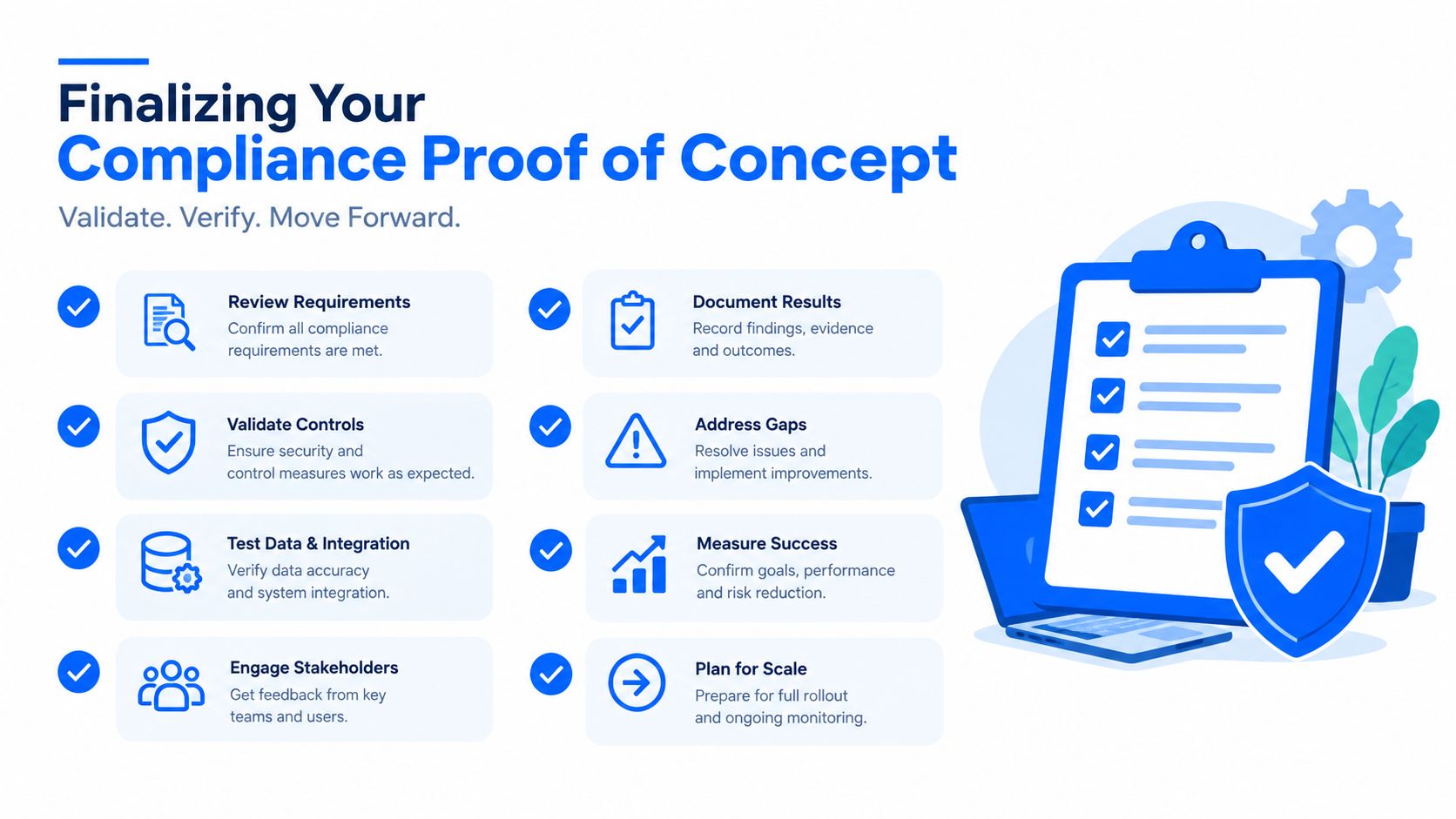
Finalizing Your Compliance Proof of Concept
A proof of concept should answer one question, can the platform prove compliance on your actual data with your actual permissions? Demo data and sanitized workflows almost always hide the actual failure points. The only way to know whether a Collibra alternative is serious enough for regulated work is to test it against real controls, real feeds, and real boundaries.
What to verify before you sign
Start with the controls that would trigger audit scrutiny. Then verify that the platform can run them continuously, produce evidence automatically, and show the result inside the same environment where the data already lives. If the platform needs special handling just to see the data, that's a red flag.
A strong POC should confirm:
Record-level validation on critical datasets. The platform must prove business rules on the data you care about most.
Timeliness monitoring on real feeds. Missing loads and early deliveries should surface without manual checks.
Schema change detection on production structures. Breaking changes need classification, not just notification.
Permission-aware operation. The platform must respect existing access boundaries and not require broad exposure.
Evidence capture for audit review. Incident history, status, and trends should be easy to retrieve.
Usability for engineers and stakeholders. The system has to work for the people who will maintain it.
digna data quality implementation is relevant here because implementation only matters if it produces usable controls on live data. A platform that looks good in a sandbox but can't sustain governance in production won't help when the auditors arrive.
Decide by evidence, not by feature count
The right decision matrix is blunt. If the tool can validate, monitor, and document controls inside your environment, it's a candidate. If it mostly catalogs, labels, and routes stewardship tasks, it may still be useful, but it's not enough on its own for strict compliance proof.
Best signal of fit: the POC team can point to a live control, a live incident, and a live artifact without leaving the customer's environment.
If you want a modern approach to audit-ready data quality, look at how digna runs validation, timeliness, schema tracking, and observability inside your own infrastructure. Visit digna to see how its in-database monitoring model can support regulated workflows without moving production data out of place.
To see how schema changes can be captured as governed events with structural evidence kept next to the data, look at digna Schema Tracker.
Frequently asked questions
Why is a data catalog not enough for a regulatory audit?
A catalog shows what data exists, while an auditor wants proof that data is correct, current and controlled. An inventory of fields and stewards cannot prove a payment record met a business rule or a claims feed arrived on time, so a catalog entry is support material, not the control itself.
What should I look for in a Collibra alternative for compliance?
Look for a platform that proves control effectiveness, not just control design. The article recommends checking whether it validates data where it lives, monitors timeliness and schema changes continuously inside the warehouse or database, and produces runtime evidence without moving production data to the vendor.
How do you turn a regulatory control into a data validation rule?
Start with the control objective in business language, then choose the system of record, define the exact record-level condition, set an escalation path and attach evidence to each incident. A control about approved transactions usually needs status, source, date and identifier consistency, not just a non-null check.
What should a compliance proof of concept for data quality verify?
Test on real controls, real feeds and real permissions rather than demo data. The article lists six checks: record-level validation on critical datasets, timeliness on real feeds, schema change detection on production structures, permission-aware operation, evidence capture for audit review, and usability for engineers and stakeholders.
How do data observability tools typically charge?
Pricing varies. The article cites one flat model with tiers of $99, $299 and $799 per month that do not change with usage, and a metered model charging $16 per monitored table per month on annual billing or $24 on demand. It advises checking whether vendors bill for scale, activity or value.