Data Curation Definition: From Raw Data to Trusted Assets
|
5
min read

Data curation is the active, ongoing process of managing data throughout its lifecycle so it remains fit for purpose, available for discovery, and valuable for reuse. In practice, it's the discipline that turns raw data into a reliable enterprise asset instead of a recurring source of broken dashboards, conflicting metrics, and avoidable rework.
If you're reading this, there's a good chance your team already has plenty of data. What you don't have is confidence that the data means the same thing from one report to the next, that it arrives when it should, or that someone can trace a number back to its source without opening five tools and asking three people.
That gap is where most data teams get into trouble. A business report goes out. Someone in finance, operations, or product spots a number that doesn't match another dashboard. The meeting stops being about the business question and turns into an investigation. Once that happens a few times, stakeholders don't just question one chart. They question the whole pipeline.
That's why a clear data curation definition matters. It isn't academic language. It's an operating model for making data usable, understandable, and durable enough to support analytics, AI, and day-to-day decisions.
Table of Contents
Introduction Why Every Data Team Needs a Curation Strategy
The usual failure pattern is simple. A dashboard looks right until someone notices the revenue total excludes a new product line, or a weekly KPI dropped because an upstream field changed type and no one caught it. The technical issue might be small. The trust damage usually isn't.
Teams often respond by cleaning the dataset that failed. That helps for the moment, but it doesn't solve the system behind the issue. The report was wrong because no one treated the dataset as a product that needed ownership, documentation, validation, context, and maintenance over time.
That's what data curation provides. According to the NISO contributor roles definition of data curation, data curation is the active and ongoing management of data throughout its lifecycle to ensure it remains fit for purpose and available for discovery and reuse. That definition is useful because it forces a shift in mindset. The job isn't to land data and move on. The job is to keep it usable.
Practical rule: If nobody can explain what a dataset means, how it changed, and whether it can be trusted today, it isn't curated. It's just stored.
A working curation strategy changes how engineers and analysts build. Pipelines stop at quality gates instead of publishing flawed records unchecked. Analysts get metadata and business definitions instead of guessing from column names. Stewards can see where ownership sits. Data consumers know which assets are approved for operational decisions and which are exploratory.
Three things tend to improve when curation becomes part of delivery:
Trust in reporting: Teams spend less time arguing over whether a number is valid.
Speed of analysis: Analysts can find and interpret datasets faster because context exists.
Reliability of downstream products: ML features, dashboards, and operational reports break less often because structural and quality issues are handled earlier.
This matters most in enterprises where data moves across warehouses, BI models, reverse ETL jobs, and AI systems. Raw collection creates potential. Curation makes that potential usable.
The Core Data Curation Definition Explained
A practical data curation definition starts at the point where raw data enters production. The file landed. The table loaded. The pipeline ran. None of that means the data is ready for reporting, feature engineering, or operational decisions.
Curation is the ongoing work of turning stored data into a reliable asset that other teams can find, understand, trust, and reuse. That includes selection, standardization, documentation, quality controls, lineage, access rules, and maintenance over time. In enterprise environments, that work has to survive schema drift, upstream changes, ownership gaps, and constant new consumption patterns.
A museum comparison still fits, but the operational detail matters more than the analogy. Curators do not just keep objects in a room. They decide what belongs in the collection, record provenance, preserve condition, describe context, and make retrieval possible. Data teams do the same with datasets, columns, models, and business definitions.
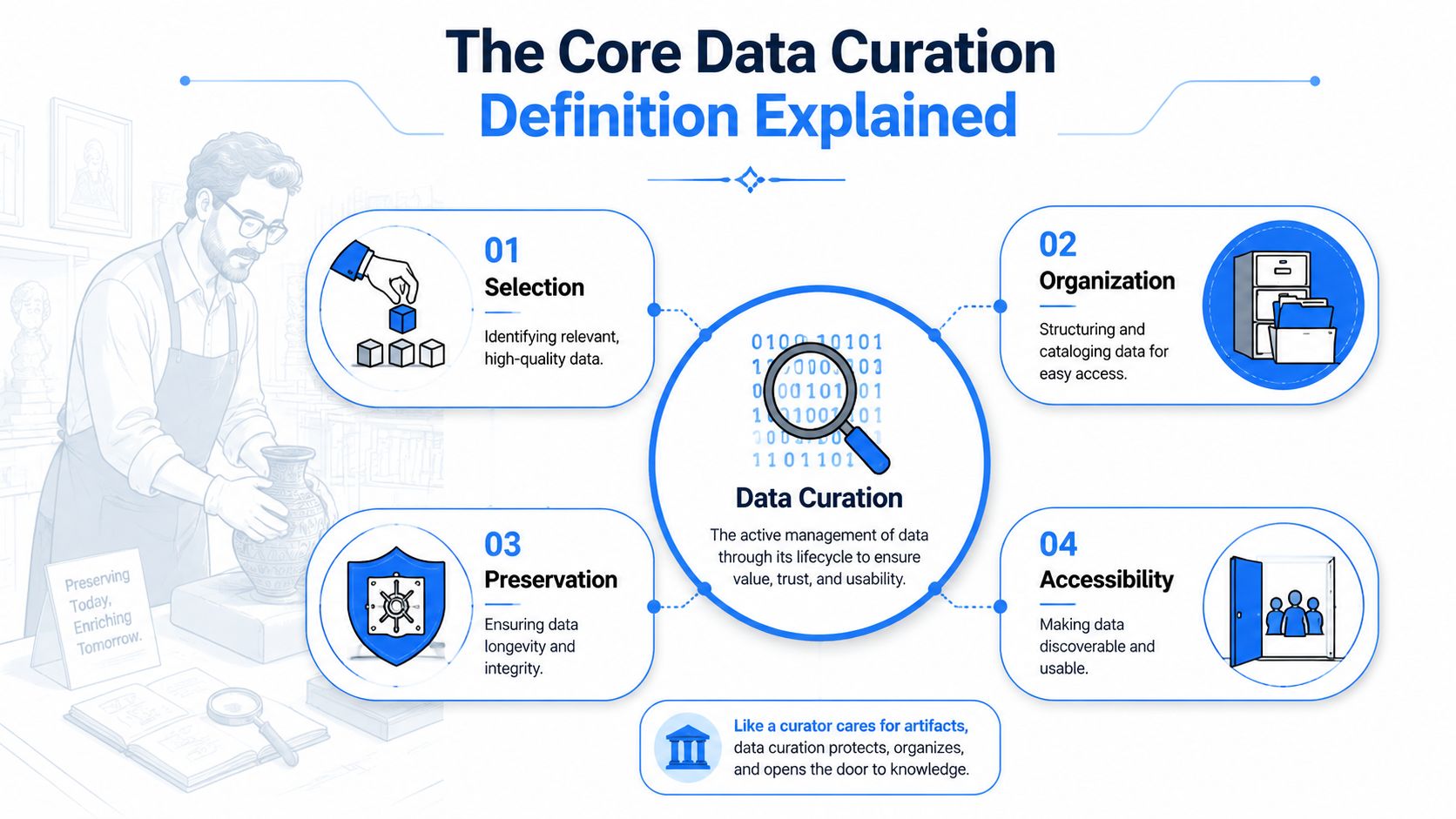
Why storage alone isn't curation
Storage keeps data available. Curation makes it usable.
A warehouse can contain every event your applications emit and still fail the business. I see this often with behavioral data. The table exists, but event names changed without notice, timestamps mix time zones, customer identifiers do not match the CRM, and nobody can tell which columns are safe for executive reporting. Engineers call it delivered. Analysts call it unusable. That gap is exactly what curation addresses.
As noted earlier, standard definitions of data curation frame it as active lifecycle management aimed at keeping data fit for discovery and reuse. The FAIR model is useful here because it gives teams an operational test for whether a dataset is ready.
What FAIR looks like in practice
FAIR becomes concrete once it is tied to delivery workflows:
Findable: The dataset is listed in the catalog with searchable metadata, ownership, tags, and a business description that says what the asset is for.
Accessible: Approved users can query or consume it through documented access paths, with permission controls that match policy.
Interoperable: Keys, formats, reference data, and naming conventions are consistent enough to support joins and downstream modeling.
Reusable: Consumers can see lineage, freshness, known limitations, change history, and the assumptions behind the transformations.
One test works well in practice. A new analyst or ML engineer should be able to pick up the asset and use it without asking the original builder for a private walkthrough.
That standard is hard to meet manually at scale. Definitions drift. Pipelines change. Owners leave. New tables appear faster than teams can document them. This is why modern data observability platforms matter to curation. They make the process repeatable by tracking freshness, schema changes, lineage breaks, and quality regressions as part of daily operations, not as a one-time documentation exercise.
For data products, the payoff is straightforward. Curated data reduces interpretation errors, shortens onboarding for new consumers, and lowers the chance that dashboards, ML features, or reverse ETL jobs are built on unstable inputs. That is the difference between data that merely exists and data a business can run on.
The Data Curation Lifecycle and Key Roles
Treating curation as an operating cycle, not a one-off task, is beneficial. The workflow is hands-on and continuous. The Atlan overview of the data curation workflow describes it as active management that includes identifying valuable datasets, evaluating accuracy and completeness, creating metadata catalogs, and maintaining data over time so quality doesn't degrade.
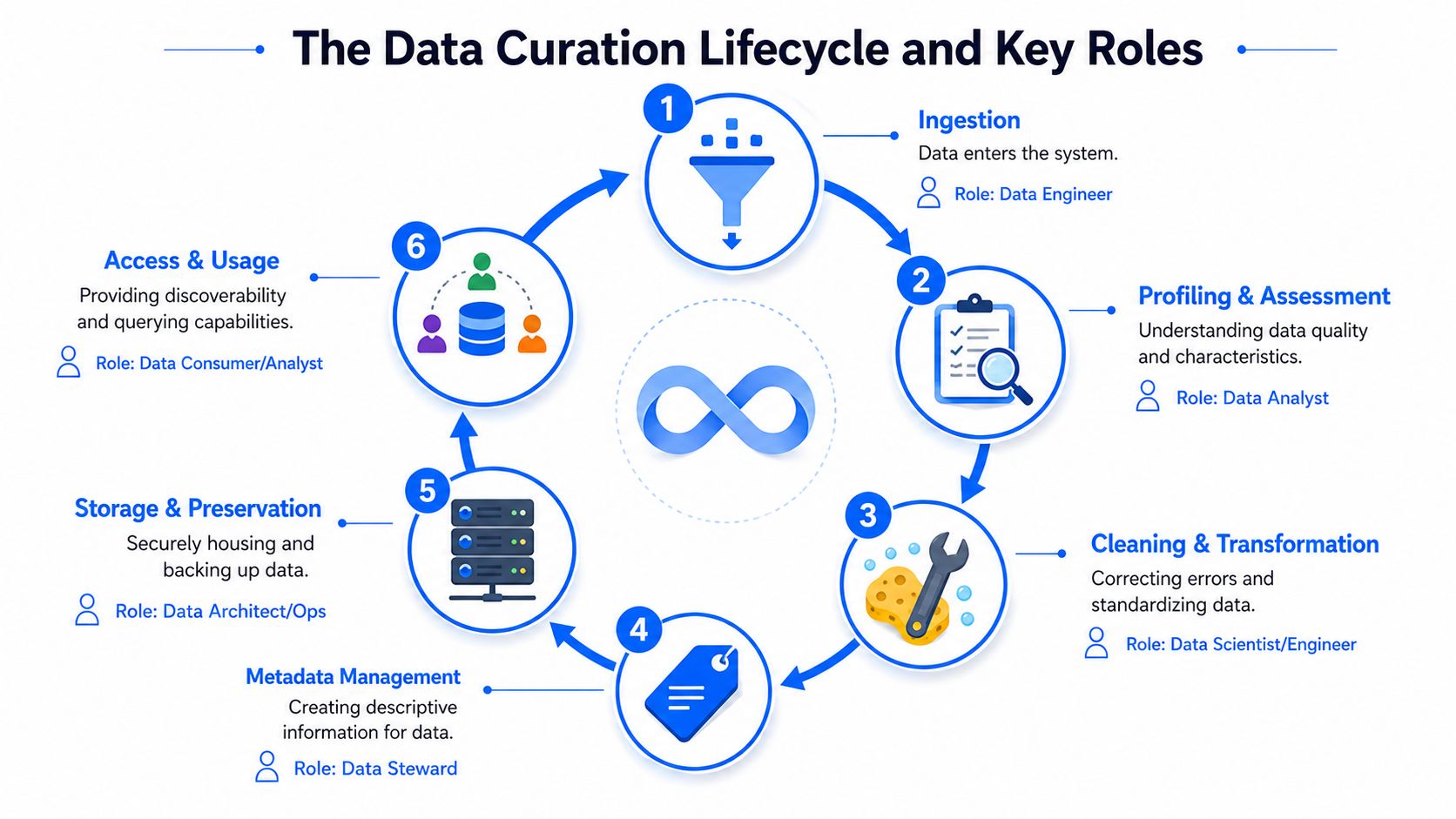
The lifecycle from raw input to reusable asset
In production environments, the lifecycle usually looks like this:
Identification and sourcing
Teams choose which datasets are worth curating based on business value, downstream dependency, and risk. Not every raw table deserves the same investment. High-impact assets do.Cleansing and validation Engineers and analysts assess accuracy, completeness, consistency, and reliability. In this step, missing values, duplicate records, malformed fields, and suspect joins get surfaced and corrected.
Transformation and enrichment
Raw data is standardized into usable models. Units are aligned, keys are normalized, business logic is applied, and data from multiple systems is integrated into a coherent structure.Metadata and cataloging
The curated asset gets named, described, classified, and connected to ownership and lineage. This step is what makes the dataset discoverable and understandable instead of merely available.Archiving and preservation
Teams decide what should be retained, versioned, or archived. Long-term integrity matters, especially for regulated and audit-sensitive environments.Continuous maintenance
Curated data still changes. Schemas evolve, source applications shift behavior, and business definitions get refined. If maintenance stops, curation decays.
Who owns what
Roles often blur in smaller teams, but the responsibilities are still distinct.
Role | Primary focus | Typical contribution |
|---|---|---|
Data Engineer | Pipeline reliability and transformation | Builds ingestion, testing, schema handling, and delivery paths |
Data Steward | Definition, ownership, and policy alignment | Maintains metadata, ownership, terminology, and usage rules |
Data Analyst or Analytics Engineer | Business meaning and usability | Validates metrics, models curated layers, and tests user interpretation |
Data Architect | System design and preservation decisions | Defines standards for storage, versioning, access, and interoperability |
Domain Owner | Operational meaning | Confirms that business logic reflects real process behavior |
What works in practice is shared ownership with clear handoffs. What doesn't work is assigning “data quality” to everyone and responsibility to no one.
A curated dataset should have a named owner, a known consumer group, and a maintenance path. Otherwise the asset drifts as soon as the original builder moves on.
Curation vs Cleaning Governance and Management
These terms get mixed together constantly, and that confusion causes weak implementations. Teams say they're doing curation when they're really just fixing bad rows. Or they launch a governance program and assume that policy documents will improve the usability of actual datasets.
A practical comparison
Here's the simplest way to separate the disciplines.
Discipline | Primary Goal | Scope | Example Activity |
|---|---|---|---|
Data Curation | Make data fit for use, understandable, and reusable | Dataset and product level across the lifecycle | Building metadata, validating quality, documenting lineage, maintaining versions |
Data Cleaning | Correct immediate defects in data | Record and field level | Removing duplicates, standardizing formats, handling nulls |
Data Governance | Define rules, accountability, and policy | Enterprise-wide | Assigning owners, setting access controls, defining standards |
Data Management | Operate the broader data environment | Platform and organizational level | Running storage, integration, security, and operational controls |
Cleaning is part of curation, but it's only one part. Governance sets the rules around ownership, access, and standards, but it doesn't by itself create a usable dataset. Management is broader still. It includes the operational machinery around storage, movement, and administration.
Where teams get confused
The most common mistake is equating data cleaning with data curation. Cleaning is reactive. A problem appears, and someone fixes it. Curation is proactive and continuous. The team designs the dataset so users can trust, discover, and reuse it over time.
The second mistake is expecting governance alone to solve operational issues. Policies matter, but they need execution. If your team is defining ownership models, approval flows, and control points, this practical guide on how to implement data governance is useful for translating policy into day-to-day operating practice.
A simple test helps. Ask four questions about a dataset:
Can users find it easily?
Can they understand what it means?
Can they trust the current contents?
Can they reuse it without asking the original builder for help?
If the answer is no to most of those, the issue probably isn't just cleaning. It's missing curation.
Concrete Practices for Successful Data Curation
Good curation programs don't rely on heroics. They rely on repeatable practices that make quality visible and context durable.
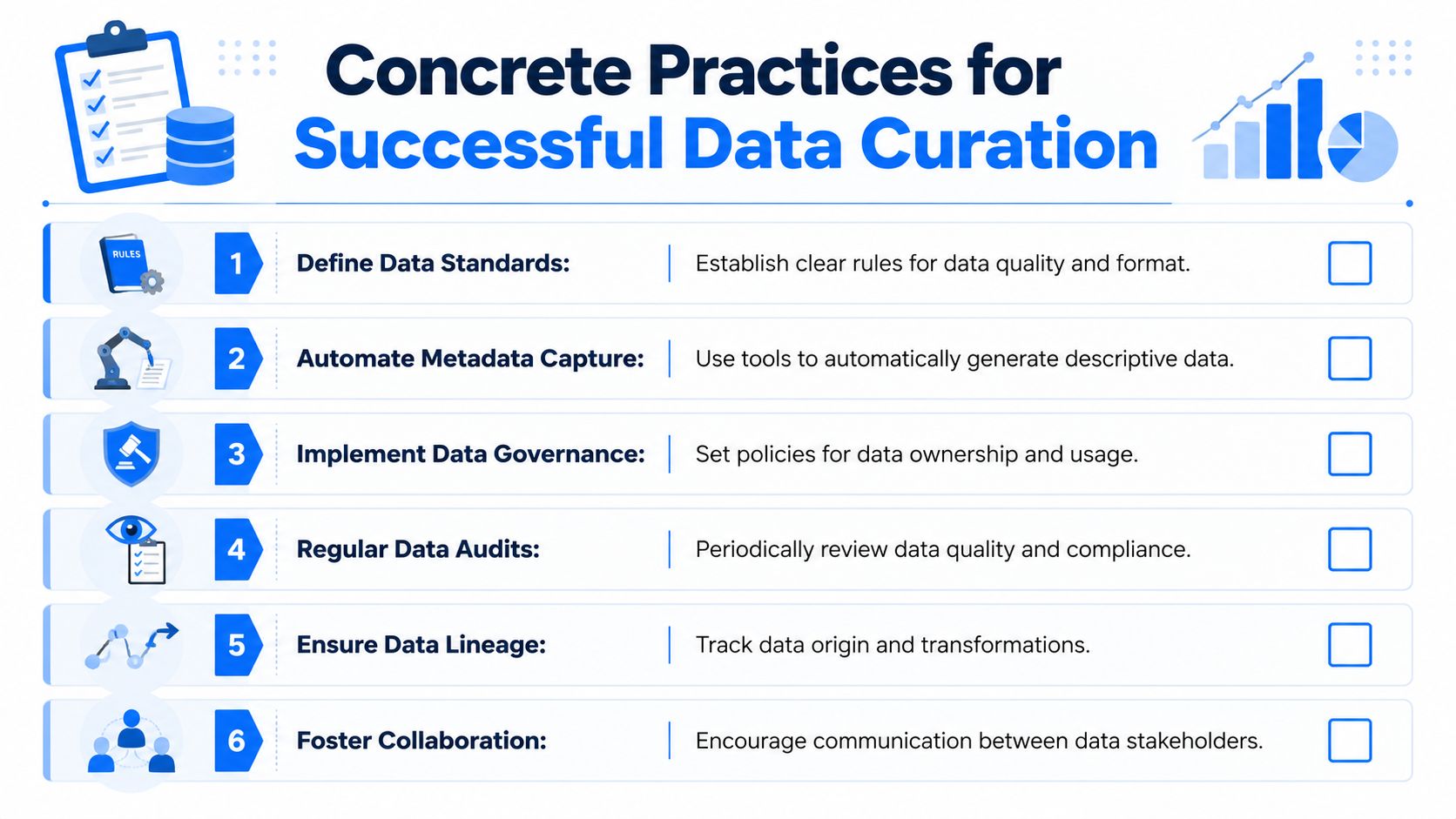
Practices that hold up in production
Start with standards that engineers can implement.
Define quality dimensions: Teams need explicit expectations for accuracy, completeness, consistency, timeliness, and validity. Without agreed dimensions, quality reviews turn into opinion.
Capture rich metadata: A useful asset needs business definitions, source notes, transformation context, owners, and usage guidance. Column names alone aren't documentation.
Version curated datasets: If a model, dashboard, or external report depends on a dataset, version changes matter. Silent revisions make root-cause analysis much harder.
Document lineage: Users should be able to trace how raw inputs became a curated output. That's essential for debugging and for regulated environments.
Validate business rules: Structural validity isn't enough. Records also need to satisfy domain logic such as allowed states, referential assumptions, and cross-field consistency.
Review regularly: Curated assets need periodic inspection because source systems, processes, and semantics change.
One place teams often learn this the hard way is during platform moves. A warehouse migration or application rewrite exposes undocumented assumptions fast. If your team is preparing for that kind of transition, this guide to database migration is useful because it highlights the operational discipline needed to preserve integrity when data structures and movement paths change.
Field note: Metadata written after a crisis is usually shallow. Metadata written as part of delivery tends to be accurate enough to help the next team.
How to judge whether curation is working
You don't need invented benchmarks to know whether progress is real. Use operational signals that reflect user experience and system reliability.
Look for changes such as:
Faster time to insight: Analysts spend less time locating and decoding datasets.
Higher adoption of curated assets: Teams prefer governed, documented tables over ad hoc extracts.
Fewer support interruptions: Data engineers and analytics teams field fewer “what does this column mean?” and “why did this dashboard change?” requests.
Cleaner incident resolution: When something breaks, lineage and ownership reduce diagnosis time.
More stable downstream products: Dashboards, reverse ETL jobs, and ML pipelines fail less often from avoidable data issues.
What doesn't work is measuring curation only by the number of docs written or tickets closed. The point is reliable use, not administrative activity.
How Modern Observability Tools Power Data Curation
A dataset can be fully documented on Monday and still break trust by Wednesday. A source team adds a column, a pipeline starts landing late, or a metric shifts just enough to distort a dashboard without triggering a hard failure. At enterprise scale, curation stops being a documentation exercise and becomes an operating model.
Why manual curation breaks at scale
Manual reviews work for a small number of stable assets. They fail when dozens of teams publish data, schemas change often, and downstream consumers depend on curated tables for reporting, activation, or machine learning. Spreadsheets of checks and wiki pages cannot keep pace with live systems.
Modern curation needs continuous signals from production data. Observability provides those signals by tracking freshness, schema stability, lineage, volume patterns, and rule violations as part of day-to-day operations. For teams that want a clearer definition, this guide on what data observability means in practice connects monitoring with trust in the data product, not just pipeline uptime.
The trade-off is straightforward. More monitoring creates more signals, and poorly configured signals create noise. Good teams do not monitor everything equally. They apply tighter controls to business-critical assets and use lighter heuristics for lower-risk data.
What observability automates well
A strong observability layer automates the repetitive detection work so data stewards, analysts, and engineers can spend time on judgment, remediation, and policy decisions.
Key automated curation tasks:
Anomaly detection: Observability systems flag unusual shifts in freshness, row counts, null rates, categorical distributions, and business metrics. Oracle's explanation of AI-powered anomaly detection is useful on this point because it describes how dynamic baselines adapt to changing patterns instead of relying only on fixed thresholds. That matters in curation because valid behavior changes by season, market, source system state, and customer segment.
Schema change monitoring: Added columns, dropped fields, renamed objects, and type changes often break curated assets before business users know anything changed.
Record-level validation: Business expectations such as allowed values, uniqueness, referential integrity, and threshold checks become executable tests rather than unwritten assumptions.
Timeliness monitoring: Late, partial, or missing loads are treated as curation failures when they affect trusted consumption.
Historical pattern analysis: Teams can distinguish a one-time outlier from gradual degradation, which improves prioritization and incident response.
In practice, observability becomes the engine behind scalable curation because it connects metadata, lineage, quality checks, and incident workflows. That connection is what turns curation into a maintained data product instead of a one-time cleanup effort.
Some teams also need platform support while expanding curation around lakehouse and warehouse stacks. If you are evaluating external help, a directory like compare Databricks consulting services can help narrow partners by specialization and delivery focus.
Your Implementation Checklist and Common Pitfalls
Teams usually decide they need data curation after a trust break. A finance dashboard shifts after a source-system change, a model starts scoring on partial data, or analysts find three definitions for the same metric. The fix is rarely a large program at the start. It is a controlled rollout with clear ownership, explicit quality rules, and monitoring that catches drift before consumers do.
A practical starting checklist
Start with one dataset that already affects decisions. A pilot works best when the business impact is obvious and the scope is still small enough for the team to maintain.
Pick one business-critical dataset: Choose an asset tied to a high-visibility report, operational workflow, or model input.
Define minimum quality expectations: Agree on the conditions that make the dataset fit for use, including semantic rules, freshness expectations, and tolerated exceptions.
Assign ownership: Name the engineer who maintains pipelines, the steward who manages definitions and metadata, and the business contact who approves meaning and acceptable use.
Create baseline metadata: Record source systems, field definitions, refresh pattern, downstream consumers, and known limitations.
Instrument monitoring and validation: Put checks around schema changes, freshness failures, volume anomalies, and business-rule violations.
Set a maintenance cadence: Review incidents, metadata gaps, ownership questions, and requested changes on a recurring schedule.
A good checklist is not documentation for its own sake. It creates the operating model for a reliable data product. Observability matters here because manual review does not scale once the dataset changes frequently or feeds multiple teams.
Common failure modes to watch for
Curation programs usually break in operations, not in strategy decks.
No business involvement: Engineers can enforce structure and pipeline health, but they cannot define semantic correctness without the people who use the data to make decisions.
Metadata postponed until later: Deferred documentation turns into tribal knowledge, and tribal knowledge fails during incidents, handoffs, and audits.
Too many assets too early: Broad scope creates review queues, weak ownership, and inconsistent standards before the team has a repeatable process.
Ownership by committee: Shared interest does not resolve incidents. One accountable owner does.
Tool-first thinking: Platforms help teams detect issues, route alerts, and track history, but they do not define trust on their own.
Start where trust is already fragile. Restoring one visible dataset usually gets more support than curating a larger set of low-impact assets.
Avoiding these failure modes takes operating discipline. A dedicated platform helps by turning quality expectations, lineage, metadata, and incident response into repeatable workflows instead of manual follow-up.
If your team is trying to make data curation operational instead of aspirational, digna can help by monitoring anomalies, validating records, tracking schema changes, and surfacing timeliness issues inside customer-controlled environments so engineers and analysts can keep curated data products trustworthy at scale.