What Is Data Discovery? a Practical Guide for 2026
|
5
min read

A dashboard that looked healthy yesterday is flat today. A revenue report is off by just enough to spark a meeting. An ML feature table still exists, but the model fed by it has started producing nonsense. Typically, the first response is the same: open the warehouse, check recent loads, inspect lineage, ask who changed what, and hope the answer appears before someone important notices.
That scramble provides the context for what Data Discovery is. It isn't a glossary term. It's the discipline that helps engineers, analysts, and ML teams find the right data, understand what it means, and decide whether it's safe to use right now. The last part matters most. A dataset can be perfectly documented and still be operationally useless if a column changed type overnight, a load arrived late, or values drifted outside their normal range without triggering an alert.
Table of Contents
The Search for Answers in a Sea of Data
Most data teams don't start caring about discovery because they love metadata. They care because production breaks in ways that are hard to see.
A common pattern looks like this: finance opens a KPI dashboard and notices a sudden drop. The SQL still runs. The table still exists. The BI layer hasn't changed. Yet the result is wrong. Someone traces the issue back to a pipeline that loaded late, or to a source team that added a field and shifted downstream assumptions. The catalog says the dataset is available, but the business is looking at stale or distorted numbers anyway.
That's the observability gap. A static inventory tells you what existed when the crawl ran. It doesn't tell you whether the data is fresh, structurally stable, or still behaving like the asset people think they're using.
A discovered dataset isn't automatically a trustworthy dataset.
This gap is one reason the category keeps expanding. The global data discovery market was valued at USD 7.50 billion in 2021 and is projected to reach USD 20.03 billion by 2030, growing at a CAGR of 15.60%, according to Spherical Insights on the data discovery market. That shift matters because it shows discovery is no longer treated as optional documentation. Teams increasingly treat it as part of operational data infrastructure.
Static metadata doesn't solve production uncertainty
Traditional discovery tools answer basic questions well:
Where is the dataset located: warehouse, lake, SaaS export, or application store.
Who owns it: at least on paper.
What does it contain: columns, types, tags, and descriptions.
How is it queried: if usage and lineage are captured.
Those are useful answers. They just aren't enough when the problem is live system behavior.
If you're tuning performance during an incident, work like Riff Analytics on query optimization is often more helpful than another static glossary entry, because the primary task is usually operational: identify what's slowing, what's changed, and what downstream work is now suspect.
Discovery is really about decision confidence
The practical question isn't "Do we have data?" It's "Can someone use this dataset for a report, feature pipeline, or executive decision without stepping on a hidden failure?"
That changes how engineers should think about discovery. It stops being a one-time documentation sprint and becomes an ongoing capability tied to reliability. When pipelines drift imperceptibly, discovery has to keep up. Otherwise, teams keep searching for answers in systems that still look intact from the outside.
What Is Data Discovery Really
The shortest useful definition is this: Data Discovery is the continuous process of finding, understanding, and evaluating data assets so people can use them with context and trust.
That sounds simple until you consider how most organizations do it. Many still rely on a catalog built from scheduled crawls, manually maintained descriptions, and a layer of tribal knowledge that lives in Slack threads and analyst notebooks. That setup works until the environment changes faster than the documentation does.
A better analogy is transportation. A traditional catalog is a paper map. It can show roads, names, and rough routes. But if traffic backs up, a bridge closes, or construction starts, the map doesn't help much. Modern discovery should behave more like a live GPS. It still tells you where things are, but it also tells you whether the path is usable right now.

The practical definition engineers can use
In an operating data platform, discovery should answer four questions at once:
What exists
What it means
How it's connected
Whether it's dependable now
The first three are familiar. The fourth is where weak implementations fail.
A table with clean descriptions but unstable upstream behavior is only partially discovered. A feature set that analysts can find but can't validate for freshness isn't fully ready for AI or BI use. Good discovery combines metadata, content understanding, usage context, and current operating condition.
What Data Discovery enables
When teams ask what is Data Discovery, they're often really asking what they get from it. In practice, they get a usable layer between raw storage and business consumption.
That layer supports work such as:
Faster dataset selection: analysts stop guessing which table is current or canonical.
Safer reuse: engineers can inspect lineage, definitions, and recent behavior before wiring a dataset into production.
Clearer ownership: people know who to contact when a metric looks wrong.
Lower friction for AI and analytics: teams spend less time hunting and more time validating.
Practical rule: If discovery doesn't help a user decide whether to trust a dataset today, it isn't finished.
The shift from inventory to operational intelligence
The old model treated discovery as a documentation artifact. The modern model treats it as an operational intelligence layer.
That's an important distinction. Inventory tells you the warehouse contains an object. Operational intelligence tells you whether that object is current, stable, and suitable for the task in front of you. In mature environments, discovery isn't separate from day-to-day engineering. It's embedded in how teams assess quality, choose data sources, investigate incidents, and protect downstream consumers from bad assumptions.
How Modern Data Discovery Works
Modern discovery works best when it behaves like an automated system, not a manual research project. Engineers shouldn't have to inspect every schema, hand-write every quality rule, and cross-reference every downstream dependency just to understand whether a dataset is usable.
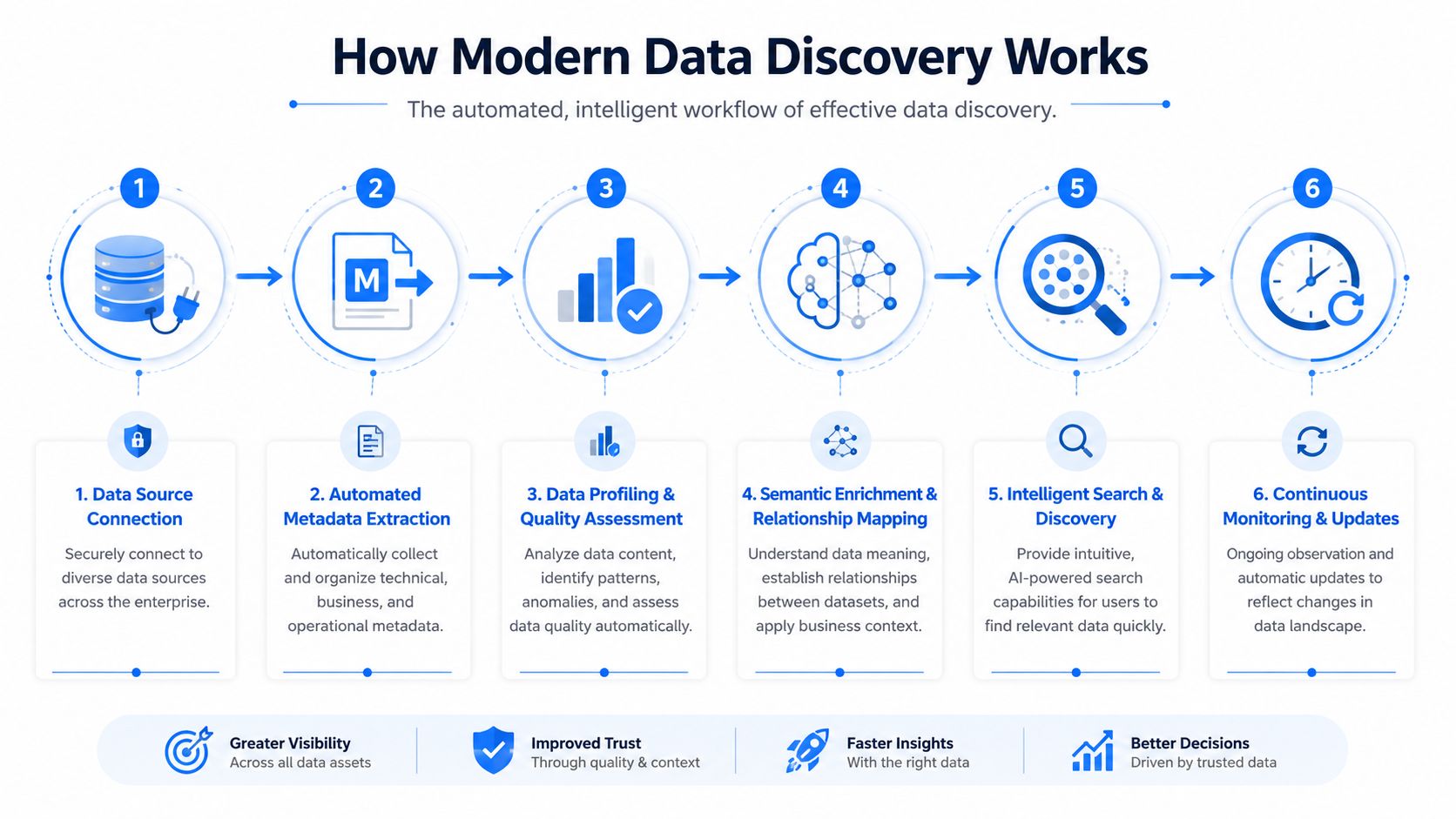
The workflow usually starts with connection and extraction. Systems connect to warehouses, lakes, and pipeline layers, then pull technical metadata, structural details, usage signals, and operational context. From there, the platform builds a richer view of what the data is, how it behaves, and where it's used.
Profiling builds the first layer of understanding
Profiling is where discovery stops being a directory and starts becoming useful. Automated systems compute descriptive statistics, examine distributions, surface null patterns, and look for outliers. That gives teams a grounded picture of how a dataset behaves instead of how someone described it months ago.
The integrity of production data is crucial, but it often fails without immediate notice. Values drift. Category distributions change. A source starts sending blanks where it used to send IDs. According to lakeFS on data discovery, automated data discovery that uses AI-driven profiling can flag 30-40% more silent data quality issues before they impact decision-making.
A useful side effect is that teams write fewer brittle manual checks. The platform learns what normal looks like and highlights deviations instead of making engineers maintain endless threshold rules.
Classification and semantics add business meaning
Raw profiling doesn't tell you whether a field contains customer identifiers, payment-related values, or low-risk telemetry. That's where classification and semantic enrichment matter.
A practical modern flow often includes:
Sensitive data identification: systems classify likely regulated or high-risk fields so teams can govern access appropriately.
Entity and domain context: tables get linked to business concepts, not just storage locations.
Relationship mapping: lineage and dependency graphs show where a dataset comes from and what breaks if it changes.
Some organizations also connect discovery outputs to internal knowledge systems. A good example of the broader pattern is Donely's Company Brain platform, which reflects the same operational need: connect scattered information to usable context so teams can act faster.
Continuous monitoring closes the gap
Modern discovery distinguishes itself from old cataloging. Metadata extraction and profiling create a snapshot. Monitoring keeps that snapshot alive.
A solid discovery stack watches for things like schema drift, delayed loads, unusual metric movement, and changing arrival patterns. That's the same operating model described in what Data Observability means in practice, where the goal isn't just documenting data assets but watching their condition continuously.
The dataset that breaks your dashboard usually doesn't disappear. It stays visible while becoming misleading.
Once teams understand that, the architecture gets clearer. Discovery isn't a crawl followed by search. It's a loop of extraction, profiling, enrichment, and observation that keeps pace with the data estate itself.
Strategic Benefits and Common Use Cases
Data Discovery earns its budget when it reduces bad decisions, shortens incident response, and improves confidence in data-dependent systems. The value isn't abstract. It shows up in whether teams can trust reports, deploy AI safely, and govern sensitive information without turning every request into a manual review.
Trustworthy AI depends on discoverable data
AI programs often fail upstream, not in the model code. Teams can fine-tune prompts, tune features, and revisit evaluation frameworks, but if the inputs are poorly understood, delayed, or semantically inconsistent, the outputs won't stabilize.
This is why discovery has become more strategic as adoption rises. As of 2024, 42% of large organizations are actively deploying AI, according to IBM's data on enterprise AI adoption. In practice, that means more organizations need to know which datasets are fit for training, inference, feature generation, and retrieval workflows.
Reliable BI depends on current context
Business intelligence breaks when a metric looks legitimate but reflects stale, incomplete, or structurally altered data. Discovery helps by giving analysts and BI developers context before a bad chart reaches an executive deck.
A few common use cases stand out:
Executive reporting: finance and operations teams need to verify that the source behind a KPI is both the intended one and still current.
Self-service analytics: analysts need search, lineage, ownership, and recent behavior signals before they reuse a table.
Root-cause investigation: data engineers need to narrow the blast radius when a dashboard diverges from expected behavior.
Governance works better when discovery is built in
Compliance and governance are where many catalog projects start, but they only work at scale if discovery is active rather than passive.
Good discovery helps teams:
Need | How discovery helps |
|---|---|
Sensitive data handling | Identifies likely regulated fields and gives stewards a clearer view of where they live |
Access review | Shows ownership, usage context, and dataset purpose before permissions expand |
Audit support | Preserves metadata, lineage, and operational context that explain how data is used |
If a team can't tell what a dataset contains, who owns it, and whether it's current, governance becomes guesswork.
That is why discovery belongs in platform strategy, not just governance tooling. It supports engineers, analysts, ML practitioners, and stewards at the same time.
Discovery vs Cataloging vs Profiling Explained
These terms get mixed together constantly, and that confusion creates bad architecture decisions. Teams buy a catalog and expect active discovery. They run profiling jobs and assume they now have governance. They document a few key assets and call the problem solved.
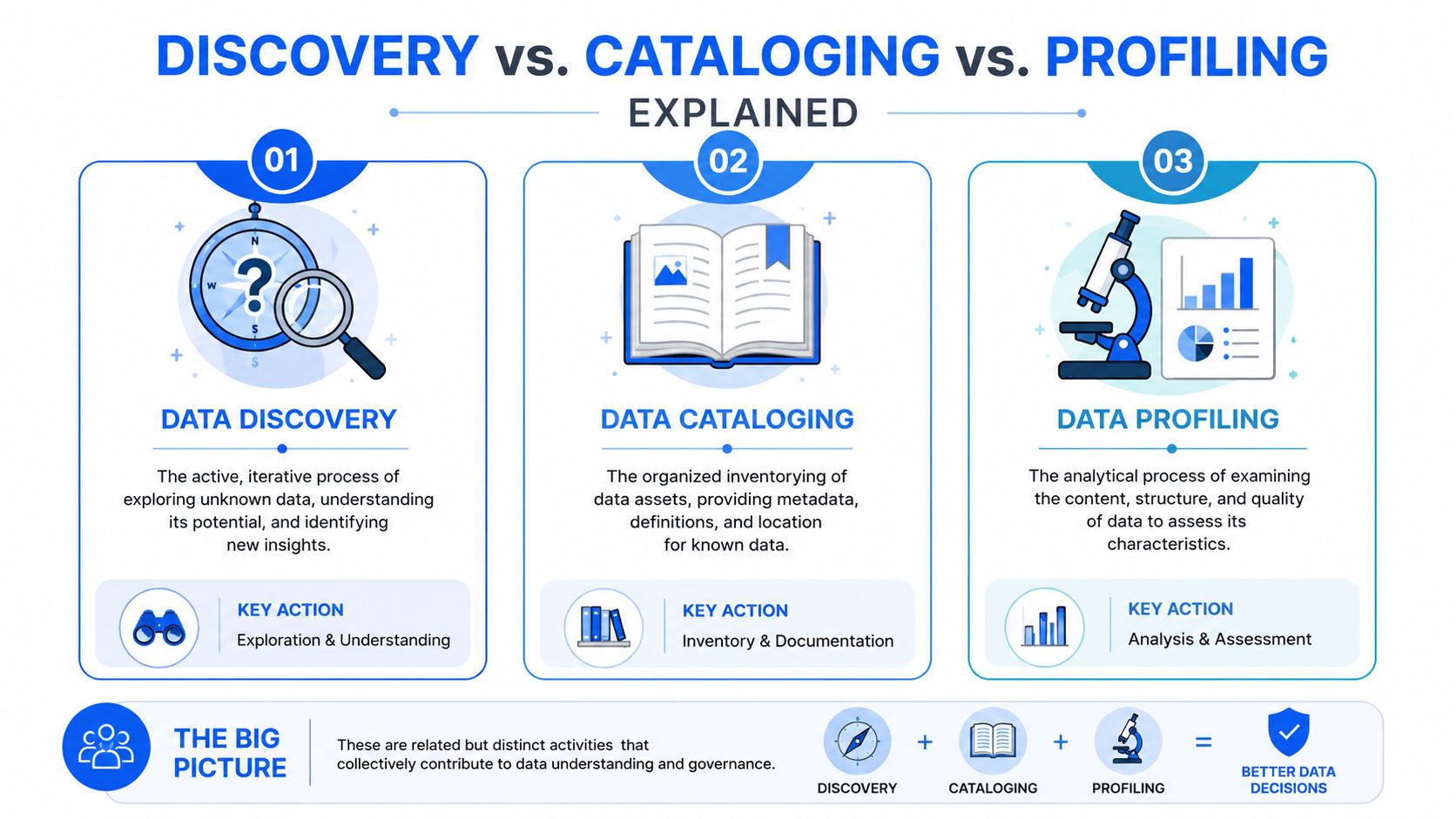
The clean way to think about it is this: profiling examines data, cataloging organizes metadata, and discovery uses both to help people find and evaluate data for actual use.
A side by side view
Discipline | Primary job | Typical output | Main limitation on its own |
|---|---|---|---|
Data profiling | Inspect content and structure | statistics, null rates, distributions, anomalies | Doesn't organize assets for broad discovery |
Data cataloging | Inventory and document assets | metadata, definitions, ownership, tags | Can go stale quickly if not kept current |
Data discovery | Help users find, understand, and assess data | searchable, contextual, trust-oriented data access | Requires the other disciplines to be effective |
That table matters because the tools often overlap, but the operating purpose isn't the same.
Where teams usually get it wrong
Some teams treat the catalog as the finished product. It isn't. A catalog is a reference system. It's valuable, but it's not a substitute for current knowledge about behavior, quality, and readiness.
Other teams over-focus on profiling. They generate rich statistics for individual tables but never connect those outputs to ownership, lineage, business meaning, or user-facing search. The result is technically interesting and operationally awkward.
A more durable approach is to treat the catalog as a component inside discovery. That's also why resources on unlocking enterprise potential with AI tend to emphasize usable context, not just raw data availability. AI and analytics need more than stored assets. They need understandable assets.
How they fit together in practice
A working stack often looks like this:
Profiling provides evidence: what values exist, how they distribute, whether something looks off.
Cataloging provides structure: where assets live, what they're called, who owns them.
Discovery provides usability: which asset a person should choose, whether it matches the task, and whether it can be trusted.
If you want the detailed distinction from the metadata side, this explanation of what a Data Catalog is is the right adjacent concept. The important operational point is that discovery is broader. It includes the catalog, uses profiling, and extends both into a decision layer for real users.
Common Challenges in Data Discovery
The hardest part of discovery isn't building an index. It's keeping that index aligned with a living data estate.
A warehouse table may still exist under the same name while its meaning changes under load. A source team might add columns without warning. A pipeline can continue to run on schedule while delivering empty partitions or unexpectedly delayed data. In each case, the asset remains "discoverable" in a static sense and unreliable in a practical one.
Static discovery decays fast
A catalog crawl captures metadata at a moment in time. That becomes a problem the minute a production system shifts.
Three failure modes show up repeatedly:
Silent drift: value distributions change enough to alter reports or model behavior without causing a hard failure.
Schema changes: a renamed field, added column, or data type change breaks assumptions downstream.
Ownership drift: the listed owner left the team, and now nobody responds when the metric goes bad.
None of these are unusual. They are normal conditions in active data platforms.
Timeliness is often underestimated
Freshness problems are especially dangerous because the data can look valid. The query runs. The rows are there. The numbers are late.
According to Monte Carlo's explanation of common data anomalies, late data is one of the eight most common data anomalies impacting quality. That's why expected delivery monitoring matters so much in analytics environments. If a business review starts at 9:00 and the source lands at 9:20, the issue isn't discoverability in the catalog sense. It's discoverability of current truth.
Fresh data and available data aren't the same thing.
Scale and fragmentation make manual discovery brittle
Even well-run teams struggle when data is split across warehouses, lakes, reverse ETL outputs, SaaS connectors, and ML feature stores. Manual curation doesn't keep up with that shape of environment.
The usual symptoms are easy to spot:
Engineers rely on memory to decide which table is canonical.
Analysts duplicate datasets because they can't verify existing ones.
Incident review starts with detective work instead of evidence.
Teams trust green pipelines while consumers stare at broken dashboards.
A set-it-and-forget-it approach doesn't survive these conditions. Discovery has to be maintained as an operating capability, not archived as documentation.
Powering Continuous Discovery with digna
The observability gap closes when discovery stops being a historical record and starts reflecting live behavior. That's where a platform like digna changes the operating model.
Instead of asking teams to maintain endless threshold rules, digna uses AI-powered anomaly detection that learns normal behavior and adapts thresholds dynamically. According to digna's overview of AI anomaly detection techniques, platforms like digna use techniques such as Isolation Forests to flag true anomalies without the manual rule maintenance required by traditional systems.
What that means in day to day operations
In practice, continuous discovery needs three things to work:
Behavioral monitoring: detect when data starts acting differently, even if schemas and jobs still appear normal.
Structural awareness: catch added or removed columns, type changes, and other shifts before they cascade into reports or models.
Timeliness control: surface late or missing arrivals before users consume stale outputs.
digna aligns with that model through Data Anomalies, Schema Tracker, and Timeliness. Together, those capabilities keep discovery current instead of letting it freeze at crawl time.
Why architecture matters
A lot of observability products create friction because they require broad data movement or vendor-side access to sensitive production records. digna's approach is different. It computes metrics in-database and runs in customer-controlled environments such as private cloud or on-prem deployments.
That design matters for regulated enterprises and for any engineering team that doesn't want another external dependency touching production data. It also makes continuous discovery more practical at scale, because the platform can inspect trends, expected arrival behavior, and schema shifts without turning every analysis into a data export project.
Discovery becomes trustworthy when the system can tell you not only what the asset is, but whether it is still behaving like the asset you think it is.
If your team needs that kind of live visibility, digna is built for it. It helps data engineers, analytics teams, and ML practitioners detect anomalies, monitor timeliness, track schema changes, and keep data quality analysis inside their own environment so discovery stays current, operational, and trustworthy.
Because renamed fields and type changes are among the fastest ways discovery goes stale, see how digna Schema Tracker catches structural changes before they cascade into reports or models.
Frequently asked questions
What is data discovery?
Data discovery is the continuous process of finding, understanding and evaluating data assets so people can use them with context and trust. It should answer four questions at once: what exists, what it means, how it is connected and whether it is dependable right now. That last question is where weak implementations fail.
What is the difference between data discovery, data cataloging and data profiling?
Profiling examines data content and structure, producing statistics, null rates and distributions. Cataloging inventories and documents assets with metadata, definitions and ownership. Discovery uses both to help people find a dataset, understand it and decide whether it can be trusted for the task at hand. On its own, a catalog quickly goes stale.
How does modern data discovery work?
It runs as a loop rather than a one-off crawl. Systems connect to warehouses, lakes and pipelines to extract metadata, then profile distributions and null patterns, add classification and lineage, and keep monitoring for schema drift, delayed loads and unusual metric movement so the picture stays current.
Why is timeliness important for data discovery?
Late data can look perfectly valid: the query runs and the rows are there, but the numbers are stale. The article gives the example of a business review starting at 9:00 while the source lands at 9:20. Expected delivery monitoring makes the current truth discoverable, not just the dataset itself.
How does digna support continuous data discovery?
digna keeps discovery current through three modules: Data Anomalies for behavioral monitoring, Schema Tracker for structural changes and Timeliness for late or missing arrivals. It learns normal behavior with AI-based anomaly detection, computes metrics in-database and runs in customer-controlled private cloud or on-prem environments.