Mastering AI Data Quality for Enterprise Monitoring 2026
|
7
min read

Monday morning starts with a familiar kind of pain. A dashboard that should have been calm is blinking red, the numbers look off, and nobody can agree whether the issue is real or just another stale feed. By the time someone traces it back to a late file, a duplicate batch, or a quiet schema change, the damage is already in the meeting notes, the model output, or the board pack.
This is the current state of AI data quality in 2026. It's no longer a tidy exercise in fixing nulls and deduplicating rows, because modern pipelines move too fast for static checks to catch every meaningful change. In Europe especially, the conversation has shifted from “is the data clean?” to “can we trust the data, prove it, and govern it across the full lifecycle?” That's why observability, auditability, and lineage now sit beside accuracy as first-class concerns, especially for high-risk AI and regulated environments. A good starting point is the practical observability view at digna's data observability overview.
Beyond Clean Data The New Imperative
A finance team can live with a broken chart for an hour. A pricing engine cannot. When the feed is subtly delayed, or when the incoming distribution shifts just enough to stay inside a brittle rule, the business still feels the impact. Manual checks catch the obvious stuff, but they miss the quiet failures that arrive one record group at a time.
That's why AI data quality has outgrown the old “clean it later” mindset. EU-focused research now treats data quality controls as part of broader data governance, especially where high-risk AI is involved and datasets must be relevant, representative, free of errors, and complete (European Journal of Information Law analysis of Article 10). The governance angle matters because a bad dataset is not just a modelling nuisance, it's evidence that the pipeline can't yet be trusted.
The shift from cleanup to control
The old model was simple. A data engineer wrote a rule, a dashboard fired an alert, and somebody investigated after the damage spread. That works when the issue is literal and repeated. It falls apart when the failure is behavioural, such as a feed that arrives on time but with a changed distribution, or a customer segment that vanishes without triggering a null check.
That's the point of modern observability. It doesn't just ask whether the column exists. It asks whether the data still behaves like the data you expected. For teams in Spain or across the EU, that's more than convenience, it lines up with the rights-focused view that dependable AI starts with dependable controls. A useful practical lens is the one used by platforms built for this problem, such as data quality dimensions and how to measure them, because the dimensions matter as much as the tooling.
Practical rule: If a data issue can only be found by a person opening a spreadsheet at the end of the week, it's already too late for operational AI.
The better question is whether the system can detect drift, delay, duplication, and validity issues before business users see the symptoms. That's the critical standard now, and it's a governance bar as much as a technical one.
What AI Data Quality Actually Means
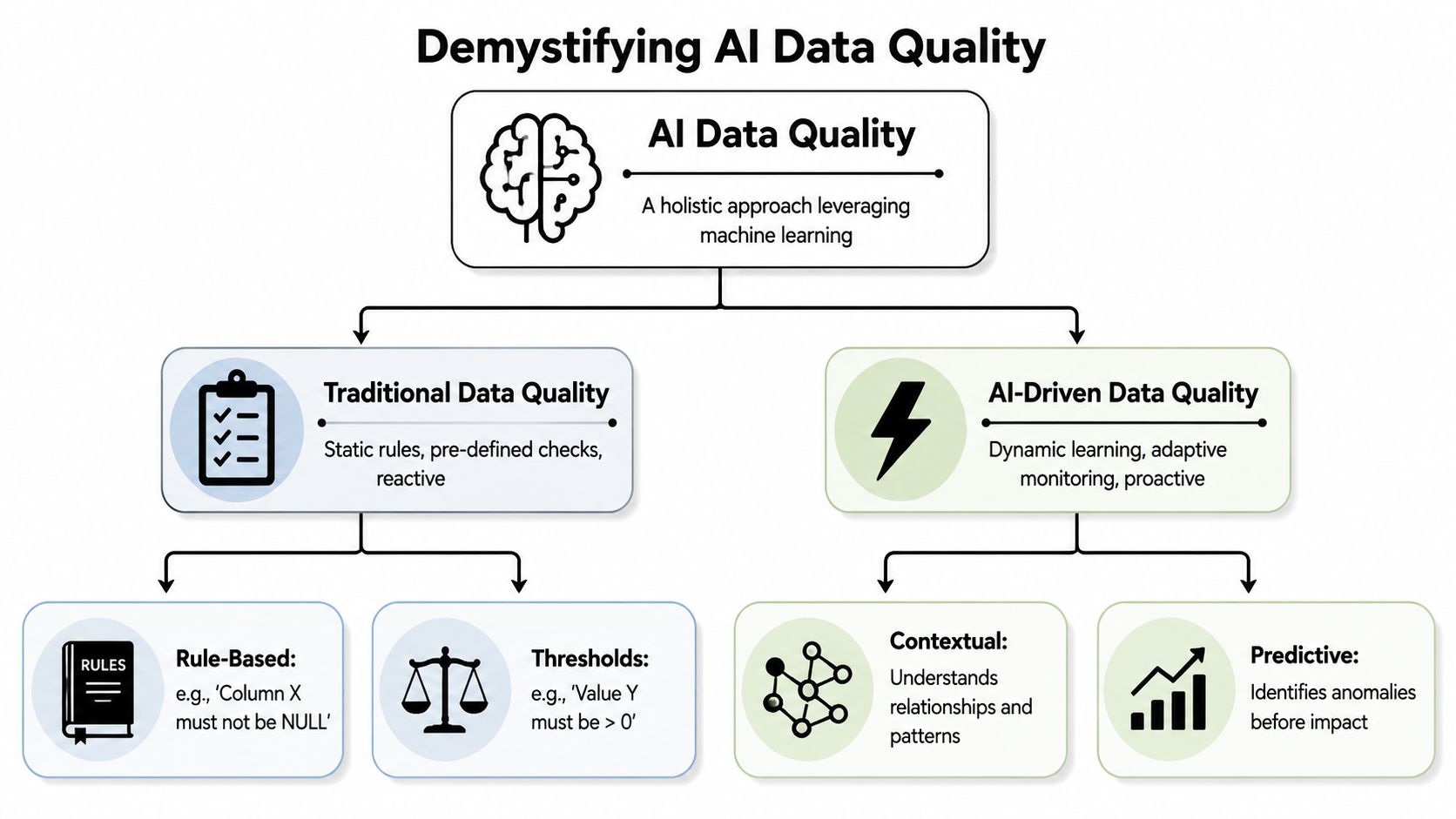
Traditional data checks are like a car alarm with one job, it screams when a window opens. Useful, but blunt. An intelligent home security system watches movement patterns, door timing, unusual access, and context around what's normal for that house. AI data quality works more like the second model, because it learns the heartbeat of a pipeline instead of waiting for a single rule to break.
The FRA's definition is a good anchor here. It says data quality for AI includes completeness, accuracy, consistency, timeliness, duplication, validity, availability, and provenance (FRA report). That matters because it widens the lens. A dataset can be accurate in a narrow sense and still be useless if it arrives late, lacks provenance, or has shifted enough to make downstream decisions unreliable.
Static rules versus learned behaviour
Rule-based monitoring asks things like “Is column X null?” or “Is value Y above zero?” Those checks are still useful, and nobody serious should throw them away. But they only catch the conditions you already thought to encode.
AI-driven monitoring learns normal patterns across time, volume, distribution, seasonality, and relationships between fields. It can flag a change even when the raw values still pass a fixed threshold. That's the key difference, and it's why modern teams use AI to complement, not replace, hard rules.
The dimensions that really matter
The FRA framing also helps teams avoid a common mistake, treating “data quality” as one vague score. It isn't. The dimensions split into different operational questions.
Completeness asks whether the data is there.
Timeliness asks whether it arrived when expected.
Consistency asks whether records still agree with each other.
Provenance asks where it came from and how it changed.
Validity asks whether records still make sense against the expected shape of the business.
That broader definition lines up well with operational observability. A system that monitors trends, schema changes, late arrivals, and record-level validity is doing real data quality work, not just housekeeping.
How AI Actively Improves Data Monitoring
European official-statistics practice already shows how this works in practice. AI is being used to support data ingestion, classification, editing, anomaly detection, and imputation suggestion, while human oversight remains in the loop to protect quality (EU official statistics webinar). That's a useful model for enterprise teams too, because it keeps the machine focused on pattern detection and keeps the expert focused on judgement.
The biggest win is not that AI is magical. It's that it scales the kind of vigilance humans are bad at sustaining manually. A platform can learn that a feed usually lands by the same time on weekdays, or that a metric naturally rises after a specific business event, then highlight the exception without someone writing a custom rule for every case. For a more product-level view of this, the workflow described in how AI detects data anomalies in pipelines maps neatly to the way teams triage incidents.
Baselines that move with the data
Static thresholds are fragile because normal changes over time. A seasonal business doesn't have one fixed pattern, and neither does a modern warehouse. AI baseline learning adapts to recurring behaviour, so the alert fires on the unexpected change rather than the expected cycle.
That makes a real difference in incident response. Instead of arguing whether a spike is “bad,” teams can see whether it deviates from the learned pattern. The signal gets better, and the noise drops.
Timeliness is a quality issue, not a scheduling annoyance
European data management treats timeliness as formal quality, not a soft operational concern. The EUROCAT DQI framework includes timeliness of data transmission alongside completeness and accuracy (EUROCAT DQI list). That's a strong reminder that a late delivery can be just as damaging as a wrong value.
A feed that lands two hours late can be more dangerous than a feed with a visible error, because the dashboard still looks healthy while the business acts on stale numbers.
Traditional Rules vs AI-Powered Monitoring
Aspect | Traditional Rule-Based Approach | AI-Powered Approach |
|---|---|---|
Detection style | Fixed thresholds and handcrafted checks | Learns behaviour and watches for deviations |
Response timing | Often reactive | Proactive and continuous |
Coverage | Limited to known failure modes | Better at finding unknown anomalies |
Maintenance | Rules need constant upkeep | Models adapt as pipelines evolve |
Timeliness | Usually separate from other checks | Monitored as part of normal behaviour |
For teams managing complex pipelines, that shift turns monitoring from a fire alarm into an early-warning system.
The Real Benefits and Hidden Risks
The best argument for AI data quality is simple. It cuts the time teams spend writing and maintaining brittle tests, and it catches issues that no one thought to encode in advance. That matters when pipelines change often and the failure modes keep evolving. It also improves trust, because analysts and business users stop seeing quality checks as a back-office ritual and start seeing them as part of the product.
There's also a deeper benefit in regulated industries. Practitioner research aligned with EU regulations found that missing data was the top quality issue, while privacy issues (37%) were a major concern (EU-aligned practitioner research). That's a reminder that quality work in finance, healthcare, and telecom has to happen inside controlled environments, not after the sensitive data has been shipped somewhere else for inspection.
What gets better fast
Teams usually notice three practical wins first. The first is reduced manual triage, because the system filters obvious noise before a person gets involved. The second is earlier warning on unknown issues, which matters more than perfect classification of every incident. The third is better confidence in downstream reporting, which makes people less likely to build their own shadow checks.
That confidence is fragile, though. If the monitoring layer itself becomes opaque, or if every edge case triggers a noisy alert, adoption stalls. Alert fatigue can kill a good system faster than bad modelling can.
The privacy trade-off most articles skip
A vendor that copies sensitive data out of a controlled environment creates a new problem while trying to solve the old one. For regulated teams, the safer pattern is usually in-database or on-prem monitoring, where the analysis runs next to the data instead of moving the data to the analysis. That architecture lines up with sectors that need privacy by default, and it's one reason platform choices matter more than feature checklists.
The same privacy and governance tension shows up in medical testing too. A useful parallel is mastering clinical test accuracy, because it helps frame why sensitivity, specificity, and context all matter when the cost of a wrong signal is high.
Why architecture is part of the quality story
digna runs inside the customer environment, either on-premises or in a private cloud, and its docs state that it is never delivered as SaaS, with no vendor access to customer data (digna docs in Spanish). That design choice is not a marketing flourish. It directly addresses the practical barrier many European teams face, which is how to improve quality without weakening control.
It also matters for governance evidence. If the system that checks quality is itself operating inside the protected environment, the audit story is cleaner, and the security review is usually less painful.
Adopting AI Data Quality in the Enterprise
The enterprise rollout usually fails for one of two reasons. Either the team buys a shiny tool before defining the operational problem, or they bolt it onto a workflow that nobody owns. The better path is narrower and less glamorous. Pick one critical pipeline, one business consumer, and one set of quality questions that are already causing pain.
From there, the evaluation criteria become clearer. A real platform should integrate with the current stack, learn patterns without endless manual rule-writing, expose enough explanation for engineers and analysts to trust the output, and operate in the security model your organisation already uses. If it can't do those things, it will become shelfware with a dashboard.
What to look for before you roll anything out
Integration depth: It should work with your warehouse, lake, and pipelines without forcing a parallel stack.
Model transparency: Teams need to understand why something was flagged, not just that it was flagged.
Governance fit: It should produce evidence that supports validation, testing, and review.
Deployment control: For sensitive workloads, look for private cloud or on-prem execution.
Mixed-user usability: Engineers, analysts, and governance leads all need different views of the same issue.
That last point is underrated. If only one specialist can use the tool, the process doesn't scale.
Regulatory pressure changes the buying decision
Under the EU AI Act, datasets for high-risk AI systems must be governed across their lifecycle so they remain relevant, representative, free of errors, and complete (EU AI Act analysis). That means anomaly detection, bias checks, and missing-data handling are not optional extras. They are part of the control plane.
A platform with in-database execution can help because it keeps the analysis close to the data and preserves the evidence trail. That's especially useful when governance teams need to show how a dataset was monitored, not just claim that it was “cleaned”.
One practical approach is to start with a feed that already matters to revenue, compliance, or customer experience. Prove that the system can catch late arrivals, schema changes, or volatility shifts before they become visible to the business, then expand from there. That beats a broad rollout every time.
Your Next Steps Toward Intelligent Data Monitoring
The main shift is already clear. AI data quality is not a decorative layer on top of old rules, it's the operating model for data that changes too quickly to babysit by hand. The organisations that get this right stop arguing about whether every row is perfect and start focusing on whether the pipeline is trustworthy, explainable, and ready for audit.
If you want to move this forward next week, keep it simple.
Choose one high-value pipeline and list the quality failures that hurt decisions.
Test how your current tools handle unknown anomalies, not just known rule breaks.
Bring observability into the governance conversation so compliance, engineering, and analytics are looking at the same evidence.
For a practical starting point, review digna's data quality monitoring tools and map them against your current incident patterns, your deployment constraints, and your audit needs. Then take that shortlist into your next data platform review with one clear question. Can this setup protect trust in the data without slowing the business down?
A CTA for digna.
To see how learned baselines, timeliness and schema monitoring come together inside the customer environment rather than in a vendor cloud, see digna for data platform observability.
Frequently asked questions
What is AI data quality?
AI data quality is monitoring that learns a pipeline's normal patterns across time, volume, distribution, seasonality and field relationships, then flags deviations even when values pass fixed thresholds. The article compares it to a smart home security system, versus traditional checks that behave like a car alarm with one job.
Which dimensions define data quality for AI?
According to the FRA definition cited in the article, data quality for AI covers completeness, accuracy, consistency, timeliness, duplication, validity, availability and provenance. This widens the lens: a dataset can be accurate in a narrow sense yet still unusable if it arrives late, lacks provenance, or has shifted.
Does AI replace rule-based data quality checks?
No, AI complements hard rules rather than replacing them. Checks such as "Is column X null?" or "Is value Y above zero?" remain useful but only catch conditions you already encoded. Learned monitoring adds coverage for unknown anomalies, like a feed that arrives on time but with a changed distribution.
What does the EU AI Act require for training data quality?
Under the EU AI Act, datasets for high-risk AI systems must be governed across their lifecycle so they remain relevant, representative, free of errors and complete. The article concludes that anomaly detection, bias checks and missing-data handling therefore become part of the control plane rather than optional extras.
How should an enterprise start adopting AI data quality?
Start narrow: pick one critical pipeline, one business consumer and one set of quality questions already causing pain. Prove the system catches late arrivals, schema changes or volatility shifts before the business sees them, then expand, checking integration depth, model transparency, governance fit, deployment control and mixed-user usability.