What Is Structural Change? a 2026 Guide
|
6
min read

What Is Structural Change? It's a lasting shift in how a system is organized, and in economics that usually means workers and output move from agriculture toward industry and services. In a data warehouse, it's the same kind of shift when a table's columns, types, or ownership change in a way that keeps affecting downstream work.
You're probably here because something changed. A dashboard went blank after a column rename, a model started behaving strangely after a type shift, or a report stopped matching finance even though nobody "broke" the pipeline in the obvious way.
Table of Contents
The Dashboard That Suddenly Returned Zero
Friday afternoon, the dashboard looked fine. By Monday morning, the same chart was flat, the alert had fired overnight, and the root-cause meeting ended with a developer saying they had renamed a column upstream because the old name felt confusing.
That is structural change in a warehouse. A schema can shift in a way that still lets the pipeline run, while every downstream assumption stays pointed at the old shape. One table can lose a column, gain a new one, change a type, or move under different ownership, and every consumer that depends on the previous structure keeps operating until the output no longer makes sense.
Why this feels so slippery
The hard part is that the pipeline often still “works.” The load finishes, the job turns green, and the semantic result is wrong. BI developers see empty visuals, ML engineers see null-heavy features, and governance teams see controls that no longer line up with the data they were built to watch.
Practical rule: if the output changed but the job did not fail, do not assume nothing happened.
In analytics work, structural change means the contract changed, even if the file arrived on time. A column rename, a datatype shift, a change in null meaning, or a moved table can all be structural because they alter how the system is organized, not just how one query behaves.
The same pattern appears in warehouses because data systems are built on expectations. A dbt model may still compile, a Snowflake task may still run, and a dashboard may still refresh, yet the meaning behind the numbers can be off if the upstream shape changed. That is why engineers watch for persistence, not just failure. A temporary blip is one thing, a changed contract that keeps affecting consumers is another.
Whether the shift happens in GDP or in a warehouse table, the test is the same, did the underlying structure change in a way that will still matter tomorrow?
Where the Term Comes From and Why It Travels So Well
The term began in development economics, where it describes a persistent shift across sectors, first from agriculture into industry, then into services. The Chicago Fed traces the classic framing to Kuznets, who treated this shift as one of the defining features of modern development, not a temporary wobble (Chicago Fed working paper).
That matters because the term only earns its name when the change lasts and spreads. A one-day spike in traffic is noise. A table that changes shape and keeps feeding the wrong assumptions for months is structural.
Why the same idea fits a warehouse
A warehouse is also a production system. Tables, views, dbt models, and orchestration jobs each carry assumptions about what exists, where it lives, and how it behaves. When those assumptions shift, the effect reaches beyond a single broken query because the change moves through dependencies.
The economic version and the data version share the same core idea, the change has to persist. As noted in the broader literature on reallocation and productivity, shifting activity across parts of a system can change aggregate outcomes, not just reflect them. In data terms, schema drift can do the same thing, it can alter the shape of every downstream metric without touching the metric code directly.
Structural change is about the system's new default, not a momentary exception.
That bridge is what makes the term travel so well. Once you start asking whether a change is lasting, widespread, and reorganizing the system, the same lens helps you separate a harmless anomaly from a structural event in a warehouse.
The distinction is easiest to see when you compare a temporary glitch with a lasting shift. A failed refresh can be rerun. A renamed source column, or a type change that keeps breaking joins, changes how every downstream consumer interprets the data. For a practical contrast, see listing change myths explained, which makes the same point in a product context.
A useful rule follows from that comparison. If the shape of the data keeps forcing people to change their assumptions, you are no longer dealing with simple noise.
The Four Faces of Structural Change in Data Systems
Structural change in data isn't one thing. It shows up in four different ways, and each one breaks a different kind of assumption.
Columns, types, meaning, and ownership
First are column changes. A source table adds customer_segment, drops region_code, or renames customer_id to client_id. That's the most visible form of change, and it hurts BI developers first because SQL, dashboards, and semantic layers often depend on exact names.
Second are datatype changes. A STRING becomes an INT, a DATE becomes a TIMESTAMP, or a numeric field gets widened. These changes are quieter because the column still exists, but casts, joins, aggregations, and model feature engineering can drift or fail in subtle ways.
Third are semantic changes. The column still says amount, but the unit changed from cents to euros, or null used to mean “unknown” and now means “zero.” That's the hardest kind to catch with pure schema checks, because the metadata looks stable while the business meaning changes underneath it.
Fourth are lineage and ownership changes. A table moves schemas, gets repointed to a new source, or switches warehouse ownership. Governance leads care here because accountability, access, and audit evidence often depend on knowing who owns the object and what system feeds it.
For a useful contrast, listing change myths explained makes a similar point in another domain, not every visible change means the underlying object changed in the way people assume.
Face of structural change | Warehouse example | Who feels it first | One-line takeaway |
|---|---|---|---|
Columns | Rename customer_id to client_id | BI developers, ML engineers | The contract changed, even if the data still arrives |
Types | Change DATE to TIMESTAMP | Analytics engineers | Casts and aggregations may quietly behave differently |
Semantics | Amount switches from cents to euros | Finance, analysts | The field name stayed put, the meaning didn't |
Lineage and ownership | Table repointed to a new source | Governance, platform teams | Dependencies and controls can change without a DDL shock |
The internal side of this problem is worth mapping too, and schema drift and broken pipelines is a useful companion if you want the pipeline view rather than the conceptual one.
The takeaway is simple. Structural change on the data side isn't defined by one symptom. It's defined by whether the shape of the system changed in a way that downstream consumers can't ignore.
Two Real Stories From the Warehouse Floor
A lot of explanations stop at definition. Real teams need the failure mode.
The rename that poisoned a feature pipeline
An analytics engineer renamed customer_id to client_id in a source table. The staging model still built, and the dashboard team didn't notice because their queries used a newer semantic layer that had already been updated.
The ML feature pipeline wasn't so lucky. It hard-coded the old field name, started feeding nulls into a fraud model, and the drift only surfaced after weeks of odd scores and confusing review cases. Nothing crashed loudly, but the structure changed and the damage landed far from the original edit.
The type widening that nudged finance out of alignment
A SaaS connector upgrade widened a numeric column from FLOAT to DOUBLE. That sounds harmless until you remember that finance teams reconcile tiny differences across systems, and small shifts in numeric behavior can show up in summary totals.
Quarterly revenue dashboards began disagreeing with finance by a fraction of a percent, and reconciliation turned into a slow hunt through transforms, casts, and source assumptions. The pipeline wasn't broken in the obvious sense. The shape of the data had changed, and the mismatch only became visible when people compared systems that were supposed to agree.
Don't look for drama first. Look for the place where a stable assumption stopped being true.
These two stories show why structural change is so easy to miss. The job can still succeed, the schema can still exist, and the impact can show up only in downstream systems that trusted an older contract.
Detecting Structural Change Before It Hurts You
Detection works best when you layer signals instead of relying on one test. A mature team doesn't ask, “Did the table load?” It asks, “Did the structure, meaning, and behavior stay within the bounds we expect?”
Start with the visible layer
Schema diffing is the first pass. Compare the current DDL against a stored baseline and flag added, removed, renamed, or retyped columns. That catches the obvious contract breaks fast, and it gives engineers a concrete object to inspect before downstream consumers start failing.
The next step is lineage-aware change tracking. When a column disappears, you don't just want the alert. You want the list of dashboards, dbt models, notebooks, and ML features that depend on it, because remediation is a dependency problem as much as a schema problem.
Then watch the behavior, not just the shape
Schema checks miss semantic shifts, so you also need behavioral detection. Track row counts, null rates, distinct-value counts, and distribution statistics. If the schema stays identical but the fingerprints change, the meaning probably changed somewhere upstream.
Freshness matters too. A structural change in an upstream system can delay a load or stop it altogether, and timeliness monitoring catches the case where the data looks fine on paper but no longer arrives when the business expects it.
The broader lesson is that detection has to follow the failure mode. Schema diffing catches contracts, lineage exposes blast radius, behavioral monitoring catches silent meaning shifts, and timeliness catches flow disruptions. None of those layers replaces the others.
This is also where understanding AI-related risks becomes relevant, because systems that learn from live data need stronger visibility into drift, stale inputs, and silent changes than simple batch checks can provide.
Choosing the Right Detection Approach
Different teams need different levels of rigor. A small analytics team with a handful of critical tables can get far with manual reviews, while a large platform team needs automation because people can't babysit hundreds of loads by hand.
Detection approaches at a glance | What it catches | What it misses | Effort to maintain |
|---|---|---|---|
Manual schema reviews | Obvious DDL changes, obvious field renames | Silent semantic shifts, late loads, dependency blast radius | Low at first, then hard to scale |
Rule-based validation | Known business rules, expected null patterns, fixed thresholds | Anything not anticipated in advance | Moderate, but rules pile up quickly |
AI-driven observability | Baseline deviations in structure, behavior, and timing | Rare edge cases that need human context | Moderate upfront, lower as coverage grows |
Manual review is cheap to start but fragile at scale. It relies on someone remembering to look, and people don't catch what they didn't expect to see.
Rule-based validation is stronger for known invariants. It works well when you already know the shape of the world, but structural problems often show up exactly where the rulebook is incomplete.
AI-driven observability is useful because it learns normal behavior and flags deviations without requiring a hand-built rule for every table. That makes it better at detecting the sort of quiet, structural drift that schema-only checks miss.
A practical team usually blends all three. Humans review the important changes, rules protect known business logic, and automated observability covers the gaps between the known and the unknown.
How a Unified Observability Platform Fits In
A warehouse can fail in more than one way at once. A schema edit can arrive with a late load, a semantic shift can leave column names untouched, and a lineage change can break a downstream model long after the original edit was approved. Structural change crosses those boundaries, so a single monitoring layer makes more sense than four disconnected tools.
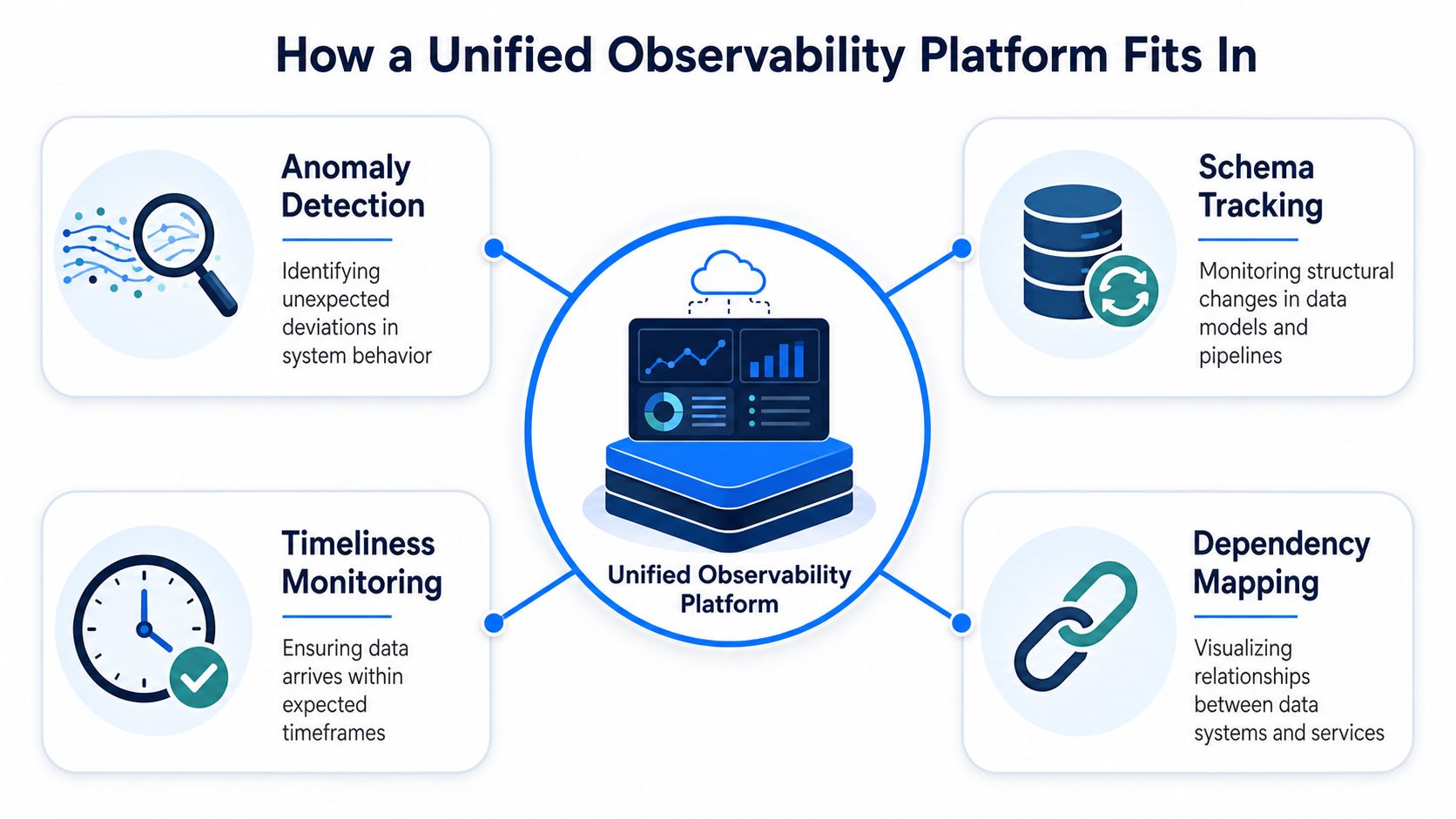
A platform like digna fits this pattern because it brings schema tracking, data anomalies, timeliness, and data validation into one monitoring layer. Schema tracking spots structural edits, anomaly detection shows behavior drift, timeliness watches for late or missing arrivals, and validation checks the record-level rules that protect known business logic. If you want a broader look at the model behind that setup, learn how a unified observability platform works.
That combination matters in regulated environments, where teams need evidence as well as alerts. When the platform computes metrics in-database, the warehouse keeps the data resident while the monitoring layer watches what changed. That approach is often a better fit for large and sensitive environments than copying data elsewhere just to inspect it.
The value here is conceptual as much as operational. A unified observability setup treats structural change as something to watch continuously, not as a one-time check after the impact has already spread.
Best Practices and a Practical Checklist
A schema change is not automatically a problem. A new column can improve reporting, a richer type can preserve precision, and a redesigned pipeline can replace a brittle process with one that is easier to trust. The aim is not to freeze the warehouse, it is to make change visible enough that teams can decide whether it is a healthy shift or a risky one.
A good way to judge that is to ask the same question economists ask about structural change, whether the new shape of the system is moving value in a better direction. In a warehouse, that means looking beyond the fact that something changed and asking whether the change fits the business contract, the downstream jobs, and the way analysts use the data.
A checklist you can apply this week
Start with a baseline. Capture the current schema, ownership, and expected arrival patterns before you need to compare them against a later state.
Then watch for differences on every load. Added, removed, renamed, and retyped columns should be treated as events, not background noise. If a fact table suddenly changes shape, that is the data equivalent of a production line swapping parts, the rest of the system may still run, but the output no longer means exactly what it used to mean.
Baseline the important tables. Capture the current schema, ownership, and expected arrival patterns before you need them.
Diff schemas on every load. Treat added, removed, renamed, and retyped columns as first-class events.
Watch row counts and null rates. When those shift, assume the meaning may have shifted too.
Validate record-level business rules. Keep known invariants close to the data, not buried in someone's memory.
Track timeliness against expected arrival. Late data can be just as structural as changed data.
Assign an owner and rollback path to every change. If nobody owns the contract, nobody owns the blast radius.
Watch row counts and null rates alongside schema changes. A new column can be harmless, but a sharp change in completeness or volume often means the meaning of the pipeline shifted too. Validate record-level business rules as well, because those invariants are often where teams discover that a column still exists but the logic behind it has drifted.
Track timeliness against expected arrival. Late data can be just as structural as changed data, especially when downstream models assume a steady cadence. Assign an owner and rollback path to every change so there is a clear response when a contract breaks.
The same principle appears in the economic literature noted earlier. When labor moves toward more productive sectors, structural change can raise economy-wide productivity, but the result depends on where the movement goes and whether the reallocation supports productive activity. Data teams should read that lesson in their own context, they are not just tracking change, they are judging whether the new structure is easier to trust, easier to monitor, and better aligned with the job the warehouse has to do.
A good warehouse does not pretend structure never changes. It makes the change legible, measurable, and reversible.
For automated detection of the added, removed and retyped columns behind most of these stories, see how digna Schema Tracker flags structural edits across your warehouse tables.
Frequently asked questions
What is structural change?
Structural change is a lasting shift in how a system is organized. In economics it usually means workers and output moving from agriculture toward industry and services, a framing traced to Kuznets. In a data warehouse, it means columns, types, meaning or ownership changing in a way that keeps affecting downstream work.
What are the types of structural change in data systems?
The article describes four faces. Column changes, such as renaming customer_id to client_id; datatype changes, such as DATE becoming TIMESTAMP; semantic changes, such as an amount switching from cents to euros; and lineage or ownership changes, such as a table being repointed to a new source.
Why is structural change in data pipelines hard to detect?
Pipelines often keep running after the structure changes. The load finishes, the job turns green and the result is still wrong. In one example, renaming customer_id to client_id fed nulls into a fraud model for weeks, and a FLOAT to DOUBLE widening pushed revenue dashboards out of line with finance.
How do you detect schema changes before they break dashboards?
Layer several signals. Schema diffing compares current DDL with a stored baseline, lineage-aware tracking lists the dashboards, dbt models and ML features that depend on a changed column, behavioral checks watch row counts, null rates and distributions, and timeliness monitoring catches loads that stop arriving when expected.
What is a practical checklist for managing structural change?
Start by baselining important tables, including schema, ownership and expected arrival patterns. Then diff schemas on every load, watch row counts and null rates, validate record-level business rules, track timeliness against expected arrival, and assign an owner and rollback path to every change so a broken contract has a clear response.