What Is Enterprise Data Governance and Why It Matters
|
6
min read

Enterprise data governance is the authority, decision rights, and operating controls that determine who may use data, how, and under what evidence. It's the working accountability system that keeps critical data trustworthy, usable, and defensible across its lifecycle.
You usually feel the need for it on an ordinary morning. A finance table is late, a report number can't be explained, an AI team says its features look wrong, and three different people each think someone else owns the dataset. That's the point where governance stops being a policy binder and becomes the difference between controlled operations and avoidable confusion.
Table of Contents
The Moment Governance Becomes Urgent
A dataset rarely fails in one dramatic blast. It slips first through a missed load, then a weak ownership handoff, then a definition no one updated after a schema change. By the time a report lands on a regulator's desk or a model starts using stale inputs, the root cause is usually not mysterious at all, it's an ownership problem that never got made visible.
That's why new programs often stall in the same place. Teams publish standards, hold a steering meeting, and assume the work is done. Then Monday arrives, a critical table is late again, and no one can say who has authority to fix it or what evidence would prove it was handled correctly.
Start With the failure, not the slogan
A useful way to think about governance is like the operating system for a building. Ownership tells you who sets the rules, operations keep the lights on, and inspection keeps everyone honest. If you're trying to translate that idea into a digital program, a practical resource on how to create a modern website can help you see how structure, roles, and execution have to work together, even though the context is different.
The same pattern shows up in internal data work. A table has users, an owner, controls, and a reason it exists, but those pieces only matter if they're connected to evidence. That's why a governance program has to answer the practical questions first, who owns this, who approves changes, what happens when it breaks, and what proof remains afterward.
Practical rule: if nobody can name the owner of a critical dataset in a few seconds, governance isn't mature yet.
For a wider view of business outcomes, it also helps to connect governance to data governance benefits, because the value only appears when roles, controls, and evidence are working together.
What Enterprise Data Governance Actually Means
Enterprise data governance is the authority, decision rights, and operating controls that decide who may use data, how, and under what evidence. Think of it as the difference between owning a building and operating it. Ownership sets the rules, operations keep everything running, and governance makes sure the rules are enforceable.

The pieces that matter
Authority answers who has the power to decide. Decision rights clarify who approves access, definitions, retention, and quality exceptions. Operating controls are the checks and workflows that make those decisions real. Accountability is the proof that someone had both responsibility and follow-through.
That distinction matters because governance is not the same as data management. Data management stores, integrates, and processes data. Governance sets the rules, ownership, and oversight that determine how those activities happen.
If you want a broader view of how authority can be split across business units and central functions, multi-level governance for enterprises is a useful lens. The point is simple, a governed environment can be federated, but it still needs named decision rights.
For a baseline comparison, what is data governance is the adjacent concept most readers start with, but enterprise governance goes further because scale forces clearer accountability and stronger evidence. That's why mature programs assign owners, stewards, and custodians instead of hoping policy text will manage itself.
A policy without decision rights is just a document. A policy with evidence becomes an operating system.
From Internal Policy to a Regulated Discipline
Governance became more serious when regulators made it demonstrable. The GDPR was adopted as Regulation (EU) 2016/679 on 27 April 2016, entered into force on 24 May 2016, and became applicable on 25 May 2018 across all 27 EU Member States as the European Commission explains. That timeline matters because it replaced a 1995 directive with one directly applicable framework, which changed the standard from “we have a policy” to “we can show how we complied.”
The GDPR's accountability principle made governance operational. Organizations didn't just need lawful processing, they needed records, controls, and evidence that the processing followed the principles in practice. That's why retention, correction, access, and audit trails moved from good ideas to required mechanics.
Why the EU framework changed the conversation
The GDPR also made one more thing obvious, governance extends beyond security and database administration. It governs how personal data may be processed and transferred, which means business ownership and legal obligations have to meet in the middle. You can't separate the people who approve use from the systems that enforce it.
The EU Data Governance Act pushed that logic further by formalizing trusted sharing, neutral intermediaries, and data altruism through its policy framework. It treats sharing as a controlled operating model, not an informal exchange of files.
For teams trying to separate policy from operating discipline, compliance vs governance is a useful comparison. Compliance tells you what must be true, governance tells you how the organization keeps proving that it's true.
Roles and Decision Rights Inside a Governed Program
A governed program fails fast when roles are vague. Someone has to own the dataset, someone has to maintain the rules, someone has to run the technical system, and someone has to escalate when the issue crosses a line. Without that chain, the same incident gets triaged in three different meetings and nobody can say who had final say.
The four roles that usually hold the line
Executive sponsors give the program authority and remove blockers. Data owners carry accountability for critical assets and business outcomes. Data stewards run day-to-day controls, definitions, and issue handling. Data custodians manage the technical platform and enforce the approved controls.
A domain-based RACI keeps those roles from blurring together. For a financial-services risk table, the owner approves a definition change, the steward manages the quality exception, the custodian implements the schema update, and the sponsor resolves conflict when business units disagree. That division matters because the same table can affect reporting, risk, and downstream models.
Role | Decision Rights | Escalation Path | Evidence Owned |
|---|---|---|---|
Executive sponsor | Final escalation and priority setting | Steering group or executive forum | Approval record, decision log |
Data owner | Definition, use, risk acceptance | Sponsor if business conflict arises | Ownership record, approval history |
Data steward | Quality exceptions, issue triage, rule maintenance | Owner for unresolved exceptions | Validation history, issue log |
Data custodian | Technical implementation, access enforcement, schema execution | Steward and owner for impact decisions | Change log, platform control evidence |
A governance program that can't show this chain usually turns into shared responsibility, which is another way of saying nobody feels accountable. The question to ask is blunt: who must act when a critical table goes late, changes shape, or violates a rule?
For readers mapping these jobs to a broader operating model, data governance roles is a useful reference point.
The Technical Control Stack Behind Governance
Roles matter, but they only work if the platform gives them force. The technical stack turns intent into proof, and proof is what auditors, regulators, and internal reviewers care about. If the platform can't capture the evidence, the governance program is mostly verbal.
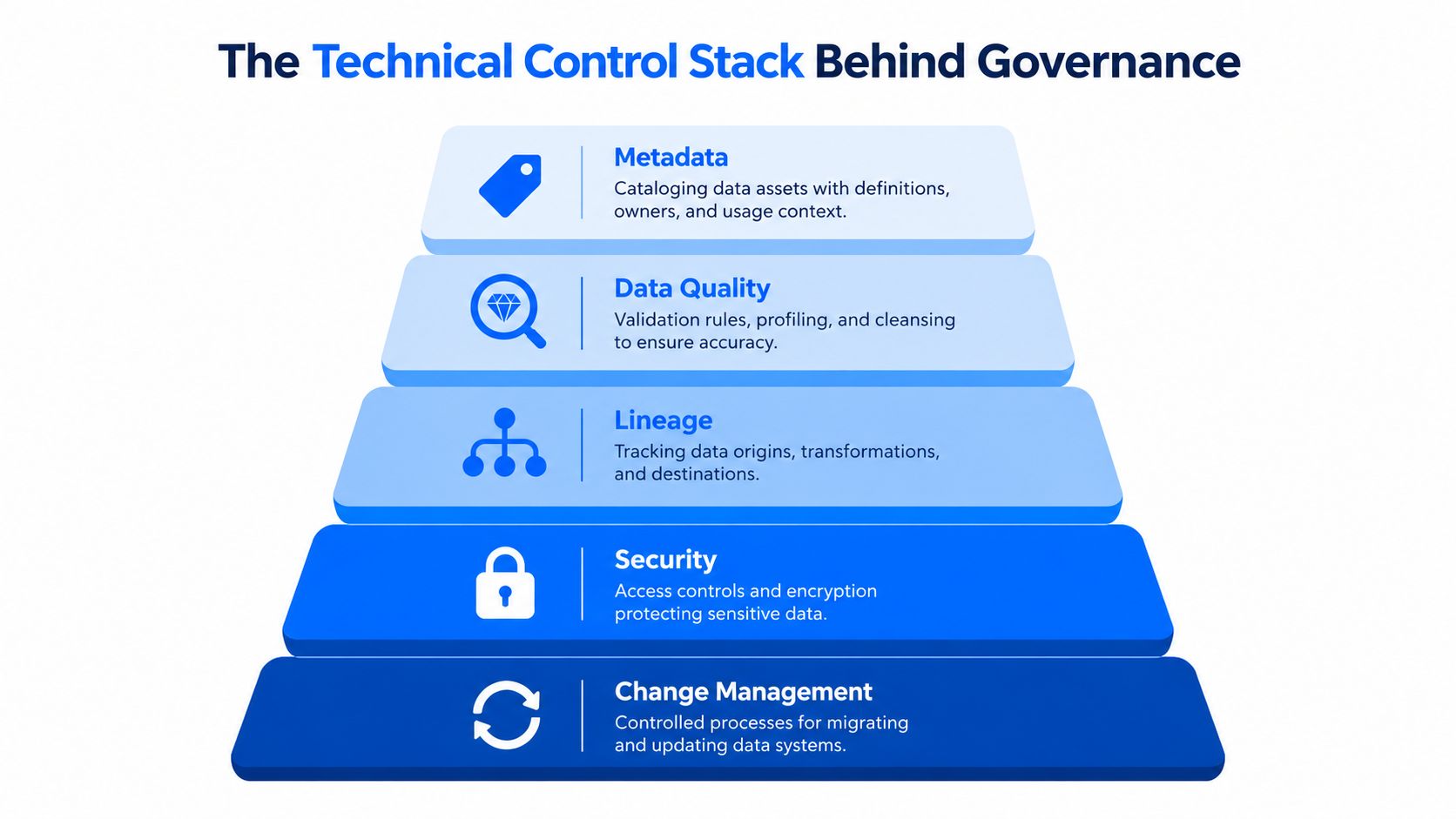
From metadata to change control
At the top sits metadata, because you can't govern what you can't name. Catalog entries need definitions, owners, and usage context so teams know what the asset means before they rely on it. Under that sits data quality, which tests whether the asset still fits its purpose through validation, profiling, and monitoring.
Lineage shows how data moves from source to report or model, which is what lets a steward judge blast radius when a control fails. Security keeps access constrained and aligned with sensitivity. Change management closes the loop by treating structural changes as governed events rather than casual edits.
Operational rule: explicit definitions enable automated tests, automated tests expose drift, lineage shows who's affected, and stewards decide what to fix first.
Many programs expose their real weakness here. A 2025 survey found that fewer than 10% of respondents believed their organization had a dedicated and effective data-stewardship function, while most did not believe stakeholders were held accountable according to the survey brief. That's not a cataloging problem, it's an accountability problem.
What a mature stack measures
A mature program doesn't obsess over catalog size. It tracks whether controls cover critical tables, whether issues are acknowledged, whether lineage is complete enough to trace impact, and whether schema changes leave a usable trail. It also records timeliness, quality failures, and exceptions so the next review has evidence instead of guesswork.
That shift matters because governance failures usually start with ambiguity, not technology. If a steward doesn't know what to do when a feed arrives late, or if a custodian can't prove who approved the change, the toolset hasn't solved the problem.
Governance for AI-Ready Data
AI raises the stakes because controls have to keep working after deployment, not only during model build. In a 2025 EY survey of 975 executives across 21 countries, 72% said their organizations had integrated and scaled AI in most or all initiatives, yet only about one-third had protocols covering all facets of responsible AI in the survey results. In the same survey's Europe West sample, only 18% reported clearly defined data-governance responsibilities, just 10% had systematic processes for updating AI models, and 25% lacked any process for collecting data for AI training.
AI doesn't replace governance, it depends on it
AI governance builds directly on the everyday data controls: provenance, drift, refresh timeliness, schema-change monitoring, and documented owner decisions.
If training data cannot be traced, model outputs become harder to defend. If inputs change without review, performance can drift before anyone notices. If ownership is unclear, the review process turns into a blame loop instead of a control loop.
For teams aligning AI initiatives with the underlying data layer, AI-ready data is the right mindset to adopt early. The model matters, but the data has to stay fit for purpose over time.
The KPIs a committee can actually review
A governance committee does not need vanity dashboards. It needs a short list of signals that connect directly to action.
Control coverage: which critical tables have named owners, validated rules, and timeliness monitoring.
Failed-rule rate: how many records violate a business rule over time.
Timeliness compliance: whether data arrived on schedule against the expected delivery time.
Lineage completeness: how much critical data can be traced from source to consumption.
Unresolved issue age: how long issues wait before acknowledgment and closure.
Policy exceptions: which deviations were approved, why they were allowed, and what compensating control was used.
These measures matter because they point to a decision, not just a status. A failed validation can be a warning, but it is not automatically a breach. The review question is whether the failure affected reporting, rights, or obligations.
How digna Turns Governance Policy into Operating Evidence
digna is one way to turn governance ideas into in-database evidence. It runs inside the customer's own environment, including private cloud or on-premises deployments, so regulated data stays in place while checks run where the data lives.
Matching controls to governance needs
Data Validation supports record-level business rules, which helps owners prove that accuracy controls ran. Timeliness checks missing, late, or early loads against expected delivery times, which gives stewards evidence for refresh discipline. Schema Tracker treats structural changes as governed events, so a new column or data type change doesn't slip downstream without review.
Data Anomalies learns baselines and flags drift on critical datasets. Data Analytics helps teams review trends and volatility, which is useful in governance meetings where recurring patterns matter more than one-off alerts. Business Monitoring and Data Platform Observability connect the governance view to business KPIs and platform health.
That combination matters because governance lives at the junction of policy and evidence. A committee can ask whether a control ran, whether it found anything, whether someone acknowledged it, and whether the change was approved before release. A platform that keeps the checks inside the environment makes that easier to prove without moving data around unnecessarily.
Answering an Auditor With Evidence Instead of Documents
An auditor doesn't really want a philosophy statement. They want to know which datasets are critical, who owns them, what rules apply, when controls last ran, what failed, who approved the exception, where the data came from, and how long it was retained. Those questions are direct because they're looking for defensible artifacts, not intent.
What proof should exist
A governed program should be able to produce ownership records, validation history, timeliness history, lineage graphs, change logs, exception registers, and retention evidence. It should also show timestamps, remediation status, and the specific decision that closed the issue. That's the difference between a control that exists on paper and a control that can survive review.
If the only answer is “the policy says so,” the audit conversation isn't finished.
The practical next step is small but decisive. Pick one critical dataset, name its owner, register its quality and timeliness rules, define who approves exceptions, and insist on evidence every time a control fails. That one dataset becomes the template for the rest of the program.
If you're building governance that has to stand up in reviews, dig into digna. It helps teams monitor data quality, timeliness, schema change, and operational behavior inside their own environment, which makes the evidence layer much easier to operationalize.
Governance policy only becomes operating evidence when each rule actually runs against the data. That is the job of digna's Data Validation module: business rules are checked continuously inside your environment, and every run leaves a recorded pass/fail history that an auditor can inspect instead of taking the policy on trust.
Frequently asked questions
What is enterprise data governance?
Enterprise data governance is the authority, decision rights and operating controls that determine who may use data, how, and under what evidence. Unlike data management, which stores and processes data, it sets the rules, ownership and oversight, and at enterprise scale it needs named owners, stewards and custodians.
What roles are needed in an enterprise data governance program?
Four roles usually hold the line: executive sponsors, data owners, data stewards and data custodians. Sponsors resolve escalations, owners approve definitions and accept risk, stewards handle quality exceptions and rule maintenance, and custodians implement schema changes and enforce access. A domain-based RACI keeps these responsibilities from blurring.
How did GDPR change data governance?
It moved governance from "we have a policy" to "we can show how we complied". Applicable since 25 May 2018 across all 27 EU Member States, the GDPR's accountability principle demands records, controls and evidence, so retention, correction, access and audit trails became required mechanics rather than good ideas.
What KPIs should a data governance committee track?
A committee needs a short list of signals tied to action rather than vanity dashboards: control coverage of critical tables, failed-rule rate, timeliness compliance, lineage completeness, unresolved issue age and approved policy exceptions with their compensating controls. Each of these points to a decision, not just a status.
What evidence do auditors expect from data governance?
Auditors want defensible artifacts, not philosophy statements. A governed program should produce ownership records, validation and timeliness history, lineage graphs, change logs, exception registers and retention evidence, along with timestamps, remediation status and the specific decision that closed each issue. "The policy says so" is never a finished answer.