What Is Data Quality Management in Healthcare
|
8
min read

A clinician opens a dashboard before morning rounds and sees a reassuring trend. The latest laboratory result appears normal, but the feed arrived after the reporting window. Elsewhere, a diagnosis code conflicts with the patient's history because a source system mapped the value differently during exchange. The record exists, yet it isn't fit for the decision being made.
That is the operational meaning of data quality management in healthcare. It's the continuous discipline of checking whether clinical, operational, public-health, research, and regulatory data is complete, accurate, consistent, meaningful, and available when people need it. The work extends from point-of-collection controls to exchange validation, anomaly detection, remediation, lineage, and governance.
Table of Contents
The High Stakes of Clinical Data Integrity
Where failure becomes visible
Defining the Core Dimensions of Healthcare Data Quality
Four questions for the same dataset
Turn dimensions into controls
Common Pitfalls in Healthcare Data Validation
Three failure modes to separate
Why aggregate scores conceal risk
The Shift from Static Audits to Continuous Observability
Audit controls versus observability
What continuous monitoring should surface
Ensuring Interoperability and Regulatory Compliance
Structural conformance isn't semantic agreement
Clean data can still produce unsafe AI
Implementing a Scalable Data Quality Framework
Build the control plane in layers
Reduce movement and alert noise
Future-Proofing Healthcare Data Strategies
The High Stakes of Clinical Data Integrity
A late result can be as disruptive as a wrong result. If a clinical warehouse receives a laboratory value after a care team has already reviewed a patient's status, the data may be technically correct but operationally unsafe. The same applies to a missing allergy, a duplicated patient identity, an outdated medication list, or a diagnosis whose meaning changed between systems.
Healthcare teams make decisions through connected systems. Electronic health records, laboratory platforms, imaging systems, registries, claims environments, and reporting warehouses each contribute part of the patient story. When one component fails, staff may repeat tests, reconcile records manually, delay reporting, or act on an incomplete picture.
The scale of exchange makes availability a quality requirement, not a convenience. In 2021, 88% of U.S. hospitals electronically sent or obtained patient health information through querying or electronically receiving summary-of-care records, according to the Office of the National Coordinator for Health IT's interoperability data brief. Data that can't be found, interpreted, or used at the point of care fails its intended purpose even if it remains stored somewhere.
Where failure becomes visible
Poor data quality creates several kinds of operational exposure:
Clinical risk: Missing or contradictory information can distort diagnosis, medication reconciliation, and treatment decisions.
Reporting risk: Incomplete events or unstable denominators can make quality indicators appear better or worse than reality.
Research risk: Inconsistent coding and provenance weaken reproducibility and make cohort definitions harder to defend.
Compliance risk: Teams may be unable to show which records were checked, which rule failed, and how remediation occurred.
Trust risk: Clinicians and analysts stop relying on dashboards when they repeatedly find discrepancies.
A periodic cleanup project doesn't address these conditions. By the time an audit identifies a late interface, a broken mapping, or a missing facility load, downstream reports and models may already have consumed the data. The practical question isn't whether an organization has errors. Every complex healthcare environment does. The question is whether it can identify meaningful failures early, determine their cause, and preserve evidence of the response.
For a grounded view of how these failures affect care, see five serious incidents caused by poor healthcare data quality. The central lesson is straightforward: data integrity is part of clinical safety and operational control, not an isolated concern for the data engineering backlog.
Defining the Core Dimensions of Healthcare Data Quality
The World Health Organization's Data Quality Review framework gives healthcare teams a useful foundation. It defines quality through completeness, internal consistency, external comparison, and external consistency of population data, as described in the WHO framework and metrics guidance.
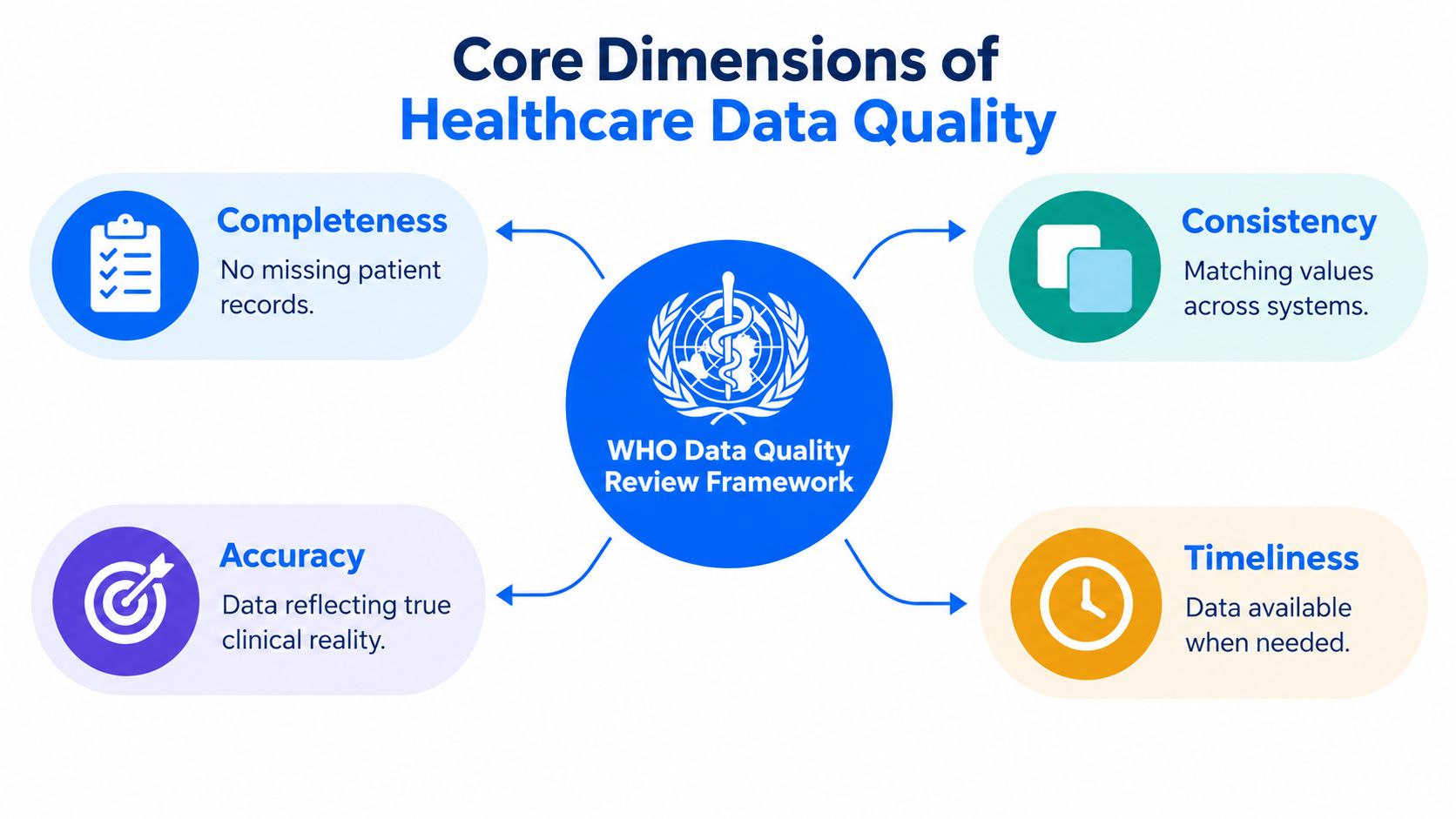
These dimensions provide a vocabulary for assessing whether data is fit for a defined use. They shouldn't become a checklist detached from workflow context.
Four questions for the same dataset
Completeness asks whether required records, fields, events, and reporting units are present. A facility may submit encounters but omit discharge events, or populate demographics while leaving clinically important fields blank. Completeness also includes delivery behavior. A complete file that arrives after a reporting deadline may still be unusable for that purpose.
Internal consistency asks whether related values agree. Dates should follow valid sequences, linked records should reference existing entities, and values should comply with clinical or business rules. A patient's age, encounter date, diagnosis, and procedure history may each look valid in isolation while forming an impossible combination together.
External comparison tests totals against an independent source. Facility activity can be compared with a registry, source application, laboratory system, or reporting ledger. This helps identify systematic under-reporting that record-level checks may miss.
External consistency of population data examines whether denominators and population estimates make reported rates meaningful. A vaccination rate, admission rate, or disease indicator can be calculated correctly yet mislead decision-makers if the underlying population estimate is outdated or mismatched.
The framework also supports practical expectations around accuracy, reliability, and timeliness. Accuracy concerns how closely a value reflects actual service delivery or clinical reality. Reliability concerns whether repeated measurements remain stable and dependable. Timeliness concerns whether information is available within the window required by the intended use.
Turn dimensions into controls
A quality program should define thresholds by dataset and workflow, not publish one organization-wide score. Useful controls include:
Required-field and event coverage checks.
Range, code-set, and conditional-rule validation.
Cross-system reconciliation of totals and identifiers.
Monitoring for delayed, missing, or unusually small loads.
Documentation of exceptions, ownership, remediation, and evidence.
The dimensions of data quality matter because a dataset can be complete but inaccurate, consistent but stale, or structurally valid but semantically misleading. Quality management begins when teams connect each dimension to the decision the data must support.
Common Pitfalls in Healthcare Data Validation
The most common validation mistake is treating populated fields as proof of quality. A value can be present, correctly typed, and still wrong for the patient, wrong for the episode, or wrong in meaning after exchange. Healthcare teams need separate controls for completeness, accuracy, validity, consistency, uniqueness, and timeliness.
The distinction is operational. The UK government's healthcare-associated-infections quality methodology defines accuracy as closeness to reality, completeness as the presence of expected records and essential values, and timeliness as currency and availability for the period represented. It also makes a critical point: completeness doesn't equal accuracy.
Three failure modes to separate
Missing data: The expected encounter, observation, denominator, or required field never arrives. The response is to investigate collection, interface delivery, and ingestion.
Incorrect data: The record arrives, but its value conflicts with an authoritative source, range, or clinical rule. The response requires comparison, validation, and correction.
Late or stale data: The value is correct but unavailable when the workflow needs it. The response requires delivery baselines and timeliness monitoring.
A fourth category deserves equal attention: semantic failure. Two systems can exchange a syntactically valid code while assigning different meanings to it. A transformation can preserve format but lose context, units, provenance, or relationship to another resource.
Why aggregate scores conceal risk
A 2025 multicenter study across 19 hospitals found that 17.7% of identified data-quality issues had a large impact, affecting at least half of the relevant records, and that incomplete investigation of error causes missed critical systemic flaws, as reported in the Journal of the American Medical Informatics Association study. The study identified chart-abstraction errors, differences between source systems, and extraction errors, showing why teams must investigate causes rather than stop at an accuracy percentage.
A useful validation sequence is:
Validate structure: Check data types, required elements, permitted values, and referential integrity.
Validate meaning: Apply clinical, operational, and cross-field rules.
Validate delivery: Compare arrival time, volume, null rates, and distributions with expected behavior.
Validate impact: Identify affected reports, measures, models, facilities, and patient groups.
Record remediation: Preserve the rule, source, timestamp, affected-record count, owner, and status.
That approach treats validation as a control system rather than a one-time cleansing exercise. Healthcare data validation at scale should help teams locate the failing layer and prioritize the defects that can change a clinical or regulatory outcome.
The Shift from Static Audits to Continuous Observability
Periodic audits still have a role. They provide independent assurance, test governance, and examine whether controls operate as designed. They're insufficient as the primary detection mechanism for fast-moving clinical data.
A review of electronic clinical documents found that 86.3% of sampled documents contained errors, averaging 4.9 errors per document, according to the peer-reviewed review of electronic clinical documents. The same review separated completeness alerts from syntax alerts, illustrating why a file that arrives successfully can still contain defects that compromise downstream use.
Audit controls versus observability
Operating model | What it does well | Where it fails |
|---|---|---|
Periodic manual audit | Provides review depth and governance evidence | Detects failures after data has propagated |
Fixed rule library | Enforces explicit business and clinical requirements | Requires maintenance and may create alert noise |
Continuous observability | Detects behavioral change, missing loads, and delivery drift | Needs baseline design, ownership, and sensible escalation |
Human investigation | Interprets context and confirms root cause | Doesn't scale as the first filter for every record |
A large hand-built rule set can look rigorous while becoming difficult to maintain. Teams may ignore alerts when thresholds are brittle, duplicates are common, or every minor distribution shift receives the same priority. Conversely, a system with no deterministic rules can detect unusual behavior without understanding whether the change violates a clinical requirement.
The practical model combines both approaches. Deterministic validation handles known constraints, such as required fields, valid codes, reference relationships, and conditional clinical logic. Behavioral monitoring learns expected patterns for record volumes, null rates, delivery times, value distributions, and workload activity, then flags deviations that deserve investigation.
What continuous monitoring should surface
A useful observability layer can identify:
A missing facility load or an unexpected reduction in records.
A schema change that adds, removes, or alters a column.
A sudden shift in code distributions or null rates.
A feed arriving later than its learned delivery pattern.
A business metric moving outside its normal range.
A repeated validation failure concentrated in one source or interface.
The value isn't an alert by itself. The value is context: which dataset changed, when it changed, which source produced it, how many records are affected, and which downstream products depend on it. Data quality observability expresses this shift from reactive cleanup to ongoing reliability monitoring.
Ensuring Interoperability and Regulatory Compliance
Interoperability is often reduced to whether systems can exchange payloads. That definition is too weak for clinical work. A receiving system must be able to parse, interpret, relate, and use the information within the required time window.
The United States Core Data for Interoperability, or USCDI, defines core data classes and elements that certified health IT systems must support. Applicable specifications include HL7 FHIR US Core and Consolidated Clinical Document Architecture. The HL7 Patient Information Quality Improvement requirements also describe mechanisms for assessing structured data, including required fields, terminology bindings, document structure, and relationships between exchanged resources.
Structural conformance isn't semantic agreement
FHIR validation can check data types, cardinality, expressions, terminology, and references. Those checks are necessary, but they don't guarantee that two organizations use a concept in the same operational context. Semantic misalignment between standards such as HL7 FHIR and SNOMED CT can leave technically interoperable data with inconsistent meaning.
Standards also evolve. USCDI and associated exchange specifications are updated annually, so organizations need change tracking rather than a one-time conformance project. A changed element, terminology binding, profile, or document structure can affect ingestion, reporting, analytics, and downstream models.
Practical rule: Treat every exchange boundary as a quality boundary. Validate what arrived, what it means, when it arrived, and how it relates to authoritative source data.
Clean data can still produce unsafe AI
A dataset may pass schema and completeness checks while remaining unrepresentative. Missingness can concentrate in a population, coding practices can vary by facility, and rare conditions can be under-recorded. These patterns affect not only descriptive analytics but also model development and monitoring.
A 2025 National Academies review highlighted that data availability, quality, and bias are closely linked in healthcare AI, warning that automated systems can amplify semantic and data-quality weaknesses rather than correct them, as summarized in the National Academies review. This changes the quality question from “Is the table clean?” to “Who is represented, whose data is missing, and how does performance change across settings and groups?”
A defensible program connects technical controls with governance:
Preserve lineage from collection through transformation.
Record provenance and semantic mappings.
Monitor subgroup completeness and distribution shifts.
Track coding changes and source-specific behavior.
Review downstream outcomes, not only validation pass rates.
Escalate unexplained degradation through clinical and governance owners.
Healthcare data compliance therefore requires more than formatting checks. It requires evidence that data remains understandable, traceable, timely, and appropriate for the decision or regulated use.
Implementing a Scalable Data Quality Framework
A scalable framework starts with use, not tooling. Identify the clinical, operational, and regulatory decisions that depend on each dataset, then define what failure looks like for that use. A laboratory feed may need strict delivery monitoring, while a historical research dataset may tolerate delay but require stronger provenance and completeness documentation.
Build the control plane in layers
Begin with a data inventory that connects sources, tables, pipelines, owners, downstream products, and intended uses. Prioritize high-impact datasets instead of attempting to monitor everything at once.
Then establish four complementary control layers:
Record validation: Apply required-field checks, code-set validation, range checks, referential integrity, and conditional business rules.
Dataset monitoring: Track volumes, null rates, duplicates, distributions, and unexpected volatility by source and facility.
Delivery monitoring: Learn expected arrival behavior and flag missing loads, delays, and unusual delivery timing.
Structural monitoring: Detect added or removed columns, changed data types, and other schema drift before consumers stop working unexpectedly.
Keep the evidence close to the control. Each incident should retain the dataset, rule or signal, timestamp, source, affected-record count, severity, owner, remediation status, and resolution notes. That record supports governance and helps engineers distinguish a local documentation issue from an upstream interface failure.
Reduce movement and alert noise
Healthcare environments place strict limits on sensitive data movement. In-database execution lets teams calculate metrics and run analysis within the customer's warehouse or platform, reducing unnecessary copying while preserving existing access controls. Private cloud and on-premises deployment can support environments where production data must remain inside the organization's cloud, virtual private network, or data center.
Alert design matters as much as detection. Route only actionable deviations, group related failures, show likely impact, and allow teams to suppress known maintenance events without hiding new behavior. A modular platform such as digna can combine anomaly detection, record-level validation, timeliness monitoring, schema tracking, and shared incident review while keeping computation in the customer's environment.
The implementation target isn't a perfect score. It's a repeatable operating loop: detect, triage, investigate, remediate, verify, and learn.
Future-Proofing Healthcare Data Strategies
Healthcare data will continue to arrive from more settings, devices, applications, and exchange pathways. Telemedicine, wearable devices, genomic research, and patient-generated information add useful signals, but they also introduce different collection behaviors, units, missingness patterns, and provenance requirements. A resilient strategy assumes that quality will change as the environment changes.
The most durable approach embeds controls in the lifecycle:
At collection: Make required context explicit and prevent ambiguous entry where practical.
At ingestion: Validate structure, terminology, relationships, and source identity.
During transformation: Preserve lineage, units, provenance, and semantic decisions.
In production: Monitor delivery, distributions, schema behavior, and business impact.
After incidents: Document root cause and convert recurring failures into preventive controls.
Programmatic software development kits can place quality checks directly in data pipelines and applications. That reduces the gap between an engineer changing a transformation and a governance team discovering the consequence later. The checks should still be observable, versioned, testable, and connected to owners.
Data quality becomes durable when teams treat it as an operational property of every pipeline, not a final inspection before publication.
The strongest healthcare programs also resist a narrow definition of “clean.” They monitor completeness by subgroup and setting, distinguish valid values from meaningful values, test timeliness against clinical deadlines, and review whether models or reports behave differently after source changes. Continuous improvement means refining thresholds, retiring noisy checks, expanding lineage, and involving clinical stakeholders when technical anomalies could affect care.
What is data quality management in healthcare, then? It's the ongoing practice of keeping information fit for its intended clinical, operational, research, public-health, and regulatory use. Organizations that build this discipline into collection, exchange, pipelines, and decision systems can make data a controlled asset rather than a recurring source of uncertainty.
digna provides in-database data quality and observability for healthcare datasets, including anomaly detection, record-level validation, timeliness monitoring, and schema tracking inside your own environment. Visit digna to evaluate a modular approach for making clinical, operational, and regulatory data more reliable.
Duplicated patient identities and encounters that point to records which no longer exist are relationship failures as much as value errors. For how to test those links across EHR, laboratory and reporting systems, see referential integrity in healthcare data.
Frequently asked questions
What is data quality management in healthcare?
It is the ongoing discipline of checking that clinical, operational, research, public-health and regulatory data is complete, accurate, consistent, meaningful and available when needed. The work runs from point-of-collection controls through exchange validation, anomaly detection and remediation to lineage and governance, rather than being a one-off cleanup project.
Which dimensions does the WHO use to assess healthcare data quality?
The WHO Data Quality Review framework uses completeness, internal consistency, external comparison with an independent source, and external consistency of population data such as denominators. It also supports expectations for accuracy, reliability and timeliness. Teams should turn each dimension into thresholds for a specific dataset and workflow instead of one organization-wide score.
Why isn't a complete record proof of good healthcare data?
Completeness does not equal accuracy. A value can be present and correctly typed yet wrong for the patient, the episode or its meaning after exchange. Missing, incorrect, late and semantically misaligned data are separate failure modes, and each needs its own control, from interface checks to delivery baselines and terminology mapping.
Why are periodic audits not enough for clinical data?
Audits detect failures only after data has already reached reports and models. One review found errors in 86.3% of sampled electronic clinical documents. Continuous observability complements audits by flagging missing facility loads, late feeds, schema changes and shifts in null rates or code distributions while there is still time to act.
How do you build a scalable healthcare data quality framework?
Start from the decisions each dataset supports, then layer controls: record validation, dataset monitoring of volumes and distributions, delivery monitoring against learned arrival patterns, and structural monitoring for schema drift. Running checks in-database limits movement of sensitive data, and every incident should keep owner, affected records and remediation status.