Data Management in Financial Services: A Practical Guide
|
8
min read

A regulator's stress request arrives before lunch. By mid-afternoon, the chief risk officer still can't see a trusted exposure view across legal entities, regions, products, and asset classes. One team is reconciling spreadsheets, another is waiting for a late source file, and the dashboard everyone relies on is built from yesterday's data.
That situation isn't unusual because financial institutions lack data. They struggle because data can't move through the organization with enough control, context, and speed. The practical discipline of data management in financial services exists to solve that problem, from origination in core systems to aggregation, validation, reporting, model use, and audit evidence.
Table of Contents
When Risk Data Couldn't Move Fast Enough
What Financial Data Management Actually Covers
Four pillars of the operating model
Turning BCBS 239 into Engineering Controls
From principle to pipeline
The Six Data Quality Dimensions Banks Cannot Skip
The dimensions in operational terms
Deterministic checks and adaptive detection
Lineage, Schema Tracking, and Timeliness as One System
What the control plane should capture
Modernizing Without Centralizing Everything
Use a control plane, not only a target platform
Data Quality as a Runtime Control for AI and Models
A 90-Day Operating Model for Financial Data Management
When Risk Data Couldn't Move Fast Enough
The pattern became impossible to ignore during the 2007–2009 global financial crisis. Supervisors found that many large banks couldn't quickly aggregate exposures across business lines, legal entities, regions, and products, particularly during stress. A bank might hold the relevant records, but its systems couldn't produce a dependable group-wide view when decision-makers needed one.
A stress request exposes the weakness quickly. The risk team asks for counterparty exposure across subsidiaries. The first extract arrives with missing entity identifiers. A second source uses a different product taxonomy. Treasury has a more current balance, but finance has the approved reporting figure. Operations knows that one feed arrived late, yet the dashboard presents the result as complete.
Practical rule: If a risk report depends on manual reconciliation during a crisis, the institution doesn't have a reporting process. It has an unmanaged operational dependency.
The Basel Committee responded by issuing “Principles for effective risk data aggregation and risk reporting” in January 2013. The framework contains 14 principles, with 11 applying directly to banks and three addressing supervisory review, tools, and cooperation. Its expectations reach beyond reporting technology. Banks need governance, appropriate architecture, reliable and complete data, timely aggregation, adaptability for ad hoc requests, and clear reporting. The capability must work in ordinary conditions and during a crisis, with aggregation performed largely through automated processes to reduce errors. The Basel framework remains a foundational reference for banking data and risk management.
The lesson is operational. Data quality, lineage, reconciliation, timeliness, and structural consistency aren't separate improvements that can wait for a future platform migration. They determine whether senior management can identify concentrations, explain movements, respond to supervisors, and act before a risk becomes a loss. Teams that want a practical view of the consequences can also review how poor data quality creates costs for financial institutions.
The rest of the discipline follows from this point. Governance defines accountability, architecture moves and preserves context, quality tests fitness for use, and reporting proves that the result can be trusted.
What Financial Data Management Actually Covers
Data management in financial services is the end-to-end discipline of governing, moving, validating, storing, accessing, and reporting data across an institution. It begins when a customer, payment, trade, loan, or market event enters a source system. It continues through warehouses, lakes, regulatory engines, risk calculations, management reports, models, and retained evidence.
A useful analogy is instrumentation. The bank's products and processes are the engine, while data management provides the gauges, sensors, alerts, and maintenance records. Instrumentation doesn't create the business activity, but without it, the driver can't tell whether the engine is operating normally or approaching failure.
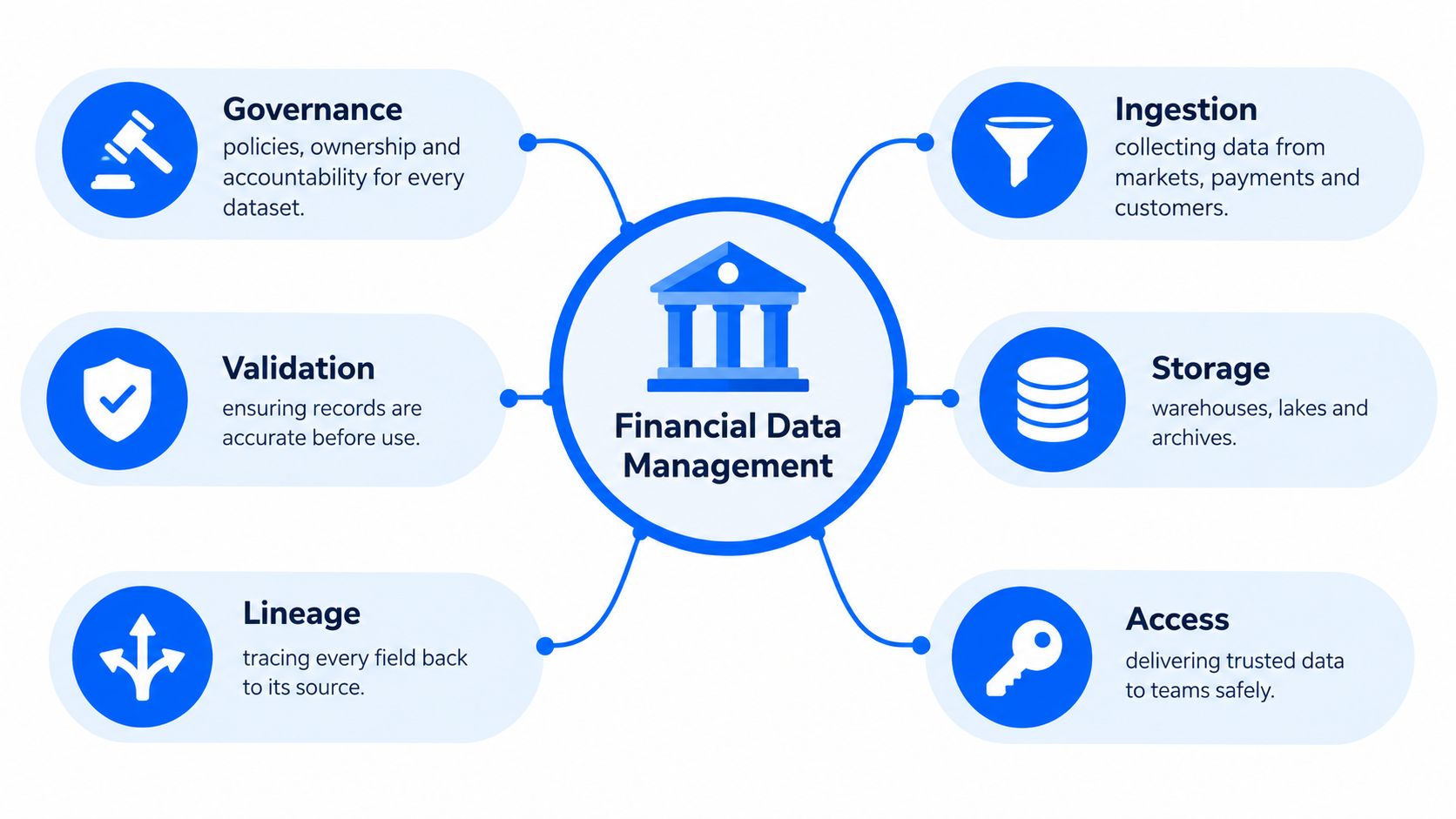
Four pillars of the operating model
Governance: Assigns accountable owners, stewards, definitions, thresholds, escalation routes, and permitted uses to critical data.
Architecture: Connects core banking, payments, trading, finance, risk, warehouses, lakes, and reporting services without losing meaning or control.
Data quality: Tests whether records are complete, accurate, timely, valid, unique, and consistent for a defined use case.
Reporting: Delivers clear, thorough, reconciled information at the frequency required by the board, management, regulators, and operational teams.
These pillars depend on one another. A quality rule without an owner has no durable response path. A report without lineage can't explain where a number came from. A centralized store without validation merely concentrates unreliable records. A governance policy without machine-readable controls remains difficult to test and easy to interpret differently across departments.
Start with the use case, not the repository. A liquidity report, credit exposure calculation, customer-risk decision, and regulatory submission may use overlapping data, but each has different freshness, completeness, and reconciliation requirements. The architecture should preserve those distinctions while giving teams shared definitions and visible control evidence.
Turning BCBS 239 into Engineering Controls
BCBS 239 is often cited in steering committees as a governance requirement, then implemented as another reporting project. That approach misses its operating intent. The bank-facing principles create expectations for how an institution identifies material data, aggregates it across the group, validates the result, and delivers information that remains useful during ordinary and stressed conditions.
The Basel Committee organized the 11 bank-facing principles into three operational areas, overarching governance and infrastructure, risk-data aggregation capabilities, and risk-reporting practices. Engineering teams can translate those areas into controls that produce evidence rather than policy statements. The original BCBS 239 publication is the governing reference for the framework.
BCBS 239 Pillar | What Regulators Expect | Engineering Control | Evidence to Retain |
|---|---|---|---|
Governance and infrastructure | Clear accountability, appropriate architecture, reliable technology, and controls across material risk data | Critical-data-element registry with owner, steward, definition, source, destination, threshold, and escalation path | Approved metadata, ownership history, control specifications, architecture records |
Risk-data aggregation | Accurate, complete, timely, adaptable aggregation across relevant dimensions | Source-to-target reconciliations, referential checks, duplicate detection, freshness monitoring, lineage, and on-demand aggregation paths | Rule results, reconciliation totals, lineage snapshots, load timestamps, incident records |
Risk reporting | Accurate, comprehensive, clear, useful, and appropriately frequent reporting | Report-level validation, distribution controls, drill-down links, recipient-specific views, and report certification | Report extracts, validation results, approvals, distribution logs, exception decisions |
From principle to pipeline
Governance becomes metadata that systems can enforce. For every critical dataset, record who owns the business meaning, who operates the control, what constitutes failure, and who must act. Ownership should follow the data through source, transformation, aggregation, and report layers, not stop at the application boundary.
Aggregation capability requires more than a successful job. Compare source and target totals, reconcile balances across systems, verify required dimensions such as legal entity and business line, and retain the result for each reporting cycle. A pipeline that completes without errors can still omit a partition, duplicate records, or apply the wrong reference mapping.
Reporting controls should test the output as a decision product. Can a senior manager understand the exposure? Can an analyst drill into the contributing entity or asset type? Can the bank generate a useful response to an ad hoc request without rebuilding the report manually?
BCBS 239 alignment remains a substantial technical challenge. The Basel Committee's 2023 assessment covered 31 G-SIBs and found that banks remained at different stages of alignment nearly a decade after the principles were issued and seven years after the expected compliance date. The practical implication is direct: a risk platform must be a controlled, repeatable pipeline for aggregation, reconciliation, lineage, and delivery, not a passive reporting repository. The Basel assessment provides the supervisory context. Teams evaluating implementation options can also examine an AI-powered approach to meeting BCBS 239 principles.
The Six Data Quality Dimensions Banks Cannot Skip
A dataset isn't “high quality” in the abstract. It's fit, or unfit, for a specific decision, report, model, or control. A loan book can be complete but stale. A customer feed can be current but inaccurate. A regulatory extract can pass format checks while using inconsistent currency treatment across entities.

The dimensions in operational terms
Completeness asks whether required records and fields are present. Missing customer-identification attributes in a KYC feed, or an absent legal-entity code in a loan extract, can make an otherwise populated dataset unusable.
Accuracy asks whether the value represents the actual world condition. A loan balance that doesn't match the authoritative servicing record should trigger investigation before it reaches a capital or management report.
Timeliness asks whether information arrives while it can still support the decision. A late trade file may be technically valid but operationally wrong for an intraday risk view.
Validity tests whether values follow defined business and structural rules. Dates, account identifiers, currencies, classifications, and product codes need accepted formats and permitted values.
Uniqueness prevents the same customer, counterparty, account, or transaction from appearing more than once where one record is expected. Duplicate counterparties can distort exposure aggregation and relationship views.
Consistency checks whether the same fact agrees across systems. A balance, currency normalization, entity hierarchy, or risk classification should not change without notice between the core platform and warehouse.
These dimensions work together, but they shouldn't be collapsed into one score. A single composite score can hide a material failure. Report the failed dimension, affected data element, business impact, owner, and remediation status instead. A risk committee needs to know that a feed is late or that a balance reconciliation failed, not merely that a quality score declined.
Deterministic checks and adaptive detection
Deterministic validation is strongest where the rule is explicit. Check that every loan has a legal entity, every trade references a known instrument, every account uses an accepted currency, and source-to-target totals reconcile. These checks are explainable and easy to attach to audit evidence.
Anomaly detection adds a different capability. It can identify an unusual volume shift, distribution change, or balance movement against the normal behavior of a particular dataset. It shouldn't replace business rules. It should help triage whether a movement is a genuine portfolio event, a partial source load, or a broken transformation.
For a practical treatment of the dimensions and their application, see the six dimensions of data quality. The important operating change is to monitor quality continuously. Profiling a table during a remediation project tells you what happened then. Runtime controls tell you whether the dataset remains safe to use today.
Lineage, Schema Tracking, and Timeliness as One System
Lineage is often treated as a diagramming exercise. Timeliness is delegated to operations. Schema tracking is added after a downstream job breaks. In financial services, those three controls belong together because a structural change or delivery delay can alter the meaning of a report even when every scheduled job reports success.
Consider a source system that changes a numeric exposure field to a string. The ingestion process accepts the new type, a transformation coerces some values, and the reporting job completes. The resulting exposure may contain nulls, truncated values, or failed joins. Without schema tracking, the organization discovers the defect only after someone questions the number.
A dropped partition creates a similar problem. The pipeline runs, but one region or legal entity is absent. A late market or transaction feed can be just as damaging when a report uses the previous valid value and presents it as current.
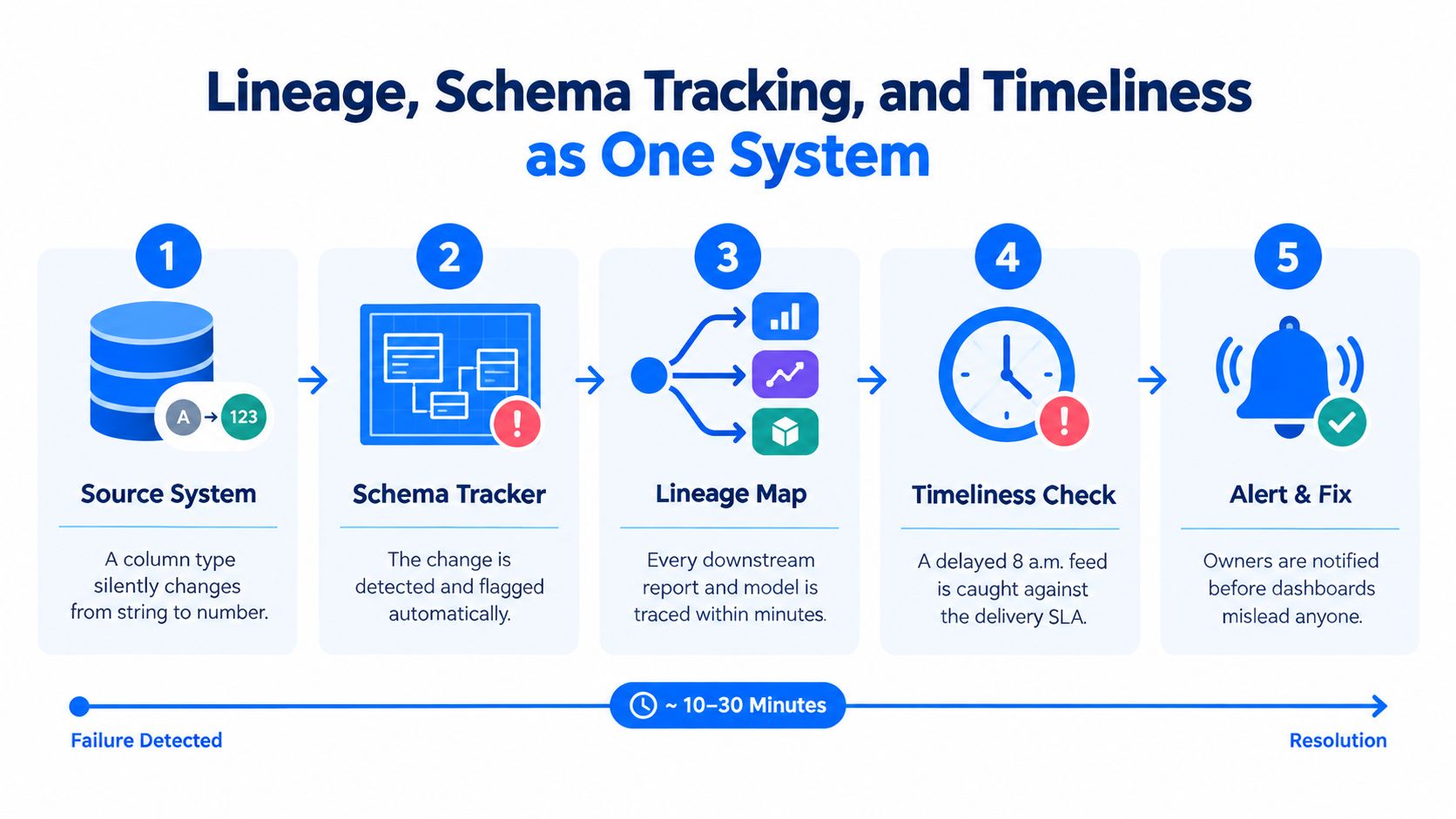
What the control plane should capture
End-to-end lineage should identify the source table, field, transformation, reference data, destination dataset, report, and model that depend on a critical element. It also needs version history, ownership, last successful delivery, and the control results associated with each run.
Schema tracking should detect:
Added or removed columns: A new field may be harmless, while a removed identifier can break joins or regulatory classification.
Data-type modifications: A retyped amount, date, or key can change calculations without stopping a pipeline.
Definition changes: A field may retain its name while its business meaning or population logic changes.
Structural drift downstream: A warehouse or reporting layer may diverge from the approved contract even when the source remains stable.
Timeliness monitoring should learn expected delivery behavior rather than apply one fixed schedule to every feed. Market, transaction, and batch sources operate differently. A feed that normally arrives early can still be anomalous if it misses its expected window, while a rigid clock may generate noise for a source with legitimate variation.
The Basel Committee's 2023 assessment covered 31 G-SIBs and found institutions at different stages of BCBS 239 alignment, reinforcing the need for controlled pipelines that support aggregation, reconciliation, lineage, and delivery under normal and stressed conditions. The assessment details make the engineering implication clear.
A useful distinction is between provenance and lineage. Provenance answers what happened to the data and under which process. Lineage maps how a field moves through systems and dependencies. Teams comparing those concepts can use this guide to data provenance and data lineage. Neither is sufficient alone. Lineage without structural and freshness controls is only a partial control plane.
Modernizing Without Centralizing Everything
A bank can centralize reporting data and still fail a BCBS 239 review. The central copy may be incomplete, late, or disconnected from the system that owns the business process. Centralization changes where data sits. It does not, by itself, establish ownership, validation, timeliness, or evidence.
Sensitive production data also creates costs when copied into a new platform. The bank must secure, classify, reconcile, govern, and explain another repository. A central store can simplify access for some users while increasing duplication, privacy exposure, latency, and integration work.
Operational reality is distributed. Customer records may remain in core systems, transactions in warehouses, market data in specialist platforms, and jurisdiction-specific copies under separate controls. The practical question is whether the bank can prove that critical data is fit for use wherever it remains.
Use a control plane, not only a target platform
A distributed control plane runs checks close to source systems or inside the customer's database, then centralizes metadata and evidence rather than sensitive records. Its operating controls should include:
In-place validation: Apply business rules to source tables without creating another production copy.
Ownership: Assign each critical dataset, rule, exception, and remediation action to an accountable team.
Structural monitoring: Detect schema changes at the point of origin and identify affected consumers through lineage.
Freshness controls: Compare actual delivery with the expected behavior of each feed.
Evidence retention: Preserve rule results, exceptions, approvals, escalation, and remediation history.
Risk-based prioritization: Start with datasets supporting capital, liquidity, credit, finance, and regulatory reporting.
This design turns supervisory expectations from BCBS 239, ECB reviews, and SR 11-7 into operating evidence. Teams can show who owns a control, which validation ran, whether a feed arrived within its expected window, what schema changed, and how exceptions were resolved.
The trade-off remains real. In-place controls demand stronger metadata, connectors, and ownership discipline. Centralized platforms may simplify analysis, but a central copy can conceal source defects or become authoritative without proof that it remains synchronized. Banks choosing between these patterns can consult this comparison of data mesh and centralized data platforms. The decision should follow control coverage, data sensitivity, performance, jurisdiction, and legacy constraints, not a preference for one architecture.
Data Quality as a Runtime Control for AI and Models
AI readiness in financial services is primarily a data-behavior problem, not a model-selection problem. A validated model can still behave unsafely when its input feed arrives late, changes schema, loses a class, develops a new distribution, or shifts away from the baseline used during validation.
An IIF–EY 2025 survey found that 79% of financial-services firms overall, and 100% of G-SIBs and globally systemically important insurers, identified data quality as a top AI-development challenge. Among those firms, 96% highlighted noisy, untimely, inaccurate, or inadaptable data as the main production obstacle. The IIF–EY survey provides the evidence behind this operational concern.

SR 11-7 adds a model-risk governance lens. Banks need documented controls across model development, implementation, validation, ongoing monitoring, and governance. Federal Reserve Supervisory Letter SR 11-7 means a data anomaly can become a model-risk event when it changes an input without an approved explanation.
Retain evidence for the moment after validation, not only the validation package itself:
Baseline change: What shifted, when it shifted, and whether the movement was expected.
Feed behavior: Whether the dataset arrived late, partially, or with missing partitions.
Schema state: Which fields, types, or definitions changed.
Distribution behavior: Whether class or value distributions moved beyond the accepted threshold.
Decision record: Who assessed the incident and whether the response was continue, rollback, or revalidate.
Teams exploring finance AI solutions should treat this evidence loop as part of the implementation, not as a later governance attachment. A model owner needs dataset-specific thresholds and explicit triggers for investigation, rollback, or revalidation.
The 2025 IIF–EY survey also reported that 72% of firms had feedback mechanisms or controls for correcting AI models, with another 25% working on them. That direction reinforces the point: model governance is becoming corrective and operational. Data observability must connect directly to that loop.
A 90-Day Operating Model for Financial Data Management
Start with the data that can change a risk decision, regulatory submission, capital calculation, or model input. Define critical data elements by risk domain, legal entity, business line, asset class, geography, and reporting use case.
Assign an accountable owner and steward as machine-readable metadata. Attach completeness, timeliness, reconciliation, referential-integrity, duplicate, and schema controls to each element. Execute checks close to the source where possible, retain evidence for every reporting cycle, and route exceptions to named people.
Use deterministic validation for known rules and baseline-based anomaly detection for unexpected behavior. Test the operating model against normal delivery and a stressed scenario before expanding coverage. A small set of controlled, evidenced datasets is more defensible than a broad catalog with no reliable response path.
digna provides in-environment data quality and observability for financial-services teams, including in-database validation, timeliness monitoring, anomaly detection, schema tracking, and evidence for distributed data pipelines. Visit digna to see how its control-plane approach can help you monitor critical data without assuming that centralization is the answer.
Duplicate counterparties and loans without a valid legal entity are, at root, broken relationships between systems. For the checks that keep those keys aligned from core banking to the risk warehouse, see referential integrity in banking data.
Frequently asked questions
What does data management in financial services cover?
It covers governing, moving, validating, storing and reporting data from the moment a payment, trade, loan or customer event enters a source system until it reaches risk calculations, regulatory reports and models. Governance, architecture, data quality and reporting form four pillars that only work when they depend on each other.
How do you turn BCBS 239 into engineering controls?
Translate each principle area into controls that produce evidence: a critical-data-element registry with owners and thresholds for governance, source-to-target reconciliations and freshness monitoring for aggregation, and report-level validation and certification for reporting. Retain rule results, lineage snapshots and incident records for every reporting cycle.
Which data quality dimensions matter most for banks?
Completeness, accuracy, timeliness, validity, uniqueness and consistency. Each answers a different question, such as whether a loan carries its legal-entity code or whether a balance agrees between core platform and warehouse. Report the failed dimension, owner and impact separately rather than collapsing them into one composite score that can hide a material failure.
Do banks need to centralize all data to meet BCBS 239?
No. A central copy can still be incomplete, late or disconnected from the system that owns the process. A distributed control plane runs checks in place, close to source systems, and centralizes only metadata and evidence, which avoids extra copies of sensitive data while still proving that critical data is fit for use.
Why is data quality a runtime control for AI models in finance?
A validated model can behave unsafely when its input arrives late, changes schema or drifts from its baseline. In an IIF-EY 2025 survey, 79% of financial-services firms named data quality a top AI challenge. Under SR 11-7, an unexplained input change can become a model-risk event that requires investigation or revalidation.