Healthcare Data Compliance in 2026: Key Strategies
|
9
min read

In 2024, U.S. healthcare recorded 663 large data breaches that exposed protected health information for nearly 243 million individuals, which is roughly three-quarters of the U.S. population in a single year (healthcare compliance statistics). That scale changes the conversation immediately. Healthcare data compliance is not a paperwork chore, it is an operational control problem that decides whether a single bad credential, a misrouted backup, or a broken pipeline becomes a reportable event.
The teams that handle this well stop treating compliance as a legal checklist and start treating it like data infrastructure. They design for identity, lineage, retention, auditability, and validation at the same time, because PHI now moves through warehouses, lakes, MLOps stacks, and hybrid cloud paths where a narrow storage-only policy no longer covers the significant risk.
Table of Contents
Why Healthcare Data Compliance Is Now a Data Engineering Problem
Mapping the Regulatory Landscape to Operational Requirements
Why Healthcare Data Compliance Is Now a Data Engineering Problem
Security incidents keep showing the same pattern, and that pattern is operational, not abstract. Healthcare compliance statistics show that hacking and IT incidents caused 81% of all large healthcare breaches reported to HHS OCR, affecting more than 241.5 million individuals. That kind of exposure does not come from a policy gap alone. It comes from weak control over pipelines, permissions, replication, and monitoring.
The old model breaks when data keeps moving
Classic compliance programs were built around storage locations, user roles, and annual review cycles. That model fails once the same PHI lands in a warehouse, gets transformed for a dashboard, feeds an AI feature store, and is then copied into a regional reporting pipeline. A checklist can confirm that encryption exists, but it will not tell you whether the downstream model is still seeing stale, overexposed, or improperly reused records.
Practical rule: if a control cannot follow the record through ingestion, transformation, replication, and export, it is not a real control.
Healthcare compliance now needs a control-plane problem mindset. Teams have to combine encryption, identity, logging, retention, and validation so PHI stays governed across databases, backups, and integrations, not just at the application layer (practical security checklist). I have seen audit failures happen because a team had a secure source system but no reliable answer to what happened after the record was copied into analytics.
Compliance now has to survive AI and analytics
The harder problem is whether someone used the data in a way the system cannot prove was allowed. Recent healthcare analytics literature frames compliance as a requirement for classification, de-identification, secure storage, auditability, consent, and technically enforceable governance inside data engineering workflows (medical and healthcare analytics review). That matches what happens in practice. AI training sets, cross-system dashboards, and federated reporting all create hidden reuse paths.
A lot of teams still talk about healthcare data compliance as if it ends at HIPAA basics. It does not. Once the pipeline is doing feature generation, enrichment, and real-time delivery, the core question becomes whether every transformation can be explained, validated, and traced. That is an engineering discipline, and the organizations that recognize it early usually spend less time reconstructing history later.
Modern pipelines also create data quality problems that turn into compliance problems fast. Poor matching, inconsistent identifiers, missing lineage, and stale reference data can push PHI into the wrong place or expose data to the wrong job. The practical failure mode is not always a dramatic breach. It is often a quiet control break that shows up only after an auditor, a clinician, or a model owner asks where a record came from and why it was there. A useful example of how these failures surface in AI-heavy healthcare workflows is described in digna's overview of healthcare data quality challenges and AI solutions.
Mapping the Regulatory Landscape to Operational Requirements
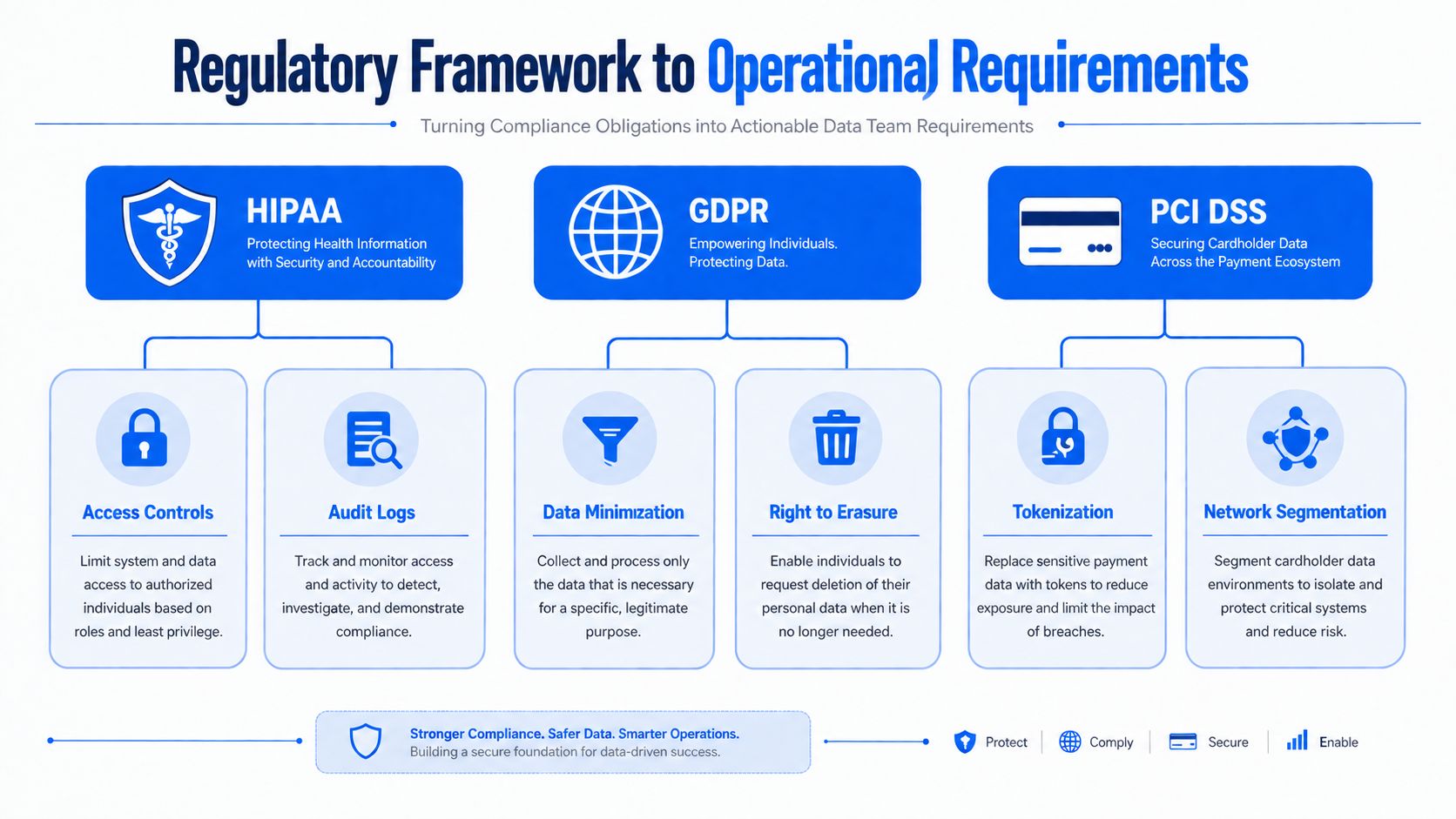
Healthcare compliance spans more than one framework, and the mistake I see most often is treating those frameworks as abstract legal text instead of system requirements. A 2024 healthcare data compliance guide puts HIPAA, GDPR, and PCI DSS into the same operational bucket, alongside risk assessment and incident response. That matters because the controls overlap, but they do not overlap perfectly.
A pipeline that looks compliant on paper can still fail at the edges, especially once clinical rules, validation logic, and downstream analytics start pulling on the same records. Teams that build around healthcare data validation and clinical regulatory rules at scale usually find the same thing I have seen in audits, policy has to become a runtime control if you want it to hold up under real traffic.
HIPAA turns policy into workflow controls
Under the U.S. HHS HIPAA Privacy Rule, covered entities generally need written authorization for uses or disclosures of PHI that fall outside treatment, payment, health care operations, or another built-in permission. That means your pipeline needs more than a permissions table. It needs consent tracking, purpose-based access, and a way to separate routine care from secondary use.
The same rule says individuals can request restrictions on certain uses and disclosures, though the covered entity does not have to agree. Operationally, that creates real branching in the data flow. Some records have to be routed differently, retained differently, or excluded from certain extracts based on approved purpose.
The criminal penalty language in the rule is not theoretical either. HHS states that criminal penalties can reach up to $50,000 and one year of imprisonment for knowingly obtaining or disclosing individually identifiable health information in violation of the Privacy Rule (HHS HIPAA Privacy Rule). That is why access control design cannot be casual.
GDPR and PCI DSS map to different technical expectations
GDPR pushes teams toward data minimization, clear notices, processing records, and purpose limitation, while PCI DSS adds controls around tokenization and network segmentation when payment data sits anywhere near healthcare operations. A UK healthcare privacy guide also calls out the need to appoint a Data Protection Officer where required, maintain current privacy notices, document records of processing activities, encrypt data at rest and in transit, and use role-based access controls with regular access reviews. Those are not paperwork tasks. They are roles, logs, and reviews that have to exist in production.
Compliance works when policy turns into a control that a platform can enforce automatically.
The practical move is to map each regulation to a capability, not a slogan. Consent handling, access restriction, encryption, retention, and audit evidence need to be visible in the data stack itself. The cleanest programs do that once and reuse the pattern across jurisdictions. That is also where teams running multi-system care workflows end up asking for operational guidance from partners like behavioral health revenue cycle tips from Clarity, because regulatory intent only matters if the pipeline can prove it end to end.
Hidden Compliance Risks in Modern Data Pipelines
The obvious controls are rarely the ones that fail first. Modern healthcare pipelines break in quieter ways, especially when data moves through lakes, multi-region clouds, AI training jobs, and operational dashboards. Recent healthcare security writing emphasizes that these environments move data between hospital networks, regional data centers, and multiple cloud providers in near real time, which makes visibility, IAM, segmentation, incident response, and continuous monitoring essential (healthcare security review). Encryption alone doesn't answer who used the data, where it went, or whether the output still fits the allowed purpose.
Silent drift and schema changes cause compliance damage
When model inputs drift without being noticed, the issue is not only accuracy. A compliance workflow can start approving decisions based on records that no longer match the validated shape or expected values. Schema changes create the same problem. A field gets renamed, a code set changes, or a units column starts carrying inconsistent values, and downstream validators never fire because nobody wired them into the pipeline.
That is where record-level validation becomes critical. Expert guidance recommends enforcing object- and record-level authorization on every request, logging every PHI access, and retaining those logs in append-only stores because broad role-based access alone doesn't stop IDOR-style exposure when users can query arbitrary patient objects (data validation standards for healthcare compliance). That same logic applies to pipelines. A system can be “authenticated” and still be wrong.
If you want a practical lens on the revenue-cycle side of this problem, behavioral health revenue cycle tips from Clarity are a useful reminder that bad data propagates into denials, delayed payment, and cleanup work that looks administrative on the surface but often starts as a validation failure upstream.
Untracked reuse is the hardest problem to spot
The most dangerous compliance issue is often not a breach but an undocumented second use. Data lands in one system for care delivery, gets copied into an analytics mart, then gets reused in a model or report with no durable lineage back to the original consent or purpose restriction. That is especially risky in AI and analytics pipelines, where the same record can be transformed many times before anyone notices the governance gap.
I've seen teams assume that role-based access and encrypted storage were enough. They weren't. Once a downstream dataset exists, every extra export, merge, and replay creates another chance to violate purpose limitation or lose the evidence trail needed later.
Key takeaway: if you can't explain where a PHI record was copied, transformed, and consumed, you don't have defensible compliance.
One more practical point. If your team is dealing with denied claims or revenue-cycle exceptions, operational guides like SEFA-compliant cabinets from Labs USA sit outside the software stack but reinforce the same principle, controlled storage and controlled access only work when the workflow is enforced. Healthcare compliance fails when people rely on intent instead of instrumentation.
Technical Controls for Healthcare Data Security
The controls that hold up in audits are usually boring, specific, and layered. A practical baseline for healthcare platforms starts with AES-256 for data at rest, TLS 1.3 for data in transit, centralized key management in a KMS/HSM with rotation, and immutable offsite backup copies built on a 3-2-1 strategy. The goal is straightforward, a compromised credential, storage bucket, or replica should not expose recoverable PHI or key material.

Build controls that survive partial compromise
Encryption is necessary, but it does not carry the whole control story. Keys need centralized management, controlled rotation, and a place to live that is separate from the same storage plane as the data. Backups also need to be immutable, or at least resilient enough that a compromised primary environment cannot rewrite recovery points without detection.
A strong backup posture means treating backup copies as governed PHI, not a leftover operational copy. If your restore path is fast but your backup chain is exposed, the risk has only moved. In design reviews, I ask one question: if the primary region is lost and one credential is stolen, what still remains secret?
Audit trails need to be useful, not decorative
The guidance that survives real reviews is simple, log every PHI access with user, patient, timestamp, and action, then store those logs in append-only systems (data validation standards for healthcare compliance). That is the minimum needed to reconstruct who touched what and when. If the logs are mutable, buried, or inconsistently structured, they will not help during an audit or an incident review.
Data validation belongs in the same control set. Standardized clinical codes, missing fields, and anomalous units should be checked automatically because bad values do more than distort reports, they can also break the evidence trail that proves the pipeline behaved as intended. The audit story gets cleaner when validation sits in the data path instead of in a separate spreadsheet review.
Practical rule: log the action at the moment the record is accessed, not later when someone remembers to summarize it.
Authorization must happen at the record level
Role-based access is still useful, but it is too blunt for sensitive healthcare workloads. A clinician, analyst, or support user may have a legitimate role and still not be allowed to query every patient object. That is why object- and record-level authorization needs to happen on each request, especially in systems that expose APIs or object stores.
The strongest designs make access checks and validation checks look like part of the same contract. The request either satisfies identity, purpose, and object scope, or it does not proceed. That structure is harder to build, but it is much easier to defend.
Using Data Observability to Automate Compliance Monitoring
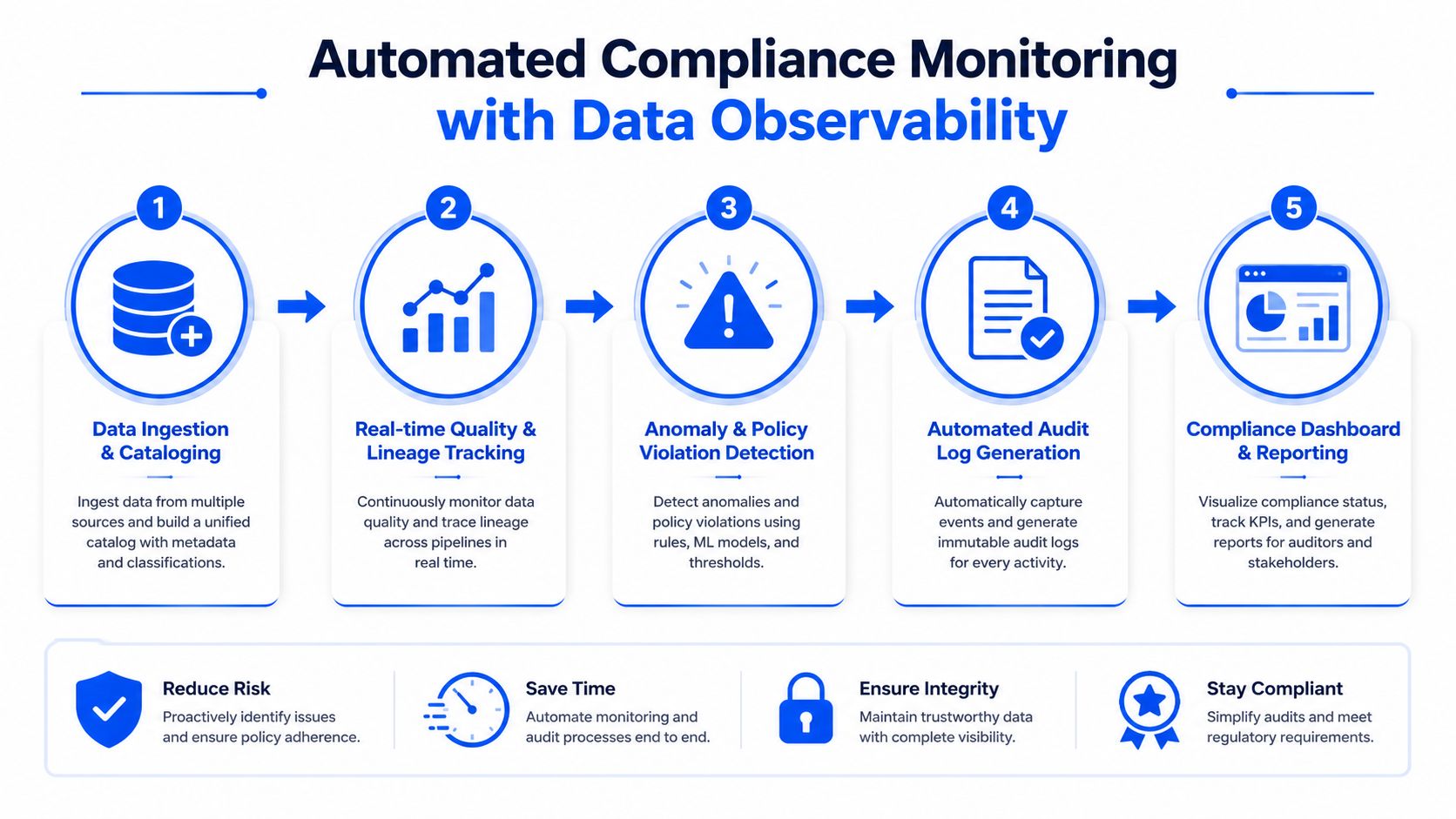
Observability changes compliance from a periodic review into a live control. That matters because modern pipelines don't fail on a neat schedule. They fail through late loads, schema drift, broken joins, volatile trends, and rule violations that only become visible after someone makes a bad decision from the output. Recent healthcare analytics literature argues that compliance now has to cover classification, de-identification, secure storage, auditability, consent, and enforceable governance in engineering workflows (healthcare analytics review).
The useful signals are the ones pipelines already produce
The strongest observability stacks learn normal behavior, then flag unexpected changes without someone writing and maintaining dozens of brittle rules. That pattern is especially valuable in healthcare because the same tables tend to carry both operational and regulated data. If a metric suddenly changes, the team needs to know whether it's a true shift, a feed failure, or a hidden compliance issue.
Schema tracking is equally important. When a column is added, removed, or retuned to a different type, downstream validation can fail unless someone is watching for structural change. Timeliness monitoring also matters because a late or missing data load can create stale reports that look valid but are missing PHI, policy-relevant transactions, or recent updates.
Observability becomes evidence when it's captured correctly
digna is one option in this space, since it runs analyses inside customer databases and provides dashboards for trends, timeliness, anomaly detection, schema changes, and record-level validation in private cloud or on-prem environments. That matters for compliance because the data stays inside the customer-controlled boundary while the platform still produces monitoring evidence.
The platform pattern here is what matters most, not the brand name. Historical analytics surface fast-changing signals and patterns that help teams prioritize root cause analysis, while validation at the record level lets governance owners enforce business rules that auditors can inspect later. If the monitoring layer can produce an explanation of what changed, when it changed, and which records were affected, it becomes part of the compliance file.
Standout advice: observability is only useful for compliance when it creates a durable trail, not just a noisy alert feed.
In-database execution reduces unnecessary movement
Another practical advantage is keeping analysis inside the customer environment. Healthcare teams don't want a monitoring tool that pulls sensitive records into yet another external store just to calculate anomaly scores. In-database execution reduces movement, keeps controls closer to the source, and makes it easier to align with existing privacy boundaries.
That's the shift. Compliance stops being a manual review of logs after an issue and becomes a continuous system that watches for drift, bad structure, delayed delivery, and policy violations as part of normal operations.
Implementation Checklist for Healthcare Data Compliance
The fastest way to improve posture is to map every control to something a platform can prove. A useful starting point is to organize the work into encryption, access, auditability, validation, monitoring, and governance, then verify each item against a live system instead of a policy document. The table below is the kind of mapping I'd want in front of me before an audit.
Compliance Requirement | Technical Control | Observability Capability |
|---|---|---|
Protect PHI at rest and in transit | AES-256, TLS 1.3, centralized key rotation | Alerts on unusual encryption or key-handling events |
Restrict PHI use by purpose | Consent tracking, purpose-based access, record-level authorization | Access pattern monitoring and policy violation detection |
Prove who touched what | Append-only audit logs with user, patient, timestamp, and action | Audit log completeness checks and access trend analysis |
Prevent bad data from propagating | Clinical code validation, missing-field checks, unit checks | Schema tracking and record-level validation outcomes |
Catch delayed or missing feeds | Scheduled ingestion checks, delivery SLAs, immutable backups | Timeliness monitoring and late-load alerts |
Support hybrid and multi-region control | Segmentation, identity controls, retention rules across systems | Cross-environment lineage and distribution monitoring |
Start with the controls that close the biggest gaps
Encryption and key management come first because they reduce blast radius. Access control and authorization come next because healthcare workflows still need data to move, but only for the right person and the right purpose. Audit logs, especially append-only ones, should follow immediately because they are the difference between a guess and an evidence trail.
Validation and observability belong in the same rollout, not as a later luxury. If you wait until the dashboards look strange, you've already lost the clean proof you'll need when someone asks what the system knew and when it knew it.
Multi-region environments need explicit policy boundaries
Hybrid cloud and multi-region architectures are where compliance programs get sloppy. Data crosses hospital networks, regional centers, and multiple clouds, often in ways the original design never anticipated. The answer is not to stop moving data, it's to make every transfer, role, and retention rule explicit and inspectable.
For teams that need governance help without wanting to move data out of their own environment, it's worth comparing platforms and deployment models the same way you'd compare production controls. The right fit isn't the flashiest interface, it's the one that respects your environment and still gives you useful evidence.
Governance Recommendations and Audit Readiness
Audit readiness comes down to whether the organization can explain its own controls under pressure. The teams that hold up in review assign clear owners, keep documentation current, and check access often enough that the process is believable. The operational spine is straightforward: DPO or equivalent ownership where required, privacy notices, processing records, data minimization, purpose limitation, encryption, RBAC, and regular access reviews.
Build governance around evidence, not promises
I've seen audits go smoothly when a team could answer three questions quickly. Who approved the use case, who can access the PHI, and what proof shows the system enforced the rule. If those answers live in three different people's heads, the audit turns into a scramble.
Governance also has to match how the pipeline behaves. Consent, restriction handling, and downstream access decisions need to show up in logs, approvals, and system state, not just in a policy PDF. For secondary uses, the organization needs a clean record of purpose, authorization, and access scope. For routine care, it still needs a clear policy that separates what is permitted from what is not.
Training and ownership matter more than policy language
Policies fail when engineers, analysts, and operations staff do not know where the boundaries are. The most useful training I've seen uses real workflow examples, such as a support export, a research extract, or a dashboard backfill, and shows exactly what is allowed, what needs approval, and what needs logging. That kind of training turns compliance from legal vocabulary into a shared operating model.
A good audit packet usually contains current privacy notices, records of processing, access review results, consent handling evidence, and a clear explanation of how PHI moves through the stack. It does not need drama. It needs consistency, and it needs the same story across engineering, security, and governance.
Audit-ready teams do not improvise evidence, they generate it as part of the workflow.
If there is one cultural shift worth making, it is this. Compliance cannot sit with legal and security while data teams optimize everything else. Platform owners, pipeline engineers, and governance leads need the same control story, because in healthcare the record itself is the product, the evidence, and the liability.
If you're building or modernizing healthcare data compliance controls, digna can help by monitoring anomalies, schema changes, timeliness, and record-level validation inside your own environment. Visit digna to see how a data observability workflow can support auditability, validation, and governed pipeline operations without forcing sensitive data out of your control.