System of Record vs Source of Truth: A Practical Guide
|
8
min read

You know the moment: finance has one revenue number in the CRM, the warehouse dashboard shows another, and a leader asks which one is right in front of everyone. The uncomfortable answer is that both systems may be telling the truth in their own way, but they're not serving the same job. That's the core of system of record vs source of truth, and getting the distinction wrong is how teams ship broken dashboards, muddy audits, and slow incident response.
Table of Contents
Why the Distinction Matters in Modern Data Architecture
A finance team can spend an hour debating a revenue discrepancy that is really a systems issue. One report reads from the CRM, which serves as the system of record for customer-facing operational data, while another reads from the warehouse, which has been shaped into a source of truth for cross-functional reporting. IBM describes a system of record as the authoritative source for a business domain or process, while a source of truth harmonizes multiple systems of record into a complete cross-domain view. That difference matters because the systems are built for different jobs, not because one is more “real” than the other. IBM's explanation of system of record versus source of truth makes that architectural split explicit.

The operational layer and the analytical layer
The cleanest way to think about it is operational versus analytical. A System of Record is an operational store that captures, validates, updates, and stores authoritative records for one business entity, and it is not used directly for reporting or analytics. That is why an HR platform, ERP, or CRM may be the system of record for its own data, while a warehouse or governed semantic layer becomes the source of truth for enterprise reporting. Peter Ritchie's breakdown of operational and analytical systems is useful because it shows that the distinction is not semantic noise, it is an architectural boundary.
The practical payoff is trust. If a dashboard is supposed to answer what happened across the company, it should not be pulling directly from isolated operational stores and expecting them to line up on their own. If a transactional system is supposed to preserve the authoritative customer address, it should not carry enterprise-level aggregation logic.
Practical rule: use the system of record for capture and control, and use the source of truth for shared interpretation.
That split became critical as enterprises moved from single operational databases to multi-system data architectures. Modern guidance treats SOR and SOT as complementary concepts, not interchangeable synonyms, because each one solves a different failure mode. When people blur them together, the result is usually the same, conflicting numbers, delayed decisions, and a long meeting nobody wanted.
Mechanical Differences Between System of Record and Source of Truth
A concrete difference shows up in production behavior. A system of record is optimized for a single domain, written to frequently, and built to preserve transactional integrity at capture time. A source of truth is wider in scope, read-heavy, and built to reconcile authoritative inputs into a governed view that decision makers can use. Nutrient's comparison of SOR and SOT draws that line clearly, especially the difference between a near-real-time operational store and a periodically refreshed analytical view. Nutrient's comparison of SOR and SOT also makes the practical point that the SOR serves one domain, while the SOT gives the organization a shared view.
Dimension | System of Record | Source of Truth |
|---|---|---|
Purpose | Authoritative source for one business entity or domain | Unified view for decision-making across domains |
Scope | Narrow, domain-specific | Broad, multi-source |
Update pattern | Real time or near-real-time | Periodic aggregation or ETL |
Primary use | Capture and manage operational records | Read, report, and align decisions |
Trust model | Validation at the point of capture | Reconciliation and enrichment across sources |
Scope, ownership, and refresh behavior
A SOR is where data is created and managed. Rework's framing helps because it separates the rulebook from the storage layer, the source of truth defines how the data should be interpreted, and the system of record is where the data is held. That is why a sales team enters a new customer, finance records an invoice, or HR updates an employee file in a SOR, while leadership relies on a SOT for a consistent view across those records. Rework's explanation of source of truth and system of record also shows why a warehouse can serve as a SOT even though it does not originate the facts.
The mechanics of trust are different. SORs are strong at point-in-time capture, but they do not resolve duplicates on their own, and they do not fill in missing fields without additional controls. SOTs depend on enrichment, verification, and reconciliation, so their reliability depends on upstream quality and ongoing validation. That is why observability matters before the data reaches dashboards. Tools such as AutoProv single source checks are useful in practice because they surface gaps, mismatches, and missing source coverage before a broken record gets treated as authoritative.
A SOR can be correct for one entity and still be a poor basis for enterprise reporting. A SOT can be authoritative for a business question and still depend on several systems of record underneath it.
That difference is why refresh behavior matters. A transactional store may contain the freshest fact for a single record, while a governed analytical layer may contain the most usable cross-domain answer for planning and reporting. If those jobs are blended together, every consumer has to guess which layer to trust, and the result is usually inconsistent numbers and slow corrections.
How Each Concept Fails in Production
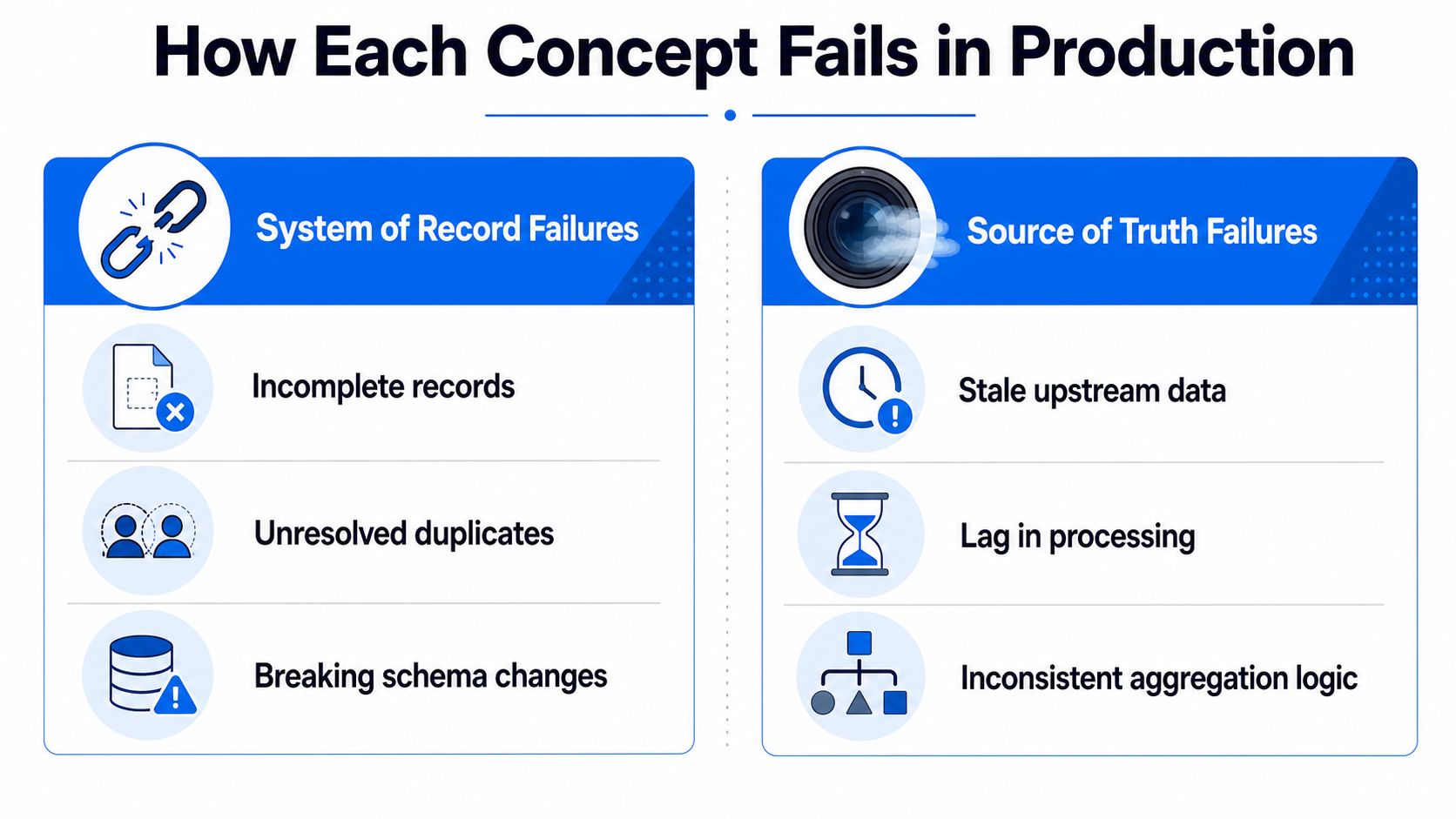
The failure modes are different, so the incident playbook should be different too. A system of record fails when the record itself is incomplete, duplicates remain unresolved, or a schema change breaks the consumers that depend on it. A source of truth fails when upstream data quality is weak, ETL delivers stale data, or reconciliation logic misses a conflict between two systems that both think they are correct. That difference matters in production because the point of failure changes where you look first, and where you place controls. Observability has to catch the problem before it reaches dashboards, which is why tools such as AutoProv single source checks are useful in practice when teams need to surface gaps, mismatches, and missing source coverage early.
What failure looks like in the operational layer
Operational failures usually show up first as data-entry or integration problems. A duplicate customer record can create two identities in downstream systems. A schema change can break an integration that expected a field to exist or expected a type to stay stable. If capture controls are weak, the source system can preserve bad data faithfully, which is worse than losing it because the bad data then looks authoritative.
The operational layer fails at the point of write. That is the trade-off. It is built to capture, validate, update, and store records, so a weakness in any one of those steps turns the system of record into a reliable place to keep unreliable facts. Peter Ritchie's framing of System of Record and Single Source of Truth is useful here because it keeps the focus on operational fidelity rather than reporting behavior.
What failure looks like in the aggregation layer
SOT failures are often quieter, which makes them harder to spot. A warehouse can keep loading on schedule while still being wrong because one upstream source is stale, one merge rule is outdated, or one deduplication assumption stopped holding last week. The layer still looks healthy from the outside, but the answer it presents can drift away from the business reality it is supposed to summarize. That is why teams need visibility into arrival patterns, structural changes, and business-rule checks before the issue reaches a dashboard.
For teams that need a concrete reference point for this kind of control, data reconciliation sits at the center of the problem. It is the discipline that exposes when records disagree, when one source has gone missing, and when a “trusted” aggregate is carrying forward a stale or partial view. A source of truth depends on those checks because authority without verification is just a label.
The root-cause question is simple, but teams skip it too often. Did the bad record originate in the operational store, or did it become misleading after aggregation and reconciliation? If you do not answer that cleanly, you waste time blaming the wrong layer and the wrong team.
Decision Criteria for Choosing or Reconciling SOR and SOT
Start with ownership. If a team creates and maintains the data as part of a live business process, that system is usually the system of record for that domain. If the goal is to present a harmonized view across domains for reporting, planning, or oversight, that layer is usually the source of truth. The mistake is trying to force one system to do both well, because the write path wants strict transactional behavior while the read path wants broad integration and history.
Use the right layer for the right question
A governed warehouse or semantic layer is often the right SOT when finance, sales, and operations need one view of the business. The operational systems stay authoritative for their own records, while the warehouse becomes the agreed reporting layer because it combines multiple authoritative inputs. That pattern works because it respects the architectural reality that the reporting layer sits on top of the operational systems instead of replacing them.
If multiple systems claim authority over the same field, reconcile by asking which system owns creation, which system owns validation, and which system owns downstream interpretation. The answer is rarely “all of them equally.” More often, one system should own the write path and another should own the shared read path, with a reconciliation workflow that flags conflicts before they spread.
Operational rule: if the field drives a transaction, privilege the SOR. If the field drives a cross-functional decision, privilege the SOT.
That's also where governance and architecture meet. The question isn't whether the warehouse is “less real,” it's whether it's the right place to create a controlled, auditable interpretation of several real systems. The earlier section on mechanical differences matters here because the same data element can legitimately have an operational home and a decisioning home.
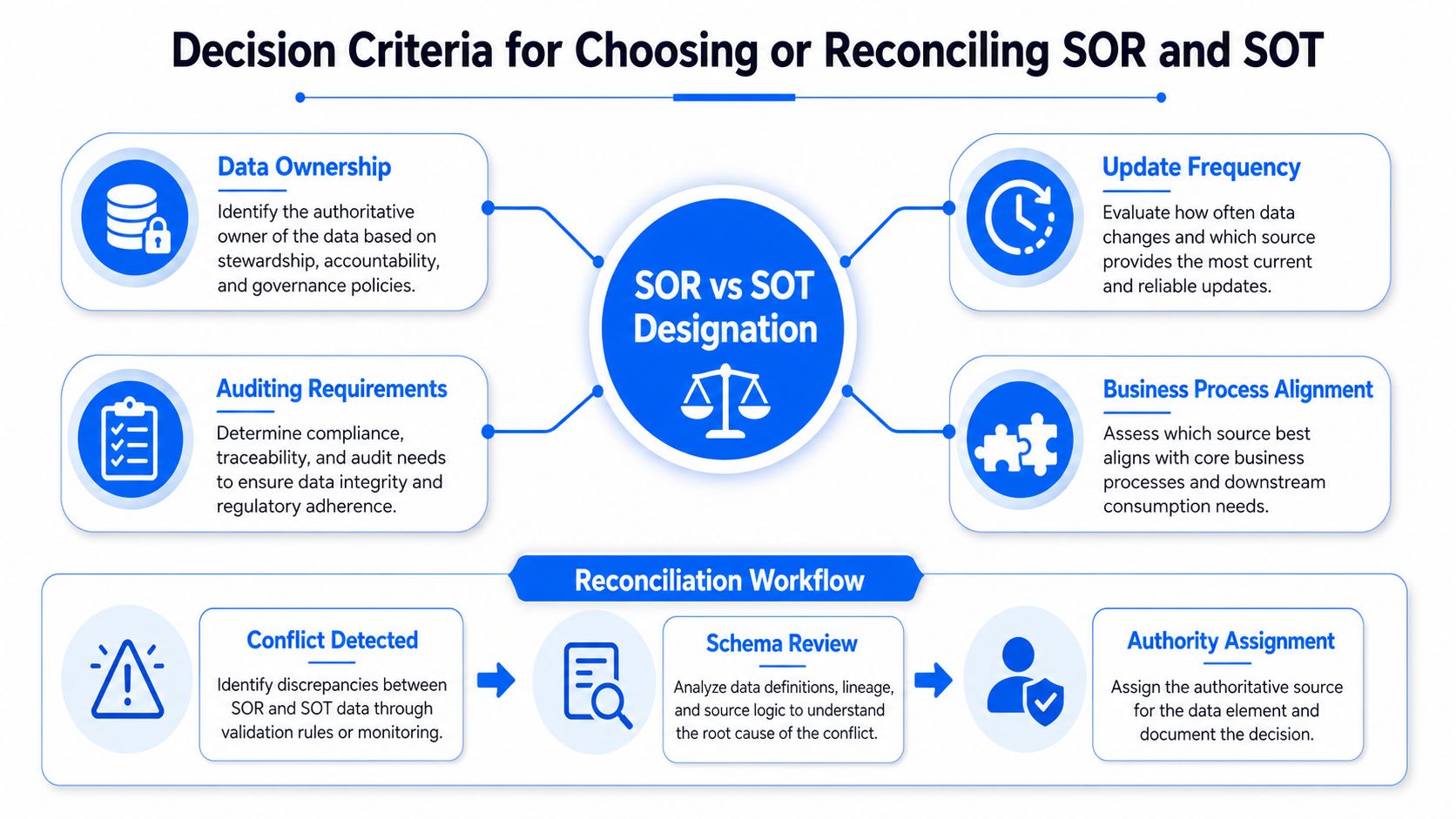
When teams need a concrete reconciliation model, this data reconciliation meaning guide is a helpful internal reference. The key is to make the authority assignment explicit, so a conflict doesn't become a political argument every time a number changes.
How Data Observability Supports Reliable SOR and SOT
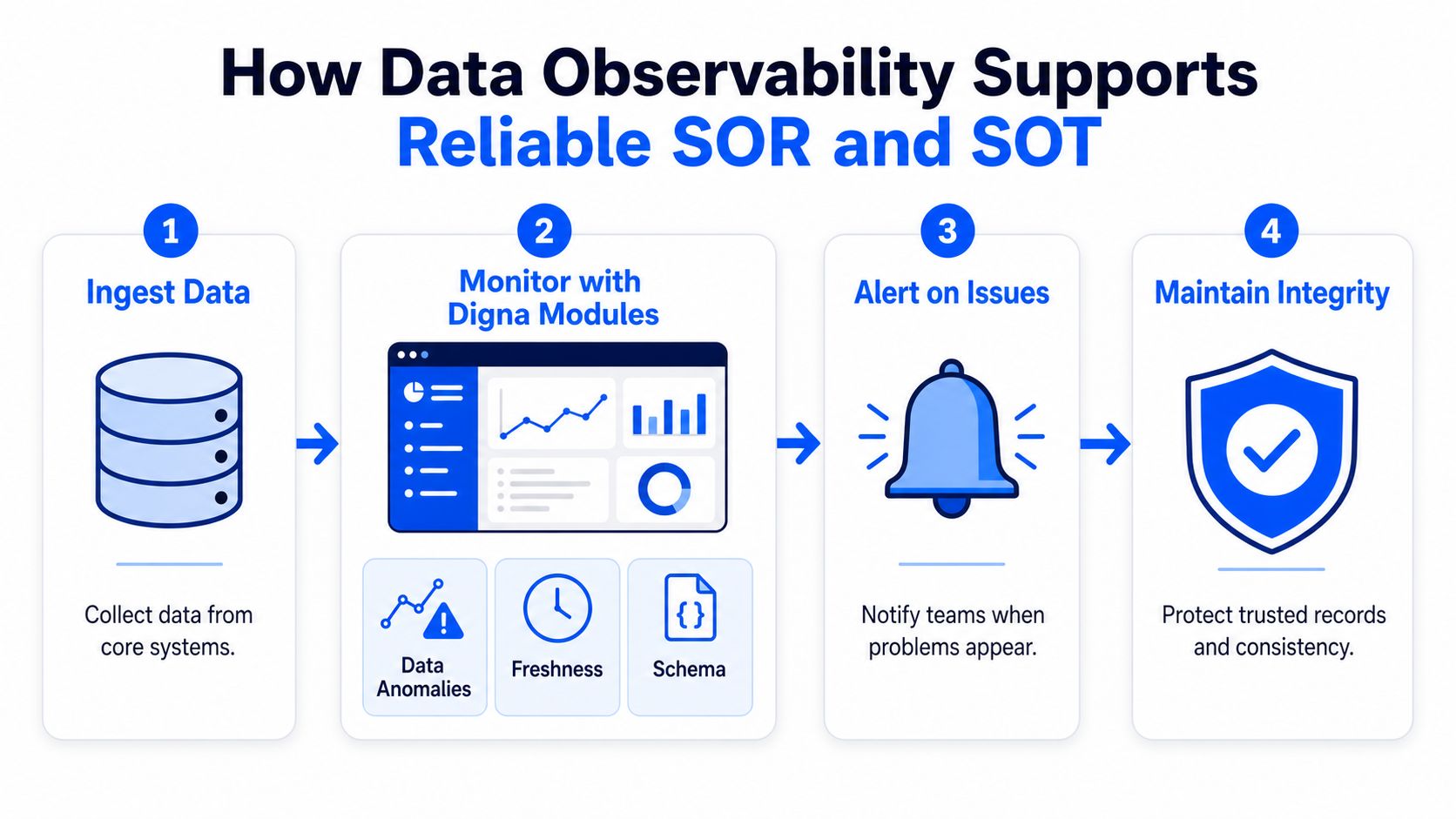
Data observability closes the gap between “the record exists” and “the record is trustworthy enough to consume.” In an operational layer, that means catching schema drift, missing records, and broken validation before downstream systems inherit the damage. In a trusted analytical layer, it means spotting arrival delays, anomaly patterns, and rule violations before business users see the wrong version of reality. digna is one option in this space, and its modules line up cleanly with the failure modes already discussed: Data Anomalies for AI-driven baseline learning, Timeliness for arrival monitoring and delay detection, Data Validation for business-rule enforcement, and Schema Tracker for structural change detection.
What observability should watch
The controls should match the layer. For a SOR, record-level validation and schema tracking matter because the point of capture has to stay clean. For a SOT, timeliness and anomaly detection matter because freshness and reconciliation quality determine whether the shared view is still dependable. digna's design also matters from a governance perspective because it runs entirely inside the customer's infrastructure, with in-database execution, so sensitive records do not need to leave the environment to be checked.
The broader lesson is that observability is not a dashboard accessory. It's the control plane between systems of record and sources of truth. When a pipeline starts delivering late, or a schema evolves, or a business rule stops holding, the issue should surface as an incident long before executives see a stale KPI.
For a deeper product overview, this digna data observability overview is a useful starting point.
Teams looking for a practical integrity playbook can also learn from the guide for Church Extension Fund leaders, especially if they need to translate governance language into operational controls. Observability works best when it's aligned with the actual data lifecycle, not bolted on after a report breaks.
Implementation Checklist and Recommended Architectures
A clean implementation starts with ownership, not tooling. First, identify every system that creates or updates a critical entity, then mark the one that owns the authoritative write path as the SOR. Next, designate the reporting layer that merges those inputs as the SOT, and document which questions that layer is allowed to answer. If both layers are expected to answer the same question, that's a design smell, not a feature.
A practical checklist
Map the entity owners: assign the system that creates and updates the record as the SOR for that domain.
Define the reporting layer: choose the warehouse or semantic layer that will act as the SOT for cross-domain decisions.
Write validation rules first: capture business rules for required fields, allowed values, and conflict handling before you automate loads.
Monitor timeliness explicitly: set expectations for when source data should arrive, then alert when it doesn't.
Track schema changes continuously: treat structural drift as a release risk, not a cosmetic change.
Keep audit evidence together: preserve the lineage and reconciliation trail so governance teams can show how the trusted view was built.
For a broader platform view, this enterprise data platform overview gives useful context for teams designing around multiple sources and governed consumers.
Architecture patterns that hold up
For multi-source customer data, let CRM, billing, and support each remain the SOR for their own domain, then consolidate into a governed semantic layer that serves as the SOT for account teams and executives. For financial reporting, keep the ERP or ledger authoritative for the transaction, then publish reconciled reporting views from the warehouse. For operational analytics, use change data capture or scheduled ingestion into an analytical layer so operations stay fast while analytics stays consistent.
The strongest pattern is not one system pretending to be everything. It's a clear operational source, a governed analytical view, and a monitoring layer that proves the two still agree.
That structure works in cloud, on-premises, and hybrid environments because the logic is the same even when the plumbing changes. The systems can differ, but the authority model shouldn't.
Real-World Applications Across Regulated Industries
Financial services tends to care first about integrity at the source and second about harmonization in reporting, because risk and regulatory data can't drift without detection. Healthcare puts a premium on clinical record reliability, then layers operational and reporting views on top so care teams and compliance teams don't work from incompatible data. Telecommunications has a different stress profile, high-volume customer and operational data can break without warning under load, so schema tracking and timeliness become critical to keep the trusted view current.
Public sector programs usually deal with a mix of long-lived records, audit expectations, and many reporting consumers, which makes the separation between SOR and SOT especially valuable. In practice, that means the operational system retains the authoritative record, while the reporting layer is designed for traceability, consistency, and evidence. digna's modular approach maps well here because the platform can monitor financial risk data, clinical records, customer-heavy operational feeds, and government reporting pipelines without forcing the same control pattern everywhere.
What changes by industry
The common thread is that regulated environments can't rely on “the dashboard looked fine.” They need proof that the upstream record was valid, that the aggregation layer received data on time, and that schema changes didn't alter meaning without notice. That's where the line between system of record and source of truth becomes an operational control, not just a definition.
If your organization is preparing for an audit or tightening controls around leadership reporting, the Regina SOC 2 audit help for CFOs resource is a useful example of how compliance work depends on reliable evidence, not just clean narratives. The same principle applies across these industries, the trusted view has to be demonstrable, not assumed.
If you're sorting out where your systems of record end and your source of truth begins, digna gives teams a way to watch the seams instead of discovering them in a broken dashboard. It monitors data behavior, validates business rules, tracks timeliness, and detects schema changes inside your own environment, which is exactly what these architectures need. Visit digna to see how that fits into your own operational and reporting stack.
For the source-of-truth side, where a warehouse can keep loading on schedule while quietly drifting from business reality, digna Data Anomalies learns each table's normal baseline and flags unexpected shifts before they reach a dashboard.
Frequently asked questions
What is the difference between a system of record and a source of truth?
A system of record is the authoritative operational store for one business domain, such as a CRM, ERP or HR platform, where data is created and managed. A source of truth harmonizes several systems of record into a governed cross-domain view, typically a warehouse or semantic layer used for reporting.
Can a data warehouse be a system of record?
Usually not; the article positions the warehouse as a source of truth. It does not originate the facts, but it combines multiple authoritative inputs into the agreed reporting layer. Operational systems such as the CRM, billing platform or ERP ledger remain authoritative for their own records and transactions.
How do systems of record and sources of truth fail differently?
A system of record fails at the point of write: incomplete records, unresolved duplicate customers or a schema change that breaks integrations. A source of truth fails more quietly, when an upstream source goes stale, a merge rule is outdated or a deduplication assumption stops holding while loads still run on schedule.
Which system wins when two systems disagree on the same field?
Ask which system owns creation, which owns validation and which owns downstream interpretation. The article's operational rule is simple: if the field drives a transaction, privilege the system of record; if it drives a cross-functional decision, privilege the source of truth, backed by a reconciliation workflow that flags conflicts early.
How does data observability support systems of record and sources of truth?
Controls should match the layer. For a system of record, record-level validation and schema tracking keep the point of capture clean. For a source of truth, timeliness and anomaly detection confirm the shared view is fresh and reconciled. The article maps these to digna Data Validation, Schema Tracker, Timeliness and Data Anomalies.