Product Master Data Management: What It Is and Why It Matters
|
8
min read

If your product catalog looks different in your ERP, your e-commerce platform, and your warehouse system, you already know the cost. Wrong prices, mismatched SKUs, and returns that nobody can explain back to a root cause. Product master data management is the discipline that fixes this by giving every product a single, trusted record that every system and team can rely on.
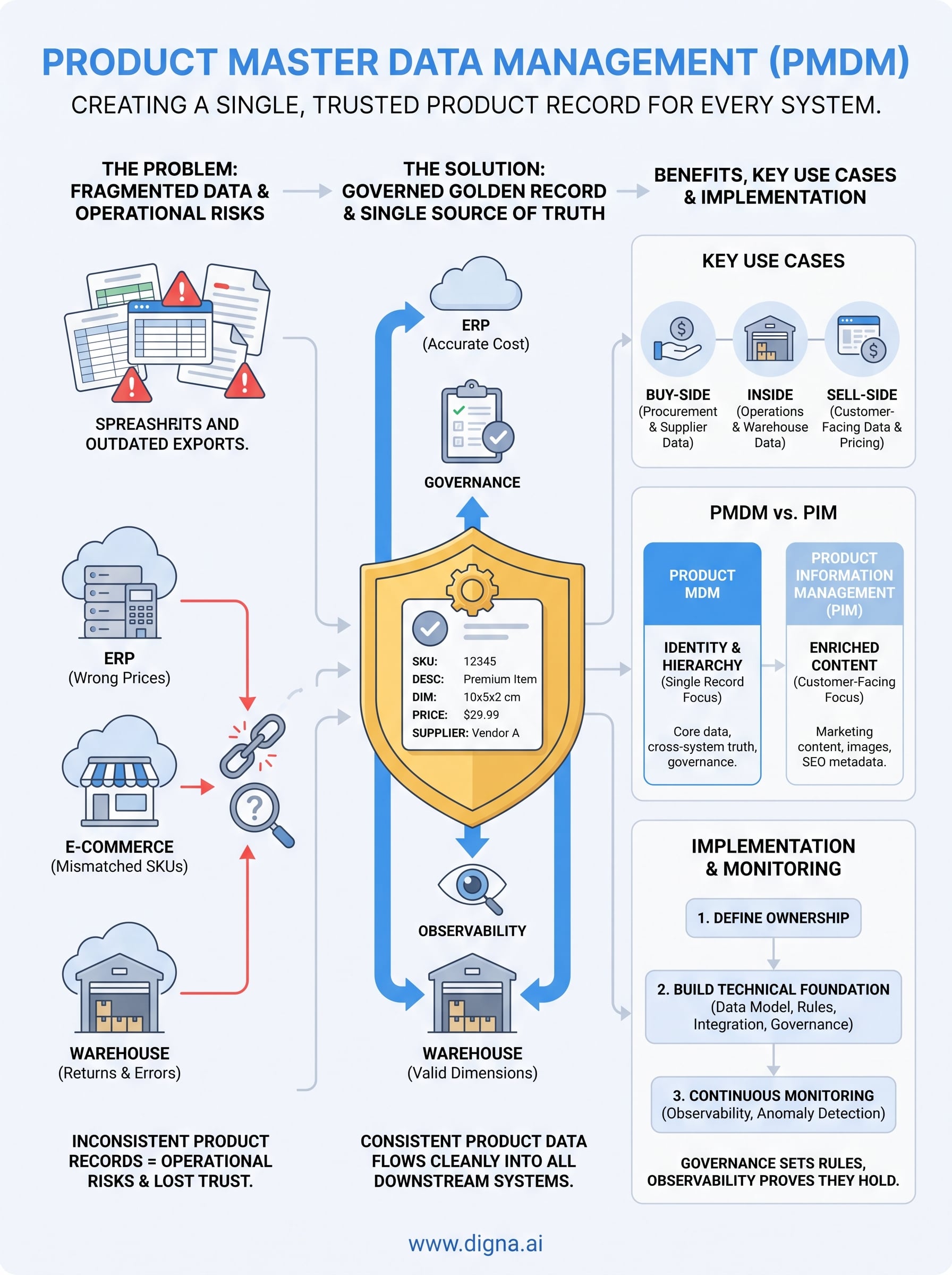
At its core, PMDM means creating one authoritative source for product attributes such as descriptions, dimensions, pricing, and supplier details, then governing how that data gets created, updated, and shared across your organization. Done right, it stops teams from working off conflicting spreadsheets or outdated exports, and it gives you a consistent product record that flows cleanly into every downstream system, from procurement to the storefront.
In this article, we break down what product master data management actually involves, the components that make it work, and why it matters more as your product catalog and system landscape grow. We'll also look at where quality checks and anomaly detection fit into keeping that master data trustworthy over time, since a management process is only as good as the data quality controls behind it.
Why product master data management matters
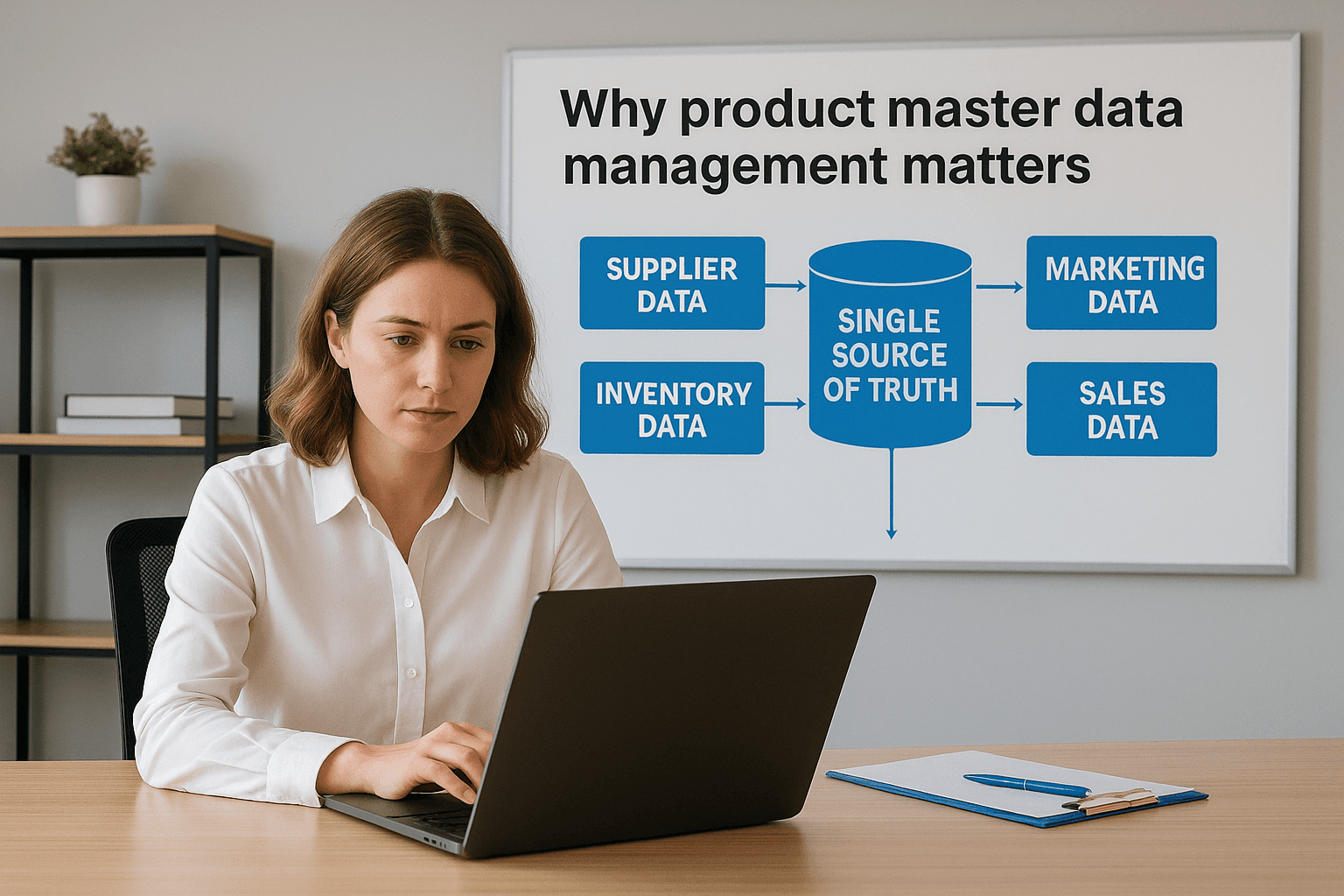
Every enterprise with more than a handful of systems eventually hits the same wall: product data drifts. A supplier updates a package weight in one system, a marketing team adds a new attribute in another, and within months your single source of truth has splintered into five different versions of the truth. This isn't a technical inconvenience, it's an operational risk that shows up in mispriced orders, failed EDI transactions, and compliance audits that drag on for weeks longer than they should. Product master data management exists precisely because manual reconciliation doesn't scale past a few thousand SKUs, let alone the hundreds of thousands that most mid-to-large enterprises manage today.
The real cost of inconsistent product data
Costs pile up quietly at first. A warehouse team ships the wrong dimensions to a carrier and eats a reshipping fee. A finance team reconciles vendor invoices against outdated contract terms and misses a negotiated discount. None of these look catastrophic in isolation, but multiply them across thousands of SKUs and dozens of trading partners, and the numbers add up fast, especially once regulatory reporting or customer-facing pricing gets involved.
Data issue | Typical business impact |
|---|---|
Duplicate SKUs | Overstocking, inaccurate demand forecasts |
Inconsistent units of measure | Billing errors, failed EDI transactions |
Outdated supplier records | Missed discounts, compliance gaps |
Mismatched attributes across channels | Returns, complaints, marketplace suspensions |
Bad product data doesn't just cost money, it quietly erodes trust in every system and every decision built on top of it.
Where clean product data pays off
Governed product data speeds up everything downstream. New product introductions move faster because teams aren't waiting on manual data entry across five disconnected systems. Regulatory filings become less painful because attributes like hazardous material classifications or country-of-origin data live in one governed record instead of scattered spreadsheets nobody trusts. Reporting teams stop second-guessing their dashboards because the product dimension feeding those reports doesn't silently change shape overnight.
Here is where data observability earns its place alongside PMDM rather than sitting off to the side. A schema tracker that flags an added column or a shifted data type catches structural drift before it corrupts a report, and anomaly detection that learns normal patterns in your product feeds can surface a pricing error or a broken supplier load long before a customer notices. PMDM sets the governance rules; observability keeps proving those rules are actually holding up in practice, every day the data flows.
How to implement product master data management
Rolling out product master data management works best as a phased program, not a single big-bang project. Start narrow: pick one product domain, like packaged goods or electronic components, prove the model works, then expand. Enterprises that try to govern every attribute across every business unit on day one usually stall out within a quarter, because the political work of agreeing on "who owns this field" takes longer than the technical build.
Define ownership before you touch tools
Sort out who owns each attribute before selecting software. Procurement typically owns supplier and cost data, product teams own descriptions and classifications, and compliance owns regulatory attributes like hazardous material codes. Without this agreement, your golden record becomes a battleground every time two systems disagree.
A master data project without clear ownership just moves the chaos into a nicer-looking database.
Build the technical foundation in stages
Once ownership is settled, build out the stack in a logical order:
Data model: agree on the attributes, hierarchies, and identifiers every product record must carry.
Matching and survivorship rules: decide which source wins when two systems disagree on the same field.
Integration layer: connect ERP, PIM, e-commerce, and warehouse systems so updates flow both ways.
Governance workflow: set approval steps for new products, attribute changes, and retirements.
Monitoring: layer in anomaly detection and schema tracking so drift gets caught immediately, not at the next audit.
That last step gets skipped more often than it should. Teams assume that once the golden record exists, it stays clean. It doesn't. Suppliers push malformed feeds, integrations break silently, and new attributes get added without anyone updating documentation. Tools that watch for structural drift and unexpected value changes catch these problems while they're still small, which is exactly the gap platforms built for data quality and observability are designed to close.
Key use cases: buy-side, inside, and sell-side data
Product master data management earns its keep differently depending on which side of the business you're looking at. Buy-side data covers everything tied to procurement: supplier records, cost terms, contract pricing, and vendor-specific SKUs. Get this wrong and you're paying invoices against expired contract terms or missing negotiated discounts because two systems list different unit costs for the same item.

Buy-side: procurement and supplier alignment
Buy-side use cases center on keeping supplier and cost data synchronized across procurement, finance, and inventory systems. Duplicate vendor records are the classic failure mode here: the same supplier onboarded twice under slightly different names, splitting purchase history and killing volume-discount visibility. A governed golden record for each supplier and product combination closes that gap and gives finance a single number to reconcile against.
Inside: operational consistency across the enterprise
Inside data is what keeps your own operations running: warehouse dimensions, storage requirements, internal classifications, and the hierarchies that feed demand planning and inventory systems. This is where mismatched units of measure cause the most damage, since a weight recorded in kilograms in one system and pounds in another can throw off freight calculations or trigger shipping fee disputes. Consistent internal product hierarchies also make demand forecasting more reliable, because planning teams work from one structure instead of reconciling five slightly different category trees.
Sell-side: customer-facing accuracy
Sell-side data is what customers and channel partners actually see: descriptions, images, pricing, and compliance attributes on your storefront or marketplace listings. Errors here are the most visible and the most expensive, since a wrong dimension or missing certification can trigger returns, complaints, or a marketplace suspension. Marketplaces like Amazon enforce strict listing accuracy requirements, and repeated data errors can lead to account-level penalties, not just a single rejected listing. Governing sell-side attributes with the same rigor as buy-side and inside data protects revenue directly, not just operational efficiency.
Buy-side, inside, and sell-side data all break in different ways, but they all trace back to the same missing governance.
Product MDM vs. product information management
Confusion between these two disciplines runs deep, and it costs teams time they don't have. Product information management (PIM) systems store and enrich the marketing-facing content that goes on a website or catalog: descriptions, images, translations, SEO metadata. Product master data management governs something more foundational: the identity, hierarchy, and cross-system truth of the product record itself. PIM answers "how does this product look to a customer." PMDM answers "is this the same product everywhere, and who's allowed to change it."
Where the two disciplines split
Overlap exists, but the split matters once you scale past a few thousand items. A PIM tool can hold beautiful, enriched content for a product that doesn't actually exist as a governed master record, which means marketing publishes a listing before procurement has even confirmed the SKU is real. That gap is exactly where mismatched attributes and duplicate listings creep in.
Dimension | Product MDM | PIM |
|---|---|---|
Primary focus | Identity, hierarchy, cross-system consistency | Enriched, customer-facing content |
Typical owner | Data governance, IT, master data team | Marketing, e-commerce team |
Core question | Is this the correct, single record? | Does this record look right to a buyer? |
Failure mode without it | Duplicate SKUs, mismatched systems | Inconsistent descriptions, poor SEO |
PIM makes a product look right. PMDM makes sure it actually is right, everywhere, at the same time.
Why enterprises need both, not one or the other
Enterprises that treat PIM as a substitute for master data management eventually pay for it in returns and support tickets, because pretty content built on a shaky record just travels the errors further and faster. Running PMDM as the governance layer underneath PIM gives marketing a trustworthy base to enrich, instead of a moving target they have to double-check every quarter.
Common PMDM challenges and how to solve them
Most product master data management programs stall for predictable reasons, not exotic ones. Legacy systems resist integration, business units defend their own version of the truth, and governance rules that looked clean on a whiteboard fall apart the moment a real supplier feed doesn't match the data model. Recognizing these patterns early saves months of rework.
Data silos and duplicate records
Silos form when business units build their own product lists faster than IT can connect them, and duplicates follow close behind. Fixing this requires matching rules that catch near-duplicate SKUs, not just exact-match ones, since a supplier code with an extra space or a shortened description slips past simple string comparisons every time. A survivorship rule that automatically picks the most complete, most recently verified record cuts down the manual cleanup that otherwise falls on a data steward's desk.
Governance that nobody follows
Rules only work if people use them. Governance fails when approval workflows are too slow for the business, so teams route around them and create shadow records to hit a deadline. Tightening the workflow, not loosening the rules, usually fixes this: fewer approval steps, clearer ownership, and faster turnaround on routine changes.
The fastest way to kill a governance program is to make the correct path slower than the workaround.
Drift that governance alone can't catch
Even a well-governed record decays over time as feeds update, schemas shift, and new attributes get bolted on without documentation. This is where monitoring earns its keep:
Challenge | Root cause | Fix |
|---|---|---|
Duplicate SKUs | Weak matching rules | Fuzzy matching + survivorship logic |
Slow approvals | Overloaded workflow | Streamlined governance steps |
Silent schema changes | No structural monitoring | Automated schema tracking |
Unexplained value shifts | No anomaly detection | AI-driven anomaly alerts |
Solving these problems takes both discipline and continuous checking, since governance sets the rule and observability confirms the rule is holding.
Building trust in your product data
Product master data management gives your organization one governed record instead of five competing versions, and that single shift changes how fast teams move. Procurement stops chasing expired contract terms, warehouse teams stop guessing at unit conversions, and marketing stops publishing content for products that were never confirmed as real. None of this holds up without ongoing checks, though. Governance rules set the standard, but only continuous monitoring proves that standard is holding as feeds update and systems change underneath you.
That's the layer most PMDM programs underbuild. Schema tracking and anomaly detection catch the drift that manual review misses, often days before it reaches a customer or an auditor. If you're ready to put real monitoring behind your product data instead of hoping it stays clean, see how digna's data observability platform catches these issues automatically, right inside your existing environment.
For the automated schema tracking that catches silent structural changes in product feeds before they corrupt a report, see how digna Schema Tracker flags added, removed and retyped columns.
Frequently asked questions
What is product master data management?
Product master data management (PMDM) creates one authoritative record for product attributes such as descriptions, dimensions, pricing and supplier details, then governs how that record is created, updated and shared. It replaces conflicting spreadsheets and exports across ERP, e-commerce and warehouse systems with one consistent record that flows into every downstream system.
What is the difference between product MDM and PIM?
PIM stores and enriches customer-facing content such as descriptions, images, translations and SEO metadata, and is usually owned by marketing. Product MDM governs the identity, hierarchy and cross-system truth of the record itself. Put simply, PIM makes a product look right, while PMDM makes sure it is the same correct product everywhere.
How do you implement product master data management?
Run it as a phased program, starting with one product domain such as packaged goods. Settle attribute ownership before choosing tools, then build in stages: data model, matching and survivorship rules, integration layer, governance workflow, and finally monitoring with anomaly detection and schema tracking so drift is caught before the next audit.
What problems does inconsistent product data cause?
Each issue maps to a business cost. Duplicate SKUs lead to overstocking and inaccurate forecasts, inconsistent units of measure cause billing errors and failed EDI transactions, outdated supplier records mean missed discounts and compliance gaps, and mismatched attributes across channels trigger returns, complaints and even marketplace suspensions.
How do you prevent duplicate SKUs in product master data?
Fuzzy matching rules that catch near-duplicates, not just exact matches, are the main defense, because a supplier code with an extra space or a shortened description slips past simple string comparison. A survivorship rule that picks the most complete, most recently verified record then cuts the manual cleanup left for data stewards.