Reliable Data Is Valid Data: A Practical Guide
|
7
min. czyt.
It's Monday morning. The executive dashboard is green, revenue looks stable, and the overnight pipeline completed without an error. By Tuesday afternoon, a product manager discovers that conversion rates have been wrong for three days because an upstream schema change altered how null values were handled. Nothing failed operationally. The workflow ran on schedule and delivered data on time. The data itself was no longer valid.
That distinction causes some of the most expensive incidents in modern data platforms. Reliable data is valid data, but a pipeline that runs consistently isn't automatically producing trustworthy records. Production reliability depends on whether data remains correct, current, structurally compatible, and fit for the decision it supports.
Table of Contents
Practical Controls for Achieving Both Validity and Reliability
Why Static Validation Is Not Enough for Modern Data Platforms
When Reliable Data Fails the Validity Test
The first alert usually isn't an alert. It's a question in Slack.
“Why did conversion drop for one channel?”
The dashboard still shows a successful refresh. Job orchestration reports no failures. Row counts look plausible, and the warehouse accepted every record. A quick comparison reveals that an upstream service changed the representation of missing values. The transformation still executed, but its join and aggregation logic treated those values differently. A metric that looked stable was calculated against a changed meaning.
This is the dangerous gap between pipeline reliability and data validity. A reliable pipeline can complete every scheduled task while delivering records that violate business meaning. A valid dataset can also become operationally unreliable if it arrives too late, arrives incompletely, or changes shape without warning.
A green pipeline can still be wrong
Basic monitoring often answers operational questions:
Did the job start?
Did it finish?
Did the warehouse accept the query?
Did the expected task produce an output?
Did the dashboard refresh?
Those checks matter, but they don't answer whether a customer identifier still maps to the correct customer, whether a timestamp belongs to the intended reporting period, or whether a status code remains within the approved business vocabulary.
Validity is the control that connects successful processing to meaningful output. IBM describes validity as a distinct data-quality dimension involving format, type, range, and business-rule constraints, while noting that plausible data can still be invalid when it violates structural or semantic expectations in its explanation of data-quality dimensions.
A malformed email, negative age, unexpected code, or null join key might pass ingestion because the storage layer permits it. Downstream models and reports then inherit the defect. The farther the record travels, the harder it becomes to identify the original cause.
Practical rule: A successful run proves that software completed its work. It doesn't prove that the result deserves trust.
The business exposure is substantial. A 2017 MIT Sloan Management Review article cited research estimating that bad data costs most companies 15% to 25% of revenue through distorted decisions, reporting, and financial performance (MIT Sloan Management Review reference). That estimate helps explain why validity belongs in enterprise controls, not only in engineering checklists.
Understanding Validity and Reliability in Data
A pipeline can complete successfully at 2 AM and still publish unusable data by breakfast. A field may parse, a job may turn green, and a dashboard may refresh while the records violate the rules that give them meaning. Validity and reliability describe different controls for catching that failure.
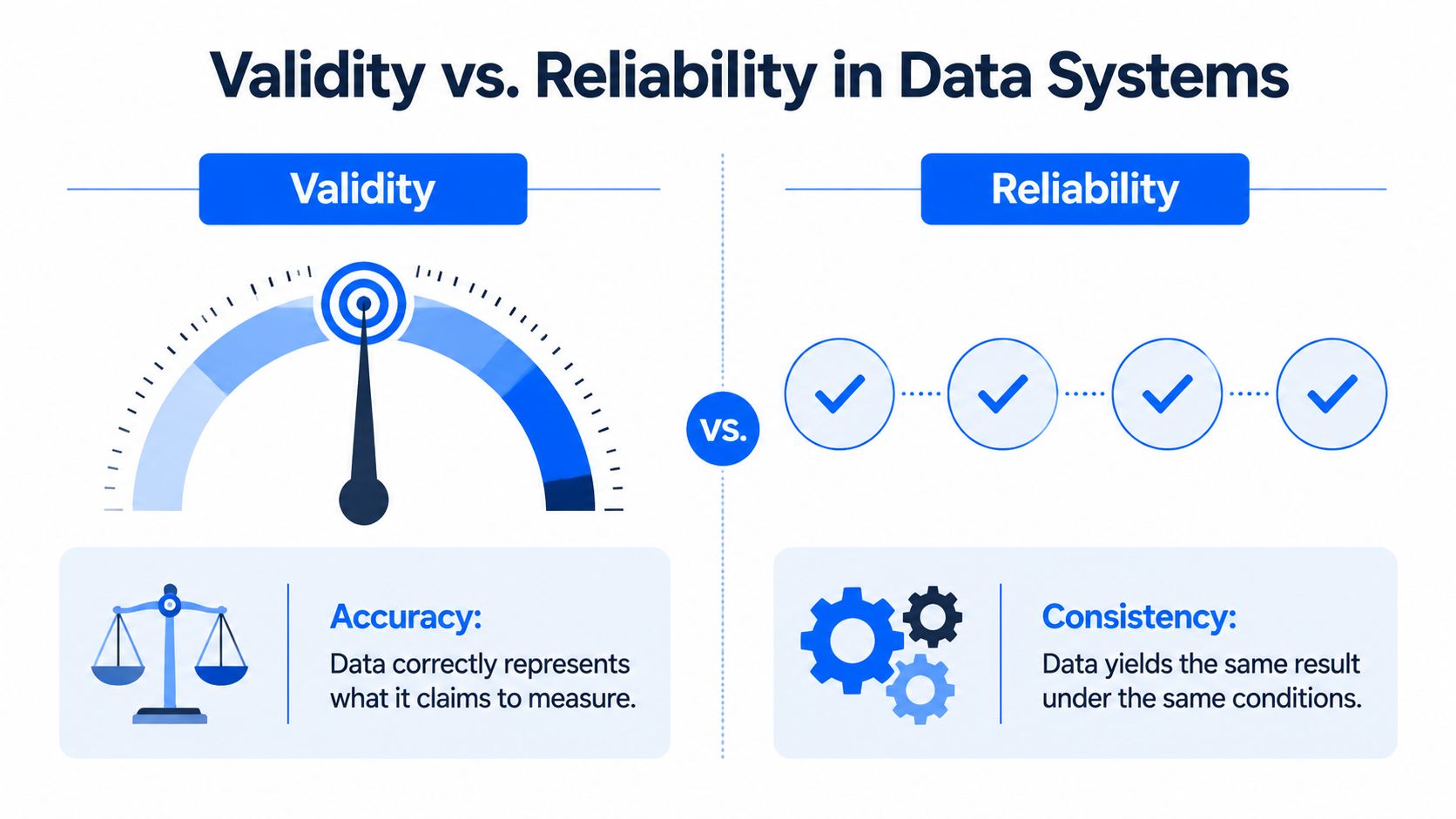
Validity asks whether a record represents what it claims to represent and conforms to the rules for acceptable data. Reliability asks whether results remain consistent over time and under changing measurement conditions. The United Nations statistical standards reference treats the two as related but separate properties.
A scale that consistently reads 5 pounds heavy is reliable because it produces repeatable results, but it is not valid because its readings miss the actual weight. A scale that fluctuates randomly is neither reliable nor valid.
What validity means in production
In a data platform, validity covers more than whether a value looks plausible. Engineers commonly check:
Type compliance: Numeric fields contain numbers, dates parse correctly, and identifiers keep their required representation.
Range compliance: Values stay within meaningful lower and upper bounds.
Format compliance: Emails, codes, phone numbers, and timestamps match accepted patterns.
Referential integrity: Foreign keys resolve to records in the correct dimension or reference table.
Business-rule compliance: Related fields agree with one another and with the process they describe.
A customer age of 37 can be accurate and valid. A negative age is invalid even if the database accepts it. A timestamp can match the required format while still representing the wrong event because an upstream system applied an unexpected timezone.
The distinction between accuracy and validity matters in production. Accuracy concerns whether a value reflects reality. Validity concerns whether it conforms to the data contract and measurement design. A value can appear reasonable and still fail a rule that protects downstream interpretation. The data validity guide explains how teams can assess that distinction in practice.
Why reliability needs more than consistency
Reliability includes dependable availability, complete delivery, and arrival within the timeframe a decision requires. A pipeline that repeats the same flawed transformation every night is consistent, but its output is not reliable evidence. Valid records that arrive after a planning meeting may also be unusable.
The World Bank's Worldwide Governance Indicators compile standardized, multi-source data for more than 200 economies from 1996 to 2024, using 35 cross-country sources such as household surveys, firm surveys, and expert assessments. Comparisons across markets require data that remains structurally valid and consistently produced.
Observability connects these properties operationally. Freshness checks, schema-change alerts, volume monitoring, and rule-failure trends show whether valid records continue arriving in a reliable pattern. “The pipeline is reliable” should describe delivery behavior. “The data is valid” should describe conformance and meaning. Production trust requires both.
Common Failure Modes That Break Data Trust
A pipeline can pass ingestion checks and still corrupt the dataset later. The failures usually appear when records meet transformations, joins, business rules, or changing upstream structures. Production controls must test those interactions, not only isolated fields.
Silent schema drift
An upstream service adds, removes, renames, or retypes a field. The consumer may continue running because the query still parses or a flexible payload accepts the change. A transformation can then map the wrong field, drop a new status, or alter null behavior without raising an operational error. Schema drift guidance from digna describes how structural changes can break consumers without detection.
Null propagation
A required join key becomes null in a small share of incoming records. Source-level schema and type checks still pass, but the join excludes those records. Fact tables lose related rows, and aggregates undercount without a clear ingestion failure. Distribution checks and join-match monitoring can expose this gap.
Timezone mismatches
A timestamp can remain syntactically valid while its timezone interpretation changes. Hourly, daily, or monthly aggregations then assign events to the wrong period. A format validator approves the value even though its analytical meaning has shifted. Monitoring should compare timezone assumptions and boundary behavior, especially around reporting cutoffs.
Duplicate delivery
At-least-once streaming can deliver one event more than once. Row-level validation approves every copy because each record is individually valid. Without idempotency or deduplication, revenue, activity, and transaction aggregates become inflated. Event identifiers and duplicate-rate alerts provide a control at the business-event level.
Stale dimensions
A fact record can contain a valid-looking key that is absent from the current dimension table. Standard schema validation does not show that the reference data is old. After the join, analysts may see unknown categories, missing attributes, or broken segmentation. Referential-integrity checks and dimension freshness checks catch different parts of the problem.
Failure Mode | What Basic Validation Catches | What Breaks in Production |
|---|---|---|
Silent schema drift | Parseability and expected field types | Transformations, joins, or mappings use changed structure |
Null propagation | Column type and basic format | Joins drop records and downstream totals become incomplete |
Timezone mismatch | Timestamp syntax | Time-series windows assign events to the wrong period |
Duplicate delivery | Individual row validity | Aggregates count the same business event repeatedly |
Stale dimensions | Fact-table structure | Reference joins lose attributes or create unresolved keys |
The operational lesson is direct: record validity is necessary but not sufficient. Tests must also observe relationships, distributions, delivery behavior, and structural change. Observability connects those checks to outcomes by showing whether a valid dataset continues arriving in the expected shape, volume, and timing. Without that view, teams validate individual pieces while missing the system failure.
How Timeliness and Schema Stability Complete the Picture
A record may pass every validation rule when created and still be wrong for the decision it supports. If yesterday's inventory snapshot arrives after today's allocation run, its types, ranges, and business rules can all be valid. The dataset is still unfit because it no longer represents the operating state.
Freshness is therefore a temporal validity constraint. Monitoring should verify that expected data arrived, that no batch is missing, and that the newest records remain within the agreed operating window. This guide to data timeliness, metrics, and monitoring explains how to make that window measurable. A practical guide to freshness monitoring provides the same operational focus: “the data should be current” must become a condition that can pass, fail, and trigger action.
Three axes for production readiness
Assess each critical dataset across three connected axes:
Correctness: Values meet type, format, range, relationship, and business-rule requirements.
Freshness: Data arrives within the agreed delivery window and reflects the relevant state of the business.
Structural stability: Fields, types, tables, and relationships remain compatible with consuming systems.
A dataset can satisfy one axis while failing another. A customer export may contain correct records but arrive after a campaign begins. A streaming feed may arrive continuously while duplicating events. A table may retain its schema even after a source changes what a status code means.
Schema stability is an active contract
Schema changes need an impact assessment, not an automatic rejection. A new nullable column may be safe for consumers that ignore unknown fields. A dropped column, renamed field, or type change can break a transformation or subtly alter its output.
Observability connects freshness, schema drift, volume shifts, and pipeline failures instead of treating them as isolated alerts. Ataccama's discussion of data quality and data observability describes freshness as currency, schema drift as structural change, and volume anomalies as unexpected changes in dataset size.
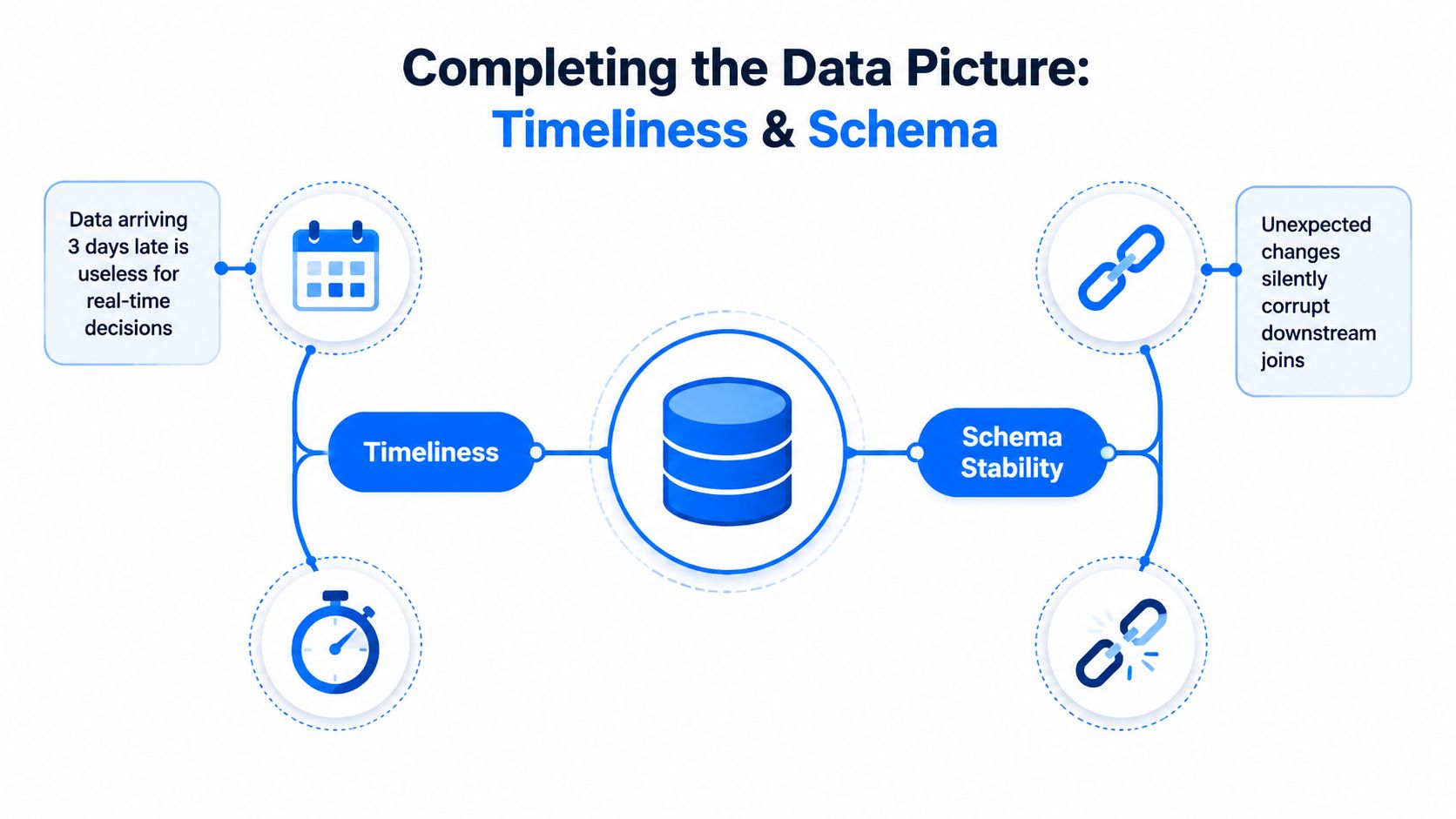
The interaction matters more than any single score. Correctness without freshness produces historical truth at the wrong decision time. Freshness without structural stability delivers current data that consumers may misread. Structural stability without correctness preserves a dependable shape for defective values.
Reliable data is valid data only when correctness, freshness, and structural stability hold together.
Practical Controls for Achieving Both Validity and Reliability
Controls work best when they sit close to the failure they're designed to catch. A single end-of-pipeline test is too late for a broken source contract, while dozens of undifferentiated alerts create fatigue and encourage teams to ignore the monitoring system.
Start with layered checks
At the source or staging boundary, apply column-level assertions for required fields, accepted types, null behavior, ranges, and approved reference values. Add distribution checks where a valid record can still create an invalid dataset, such as a sudden concentration in one category or an unexpected collapse in populated values.
At the integration layer, test relationships. Referential integrity checks should confirm that keys resolve. Uniqueness checks should identify duplicate business events. Cross-column rules should verify combinations such as status and completion date, rather than testing each field in isolation.
At the consumption layer, monitor the metrics stakeholders use. A dashboard can remain technically available while its core revenue, customer, or risk metric behaves abnormally. Business-level checks provide a final guard against defects that lower-level assertions don't understand.
Add operational observability
Freshness monitors should watch expected arrival patterns, delayed batches, missing loads, and early deliveries. Schema-diff detectors should flag added, removed, renamed, or retyped fields before a breaking change reaches dependent models. Datadog's data-observability monitor documentation describes detection at database, schema, table, and column levels.
Volume anomaly detection closes another important gap. It can surface silent truncation, unexpected duplicate surges, and partial extraction even when every delivered row passes validation.
Control | Catches | Pipeline Stage | Alert Severity |
|---|---|---|---|
Null and range assertions | Missing required values and invalid bounds | Source or staging | High when critical fields fail |
Referential checks | Unresolved dimension and reference keys | Integration | High for affected joins |
Freshness monitoring | Late, missing, or unexpectedly early loads | Source and staging | Critical for decision-time datasets |
Schema diff detection | Added, removed, renamed, or retyped fields | Source contract | Critical for breaking changes |
Volume anomaly detection | Truncation, duplicate surges, and partial loads | Staging and consumption | High when aggregates are affected |
Business metric monitoring | Unexpected KPI behavior | Consumption | Severity follows business impact |
Thresholds should reflect normal behavior, not arbitrary perfection. A warning that fires on every weekend fluctuation teaches operators to dismiss alerts. A useful health dashboard combines technical signals with ownership, affected assets, last successful delivery, and the business decision at risk. Teams can also use continuous data validation rules and checks to connect record-level controls with ongoing quality monitoring.
Why Static Validation Is Not Enough for Modern Data Platforms
Static validation rules are useful gates, but they become brittle when teams treat them as a complete reliability strategy. A rule written once may confirm that a field isn't null while missing a new enum value, a changed semantic, a duplicate event pattern, or a source that stopped delivering current records.
Modern platforms process streaming events, semi-structured payloads, and third-party responses that evolve outside the warehouse team's release cycle. That operating environment needs continuous observability, not only point-in-time validation.
The business consequences can be severe. One reported retailer incident involved a static null check that missed a new enum value and rerouted USD 4 million in attribution. A separate fintech example involved a hardcoded range assertion that failed to catch a currency-code swap that inflated risk scores. These examples illustrate the central weakness of static rules: they can verify known conditions while missing unfamiliar but consequential behavior.
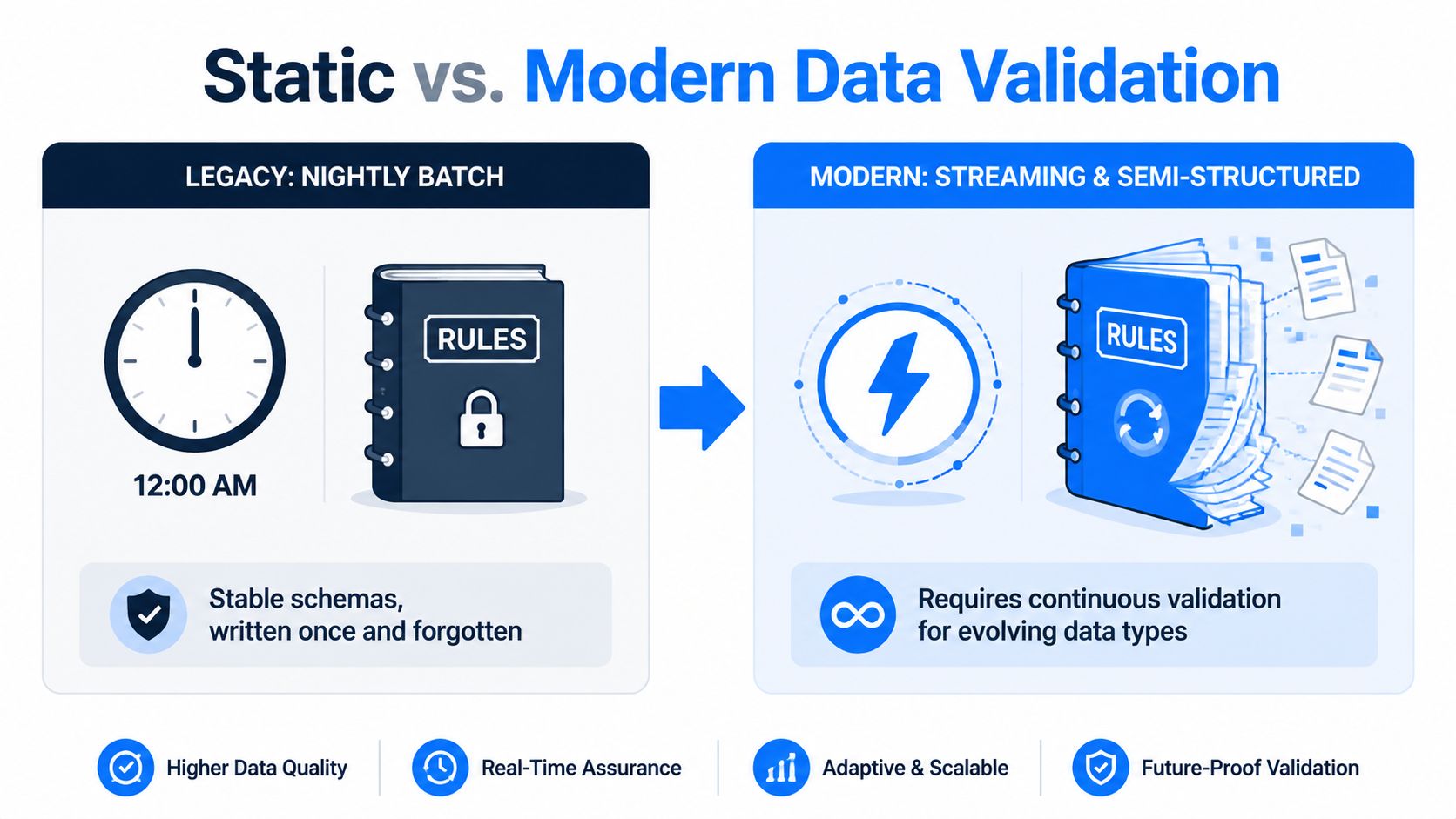
Continuous observability watches how data behaves over time. It combines explicit contracts with anomaly detection, freshness tracking, volume analysis, and schema-change monitoring. That model doesn't eliminate deterministic rules. It places them inside a feedback loop that can identify when the environment has changed.
The practical shift is from “did this value pass the test?” to “does this dataset still behave as expected for its purpose?” That question catches failures that static validation can't describe in advance.
Building a Data Reliability Strategy That Scales
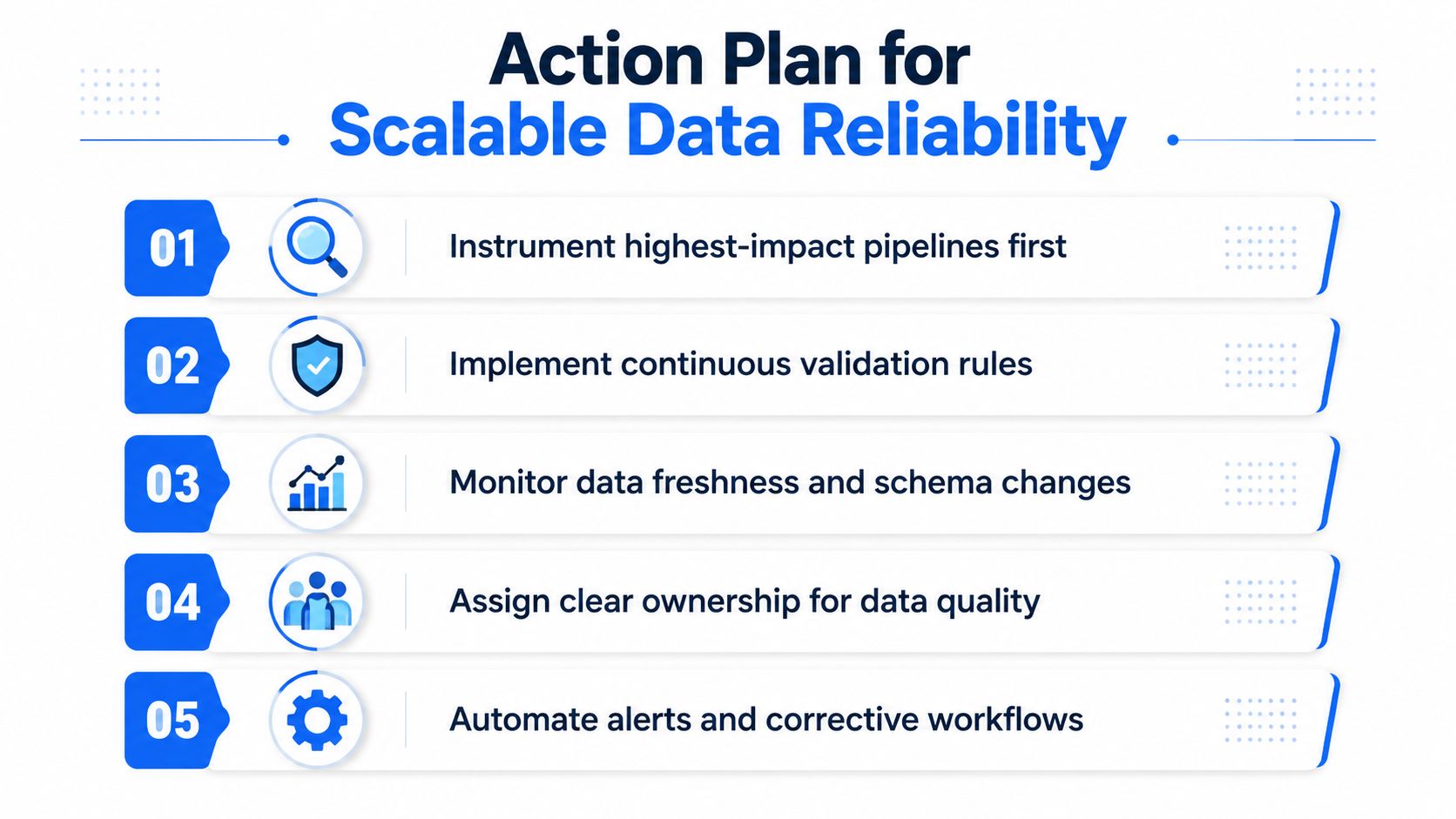
Teams don't need to instrument every table before improving trust. Start with the pipelines that feed regulatory reporting, executive metrics, customer operations, financial decisions, or AI features.
Use this sequence:
Prioritize impact: Map critical datasets to the decisions and models that depend on them.
Define delivery contracts: Set expectations for freshness, completeness, and schema compatibility.
Layer controls: Combine deterministic validation with anomaly, volume, and structural monitoring.
Assign ownership: Give engineers, analysts, and business stakeholders clear escalation paths.
Close the loop: Use incidents to refine thresholds, contracts, and remediation workflows.
For teams analyzing management communication alongside operational data, earnings call linguistics insights can add context to how business language and performance signals are interpreted. That kind of contextual analysis still depends on source data that remains valid, timely, and structurally stable.
The operational standard is summarized well by digna's perspective on data reliability: observability should connect technical health with the trustworthiness of the data being consumed. Scaling reliability isn't about accumulating static rules. It's about building feedback loops that help teams detect change, understand impact, and respond before invalid data reaches decisions.
digna helps data teams monitor record validity, freshness, schema changes, anomalies, and business metrics inside their own data environment. Visit digna to see how continuous observability can help catch broken pipelines and invalid data before they reach dashboards, analytics, and AI workflows.


Poznaj zespół tworzący platformę
Zespół z Wiednia, składający się z ekspertów od AI, danych i oprogramowania, wspierany rygorem akademickim i doświadczeniem korporacyjnym.