Data Validity: What It Means, How to Measure It and Why It Matters
|
9
min read

Data validity is the degree to which data conforms to defined formats, data types, allowed values, ranges, and business rules. Validity measures conformance to defined requirements; it doesn't by itself prove that the data reflects reality.
That distinction is easy to miss and expensive to ignore. A value can pass every structural check and still describe the wrong customer, transaction, or event. For enterprise teams, validity is the practical rule-based control that catches malformed data before it reaches analytics, reporting, AI models, or regulatory processes.
Table of Contents
What Is Data Validity and Why It Matters
Data validity is a measurable data quality dimension that tests whether values satisfy predefined requirements. Those requirements may describe syntax, type, range, permitted domains, relationships, or business logic. An email must follow an accepted pattern, a month must fall within its defined domain, and a reference code must resolve against an approved list.
Validity differs from accuracy at the point of definition. Accuracy asks whether a value represents the world object or event correctly. Validity asks whether the value conforms to the rules the organization has established. A date such as 1800-01-01 may be structurally valid if it uses the expected date format and falls within the configured range, yet it may still be the wrong birthdate.
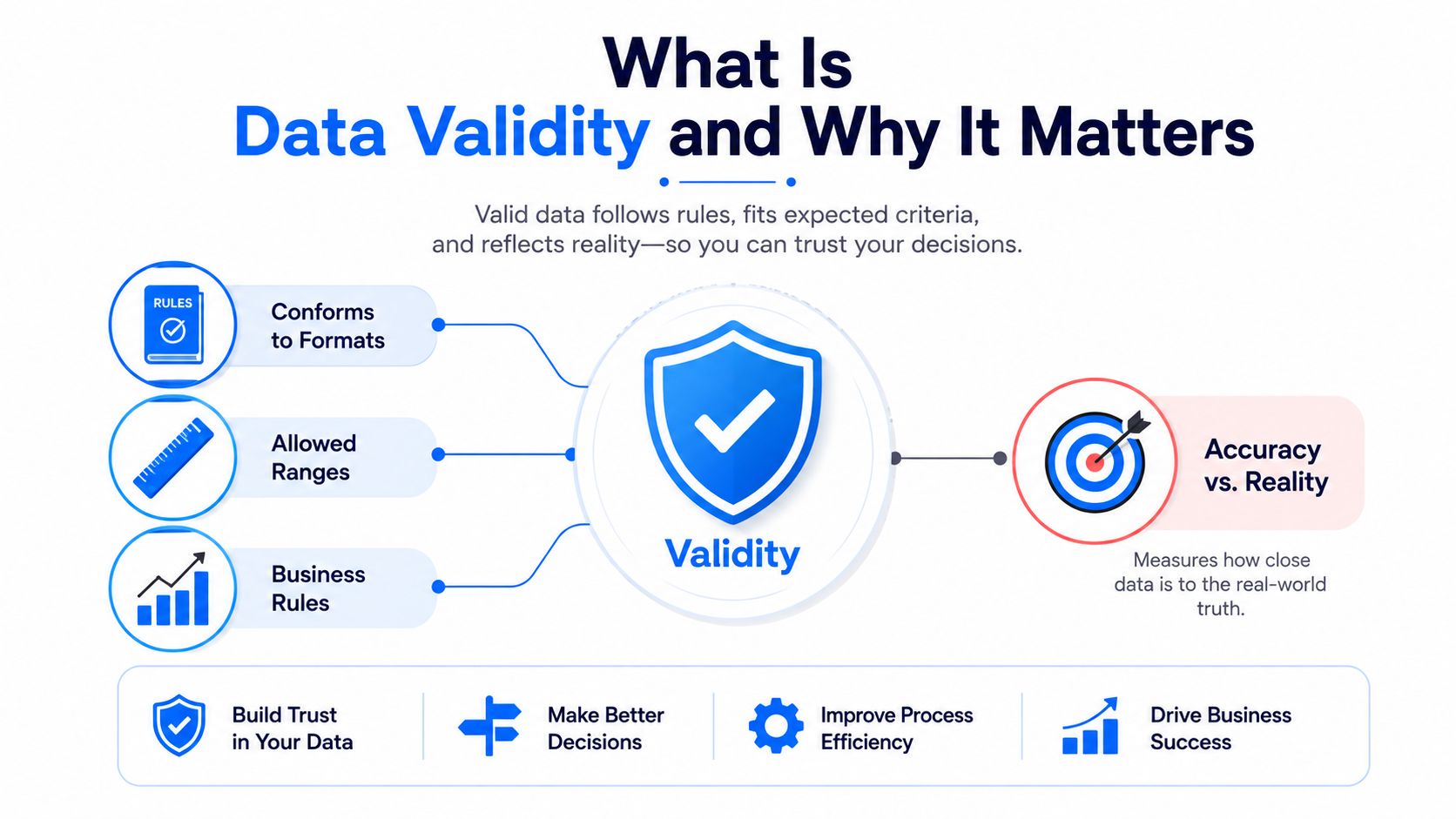
Validity as an operational gate
A validity rule is deterministic. Given the same value and the same rule, the result should be pass or fail. That makes validity suitable for automated checks at ingestion, transformation, warehouse loading, and reporting boundaries.
A useful implementation sequence is:
Define the requirement. Document the expected type, format, domain, range, null policy, or relationship.
Apply the rule at the right grain. Check critical fields individually, then evaluate record and dataset outcomes.
Capture evidence. Store the failed rule, affected record, source, timestamp, and remediation status.
Set ownership. The team responsible for the source or transformation should own correction, not just the team that discovers the defect.
Practical rule: A validity score is only meaningful when every rule has a documented definition, owner, and business purpose.
Organizations building a broader data quality program can place this control alongside other dimensions in their data quality framework. The central point remains simple: validity prevents data that violates known requirements from propagating downstream.
What Does Validity Mean in Data Quality
Validity in data quality means conformance to explicit constraints that can be tested consistently. The DAMA-DMBOK® 2.0 Revised Edition identifies Validity as a standard Data Quality dimension, alongside dimensions such as Accuracy, Completeness, Integrity, Uniqueness or Deduplication, Timeliness, Reasonableness, and Consistency.
The main validity types are distinct, but they often operate together:
Validity Type | Definition | Enterprise Example |
|---|---|---|
Format validity | The value follows an expected pattern or syntax. | An invoice identifier matches the organization's approved identifier pattern. |
Domain validity | The value belongs to an approved set of values. |
|
Range validity | The value falls between defined boundaries. | An account balance isn't below the permitted business threshold. |
Data-type validity | The value uses the required type. | A revenue field contains numeric values rather than text. |
Nullability | Missing values comply with the field's allowed null policy. | A transaction identifier is never null after payment authorization. |
Cross-field validity | Related fields satisfy a logical relationship. | A policy end date occurs after its start date. |
Business-rule validity | The record complies with domain-specific policy. | A loan's repayment status follows the rules associated with its lifecycle state. |
Referential validity | Keys and codes resolve to valid records in reference data. | A branch identifier exists in the current branch master. |
Choosing the right rule
Format checks catch obvious syntax failures, but they're rarely sufficient on their own. A value can have the correct shape while using a retired code, violating a relationship, or contradicting a business policy.
That's why a mature data quality dimensions model treats validity as layered control. Structural checks should run first, followed by domain, relationship, and business-rule checks where the data's use requires them. The more consequential the field, the more important it is to validate at field level rather than relying on a single dataset-wide score.
What Are Examples of Invalid Data
Invalid data is data that fails a defined format, type, domain, range, nullability, relationship, or business rule. It often enters through permissive forms, source-system changes, manual uploads, default placeholders, or transformations that don't preserve the original constraints.
Validity Sub-Type | Invalid Data Example | Why It Fails |
|---|---|---|
Format | Letters stored in a national identifier field that requires a defined pattern. | The value doesn't match the required syntax. |
Domain | A payment record uses an unapproved currency or country code. | The value isn't in the maintained domain. |
Range | An IoT feed stores | The value violates the field's physical or operational range. |
Data type | A numeric amount arrives as an unparseable text string. | The value can't be interpreted as the required type. |
Nullability | A mandatory customer identifier is empty. | The field's definition prohibits null values. |
Cross-field | A contract end date precedes its start date. | The related values violate temporal logic. |
Business rule | A lending record exceeds a policy limit for its risk category. | The record fails an explicit organizational rule. |
Referential | A transaction points to a customer key absent from the customer master. | The relationship can't be resolved. |
A value such as 0000-00-00 illustrates why parsing alone isn't enough. A system may store it as text, or a permissive parser may accept it, but the value can still violate the organization's date definition.
Operational teams should classify failures rather than merely count them. A format failure may indicate an interface defect, while a sudden increase in unknown reference codes may point to an upstream release or a reference-data synchronization problem. data anomaly detection complements deterministic validation by highlighting unusual changes in failure behavior without replacing the underlying rules.
How Is Data Validity Measured
Data validity is measured by counting the values or records that pass defined validation rules. The core calculation is:
Validity rate = valid records or values / records or values assessed × 100
The inverse view, invalid-record rate, shows the share that failed at least one rule. Teams should also retain rule failure count, rule pass rate, and the percentage of values within an approved domain. These metrics reveal different operational realities. A dataset can have a stable overall validity rate while one critical rule deteriorates sharply.
Measure at multiple levels
At field level, measure whether values satisfy the field's rules. At record level, determine whether a record passes all required checks. At table and pipeline level, aggregate results while preserving the underlying failure categories.
Validation Layer | Metric | Example Rule | Typical Threshold |
|---|---|---|---|
Format and type | Rule pass rate | Every identifier matches the approved pattern and type. | Set according to field criticality. |
Domain and range | Percentage within domain | Every | Set according to operational risk. |
Business and cross-field | Rule failure count | End date is later than start date. | Investigate any material increase. |
There's no universal acceptable threshold. A regulatory reporting field may require near-total conformance, while an exploratory dataset may tolerate more exceptions if analysts understand the limitations. The threshold should reflect business criticality, regulatory exposure, downstream use, and the cost of blocking versus quarantining records.
Automation matters because one-time profiling produces a snapshot, not control. Track results over time, retain failed-record samples, and review whether rules still reflect current business definitions. Teams establishing a wider measurement practice can use this practical QA guide 2026 alongside their data quality controls. For a broader metric framework, see data quality metrics.
Validity vs Accuracy Completeness and Reasonableness
Validity asks whether data follows defined rules. Accuracy asks whether it represents reality. Completeness asks whether required data is present. Reasonableness asks whether a value or pattern appears plausible in context.
Consider one customer record. A phone number can satisfy the required international format, making it valid, but belong to another person, making it inaccurate. A missing email address is primarily a completeness failure. A salary that fits the permitted numeric range may still look unreasonable for the employee's role or peer group.
Why the distinction affects operations
Validity is usually the cheapest of these controls to run because it relies on explicit rules. Accuracy often needs a trusted source, such as an authoritative customer record or external verification. Completeness requires a clear definition of which fields are mandatory, and reasonableness may require historical distributions, peer comparisons, or anomaly models.
The dimensions overlap, but they shouldn't be collapsed into one score without explanation. A record can be completely populated and structurally valid while still being inaccurate. Conversely, a record can contain an accurate value that fails a local format requirement because the source systems use incompatible representations.
The accuracy dimension in data quality therefore belongs in a layered assessment rather than as a substitute for validity. Use deterministic validity gates early, then apply accuracy and reasonableness controls where external truth or contextual interpretation is available.
A valid record is usable by the rules. It isn't automatically true, complete, or sensible.
Why Is Data Validity Important for Enterprises
Data validity matters because invalid values can disrupt downstream processing and undermine analytics, AI, and compliance work. A failed reference code can stop a transaction flow, while malformed or out-of-range model features can pass through a lake and influence decisions without obvious errors.
The business case is substantial. Gartner reported an average annual cost of $12.9 million per organization for poor data quality, and 68% of respondents cited inaccuracy as a major driver, as summarized in the NISS statistical perspective on data quality. A separate IBM cost summary cited in 2026 coverage said inaccuracy could drive 25% of revenue loss for large enterprises through flawed decision-making.
Validity as a control point
A validity check won't prove that a customer's address is correct, but it can stop an impossible country code, broken identifier, or invalid date from entering a regulated report. That makes it a practical first control before more expensive accuracy verification and contextual analysis.
AI raises the stakes. Models inherit structural defects from their inputs, and invalid records can create silent failures even when the resulting predictions appear plausible. Continuous checks give engineering and governance teams an auditable way to detect rule deterioration, isolate affected data, and decide whether to block, quarantine, or release a dataset with an explicit exception.
How Can Data Validity Be Monitored Continuously
Continuous data validity monitoring runs validation rules whenever data arrives or changes, rather than waiting for a periodic review. The right operating model combines automated checks, alerting, ownership, and historical evidence.
A practical pattern looks like this:
Validate early: Run format, type, domain, and nullability checks near ingestion where failures are easiest to isolate.
Validate relationships: Apply cross-field, business-rule, and referential checks after the required fields and reference data are available.
Route exceptions: Quarantine or label failed records instead of dropping them.
Alert on change: Notify owners when failure counts or validity rates move beyond approved limits.
Preserve history: Retain rule results so teams can identify when degradation began and connect it to source or schema changes.
Real-time validation suits payment authorization, customer onboarding, and other flows where bad input should be rejected immediately. Batch validation remains practical for large analytical loads, scheduled regulatory extracts, and datasets where a complete assessment is more useful than record-by-record blocking.
The CDC distinguishes validity from accuracy and describes validity as conformance to metadata and syntax rules in its data quality assessment worksheet. External reconciliation can then add a separate accuracy layer. A trauma-care study indexed by PubMed associated external validation with improved data accuracy, reliability, and downstream model validity, which supports combining internal checks with periodic authoritative comparison.
How Can digna Support Data Validity
digna Data Validation supports deterministic, record-level validity checks against defined rules. Teams can use it for format, domain, range, nullability, business-rule, cross-field, and referential or business constraints, with results available for quality assessment and remediation.
Consider a customer master with an approved country_code domain. A validation rule checks every incoming value against that reference list. If a source begins sending an unapproved code, Data Validation identifies the affected records and records the failed rule. The pipeline may then reject, quarantine, or route those records according to the organization's operating policy.
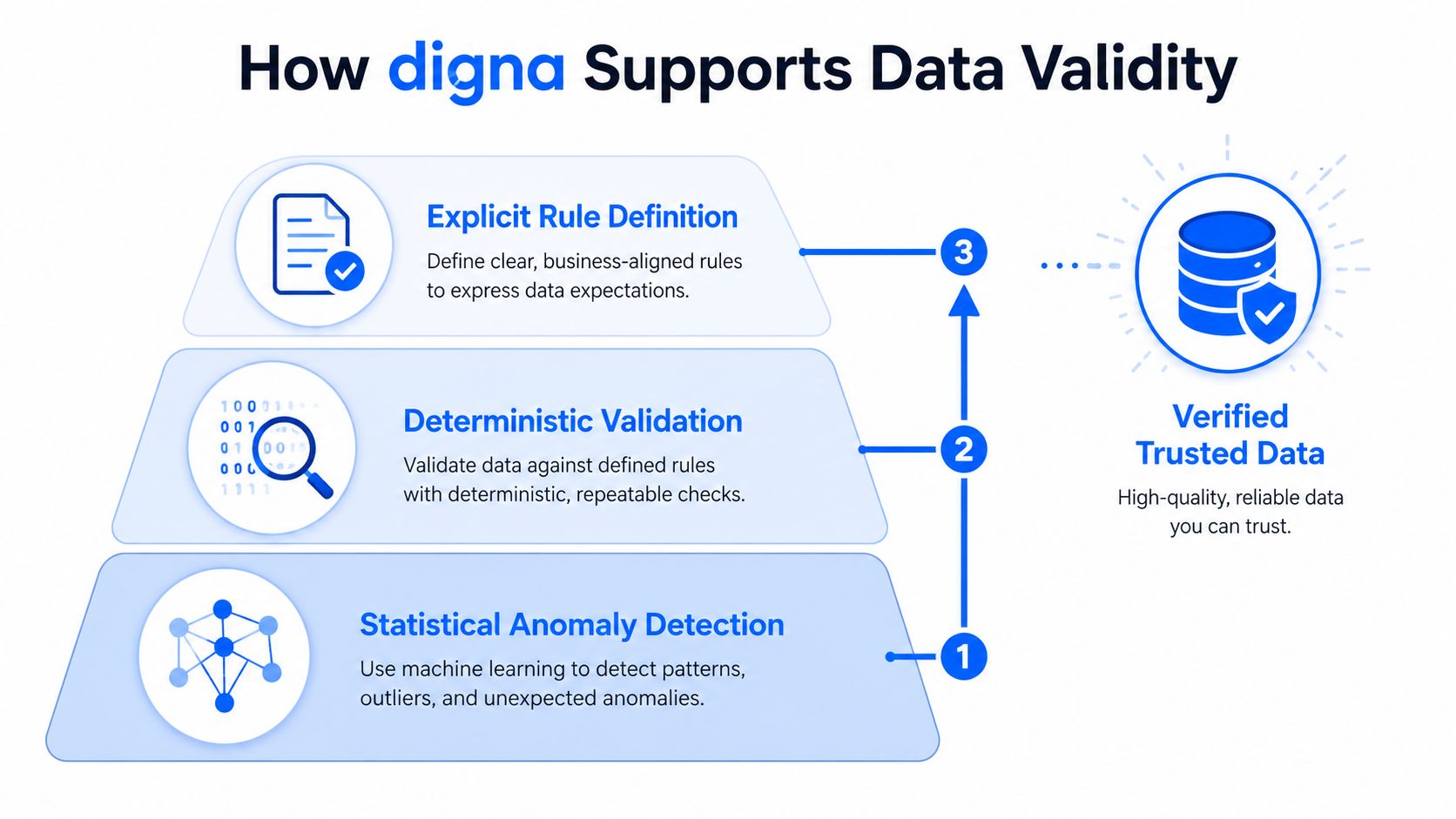
digna Data Anomalies has a complementary role. It can identify an unusual increase in country-code failures compared with the dataset's established behavior, but it doesn't replace the deterministic rule that defines which codes are approved.
digna Data Analytics helps teams examine validation results and trends over time. In the customer-master example, analytics can show when failures began, whether they affect one source or several, and whether remediation restored the prior pattern. Because digna runs inside the customer's environment and supports in-database execution, teams can monitor results while keeping data in place.
Frequently Asked Questions About Data Validity
What is Data Validity?
It's the degree to which data conforms to defined formats, types, domains, ranges, and business rules.
What is Validity in Data Quality?
Validity is a measurable Data Quality dimension focused on rule conformance.
How do you measure Data Validity?
Use validity rate, invalid-record rate, rule pass rate, failure count, and approved-domain conformance.
What are examples of invalid data?
Invalid examples include malformed identifiers, unknown reference codes, prohibited nulls, impossible ranges, and contradictory field combinations.
What is a Data Validation rule?
It's an explicit test that determines whether a value or record satisfies a defined requirement.
What is the difference between Validity and Accuracy?
Validity checks conformance. Accuracy checks correspondence with real-world truth.
What is the difference between Validity and Completeness?
Completeness concerns missing data. Validity concerns present data that fails its rules.
How can Data Validity be monitored continuously?
Run automated checks in pipelines, alert on deterioration, retain evidence, and assign remediation ownership.
Which digna module supports Data Validity?
digna Data Validation is the primary module for deterministic validity controls.
Use digna to define record-level validation rules, monitor failures across critical datasets, and investigate changes before invalid data reaches reporting or AI workflows. Visit digna to assess how its Data Validation, Data Anomalies, and Data Analytics capabilities can fit your enterprise data quality process.
Frequently asked questions
What is data validity?
The degree to which data conforms to defined formats, data types, allowed values, ranges and business rules. It is a measurable dimension that tests whether values satisfy predefined requirements, rather than whether they are true.
How does validity differ from accuracy?
At the point of definition. A date such as 1800-01-01 may be structurally valid if it uses the expected format and falls within the configured range, yet still be the wrong birthdate. Validity checks the rule; accuracy checks reality.
Why is a validity rule useful as a gate?
Because it is deterministic. A validity rule either passes or fails without interpretation, which makes it safe to place in the delivery path where a probabilistic signal would produce arguments instead of decisions.
What should a validity rule cover?
Formats, data types, allowed values, ranges and business rules, in that order of increasing specificity. The first three are usually generic across a system, while ranges and business rules encode what this particular dataset means.
Why is the distinction expensive to ignore?
Because a fully valid dataset can still be wrong in every row. Teams that treat a passed validity check as evidence of correctness stop investigating exactly where the harder and more costly errors live.