Customer Master Data Management: A Practical Guide for 2026
|
7
min. czyt.

Your customer updates an email in the mobile app, but the marketing platform still has the old address. The CRM reflects the change, billing keeps a different phone number, and the next campaign promotes a product the customer already bought. The result is a mistargeted message, a support ticket, and another manual reconciliation task for an operations team that already has too many of them.
That failure is familiar because customer data rarely changes in one place. Customer master data management brings those records together, resolves identities, applies accountable rules, and distributes trusted attributes to the systems that use them. The important shift for 2026 is that a mastered record can't sit still. It must also be fresh, observable, traceable, and ready for activation by CRM workflows, analytics, personalization, fraud controls, and AI.
Table of Contents
Why Customer Master Data Management Matters Now
The business pressure is no longer theoretical
Core Components of Customer MDM Architecture
The five layers that matter in production
Design for isolation, not optimism
Identity Resolution Approaches and Trade-offs
Identity Resolution Methods Comparison
Confidence must drive workflow
Governance and Validation Requirements
Assign ownership at attribute level
Use validation gates before activation
Integration with Data Observability Platforms
Monitor the signals that reveal silent failure
Turn quality into service objectives
Moving Beyond Static Golden Records
Use events without abandoning control
Measuring Business Impact and ROI
MDM ROI Measurement Framework by Stakeholder
Why Customer Master Data Management Matters Now
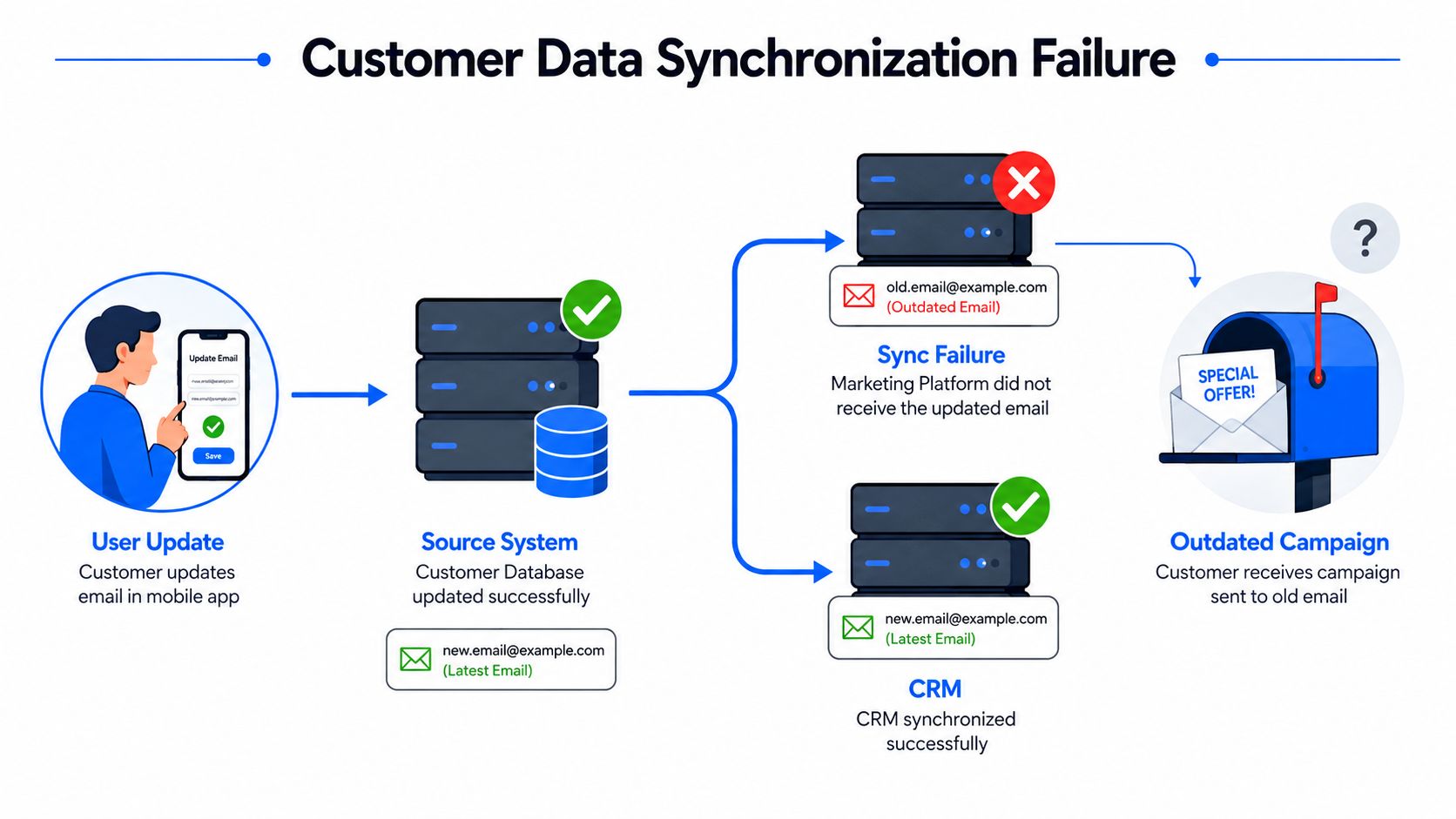
The scenario above is an operational latency problem, not merely a data-cleanup task. A customer changes an attribute, but the update misses the time window required by one or more consumers. Marketing uses stale data, support inherits the complaint, and the business pays for a synchronization failure.
Customer MDM builds a reliable identity from records in CRM, ERP, billing, commerce, support, and analytical systems. It consolidates records, removes duplicates, reconciles conflicting attributes, and preserves lineage so teams can determine where each value originated. IBM describes MDM as a process that integrates source data, deduplicates records, reconciles discrepancies, and enriches the result for downstream use in its overview of master data management.
The discipline predates modern enterprise platforms. Edwin G. Seibels introduced the lateral file concept in 1898, and the U.S. Social Security Administration created a death master file in 1936, according to this history of master data management. Customer MDM became a formal enterprise discipline in the 1990s, as ERP systems began managing customer, product, and supplier domains. By the mid-2000s, vendors were offering broader capabilities.
The business pressure is no longer theoretical
McKinsey's 2023 MDM survey found that 83% of organizations considered client and product data their most dominant domains. 82% of respondents spent at least one day each week resolving master-data quality issues, and 66% relied on manual review to assess and manage quality (McKinsey). The operational contradiction is clear: customer data carries strategic weight, while its maintenance still depends heavily on recurring human intervention.
Customer data also has a prominent role in the global MDM market, reflecting its effect on analytics, compliance, operations, and decision-making across major markets.
Practical rule: A golden record has no operational value if a downstream system receives it after the business event has already passed.
Measure customer MDM by more than duplicate reduction. Track how quickly consent changes propagate, how long a source outage remains undetected, how many consumers use a changed attribute, and whether an AI model receives current identity context. For a broader examination of how reliable records affect business outcomes, review the benefits of data quality.
Core Components of Customer MDM Architecture
A production customer MDM architecture is a chain of controlled transformations, not a single repository. Each layer needs an input contract, a failure path, an owner, and a measurable service expectation.
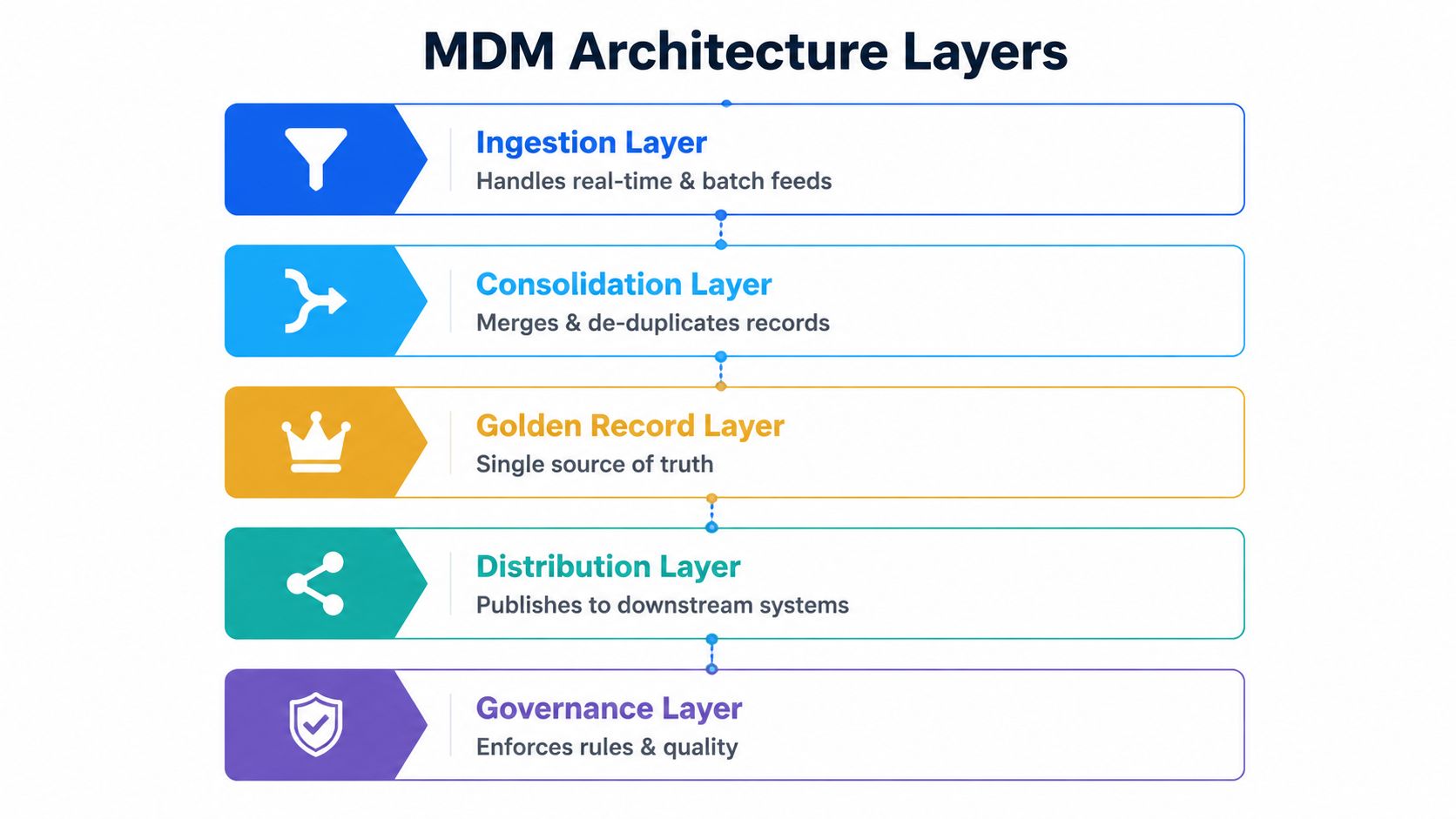
The five layers that matter in production
Ingestion accepts real-time events and batch feeds from CRM, commerce, support, billing, and other systems. Validate schemas before records enter the process. A renamed field, changed data type, or altered null-handling rule shouldn't automatically become a broken customer attribute.
Staging provides a controlled area for normalization. Standardize formats, trim malformed values, apply reference checks, and identify obvious duplicates before the matching engine evaluates identity. Keep the original payload alongside the transformed value so stewards can reconstruct what happened.
Matching and consolidation resolve whether records represent the same customer. Deterministic keys handle clear matches, while probabilistic logic evaluates less exact combinations of names, contact details, addresses, and source identifiers. The engine should preserve both the linkage decision and its confidence.
The golden-record layer applies survivorship rules to each attribute. The CRM might be authoritative for sales ownership, billing might be authoritative for legal invoicing details, and a consent service might control communication preferences. These decisions belong to the business, not to whichever source happened to arrive last.
Distribution publishes mastered records through APIs, event streams, or batch extracts. Consumers need delivery status, replay support, version information, and clear behavior when a publication fails. A master that updates internally but doesn't reach the CRM or marketing platform is not mastered from the user's perspective.
The governance layer cuts across all five. It defines ownership, access, retention, validation, lineage, and exception handling. IBM governance guidance emphasizes that master data requires cleansing, duplicate removal, and ongoing quality checks beyond initial loading, rather than a one-time repository import (IBM governance guidance).
Design for isolation, not optimism
Put circuit breakers between stages. If the source feed violates its contract, quarantine the affected messages instead of allowing malformed records to contaminate the master. If matching confidence falls unexpectedly, route uncertain cases to stewardship rather than expanding an unsafe merge automatically.
A useful implementation reference is this guide to data quality for business results, especially when translating technical controls into operating outcomes. For a deeper treatment of MDM architecture and the role of governed, synchronized records, see digna's master data management guide.
Identity Resolution Approaches and Trade-offs
Identity resolution determines whether two records belong to one customer. The wrong decision is expensive in both directions. A missed match fragments the customer view, while a false merge can expose one person's history to another customer or distort eligibility, compliance, and model features.
Deterministic matching compares exact or normalized identifiers such as email, phone, customer ID, or an external source key. It's fast and explainable, which makes it useful for high-confidence paths. It fails when identifiers are missing, outdated, shared, mistyped, or deliberately different across channels.
Probabilistic matching evaluates similarity across multiple attributes and produces a confidence score. It can catch variations that exact rules miss, but it needs tuning, representative examples, threshold management, and a stewardship queue for borderline cases. A hybrid approach usually works best operationally, with deterministic rules resolving obvious links and probabilistic logic handling ambiguity.
Identity Resolution Methods Comparison
Method | Match Rate | False Positive Rate | Implementation Complexity | Best Use Case |
|---|---|---|---|---|
Deterministic | High for complete, stable identifiers | Low when identifiers are trusted | Low | Shared customer IDs and validated contact details |
Probabilistic | Broader coverage across imperfect records | Requires active control and review | High | Fragmented identities with inconsistent attributes |
Hybrid | Strong coverage with explicit confidence bands | Controlled through rules and stewardship | Medium to high | Enterprise environments spanning many source systems |
Don't treat “match rate” as a target to maximize in isolation. A higher apparent rate can hide aggressive merges. Review false merges by business impact, not just aggregate quality scores. Finance may tolerate a manual exception in a low-risk account hierarchy, while a regulated onboarding process may require conservative matching and explicit evidence.
Confidence must drive workflow
Set separate outcomes for high-confidence matches, uncertain candidates, and rejected links. Store the evidence used by the engine, including source values, normalized values, rule paths, and model scores. When a steward overrides a decision, feed that action into rule refinement and audit history.
Cross-platform reporting also depends on consistent identity keys and definitions. Teams designing those reporting layers may find key metrics for cross platform useful for thinking about comparability across systems. Where source contact details are unreliable, a disciplined personal data validation approach should sit before matching, not after a questionable merge.
Governance and Validation Requirements
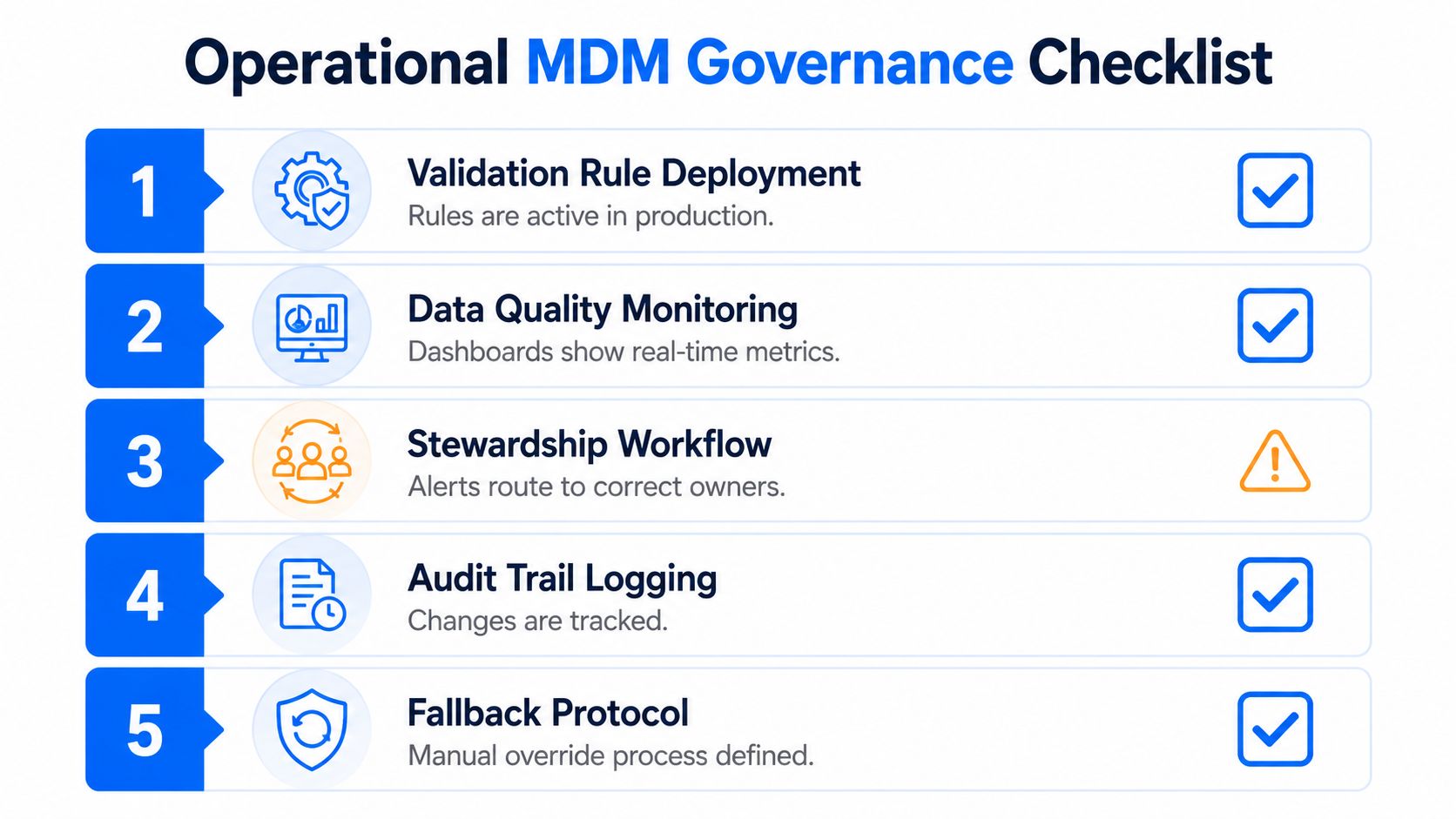
Governance becomes real when it changes what the pipeline accepts, publishes, and escalates. A policy document can define principles, but production controls need executable rules, accountable owners, and evidence that someone can inspect later.
Assign ownership at attribute level
An entity-level owner is often too vague. Assign responsibility for specific attributes and decisions. Marketing may own contact preferences, finance may own invoicing attributes, compliance may own consent status, and a data platform team may own technical identifiers and distribution contracts.
Survivorship rules need the same precision. If two systems disagree, the winning value must be traceable to source lineage, transformation history, and a documented stewardship rule. Guidance from CDQ on data cleansing makes the core point clearly: if stewards can't explain why a source won, the golden record becomes a black box that weakens trust and auditability.
Use validation gates before activation
A practical pre-launch checklist should cover these gates:
Schema validation: Confirm required fields, types, formats, and allowed changes at ingestion.
Identity integrity: Test match, merge, split, and reject behavior against reviewed examples.
Referential integrity: Verify links to authoritative reference and source identifiers.
Attribute survivorship: Confirm every critical field has an accountable precedence rule.
Privacy propagation: Carry consent, restrictions, and deletion instructions to every relevant consumer.
Distribution control: Test delivery, retries, replay, versioning, and failure isolation.
Audit evidence: Record source lineage, transformations, decisions, overrides, and publication status.
Strict gates protect trust but can delay activation when legitimate edge cases are blocked. Permissive gates preserve flow but allow questionable data into systems that may act on it immediately. Use severity tiers. Block high-risk privacy or identity failures, quarantine uncertain records, and allow low-impact enrichment gaps with visible warnings.
GDPR Article 5 requires personal data to be adequate, relevant, and limited to what is necessary, and says identifiable data should be retained no longer than necessary for its purpose, subject to defined exceptions and safeguards (GDPR data minimization and storage limitation). That makes collection and retention controls part of MDM design, not a later legal review. Teams can also use customer data protection guidance when mapping operational controls to privacy responsibilities.
Integration with Data Observability Platforms
Most MDM teams discover problems at the consumer boundary. A campaign fails, a dashboard shifts, or an AI feature produces questionable recommendations. By then, the customer master may have been wrong for hours or days.
Observability changes the operating model by monitoring data behavior, not just pipeline completion. A successful job can still deliver stale, incomplete, duplicated, or structurally changed records. Customer MDM needs signals that describe whether the data is arriving on time, retaining expected volume, preserving schema contracts, and producing stable identity-resolution outcomes.

Monitor the signals that reveal silent failure
Freshness monitoring should compare actual arrival behavior with expected delivery patterns. A CRM update feed that stops arriving may not trigger an infrastructure alert if the scheduler still runs successfully. A schema tracker can identify added or removed columns and data-type changes before a downstream parser fails.
Volume anomalies provide another early warning. An unexpected surge in duplicates, an unusual drop in new customer creation, or a sudden shift in null values can indicate a broken integration or source-process change. Identity resolution confidence should be treated as an observable metric too. When the distribution of scores drifts, the matching engine may be seeing a new format, source population, or data-entry behavior.
Column-level lineage connects those signals to impact. If the phone attribute changes upstream, the team should know which CRM, support, marketing, analytics, and AI consumers depend on it before approving the change. Monitoring principles discussed in Rite NRG's guide to monitoring reliability are useful here because MDM needs the same discipline as other production services.
Turn quality into service objectives
Define service indicators for source freshness, publication delay, schema stability, match-confidence distribution, duplicate levels, and validation failures. Then set objectives by use case. Fraud controls and operational decisions may require rapid propagation, while a lower-priority analytical extract can tolerate a slower schedule.
Push MDM quality signals into tools such as Monte Carlo or Datadog, or expose them through the organization's incident workflow. The alert should name the affected attribute, source, consumer, last healthy state, and recommended owner. A broader explanation of these practices appears in what data observability means.
The key design decision is feedback. Observability shouldn't only notify a data team. It should be able to pause distribution, downgrade confidence, open a stewardship task, or trigger a replay when the evidence shows that activation would be unsafe.
Moving Beyond Static Golden Records
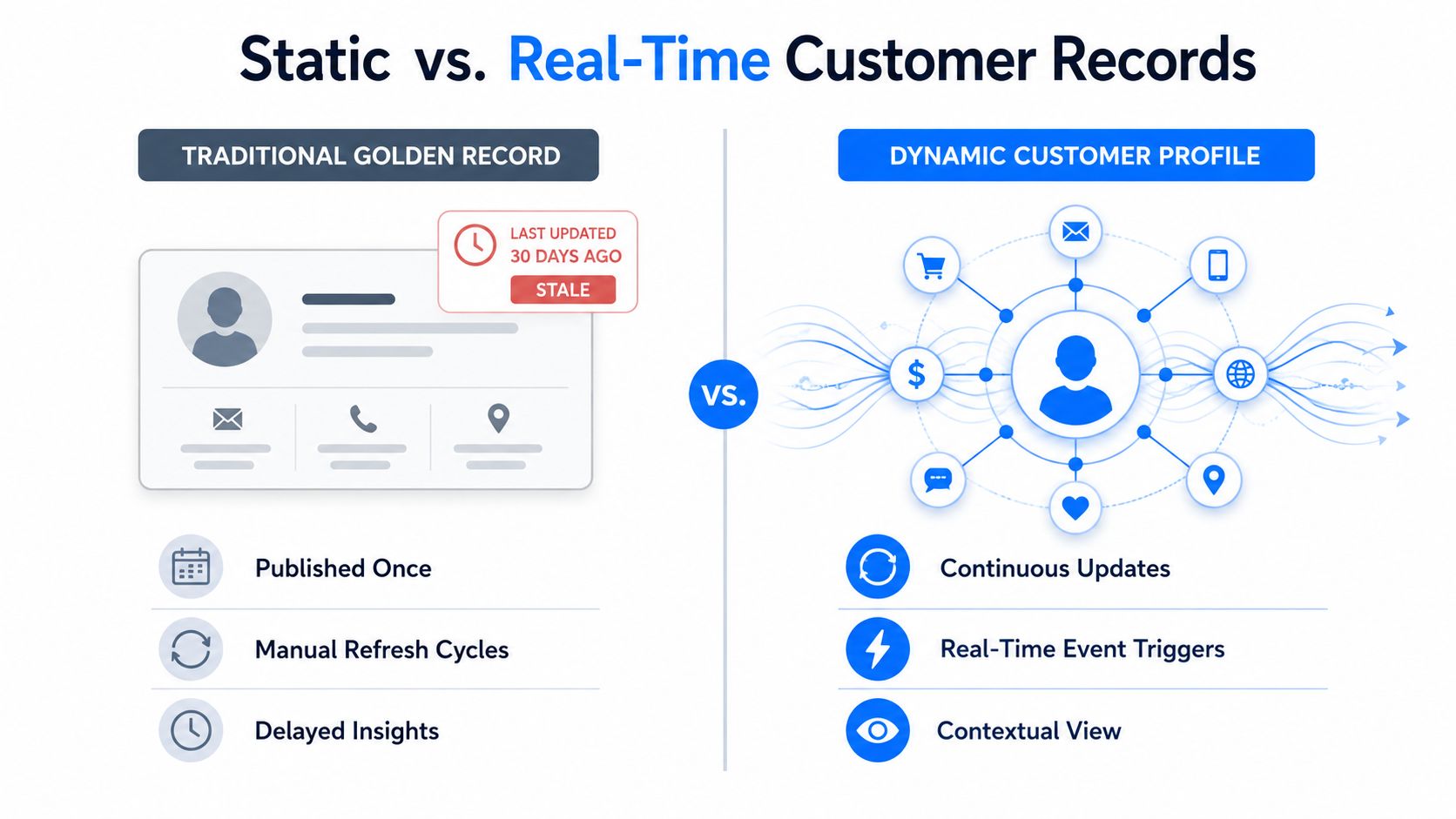
A static golden record is already stale when the next customer event arrives. That doesn't make the concept useless, but it does make batch-only MDM a poor fit for real-time personalization, fraud detection, and AI systems that depend on current customer context.
Recent coverage describes a move toward dynamic, composable, and warehouse-integrated MDM. A Twilio report also found a 57% surge in predictive traits, alongside growing CDP and warehouse integration, indicating a shift from batch mastering toward activation-ready customer data (2025 discussion of the new rules of MDM).
Use events without abandoning control
An event-driven design can consume change data capture from CRM, support, commerce, and transaction systems. Each event triggers validation, identity resolution, survivorship, and publication to relevant consumers. That reduces the gap between a customer change and the action taken from it.
The architecture introduces real complexity. Events can arrive out of order, consumers can converge at different times, and two sources can update the same attribute nearly simultaneously. You need idempotent processing, event timestamps, version checks, conflict policies, replay capability, and a clear treatment of eventual consistency.
A sensible migration doesn't require replacing the entire MDM platform. Keep the existing mastered model and governance rules, then introduce streaming for the attributes and use cases where latency matters most. Start by measuring current propagation delays and failure visibility. Move one high-value flow to event-driven distribution, compare operational behavior, and extend the pattern only when lineage, rollback, and observability are working.
Architecture decision: Real-time MDM isn't “everything streams.” It's choosing which customer changes must propagate immediately, which can remain batch-oriented, and how the system proves that choice is working.
Measuring Business Impact and ROI
A business case built around “better data quality” won't survive serious finance review. Tie customer MDM to outcomes that a stakeholder already owns, then establish a baseline before changing the process.
Revenue measures can include duplicate campaign contacts, suppressed or misdirected offers, account-linkage quality in cross-sell workflows, and churn interventions based on a unified customer view. Cost measures include manual reconciliation effort, failed transactions caused by mismatched identities, support work related to conflicting records, and the time required to investigate data incidents.
Risk measures should cover consent propagation, data-subject request handling, audit completeness, identity confidence in sensitive workflows, and the reach of an incorrect attribute across downstream consumers. The point isn't to claim every improvement came from MDM. Isolate the MDM contribution by comparing defined flows, recording process changes, and documenting other initiatives that could influence the result.
MDM ROI Measurement Framework by Stakeholder
Stakeholder | Primary KPI | Baseline Metric | Expected Improvement | Measurement Cadence |
|---|---|---|---|---|
CFO | Reconciliation and rework cost | Recorded effort and incident cost before rollout | Lower avoidable manual work and failure handling | Quarterly |
CMO | Suppression accuracy and audience integrity | Duplicate and stale-contact rate in campaign inputs | Fewer conflicting contacts and cleaner activation | Per campaign, summarized quarterly |
Customer operations | Identity-related resolution workload | Tickets and handling effort tied to customer confusion | Faster investigation and fewer repeat corrections | Monthly |
Compliance officer | Consent and lineage coverage | Records and downstream uses with verifiable evidence | Stronger traceability and controlled propagation | Monthly and audit cycle |
Head of data and AI | Freshness, confidence, and consumer reliability | Source-to-master delay and model-input incidents | More timely, explainable customer context | Weekly, with quarterly review |
Use leading indicators early. Monitor duplicate behavior, validation failures, freshness breaches, unresolved stewardship items, and publication errors before waiting for revenue or compliance outcomes. Then connect those indicators to business events through a quarterly review that shows which customer attributes improved, which consumers benefited, and where the operating model still creates risk.
A good ROI narrative is stakeholder-specific. Tell the CFO what manual work and failure handling changed, the CMO how activation integrity improved, and compliance how evidence and privacy controls became traceable. Avoid claiming causation where the measurement design can't support it.
digna provides an enterprise data quality and data observability platform that runs inside your own environment, with modules for anomaly detection, timeliness, validation, schema tracking, and in-database monitoring. If your customer MDM program needs evidence that records are fresh, structurally stable, and safe to distribute, visit digna to evaluate an observability layer for your critical data flows.



Poznaj zespół tworzący platformę
Zespół z Wiednia, składający się z ekspertów od AI, danych i oprogramowania, wspierany rygorem akademickim i doświadczeniem korporacyjnym.