How Do You Reference a Database: A Practical Guide
|
7
min read

You've pulled a record from a database, the deadline is close, and the citation field is staring back at you with just enough metadata to be annoying. The hard part usually isn't finding the item, it's deciding what counts as the source. When you ask how do you reference a database, the answer starts with a narrower question, what is the underlying work, what is the platform, and which one belongs in your reference list.
Table of Contents
Understanding What You Are Actually Citing
Platform versus source
Citation Rules Across Major Style Guides
Side by side differences
Handling DOIs and Persistent Identifiers
A simple decision path
Edge cases that trip people up
Citing Datasets and Dynamic Database Content
Static snapshot versus live query
Building a Reliable Database Citation Workflow
A checklist that holds up in practice
Understanding What You Are Actually Citing
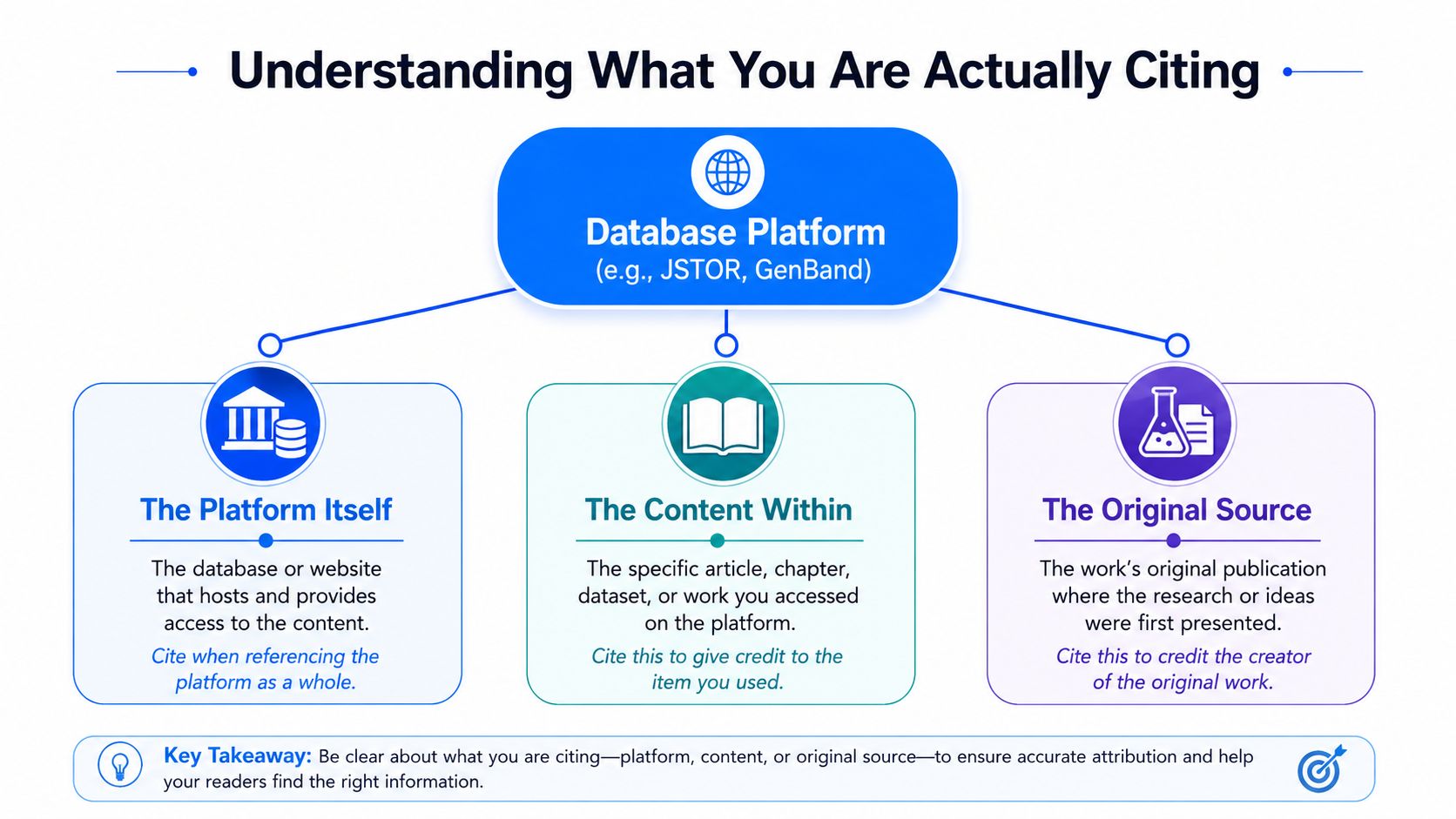
Researchers often assume the database platform must be cited because that's where they clicked. In most cases, that instinct leads them away from the thing that should be named, which is the underlying article, report, or dataset. APA Style is explicit that, in general, you should cite the work found in a database rather than the database itself, and you should not include the database or platform name unless the item comes from a database with original, proprietary content or limited circulation. APA database information guidance
Platform versus source
Think of a database as a container or discovery layer. JSTOR, ProQuest, and similar systems often surface material that was published elsewhere, so the scholarly object you're citing is the journal article, book chapter, report, or dataset inside it. The platform matters only when it is the actual source of the content, or when your reader needs the platform to locate a proprietary record.
Practical rule: cite the item itself first, then add database information only when the database is the source, the content is exclusive, or the record is changing in ways that affect reproducibility.
That distinction gets easier when you separate database-as-aggregator from database-as-publisher. An aggregator points you to the work, while a publisher or proprietary database may be the only place the record exists in that form. APA's database guidance reflects that source-level approach, and it also supports data-set citations that name the version year, the title in italics, and any identifier or version information in parentheses, which matters when a record can change over time. APA database information guidance
If you're mapping citation rules across a research team, it helps to tie that work to a shared metadata process, like the one described in metadata management for reliable data assets. That way, the citation decision isn't guessed at the end, it's captured alongside the record from the start.
Citation Rules Across Major Style Guides
A researcher opens three style guides and gets three slightly different answers. That is common with database citations, because the citation changes with the item, the platform, and whether the record can shift after you view it. APA gives the cleanest starting point: cite the work itself, use the DOI when one exists, and avoid adding a database name for works that are widely available. For guidance on DOI and URL choice, see APA DOI and URL guidance.
Side by side differences
Chicago and Harvard handle the same problem through local convention and source type. Chicago-style guidance often folds database information into notes for online research materials, while the bibliography stays centered on the work. Harvard varies more across institutions, so the local sheet matters. Western Sydney University's Harvard guide, for example, says electronic items from a database should include the database name after the date viewed, and if it is not obvious that the source is a database, the word database should follow the name. Western Sydney University Harvard guide
Citation Element | APA 7th Edition | Chicago 17th Edition | Harvard |
|---|---|---|---|
Database name | Usually omitted for widely available works, included for proprietary or limited-circulation content | Often appears in notes for database-sourced items | Often included after the date viewed, depending on institutional guidance |
DOI | Preferred when available | Preferred for scholarly works when available | Often preferred when available, but local rules vary |
URL | Use only when needed, and avoid session-specific links | Use stable links when required by the style format | Include the exact URL for publicly accessible items when required |
Access or retrieval date | Used for content likely to change, such as dynamic records | Common for changing online sources and databases | Commonly required by institutional guides for database items |
Entire database | Cite as a data source only when the database itself is the subject or original source | May be handled as a database title in notes or bibliography, depending on context | Usually treated according to local guide and source type |
For a compact side-by-side comparison of citation mechanics, citation styles for creators is useful because it shows how style-specific rules change the shape of a reference. That kind of comparison helps when one system exports a field and another asks for a different one.
Changing records need another layer of care. APA distinguishes databases and similar resources that function more like living records than fixed pages, so a retrieval date may be needed when content is likely to change, and the last updated date should be used when available. A record that is revised often needs enough metadata to preserve the version you saw, not just the platform name. GWU APA database guidance
Keeping that information straight is a metadata job as much as a citation job. A shared data governance strategy helps teams record source details consistently, so the citation is built from the same information the researcher used.
The style guide does not just tell you how to punctuate a citation, it tells you what counts as the source of truth.
Handling DOIs and Persistent Identifiers
A researcher copies a database record into a manuscript, then checks the citation and finds only a session link. That link may open today and fail later, which is why a DOI or other persistent identifier matters more than the address bar copy. APA's DOI and URL guidance points to the same rule, use the identifier that is designed to last, not the temporary path you happened to view. APA DOI and URL guidance
A simple decision path
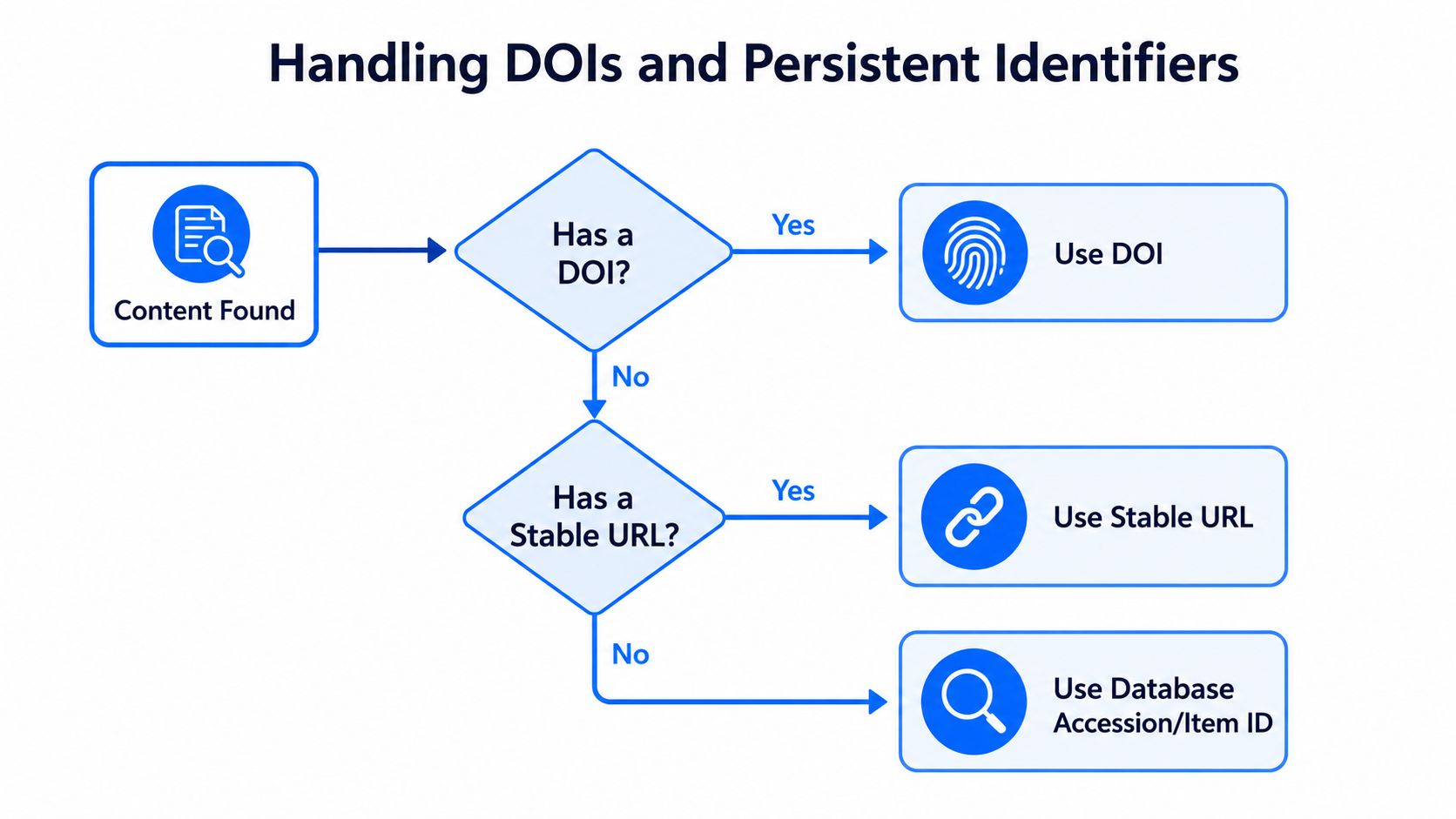
Start with the most stable identifier available. If the record has a DOI, use it. If it does not, look for a stable URL or permalink. If that is missing too, use a database accession number or item ID. A session-based URL belongs at the end of that line, because it is the easiest to lose and the hardest for someone else to reuse.
That order matters because a citation is a retrieval tool, not just a label. A DOI behaves like a permanent forwarding address, while a session URL behaves more like a temporary guest pass. If the interface changes, the DOI still has a chance of leading a reader to the same record, but a transient link often will not.
Edge cases that trip people up
Datasets often carry both a DOI and an internal record number. In that case, the DOI usually does the main identification work, and the accession number stays in the record metadata unless your style guide or repository instructions ask for it. NCBI's database guidance also reminds you to date the database or retrieval system as it appears online, especially for databases that change over time. NCBI database citation guidance
Legacy records are harder. If a database entry has no DOI and no stable URL, the citation has to rely on record-level metadata, access date, and the database name. That is where a clear data catalog helps, because it gives researchers a place to record identifiers, version notes, and other details before the trail goes cold. APA's dataset guidance follows the same logic, with attention to versioning and persistent identifiers rather than the platform name alone. APA data set references
APA treats a DOI as a link. Chicago uses the DOI as the persistent locator when one exists. Harvard practice varies, but the underlying rule stays the same, cite the item in a form a reader can still find later. If you need to locate a missing DOI, check the database's metadata export, use the record's citation tools, or search a DOI resolver such as Crossref. Many researchers stop at the visible URL and miss the identifier that would make the citation durable.
Citing Datasets and Dynamic Database Content
A downloaded CSV with a fixed version number is easier to cite because the object stays put. Live databases work differently. Records may be added, corrected, or reclassified, so the citation has to point to the version, snapshot, or query state you used, not only to the database name.
Static snapshot versus live query
A versioned dataset citation usually includes the creator, year, italicized title, version or edition if one exists, publisher or repository, and a persistent locator such as a DOI. A dynamic query citation needs more context, because the result set depends on the question asked and the date it was run. Record the query parameters, the execution date, and any version or snapshot information the database provides.
Reproducibility rule: if the content can change without the title changing, the citation needs version, date, or query detail to make the record recoverable.
Query-based outputs create a citation problem, not just a download problem. If you pulled a table from a database search, the filters define the result. If you pulled a live record, the retrieval date matters because the record may look different later. APA's dataset guidance follows the same logic, with attention to versioning and persistent identifiers rather than the platform name alone.
Citation Element | Versioned Dataset (Static) | Dynamic Query Output |
|---|---|---|
Creator or author | Yes | Yes |
Title | Yes, italicized | Yes, plus query context if needed |
Version or release | Yes | Often needed if the database is revised regularly |
Access or retrieval date | Sometimes | Usually needed |
Query parameters | Usually not needed | Often needed for reproducibility |
Persistent identifier | DOI or repository ID preferred | DOI, accession number, or stable query link if available |
Repositories like Zenodo and Dryad solve part of this problem by assigning DOIs to dataset releases. That makes the release citeable as a discrete object, which is easier than trying to freeze a changing portal view. If the repository is the source of the released dataset, cite that release. If the original data producer is the authoritative creator and the repository only distributes the file, cite the creator and describe the repository accurately in the locator field.
A useful distinction here is data provenance versus data lineage. Provenance shows where the result came from. Lineage shows how it changed before you cited it.
For teams working with live operational data, traceable exports matter. A guide to database integration for traceable exports, like the Webtwizz database integration guide, helps readers think about how database connections, exports, and downstream records stay traceable, especially when the same query is run again months later.
Building a Reliable Database Citation Workflow
The easiest way to avoid bad citations is to treat them as a workflow, not a formatting chore. Start by identifying the content type. An article found through a database, a standalone dataset, and a query output all need different decisions before you ever pick punctuation.
A checklist that holds up in practice
Identify the source type. Decide whether you're citing a journal article, a dataset, a database record, or a query result.
Find the authoring entity. Use the original creator, editor, agency, or corporate author, not the platform name unless the platform is the source.
Locate the persistent identifier. Prefer a DOI, then a stable URL, then an accession number or record ID.
Match the style guide. Apply APA, Chicago, or Harvard rules for order, punctuation, and retrieval dates.
Record the retrieval metadata. Keep the date viewed, version, and query details when the content can change.
Common failure point: a citation can look polished and still be wrong if it names the database instead of the record, or if it leaves out the version of a changing dataset.
The most frequent mistakes are predictable. Researchers copy a database session link, omit the access date for a changing record, or forget to note that they used a particular version of a dataset. APA's guidance on point-of-care and data sources shows why those details matter, because maintenance dates and retrieval dates can be part of the citation itself when content changes over time. GWU APA database guidance
For day-to-day capture, reference managers help, but only if you verify the output. Zotero and Mendeley can import database metadata quickly, yet their exports still need a human check against the official style guide. If the imported record uses a database page title instead of the original work title, the citation will look legitimate and still mislead the reader.
The safest habit is to save the source page, the version or release number, and the exact query or accession detail at the moment you discover the item. That's the same logic behind data workflow automation, because reliable recordkeeping depends on capturing metadata before the source changes.
If your team regularly cites changing database content, build a shared checklist and apply it the same way every time. Keep the original source, the persistent identifier, and the retrieval metadata together, then format the final reference only after those pieces are confirmed. That one discipline saves time, reduces broken references, and makes your bibliography defensible.
If your team needs a cleaner way to capture database metadata, version history, and record-level changes before citations break down, visit digna and see how its data quality and observability tools support traceable, reliable source records. It's a practical fit when your database content changes often and your citation trail has to stay reproducible.
Frequently asked questions
What are you actually citing when you cite a database?
Usually the item, not the platform. Researchers often assume the database must be cited because that is where they clicked, but a database is typically a container or discovery layer rather than the source of the work itself.
When should the database name appear in the citation?
Cite the item first, then add database information only when the database is the source, the content is exclusive, or the record is changing in ways that affect reproducibility. That last condition is the one most often overlooked.
What is the difference between database-as-aggregator and database-as-publisher?
An aggregator collects and indexes work published elsewhere, so the original publication is what a reader needs. A publisher originates the content, which makes the database itself part of the source. Separating the two settles most citation arguments before they start.
How do APA, Chicago and Harvard differ here?
Mainly on when to name the database. APA usually omits it for widely available works and includes it for proprietary or limited-circulation content, while Chicago often places database-sourced details in notes and Harvard follows local convention and source type.
Why does dataset versioning matter for citation?
Because a changing record breaks reproducibility. If the version a reader retrieves differs from the one you used, the citation no longer points at the same evidence, which is why versions, DOIs and retrieval context earn their place in the reference.