Data Warehouse Star Schema: A Modern Guide for 2026
|
0
minuto de lectura

You're probably dealing with some version of this right now. A dashboard that should load in seconds takes far longer. A simple revenue question turns into SQL with a chain of joins across orders, customers, products, regions, currencies, and calendar tables. Then a business stakeholder asks why yesterday's number changed, and nobody can answer quickly because the model was built for transaction processing, not analysis.
That's where the data warehouse star schema still earns its place. It gives analytics teams a structure that matches how people ask business questions. It also gives engineers a model they can reason about, optimize, and maintain without turning every report into a custom project. The catch is that design alone isn't enough anymore. In modern stacks, the hard part often starts after the schema goes live, when source systems drift, dimensions change, and downstream trust starts to erode.
Table of Contents
Why Your Analytics Queries Are Slow and Complex
A common warehouse failure starts with good intentions. The team lands data from an application database exactly as it exists upstream. Every entity is neatly normalized. Customer data lives in one place, addresses in another, order headers in one table, line items in another, and status history somewhere else. It's clean for writes, but it's painful for reads.
Analysts feel that pain first. They write one query to answer a simple question like monthly sales by product family and region, then spend most of their time figuring out join paths and duplicate behavior. BI developers build a semantic layer on top of that complexity, but the complexity doesn't disappear. It just moves.
Business users don't care that the source model is elegant. They care whether they can trust a number and get it on time.
This is the problem the star schema was built to solve. Instead of mirroring transactional design, it reshapes data around business events and analytical context. If the team is also evaluating selecting AI for reliable data work, that usually points to the same operational reality. Better models and better tooling both matter, because bad structure and bad monitoring tend to fail together.
A practical way to think about it is this:
Transactional schemas optimize change: insert an order, update an address, cancel a subscription.
Analytical schemas optimize interpretation: aggregate orders, compare periods, slice by category, filter by geography.
Confusion happens when one model is forced to do both jobs.
If your warehouse is still exposing highly normalized source data directly to analysts, the model is asking every user to be a database expert. That doesn't scale. For teams untangling source systems before they model them, a clear view of data warehouse integration architecture helps because integration problems often show up later as reporting complexity.
The Anatomy of a Star Schema
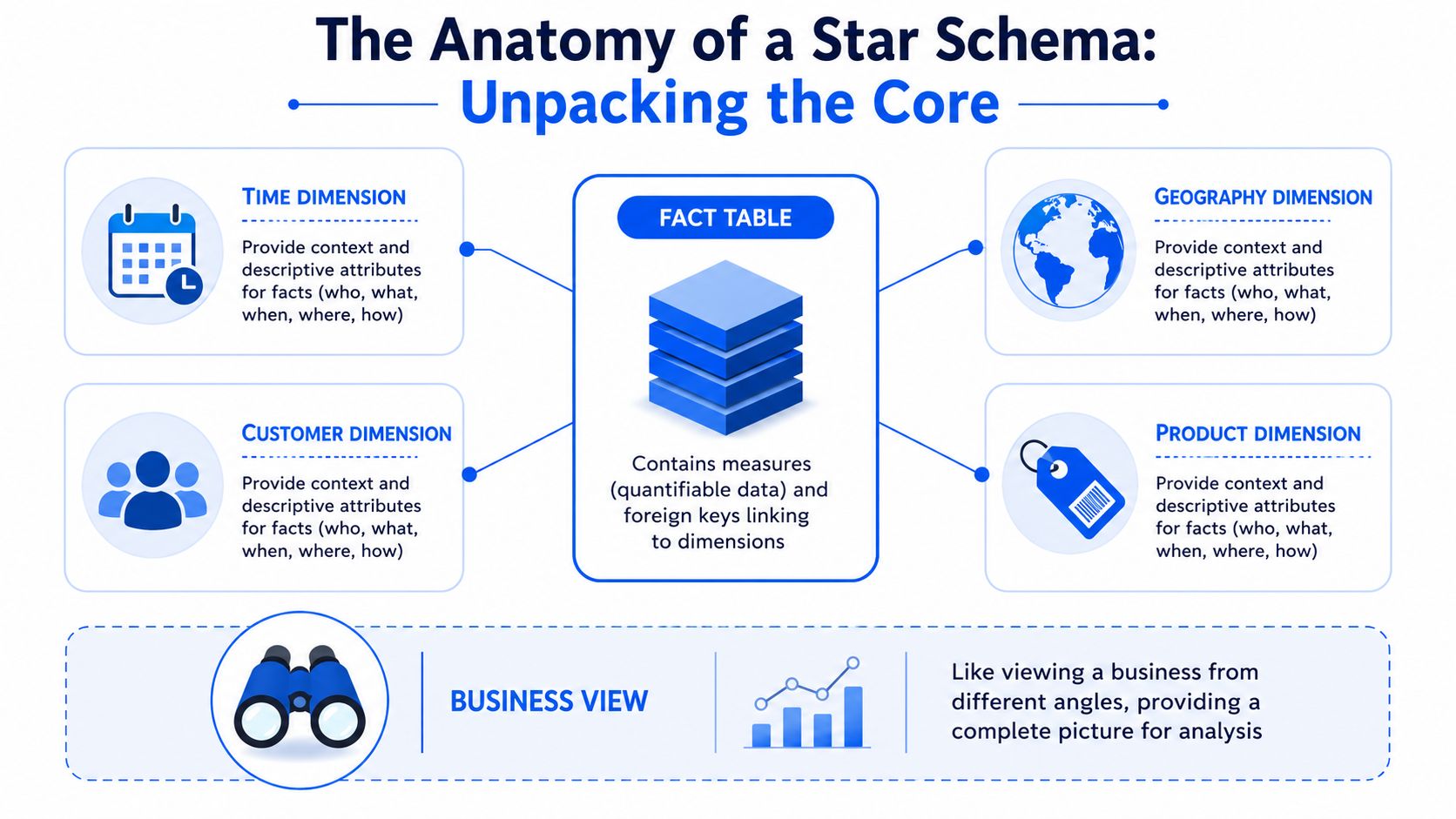
A star schema is simple on purpose. One central fact table stores measurable business events. Around it sit dimension tables that describe those events. That shape is why it remains the standard mental model for reporting systems.
Star schemas are structurally optimized for OLAP and read-heavy workloads. The design uses a central fact table linked to radiating dimensions that provide the “who, what, where, when, and why” context, which makes the structure a natural fit for BI use cases such as financial reporting and marketing analysis, as described in MotherDuck's guide to star schema design.
Fact tables hold the event
Think of a fact table as the headline of a news story. It tells you what happened in measurable terms.
A sales fact might contain order quantity, net amount, discount amount, and foreign keys to date, product, customer, and store. An inventory fact might contain stock on hand and reorder count. A subscription fact might store start events, renewals, and cancellations.
The most important part is that each row represents a clearly defined event or observation. Facts are where aggregation happens. If a report asks for revenue by month, units by category, or average duration by channel, it's reading from the fact table.
Dimension tables provide the language
Dimensions make facts understandable. They contain the attributes people use to filter, group, and label results.
A product dimension might include SKU, brand, category, and subcategory. A date dimension might include day name, fiscal period, and holiday flags. A customer dimension might include segment, acquisition channel, and region.
Here's the mental model I use with engineering teams:
Table type | Purpose | Typical contents |
|---|---|---|
Fact | Measure the business event | quantities, amounts, durations, counts |
Dimension | Describe the event | names, categories, statuses, locations, dates |
That one-to-many relationship matters. One product row in a dimension can relate to many rows in a sales fact. One calendar date can relate to many transactions. The star works because dimensions don't branch into a maze of further joins in the reporting layer.
Practical rule: If analysts need a map to understand how to answer a common business question, the model is too close to the source system and too far from the business.
For teams trying to document these relationships clearly, a good data architecture diagram reference is useful because dimensional models fail as often from unclear communication as from bad SQL.
Core Design Principles Grain Keys and Dimensions
The difference between a pleasant star schema and an expensive one usually comes down to a handful of design decisions made early. Most of the pain I see in production traces back to grain that wasn't declared, keys that were borrowed from source systems without thought, or dimensions that weren't designed to handle change.
Ralph Kimball introduced the star schema in 1996 for restructuring transactional databases for analytics, separating quantitative measurements from descriptive context. That approach has remained the most widely adopted pattern for enterprise analytical systems for nearly 30 years, as noted in Iteration Insights' review of Kimball's dimensional model.
Start with grain or you will rebuild later
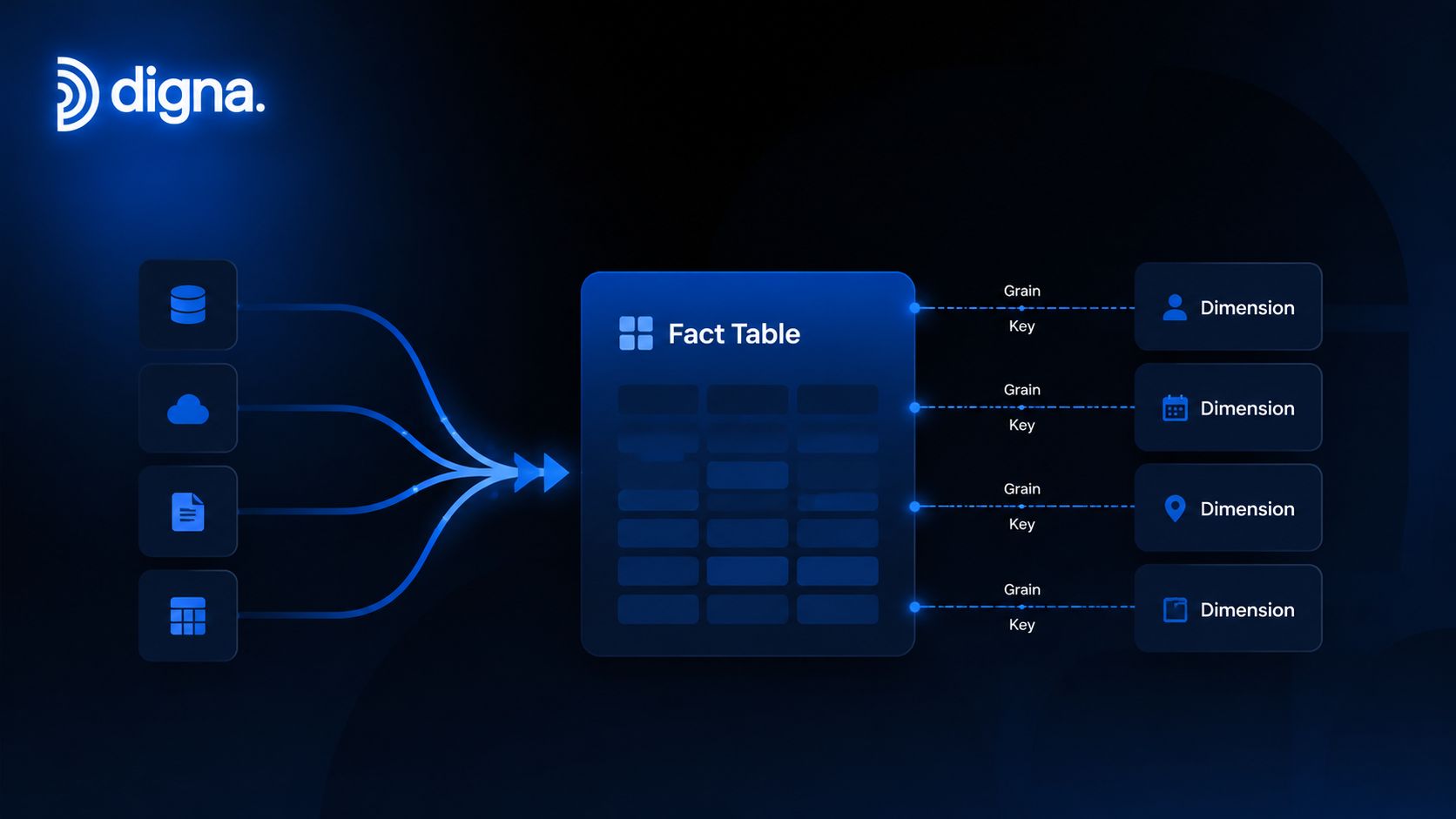
Grain means the exact level of detail represented by one row in a fact table. One row per order line is a grain. One row per invoice is another. One row per daily account balance is another.
If you don't lock this down first, everything else gets fuzzy. Measures become inconsistent. Duplicate counts appear. A dashboard owner thinks they're querying transactions, while the pipeline is loading daily snapshots.
A useful test is to finish this sentence before writing any SQL: one row in this fact table represents... If the answer isn't precise, stop.
Examples:
Good grain: one row per shipped order line
Good grain: one row per account per day
Bad grain: one row per customer activity, unless “activity” is formally defined
Keys should support change not just identity
Natural keys from source systems are tempting. They already exist, and they look convenient. But they carry baggage. Source IDs can be reused, reformatted, merged, or arrive late. That makes them brittle as warehouse join keys.
Use surrogate keys in dimensions when you need independence from source volatility and a clean way to preserve history. Keep the business key too, but don't make the warehouse depend entirely on it.
A customer example makes this concrete. If a customer changes segment or region and you need historical reporting, the warehouse needs a way to distinguish the old dimensional state from the new one. Surrogate keys make that manageable.
After the base model is clear, this walkthrough is a useful visual complement:
SCD choices are business decisions
Slowly Changing Dimensions aren't just a technical pattern. They encode what the business means by history.
Type 1: overwrite the old value. Use this when the current value is all that matters.
Type 2: add a new row for the changed dimension record. Use this when historical accuracy matters.
Type 3: add a new attribute for prior value. Use this when limited comparative history is enough.
A short comparison helps:
SCD type | What happens on change | Best fit |
|---|---|---|
Type 1 | old value replaced | correction or current-state reporting |
Type 2 | new row added | historical analysis |
Type 3 | prior value stored in extra field | limited before-and-after analysis |
The mistake isn't choosing one type over another. The mistake is mixing strategies randomly across dimensions without agreement from reporting owners.
Star Schema vs Snowflake and Normalized Models
There isn't one right schema for every warehouse. There's a right fit for a workload, a team, and a set of downstream consumers. The star schema is strong, but it's not a religion.

Where each model fits
A star schema denormalizes dimensions so analysts can query with fewer joins and less cognitive overhead. A snowflake schema normalizes some dimensions into sub-dimensions. A 3NF model keeps data highly normalized for transactional correctness and update efficiency.
Here's the practical comparison:
Model | Strength | Weakness | Best use |
|---|---|---|---|
Star | simple analytics and predictable reporting | some redundancy and less flexibility | BI, dashboards, semantic models |
Snowflake | cleaner dimension storage | more joins and harder SQL | dimensions with strong hierarchical reuse |
3NF | strong integrity and write efficiency | awkward for analytics | source systems and operational stores |
Snowflaking can make sense when a dimension contains stable hierarchical structures you want to manage centrally. But many teams overuse it and reintroduce the same complexity the star was supposed to remove.
Cloud warehouses changed the default answer
Legacy guidance often treated star schema as mandatory for performance. That's less true in cloud platforms with distributed execution and strong join optimizers. According to Microsoft's Power BI guidance page referenced here, modern cloud platforms can achieve fast joins even on normalized schemas, and an emerging trend claims 45% of new data lake implementations in 2025 are avoiding star schema in favor of normalized models with pre-aggregated views.
That doesn't mean star schemas are obsolete. It means the decision should be intentional.
Use a star schema when:
You have many BI users: they need understandable, reusable models.
Your semantic layer expects dimensions and facts: Power BI and similar tools benefit from it.
Your workload is dominated by recurring aggregations: standard reporting likes predictable paths.
Lean toward normalized or hybrid patterns when:
The warehouse serves many engineering use cases beyond BI
Dimension duplication creates maintenance friction
You can rely on modern query engines and carefully curated views
A star schema is a user interface for data as much as it is a storage design.
How Star Schemas Achieve High Performance
The star schema's speed isn't magic. It comes from reducing the amount of work the query engine has to do to answer common analytical questions.
The denormalized star structure reduces join path complexity to O(1) for analytical queries and is associated with 30 to 50% OLAP performance improvements in read-heavy workloads because each dimension connects directly to the fact table instead of chaining through other dimensions, as summarized in GeeksforGeeks' explanation of star schema performance.

The performance gain comes from structure
In a normalized model, a query may need to walk through several tables before it reaches the attributes needed for grouping and filtering. In a star, the route is direct. Fact joins to product. Fact joins to customer. Fact joins to date. The engine has a simpler plan.
That matters most in common warehouse work:
Aggregations: sum revenue by month, region, and category
Filtering: isolate a segment, channel, or period
Drill-downs: move from total sales into product or geography detail
Because dimensions are denormalized, the query path is stable and predictable. That predictability often matters as much as raw speed. Engineers can reason about it. BI tools can generate SQL against it. Data consumers can learn it.
The trade off is real
You pay for that simplicity in other ways.
Redundancy: dimension tables may repeat descriptive attributes that a normalized design would isolate.
Rigidity: changing analytical grain after rollout can be expensive.
ETL responsibility: the pipeline now owns business-friendly shaping, not just data movement.
A practical decision framework looks like this:
If your priority is | Prefer |
|---|---|
repeated reporting queries | star schema |
lowest duplication and centralized entity maintenance | normalized model |
mixed workloads with BI and engineering consumers | hybrid approach |
Cloud warehouses soften some of the old constraints, but they don't erase the usability benefits of a well-built star. High performance still comes from reducing unnecessary work, whether that's CPU work in the engine or mental work for the people writing SQL.
Practical Design Patterns and Anti-Patterns
Once the basics are in place, the skillful design begins. A good star schema doesn't just answer today's reporting questions. It survives new source systems, changing hierarchies, and awkward business rules without collapsing into confusion.
Patterns that work in production
Some patterns repeatedly prove their value:
Conformed dimensions: reuse shared dimensions like date, customer, or product across multiple fact tables so teams don't end up with competing definitions.
Bridge tables for many-to-many relationships: use them when a fact can legitimately relate to multiple dimension members, such as a sale associated with several promotions.
Separate facts by process: orders, shipments, returns, and payments usually deserve separate fact tables even if they look related in the source system.
Engineering discipline matters. A warehouse becomes easier to trust when each fact tells one business story clearly.
Keep business processes separate, then connect them through shared dimensions. Don't force one fact table to behave like four.
Anti-patterns that create long term pain
The most common failures aren't exotic.
One is mixed grain in the same fact table. If some rows are transaction-level and others are daily summaries, you've created a table that can't be safely aggregated without caveats. Another is accidental snowflaking, where dimensions start referencing other dimensions because it feels cleaner. It usually makes reports harder to write and reason about.
A third anti-pattern is using a BI-optimized star model as the main interface for feature engineering and ML inputs. That sounds efficient, but it often hides the low-level behavioral detail model builders need. The problem isn't just inconvenience. It can become a quality issue. The Reddit discussion referenced in the verified material notes that BI teams often prefer star schema, while ML engineers struggle with its limited granular context, and it cites an estimate that 70% of data quality failures in ML originate from schema anomalies and data drift that can go undetected in denormalized star models.
A practical “do this, not that” list:
Do define one grain per fact. Don't mix snapshots and transactions.
Do use dimensions for descriptive context. Don't store narrative attributes all over the fact table without purpose.
Do model BI and ML consumption separately when needed. Don't assume one denormalized layer serves every downstream job equally well.
Do keep dimension joins simple. Don't rebuild a normalized maze inside the reporting layer.
Teams that acknowledge these boundaries early spend less time unwinding them later.
Maintaining a Healthy Star Schema with Data Observability
A star schema can be clean on day one and unreliable by quarter two. Most failures don't start in the model itself. They start upstream.
A source team adds a column, changes a data type, stops sending a status code, or delivers a daily load late. The fact table still runs. The BI layer still refreshes. But the numbers begin drifting, dimensions lose alignment, and trust erodes one dashboard at a time.
What actually breaks after launch
These are the issues that show up repeatedly in production warehouses:
Schema drift: a source field is renamed, removed, or recast and downstream logic keeps running with wrong assumptions.
Data anomalies: values collapse to zero, spike unexpectedly, or stop varying in a way that should trigger investigation.
Timeliness failures: data lands late, and yesterday's dashboard effectively becomes a partial-day dashboard.

A healthy star schema needs operational guardrails around all three. That's where data observability becomes part of the model lifecycle, not an optional add-on. If your team is still separating “data quality” from “model design,” it helps to look at the overlap in data observability vs data quality.
Why observability belongs in the model lifecycle
AI-powered anomaly detection changes monitoring from static rules to a learned baseline of normal behavior that adapts to changing patterns, improving the speed and accuracy of detecting suspicious deviations, according to Oracle's explanation of AI anomaly detection.
That matters for star schemas because dimensional models amplify upstream assumptions. If product category values stop arriving, the issue doesn't stay local. It affects every report grouped by category. If a source changes timestamp behavior, time-based facts and timeliness expectations drift together.
What works in practice is a combination of checks:
Risk | Useful control |
|---|---|
structural changes | schema tracking |
unexpected value shifts | anomaly detection |
late or missing loads | timeliness monitoring |
business logic errors | record-level validation |
A star schema is not finished when the dbt run turns green. It's finished when the team can detect, explain, and contain drift in production.
That's the missing half of most star schema discussions. Modeling gets the warehouse into a usable shape. Observability keeps it usable.
If your team wants that second half, digna is built for it. It helps data teams monitor schema changes, detect anomalies with AI-powered baselines, validate records, and track timeliness without moving production data out of customer-controlled environments. That makes it a strong fit for warehouses where reliable reporting depends on catching drift before dashboards and downstream models break.