Data Quality Standards: A Practical Guide for Modern Teams
|
7
min. Lesezeit

A quarterly board deck shows revenue trending up, but finance refuses to approve the number. An overnight CRM export duplicated accounts, a source schema changed without notice, the warehouse refresh arrived late, and nobody had configured an alert for the abnormal row count. The team spends two weeks tracing the failure, postpones the board meeting, and loses credibility with leadership.
That situation is common in modern warehouses, lakes, and pipelines because data moves through too many systems for informal trust to work. Data quality standards give teams shared rules for deciding whether data is accurate, complete, timely, valid, consistent, unique, and fit for its intended use. They also connect those rules to controls, owners, alerts, and evidence.
A published standard won't repair a broken pipeline by itself. The value appears when engineers turn definitions into checks, stewards approve thresholds, and governance teams review failures before a dashboard, regulatory report, or AI workflow consumes unreliable data.
Table of Contents
The Moment You Realize You Need Data Quality Standards
The first sign usually isn't a dramatic system outage. It's a meeting where two teams bring different versions of the truth.
Finance compares revenue from the ERP with a warehouse model used by analytics. The numbers disagree. An analyst checks the transformation logic and finds duplicate customer accounts in the CRM export. An engineer discovers that the source added a field and changed a type. The platform team then notices that the overnight load completed after leadership had already opened the dashboard.
Each issue is manageable on its own. Together, they create a failure that nobody can explain quickly. The problem isn't only the bad records. It's the absence of an agreed definition of acceptable data, a named owner, a measurable threshold, and an escalation path.
Standards replace intuition with shared rules
A standard turns “this looks wrong” into an operational statement:
Required fields: A customer identifier must be present before a record enters the curated warehouse layer.
Freshness: A critical table must arrive within the agreed delivery window.
Schema: A region field must conform to the approved type and domain.
Reconciliation: Revenue totals must agree across designated source systems.
Escalation: A failed control routes to the steward and engineer responsible for that data product.
Those rules let finance, analytics, engineering, and executives discuss the same failure in the same language. They also move detection closer to the source, rather than waiting for a final report to expose the problem.
Practical rule: If a team can't state what failure looks like, who owns it, and what happens next, it doesn't yet have an enforceable data quality standard.
Standards also create a basis for prioritization. A missing optional marketing attribute shouldn't receive the same response as a broken transaction key or an unexplained change in a regulatory dataset. Mature teams document the difference and attach severity to business impact.
The result isn't perfect data. No organization can eliminate every exception across every warehouse, lake, and pipeline. The result is predictable handling of imperfect data, with failures detected, explained, assigned, and tracked before they become another leadership fire drill.
What Data Quality Standards Actually Mean
A data quality standard is a formal rule that an organization documents and agrees to apply. It can define an acceptable range, a required value, a freshness expectation, a validation condition, a reconciliation method, or an escalation route for a specific dataset.
For example, a warehouse orders table might require a non-null order ID, an approved currency code, a non-negative order total, and a delivery interval that matches the reporting use case. A lake ingestion job might require the incoming schema to match the contract before it writes to a curated zone.
Several related terms cause confusion because teams use them interchangeably.
A framework organizes the concepts. It might describe accuracy, completeness, timeliness, consistency, validity, uniqueness, and lineage.
A control is the technical check that tests a rule. It can query for nulls, compare totals, detect a type change, or measure arrival lag.
A policy states who is accountable and what the organization expects. It might assign a business owner to customer data or require evidence for audit review.
An SLA or SLO makes the expectation operational by defining a target, response, and consequence when the target is missed.
A construction analogy that holds up
Think of a data program as a construction project.
Standards are the building code. They define what a safe structure must satisfy. Frameworks are the architecture manual. They provide the vocabulary and design patterns. Controls are inspections. They test whether the implementation follows the rules. Observability is the inspector walking the site daily, watching for changes, defects, and conditions that static inspections miss.
The analogy matters because each layer has a different job. Standards without controls remain aspirations in a document. Controls without standards produce alert noise, because nobody knows which failures matter or what threshold should trigger action.
ISO 8000 is the best-known international standard series for data quality and master data. Its scope has expanded from foundational concepts toward operational guidance. ISO's overview of ISO 8000 identifies ISO 8000-1:2022 as an updated overview of the series and ISO 8000-150:2022 as the part that formalizes data quality management roles and responsibilities.
That distinction keeps the conversation practical. A framework helps a team choose language. A standard helps it define expectations. A control checks production behavior. Observability supplies the ongoing evidence that the controls continue to work as data changes.
The Core Dimensions Every Team Must Measure
Dimensions become useful when a team connects each one to a failure mode and a measurement method. The right question isn't “Is this dataset high quality?” It's “Which quality conditions must this dataset satisfy for this business use, and how will we know when it stops satisfying them?”
Field and record dimensions
Accuracy asks whether a value represents the world object it describes. A customer address with a transposed house number may pass a text-format check while still being wrong. Teams can measure accuracy by matching records against trusted reference data or validating attributes against an authoritative source.
Completeness asks whether required information is present. Missing middle-name fields might break a personalization process, while missing order totals can invalidate a financial model. A basic control calculates the null percentage for each required column and distinguishes legitimate absence from an error.
Timeliness measures whether information becomes available when users or systems need it. A dashboard refreshed at two in the morning may still be stale for an eight o'clock leadership meeting if the source event arrived earlier and the pipeline delayed it. The useful signal is the lag between the source event time and warehouse availability, not merely whether a job eventually finished.
Consistency checks whether related systems agree. If an order ID carries different totals in the CRM and ERP, the team needs a cross-system reconciliation control and a defined authority for resolving the conflict.
Validity tests conformance to schema, formats, enumerations, and business rules. A region column that accepts free text can accumulate values such as “North,” “N,” and “Northern,” even though the reporting model expects an approved domain.
Uniqueness ensures that one real-world entity isn't represented multiple times where a single record is required. Duplicate customer records inflate counts and distort segmentation. Teams commonly compare total records with distinct keys and check for collisions on identifiers that should be unique.
System-wide traceability
Lineage answers a different question: where did this number come from, and what changed it along the way? A lineage control measures the coverage of upstream-to-downstream mapping across sources, transformations, models, and reports. Without that map, an analyst may find an anomaly but struggle to identify the pipeline or owner responsible for it.
These dimensions interact. Accurate records that arrive too late can still produce poor decisions. Complete data with inconsistent definitions can mislead a dashboard. Valid values can remain operationally unfit when the business meaning is wrong, which is why ISO 8000-8:2015 distinguishes syntactic, semantic, and pragmatic quality and requires organizations to consider format, meaning, and fitness for use in measurement processes. ISO's description of ISO 8000-8:2015 provides the foundation for that distinction.
Core Data Quality Dimensions at a Glance
Dimension | Failure Example | Primary Metric |
|---|---|---|
Accuracy | Address contains a real-looking but incorrect value | Reference-data match rate |
Completeness | Required customer attributes are missing | Null percentage by field |
Timeliness | Source event arrives after the reporting window | Event-to-availability lag |
Consistency | CRM and ERP show different order totals | Cross-system reconciliation |
Validity | Region accepts values outside the approved domain | Schema and rule conformance |
Uniqueness | Duplicate customers inflate active-account counts | Distinct-to-total ratio |
Lineage | Report metric has no traceable upstream source | Mapping coverage |
Teams that need a more detailed operational treatment of these dimensions can use this guide to the dimensions of data quality as a reference point while defining controls for individual assets.
Frameworks and Standards Worth Knowing
No single framework tells a team everything it needs to run reliable analytics and machine learning workloads. Each reference solves a different problem, and choosing one should depend on whether the immediate need is vocabulary, measurement, governance, or fitness for use.
DAMA-DMBOK is useful as a broad conceptual vocabulary for data management. It helps teams place data quality alongside governance, metadata, master data, architecture, and stewardship. Its breadth is an advantage for enterprise planning, but it doesn't provide every production-ready query, alert condition, or warehouse-specific threshold.
ISO 8000 provides formal language for data quality and master data. The series includes specialized parts such as ISO 8000-110 for characteristic-data exchange, ISO 8000-114 for portable data, ISO 8000-115 for quality identifier prefixes, ISO 8000-150 for roles and responsibilities, and ISO 8000-210 for sensor data quality characteristics. The ISO 8000 standards overview shows publication activity across 2011, 2015, 2016, 2020, 2021, 2022, and 2024, indicating an evolving family rather than a single static document.
ISO/IEC 25012 defines a general data quality model for data stored in structured form. Its companion, ISO/IEC 25024, provides measurable characteristics and measures for evaluating data quality in computer systems. The ISO/IEC 25012 reference makes the connection between abstract characteristics and measurable controls clearer for analytics pipelines.
DCAR, or a data context and risk-oriented approach, helps teams judge fitness for purpose. It is valuable when the same data can be acceptable for exploratory analysis but unsuitable for a regulated report or model input. Its limitation is that teams still need to translate the evaluation into ownership, automated checks, and incident handling.
Framework | Primary Focus | Dimensions Covered | Best Fit For | Known Limitation |
|---|---|---|---|---|
DAMA-DMBOK | Enterprise data-management vocabulary | Quality, governance, metadata, stewardship, architecture | Program design and operating models | Broad guidance needs operational translation |
ISO 8000 | Formal data-quality and master-data language | Measurement, exchange, roles, domain-specific quality | Standardization and auditable definitions | Doesn't prescribe every platform implementation |
ISO/IEC 25012 | Structured-data quality model | Intrinsic and contextual quality characteristics | Software and system quality evaluation | Requires local thresholds and workflow design |
ISO/IEC 25024 | Quality measures | Measurable characteristics and evaluation methods | Metric design and assessment | Doesn't assign business ownership by itself |
DCAR | Fitness for purpose and risk | Contextual quality and decision suitability | Analytics, reporting, and model-use decisions | Needs supporting controls and governance |
Data classification belongs beside quality design because sensitivity, retention, and access affect which controls a team can run and who may review the evidence. Founders who need a plain-language introduction can consult practical data classification for founders from By Design Law Firm & Legal Consultancy, PLLC.
A practical data management frameworks guide can help teams compare these references without treating completeness of documentation as the same thing as operational readiness.
From Dimensions to Measurable Metrics and SLAs
A dimension becomes enforceable only after the team defines its calculation, target, alert behavior, and owner. The calculation should be simple enough to explain during an incident and stable enough to compare across pipeline runs.
Accuracy might use the ratio of records that match an approved reference set to the records evaluated. Completeness can use non-null records divided by records expected to contain a value. Timeliness uses the lag between event time and availability. Validity counts records that pass declared rules, consistency compares values across designated sources, and uniqueness identifies duplicate keys or duplicate entities.
Turning Dimensions into Metrics and SLAs
Dimension | Calculation Method | Example SLA Threshold | Alert Signal | Owner |
|---|---|---|---|---|
Accuracy | Matched records divided by evaluated records | Agreed match target for the domain | Match rate drops below target | Domain steward |
Completeness | Non-null values divided by expected values | Required-field target by asset | Null rate rises above target | Data owner |
Timeliness | Availability timestamp minus source event timestamp | Maximum permitted delivery lag | Late or missing load | Pipeline engineer |
Validity | Passing records divided by evaluated records | Rule-conformance target | Invalid values detected | Analytics engineer |
Consistency | Agreement across source-system comparisons | Reconciliation target | Cross-source mismatch | Domain steward |
Uniqueness | Duplicate keys or duplicate-entity count | No unexplained duplicates | Collision detected | Data custodian |
The thresholds in this table are design examples, not universal requirements. A transaction ledger, customer profile, and exploratory event stream have different consequences when they miss a quality condition. The data owner should set the target with the users who depend on the asset, then document whether a breach blocks publication, opens an exception, or creates a warning.
A static batch test may report a failure after a job finishes. Continuous observability adds context, including historical behavior, arrival patterns, schema changes, and value-distribution shifts. That context helps teams separate an expected seasonal change from a broken ingestion process.
The data quality metrics reference can support metric selection, but implementation still belongs in the environment where the data is produced and consumed. An alert should route to a human owner, include the affected asset and rule, preserve evidence, and define what closes the incident.
A metric without an owner is a dashboard decoration. An SLA without an escalation path is a hope.
Industry and Regulatory Expectations
A quality dimension matters differently depending on the harm caused by failure. Financial services generally place heavy weight on accuracy, completeness, and lineage, because teams must reconcile records, explain reported figures, and demonstrate how data moved from source to output under expectations such as BCBS 239 and Dodd-Frank reporting rules.
Healthcare teams may prioritize validity and timeliness when clinical and operational systems exchange structured information through environments shaped by HIPAA and HL7 or FHIR expectations. A correctly formatted value that arrives too late can be as problematic as an invalid value, particularly when a downstream workflow depends on current information.
Telecommunications operators typically need controls that handle high-volume customer, network, and operational records. Public-sector agencies must confront the familiar GIGO principle, meaning that poor inputs produce poor outputs, alongside open-data expectations for metadata, interoperability, and deployment quality.
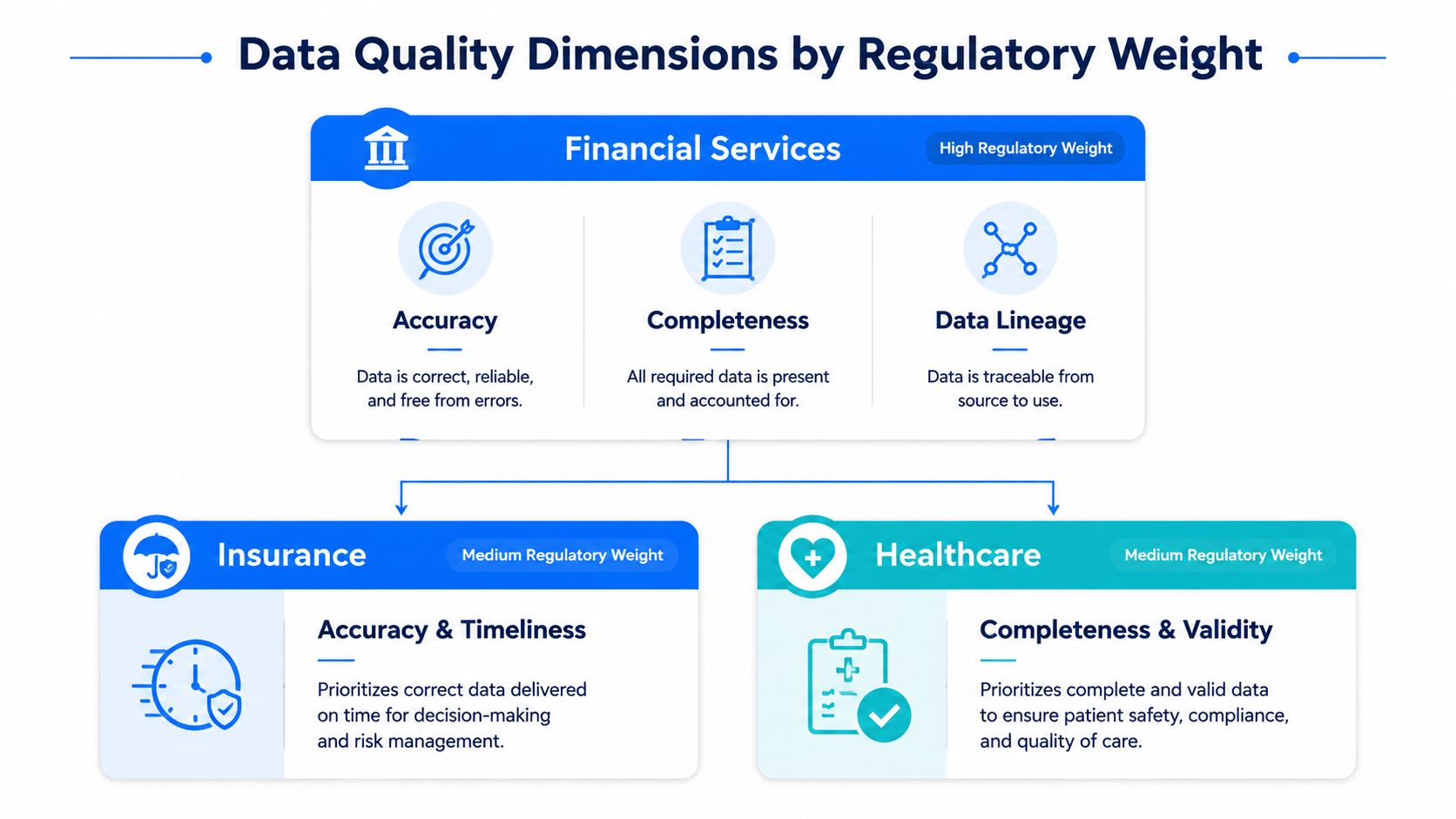
The technical controls remain familiar across sectors. Financial reporting may need reconciliation and lineage coverage. Healthcare exchange may require domain validation and delivery-lag monitoring. Telecom operations may watch volume, schema, and distribution changes. Public data programs may emphasize metadata completeness and consistent formats.
Regulation still depends on implementation
Published rules don't automatically produce reliable data. ESMA's 2025 report says there was still no formal Data Quality Framework in place, while ESAP-aligned metadata requirements and updated rules were expected to take effect in summer 2026, according to the ESMA report on quality and use of data. That gap shows why regulated teams need controls, evidence, and accountable owners, not just a library of standards.
The same report supports a contrarian conclusion: more standards don't automatically mean better quality. Adoption, interoperability, metadata implementation, and consistent deployment determine whether a published requirement changes production behavior.
Governance, Roles, and Operational Enforcement
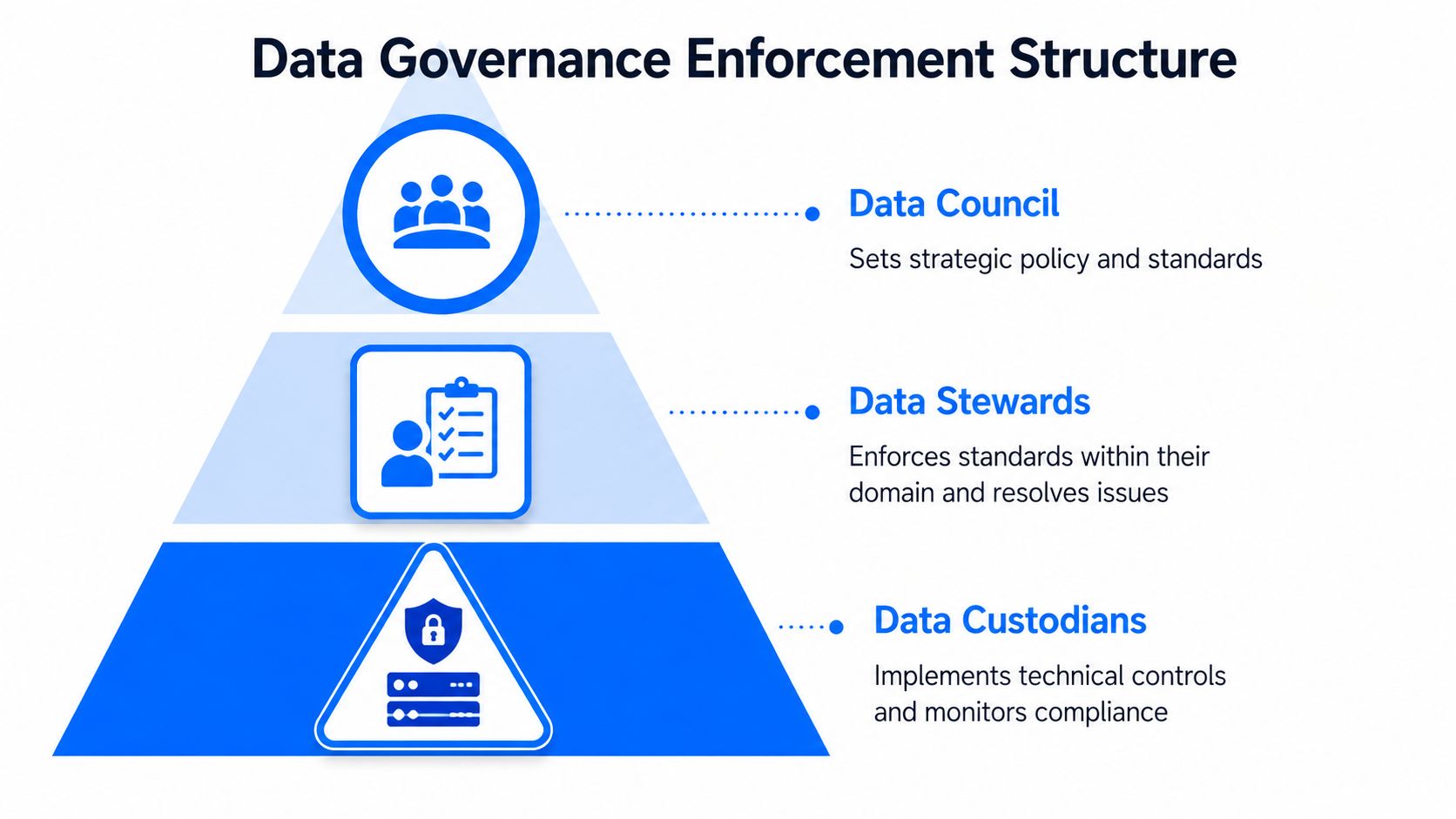
A framework can define quality characteristics, but people enforce the rules. Most organizations need a clear division between strategic decisions, domain accountability, and technical implementation.
The data council sets enterprise policy, approves the quality vocabulary, and decides which assets are critical. Data stewards apply those expectations within a domain, approve thresholds, resolve interpretation disputes, and coordinate remediation. Data custodians, often engineers or platform specialists, implement the controls in pipelines and monitor compliance.
The cadence keeps governance active rather than ceremonial:
Weekly triage: Review failed controls, assign incidents, and remove blockers.
Monthly review: Examine SLA breaches, recurring causes, and aging exceptions.
Quarterly update: Revisit standards, thresholds, ownership, and framework fit.
Leadership needs measures that describe whether the operating model works. Useful governance KPIs include the percentage of critical assets with active SLAs, mean time to detect a quality incident, exception aging, and audit findings closed on time. These indicators don't replace technical metrics. They show whether the organization responds to those metrics consistently.
An observability platform such as digna can provide the operational layer by monitoring freshness, volume, schema changes, value distributions, and record-level business rules in production. The platform runs checks in the customer's environment and can execute analysis in-database, allowing teams to turn a documented standard into a live, queryable control without treating the policy document as the monitoring system.
Teams can map responsibilities with this data governance roles guide, then adapt the model to their organization's architecture and regulatory obligations.
Building a Standards-Driven Program That Holds Up
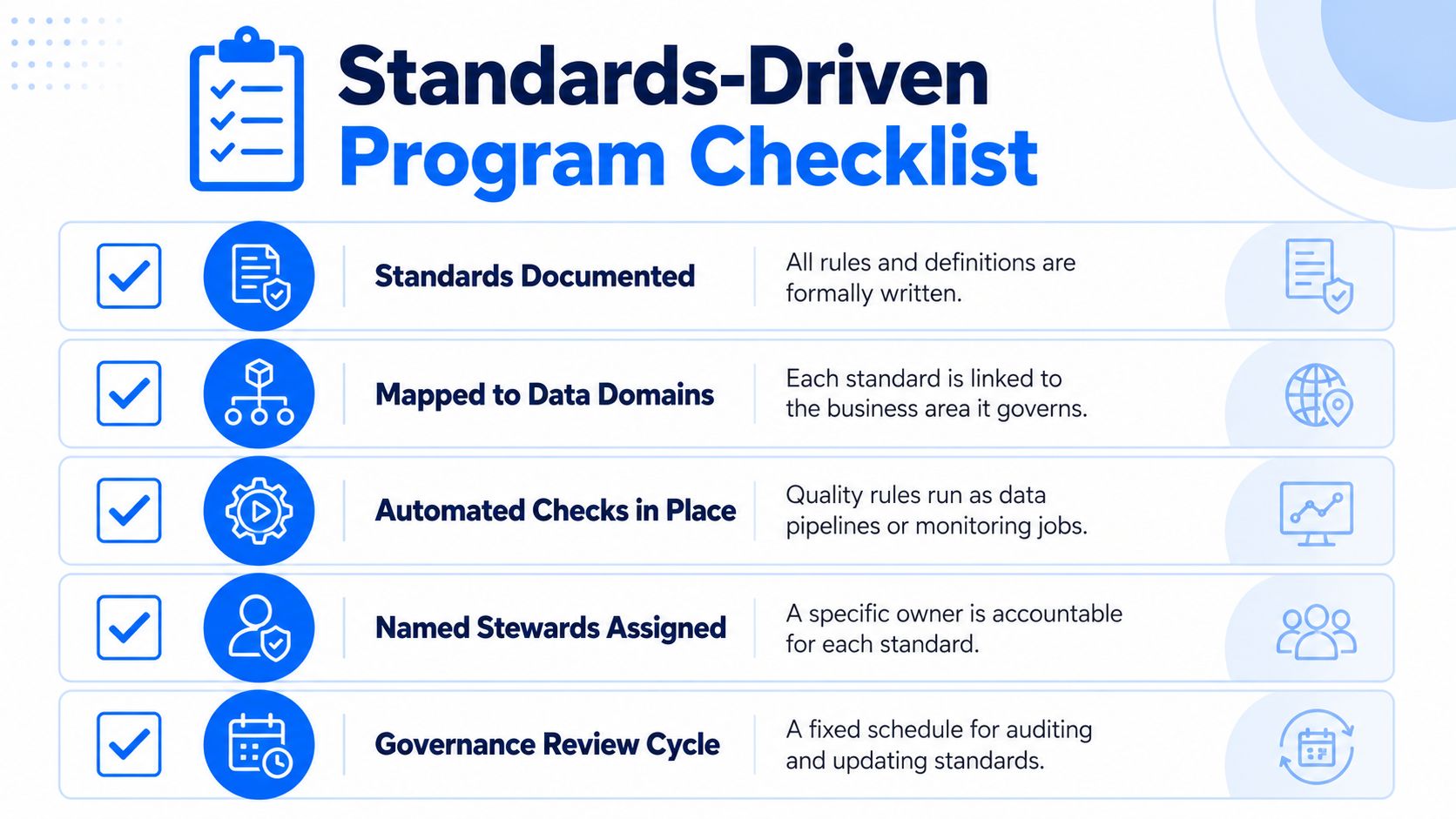
A durable program has five visible properties: standards are documented, rules are mapped to data domains, automated checks run against critical assets, named stewards own decisions, and governance reviews results on a fixed cadence.
A focused first month can establish the operating loop:
Day one: Inventory critical warehouse, lake, and pipeline assets.
By day ten: Define baseline SLAs for the top three assets.
By day twenty: Instrument those assets with automated quality checks.
By day thirty: Present the first KPI results to the data council.
Use the data quality maturity model to identify the next capability, but don't wait for a perfect target state. Standards create value only when teams test them against real workloads. The first quarter should expose where published thresholds were too strict, too loose, or assigned to the wrong owner.
digna provides modular data quality and observability capabilities for monitoring data behavior across warehouses, lakes, and pipelines, including validation, timeliness monitoring, anomaly detection, and schema tracking. Visit digna to see how its in-environment approach can turn your data quality standards into measurable, auditable production controls.