Data Monetization Services: Models, Governance, and ROI
|
10
min read

Your executive team wants a new revenue stream from data. Product has a shortlist of datasets, engineering has built an export, and legal has asked a basic question: What exactly are we allowed to share, with whom, and how can we prove the data is reliable? Then a delivery arrives late, a KPI changes definition, or a renamed column breaks a customer's pipeline. The launch pauses.
That situation is common because data monetization services aren't mere transactions involving files. They're commercial services whose value depends on data being trustworthy, available, useful, and governed. A buyer doesn't pay only for records. They pay for dependable access, understandable definitions, permitted use, operational continuity, and evidence that the product will keep working.
Table of Contents
Why Data Monetization Programs Stall Before They Launch
The operational symptoms appear first
Reframe the product
What Data Monetization Services Actually Are
Start with the customer and contract
Treat evidence as part of the product
Technical and Governance Prerequisites That Monetization Requires
Data quality must be measurable
Observability covers behavior over time
Lineage connects trust to explanation
Regulatory and Contractual Layers Around Monetization
Translate legal duties into operating controls
Contracts must describe evidence, not only access
How SourceX Can Help
Evaluate the workflow, not just the buyer network
A Practical Checklist for Evaluating Monetization Vendors
Five areas deserve a structured review
Test industry fit with realistic scenarios
Industry Use Cases in Finance, Healthcare, Telecom, and Public Sector
Finance
Healthcare
Telecom
Public sector
ROI Metrics and Common Pitfalls
Follow the causal chain
Avoid the quiet failures
How digna Supports Trustworthy Monetization and Key Takeaways
Map controls to commercial proof
Why Data Monetization Programs Stall Before They Launch
The announcement usually sounds straightforward. A leadership team identifies valuable operational data, asks a product group to package it, and sets an ambition to sell datasets, APIs, insights, or data-enabled services. The first internal review often reveals a different reality: source tables have inconsistent definitions, ownership is unclear, delivery schedules aren't documented, and nobody can produce a customer-facing record of quality checks.
A prospective buyer may ask whether yesterday's data has arrived, whether a field changed type, and whether a reported metric follows the same business rule as last month. The team can answer each question informally, but it can't show a repeatable evidence trail. That gap turns a promising product into a fragile promise.
The operational symptoms appear first
Teams normally encounter the problem through operational symptoms rather than through a failed business case:
Late deliveries: A scheduled dataset arrives after a buyer's reporting process has run.
Drifting KPIs: A revenue, risk, usage, or customer metric changes because a source system or business definition changed.
Breaking schemas: A renamed, removed, or retyped column disrupts downstream consumers.
Unclear provenance: Stakeholders can't trace a field from its origin through transformations to the delivered product.
Unproven fitness: Sales can describe the dataset, but nobody can demonstrate whether it meets a buyer's stated purpose.
These issues don't mean the data has no commercial value. They mean the organization hasn't converted that value into a service that another party can safely depend on.
Practical rule: If a buyer has to trust a verbal assurance instead of reviewing operational evidence, the data product isn't ready for a serious contract.
Reframe the product
A useful definition is broad: a data monetization service is any internal or external commercial offering whose value depends on governed data or data-enabled capability. Raw dataset resale is one option, but it sits beside curated subscriptions, API products, embedded analytics, advertising, audience products, and managed services.
The common thread is service reliability. Each model has a customer, a delivery promise, a permitted use, and measurable signals that show whether the promise is being met. Governance and observability therefore aren't backstage functions added after launch. They form the evidence layer that gives the offer its right to exist.
The rest of the operating model follows from that idea. Before choosing a pricing model, the team needs to know what it can prove about quality, timeliness, structural stability, lineage, access, and permitted use. Without that foundation, monetization remains a slide in a strategy deck rather than a dependable service.
What Data Monetization Services Actually Are
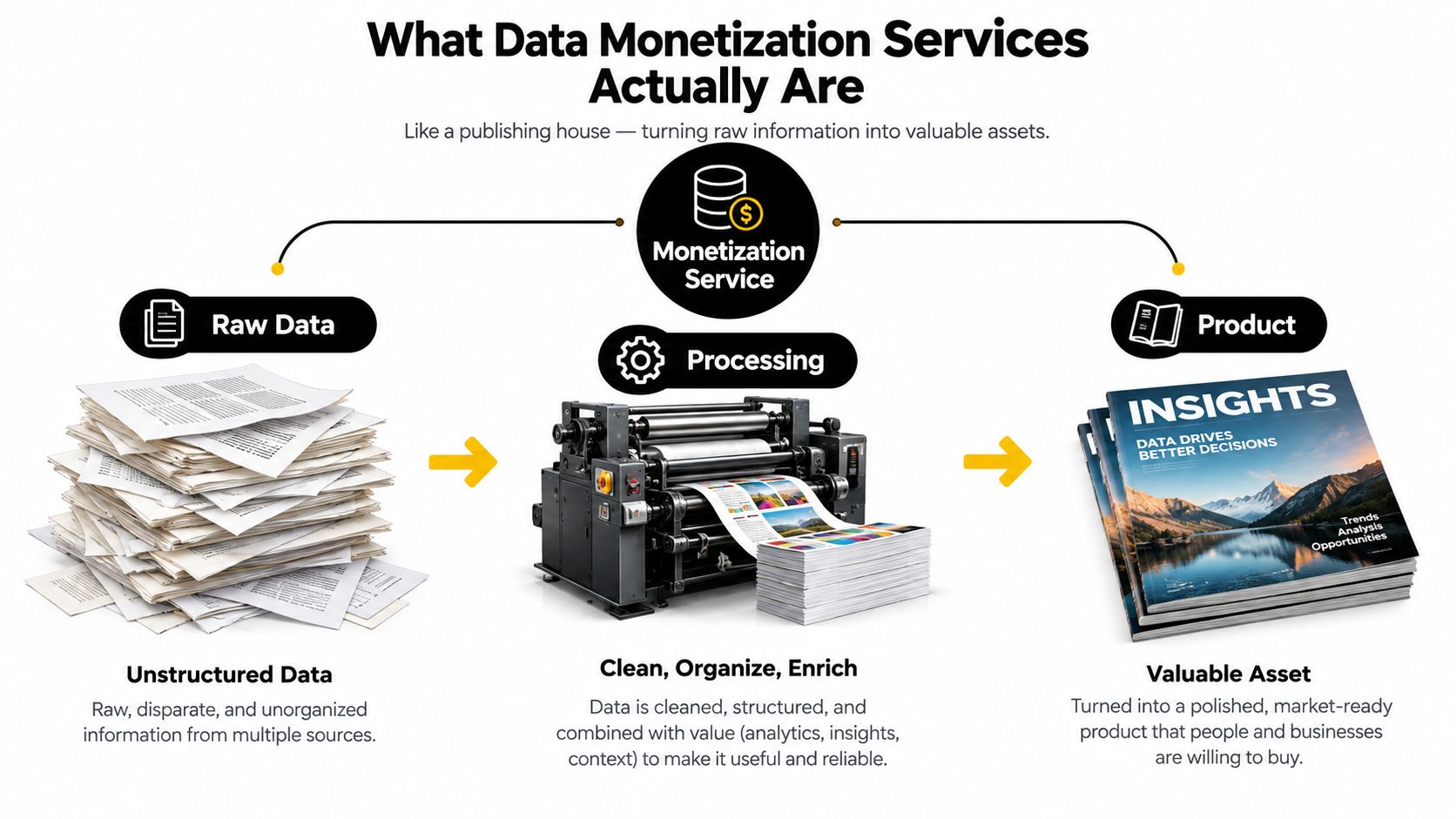
Think of a publishing house. It doesn't sell loose pages pulled from different desks. It edits articles, checks facts, applies a consistent layout, adds metadata, prints a finished magazine, and distributes it under defined commercial terms. A data monetization service performs a similar transformation. It turns raw information into a repeatable product or capability that someone can consume and evaluate.
The raw material might be transaction records, support conversations, sensor readings, customer attributes, or public-sector information. The finished offering could be a licensed file, a queryable API, an analytics workspace, an audience segment, or a managed decision service.
Start with the customer and contract
The main models differ by what the customer receives and how the provider must operate:
Raw dataset resale gives a buyer a defined extract or licensed collection. The evidence layer needs provenance, permission, field definitions, completeness checks, and a record of the exact version delivered.
Curated subscription access provides continuing access to normalized data. Freshness, delivery success, schema compatibility, and change notices become part of the service promise.
API-based insight products return a result rather than a full dataset, such as a risk indicator or location attribute. The provider must validate inputs, monitor response behavior, preserve decision lineage, and explain version changes.
Embedded analytics places data-powered charts or recommendations inside another application. The customer may never see the underlying tables, so metric definitions, availability, latency, and interface stability matter.
Advertising and audience monetization uses data to improve targeting or reach. Permission, purpose limitation, segment quality, suppression controls, and audit records matter as much as audience scale.
Managed services combine data with consulting, integration, or operational support. The provider must define responsibilities, incident handling, service levels, transformation logic, and handoff evidence.
The distinction isn't cosmetic. A file buyer may care about field completeness and licensing rights, while an API customer may care more about response consistency and versioned behavior. An internal risk team consuming an embedded metric needs a traceable calculation, even if no external buyer sees the source table.
Treat evidence as part of the product
A governed data product combines relevant resources and services into a standardized, consumable package published through controlled sharing mechanisms. In practical terms, that means profiling and validating source data, creating a stable semantic model, publishing metadata and access policies, delivering through an API or governed interface, and monitoring the product after release. Research on data-product pipelines identifies quality, security, privacy, standards, and contractual controls as requirements that become harder to manage as products scale, as described in this research on governed data-product pipelines.
The mental model is simple:
Monetization is a service.
The service has customers and defined terms.
Customers need evidence that the service works and is permitted.
That evidence includes quality, timeliness, schema stability, lineage, access controls, and audit history. The business model determines how value is captured. The evidence layer determines whether anyone can trust the value long enough to pay for it.
Technical and Governance Prerequisites That Monetization Requires
Demand rarely provides the main obstacle. The harder problem is proving that a dataset can support an external commitment without exposing the organization to avoidable operational, legal, or reputational risk.
Data quality must be measurable
Quality begins with the records themselves. Completeness asks whether required fields and expected records exist. Accuracy asks whether values represent the underlying event. Consistency checks whether the same entity or metric follows compatible definitions across systems. Validity tests whether values obey expected formats and business rules.
Rule-based validation is useful for deterministic conditions, such as permitted status values, date relationships, identifier formats, or balance equations. Statistical anomaly detection adds a different capability. It looks for unusual volumes, distributions, patterns, or relationships that may not violate a written rule but still indicate a source or pipeline problem.
A monetized dataset needs both. Rules catch known failure modes. Baselines help teams detect behavior they haven't fully specified.
For a practical explanation of record-level controls and continuous monitoring, see data validation rules, checks, and continuous data quality.
Observability covers behavior over time
Traditional monitoring may show that a job completed successfully. It may not show that the job loaded an empty partition, delivered an unusual record volume, changed a field type, or arrived outside the customer's expected window.
Data observability asks what is happening to the data domain:
Freshness: Did the product arrive when the contract or process requires it?
Volume: Did record counts and partition sizes behave as expected?
Distribution: Did values shift in a way that changes analytical meaning?
Schema: Were columns added, removed, renamed, or retyped?
Business behavior: Did a critical KPI move beyond its normal pattern?
A provider should turn these signals into customer-facing evidence where appropriate. If the evidence stays hidden inside an engineering dashboard, buyers still have to accept an unsupported assurance.
Lineage connects trust to explanation
Lineage answers questions that become unavoidable during procurement and incidents. Where did this field originate? Which transformations changed it? Which source systems contributed to the result? Which consumers received the affected version?
This connective tissue also supports responsible change management. When a source schema changes, lineage shows which products, reports, APIs, and customers could be affected. The team can then assess impact before publishing a broken update.
Security and privacy complete the foundation. Leaders need to decide where data lives, who can reach it, how access is logged, how personal information is removed or restricted, and how the provider separates environments. In regulated sectors, moving sensitive data into a separate monitoring or marketplace environment can create risk by itself. In-database checks and execution inside the customer's environment reduce unnecessary movement while preserving operational control.
Buyers don't just purchase the dataset. They purchase confidence in what the dataset will do next.
Regulatory and Contractual Layers Around Monetization
Regulation adds conditions that a commercial team can't solve with a better catalog page. The EU Data Act entered into force on 11 January 2024 and began applying on 12 September 2025, with rules covering fair access and use of data, including data generated by connected products and related services. The framework gives businesses and legitimate users rights to access relevant data and creates sharing obligations for data holders, as outlined by the European Commission's Data Act policy page.
The Data Act doesn't replace the GDPR. When personal data is involved, GDPR remains controlling. A monetization service therefore needs to classify the data before it designs the product, not after a buyer requests access.
Translate legal duties into operating controls
A reliable workflow turns each legal question into an observable control:
Is the dataset eligible? Record the source, product context, data category, and applicable rights.
Does it contain personal data? Separate personal and non-personal elements, apply the relevant privacy basis, and document preparation.
What purpose is permitted? Record the intended use, restrictions, recipients, and onward-sharing conditions.
Are the terms fair? Use clear, fair, reasonable, and nondiscriminatory contractual terms.
Can the organization prove what happened? Preserve versions, validation evidence, delivery history, access records, and approvals.
The compensation model also changes day-to-day work. A data holder may request reasonable compensation for making data available, including costs associated with preparation, technical dissemination, and storage. Microenterprises, small and medium-sized enterprises, and nonprofit research organizations can't be charged more than the costs incurred to make the data available. These rules make cost evidence, recipient classification, pricing logic, and auditability central to the service, as explained in the official EU Data Act regulation.
Contracts must describe evidence, not only access
A contract should define the dataset, permitted purposes, recipients, retention, delivery method, quality expectations, change notification, incident handling, and dispute process. It should also distinguish compensation for making data available from unsupported claims that the provider owns the economic value of the data itself.
The same principle applies to sector rules and private agreements. A healthcare partner may require strict purpose limitation. A financial counterparty may need reproducibility for a reported figure. A public body may need controlled onward sharing and records suitable for review. A data-processing agreement can help formalize roles and processing boundaries, particularly where a supplier handles personal data. A useful starting point is this data processing agreement resource.
Regulation doesn't make a dataset monetizable automatically. It raises the standard for evidence. Freshness failures, silent schema changes, or unexplained transformations can become contractual, compliance, and commercial problems at the same time. Observability pays back because it turns those conditions into records that people can review before, during, and after a transaction.
How SourceX Can Help
Some organizations don't need a marketplace platform first. They need a controlled way to assess whether operational data can be licensed, document rights, prepare the material, and coordinate a buyer without losing supplier control.
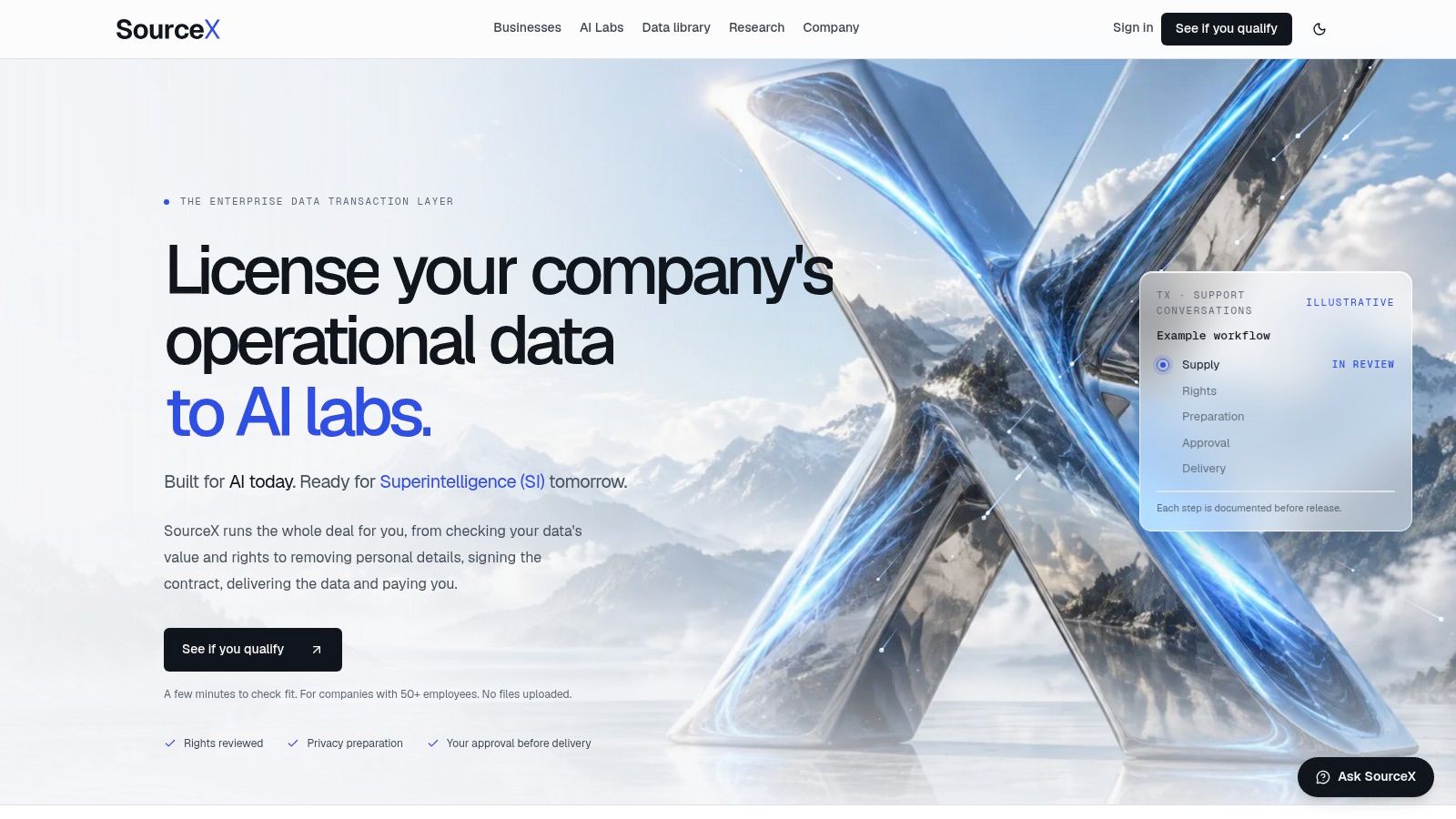
Enterprise data monetization services from SourceX are designed around that transaction layer. SourceX supports fit assessment without requiring an initial upload, then maps datasets across systems and historical periods. It can create a private inventory from exports associated with tools such as Zendesk, Salesforce, GitHub, Jira, SharePoint, and Google Workspace, summarizing sources, fields, depth, and availability.
Evaluate the workflow, not just the buyer network
SourceX's workflow covers rights review, provenance confirmation, dataset-specific deidentification, pricing and terms, buyer outreach, agreement execution, packaging, and delivery coordination. The supplier approves each step, and nothing is shared before explicit authorization. An evidence packet records the system of origin, licensing rights, defined purpose, and usage constraints.
That makes the service a plausible fit when the main obstacle is rights-cleared operational data, fragmented exports, uncertain deal mechanics, or the coordination burden between legal, privacy, sales, and engineering. Suppliers retain ownership of original data, while selected deidentified datasets follow the ownership and intellectual-property terms in the agreement. The workflow also supports selection windows, fixed-fee arrangements, exclusivity terms, and defined invoicing timelines where those terms suit the deal.
The right evaluation questions remain important:
Can the supplier approve every release?
Are deidentification steps recorded for each dataset?
Does the inventory preserve enough structure for buyer evaluation?
Are permitted uses and onward restrictions embedded in the agreement?
Can the provider explain how delivery and payment are coordinated?
SourceX may be less suitable when the priority is continuous observability of an internal API or subscription product rather than licensing operational records to data buyers. A licensing transaction layer and a data reliability platform solve adjacent but different problems.
A Practical Checklist for Evaluating Monetization Vendors
A shortlist may contain three vendors that all claim to support monetization, yet each may define governance, usage, and pricing differently. Compare them against evidence rather than feature count.
Five areas deserve a structured review
Evidence capabilities come first. Ask to see how a vendor records validation failures, freshness, anomaly history, schema changes, lineage, approvals, and delivery status. Good answers include customer-reviewable evidence, not just alerting.
Deployment model matters when data is sensitive. In-environment or in-database execution can reduce data movement and help regulated organizations preserve control. Ask whether the vendor accesses production data, where metadata is stored, and how administrators restrict access.
Governance and compliance should cover classification, purpose, retention, access, audit records, contract terms, and change management. A vendor that offers a governance report only after an incident is weaker than one that includes evidence in the operating workflow.
Pricing transparency deserves special attention. Pricing based on data movement, scans, API calls, or alert volume can create perverse incentives. Teams may suppress checks, delay monitoring, or avoid investigating noisy areas to control spend. Transparent, usage-stable pricing makes it easier to expand coverage without turning reliability into a metering dilemma.
Integration fit is practical, not decorative. The vendor should work with the warehouses, lakes, relational databases, orchestration tools, and identity controls already used by the organization. Engineers need technical compatibility, analysts need understandable status, and governance teams need traceability in the same operating picture.
This data quality tools overview can help teams frame the evidence portion of the review.
Criterion | What to Verify | What Good Looks Like |
|---|---|---|
Data quality standards | Rules, anomaly detection, completeness, accuracy, and validation scope | Evidence is linked to datasets and retained across deliveries |
Regulatory compliance | Data classification, permitted use, privacy controls, and audit history | Controls map to contractual and regulatory obligations |
Security model | Deployment location, access roles, logging, and data movement | Production data remains under customer control |
Integration capability | Supported platforms, APIs, scheduling, and identity integration | Deployment fits existing pipelines without duplicate exports |
Pricing model | Charges for tables, users, volume, scans, alerts, or movement | Costs remain understandable as coverage expands |
Test industry fit with realistic scenarios
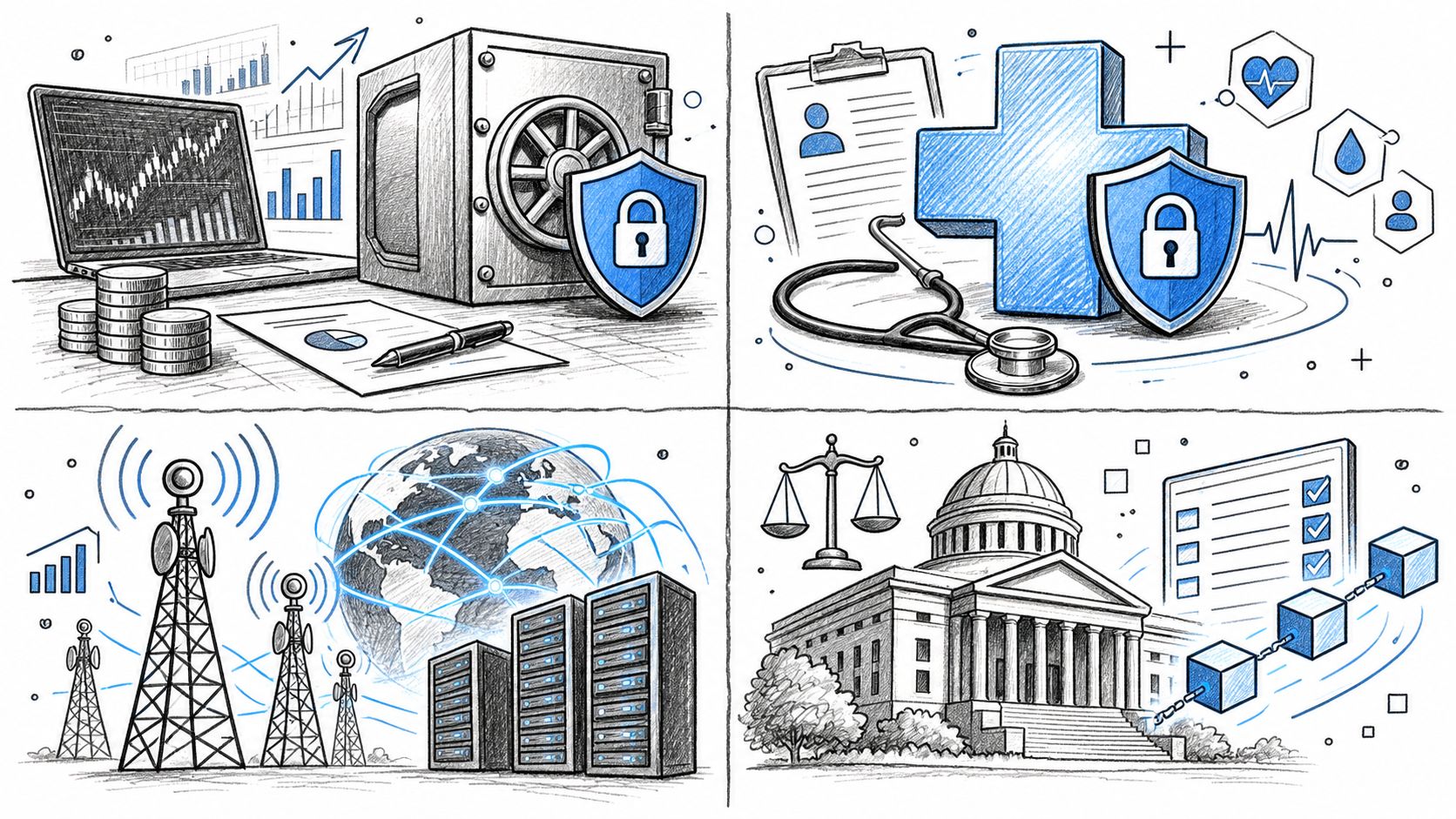
A finance buyer should test a transaction or risk product against rule validation, timeliness, schema stability, and reproducibility. A healthcare team should test lineage, privacy preparation, role-based access, and purpose restrictions. A telecom provider should test high-volume anomaly detection and structural change handling. A public-sector organization should test recipient controls, audit evidence, and support for official or analytical reuse.
Ask each vendor to demonstrate what happens when a critical source arrives late, a column changes type, or a business rule fails. The strongest shortlist candidate won't only show a green dashboard. It will show who receives the incident, what evidence is retained, how the consumer is notified, and how the team proves resolution.
Industry Use Cases in Finance, Healthcare, Telecom, and Public Sector
The same monetization architecture behaves differently across industries because the valuable product and the unacceptable failure differ.
Finance
A financial institution might package risk indicators, transaction-derived insights, regulatory datasets, or operational analytics for internal teams, counterparties, or supervisors. The commercial pattern may be a subscription, an API, or an embedded decision service.
The key controls are business-rule validation, delivery timeliness, schema tracking, and reproducibility. A late risk feed can affect decisions. A changed definition can alter a report without producing an obvious technical error. The evidence packet should connect source records, transformations, calculation rules, release versions, and recipient access.
Healthcare
Healthcare organizations may share clinical, operational, or regulatory data with approved partners, or use it inside analytics products. Privacy and lineage dominate the design because the organization needs to show what data was used, for which purpose, under which access conditions, and after what preparation.
A useful product isn't just a deidentified file. It includes clear field definitions, transformation history, permitted use, quality status, and controls that prevent accidental expansion of the audience or purpose. Buyers need confidence that the data remains useful without exposing people or obscuring provenance.
Telecom
Telecom providers generate connected-product and operational data that can support network analytics, enterprise services, or API products. The Data Act reshapes access conditions for covered connected products, but access rights don't remove the need for reliable delivery or privacy controls.
High-volume pipelines amplify the cost of an undetected anomaly. A sudden shift in device events, a missing partition, or a structural change can affect downstream products at scale. Monitoring should combine volume behavior, freshness, schema stability, record validation, and access evidence.
Public sector
Government and statistical organizations may share data for public services, research, official statistics, or approved analytical activities. Revenue may be secondary to lawful access, transparent cost recovery, recipient controls, and public accountability.
The compensation rules and onward-sharing safeguards in the Data Act make evidence particularly important. The organization should preserve purpose, recipient, preparation, delivery, cost, and approval records. For this context, a reliable product may be one that supports controlled reuse and auditability rather than one that maximizes the number of buyers.
Across all four sectors, revenue alone is a weak operating measure. Track reuse, consumer retention, incident cost, time to trust, freshness compliance, validation failure rate, schema incidents, and cost per delivered unit. Those signals show whether the product is becoming easier to trust and reuse, or whether each new consumer is adding disproportionate support and governance work.
ROI Metrics and Common Pitfalls
Revenue is a lagging indicator. By the time a contract is lost, the underlying reliability problem may have been present for months.
A stronger measurement system connects operational health to commercial behavior. Track active consumers, table or product utilization, delivery success, freshness compliance, validation failures, schema-change incidents, consumer retention, and cost per delivered unit. These measures reveal whether the service is earning repeat use and whether its operating cost is controlled.
Follow the causal chain
Better completeness and timeliness reduce customer incidents. Fewer incidents support renewal and expansion. Higher reuse spreads fixed platform and governance costs across more buyers. That chain gives finance and data teams a common language.
Historical evidence shows why this discipline matters. In a market analysis covering nine domains that together represented more than USD 1 trillion in 2021 revenue, advertising accounted for 28% of data monetization revenue, customer-insight sales for 25%, and data-powered applications or services for 21%, as reported in this data monetization market analysis. The same analysis reported a 33% average net margin for advertising, while customer-insight margins ranged from 20% for companies with USD 5 million in revenue to 5% for companies with USD 1 billion in revenue.
The lesson isn't that one model always wins. Scale can bring privacy, engineering, compliance, integration, sales, and support costs that reduce profitability if the operating model doesn't mature with the product.
Avoid the quiet failures
Common pitfalls include:
Treating monitoring as internal only: Buyers and stakeholders need evidence they can understand and review.
Ignoring schema drift: A customer often discovers the breaking change first.
Scaling insight sales without scaling controls: Privacy and engineering costs can grow faster than usage.
Measuring only bookings: A signed contract doesn't prove reuse, retention, or delivery quality.
Expecting instant scale: McKinsey describes a three-to-five-year runway for the scale economies behind a durable, high-margin data offering in its analysis of data monetization.
Instrument the service from its first release. Give every product a defined quality status, delivery record, schema history, lineage reference, consumer count, incident log, and cost view. Review those signals alongside revenue, not after a customer complains. A data quality business case can help finance and governance teams connect prevention, incident reduction, and commercial reliability.
How digna Supports Trustworthy Monetization and Key Takeaways
A platform such as digna fits the evidence problem by treating each monetized table or data product as a service-level object. Its modules cover data anomalies, validation, timeliness, schema tracking, business monitoring, and platform metrics, so teams can connect a buyer-facing promise to the behavior of the underlying data.
The deployment model matters. digna runs in a customer's private cloud or on-premises environment, with metrics computed in-database. Production data stays in place, and the vendor doesn't access it. That approach suits organizations in finance, healthcare, telecom, and public services where data movement, access, and residency require explicit control.
Map controls to commercial proof
Data anomalies identify unusual behavior against learned baselines.
Data validation tests record-level business rules and audit requirements.
Timeliness detects late, missing, or unexpectedly early deliveries.
Schema Tracker identifies added, removed, or modified structures.
In-database execution reduces unnecessary movement of sensitive data.
The shared UI gives engineers, analysts, and stakeholders a common view of incidents and status.
This operating model also supports the regulatory layer. When a data holder needs to explain preparation, delivery, storage, pricing, or a disputed sharing arrangement, observable evidence is more useful than a retrospective spreadsheet. The platform's data product management capabilities can help teams connect ownership, status, controls, and operational context around the product itself.
A steering group can use this checklist:
Define the customer promise: State what is delivered, how often, for which purpose, and under what terms.
Prove data fitness: Validate records, monitor anomalies, measure timeliness, and track structural changes.
Trace the product: Preserve lineage from source through transformation and delivery.
Control access: Document permissions, personal-data handling, recipients, and onward use.
Measure reuse: Track incidents, retention, utilization, delivery success, and cost per delivered unit.
Choose a sustainable model: Confirm that pricing, deployment, and governance won't discourage monitoring.
Review evidence before release: Don't sell or share a product that can't demonstrate its own reliability.
If your organization is preparing a dataset, API, analytics product, or data-enabled service for commercial use, start with a readiness review rather than a marketplace launch. Map the source systems, rights, quality rules, delivery expectations, schema dependencies, lineage, and consumer measures, then select the controls and vendors that can produce evidence inside your operating environment.
Speak with the digna team at digna.ai to assess whether your critical data products are ready for trustworthy monetization, and build an evidence layer that business, engineering, governance, and buyers can rely on.
Late deliveries are usually the first breach a data buyer notices, so it is worth seeing how digna Timeliness learns each table's normal arrival pattern and flags late, missing or unexpectedly early loads.
Frequently asked questions
What are data monetization services?
They are commercial offerings whose value depends on governed data: raw dataset resale, curated subscriptions, API-based insight products, embedded analytics, advertising and audience products, and managed services. Each has a customer, a delivery promise and a permitted use, so buyers pay for dependable access and proof, not just records.
Why do data monetization programs stall before launch?
Usually because of operational gaps rather than a lack of demand: late deliveries, KPIs that drift after a definition change, schemas that break consumer pipelines, unclear provenance and no way to prove fitness for purpose. If a buyer has to rely on verbal assurances, the product is not ready for a contract.
How does the EU Data Act affect data monetization?
It has applied since 12 September 2025 and governs fair access to data, including data from connected products. Data holders may ask for reasonable compensation, but SMEs and nonprofit research organizations can only be charged the cost of making data available. Where personal data is involved, the GDPR still applies.
What should I check when evaluating data monetization vendors?
Review five areas: evidence such as validation, freshness and schema history; the deployment model and whether production data leaves your environment; governance and compliance controls; pricing transparency, since per-scan or per-alert pricing discourages monitoring; and integration with your existing warehouses, orchestration and identity tools.
How do you measure ROI on a data monetization service?
Revenue lags, so track leading signals as well: active consumers, utilization, delivery success, freshness compliance, validation failures, schema incidents, retention and cost per delivered unit. McKinsey describes a three-to-five-year runway before the scale economies of a durable, high-margin data offering appear.