Data Curation Network: How Collaborative Quality Works
|
7
min read

A repository can have excellent storage, reliable backups, and a committed data team, yet still struggle when a genomics dataset arrives beside a qualitative interview archive and an environmental sensor collection. Each dataset needs different judgments about metadata, file formats, provenance, documentation, and reuse. A small team can't maintain deep expertise in every discipline, especially when staff changes or submission volume rises.
A data curation network addresses that structural problem by sharing specialist knowledge across institutions. The difficult part isn't only finding experts. It's designing an operating model that keeps work moving, forecasts capacity, aligns policies, and makes quality decisions trustworthy across organizational boundaries. The Data Curation Network, or DCN, offers a useful example because its collaborative model exposes both the value and the hidden economics of distributed curation.
Table of Contents
When Single Institutions Hit Expertise Walls
You're the data lead at a mid-size research institution. Your team understands social science surveys well, has some experience with environmental monitoring data, and can manage common tabular formats. Then a research group submits a genomics collection with specialized file types, incomplete provenance, and documentation written for domain experts rather than future users.
The immediate problem isn't storage. Your repository may preserve the files safely. The problem is whether another researcher can understand what the files contain, discover them through metadata, validate their structure, and reuse them without relying on the original research team.

Hiring a specialist for every subject area would create a large fixed commitment. Even if you could recruit the right people, their expertise might sit idle between suitable submissions. Staff departures create another risk. When a specialist leaves, the institution loses not only labor but also local knowledge about repository policies, recurring data problems, and practical decisions that were never fully documented.
The network response
The DCN uses a different structure. A dataset submitted through one member institution can be matched with a curator at another member institution who has the relevant domain, file-format, or disciplinary expertise. The DCN's description of its shared-curation model presents the organization as a membership network based at the University of Minnesota, focused on making research data more ethical, reusable, and understandable.
That arrangement changes the economics of specialty work. Each institution doesn't need to maintain complete coverage internally. Members contribute to and draw from a shared pool, allowing the network to use scarce expertise where it fits best. For heterogeneous research collections, that can lower the marginal cost of specialist review while reducing the inconsistency that occurs when generalists make unfamiliar decisions under time pressure.
The model also changes what “capacity” means. A repository isn't only counting its own curators. It must understand access to external expertise, routing time, review queues, policy boundaries, and the effort required to explain local expectations to a partner institution.
Practical rule: Treat expertise coverage as a portfolio problem. Identify which skills you need continuously, which you need occasionally, and which are safer to access through a governed network.
A useful data curation definition starts with this distinction between preserving files and making data usable. The network approach turns a single institution's expertise gap into a shared operating capability, but only when the collaboration has clear workflows and accountability.
How Collaborative Curation Workflows Operate
Distributed curation works because the network standardizes the work, not because every curator makes identical judgments. A consistent workflow gives specialists room to apply domain knowledge while requiring them to document what they changed and why.
The DCN's CURATED workflow connects several activities into one traceable chain. A practical implementation can be understood as follows:
Request missing information or provenance changes. The curator identifies gaps in origin, processing history, ownership, or context. Instead of filling a gap with an assumption without asking, the curator asks the depositor or repository for clarification.
Augment metadata for findability. The curator improves descriptions, keywords, relationships, and other metadata so that users can locate and interpret the dataset. Findability isn't a cosmetic layer. It determines whether a valuable collection can be distinguished from similar or incomplete records.
Transform file formats for reuse. A curator may recommend or perform format changes when the existing representation limits access or future use. The decision should preserve meaning, document the transformation, and avoid creating an undocumented derivative.
Evaluate FAIRness. The curator examines whether the data is findable, accessible, interoperable, and reusable within the constraints of the repository and the dataset.
Document every curation activity. Each intervention becomes part of the record. The CURATED workflow documentation describes this activity-level documentation as part of an auditable process that supports reproducibility, preservation, and governance.
Why routing needs more than availability
Routing is not just a matter of assigning the next available curator. The coordinator needs to consider the dataset's subject area, formats, disciplinary expectations, sensitivity, and the member institution's authority to make changes. A curator may have the right expertise but lack permission to modify a record, or may work under policies that differ from the originating repository.
The workflow therefore acts as a contract between the submitting institution, the assigned curator, and the eventual data user. It states what the curator checked, what information was requested, what transformations occurred, and what limitations remain. That record lets a repository explain its decisions rather than asking users to trust an invisible process.
Teams that connect curation with DataOps practices can make the handoffs more visible. They can track assignment status, exceptions, review completion, and recurring failure points without confusing workflow monitoring with the substantive expertise of the curator.
The important design principle is separation of responsibility. The network can distribute specialist labor, while the originating repository remains responsible for policy, access decisions, and the final service promise made to its users.
Membership Structure and Governance Economics
A collaborative network has real operating costs, even when its mission centers on community and open research. Before an institution treats network access as a substitute for internal hiring, it needs to know what it contributes, what it can draw on, and which decisions it actually helps shape.
The DCN's current membership page lists 23 sustaining institutions plus 5 institutions with membership through the RADS Initiative, for a total of 28 member institutions. The same page describes benefits that include access to a curator expertise pool for up to 200 hours per year, registration and travel support for up to two attendees at the annual All Hands Meeting, and curator training and ongoing support. These are defined membership benefits, not unlimited on-demand labor, so a repository still needs an intake policy and a prioritization process. The DCN membership information provides the relevant details.
What the operating model pays for
Membership economics cover more than the time spent editing metadata. A viable network must fund several layers of work that keep distributed curation usable:
Specialist access: Members can route work to expertise they do not maintain internally.
Training and shared practice: Curators need common methods so distributed work stays comparable.
Coordination: Someone has to assess requests, match assignments, manage deadlines, and resolve exceptions.
Community infrastructure: Meetings, documentation, governance, and ongoing support keep the network running.
Financial oversight: A member-funded organization must make resource decisions that members can understand.
The DCN launched publicly in April 2018 with a three-year Alfred P. Sloan Foundation grant and an initial cohort of 8 institutions. By January 1, 2019, it had expanded to 10 partner institutions. The organization later described its development as growth from 6 original institutions to 25 institutions, and in July 2021 it transitioned from grant-supported operations to a member-funded organization. CASRAI's account of the Data Curation Network records these milestones and the shift toward member-supported sustainability.
Governance is part of the service
The DCN Governance Board includes representatives from each sustaining member organization. Its listed representatives include people from the University of Nebraska–Lincoln, Iowa State University, the University of Notre Dame, Dryad, and the University of Nevada–Las Vegas, among other institutions. That structure spreads authority, but it also means decisions have to fit different repository environments and institutional priorities. The DCN governance page shows this multi-institution arrangement.
In June 2023, the Governance Board adopted a revised model effective from July 1, 2023 through June 30, 2024. The model expanded the DCN Director's role, replaced elections for committee chairs and Executive Board committee members with volunteer selection, and added a Finance Committee. Those changes show a basic operational reality. As a network grows, governance has to change with service demand, or the coordination burden starts to outweigh the shared capacity.
A repository evaluating a data quality team should include coordination and governance effort in its business case. The apparent saving from shared expertise can disappear if routing, policy interpretation, and quality review remain unowned.
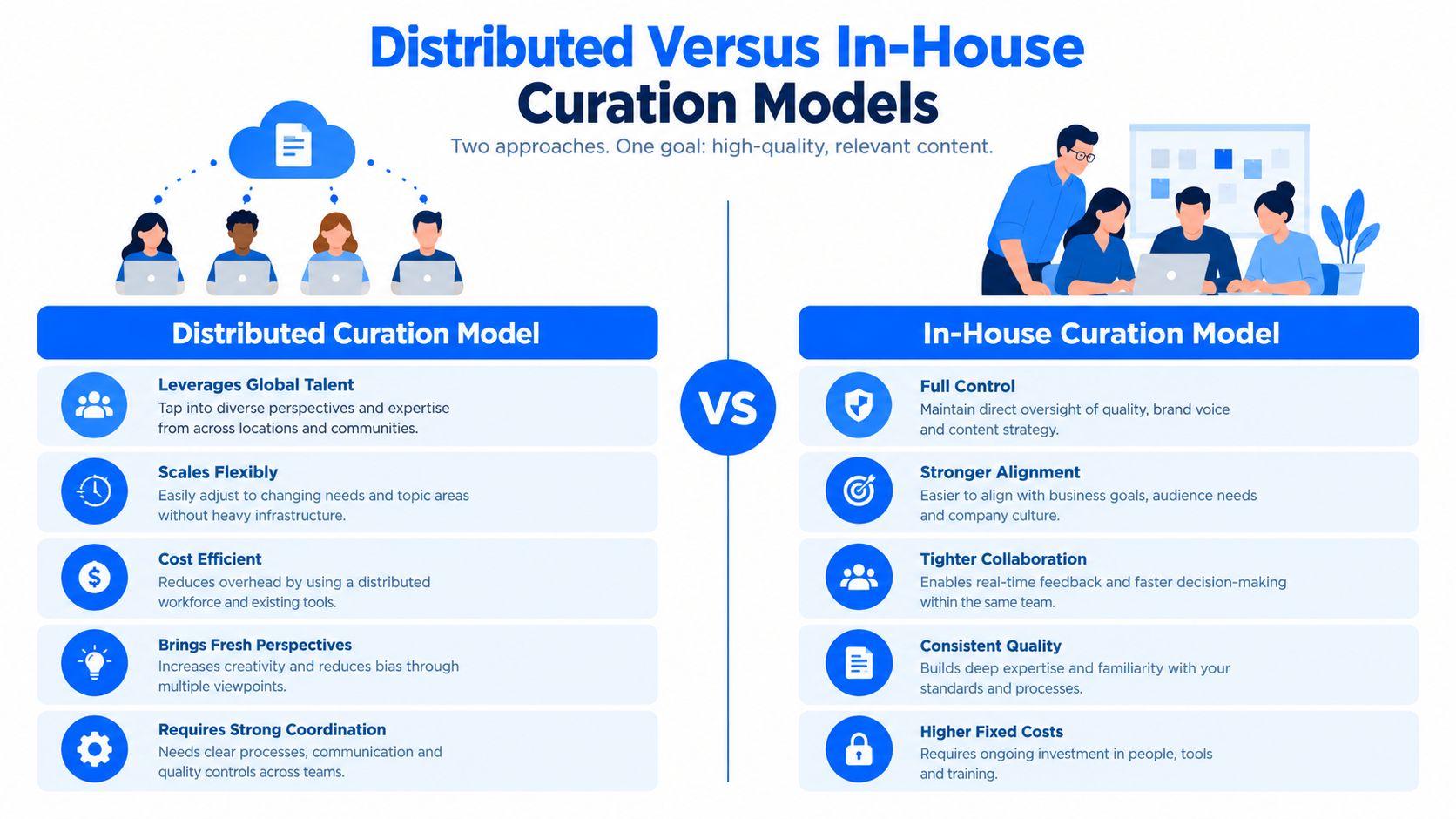
Distributed Versus In-House Curation Models
The choice between distributed and in-house curation isn't a simple choice between cheap and expensive. It's a decision about where an institution wants to hold fixed costs, where it accepts coordination costs, and how much control it needs over specialist work.
Decision factor | In-house model | Distributed network model |
|---|---|---|
Expertise coverage | Built and maintained by the institution | Accessed across member institutions |
Cost pattern | Higher fixed staffing commitment | Shared contribution with usage and coordination limits |
Local control | Direct authority over methods and priorities | Shared process shaped by network policies |
Rare disciplines | Difficult to keep expertise available | Specialist access can be requested when needed |
Operational dependencies | Primarily internal | Routing, availability, communication, and partner policies |
Consistency mechanism | Local standards and supervision | Shared workflow, training, documentation, and review |
An in-house model makes sense when a repository has sustained volume in a defined set of domains and needs immediate control over every decision. Internal curators know the repository's systems, escalation paths, access rules, and stakeholders. They can also build deep institutional memory instead of explaining local context to an external partner.
The weakness appears when the portfolio is broad but demand is uneven. Maintaining specialists across every discipline can leave the institution paying for coverage it rarely uses. Turnover can remove hard-won expertise, and a small internal team may lack a second reviewer for unfamiliar or complex formats.
The hidden price of distribution
A network reverses part of that cost structure. Members share access to specialist capability rather than replicating complete coverage. That can improve economics for occasional needs, but the institution pays in other ways:
Routing effort: Someone must classify the request and identify a suitable curator.
Context transfer: The submitting team must explain local metadata, policy, and repository constraints.
Policy alignment: Partners need agreement on what may be changed and how changes are recorded.
Quality verification: The originating institution needs confidence that the output meets its service standard.
Availability risk: A suitable expert may not be available when the queue grows.
For most mid-size repositories, a network can offer stronger access to rare expertise than a fully internal model. That conclusion isn't automatic. The right comparison uses actual workload categories, sensitivity constraints, expected service levels, and the internal effort required to coordinate distributed assignments.
A distributed model is efficient only when the coordination layer is designed as carefully as the curation layer.
Throughput Reality and Capacity Planning
A network's mission statement won't tell you whether it can absorb your next submission surge. Managers need a service model that answers practical questions: How much curator time does a typical assignment consume? How long does a dataset remain in the process? Which delays come from curation itself, and which come from missing information, system outages, or reviewer availability?
A study of DCN work found that each curation assignment took 2.4 hours on average, while datasets moved through the network in a median of three days. The study of DCN curation work also noted unpredictability caused by outages, turnaround constraints, and curator availability. The figures are useful planning inputs, but they aren't a guaranteed service-level agreement for every dataset.

Turning averages into an operating plan
Suppose your repository expects a mixture of routine and specialist submissions. The average assignment effort helps estimate curator demand, while the median transit time helps frame a normal delivery expectation. Neither measure tells you how a queue behaves during a surge. A few complex datasets, an unavailable specialist, or a repository outage can extend the tail of the process.
Capacity planning should separate at least four stages:
Intake capacity: How quickly can staff assess completeness and classify the request?
Assignment capacity: How quickly can the network find an appropriate curator?
Curation capacity: How much specialist time is available for the work itself?
Acceptance capacity: How quickly can the originating institution review the result and resolve open questions?
Track each stage independently. If the median completion time rises, you need to know whether curators are overloaded or whether submissions are waiting for provenance information. A single end-to-end number hides the bottleneck.
A scenario model, such as a Monte Carlo simulation approach, can help teams test different arrival patterns, availability assumptions, and queue rules without presenting a forecast as certainty. The decision value comes from identifying fragile assumptions, not from producing a deceptively precise date.
Governance Complexity and Trust Frameworks
A data curation network is a governance architecture as much as a staffing arrangement. The network must decide who can change a record, which policies apply, how curators handle conflicting instructions, and how the originating institution verifies the result.
Foundational DCN materials identify unresolved questions around routing datasets to the right expert, managing different institutional policies and infrastructure, creating consistency among curators, and communicating across a distributed network. These are not administrative details. They define whether a shared service can make reliable decisions at scale.
Independent repository research identifies related barriers, including limited technical capacity, insufficient disciplinary expertise, a lack of authority to make changes, and unclear or missing policy. The DataONE webinar material on DCN implementation provides context for these challenges and shows why expertise alone doesn't resolve governance gaps.
A practical trust framework
Trust should be implemented through explicit controls rather than assumed from membership. A repository should establish:
Routing rules: Define which attributes determine curator assignment and when a request must be escalated.
Authority boundaries: Record which institution can edit metadata, transform files, request changes, or approve release.
Policy mapping: Compare repository rules before work begins, especially for access restrictions, provenance, retention, and sensitive data.
Evidence requirements: Require an activity record that explains the decision, the change, and any unresolved limitation.
Review paths: Give the originating institution a clear way to challenge, reject, or request clarification on a curation result.
Sensitive-data controls: Limit distributed handling when confidentiality, regulation, contractual terms, or jurisdictional differences create unacceptable exposure.
The strongest design separates expertise from authority. A curator may be the best person to explain a file format without being authorized to publish a modified record. Another person may hold the release decision while relying on the curator's documented assessment.
International collaboration adds legal and privacy differences to the same operational problem. A network must know where data may be handled, what metadata may leave the originating environment, and which decisions require local approval. Teams exploring federated data governance should apply the same discipline to curation: keep responsibilities explicit, make evidence inspectable, and treat policy differences as design inputs rather than exceptions discovered after work starts.
Making the Decision to Join a Curation Network
A curation network earns consideration when specialist demand arrives in bursts, while the institution still carries steady intake, review, and governance work. Start with an operational audit. Map recent workloads by subject area, file type, sensitivity, and specialist effort. Mark datasets delayed by missing expertise, repeated clarification, or inconsistent decisions.
Then compare demand with available capacity. The DCN describes member access to a curator expertise pool for up to 200 hours per year. Estimate how much of that capacity your workload could consume, which queues it could reduce, and which responsibilities must remain internal. See The DCN membership overview for the stated membership benefit.
Use a staged evaluation
Inventory expertise gaps. List disciplines and formats handled poorly or through informal staff knowledge.
Measure queue behavior. Separate intake delay, assignment delay, review time, and unresolved questions.
Check governance readiness. Confirm that authority, provenance, access, and approval responsibilities are documented.
Classify sensitivity. Separate open collections from confidential, regulated, contractually restricted, or jurisdiction-sensitive data.
Define success criteria. Track activity records, clarification loops, assignment predictability, review effort, and decision consistency.
Run a bounded pilot. Include a specialist workload and a routine workload, then compare distributed handling with the current process.
Review the economics. Count coordination, policy mapping, training, quality review, and escalation time alongside curator hours.
Capacity planning deserves close attention. A nominal pool of hours does not guarantee immediate service. Specialist availability, queue shape, handoffs, and review capacity determine whether work moves at the required pace. Ask members which workload profiles fit the network, how unavailable specialists are handled, and which decisions stay local.
Use the pilot to set routing rules and exclusions. A successful result for selected datasets does not make distribution suitable for every collection. Define the internal role that will request work, review outputs, maintain policy context, and resolve exceptions.
A network fits when specialist demand is intermittent and the institution can participate in shared governance. In-house capacity may suit high-volume domains, sensitive collections, or workflows requiring immediate local authority.
digna provides in-database validation, anomaly detection, timeliness monitoring, and schema tracking in a customer-controlled environment. Visit digna to review its modular observability platform alongside a distributed curation model.
Whichever model you choose, the originating repository still owns the final quality promise to its users, which is where automated data quality management inside your own environment earns its place.
Frequently asked questions
What is a data curation network?
A data curation network is a group of institutions that share specialist curators, so a dataset submitted at one member can be reviewed by an expert at another. The Data Curation Network (DCN), based at the University of Minnesota, uses this model to make research data more ethical, reusable and understandable.
How many curation hours does a DCN membership include?
Membership gives access to a curator expertise pool for up to 200 hours per year, plus support for up to two attendees at the annual All Hands Meeting and curator training. Those hours are a defined benefit, not unlimited labor, so a repository still needs an intake policy and a way to prioritize requests.
How long does curation take in the Data Curation Network?
On average, a single curation assignment takes 2.4 hours, and datasets move through the network in a median of three days, according to a study of DCN work. Treat these as planning inputs rather than a service-level agreement, since outages, turnaround constraints and curator availability can stretch the tail.
What steps does the CURATED workflow include?
Curators following CURATED request missing information or provenance, augment metadata for findability, transform file formats for reuse, evaluate FAIRness, and document every curation activity. That last step matters most for trust: each intervention becomes part of an auditable record, so the originating repository can explain what changed and why.
Should a repository join a curation network or curate in-house?
It depends on the shape of demand. A network fits when specialist needs arrive in bursts across many disciplines and the institution can take part in shared governance. In-house curation suits high-volume domains, sensitive collections, or workflows that need immediate local authority. Run a bounded pilot before deciding.