Class of Data Explained: A Practical Guide for Modern Teams
|
7
min read

The popular advice is to classify data once, attach labels such as public or confidential, and consider the governance problem solved. That approach confuses description with control. A label that doesn't alter access, validation, retention, monitoring, or incident response is documentation, not governance.
A useful class of data framework must describe what an asset contains, how it behaves, and what the organization must do when its risk changes. That means combining analytical type, statistical meaning, representation, business context, and security impact. The difficult work begins after the taxonomy is published, because teams must connect each class to controls that operate in real databases, pipelines, warehouses, lakes, and document repositories.
Table of Contents
The Hidden Risk of Static Data Labels
Many classification programs fail without raising an alarm: a governance team creates a policy, owners tag important datasets, and auditors receive a catalog export while permissions remain unchanged. Monitoring still treats every table alike, and incident responders lack a dependable signal when an ordinary operational dataset becomes a higher-risk asset.
Categories such as public, internal, confidential, and regulated still provide useful shared vocabulary. The failure begins when teams assume that vocabulary enforces anything by itself. A static label does not mask a field, shorten retention, increase validation frequency, or escalate an alert.
The gap between classification and enforcement
The evidence points to a measurable operational gap. 55% of surveyed organizations had not achieved automated classification across all major systems, and only 47% had classification that enforced downstream controls rather than only applying labels, according to the Kiteworks 2026 Data Security and Compliance Risk Report.
Those figures separate two outcomes that teams often combine. Classification accuracy asks whether the assigned class is correct. Classification effectiveness asks whether that class changes behavior in the systems that store, process, monitor, and protect the data.
A team may correctly identify a customer table as confidential while leaving broad analyst access in place. It may label a regulatory report as high integrity, then permit an unreviewed schema change to alter its inputs. It may classify a pipeline as high availability while monitoring only whether a job completed, not whether the expected data arrived on time.
Practical rule: Treat every class as a trigger for a control decision. If no control changes, question whether the class has operational value.
Why adding categories rarely fixes the problem
Weak enforcement often leads teams to expand the taxonomy. They add labels for personal data, financial data, critical data, restricted data, AI-approved data, archival data, and local exceptions. The result looks precise, yet owners and tooling face more ambiguity about which label governs and what action follows.
A smaller set of dependable classes connected to explicit actions usually performs better. Each class should answer practical questions:
Who can access the asset? Define the access posture and permitted exceptions.
What must be validated? Specify field, record, reconciliation, or business-rule checks.
How quickly must failures surface? Set alert severity and response expectations.
How should changes be evidenced? Preserve lineage, audit events, and ownership.
What happens when context changes? Trigger review instead of allowing the old label to persist indefinitely.
The class of data earns its value when an automated process can detect a mismatch between the label and current behavior. A schema change, unexpected delivery pattern, new downstream use, or altered business meaning may require reclassification.
Without that feedback loop, the taxonomy becomes stale while stakeholders continue to trust it. Governance then produces a catalog that describes yesterday's risk, even as permissions, pipelines, and business uses have changed. Classification must therefore connect to monitoring and response, or its labels become liabilities rather than safeguards.
Understanding the Three Dimensions of Data Classes
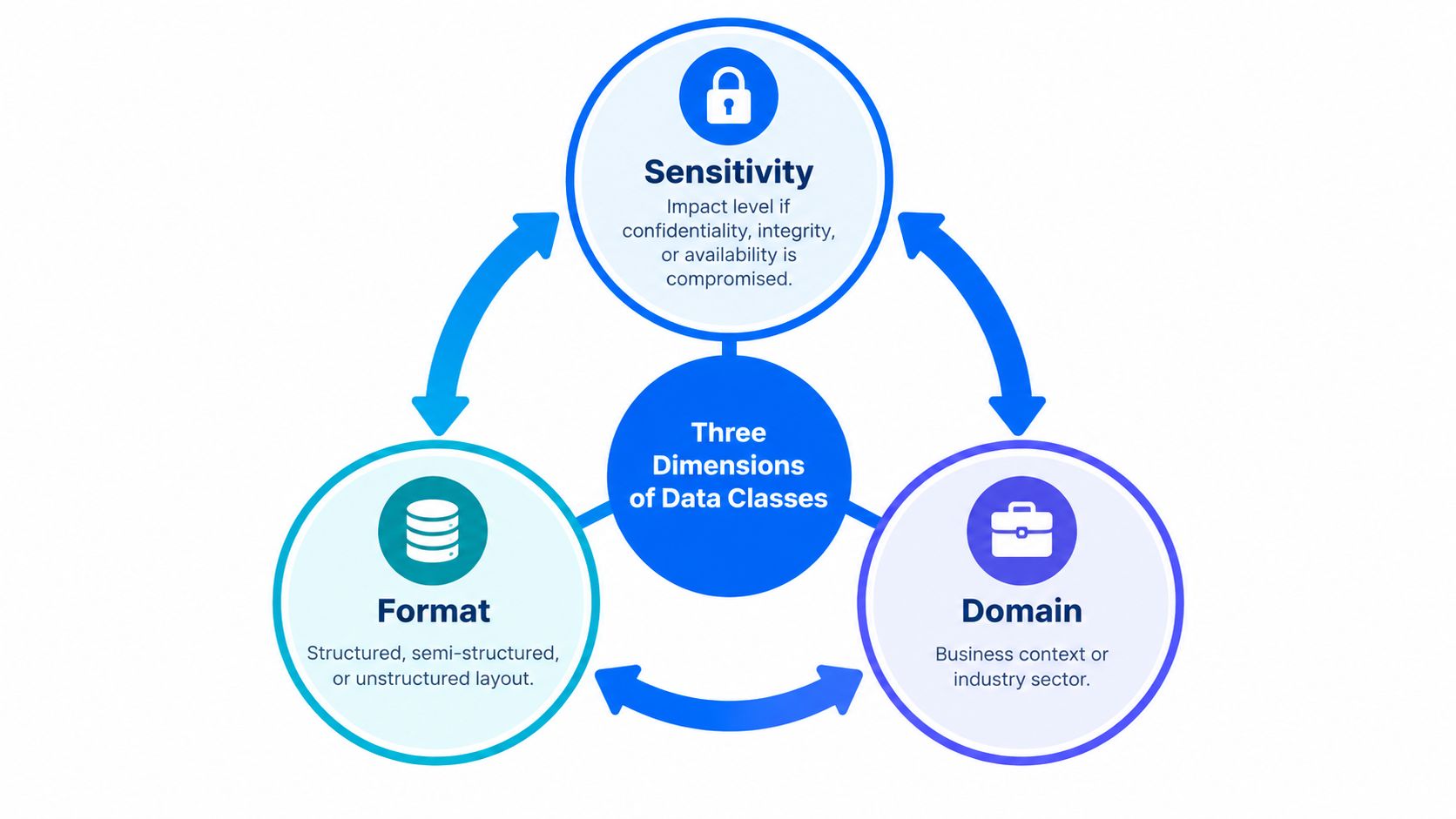
A reliable classification system needs more than a sensitivity ladder. It should evaluate sensitivity, format, and domain together, because each dimension changes the meaning of the others.
Sensitivity describes the consequence of compromise. Format describes how the asset is represented and what can be tested. Domain supplies business context, ownership, and regulatory expectations. A dataset's class should emerge from their interaction, not from one label selected in isolation.
Sensitivity changes the consequence
Security classification evaluates each information type independently across confidentiality, integrity, and availability. A class can be low on one dimension and high on another. A public KPI feed may contain no confidential information, yet incorrect values could drive regulatory or operational decisions, giving integrity a high consequence.
That distinction prevents a common error, treating “public” as synonymous with “low risk.” Public data may still require strong change control, reconciliation, lineage, or freshness monitoring. Conversely, private data may not need identical controls across every dimension.
Format changes the test
A relational table supports checks for columns, data types, uniqueness, relationships, and record-level rules. A JSON event stream requires attention to nested paths, optional attributes, payload variants, and parser failures. A document repository may need extraction status, metadata checks, and confirmation that stored files remain usable.
The representation determines which failures are visible. A generic missing-value test might pass even when a nested JSON attribute has disappeared or a document ingestion job stores files without extractable content.
Domain changes the decision
The same field can require different controls in different contexts. A timestamp in a healthcare workflow may govern clinical timeliness. The same type of field in a public reporting feed may support publication schedules and accountability. Finance, telecommunications, healthcare, and public-sector teams each attach different consequences to delay, alteration, and incomplete records.
A practical model therefore records the asset's business owner, use case, criticality, format, and CIA impact. Teams looking for a deeper treatment of how quality dimensions influence these decisions can use this guide to understand the dimensions of data quality.
The result is a class that tells engineers not only what data is, but how they should monitor it.
Applying the CIA Triad to Data Classification
Security-oriented classification should evaluate each information type independently across confidentiality, integrity, and availability, assigning an impact level based on the harm caused by losing each objective. This principle is documented in enterprise data classification guidance from the Organization of American States.
The practical mistake is collapsing the three dimensions into one sensitivity score. A single score hides the reason a dataset matters and makes it harder to select the right control. The high-watermark principle addresses that problem: the most consequential CIA dimension determines the overall protection requirement.
Confidentiality requires exposure controls
Confidential data creates harm when unauthorized people can view, copy, or infer it. Customer records, health information, employee information, and commercially sensitive material need controls such as restricted access, masking, encryption, and exposure monitoring.
Classification should identify the information type and the permitted use, not merely the table name. A table called customer_summary may contain aggregated values in one environment and directly identifying records in another. The control must follow the actual content and context.
Integrity requires evidence of correctness
Integrity concerns unauthorized or incorrect alteration. Financial records, regulatory figures, and decision-making metrics can be publicly visible yet still demand rigorous protection against silent changes.
That leads to a different control set:
Record validation: Test values against business rules and permitted relationships.
Reconciliation: Compare related totals or source and destination results.
Lineage: Preserve the path from source records to published metrics.
Tamper evidence: Record changes and make unexplained alterations visible.
A public data feed can therefore receive a high integrity impact while remaining low in confidentiality. The class should communicate that distinction to data engineers and incident responders.
Availability requires delivery awareness
Availability is about access at the time users and systems need the data. Operational datasets, feeds, and platform dependencies may fail through delayed delivery, missing loads, or outages even when their content remains accurate and confidentially protected.
Monitoring should therefore track freshness, delivery latency, expected arrival patterns, and missing-load conditions. A completed pipeline task isn't proof that usable data arrived. The control needs to observe the data event that downstream consumers actually depend on.
A CIA-based class should map directly to alert severity, validation frequency, retention, and incident-response targets. It should also remain reviewable. Business use changes, dependencies expand, and schemas evolve. Classification that can't absorb those changes becomes an outdated assumption rather than a reliable security signal.
Structuring Classification by Data Format
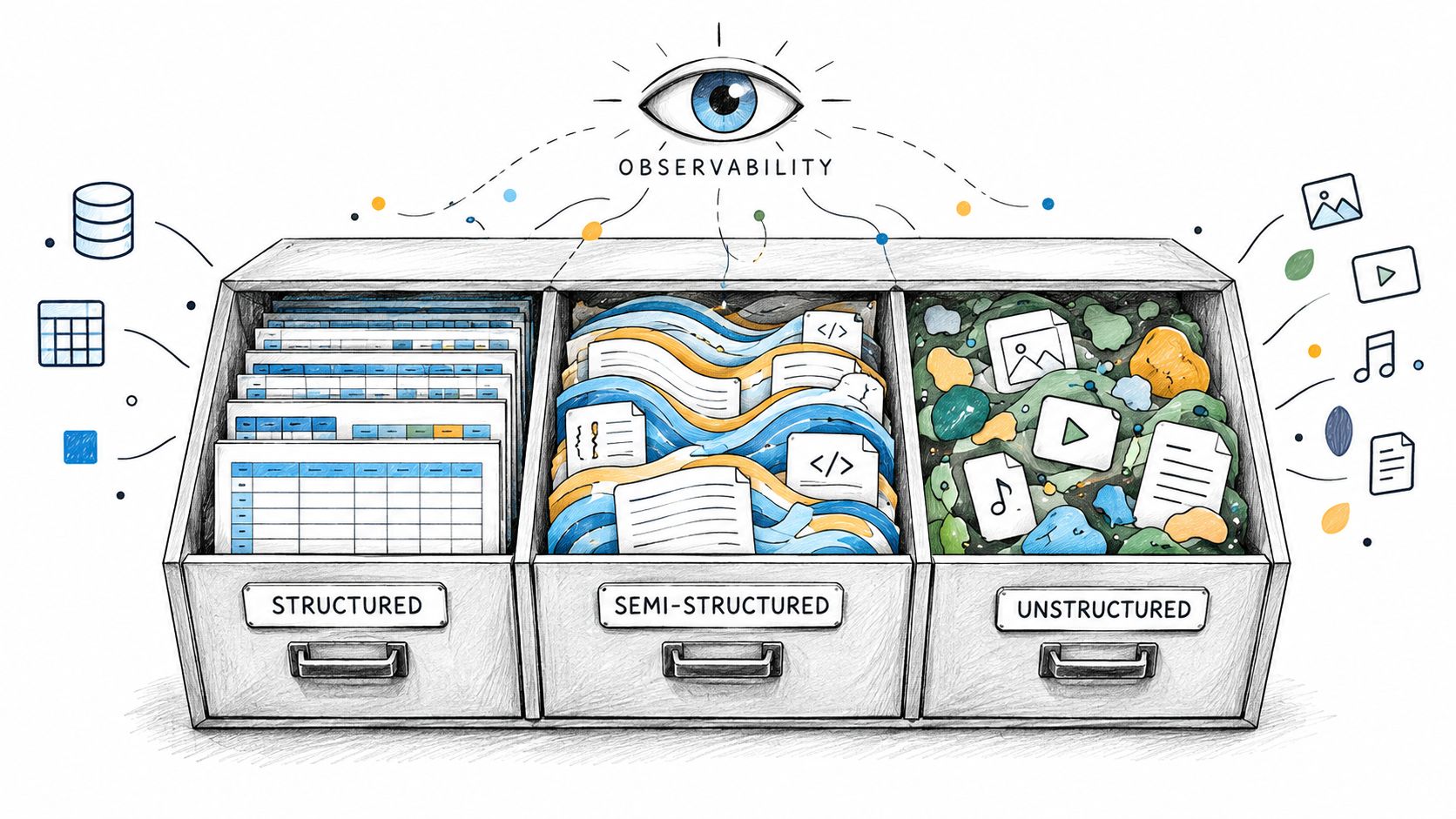
The first structural question isn't whether a dataset is sensitive. It's how the data is represented. Structured, semi-structured, and unstructured assets expose different failure modes, so they need different observability controls. The European Commission identifies quality, structure, interoperability, authenticity, and integrity as important conditions for extracting value from data, especially in AI settings, as summarized in its data governance and data policies document.
Structured assets
Structured tables follow a defined model. That makes them suitable for targeted checks:
Schema conformance: Detect missing, added, or renamed columns.
Type validation: Confirm that values match the analytical expectation.
Uniqueness: Identify duplicate keys or unexpected repetition.
Referential integrity: Verify relationships across tables.
Business rules: Test record-level conditions and permitted combinations.
Storage type still isn't the same as analytical meaning. A numeric field may encode a category, such as a status code, rather than represent a measurable quantity. Statistical data is commonly divided into categorical and quantitative classes, and that distinction determines whether teams should use frequency counts and unexpected-value detection or distributions, averages, percentiles, variance, and outlier analysis. The OECD glossary of statistical terms documents this difference.
Semi-structured payloads
JSON events and similar payloads may have a recognizable shape without a consistently enforced schema. Monitoring should inspect nested-field presence, variant structures, parser errors, array changes, and semantic drift.
A null-rate check can miss a failure where a producer moves a value to a different path or changes its meaning while keeping the field populated. Teams working with columnar storage should also understand the Parquet file format, including how its structure affects downstream validation and schema tracking.
Unstructured documents and media
Documents, images, and other media require a different control model. A successful file upload doesn't prove that extraction worked, metadata is complete, or downstream processing can interpret the content.
Track ingestion status, extraction completeness, metadata validity, and content-processing outcomes. Classifying the asset as unstructured should automatically select these checks rather than applying relational assumptions.
The most effective catalogs record representation, schema strictness, ownership, expected refresh behavior, and downstream criticality. Format is not a descriptive footnote. It determines which signals can prove that the asset remains usable.
Connecting Classification to Executable Controls
Once classes are assigned, the question is what each class makes a system do. The table maps four common classes to a primary control and the evidence that proves the control fired.
Compare the operating choices
Data Class | Primary Control | Monitoring Metric |
|---|---|---|
Confidential customer data | Access restriction, masking, and exposure review | Unauthorized access, masking status, and sensitive-field exposure |
High-integrity financial data | Record validation, reconciliation, lineage, and tamper evidence | Rule failures, reconciliation differences, and structural changes |
High-availability operational data | Freshness, delivery, and outage detection | Arrival time, missing loads, latency, and availability |
Public but decision-critical metrics | Publication governance and integrity validation | Value drift, source reconciliation, and unexplained changes |
Each row connects a label to an operational response. Owners do not have to interpret “critical” differently across systems. They can identify the required control, assign responsibility, and inspect the evidence produced when that control succeeds or fails.
A class has value only when its policy reaches the systems that enforce it. Catalog metadata may need to drive access restrictions, masking, retention, monitoring, incident routing, or publication review. If those destinations are disconnected, the label remains descriptive and can create false confidence.
Map classes across the estate
Start with high-impact assets rather than every object in the organization. Assign the multidimensional class, identify the owner, define the control destination, and verify that the classification reaches each relevant system. Check that each system records evidence, such as a validation result, access event, reconciliation outcome, or alert, when the control runs.
The data validation rules and continuous data quality guidance helps translate classes into record-level checks, business rules, and recurring quality controls. The practical choice is to define checks that correspond to the risk, not to attach a generic quality score to every asset.
Ownership must include reclassification. A dataset may gain a new consumer, change schema, move between domains, or enter a regulated workflow. Each event should trigger a review of the class and an update to downstream policies.
Test the chain regularly. A classification that updates a catalog but does not change monitoring, access, or workflow behavior is not governance. It is an unverified intention.
Embedding Observability Within Infrastructure
Classification becomes enforceable when monitoring runs close to the data and can act on the same context that defined the class. Moving production records into an external analysis service may create unnecessary exposure, complicate residency requirements, and separate governance decisions from operational evidence.
An embedded architecture keeps analysis inside customer-controlled infrastructure. That matters for organizations with strict security, compliance, or residency requirements, including teams operating on premises or in private cloud environments.

Keep controls near the source
In-database execution lets teams calculate metrics and run validation without extracting production data into a separate vendor-hosted environment. It also makes it easier to connect a class with the signals that matter:
Schema behavior: Detect added, removed, or changed fields.
Record behavior: Apply business-rule checks to individual records.
Timeliness: Identify delays, missing loads, and unexpected arrival patterns.
Business metrics: Monitor the behavior of critical measures.
Platform health: Observe workload, availability, and operational changes.
This is the architectural role described for digna's data observability platform, which is designed to operate inside an organization's own environment. The digna documentation describes an AI-driven data quality and observability platform that supports on-premises and private-cloud deployment, keeps monitoring inside customer-controlled infrastructure, and reduces the need to extract production data into an external service.
Use learned behavior where thresholds become brittle
Manual thresholds are useful for hard business limits, but they become difficult to maintain when every dataset has different volatility, seasonality, delivery timing, or operational behavior. An AI-driven baseline can learn normal behavior for each dataset and identify unexpected changes without requiring teams to configure a threshold for every metric.
Historical analysis adds the missing context. Engineers can examine trends, volatility, and statistical patterns to distinguish a one-time deviation from a developing issue. That distinction supports better incident triage and prevents teams from treating every alert as an isolated failure.
The important design choice is not “AI versus rules.” Reliable governance uses deterministic validation for explicit requirements and behavioral detection for patterns that are difficult to encode manually. The class determines which combination is appropriate, while the infrastructure determines whether the evidence remains secure, timely, and usable.
Building an Operational Classification Framework
A practical framework starts with a bounded inventory of critical assets. Select the datasets that support important reporting, regulatory work, customer operations, clinical processes, telecommunications services, or public-sector decisions. Don't begin by attempting to classify every file and table with equal precision.
Assign each selected asset a multidimensional record:
Describe the sensitivity: Record confidentiality, integrity, and availability impact separately.
Describe the format: Identify structured, semi-structured, or unstructured representation and its schema behavior.
Describe the domain: Capture business owner, purpose, regulatory context, and downstream dependencies.
Assign the controls: Map the class to access, validation, freshness, schema, retention, and response requirements.
Verify execution: Confirm that monitoring and policy systems applied the expected controls.
Review changes: Reassess the class when behavior, schema, ownership, or business use changes.
The classification record should be useful to both governance and engineering teams. A security owner needs to know the consequence of exposure. A data engineer needs to know which tests must run. An incident responder needs to know how quickly the issue should escalate and what evidence to collect.
A class is current only when its controls still match the way people use the data.
This operating model also supports data sovereignty decisions. Teams evaluating residency and governance requirements may find meeting data regulations with Stoa useful when considering how legal obligations, infrastructure location, and data handling practices interact.
Review classification against observed behavior rather than relying on annual paperwork. A dataset can remain confidential while its integrity requirements increase after it becomes a regulatory input. A structured table can acquire semi-structured payloads through a new ingestion path. A low-availability feed can become operationally critical after a business process starts depending on it.
The data governance implementation guidance from digna can help teams connect ownership, quality controls, monitoring, and governance workflows. The goal isn't the largest taxonomy. It's a set of classes that consistently changes what systems measure, protect, retain, and escalate.
digna helps teams turn a class of data into executable controls through in-database validation, schema tracking, timeliness monitoring, business monitoring, and AI-driven anomaly detection inside private-cloud or on-premises environments. Visit digna to see how your team can monitor critical data without moving production records into an external service.
Classification also decides where data may be stored and processed. Our guide to data residency requirements explains how location rules interact with the classes you assign and the controls they trigger.
Frequently asked questions
What is a class of data?
A class of data is the category an asset belongs to based on its sensitivity, format and business domain. A useful class does more than describe the data: it decides which access, validation, retention and monitoring controls apply, so a label that changes nothing downstream is documentation rather than governance.
What are the three dimensions of data classification?
Sensitivity, format and domain. Sensitivity describes the consequence if the data is compromised, format describes how it is represented and therefore what can be tested, and domain supplies business context, ownership and regulatory expectations. Evaluating all three together gives a more reliable class than a single sensitivity ladder.
How does the CIA triad apply to data classification?
Each information type is rated separately for confidentiality, integrity and availability, based on the harm caused by losing each. A public KPI feed may need no confidentiality controls yet still demand strong integrity checks, because incorrect values could drive regulatory or operational decisions. Collapsing the three into one score hides that.
Why do data classification programs fail?
Most fail quietly because labels never change controls. Owners tag datasets and auditors get a catalog export, but permissions and monitoring stay the same. A cited 2026 report found only 47% of organizations had classification that enforced downstream controls, and adding more categories usually adds ambiguity instead of fixing enforcement.
How should structured and unstructured data be monitored differently?
Structured tables suit schema, type, uniqueness, referential-integrity and business-rule checks. Semi-structured JSON needs nested-path, variant and parser-error monitoring, because values can move without becoming null. Unstructured documents and media need ingestion, extraction-completeness and metadata checks, since a successful upload doesn't prove the content is usable.