What Is Backfilling: Data Engineering Guide for 2026
|
8
min read

You usually meet backfilling when something already went wrong.
A dashboard that was stable yesterday now shows a hole in last month's revenue. A feature store starts feeding strange values into a model. A stakeholder asks why a historical trend changed after a “small schema update.” You trace the issue backward and find the same pattern data didn't just fail in the present, it went bad in the past. That's when the repair job stops being a normal rerun and becomes a backfill.
For most data teams, backfilling sits in the uncomfortable category of work that's both routine and dangerous. It fixes real business problems, but it also stresses pipelines, compute, validation workflows, and everyone's patience. The part many guides miss is this. Frequent backfills usually point to a deeper visibility problem. If your team only discovers bad data after reports break, you're not just dealing with a rerun problem. You're dealing with an observability gap.
Table of Contents
The Inevitable Data Rerun
The familiar version starts with a fire drill. A finance report is wrong, and the wrongness isn't subtle. An analyst sees stale values in a dimension table. An ML engineer notices bizarre predictions because historical features shifted. Nobody trusts the outputs, and the first question becomes brutal and practical: how far back is the damage?
At that point, streaming the next clean record won't help. You have to go back and repair history. That's what makes backfilling different from ordinary processing. It's a controlled rerun over prior data, usually under pressure, with downstream trust already damaged.
Seattle Data Guy's write-up on backfills as a necessary evil captures the reality well: backfills are considered a “necessary evil” because systems change, people make mistakes, and pipelines don't stay perfect for long. That framing matters. Teams waste time pretending backfills are rare exceptions when they're really part of operating any serious data platform.
Why this work feels painful
Backfills hurt for reasons every mid-level data engineer learns the hard way:
Historical scope expands fast. A bug that looked local often touched more partitions, more consumers, and more assumptions than anyone expected.
Business pressure rises immediately. Once trust drops, stakeholders want the fix now, even if the safe version takes longer.
The rerun competes with production work. You're fixing history on the same systems that still need to serve today's pipelines.
Backfills aren't just data repair jobs. They're operational events.
The useful mindset is to treat backfilling as both a recovery skill and a design smell. You need to know how to execute it safely. You also need to ask why the issue wasn't detected before corrupted or missing data made it into downstream tables.
What Is Backfilling in Data Engineering
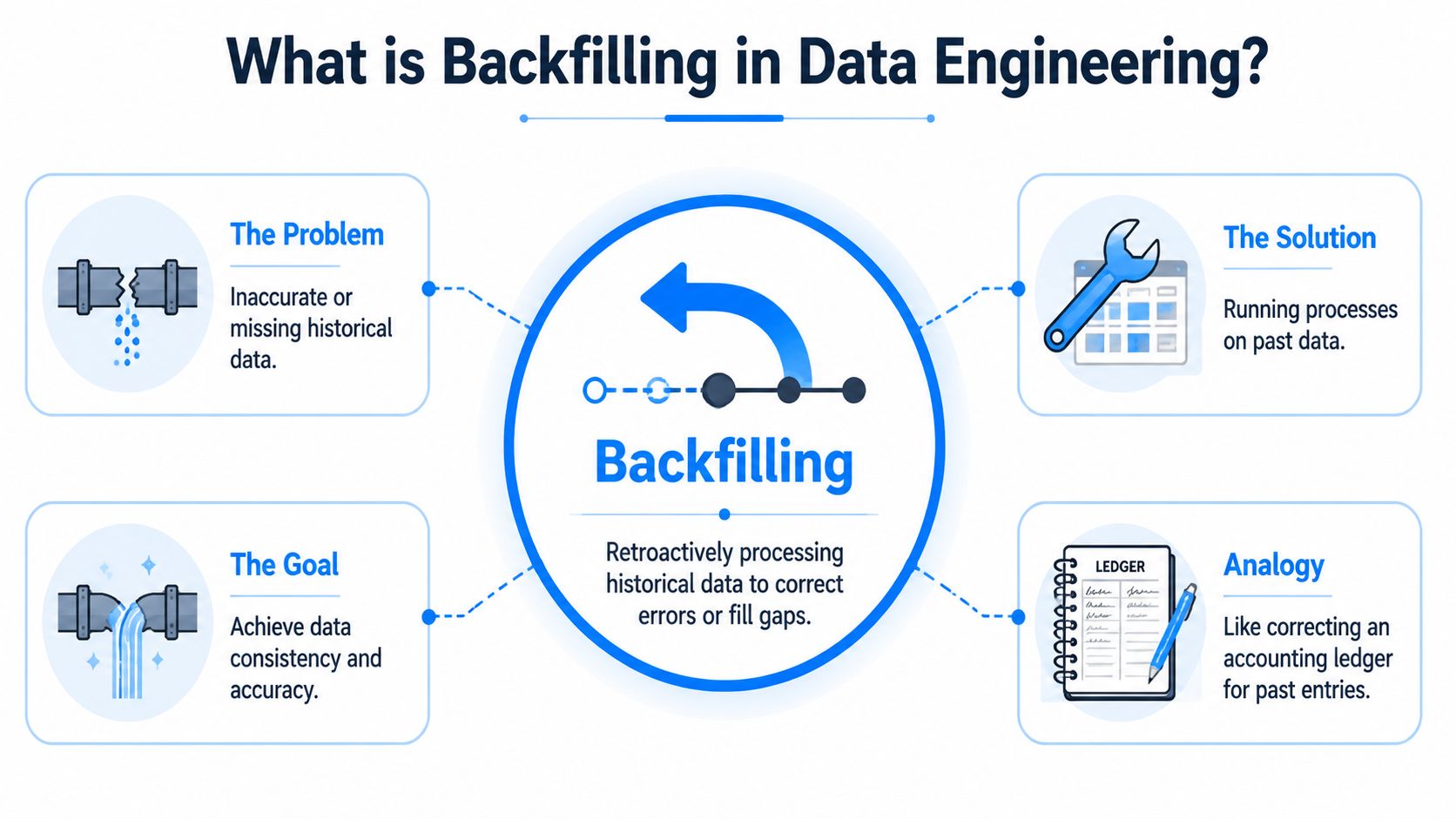
Backfilling is easiest to understand if you think like an accountant fixing an old ledger. You discover that prior entries were incomplete or wrong, so you don't just correct today's line item. You go back through the affected period, rebuild the missing or incorrect values, and update the historical record so the full timeline makes sense again.
A practical definition
In data engineering, backfilling means retroactively populating historical data or correcting incomplete datasets so your tables remain complete and analytically usable. A concrete example appears in this technical explanation of backfilling: if you add a new column such as customer_ltv to a table with 10,000 existing rows, those rows won't have values until you derive or load them and write them back into history.
That example matters because it shows that what is backfilling isn't limited to outage recovery. Sometimes nothing “broke” in the operational sense. You evolved the schema, and now historical records need to catch up so analysts, models, and BI tools can use the new field consistently.
This comes up often in teams that are modernizing legacy software. When legacy applications move into a more modern data stack, old records often lack fields, structure, or semantics that new platforms expect. Backfilling becomes the bridge between what the system used to store and what the business now needs.
What usually triggers a backfill
The trigger is usually one of a few recurring patterns:
Pipeline downtime: A job failed or a source system stopped delivering data for a period.
Transformation bugs: Logic ran successfully but produced bad values.
Schema changes: New fields or changed types left older records incomplete.
Delayed arrivals: The source system eventually sent the data, but too late for the normal processing window.
Targeted business corrections: A narrow subset of data, such as a partner-specific slice over a defined date range, needs to be rerun.
Practical rule: If the defect lives in history, the fix usually has to live in history too.
The main mistake I see is treating backfills as simple replay operations. They aren't. Historical data often depends on code versions, upstream contracts, partition logic, and assumptions that changed since the original load. A safe backfill is less like pressing rerun and more like reconstructing a past state with today's tooling.
Key Backfilling Strategies and Trade-Offs
Not every backfill should use the same playbook. Engineers usually choose among three patterns, and each one optimizes for a different balance of speed, risk, and operational burden.
Full reprocessing
This is the blunt instrument. You rebuild the full target from source or trusted intermediates and replace the old output with the new one.
Use it when your transformation logic changed broadly, when you no longer trust the current table, or when selective repair is riskier than starting over. The advantage is conceptual simplicity. You get one coherent rebuild under one code path.
The downside is obvious. It's expensive, slow, and often disruptive. Large systems may spend a long time rerunning broad historical ranges, and every dependency under that target has to be considered too.
Incremental backfilling
This method should be preferred by default. Instead of rebuilding everything, you split the repair by time partition, event range, tenant, or another reliable boundary and process only the affected slices.
This approach works well when the problem window is known. It reduces resource pressure, lowers blast radius, and gives you checkpoints. If one partition fails, you don't lose the entire operation.
A lot of mature ingestion setups are designed around this assumption. If your ingestion layer can isolate windows cleanly, a targeted rerun becomes operationally realistic. That's one reason teams invest in tools and architectures centered on data ingestion software for controlled pipeline design.
Data patching
This is the surgical option. You identify specific records or a narrow condition and update only those rows.
It's useful for small, well-understood defects. For example, a subset tied to a partner ID, a misapplied mapping, or a derived field that can be recalculated without touching the rest of the table. The benefit is low cost and fast execution.
The risk is hidden complexity. Small fixes can leave historical inconsistencies if you miss dependent datasets, derived aggregates, or downstream materializations. Patching works only when lineage and scope are clear.
Backfilling strategies compared
Strategy | Best For | Pros | Cons |
|---|---|---|---|
Full reprocessing | Broad logic changes, low trust in existing table | Simple mental model, consistent rebuild | High compute cost, long runtime, larger operational risk |
Incremental backfilling | Known date windows, partitioned data, scoped incidents | Lower blast radius, easier retries, better production safety | Requires good partitioning and dependency awareness |
Data patching | Small targeted defects, isolated record sets | Fastest and cheapest when scope is precise | Easy to miss related tables or downstream effects |
What works in practice
Here's the operational reality.
Choose full reprocessing when selectivity would create more risk than it removes.
Choose incremental backfilling when you can define exact windows and dependencies.
Choose patching only when you can prove the issue is strictly narrow.
The best backfill strategy is the one that limits uncertainty, not the one that sounds most efficient on paper.
What doesn't work is improvising halfway through. Teams often begin with a “quick patch,” discover wider impact, then pivot into a messy partial rebuild. Decide your trust boundary up front. If you can't describe exactly what was affected and which downstream datasets depend on it, you're not ready to run anything yet.
A Framework for Safe Backfill Implementation
A backfill usually starts under pressure. A stakeholder spots bad history, dashboards are off, and the instinct is to rerun fast. That is exactly how teams turn a contained repair into a larger incident. Safe backfills come from control. Control of scope, control of blast radius, and control of what changes become visible.

The practical framework is simple: scope the repair, build it in isolation, run it with operational guardrails, then release it with a controlled swap. The hard part is discipline. Backfilling is a necessary evil, and repeated backfills usually point to a second problem. Weak observability let the defect sit long enough to spread.
Phase one is isolation and scoping
Start with the failure boundary, not the rerun script.
Identify the broken table or model, the affected time range, the code or source change that caused it, and every downstream dependency that will inherit corrected history. If any of that is fuzzy, the team is still diagnosing. It is not ready to backfill.
I push teams to parameterize scope from the start. Date ranges, tenant IDs, replay limits, source system filters, and write targets should be runtime inputs. Hardcoded edits create one-off jobs that are hard to retry and harder to audit later.
This phase is also where observability should have helped earlier. If lineage, freshness, volume shifts, and schema drift were already visible, the repair window would often be smaller. Many backfills are not caused by complex failures. They are caused by late detection.
Phase two is development and testing
Build the correction path away from production readers. The pattern described in lakeFS's guide to backfilling data safely is still the recommended practice: rerun in isolation, rebuild dependent datasets in that same isolated path, then publish once the corrected state is proven.
That matters because base tables are rarely the whole problem. A corrected fact table does not help much if derived marts, aggregates, and feature tables still reflect the old logic. I have seen teams declare a backfill complete while half the platform was still serving stale history.
A clean isolated build also makes review easier. Engineers can inspect outputs, compare old and new partitions, and decide whether the issue was narrow enough for the chosen approach.
Phase three is execution and monitoring
Run in controlled batches and treat the backfill like a production workload. Batch size should reflect warehouse capacity, partition design, concurrency limits, and downstream sensitivity. The point is not speed alone. The point is finishing without starving normal jobs or corrupting partial state.
Monitor three things continuously:
Infrastructure pressure: warehouse usage, memory, queue depth, task failures, and query contention
Backfill progress: completed partitions, skipped windows, retries, and idempotency behavior
Data health: unexpected nulls, duplicate growth, key mismatches, and metric drift during the run
Good monitoring changes the operating model. Instead of discovering a bad rerun at the end, the team can stop early, fix the issue, and resume from a known checkpoint. That is one reason modern observability reduces backfill pain even when it cannot prevent the backfill itself.
For teams that need a release checklist, the safest operating pattern aligns well with data validation practices for migrations and backfills: test the repaired dataset in isolation, update dependencies before release, and expose changes in one controlled action.
Phase four is validation and swapping
Release design decides whether users see a clean correction or a half-rewritten history.
Build the corrected version beside the current production object. Keep the original as a backup. Then perform an atomic swap once the repaired version is ready. Earlier guidance in this article already covered that table replacement pattern, and it remains the safest option when concurrent readers cannot tolerate mixed states.
Build beside production. Validate beside production. Expose once.
That approach holds up under pressure because it separates compute from release. Analysts, dashboards, and downstream services stay on the known-good version until the corrected history is ready. No partial partitions. No mid-run confusion. No guessing which users saw which version.
Testing and Validating Your Backfilled Data
A backfill isn't done when the job finishes. It's done when you can prove the corrected history is trustworthy.
That sounds obvious, but teams still lean too hard on row counts. Matching counts can hide broken joins, duplicate inserts, null explosions, shifted timestamps, and logic regressions. Good validation checks the shape, semantics, and downstream consistency of the repaired data.

Validation that catches real failures
The strongest baseline remains the industry pattern described in these migration and backfill validation practices: test the backfill in isolation, update all dependent datasets, then expose the changes in one atomic action. That sequence matters because validation at only one layer can give false confidence.
I usually separate validation into three levels.
Structural checks: Confirm required columns are populated, keys still behave as expected, and record relationships remain intact.
Behavioral checks: Compare key metrics before and after the repair. If distributions, seasonality, or category breakdowns changed sharply, investigate before release.
Record-level checks: Pull a sample and compare it against a trusted upstream source or business system.
A practical checklist before release
Use a checklist that forces more than one kind of evidence:
Null and completeness review: Check whether new or corrected columns contain unexpected gaps, especially where downstream consumers assume non-null values.
Duplicate detection: Verify that retries or append logic didn't create extra records in the repaired window.
Boundary tests: Inspect the first and last records in the backfill range. Off-by-one date errors show up here more often than anywhere else.
Dependency consistency: Reconcile downstream marts, materialized views, and feature tables against the corrected base.
Spot checks with business meaning: Pick records a stakeholder would care about and confirm them manually.
If a backfill changes history, validation has to answer a business question, not just a technical one.
One more point matters. Validation should be scripted wherever possible. Manual review is useful, but repeatable checks are what make retries safe and post-incident learning durable.
The Role of Modern Data Observability
Backfills are often discussed as if they begin with repair. In practice, they begin much earlier, at the moment a data issue goes unnoticed.

A schema drifts. A source starts arriving late. A transformation still runs but produces values outside the expected range. No alert fires, nobody sees the anomaly, and the defect continues flowing into downstream assets. By the time an analyst catches it in a dashboard, the repair window is now historical. That's how an observability problem turns into a backfill problem.
Why backfills often start as visibility failures
This is the missing perspective in many “what is backfilling” articles. They explain how to rerun data, but they rarely ask why the corruption reached production history in the first place.
Modern observability platforms attack that earlier failure point. They monitor freshness, schema changes, metric drift, and record-level quality before consumers absorb the damage. That matters because prevention is operationally cheaper than reconstruction.
The shift is measurable. Monte Carlo's anomaly detection write-up notes that 65% of enterprises adopting AI-powered anomaly detection reported a 50% reduction in backfill incidents. That doesn't mean backfills disappear. It means many of the painful ones never become necessary.
What observability should detect early
The strongest observability setups combine classical checks with adaptive detection.
Statistical techniques such as Z-Score and IQR help identify outliers and distribution shifts in data quality monitoring, as explained in Monte Carlo's overview of anomaly detection methods. On top of that, machine learning methods such as Isolation Forests and autoencoders can learn seasonality and trend patterns, then adjust thresholds dynamically, as described in digna's overview of AI anomaly detection techniques.
That combination matters because fixed thresholds alone don't hold up in real pipelines. Data volumes vary. Weekly cycles exist. Business events create expected spikes. Adaptive monitoring catches the unusual without training engineers to ignore noisy alerts.
A useful primer on this distinction appears in data observability versus data quality. Data quality tells you whether records satisfy rules. Observability tells you whether the system's behavior itself has shifted in ways that will create quality incidents soon.
Here's a helpful practical walkthrough:
Good observability doesn't replace backfill skills. It reduces how often you need to use them.
For teams running warehouses, lakes, and hybrid estates, the best pattern is straightforward. Keep detection close to the data, monitor timeliness and schema movement continuously, and add record-level validation where business rules are strict. When those controls work, backfilling becomes a rare and controlled maintenance action instead of a recurring emergency.
Conclusion From Reactive Fixes to Proactive Control
Backfilling is one of those skills every serious data engineer needs. You need to know how to scope it, choose the right strategy, run it in isolation, validate it thoroughly, and release it safely. There's no way around that. Historical data breaks, systems evolve, and repairs will always be part of the job.
But teams get into trouble when they accept frequent backfills as normal operating posture.
The healthier model is different. Treat backfills as controlled recovery work, then invest upstream so fewer incidents ever require one. Better observability, parameterized pipelines, isolated rerun paths, and strong validation habits change the shape of the problem. You spend less time repairing history and more time building reliable systems people trust.
If your team is also tightening the operational side of response, this guide to automation tips for incident management is worth reading alongside your data runbooks. The best data platforms don't just recover well. They detect earlier, coordinate faster, and fail in ways operators can manage.
If you want fewer surprise backfills and tighter control over data incidents, digna is built for that job. It helps teams detect anomalies, validate records, monitor timeliness, and track schema changes inside their own environment, so issues surface before they spread through dashboards, models, and downstream tables.
Frequently asked questions
What is backfilling in data engineering?
Backfilling is reprocessing historical data to correct or complete it — after a bug, a schema change, a failed load or a new field that needs populating for past periods.
What triggers a backfill?
Common triggers are a defect found in transformation logic, a source correcting its own history, a pipeline outage that left gaps, or a new attribute that downstream consumers expect for prior periods.
What are the main backfilling strategies?
Full reprocessing, incremental backfilling by partition or window, and targeted data patching. The trade-off is between cost and blast radius: full reprocessing is simplest and most expensive, patching is cheapest and riskiest.
How do you run a backfill safely?
Scope it by partition, run it in a controlled window, keep the old data recoverable, and validate the result against known aggregates before making it visible to consumers.
How do you know a backfill worked?
Compare volumes, distributions and key metrics before and after for the affected periods. A backfill that silently doubles rows or drops a segment looks successful to the orchestrator.