REST API Data Validation: A Practical Implementation Guide
|
8
min read

You're usually not staring at a clean validation layer when things go wrong. You're staring at a dashboard full of weird rows, a broken webhook retry loop, or a report that's “almost right” until someone notices the numbers don't reconcile. That's the actual cost of REST API data validation, bad requests don't just fail at the edge, they can slip into pipelines, distort downstream analytics, and turn a simple contract mismatch into an expensive cleanup.
The practical move is to treat validation as part of the API contract, not as a polite pre-check. That shift changes how you design schemas, where you reject requests, what you log, and how much detail you expose when something fails. It also changes how teams think about reliability, because a malformed request is rarely just malformed input, it's often the first signal that a machine-readable contract is drifting out of sync with the systems that depend on it.
Table of Contents
Why REST API Validation Is a Contract Problem
A broken request does not always fail at the edge. In enterprise systems, it can pass through a controller, land in a queue, and show up later as a misleading dashboard trend or an operational report that no one trusts. That is why REST API data validation is really about enforcing the contract that downstream systems depend on, not just screening out messy input.
AWS API Gateway's REST validator makes that contract mindset concrete. It checks whether required URI, query string, and header parameters are present and not blank, and it can validate a payload against a configured JSON Schema. If there is no matching content type, validation is skipped, which is a useful reminder that validation only works when the contract is explicit enough for the platform to enforce it. AWS API Gateway request validation details
That matters because validation failures in enterprise settings do not stay local. A single invalid request can contaminate analytics, monitoring, and reporting workflows if the system accepts it too late or not at all. Eurostat's REST API guidelines describe requests as a structured URL pattern made up of host, service, version, response type, dataset code, format, language, and filters. Eurostat REST API guidelines
Practical rule: if downstream systems cannot safely assume the shape and meaning of a request, you do not have a contract yet, you have a suggestion.
Validation started as simple input checking, then grew into contract enforcement, security hygiene, and performance control for large-scale APIs. That shift shows up in guidance that stresses fail-fast behavior, clear errors, and avoiding technical leakage. REST API validation guidance
For teams that manage data pipelines, the model is even stricter. Validation is one layer of the reliability story, and data contracts are the broader discipline that makes the contract explicit across producers and consumers.
The Two-Layer Validation Pattern
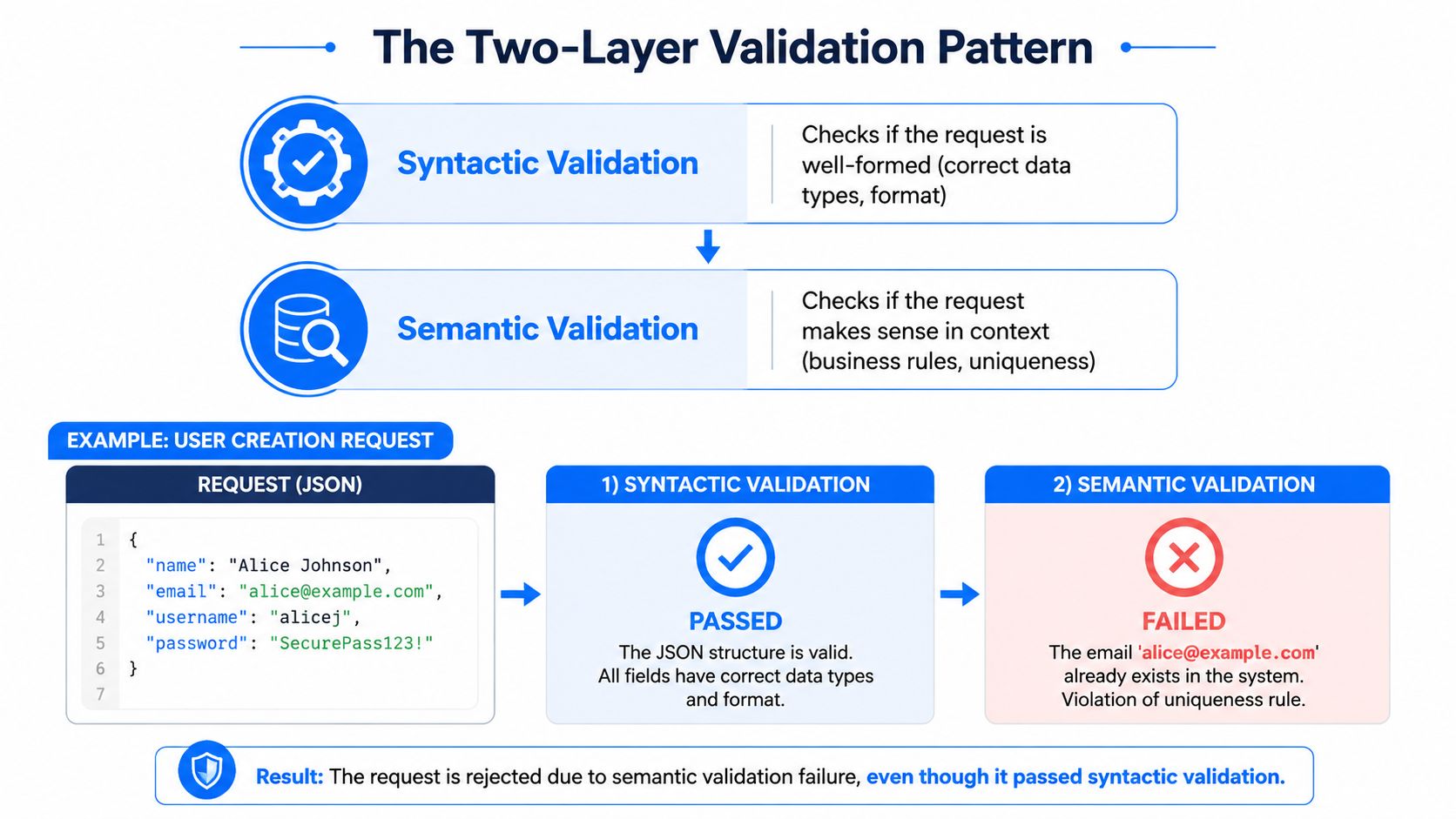
The cleanest way to design REST API validation is to separate syntactic validation from semantic validation. Syntactic checks answer one question, is this request well formed? Semantic checks answer the harder one, does this request make sense for this resource and business domain?
What belongs in syntactic validation
Syntactic validation catches malformed JSON, missing required fields, wrong data types, parse failures, empty strings, and values that violate declared bounds. The point is to reject obviously broken requests before they reach expensive business logic. That's the layer where OpenAPI schemas, JSON Schema validators, and controller-level guards earn their keep.
The workflow is straightforward. Validate at the gateway or controller, enforce a strict schema, reject type mismatches and out-of-range values, and run negative tests for malformed JSON, nulls, empty strings, and oversized payloads before downstream processing begins. OWASP-style guidance also recommends strong typing, regex constraints, illegal-content rejection, and request-size limits that return HTTP 413 when exceeded. Validation and input handling practices
What belongs in semantic validation
Semantic validation checks business meaning. A user ID might be syntactically valid and still not exist. An enum value might be structurally valid and still wrong for the current resource state. That's where you verify referential integrity, uniqueness, workflow state, ownership, or any rule that depends on live domain data.
A useful decision tree is simple:
Can the parser read it? Put that in syntax.
Is the type, required field, or range wrong? Put that in syntax.
Does the value refer to a real entity or valid state? Put that in semantics.
Does the rule depend on business context, permissions, or current database state? Put that in semantics.
Start with the cheap checks. If a request fails basic shape validation, don't spend database reads proving a business rule for a payload that should have been rejected two milliseconds earlier.
That sequencing is what people mean by progressive validation. Check critical fields first, reject early, and reserve expensive checks for requests that already cleared the structural gate. Practitioner guidance splits the two layers for exactly this reason, syntax gives you speed and safety, semantics gives you correctness. Syntax versus semantic validation
Designing Schemas That Work in Production
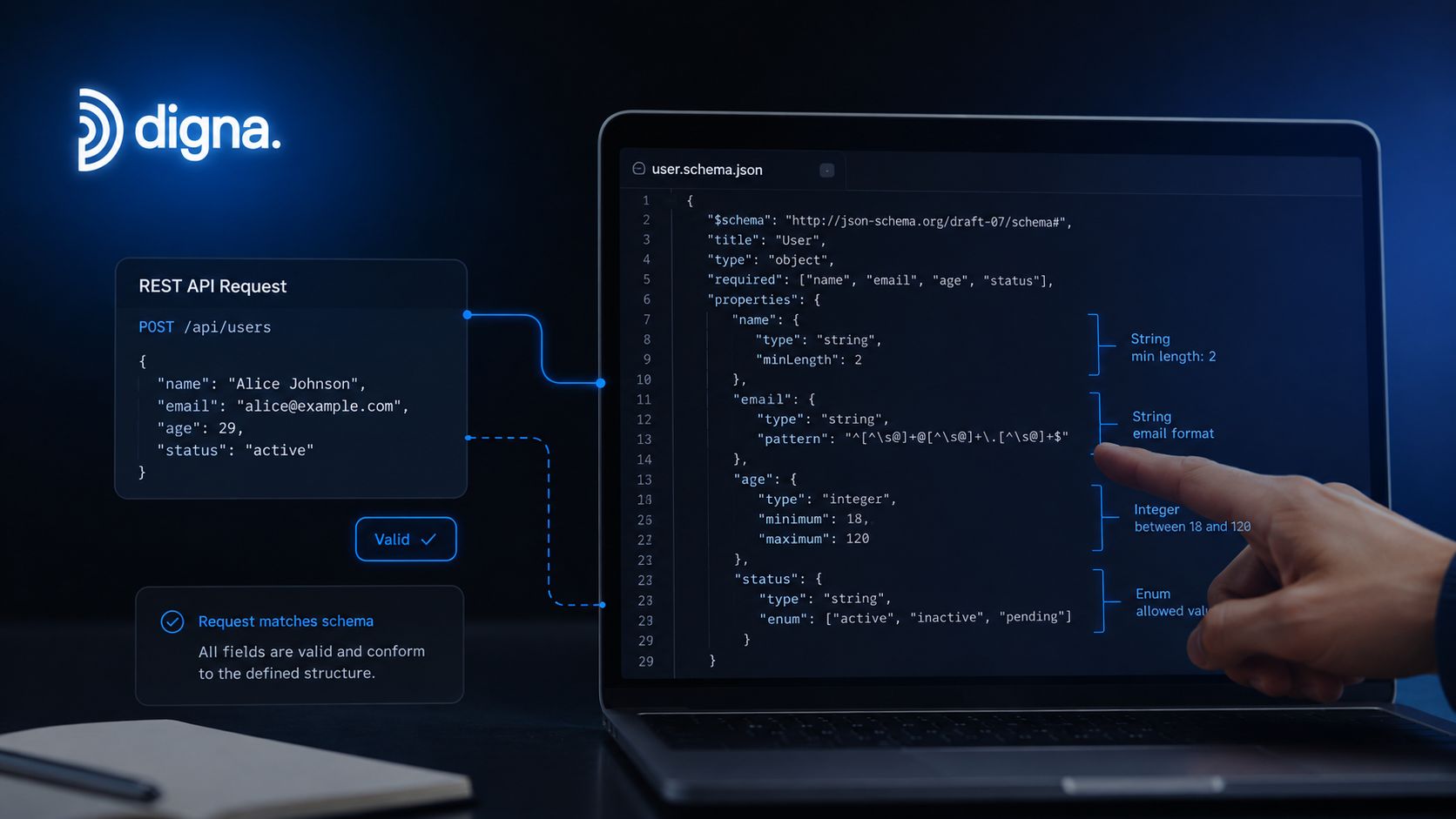
A schema that accepts everything is not flexible, it is useless. Good schema design starts with the fields clients must send, then tightens the contract with types, patterns, ranges, and enums that match the business object the API is supposed to accept. In practice, JSON Schema and OpenAPI work well together because the schema describes the request shape while the API spec describes where and how that shape is used.
Schema rules that hold up in production
Define required fields explicitly, then constrain each property with the narrowest practical type. For strings, use regex patterns when format matters more than free-form text. For numbers, declare ranges instead of relying on downstream code to catch edge cases. For closed sets, use enums so clients cannot invent new values by accident.
That discipline prevents the failure modes that show up in production. Teams often skip format checks for emails and dates, or they write schemas that do not reflect the endpoint's real business rules. The result is a contract that admits bad data into later stages and forces the application layer to make up for missing structure. Using schema descriptions that stay aligned with stored data structures helps keep request validation close to the data model it is supposed to protect.
A practical schema design pattern looks like this:
Shared base objects for fields reused across endpoints.
Endpoint-specific overlays for action-specific requirements.
Explicit enums and regexes for constrained values.
Versioned schema files when a contract change would otherwise break consumers.
Performance and drift control
Compiling schemas matters when request volume is high. Repeated parsing adds noise you do not want in hot paths, and compiled validators reduce that cost. Schema versioning matters for the same reason, because business requirements change and old clients do not disappear on your schedule.
The failure mode to avoid is silent schema drift, where the code, the OpenAPI document, and the actual payload shape stop matching each other.
Structural monitoring becomes useful at that point. digna's Schema Tracker is built to watch structural changes in production so teams can catch drift before it breaks validation, which is the right problem to solve when your API contract is only one part of a larger data pipeline. Keep the schema close to the service, keep the versioning explicit, and do not let “we will update it later” become the default release strategy.
Choosing Validation Libraries and Middleware
Library choice is mostly a trade-off between speed, expressiveness, and maintenance burden. JSON Schema validators like Ajv are strong when you want compiled schemas and predictable enforcement. OpenAPI-based tools are better when your validation needs to stay tightly coupled to an API contract that already exists for documentation and client generation. Type systems such as TypeScript help at build time, but they don't replace runtime validation because external requests don't care what your compiler believes.
Framework middleware is where teams often make the wrong optimization. Express middleware is easy to wire in, FastAPI gives you strong request parsing out of the box, and gateway-layer validation can stop malformed traffic before it reaches application code. The right split depends on where you want the failure to happen and who should own the error surface.
Approach | Performance | Error Quality | Learning Curve | Best For |
|---|---|---|---|---|
JSON Schema validator | Strong when compiled | Good if mapped well | Moderate | Strict request contracts |
OpenAPI-based tooling | Solid | Good, contract-aligned | Moderate | API-first teams |
TypeScript plus runtime checks | Mixed, depends on runtime layer | Varies | Lower for TS teams | Shared codebases |
Framework middleware | Good for simple cases | Often framework-specific | Low | Fast integration |
Gateway-layer validation | Strong at the edge | Usually standardized | Moderate to high | High-traffic APIs |
Compiled schemas and progressive validation should be mandatory in busy systems. Check the cheapest fields first, fail fast, and only invoke deeper validators when a request has already earned that CPU time. That pattern matters more than the library brand name.
There's also a maintenance question that teams underestimate. Custom validators feel easy when the first endpoint ships, then become brittle when ten more endpoints need the same rules with slightly different exceptions. Established libraries reduce that drift, especially when they give you reusable schemas, field-level messages, and an escape hatch for domain-specific checks that don't belong in the library itself.
Error Handling That Developers Use
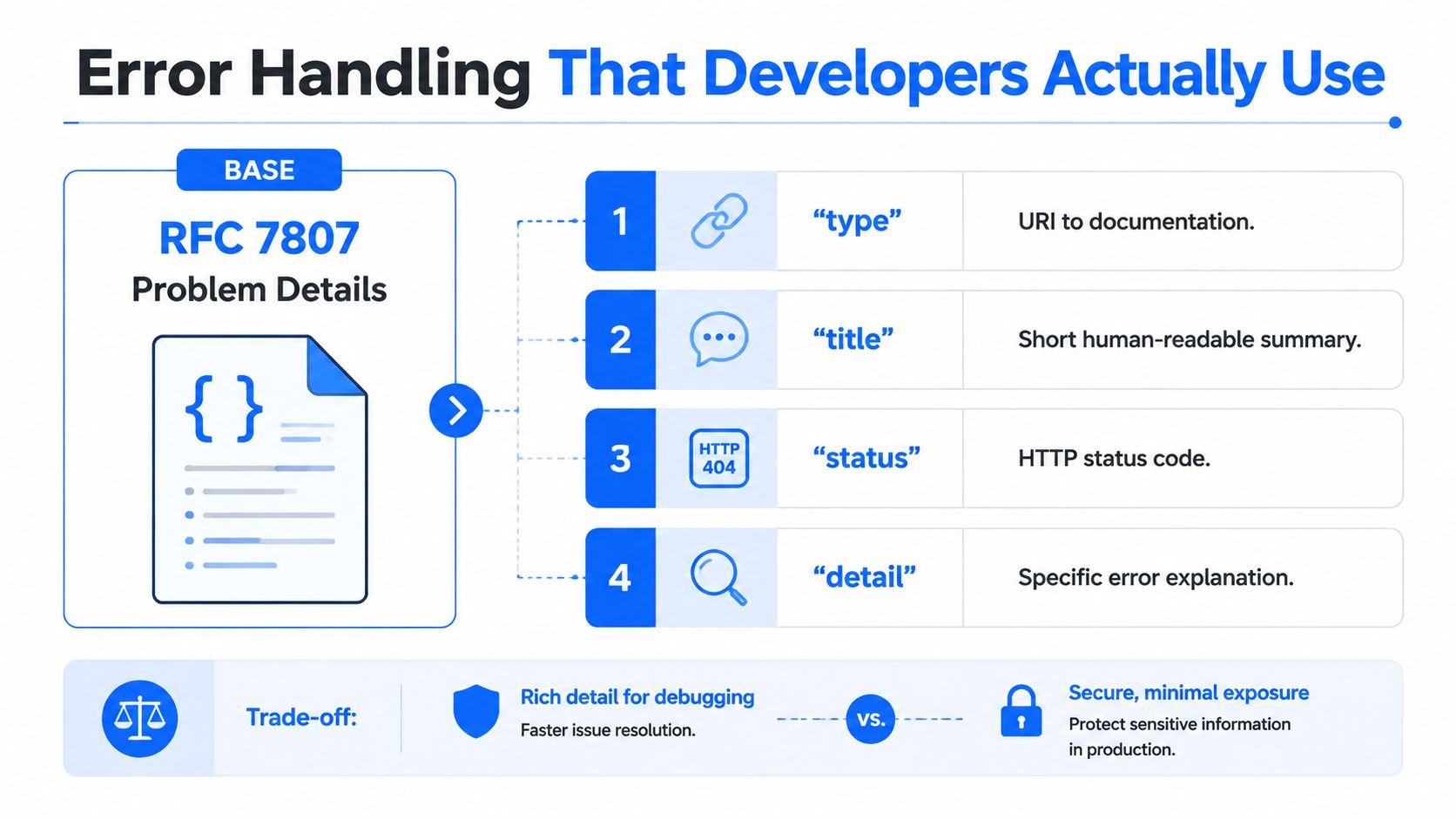
Validation only helps when the response gives clients something they can act on. RFC 7807 works well as the baseline because it gives API consumers a machine-readable structure for parsing failures without making them reverse-engineer a custom format. The fields that matter are type, title, status, and detail, plus field-level information when a payload fails validation. RFC 7807-style validation responses
What to return and what to hide
Use HTTP 400 Bad Request when the payload fails schema or field validation. Keep the body safe, specific, and consistent. Include the field name, the reason, and the expected format so front-end developers and automated clients can fix the request without guessing.
A good response is descriptive without being chatty. Field-specific errors work better than a generic “invalid input” message because they map directly to the offending property. Aggregated errors are even better when multiple fields fail at once, since they let clients fix everything in one round trip. Public guidance also recommends avoiding internal implementation details, which protects you from leaking stack traces, field internals, or backend structure. API validation error handling guidance
Where status codes fit
There is a real trade-off between 400 and 422 semantics, and public material still does not fully settle the boundary. The practical rule is to be consistent inside your own API and document it clearly for consumers. If your team uses 400 for all request-shape failures, keep it that way and make the body precise enough to compensate.
Server-side logging should be much richer than client responses. Log the validation context, request ID, and internal rule that failed, but never log passwords, tokens, or other sensitive payload fields. That split lets support teams debug quickly while keeping production responses safe for hostile clients. In a real API, that balance matters more than perfect theoretical purity.
The best error response is one the client can fix and an attacker can't mine for extra information.
Connecting Validation to Data Quality and Observability
Validation failures are not just API problems, they're signals about the health of the data system around the API. A spike in rejected requests can point to upstream source changes, schema drift, or a business rule that changed faster than the clients did. If you only treat validation as an input filter, you miss one of the earliest warnings that the pipeline is starting to misalign.
What to watch after the request is rejected
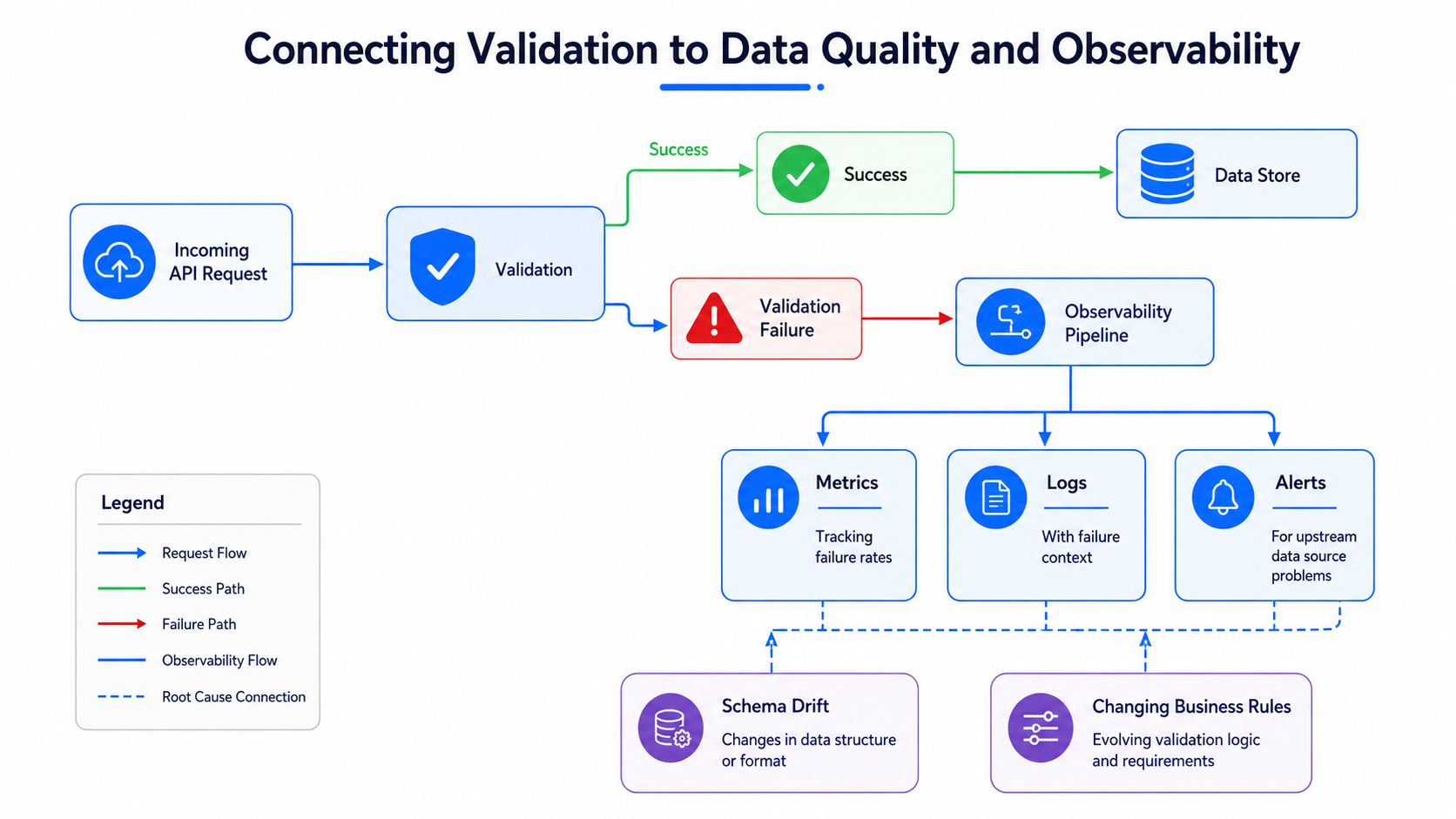
Validation failures should feed observability the same way successful writes feed storage. Track failure patterns, preserve contextual logs, and alert when a specific endpoint starts rejecting a new class of payloads. That's how teams distinguish a bad client rollout from a deeper compatibility issue.
The point extends downstream too. If the API is the front door to a warehouse, lake, or operational store, request validation and post-load data quality checks should reinforce each other rather than duplicate blindly. API-level validation catches malformed requests before ingestion, while downstream checks catch anomalies that only show up after data is combined, transformed, or compared with other systems.
How platforms fit into the loop
digna's Data Validation and Schema Tracker modules sit naturally in this layer because they let teams monitor business rules and structural changes across the pipeline, not just at the ingress point. That's useful when the API contract is stable but the source behavior isn't, or when multiple producers feed the same downstream tables. digna data observability
A practical observability loop looks like this:
Validation metrics to flag new error patterns.
Logs to capture the rejected field and reason.
Alerts to notify owners of upstream source problems.
Schema change monitoring to catch drift before it spreads.
Business-rule checks to confirm the data still makes sense after ingestion.
Treat validation failures as operational telemetry, not just application noise.
That mindset is what keeps the API layer connected to data reliability. When validation, observability, and downstream quality checks are aligned, teams stop debating whether a failure belongs to the API team or the data team. They can see the same signal, interpret it in context, and fix the right layer faster.
If you're tightening request contracts, reducing bad payloads, or trying to stop schema drift from breaking your pipeline, digna gives data teams a way to monitor validation, schema changes, and data behavior inside their own environment. Visit digna to see how its data observability and validation modules fit into the same reliability layer your APIs already depend on.
Frequently asked questions
Why is REST API validation a contract problem?
An API endpoint is a promise about what a payload will contain and mean. Validation enforces that promise. When it is missing or partial, the contract is broken silently and the damage appears later as strange rows, retry loops and reports that almost reconcile.
What is the two-layer validation pattern?
Syntactic validation checks structure: required fields, types, formats and ranges, and it can reject a payload without any business context. Semantic validation checks meaning: that the referenced account exists, the dates are ordered, the totals agree. Both layers are needed because each misses what the other catches.
What should an API return when validation fails?
Return a status code that distinguishes a malformed request from a rejected but well-formed one, plus a machine-readable list of which fields failed and why. Do not leak internal identifiers, stack traces or schema internals in the error body.
How do you stop API schemas from drifting?
Version the schema alongside the code that serves it, treat additions as backwards compatible and removals as breaking, and monitor the rate of rejections per field. A sudden rise in failures on one field is usually a producer change nobody announced.
How does API validation connect to data quality monitoring?
Rejecting a bad payload protects the store but hides the problem. The rejected volume, the fields failing most often and the clients responsible are quality signals in their own right, and they belong in the same observability view as warehouse checks.