Master Data Management: The Complete Guide to MDM
|
9
min read

Every enterprise has the same problem hiding in plain sight: five systems, five versions of the same customer, and nobody sure which one is right. That's the gap master management data practices exist to close, and if you're reading this, you've probably just watched a report break because a product ID meant two different things in two different databases.
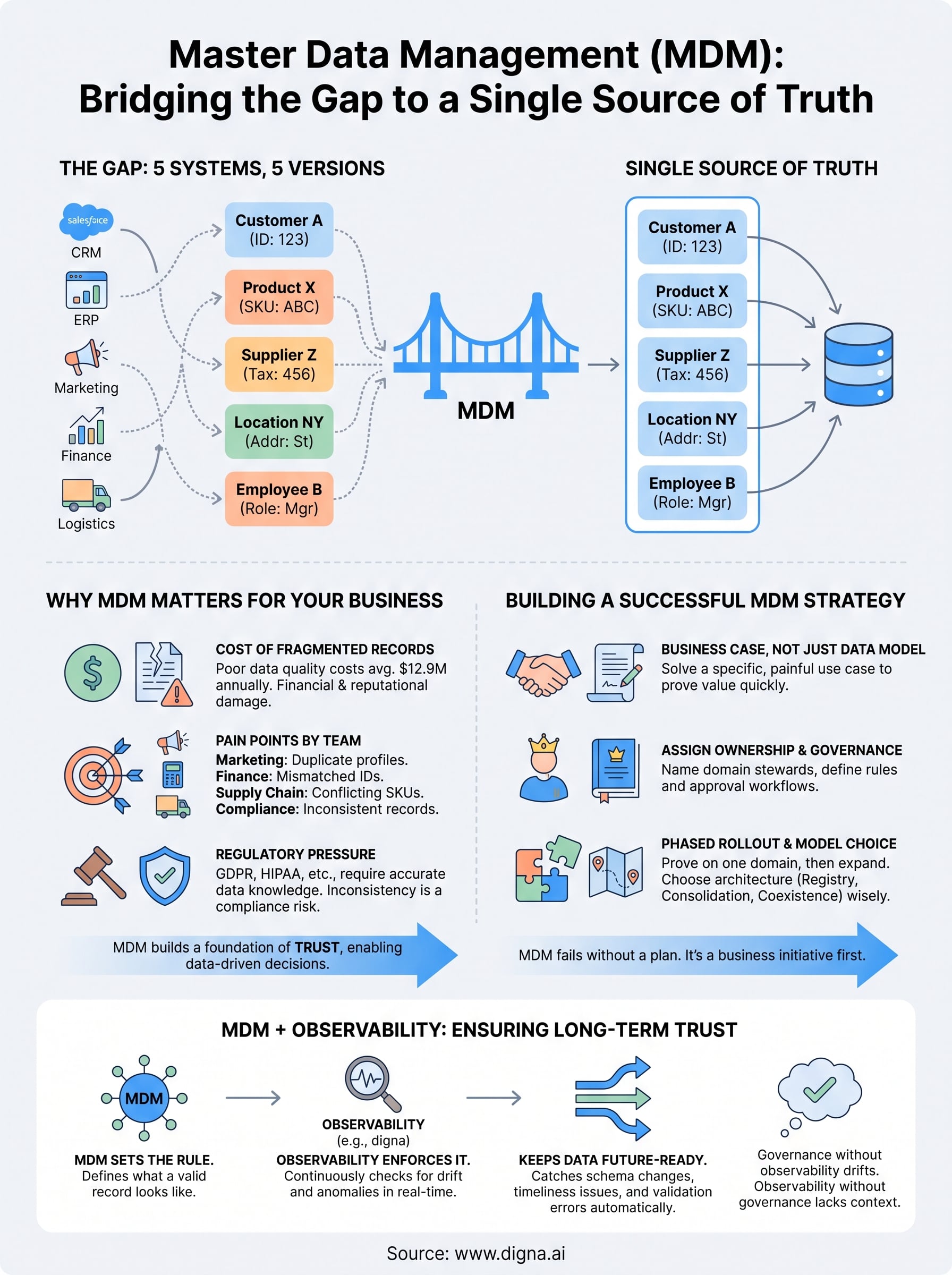
Master Data Management (MDM) is the discipline of identifying, cleaning, and governing the critical business entities, customers, products, suppliers, locations, that every department depends on, then making sure one consistent, trusted version of each record flows across every system that touches it. Done right, it turns scattered, duplicated data into a single source of truth your teams can actually build decisions on.
This guide walks through what MDM means in practice, why it matters beyond the buzzword, and how it fits alongside data quality and observability work. We'll cover the core components of an MDM program, the common implementation approaches, and where tools that monitor and validate data automatically, like the anomaly detection and schema tracking we build at digna, fit into keeping your master data trustworthy long after the initial cleanup.
Why master data management matters for your business
Bad master data doesn't announce itself with an error message. It shows up as a marketing campaign that emails the same customer six times, a supply chain report that overstates inventory by 15%, or a compliance filing that lists a supplier under three different tax IDs. Master Data Management exists because these small inconsistencies compound into real financial and reputational damage once they scale across an enterprise with dozens of systems and thousands of daily transactions.
The cost of fragmented records
Consider what happens when a bank's mortgage system, CRM, and fraud detection tool each hold a slightly different version of the same customer's address history. Analysts spend hours reconciling numbers instead of analyzing them, executives lose confidence in dashboards, and regulators start asking pointed questions during an audit. Gartner has long estimated that poor data quality costs organizations an average of $12.9 million annually, and fragmented master data is usually the root cause, not a symptom. Fixing it isn't a nice-to-have IT project; it's a direct lever on operating costs.

Where the pain shows up first
Most teams don't notice master data problems until they hit a specific department. Here's how the same underlying issue plays out differently depending on who's affected:
Team | Symptom of poor master data | Business impact |
|---|---|---|
Sales & Marketing | Duplicate customer profiles | Wasted spend, inconsistent outreach |
Finance | Mismatched supplier IDs | Delayed payments, audit flags |
Supply Chain | Conflicting product SKUs | Overstocking or stockouts |
Compliance | Inconsistent entity records | Regulatory fines, failed audits |
Data Science | Unreliable training data | Inaccurate AI/ML model outputs |
Once you see the pattern across these rows, it's obvious the problem isn't a single bad dataset. It's a structural gap in how the organization defines and governs its most important records.
Building a foundation of trust
A well-run MDM program gives every department the same starting point: one validated record for each customer, product, or supplier that other systems reference rather than recreate. This shared foundation is what lets a data-driven culture actually function, because analysts and executives stop second-guessing the numbers in front of them.
When everyone works from the same master record, arguments shift from "whose data is right" to "what should we do about it."
That shift matters more than it sounds. Teams that trust their data move faster. They test new pricing models, launch personalized campaigns, and automate approvals without pausing to verify basic facts first.
Regulatory pressure is rising
Enterprises in finance, healthcare, and telecommunications face growing scrutiny over how they manage customer and transaction records. Regulations like the EU's GDPR require organizations to know exactly which systems hold personal data and to correct or delete it on request, something that's nearly impossible without a master record showing where each entity's data lives. The European Data Protection Board has repeatedly flagged inconsistent record-keeping as a compliance risk during enforcement actions, and regulators in the US and UK are following similar lines of inquiry.
Ultimately, MDM matters because it touches everything downstream, reporting accuracy, AI model reliability, customer experience, and audit readiness. Skipping it doesn't eliminate the cost of bad data; it just defers the bill to whichever team discovers the discrepancy first, usually at the worst possible moment.
How to build a master data management strategy
A master data management program fails fast when it starts with software instead of a plan. Successful teams treat MDM as a business initiative first and a technical project second, which means defining what "good" master data looks like before anyone evaluates a vendor. Get the strategy right and the tooling decision becomes much easier later.
Start with a business case, not a data model
Before you touch a schema, pin down the specific problem you're solving. Is it duplicate customers costing marketing dollars? Mismatched supplier records slowing finance close? Pick one painful, measurable use case and build around it. A narrow, well-documented business case gives you a way to prove value quickly and secures budget for the harder work of expanding coverage to other domains later.
Assign ownership before you touch technology
Master data has no chance of staying clean if nobody owns it. This is where data governance earns its keep: naming stewards for each domain, defining who can create or edit a record, and setting rules for what counts as "correct." Without this structure, even the best matching algorithm just automates confusion faster.
Name a business owner for each master data domain (customer, product, supplier, location)
Define approval workflows for creating, merging, or retiring records
Set data quality thresholds each domain must meet before it's considered trustworthy
Document the rules in a governance charter that survives staff turnover
A governance model without a technology stack is slow. A technology stack without governance is fast at spreading errors.
Choose a data model approach
Enterprises typically pick one of three architectural patterns, and the choice shapes everything downstream, from integration cost to how quickly bad records get caught.
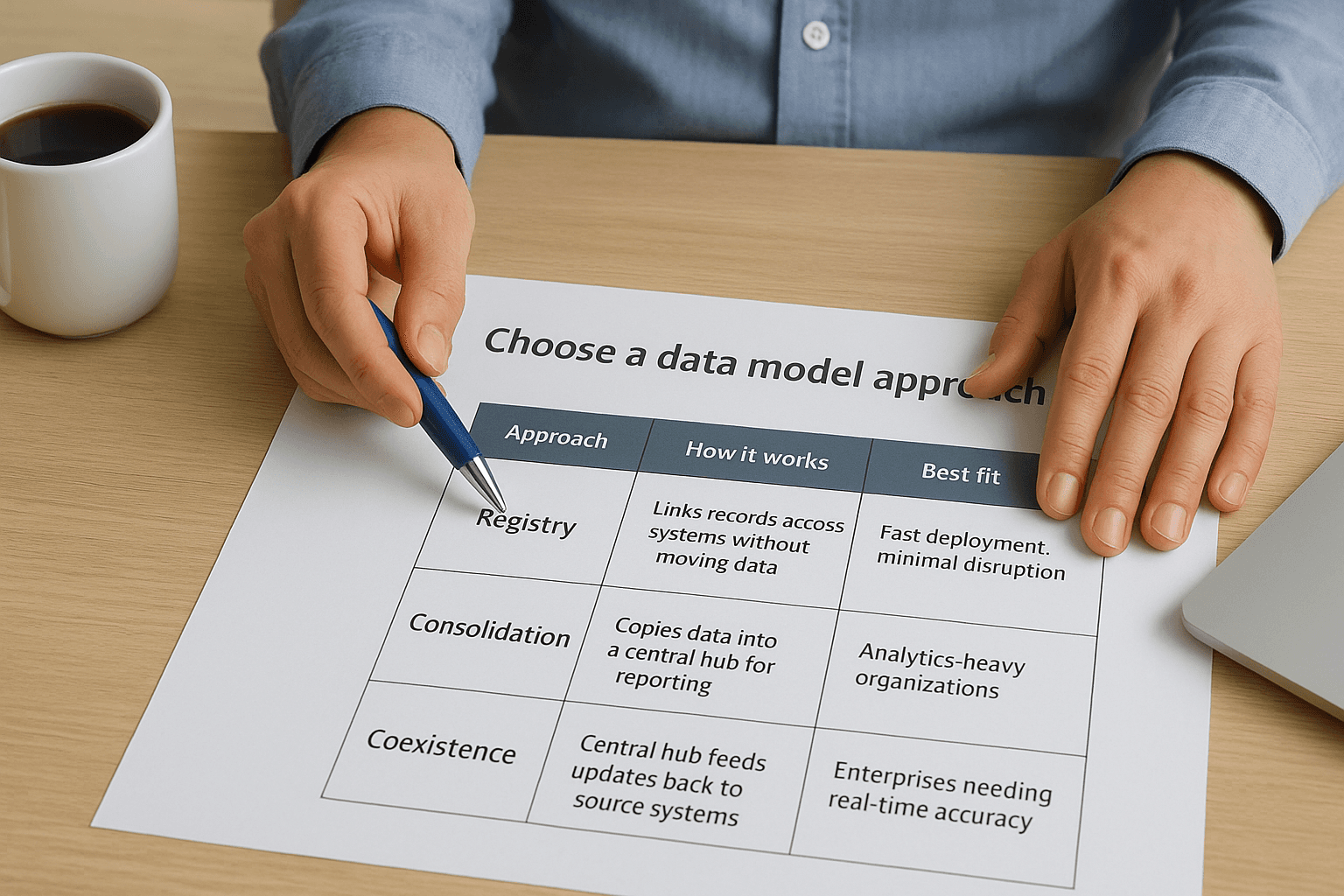
Approach | How it works | Best fit |
|---|---|---|
Registry | Links records across systems without moving data | Fast deployment, minimal disruption |
Consolidation | Copies data into a central hub for reporting | Analytics-heavy organizations |
Coexistence | Central hub feeds updates back to source systems | Enterprises needing real-time accuracy |
None of these is universally "better." The right choice depends on how much your organization can tolerate changing source systems versus building a parallel hub.
Roll out in phases, not all at once
Organizations that try to master every domain simultaneously usually stall within a year. Instead, prove the model on one domain, measure the improvement in match rates and error reduction, then extend the same governance and matching rules to the next domain. Phased rollouts also give data quality tools time to catch structural drift before it spreads across the whole architecture.
Common challenges in master data management
Even the best-planned master data management initiative runs into friction once it moves from whiteboard to production. The obstacles aren't usually technical in the purest sense; they're organizational habits that built up over years and don't disappear just because you bought new software. Knowing these challenges ahead of time lets you budget extra time and political capital where it's actually needed.
Data silos resist consolidation
Legacy applications were built to solve one department's problem, not the enterprise's. A CRM team optimized for lead conversion and a finance team optimized for billing accuracy end up with two customer records that were never designed to match. Breaking down these data silos means convincing system owners to expose their data for matching, which is often a harder conversation than any integration script.
Matching records across inconsistent formats
Merging records sounds simple until you see how differently the same entity gets recorded across systems. A supplier named "Acme Corp." in one database might appear as "ACME Corporation Ltd" in another, with a different tax ID typo thrown in for good measure. Common mismatches include:
Abbreviated versus full legal names
Inconsistent address formatting across regions
Duplicate IDs created during system migrations
Free-text fields with no validation rules
Matching algorithms help, but they need clean training examples, and someone still has to resolve the edge cases by hand.
Governance stalls without executive buy-in
Stewardship programs frequently die quietly when leadership treats them as a one-time cleanup rather than an ongoing responsibility. Stewards get reassigned, the governance charter gathers dust, and duplicate records creep back in within a year. Data governance only holds up when someone senior is accountable for the outcome, not just the launch.
A one-time data cleanup fixes a symptom; ongoing governance is the only thing that fixes the disease.
Legacy systems slow integration
Older mainframes and custom-built applications rarely expose clean APIs, which forces teams into brittle batch extracts or manual reconciliation. Every workaround adds latency between when a record changes and when the rest of the enterprise sees the update, undermining the real-time accuracy MDM is supposed to deliver. Budgeting for this integration debt early avoids the common trap of a strategy that looks perfect on paper but stalls the moment it meets a 20-year-old database schema.
., are more common. Under HIPAA, financial institutions face similar mandates: identity records, product hierarchies, and beneficiary information have their own recognized structures and regulatory checkpoints.Providers must t requirements.The table belowows how the same underlying discipline solves very different problems depending on the domain you apply it to..,write concise.Let's write.6 domains customer product supplier location employee reference/finance. Provide within budget 406 words max452452.br format table for domains, examples use cases. Then a coucase narr., one industry (banking) with subheains and product domain interplay.description, and a healthcare example (patient domain). Use bold phrases, blockquote after key point.Dom write with H3 subheadings:
Choosing the right master data management tools
Once governance and strategy are settled, the technology decision gets much simpler, but it's still where many projects lose momentum. Vendors market dozens of features, yet the real evaluation comes down to a handful of questions: does the tool fit your deployment constraints, can it actually match your messiest records, and will your team still be able to maintain it two years from now. Skipping this discipline is how organizations end up with expensive software that automates the wrong workflow.
Match your deployment model to your compliance needs
Banks, insurers, and healthcare providers often can't move master data to a third-party cloud without triggering a compliance review, so deployment flexibility matters as much as functionality. Look for platforms that support the pattern your regulators expect, not just the one that's cheapest to set up.
Deployment model | Where data lives | Best fit |
|---|---|---|
Public cloud | Vendor-managed infrastructure | Lower regulatory burden, fast scaling |
Private cloud | Dedicated, isolated environment | Enterprises needing control without on-prem overhead |
On-premises | Customer's own data center | Strict residency or sovereignty requirements |
An organization bound by GDPR or similar data residency rules should treat this table as a filter, not a preference, before comparing anything else.
Evaluate matching and survivorship capabilities
A tool's real value shows up in how it resolves conflicting records, not in its dashboard design. Ask vendors to run a proof of concept against your actual, messy data rather than a clean demo dataset.
Can it handle fuzzy matching across name, address, and ID variations?
Does it support configurable survivorship rules for which source wins when records conflict?
Can business users adjust matching thresholds without a developer?
Does it log every merge and edit for audit purposes?
A tool that can't show its matching logic isn't trustworthy enough to run master data on.
Don't overlook integration and total cost of ownership
The sticker price of an MDM platform rarely reflects what it costs to run. Factor in the effort to connect it to your CRM, ERP, and data warehouse, plus the ongoing work of tuning matching rules as new systems get added. A platform with strong API connectivity and prebuilt connectors to common enterprise systems cuts implementation time significantly compared to one that requires custom middleware for every source.
Finally, weigh how the tool fits alongside the data quality checks running elsewhere in your stack. An MDM platform that assumes clean incoming data will inherit every upstream error, which is exactly the gap observability tooling is built to close.
How data quality and observability strengthen MDM
Master data management gives you a governed, agreed-upon version of each record, but it doesn't watch that record after it's created. Data quality and observability tools pick up exactly where MDM governance leaves off, continuously checking whether the master data you built still behaves the way it should once it's flowing through dozens of downstream systems. Without that ongoing layer, even a well-designed MDM program slowly drifts back toward the mess it was built to fix.
MDM sets the rule, observability enforces it
Governance charters define what a valid customer or product record looks like, but they can't catch every violation as it happens. A schema change in a source system, a new field left unvalidated, or a batch load that silently fails can all corrupt master records within days. Observability platforms solve this by monitoring the actual data flowing through pipelines, not just the rules written on paper, flagging the moment reality stops matching the governance model.
Governance tells you what correct looks like; observability tells you the second it stops being true.
Catching drift before it reaches the business
This is where a platform like digna adds practical value on top of an MDM foundation. Its anomaly detection learns the normal patterns in your master data automatically, so a sudden spike in duplicate supplier IDs or a missing daily customer load gets flagged before finance or marketing ever sees the bad number. A few specific capabilities matter most here:

Schema tracking that catches structural changes, like a renamed column or altered data type, before they silently break matching logic
Timeliness monitoring that confirms master data loads arrive on schedule, so stale records don't get treated as current
Record-level validation against business rules, catching malformed IDs or out-of-range values that MDM matching alone might miss
Keeping analysis within your own environment
Regulated enterprises can't always send master data to an external service for monitoring, which is why in-database execution matters as much as the detection itself. digna runs its checks directly inside your existing database or private cloud, so sensitive customer and supplier records never leave your environment while still getting the same anomaly detection and schema tracking. Combined with a solid MDM strategy, that pairing turns a one-time cleanup project into a system that keeps catching problems long after the initial rollout, which is really the only way master management data stays trustworthy at enterprise scale.
Keeping your master data future-ready
Master data management isn't a project you finish and file away. It's a discipline that has to survive new acquisitions, new regulations, and new systems that nobody has designed matching rules for yet. The organizations that get this right treat governance and monitoring as permanent operating costs, not one-time cleanup budgets, and they build the feedback loop between the two into how teams actually work day to day.
Get the strategy, ownership, and tooling decisions right using what you've read here, then close the loop with continuous checks that catch drift before it reaches a dashboard or a regulator. That combination is what keeps a single source of truth actually true six months and six system upgrades later.
If you want to see how automated anomaly detection and schema tracking can keep your master data trustworthy without adding manual review work, explore digna's data observability platform and see what it catches in your own environment.