Solution Master Data Management: A 2026 Guide
|
9
min di lettura

Your CRM says a customer has one address, the ERP stores another, and the analytics platform counts both as separate entities. Product records create the same problem: one system calls an item “Industrial Pump A,” another uses a supplier code, and a third has incomplete specifications. Every team believes its own record is correct, so engineers build reconciliation logic, analysts question reports, and compliance teams struggle to prove which version is authoritative.
Solution master data management addresses this conflict by creating governed, reusable records for core entities such as customers, products, suppliers, assets, and locations. It does not just move data into another database. It identifies which records refer to the same entity, resolves conflicting attributes, assigns ownership, preserves lineage, and distributes trusted information to the applications that need it. That makes MDM a foundation for dependable operations, analytics, and AI workloads.
Table of Contents
Understanding Solution Master Data Management
A finance team may need one customer identity for credit decisions, while sales needs that identity for account planning and support needs it for service history. If each function maintains a separate profile, the organization doesn't have a customer view. It has several partial opinions about the same person or company.
A solution master data management platform creates a golden record, a governed representation assembled from source records and business rules. Consider a customer named Robert Smith. The CRM might contain “Robert Smith,” the billing system “R. Smith,” and the support system a phone number with no full name. MDM uses identifiers, attributes, relationships, matching logic, and stewardship review to determine whether those records belong together. The resulting profile can retain the strongest verified address, phone number, and account relationship without erasing source lineage.

What MDM solves in practice
MDM solves a coordination problem between systems and teams. It gives data engineers a controlled way to reconcile entities, gives stewards a process for reviewing uncertain matches, and gives consuming applications a consistent reference. The value appears in ordinary decisions, such as whether two invoices belong to one account, whether a product is eligible for a market, or whether an AI model is training on duplicate customers.
The IBM overview of MDM and data governance describes MDM as application infrastructure that manages master data and serves it to downstream applications through business services. That distinction matters. A warehouse is optimized for analysis, while MDM actively manages shared business entities used by operational systems.
A useful mental model is a railway junction. Source systems bring records into the junction, MDM resolves and governs them, and applications receive reliable routes to the records they need. Without the junction, every application builds its own connection and reconciliation logic.
The Evolution and Current State of MDM
MDM grew from a long history of recordkeeping rather than appearing as a single product category. A chronology from SSP's history of master data management identifies 1890, when Herman Hollerith developed a punch-card system for the U.S. census and helped separate static fields from changing data. It also identifies 1898, when Edwin G. Seibels invented a lateral file, and a 1936 Social Security Administration master file used to track deaths.
Those examples share a practical concern with modern MDM: keep important entities identifiable while their attributes change. Digital data management emerged through work associated with ADAPSO in the 1960s, computerized master data developed into early MDM software in the 1980s, and MDM gained prominence in the 1990s as organizations faced fragmented data, growing volumes, and regulatory pressure. The discipline moved from master files to enterprise platforms, but the core question remained the same: which record should the organization trust?
Why the market matters now
MDM has become a substantial enterprise infrastructure market. Mordor Intelligence estimates that the global MDM market will reach USD 18.23 billion in 2025, rise to USD 21.63 billion in 2026, and reach USD 50.85 billion by 2031, implying an 18.66% CAGR over 2026 to 2031.
The deployment mix explains the change in buying behavior. Cloud deployments accounted for 60.35% of the MDM market in 2025, and cloud implementations represented 61% of new installations, according to the same market source. MDM is therefore shifting from a heavily managed, legacy back-office capability toward a scalable delivery model that can connect more readily with modern data platforms.
Software remained the dominant component, with 67.42% of market share in 2025, while services are projected to grow at a 19.26% CAGR through 2031. That combination tells data leaders something important: buying software doesn't remove the need for operating expertise. Modeling entities, defining survivorship, assigning stewardship, and integrating source systems still require sustained architectural and organizational work.
MDM now sits across analytics, operations, and compliance. A retailer may govern products and locations, a bank may prioritize customers and legal entities, and a public agency may need consistent citizen or supplier records. The historical evolution explains why the discipline combines storage, governance, traceability, and operational distribution rather than functioning as a simple reporting database.
MDM Architecture and Core Principles
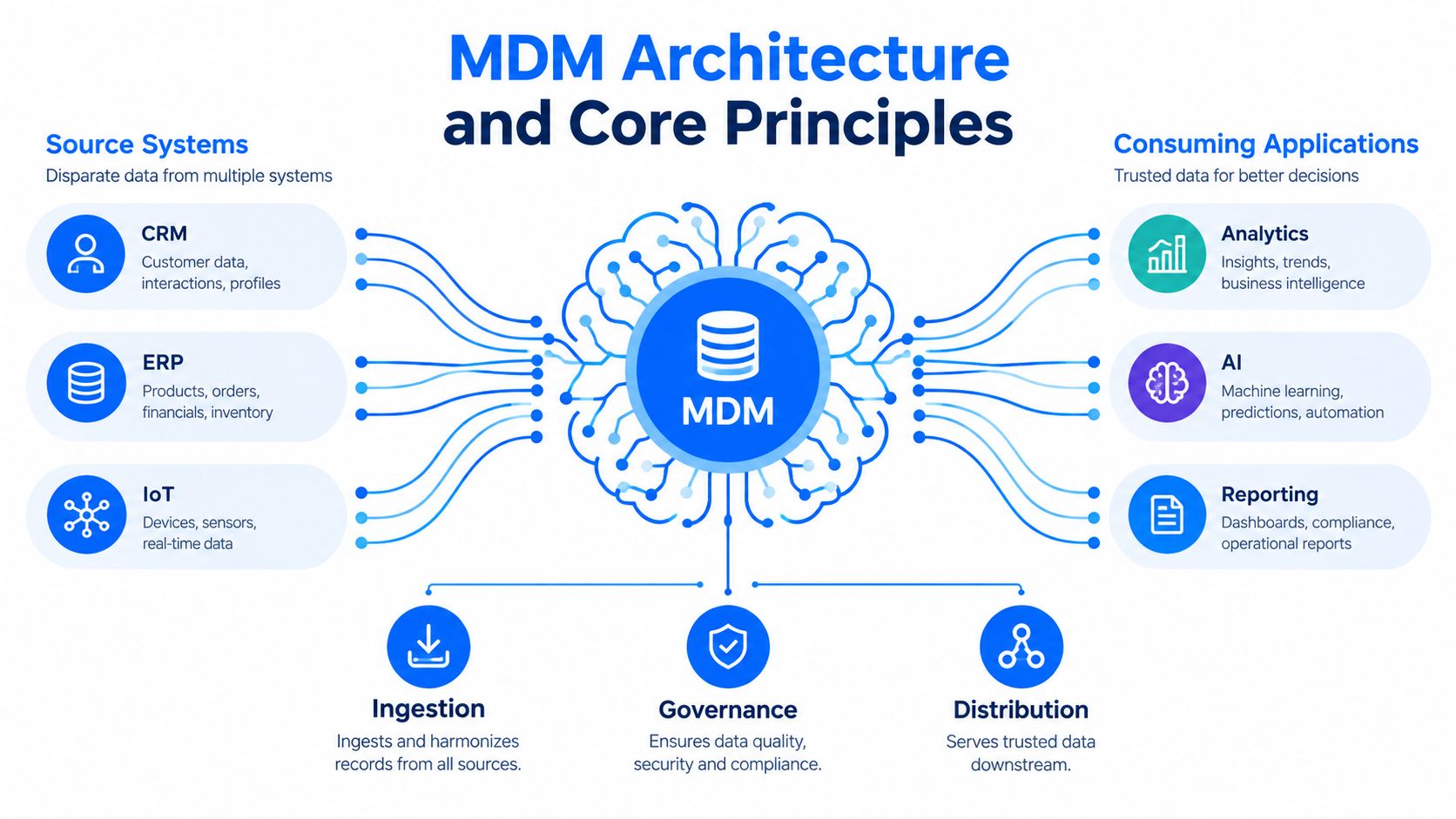
Think of MDM as the central nervous system of an enterprise data environment. It receives signals from source systems, interprets relationships between records, applies policies, and sends trusted information to applications. The analogy is useful because MDM doesn't merely collect data. It coordinates how business entities are understood and used.
Three architectural layers
The first layer contains source systems. CRM, ERP, billing, commerce, IoT, and supplier applications create or update records. Each system has a legitimate local purpose, so source differences aren't automatically errors. A CRM may own sales-contact details, while an ERP owns billing attributes. MDM must preserve that context instead of flattening every record into an arbitrary common format.
The second layer is the MDM layer. It ingests records, profiles them, standardizes values, resolves entities, stores relationships, applies survivorship rules, and routes uncertain cases to stewards. It also maintains governance metadata, audit history, and lineage. This layer isn't a passive database and isn't a data warehouse. It manages master records and exposes them to applications through business services.
The third layer is the consumption layer. Analytics, reporting, AI pipelines, operational applications, and downstream services consume mastered entities. Distribution can occur through APIs, events, or controlled batch processes, depending on latency and system requirements. A mastered product that never reaches the ERP or analytics environment hasn't solved the business problem.
Controls that keep the architecture useful
Entity resolution connects records that describe the same customer, product, or supplier. Stewardship handles ambiguity, especially when matching evidence is incomplete. Governance defines who can approve changes, which values are valid, and how teams should interpret a field.
Quality control must continue after the initial load. If a mastered customer record becomes stale, or a source system changes a product code without notice, downstream transactions and models inherit the defect. The architecture should therefore include:
Source profiling: Identify duplicates, missing attributes, invalid values, and unusual distributions before onboarding a domain.
Match and survivorship logic: Explain how records are linked and how conflicting attributes are selected.
Stewardship workflows: Route low-confidence cases to accountable people with enough context to decide.
Distribution controls: Publish trusted records through governed interfaces and track delivery status.
Lineage and auditability: Show where each attribute came from, which rule changed it, and who approved an exception.
Continuous monitoring: Detect quality drift, stale data, schema changes, and failed downstream delivery.
For a broader view of how these layers fit into an enterprise environment, see digna's data system architecture guidance. The key design test is simple: can an engineer trace a record from source to golden record to consuming application, while a business steward can understand and challenge the decision?
The Three Pillars of Reliable MDM Programs
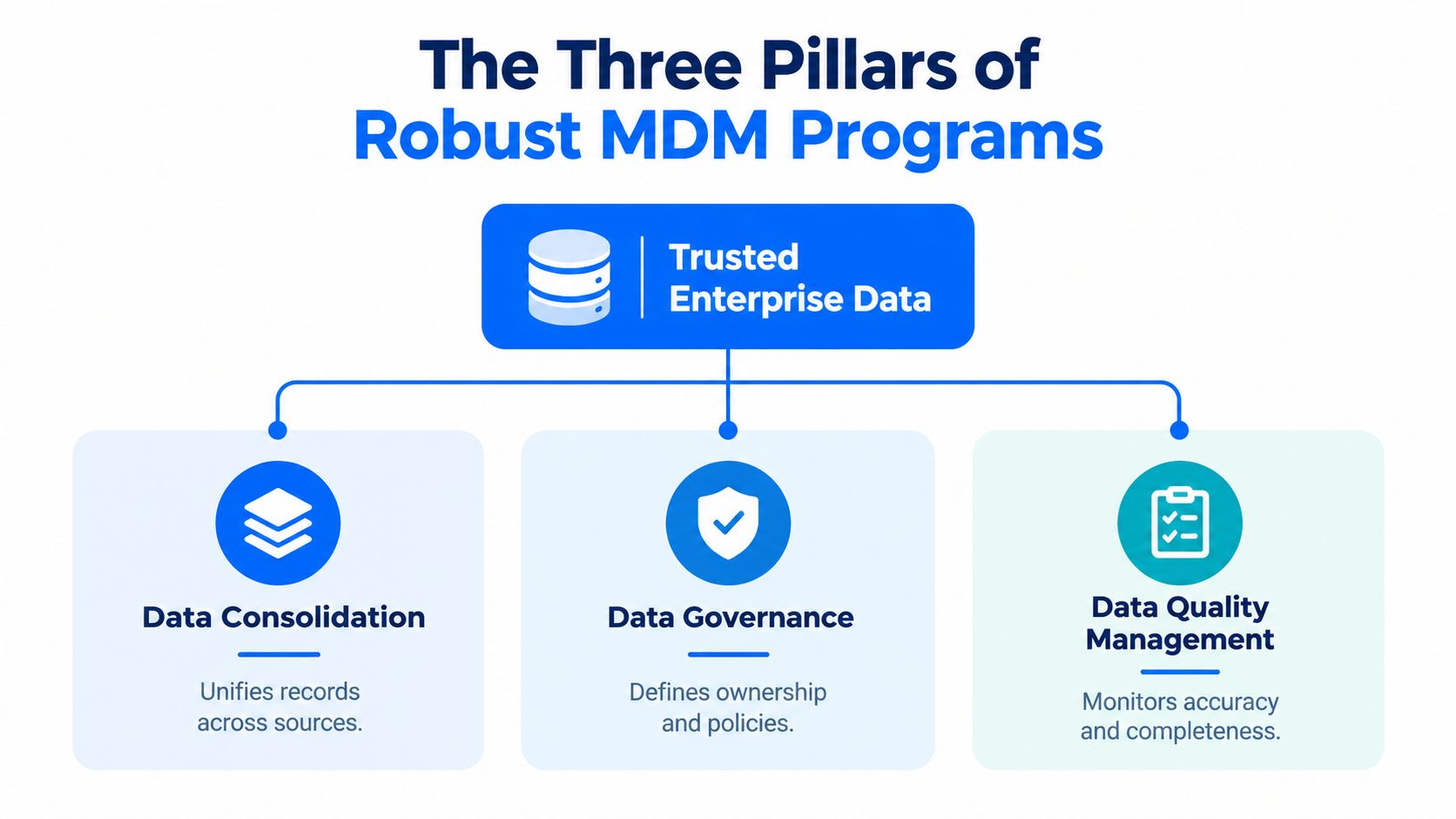
A repository by itself does not create trusted master data. A dependable program combines data consolidation, data governance, and data quality management. Each pillar answers a different question, and a weakness in one quickly weakens the other two.
Data consolidation creates shared context
Consolidation brings records from relevant systems into one coordinated model. It does not require every source to give up ownership of every attribute. The organization still decides how customer, product, supplier, or location records relate to one another and where authoritative evidence lives.
Suppose the CRM owns a customer's sales status, the billing platform owns payment terms, and a service platform owns support eligibility. Consolidation lets MDM connect those attributes to one entity while keeping source provenance visible. Without it, each system exposes a siloed view and teams waste time comparing extracts.
Governance assigns accountability
Governance answers who decides. Data owners define policies for a domain, stewards review exceptions, architects maintain models, and security teams control access. Standards also need precise definitions. “Active customer” may mean a current contract to finance, a recent interaction to marketing, and an open case to support.
A practical data governance strategy from digna can help teams formalize ownership, policies, and responsibilities around the mastered domain. Governance is not a document stored in a shared folder. It is the decision process that determines whether a change is valid and who must approve it.
Quality management keeps the record dependable
Quality management enforces timeliness, validity, accuracy, completeness, and consistency across the master-data lifecycle. It checks whether required attributes exist, whether values follow domain rules, whether records arrive when expected, and whether related systems use compatible definitions.
The cause and effect is direct:
Without consolidation: Teams maintain duplicate records and reconcile siloed views.
Without governance: Nobody owns definitions, exceptions, or approval decisions.
Without quality management: Errors enter the golden record and spread to transactions, reports, and AI workloads.
With all three: Teams can detect deviations, automate routine maintenance, and address root causes instead of repeatedly correcting symptoms.
A mature program assigns a named owner to each domain and reviews drift signals on a fixed cadence, so a supplier hierarchy change is caught in the weekly stewardship review rather than in a quarterly cleanup.
Deployment Models and Enterprise Considerations
Deployment decisions shape security boundaries, operating responsibilities, integration patterns, and long-term cost. The right answer depends on the organization's regulatory obligations, existing infrastructure, internal skills, and appetite for managing platform operations.
Model | Security Control | Compliance Readiness | Cost Structure | Typical Use Cases |
|---|---|---|---|---|
On-premises | Direct control of infrastructure, networks, and access | Useful where data must remain inside controlled facilities | Infrastructure, licensing, maintenance, and internal operations | Highly regulated estates, legacy environments, restricted data |
Private cloud | Exclusive cloud environment controlled by the organization or a designated provider | Supports strong isolation and customer-specific governance | Cloud infrastructure plus platform operations and administration | Regulated enterprises seeking cloud operating practices |
Hybrid | Control split across private infrastructure and cloud services | Can keep sensitive domains in controlled environments while connecting other workloads | Multiple environments, integration, monitoring, and duplicated operational concerns | Enterprises modernizing gradually or separating domains by risk |
On-premises deployment
On-premises MDM gives infrastructure teams direct control over storage, network paths, identity integration, and platform configuration. It can fit organizations with established data centers and strict residency requirements, but the team also carries capacity planning, patching, resilience, upgrades, and hardware responsibilities.
The model can become difficult when source systems are already distributed across cloud services. Each new integration needs careful routing, identity management, and monitoring, so security control may come with additional operational friction.
Private cloud deployment
NIST defines a private cloud as infrastructure provisioned for the exclusive use of one organization. It may be owned, managed, and operated by the organization or a third party, and it can exist on or off premises. The NIST private cloud definition summarized by Collibra supports a useful distinction: private cloud is not merely “someone else's public environment.” It describes an exclusive deployment model with customer-specific control expectations.
Private cloud suits teams that want cloud automation and elasticity while keeping MDM within a customer-controlled cloud, VPC, or data center. Architects still need to verify identity, encryption, backup, exit, and data-residency requirements. Review data residency requirements before selecting a region or operating arrangement.
Hybrid deployment
Hybrid MDM keeps some domains or services in controlled infrastructure while connecting cloud-based applications. It can support gradual modernization, but it introduces another challenge: the organization must govern synchronization, latency, failure recovery, and duplicate processing across environments.
Financial services, healthcare, and public-sector teams may favor on-premises or private cloud for sensitive domains, while using hybrid patterns to connect modern analytics or engagement platforms. The decision should follow the risk profile, not the popularity of a deployment label.
Modern MDM From Centralized Control to Federated Intelligence
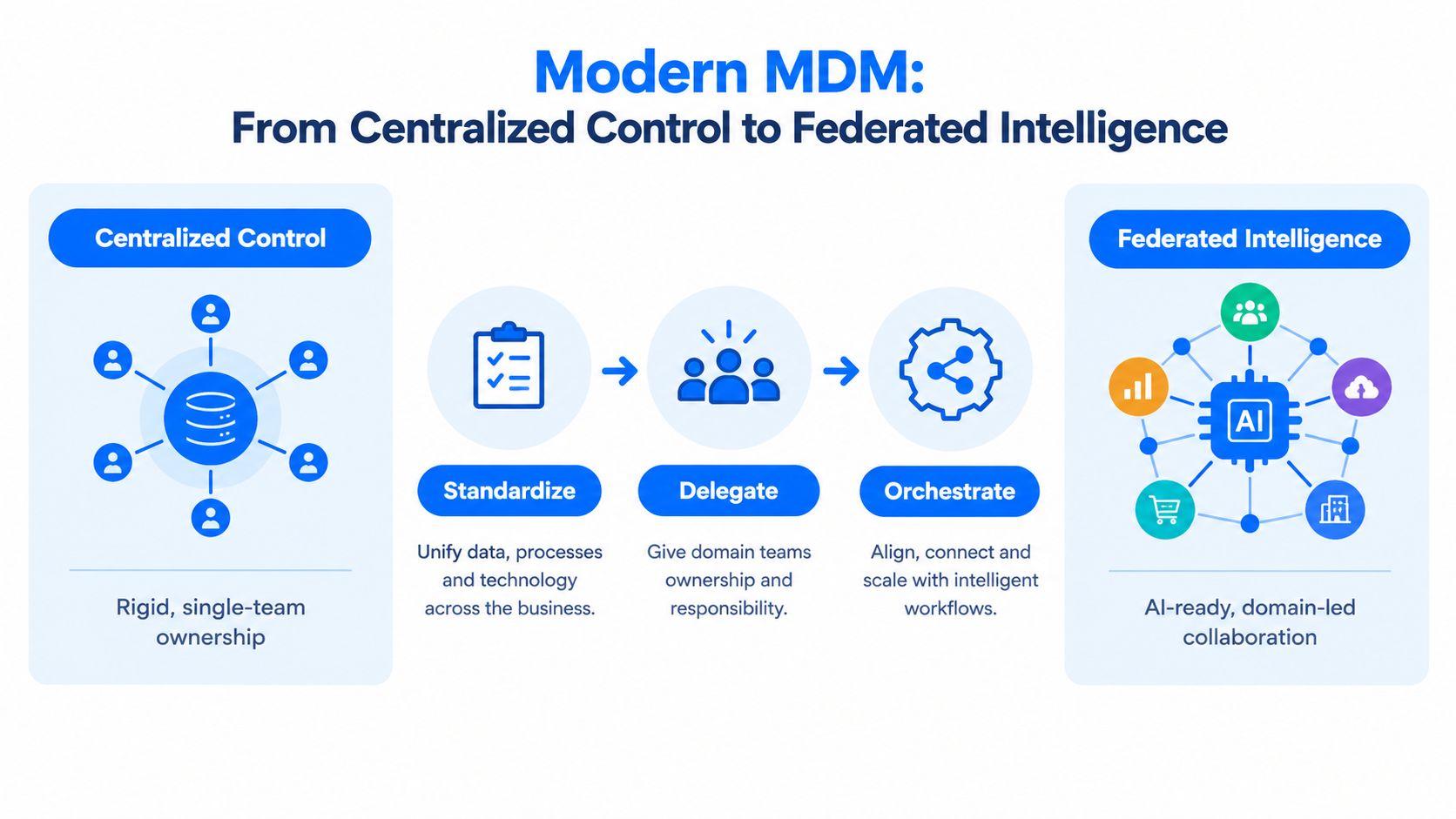
Traditional MDM often placed a central team in charge of models, rules, approvals, and publication. That approach can create consistency, but it also creates a queue. Domain experts wait for a central group to understand product classifications, customer relationships, supplier exceptions, or local regulatory needs.
A federated operating model distributes responsibility to domain teams while preserving enterprise standards. The customer domain can manage customer-specific decisions, the product domain can own product semantics, and a central governance function can define shared policies for identity, lineage, privacy, and auditability. Federation isn't the removal of control. It is the placement of control closer to the people who understand the data, with enterprise guardrails that prevent incompatible local practices.
Autonomy with a common contract
The operating model works when teams share a common contract. That contract can define entity identifiers, minimum required attributes, security classifications, lineage expectations, approval roles, and quality signals. Domain teams can then manage local enrichment and workflows without redefining enterprise identity or bypassing compliance controls.
The federated data model explained by digna helps clarify the distinction between distributed responsibility and uncontrolled duplication. A federated MDM program needs shared metadata and policy enforcement, not merely multiple independent repositories.
AI changes the work, not the accountability
AI and machine learning can support matching, rule mining, enrichment, anomaly detection, and stewardship triage. A model might surface likely duplicates, identify a recurring invalid value, recommend a mapping, or send only ambiguous cases to a human steward. Those capabilities reduce repetitive work, but they don't eliminate the need for explainability and review.
A steward should be able to see why two records were linked, which evidence supported a recommendation, and what policy governed the decision. Privacy, access controls, audit trails, and regulatory review remain essential because an opaque automated match can create a larger problem than an obvious duplicate.
Forrester's discussion of MDM solutions in 2025 describes a market moving toward federation, agility, intelligence, and stronger self-service expectations. It also highlights the tension between AI adoption and the privacy and governance controls required for enterprise use. Cloud-native platforms are gaining attention because they can offer faster time to value and interoperability, while legacy implementations are often criticized for technical overhead and long delivery cycles.
Operating principle: Let domains make context-rich decisions, but make identity, policy, lineage, and auditability visible across the enterprise.
Selecting and Implementing Your MDM Solution
Start with the business domain that creates the most operational friction. Customer, product, supplier, location, and asset data have different matching patterns, ownership structures, and downstream consequences. A product-first program may depend on specifications and hierarchies, while a customer-first program may depend on identity resolution, relationships, and consent context.
Evaluate the platform and the operating model together
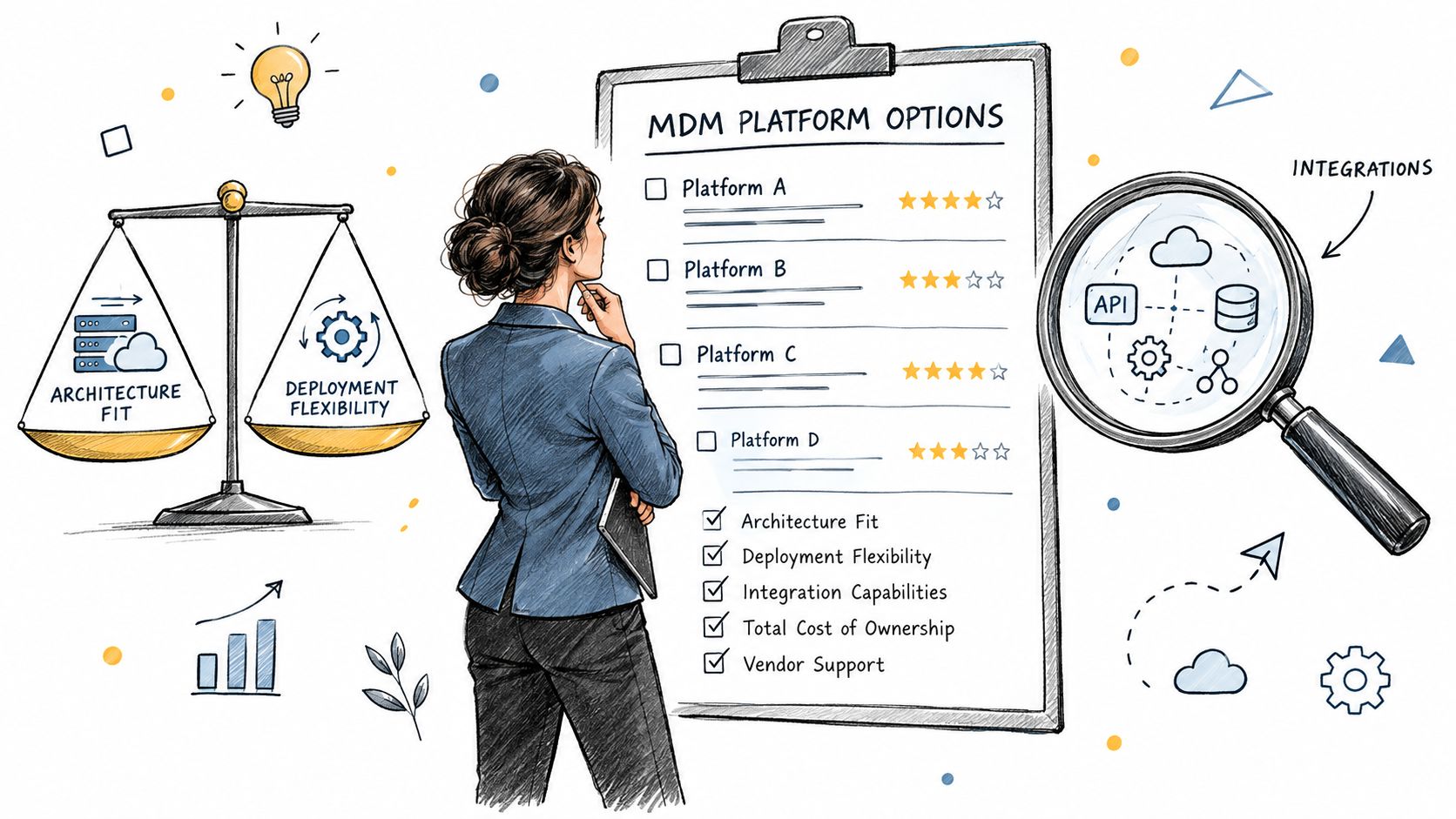
Assess architecture compatibility before comparing feature checklists. Confirm that the candidate can connect to the actual CRM, ERP, billing, warehouse, and analytics systems in scope. Ask which integrations are native, which require custom work, and how mastered records return to source applications.
Evaluate these areas:
Entity modeling: Can the platform represent relationships, hierarchies, and cross-domain links?
Matching transparency: Can stewards inspect confidence, evidence, survivorship, and overrides?
Governance workflows: Can ownership, approvals, roles, policies, and audit history be configured?
Deployment flexibility: Does the model fit on-premises, private cloud, or hybrid constraints?
Operational behavior: Can the system serve live applications as well as analytical consumers?
Total cost: Include implementation, integration maintenance, stewardship, platform operations, and change management.
A feature-rich platform can still fail if data owners aren't assigned or stewards have no capacity. Treat organizational readiness as an implementation dependency, not a soft concern.
Roll out by domain and feedback loop
Begin with a defined domain, a small set of high-value source systems, and measurable quality rules. Profile data before designing the model, document exception paths, and test matching against records that stewards already understand. Publish mastered data to one or more meaningful consumers, then use feedback to improve rules and workflows.
Avoid a “big bang” rollout that attempts to model every enterprise entity at once. Iterative delivery exposes unresolved ownership and semantics earlier, while giving engineering and stewardship teams a working pattern to extend.
A useful implementation review asks:
Can users explain which record became the golden record and why?
Can engineers trace each important attribute back to its source?
Can stewards correct uncertain matches without developer intervention?
Can consuming applications receive updates reliably?
Can quality monitoring detect drift after go-live?
Tools for data quality management and continuous validation can complement MDM where teams need ongoing checks after consolidation. The selection decision should prioritize a sustainable operating model over an impressive demonstration.
Looking Ahead The Future of Master Data Management
The next phase of MDM will be defined less by the central repository and more by the operating network around it. Domain teams will expect self-service workflows, engineers will expect interoperable APIs and events, and governance teams will expect evidence that automated decisions remain explainable. The platform must support all three without turning every change into a central approval queue.
AI-native MDM will likely help teams identify duplicate entities, recommend mappings, classify attributes, and prioritize stewardship work. The safe design pattern keeps people accountable for consequential decisions. Automation can rank or enrich a case, but the system should retain the evidence, rule context, confidence, and approval history needed for review.
Observability becomes part of the control loop
Master data quality is not static. A record can pass validation during onboarding and become unreliable after a source-system release, a delayed feed, a changed schema, or a shift in business behavior. Observability gives teams a way to watch the system continuously rather than relying on periodic audits.
Actian defines data observability across freshness, volume, schema, quality, and lineage. Its baseline-driven approach can learn what normal looks like for an asset and flag deviations, such as a delayed arrival, unexpected row volume, structural change, or sudden increase in null values.
Database observability adds another layer. A technical overview of database observability describes analysis of query execution plans, wait events, workload patterns, resource usage, and configuration changes in both real time and historical context. For MDM, that means teams can investigate not only whether a mastered dataset is wrong, but also whether blocking, resource constraints, or configuration drift delayed its processing or distribution.
The fragmented enterprise gets a different answer
Return to the opening situation. The CRM, ERP, and analytics platforms still have different local responsibilities, but they no longer need to produce conflicting interpretations of the same customer or product. A federated model lets domain teams maintain context, while shared identity, governance, lineage, and observability controls keep the enterprise aligned.
MDM will also converge more closely with data fabric and broader metadata architectures. That convergence shouldn't be treated as a reason to purchase another abstraction layer. The practical question is whether engineers and stewards can discover a record, understand its meaning, trace its history, monitor its quality, and distribute it safely.
The enduring lesson is that MDM isn't finished when the golden record is created. It becomes valuable when an organization treats master data as an operational asset with named owners, measurable quality, continuous monitoring, and clear accountability. That combination supports reliable reporting today and gives AI systems a more trustworthy foundation tomorrow.
digna provides data quality and data observability capabilities for monitoring master data behavior, validating records, tracking timeliness, detecting schema changes, and analyzing data inside a customer-controlled environment. Visit digna to explore a modular approach to keeping mastered data reliable for analytics, operations, and AI.
When a source-system release renames or drops a column that feeds your golden record, digna Schema Tracker flags the structural change before the mastered data reaches downstream applications.
Frequently asked questions
What is a solution master data management platform?
It is software that creates governed, reusable records for core entities such as customers, products, suppliers, assets and locations. Rather than copying data into another database, it matches records that describe the same entity, resolves conflicting attributes, assigns ownership, keeps lineage and distributes trusted data to applications.
What is a golden record in MDM?
A golden record is the governed version of an entity assembled from source records and business rules. If the CRM holds "Robert Smith", billing holds "R. Smith" and support only a phone number, MDM links them and keeps the best verified attributes without erasing source lineage.
What are the three pillars of a reliable MDM program?
Data consolidation, data governance and data quality management. Consolidation connects records from relevant systems into one model, governance decides who owns definitions and approves changes, and quality management checks timeliness, validity, accuracy, completeness and consistency. A weakness in any one pillar quickly undermines the other two.
Which deployment model should you choose for MDM?
Choose based on your risk profile, not on popularity. On-premises gives direct control but adds patching and hardware work, private cloud offers cloud automation inside a customer-controlled environment, and hybrid keeps sensitive domains controlled while connecting cloud apps, at the cost of synchronization and duplicate operations.
How should an MDM implementation be rolled out?
Domain by domain, not as a big bang. Start with the domain causing the most operational friction, a few high-value source systems and measurable quality rules. Profile data first, test matching on records stewards already know, publish to one real consumer, and keep monitoring for drift after go-live.