Definition of Master Data Management: What It Actually Means
|
6
min di lettura

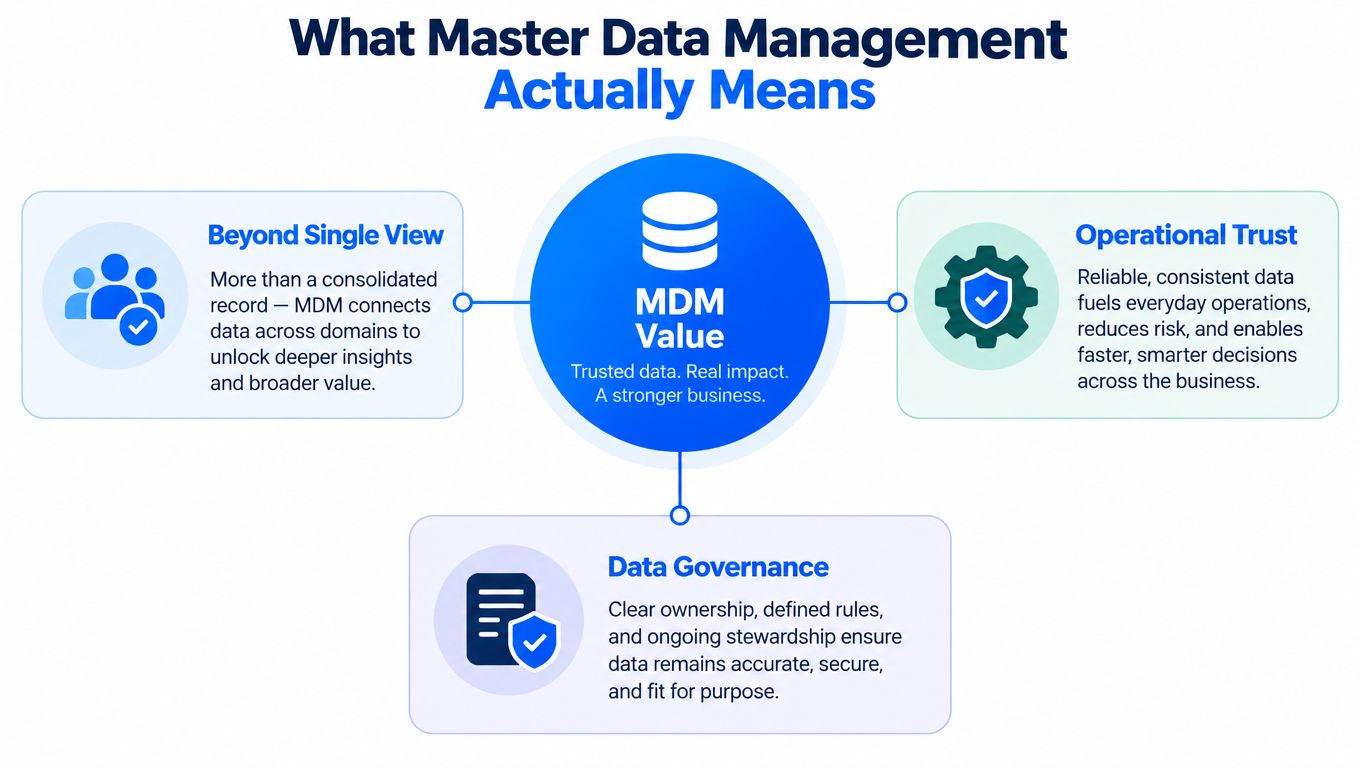
What if the biggest mistake in the definition of master data management is treating it like a cleanup job? That view misses the core point. MDM is the discipline that decides which business data counts, who can change it, how it stays consistent, and how the rest of the company can trust it.
In practice, that means MDM sits between business meaning and technical execution. It gives teams a shared way to manage customers, suppliers, products, locations, employees, and accounts across systems, so every downstream process works from the same reference point. When that foundation is weak, reporting drifts, workflows split apart, and AI systems inherit confusion instead of clarity.
Table of Contents
What Master Data Management Actually Means
People first meet MDM as a way to create a single trusted view of customers or products. That's part of it, but it's not the whole answer. A stronger way to think about the definition of master data management is as a technology-enabled discipline where business and IT work together to ensure uniformity, accuracy, stewardship, semantic consistency, and accountability across the organization's shared master data assets, as described in Gartner's glossary on MDM. Gartner's MDM glossary
MDM is more than cleaning
Cleaning data removes obvious errors. MDM goes further by deciding what the authoritative version of a business entity should be, how that entity is governed, and how it travels across applications without losing meaning. A customer in sales, finance, and support might have different source records, but MDM creates the governed reference point those teams can rely on.
That's why MDM is tied to operational trust, not just data hygiene. ISO/IEC 25024 defines master data as the data held by an organization that describes key entities fundamental to the enterprise and needed to perform transactions, which makes the point clear, master data supports the business itself, not only analytics. ISO/IEC 25024 framing of master data
Practical rule: If a record influences transactions, customer service, compliance, or reporting, it belongs in the MDM conversation.
Why the business side matters
A lot of teams assume MDM belongs only to IT because the work sounds technical. In reality, business teams decide what a “customer” is, which product attributes matter, and when two records should merge. IT then implements the rules, integrations, and controls that make those decisions repeatable.
That's also why MDM reduces duplication and improves synchronization. When systems share one authoritative record per core entity, downstream applications stop arguing over identifiers, attributes, and ownership. For a broader operational view of the data layer around MDM, the data modernization guide from Software Modernization Intelligence is a useful companion read.
A simple example helps. If procurement, accounting, and logistics each maintain their own supplier list, every update becomes a guessing game. With MDM, the supplier record is governed once, then reused everywhere that record matters.
For teams also mapping formal governance models, the digna DAMA DMBOK page is a practical reference point for aligning MDM with broader data management thinking.
Core Components That Make MDM Work
MDM only works when several pieces fit together. If any one of them is missing, the program turns into a brittle repository, a manual cleanup queue, or a naming-standard project with no authority behind it.
Entity resolution and the golden record
The technical heart of MDM is entity resolution. Systems match many source records to one surviving or golden record per entity, usually by combining matching algorithms with governance rules, as SAP describes in its MDM documentation. SAP on entity resolution and golden records
That single surviving record isn't just a duplicate removed from a list. It becomes the controlled version used by applications, analytics, and operational workflows. When the record is right, finance posts to the right account, support sees the right customer, and reporting stops splitting one entity into several.
Stewardship, identifiers, and shared meaning
The second pillar is data stewardship. People need to own decisions about merges, exceptions, and attribute rules, because business context changes faster than software rules do. A good steward doesn't just approve records, they keep the meaning of the record stable when source systems disagree.
Standardized identifiers matter just as much. If one system calls a supplier by a tax ID and another by an internal code, MDM has to reconcile those references before any downstream process can trust them. That's why MDM is so often the quiet layer behind cross-system integration.
The best MDM programs make trust visible. Teams know who owns each entity, which rule created the record, and where the record came from.
What the 360-degree view really means
The phrase 360-degree view gets overused, but in MDM it has a specific meaning. It's the complete governed record that applications and teams can reuse without rebuilding the same entity picture over and over. That view depends on matching, merging, enrichment, and standardization working together, not as separate tasks but as one discipline.

For readers deciding which entities deserve attention first, the digna critical data elements page is a useful reminder that not every field deserves master data treatment.
How Master Data Management Evolved
MDM wasn't invented as a software category. It grew out of a long operational problem, the need to keep core business entities consistent across systems that kept multiplying faster than manual control could handle.
From master files to enterprise governance
The historical arc starts much earlier than commonly understood. One industry history traces early master files to the late 1800s, with 1890 marking Hollerith's punch-card census system, 1898 tied to the lateral file concept, and 1936 bringing a Social Security Administration master file into the picture. The same history notes that computerized data-management concepts accelerated in the 1960s, early MDM software programs appeared in the 1980s, and the term gained broader use in the 1990s. History of master data and MDM milestones
Those dates matter because they show a pattern. Every time organizations grew more complex, they needed a more reliable reference layer for people, places, and things.
Standards turned practice into discipline
MDM later became more formal because standards started treating master data quality as a governance issue, not a cleanup task. ISO 8000 frames master data quality as a global concern, while ISO/IEC 25024 defines master data as data held by an organization that describes key entities fundamental to the enterprise and needed to perform transactions. That shift turned MDM into a foundational part of operational integrity.
The modern takeaway is simple. MDM exists because enterprises can't run critical work on fragmented records and expect stable outcomes. The technology changed, but the need stayed the same.
For teams building their own operating model, the digna data management frameworks guide helps connect that history to practical governance choices.
Common MDM Architectures Explained
The right MDM architecture depends on what you're trying to protect. Some organizations need speed and low disruption. Others need tight control, strong centralization, or easier governance across regulated data.
Registry and centralized models
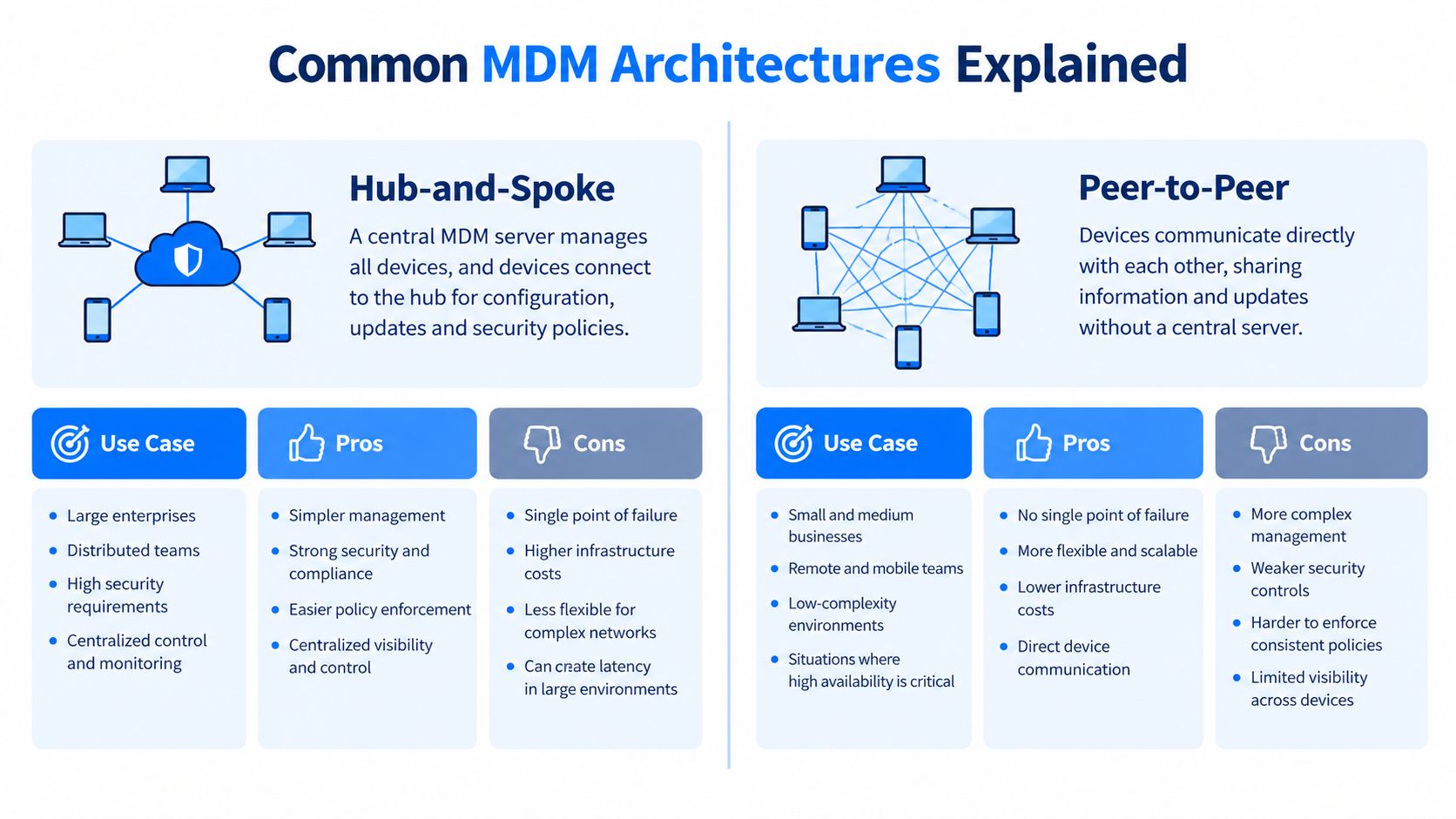
A registry model keeps pointers to authoritative source systems without physically moving all records into one repository. That makes it lighter on data movement and can fit environments where source systems already remain highly trusted. The tradeoff is that every lookup depends on the sources staying available and consistent.
A centralized storage model gathers master data into one repository. That usually makes governance simpler because the master record lives in one place, but it also increases the need to manage synchronization, latency, and data movement carefully. In other words, you gain control, but you also take on more responsibility for the stored copy.
How to choose between them
The better choice depends on the business problem, not on fashion. If your organization needs minimal duplication and can tolerate distributed source dependence, a registry-style design may fit. If your teams need a single managed store with strong oversight, centralized storage is often the more natural path.
Decision factor | Registry model | Centralized storage model |
|---|---|---|
Data movement | Low | Higher |
Governance load | More dependent on sources | More dependent on the MDM hub |
Operational fit | Distributed environments | Controlled enterprise reference layer |
Main risk | Source inconsistency | Repository synchronization |
The digna system of record vs source of truth guide is a useful lens here, because architecture decisions often fail when teams confuse ownership with truth.
Real-World MDM Use Cases by Industry
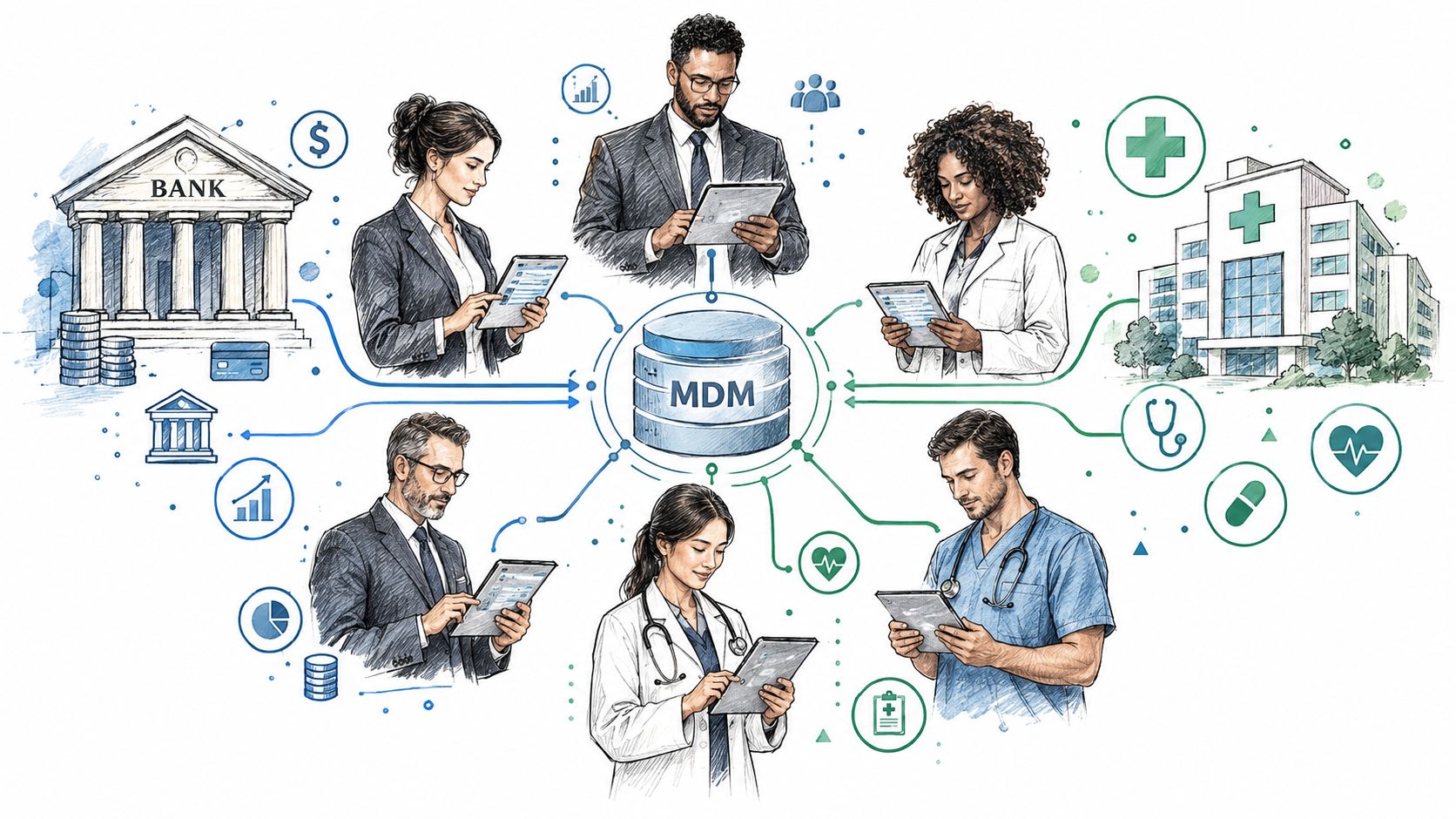
MDM becomes easier to understand when you see the pressure it relieves in specific industries. The data problems differ, but the logic stays the same, critical entities need one governed identity that teams can trust.
Financial services and healthcare
In financial services, MDM helps maintain reliable customer, account, and transaction data, which supports risk reporting and cleaner regulatory workflows. That matters because a fragmented record can distort how institutions see exposure, relationships, and obligations. In healthcare, MDM helps unify patient, provider, and treatment information so care teams aren't making decisions from half-complete records.
The difference between those sectors is detail, not principle. Both need accuracy, traceability, and controlled reuse of core records.
Telecom and the public sector
Telecommunications organizations deal with high-volume customer and operational data, so MDM helps them keep identities, services, and accounts aligned across multiple systems. Public sector agencies use MDM to consolidate citizen, program, and asset data, which helps maintain audit-ready evidence and more consistent service delivery.
A useful way to frame these examples is by the type of risk they reduce:
Financial services: MDM supports trustworthy risk reporting and transactional integrity.
Healthcare: MDM reduces confusion across patient-facing and operational records.
Telecom: MDM helps keep high-volume customer data synchronized across systems.
Public sector: MDM strengthens consistency, evidence, and cross-agency coordination.
The digna customer master data management page is relevant here because customer identity is often the first domain organizations try to stabilize.
Why MDM Definitions Miss the Modern Challenge
A lot of MDM definitions still stop at “single view” or “single source of truth.” That language is useful, but it can hide a harder question, what happens when context changes the meaning of truth?
One truth is not always enough
Recent commentary frames MDM as moving beyond back-office standardization toward context-aware governance and record-level trust, where a version of truth can vary by bounded context rather than staying fixed for every use case. That matters more now because AI-driven workflows and probabilistic data usage can produce multiple plausible interpretations of the same entity.
A customer record used for billing may not need the same shape or confidence level as the same customer record used for personalization. MDM has to govern both without pretending they're identical problems.
Modern MDM asks a harder question than deduplication, which version of the record is trusted for this decision?
What changes in AI-heavy environments
AI systems don't remove the need for MDM, they raise the bar. When models consume inconsistent entities, the output can look precise while still being built on unstable foundations. That's why the newer view of MDM focuses less on a static master record and more on governed trust that can adapt to business context.
Many definitions feel dated. They describe the destination, a trusted record, but not the operating reality, where different workflows may need different confidence rules and different levels of survivorship. The modern challenge is to keep governance deterministic while letting context guide how data is used.
The result is a shift in mindset. MDM is no longer just about declaring one truth. It's about managing how truth is established, reused, and questioned across contexts.

Governance Patterns That Keep MDM Trustworthy
Technology can store a master record, but governance decides whether anyone should trust it. Without governance, MDM becomes a database with opinions. With governance, it becomes a business control.
Stewardship, policy, and auditability
The most durable MDM programs assign clear stewardship roles. Business owners define what the entity means, data stewards manage exceptions, and technical teams keep the rules enforced across systems. That structure matters because a record can be technically valid and still be wrong for the business.
Policy enforcement gives those roles teeth. If merge rules, update rights, and approval paths are undocumented, the master record becomes inconsistent the moment teams disagree. Audit trails close that gap by showing who changed what, when, and why, which is critical when compliance or internal review comes into play.
Governance is not just a quality check
Data quality checks catch bad values. Governance shapes the process that prevents bad values from spreading in the first place. That difference matters because MDM without governance is fragile, while governance without MDM technology is incomplete.
The practical pattern looks like this:
Define ownership clearly: Each core entity should have a business owner and a steward.
Set merge and survivorship rules: Teams need a repeatable way to choose the surviving record.
Track exceptions: Outliers should be visible, not buried in workflow noise.
Review changes regularly: Governance only works if it stays current with the business.
digna is one option for teams that need in-database validation, schema tracking, anomaly detection, and timeliness monitoring around master data after cleanup. Those controls don't replace MDM governance, but they can help keep master records trustworthy as pipelines and business rules change.
Getting Started with Master Data Management
A good MDM program starts with scope, not software. Teams that jump straight into tools often end up automating confusion instead of solving it.
A simple readiness check
Start by identifying the business entities that cause the most friction. If customer, product, supplier, or location data creates repeated errors across teams, that domain probably belongs near the top of the list. Then ask which systems currently act like sources of truth, because many organizations have several competing versions already.
Use this short checklist:
Name the critical entities. Focus on records that affect transactions, service, or compliance.
Map the owning teams. Identify who defines the entity and who updates it.
Trace the source systems. Find where the same record is created, changed, and reused.
Decide the first domain. Start where business impact is visible, not where the data model looks simplest.
Set governance early. Assign stewardship before you try to merge anything.
Questions worth asking before implementation
What breaks when the record is wrong? Who notices first? Which downstream process suffers most? Those questions keep the work grounded in business value instead of technical neatness.
Start with one domain, one steward group, and one clear business outcome. Expansion comes after the first record set proves it can stay trustworthy.
If you want a practical next step, visit digna to see how its data quality and observability platform can support the monitoring and validation side of master data work inside your own environment.
To keep merge and survivorship rules enforced once the golden record is live, rule-based data validation that runs inside your database turns stewardship decisions into checks on every load.
Frequently asked questions
What is the definition of master data management?
Master data management is a technology-enabled discipline in which business and IT work together to keep shared master data uniform, accurate, stewarded, semantically consistent and accountable. It decides which business data counts, who can change it and how customers, suppliers, products and accounts stay consistent across every system.
Is master data management the same as data cleansing?
No. Cleansing removes obvious errors, while MDM decides what the authoritative version of a business entity should be, how it is governed and how it travels between applications without losing meaning. A customer can hold different records in sales, finance and support, yet MDM gives all three one governed reference point.
What is a golden record in MDM?
A golden record is the single surviving version of an entity that MDM produces after entity resolution. Systems match many source records to it by combining matching algorithms with governance rules. Applications, analytics and workflows then use it, so finance posts to the right account and support sees the right customer.
What is the difference between a registry and a centralized MDM model?
The two models differ in where master data lives. A registry keeps pointers to trusted source systems and moves little data, but every lookup depends on those sources staying available and consistent. A centralized model stores master data in one hub, which simplifies governance but adds synchronization and latency work.
How should an organization start with master data management?
Start with scope rather than software. Name the critical entities that affect transactions, service or compliance, map the teams that own them, trace the source systems, pick the first domain where business impact is visible, and assign stewardship before merging anything. Expand only once that first record set stays trustworthy.