Data Completeness: What DAMA Says and How to Measure It
|
6
min. Lesezeit

The most popular advice about data completeness is also the most misleading: count the NULL values and call the job finished. What is Data Completeness? It's the degree to which all data required for a particular purpose is present. That definition changes the question from “Are there empty cells?” to “Does this dataset contain what the business process, report, model, or control needs?”
A populated field can still contain the wrong value, while a NULL in an optional field may have no practical impact. Completeness is therefore a fitness-for-use question, not a demand for abstract perfection. The United Nations guidance on coverage and completeness makes the same conceptual distinction in official statistics, where completeness compares registered events with the world total they are intended to represent.
Table of Contents
What Data Completeness Really Means
Data Completeness is the degree to which all data required for a particular purpose is present. In an enterprise dataset, that can mean populated mandatory attributes, complete business records, expected record populations, required reporting periods, or all source datasets needed by a downstream process.
This is why completeness isn't just the absence of NULL values. Suppose a customer table contains a missing customer ID. That is a completeness failure when the identifier is required for joins, reconciliation, or reporting. A missing secondary marketing preference may be acceptable if the intended use doesn't depend on it.
The distinction also separates completeness from other data quality dimensions. If an address is present but incorrect, the problem concerns accuracy. If a phone number is present but violates the required format, the problem concerns validity. Completeness asks only whether the required information exists within the defined scope.
Start with the business purpose
Before choosing a metric, identify what the data must support:
Regulatory reporting may require every reportable entity and mandatory attribute.
Operational processing may depend on identifiers, dates, and status fields.
Analytics may tolerate missing enrichment attributes if the core population remains available.
AI development requires sufficient fields, records, and time periods for the intended analysis, because missingness can reduce analyzable sample size and produce biased or imprecise estimates, as described in this NIH-hosted review of missing data.
Practical rule: Define what “complete enough” means before measuring it. Otherwise, a dashboard reports a number without telling anyone whether the number supports the decision.
A useful working definition is: the required records, fields, relationships, and delivery periods are present in the expected scope and cadence for a defined use case. That definition gives data owners something they can turn into controls.
The Five Types of Completeness Worth Measuring
Organizations need more than one completeness lens because missing values and missing populations are different failures. The five types below cover common enterprise monitoring needs, although teams should select the combination that matches the business requirement.
Attribute completeness
Attribute completeness asks whether required fields are populated. Typical examples include:
Missing customer IDs
Missing transaction dates
Missing account numbers
NULLbusiness attributes required by a report or process
A customer record may exist, but if its identifier is absent, the record may be unusable for deduplication or joins. The relevant measure is the share of expected records containing a value in the specified attribute.
Record completeness
Record completeness asks whether each available record contains all mandatory fields together. A transaction might have a transaction ID and amount but lack its customer ID, currency, or transaction date. Counting the row as present would hide the fact that the record isn't operationally complete.
Record-count completeness
Record-count completeness compares delivered population with the expected population. For example, a daily transaction table that normally contains 10 million records but suddenly contains 7 million records has a population completeness issue, even if every delivered row has perfectly populated fields.
The DAMA data-quality research paper supports this broader view by discussing completeness across records, files, attributes, and metadata.
Temporal completeness
Temporal completeness checks whether all expected dates or reporting periods are present. A finance pipeline can load successfully while omitting a reporting day, month, or partition. The table may contain valid rows, but the time series is incomplete.
Dataset completeness
Dataset completeness asks whether every dataset required by a downstream process is available. A monthly reporting workflow might need customer, transaction, product, and exchange-rate datasets. If one source doesn't arrive, the workflow's inputs are incomplete even when the other tables are populated.
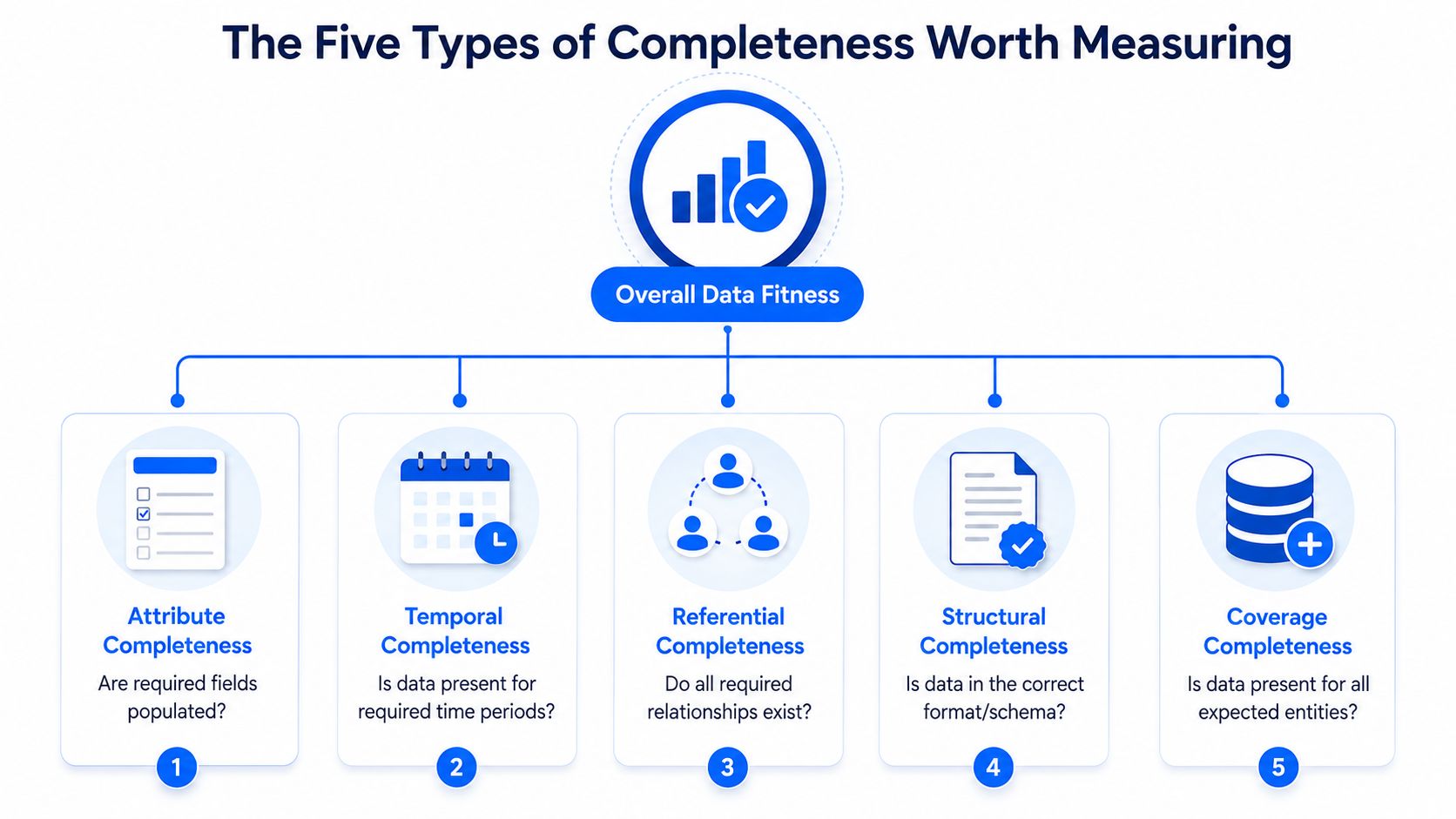
These checks aren't interchangeable. A team may need attribute and record completeness for a customer master, record-count and temporal completeness for transactions, and dataset completeness for an orchestration dependency.
How DAMA and DMBOK Approach Completeness
DAMA International and the DAMA-DMBOK® 2.0 Revised Edition treat completeness as a Data Quality dimension. The framework is most useful when teams apply completeness in relation to business requirements and fitness for use, rather than treating it as a universal technical score. The DAMA and data management frameworks overview provides related context for positioning data quality within broader management practices.
DAMA's framing aligns with a practical question: what must be known for this data to perform its intended role? The UK Government's data quality guidance states that data is complete when all data required for a particular use is present, and it advises measuring completeness for critical data rather than every field in every dataset.
That means 100% completeness isn't automatically the right requirement for every dataset. A 98% completeness rate might be acceptable for one analytical use case but unacceptable for regulatory reporting. Those values illustrate a governance decision, not universal thresholds.
Set requirements by impact
A useful policy connects completeness to consequences:
Identify the report, model, process, or control that consumes the data.
Define the records and attributes it cannot operate without.
Establish an acceptable completeness threshold with the data owner.
Document what happens when the threshold is missed.
Review the requirement when the use case changes.
A primary key, regulatory attribute, or transaction identifier usually deserves stricter treatment than optional descriptive enrichment. DAMA's contribution is the vocabulary and discipline to make that distinction explicit. It doesn't replace local ownership decisions.
Metrics and Formulas for Measuring Completeness
Data completeness metrics should measure the missingness that can affect a defined use case. A strong measurement model combines field-level, record-level, population-level, time-based, and dataset-level indicators instead of relying on one null count.
The basic formula is:
Completeness rate = populated required values / expected required values × 100
For attribute completeness, “populated required values” is the number of records with a value in the selected field. For record completeness, the numerator counts records containing every mandatory attribute. For population completeness, compare delivered records with the expected record population. The denominator must reflect the business definition of expected data, not merely the number of rows that happened to arrive.
Core measures
NULL rate: The share of records where a selected field is missing. It helps locate field-level gaps but doesn't reveal missing records or datasets.
Required-field coverage: The share of expected values populated for mandatory attributes.
Record counts: The number of records delivered for a defined load, partition, entity, or period.
Record-count variance: The difference between observed and expected volume, using a documented baseline or source reconciliation.
Dataset availability: Whether each required source, table, file, or partition is present.
Temporal coverage: Whether all required dates and reporting periods are represented.
Completeness trends: The movement of each measure over time, which helps distinguish a one-off incident from deterioration.
Metric | What It Measures | Typical Use |
|---|---|---|
NULL rate | Missing values in a selected attribute | Required customer ID or account number |
Required-field coverage | Populated mandatory values against expected values | Operational and regulatory controls |
Record count | Delivered row population | Batch and event-stream monitoring |
Record-count variance | Difference from expected volume | Detecting row loss or incomplete loads |
Temporal coverage | Presence of required periods | Finance, operations, and time-series analysis |
Dataset availability | Presence of required data sources | Downstream dependency checks |
Completeness trend | Change in completeness over time | Recurring issue and process-drift analysis |
The data quality metrics guidance from digna offers additional context for selecting measures. The important governance decision is to prioritize critical attributes and populations. Measuring every field equally creates noise and can make a serious gap harder to see.
How Completeness Differs From Accuracy and Validity
Completeness asks whether the required data is present. Accuracy asks whether it is correct. Validity asks whether it follows the required rules or format. These dimensions can fail independently, so teams should avoid assigning one generic “quality problem” label to all three.
Consider a customer phone number:
Completeness: Is a phone number present when the business requires one?
Validity: Does the value follow the accepted phone-number format?
Accuracy: Does the value match the customer's real phone number?

Completeness and accuracy
A missing phone number is a completeness problem. A correctly formatted phone number that belongs to another customer is an accuracy problem. The field is present in both cases, but only one value represents the real-world entity correctly.
Dataversity's explanation of data quality dimensions describes completeness as measuring what information is missing, not whether the stored information is accurate or valid. This separation matters because remediation differs. Missing data may require source-system completion or reprocessing, while inaccurate data may require verification, correction, or master-data stewardship.
Completeness and validity
A missing phone number is incomplete. A phone number containing letters when the schema requires a numeric pattern is invalid. A correctly formatted but wrong phone number is inaccurate.
Question | Dimension | Example |
|---|---|---|
Is the required value present? | Completeness | Phone number is missing |
Does it conform to the rule? | Validity | Phone number has an invalid format |
Does it match reality? | Accuracy | Number belongs to someone else |
IBM's distinction between completeness, accuracy, and validity reinforces this three-question model. Use it when assigning owners, designing tests, and explaining incidents to business stakeholders.
Monitoring Completeness Across Modern Pipelines
A technically successful pipeline doesn't necessarily produce complete data. Consider a warehouse receiving daily customer and transaction data: the ETL job finishes, orchestration reports success, and the target table is available, but the transaction volume is significantly lower than normal and required customer IDs show a sharp increase in NULL values.
A single pipeline status cannot detect both conditions. The first is a record-count or population problem. The second is attribute completeness. A monitoring design must examine the data after delivery, not only whether the code ran without an execution error.

Use layered controls
Deterministic validation checks known requirements, such as a mandatory customer ID not being
NULL.Anomaly detection identifies unexpected changes in record volume, null rates, distributions, or delivery behaviour.
Historical analytics shows whether the deviation is isolated, seasonal, recurring, or part of a longer deterioration.
Timeliness monitoring checks whether expected data arrived at the required time and cadence.
In this scenario, data completeness checks for enterprise pipelines can be organized around row loss, field loss, missing records, and missing fields. The control should also identify the source partition or delivery responsible for the gap, so engineers can investigate rather than merely observe a red status.
A successful ETL run proves that the process executed. It doesn't prove that the required business data arrived.
Continuity matters because completeness changes over time. A clean dataset today can become incomplete after a source-system release, a changed extraction filter, a late partition, or a workflow handoff. Continuous monitoring makes the condition visible close to when it changes.
How Can digna Support Data Completeness?
digna supports Data Completeness through distinct capabilities for explicit rules, unusual behaviour, and historical context. Each capability addresses a different layer, so a team shouldn't treat one module as a complete substitute for all completeness controls.
digna Data Validation
digna Data Validation supports known, rule-based requirements, including:
Required fields must not be
NULL.Every transaction must have a required identifier.
Mandatory business attributes must be populated.
Defined completeness rules must be satisfied.
This is the primary capability for requirements that can be stated directly and evaluated record by record.
digna Data Anomalies
digna Data Anomalies can identify unexpected changes in completeness-related behaviour, such as sudden increases in NULL rates, unexpected drops in record counts, significant distribution changes, and unusual deviations from historical data volumes.
Anomaly detection identifies unusual behaviour. It doesn't automatically prove that data is incomplete. A legitimate seasonal change may look unusual, while a subtle completeness failure may remain within a broad historical pattern. Teams still need business context and, where appropriate, explicit validation rules.
digna Data Analytics
digna Data Analytics provides historical context for completeness metrics. Teams can examine record-count trends, NULL-rate trends, historical completeness, recurring missing-data patterns, and changes between reporting periods.
Completeness requirement | Example | digna capability |
|---|---|---|
Required values | Required field must not be | Data Validation |
Record volume | Expected number of records | Data Anomalies |
Historical completeness | Detect deterioration over time | Data Analytics |
Dataset availability | Expected data source is present | Data Validation / Data Anomalies |
The mapping is deliberate. Validation enforces known conditions, anomalies surface unexpected behaviour, and analytics helps determine whether an issue is isolated or recurring.
Key Takeaways and Frequently Asked Questions
Data Completeness is a moving business condition, not a static null check. Define the required data for each use case, measure the relevant layer, and monitor whether records, attributes, periods, and datasets continue to arrive as expected.
What is Data Completeness?
It's the degree to which all data required for a particular purpose is present. The scope depends on fitness for use.
What are the types of Data Completeness?
Common types include attribute, record, record-count, temporal, and dataset completeness. Each addresses a different missing-data risk.
How is Data Completeness measured?
Use measures such as NULL rate, required-field coverage, record counts, record-count variance, dataset availability, temporal coverage, and completeness trends.
What does DAMA say about Data Completeness?
DAMA-DMBOK treats completeness as a Data Quality dimension and relates requirements to business needs and fitness for use.
Is 100% Data Completeness always required?
No. 100% isn't universally appropriate. A requirement should reflect the consequences of missing data for the intended use.
What is the difference between Completeness and Accuracy?
Completeness asks whether the required value is present. Accuracy asks whether that value is correct.
What is the difference between Completeness and Validity?
Completeness concerns presence. Validity concerns conformity to defined formats, rules, or standards.
How can Data Completeness be monitored continuously?
Combine rule-based validation, record and delivery monitoring, anomaly detection, and historical analysis across batch, streaming, and cross-system pipelines.
Which digna modules support Data Completeness?
digna Data Validation, digna Data Anomalies, and digna Data Analytics support different completeness needs. They should be mapped to the specific control rather than treated as interchangeable.
digna provides Data Validation, Data Anomalies, and Data Analytics capabilities for checking required values, identifying unusual record and null-rate behaviour, and analyzing completeness over time. Visit digna to see how these controls can fit into your data quality monitoring approach.