Data Asset Management a Practical Guide for 2026
|
7
min. Lesezeit

Your executive dashboard looked fine yesterday. This morning, revenue by region is off, a key KPI is blank, and nobody can say with confidence whether the issue came from a schema change, a late pipeline, or a business rule that stopped matching the source system. The data still exists, but it's no longer trustworthy.
That's the moment organizations often realize they haven't been managing data as an asset. They've been storing it, moving it, transforming it, and consuming it. But they haven't been governing it as something with owners, dependencies, operating standards, and failure modes. In modern platforms, data asset management is what turns datasets, metrics, features, and pipelines from technical byproducts into managed business infrastructure.
Table of Contents
Beyond the Media Folder Why We Need Data Asset Management
A lot of confusion starts with the acronym. Ask five people about asset management and at least a few will think about logos, campaign videos, product images, or brand files sitting in a digital asset management platform. That's a real discipline, but it's not the same problem as managing analytical tables, transformation logic, metrics layers, feature sets, or ML inputs.
The distinction matters because the operational risks are different. A missing image might delay a campaign. A silent column type change can corrupt a financial report, break a downstream model, or push bad numbers into a board presentation without triggering an obvious failure.
That's why data teams need to stop borrowing the media-centric definition and use a sharper one. A data asset isn't just a file or table. It's any data object that drives decisions, automation, compliance, or customer-facing behavior, together with the metadata, lineage, controls, and expectations needed to trust it.
A useful way to see the gap comes from the adjacent DAM market. A 2025 Mordor Intelligence report on the Digital Asset Management market states that 66.26% of DAM spend goes to AI tagging and workflows for media, which does nothing to detect silent data drift in ML inputs or broken business metrics. That's the core mismatch. Media DAM is optimized for discoverability and reuse of content assets. Data asset management has to deal with freshness, schema stability, transformation correctness, access policy, and downstream blast radius.
Practical rule: If a platform can tell you who downloaded the latest brand image but can't tell you which dashboards depend on a renamed column, it isn't solving data asset management.
This is why shared folders, wikis, and static catalogs fail so often in production. They document a snapshot of reality. Data platforms change continuously. New columns appear. Joins change. schedules slip. Producers and consumers drift apart. Without active monitoring, the documentation becomes historical fiction.
Teams that manage data well treat it like infrastructure. They assume change is constant, trust is earned, and visibility has to be continuous.
What Is Data Asset Management Really
Data asset management is the discipline of making business-critical data usable, trustworthy, controlled, and durable across its full lifecycle. That includes raw ingestion tables, curated models, metrics, dashboards, ML features, validation rules, ownership metadata, and the pipelines that connect them.
The simplest analogy is a city. A city doesn't function because someone drew a map. It functions because roads are maintained, water quality is monitored, power flow is controlled, access is regulated, and incidents are detected before they spread. Your data platform works the same way.
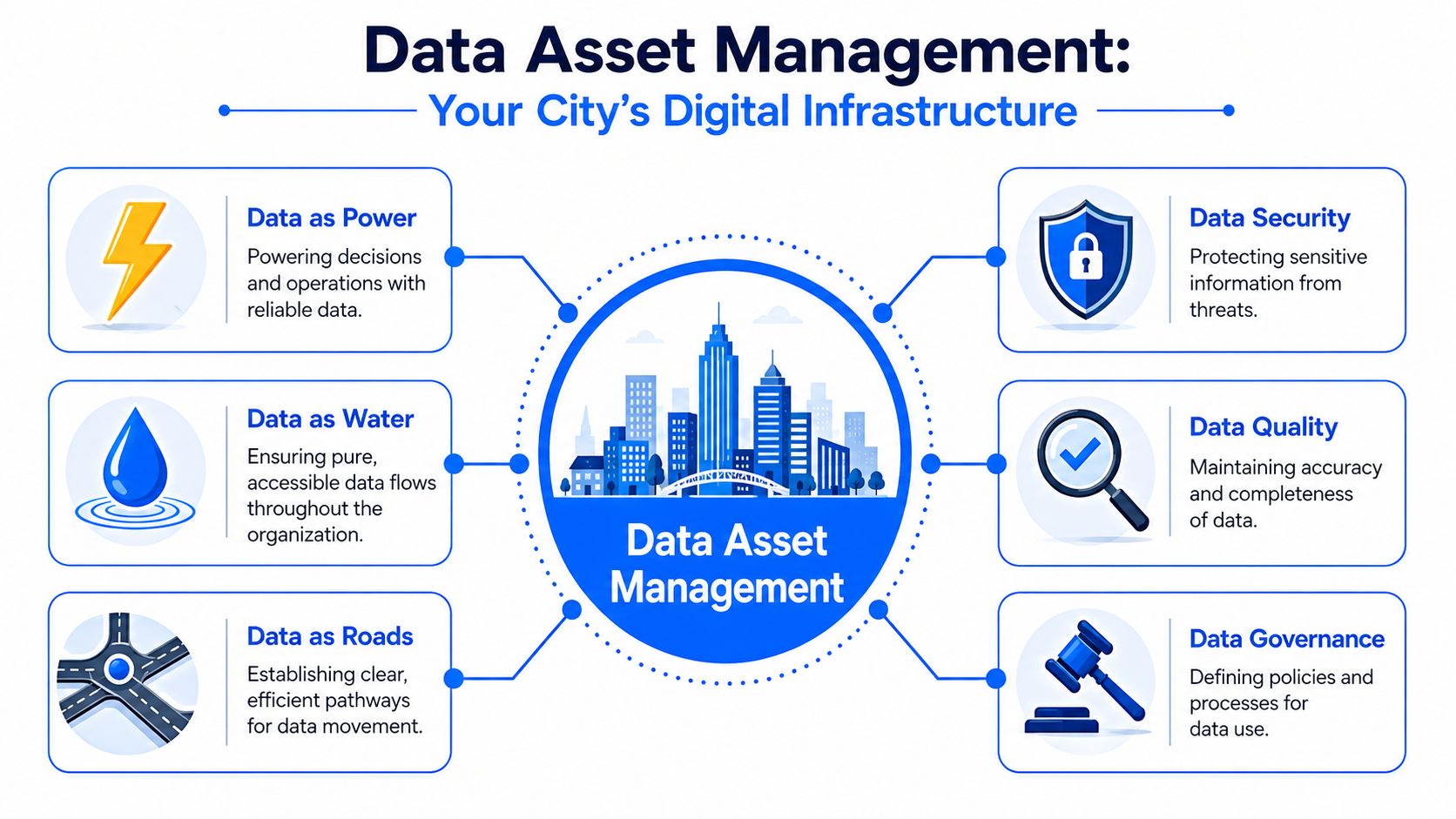
A catalog is only the street map
A data catalog matters, but it's only one layer. If all you have is an inventory of tables and descriptions, you haven't built management. You've built reference material.
Real management means asking operational questions and getting reliable answers:
Ownership: Who approves access, defines acceptable use, and signs off on breaking changes?
Quality: What conditions make this asset fit for use?
Lineage: Which reports, models, and downstream jobs depend on it?
Lifecycle: When is it created, changed, deprecated, archived, or retired?
Security: Which users can view, edit, export, or join it with other assets?
If your team is still treating metadata as optional admin work, it helps to revisit what a data catalog is in practice. The catalog is the foundation for discoverability. It isn't the operating model by itself.
The market signals are clear even if the terminology is messy. In a related field, the global Digital Asset Management market was valued at USD 4.22 billion in 2023 and is projected to reach USD 11.94 billion by 2030, while Europe accounts for 28% of that market according to Grand View Research's DAM market analysis. Enterprises are investing heavily in centralized asset control. Data teams need to apply that same seriousness to analytical assets, not just media libraries.
What belongs inside the asset boundary
One of the biggest mistakes I see is defining the asset too narrowly. Teams register tables, but ignore the logic and contracts around them. That creates false confidence.
A mature asset definition usually includes:
The object itself. A table, view, metric, feature set, event stream, or report.
Its business meaning. Definitions, approved use cases, and known limitations.
Its technical behavior. Schema, refresh pattern, dependencies, and lineage.
Its control plane. Owners, access rules, quality checks, and change procedures.
This matters even more in multilingual or distributed operating environments, where metadata quality and workflow consistency affect adoption. For teams dealing with cross-functional systems and governance handoffs, this comprehensive guide for developers on TMS is a useful parallel because it shows how structured workflow control becomes essential once multiple teams and contexts touch the same information assets.
A trustworthy data asset is one that can survive change without surprising its consumers.
That's the threshold. If a business user, analyst, or ML engineer can use a dataset safely because the context, controls, and downstream dependencies are visible, then the asset is being managed. If they're relying on tribal knowledge and Slack messages, it isn't.
Pillars of Modern Data Governance and Lifecycle
Most governance programs fail because they lean too hard on policy and not enough on operations. People write standards, publish stewardship matrices, and launch a catalog. Then the first upstream schema change lands on Friday night and half the Monday dashboards are wrong.
Governance only works when it's embedded in the runtime behavior of the platform.
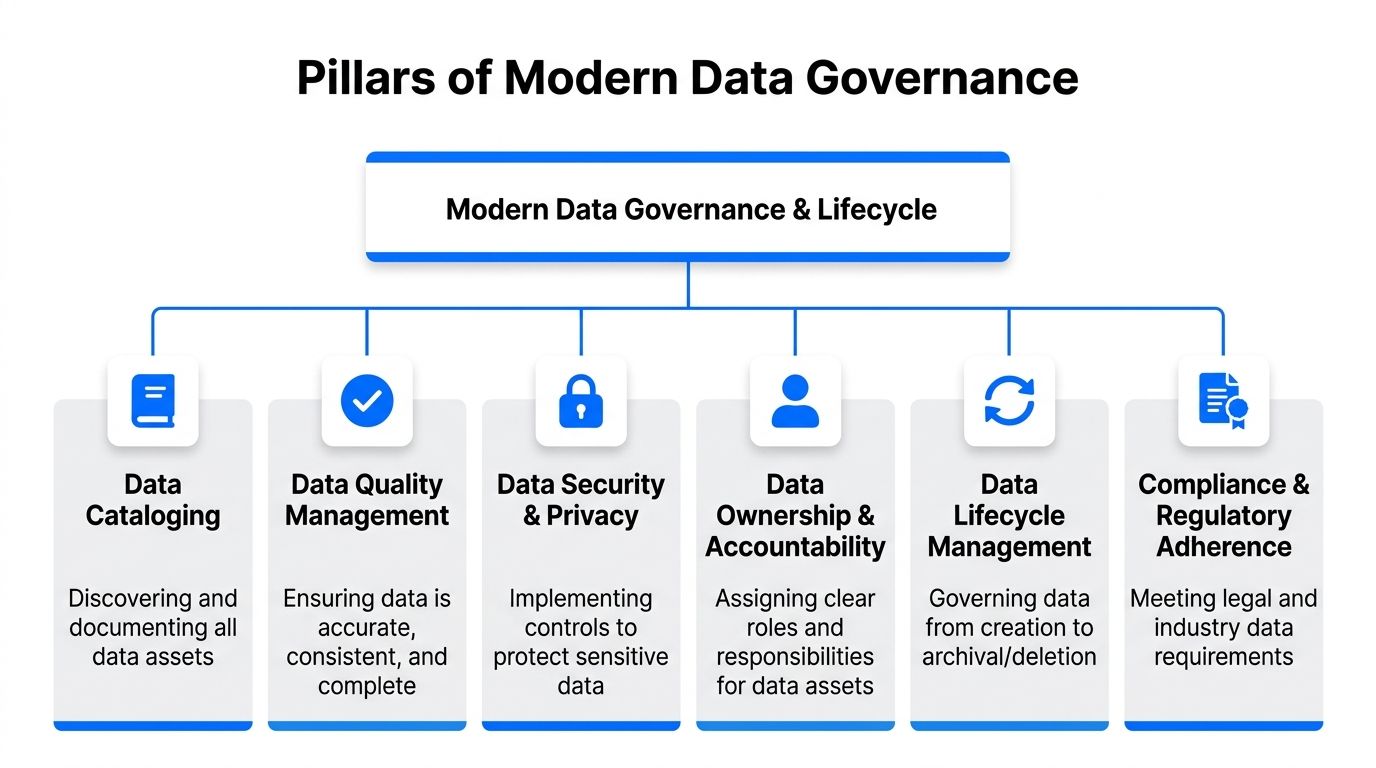
Ownership has to be explicit
Every critical asset needs someone accountable for business fitness and someone responsible for operational upkeep. When that split is fuzzy, incidents stall. Engineers wait for semantic clarification. Analysts wait for pipeline fixes. Nobody wants to approve access or retire stale logic.
Clear ownership usually means:
Business accountability: A data owner decides what the asset means, who should use it, and what counts as acceptable quality.
Operational stewardship: A steward or platform function keeps definitions, lineage, controls, and policy alignment current.
Technical execution: Engineers build, change, test, and monitor the data path.
Without this separation, organizations confuse data creation with data accountability. Those aren't the same thing.
Quality without lineage breaks down fast
Quality checks are often implemented as isolated tests. Null checks here, row-count checks there, maybe a freshness alert in orchestration. That's useful, but it doesn't answer the hard question: if something changes upstream, who gets hit downstream?
Automated lineage moves from nice-to-have to mandatory. According to OvalEdge's guide to enterprise data asset management software, platforms with end-to-end automated lineage and impact analysis achieve 40-60% faster governance enforcement than manual cataloging approaches because they can predict which assets will be impacted by upstream changes before failures occur. That speed matters because governance isn't just policy enforcement. It's incident prevention.
If lineage is manual, it will be incomplete. If it's incomplete, impact analysis will fail when you need it most.
Lineage also changes the operating model. Instead of discovering breakage from a dashboard complaint, teams can review affected reports, metrics, and models before promoting a change. That shifts governance from reactive cleanup to controlled change management.
For the resilience side of the picture, teams also need operational protection around the wider data estate. This guide on essential data protection for businesses is a helpful complement because recovery planning and governance fail together when organizations treat them as separate concerns.
Lifecycle management is operational, not ceremonial
Assets age. Definitions drift. pipelines get replaced. Regulatory requirements change. A metric that was once business-critical becomes legacy but keeps feeding downstream logic because nobody formally retired it.
That's why lifecycle management needs concrete events, not generic status labels:
Lifecycle stage | What good management looks like |
|---|---|
Creation | Naming, ownership, access policy, and quality expectations are defined before broad adoption |
Active use | Monitoring, lineage, validation, and issue triage are in place |
Change | Breaking and non-breaking changes are reviewed with downstream impact visible |
Deprecation | Consumers are notified and migration paths are documented |
Retirement | Access is removed, references are cleaned up, and the asset stops producing hidden dependencies |
Teams get the most value when they combine these pillars instead of treating them as separate workstreams. Ownership tells you who decides. Quality tells you whether the asset is fit for use. Lineage tells you what else will break. Lifecycle tells you when and how change should happen.
Mapping Data Asset Roles and Responsibilities
The fastest way to weaken a data asset management program is to make responsibility collective. Collective responsibility sounds collaborative, but in practice it means access requests sit unanswered, data quality rules never get approved, and incident reviews end with “the team” owning the action items.
A working program needs named roles with different decision rights.
A practical RACI for data platforms
The matrix below is simple on purpose. What's often needed is not more roles, but clearer ones.
For teams formalizing accountability, it's worth reviewing data owner responsibilities in enterprise settings, especially when ownership has been informal or inherited through technical control rather than business accountability.
Activity | Data Owner | Data Steward | Data Engineer | Data Consumer |
|---|---|---|---|---|
Define business meaning of a critical dataset | A | R | C | I |
Approve access policy and intended use | A | R | C | I |
Maintain metadata and business glossary alignment | C | A/R | I | I |
Build and operate ingestion and transformation pipelines | I | C | A/R | I |
Define technical quality checks | C | R | A | I |
Define business rule validations | A | R | C | I |
Review upstream schema changes | C | R | A | I |
Assess downstream impact on dashboards and models | A | R | C | C |
Triage incidents affecting trust or availability | A | R | R | I |
Consume data and report defects | I | I | I | R |
A few patterns usually work better than the org chart suggests:
Data owners should be close to business outcomes. A finance metric owner should sit with finance leadership or domain operations, not only inside the platform team.
Stewards should maintain meaning and control context. They're the connective tissue between semantic intent and runtime enforcement.
Engineers should own implementation, not business truth. They can encode rules, but they shouldn't be forced to invent them.
Consumers should have a feedback path. If analysts and ML teams can't flag suspect assets quickly, bad data survives too long.
Where tooling helps and where it doesn't
Tooling can't create accountability, but it can make accountability executable. Systems with strong metadata, search, and permissions reduce the amount of manual coordination needed to keep roles functioning.
According to Aprimo's overview of enterprise digital asset management capabilities, enterprise-grade systems with AI-driven search, deep metadata governance, and role-based access control can reduce specialist overhead for routine monitoring by 30-50% and achieve 35% higher operational efficiency. The underlying lesson transfers well to analytical data. If role assignment still lives in spreadsheets and exception handling still happens in chat threads, your governance model won't scale.
What tooling does well:
Enforce access boundaries by team, function, or geography.
Surface ownership metadata at the point of use.
Route review tasks when schemas, validations, or usage rights change.
Expose search and context so consumers don't need a steward for every lookup.
What tooling won't solve:
Poor domain ownership.
Undefined business rules.
Conflicts between platform teams and data-producing applications.
Leadership unwillingness to retire broken assets.
Good governance tooling removes friction from the right decisions. It doesn't make the decisions for you.
Concrete Implementation Patterns and Metrics
Most failed programs try to catalog everything, define every owner, and standardize every data product in one pass. That approach burns time, floods teams with low-value cleanup work, and delays the one thing that builds support: visible improvement on critical assets.
Start narrower.
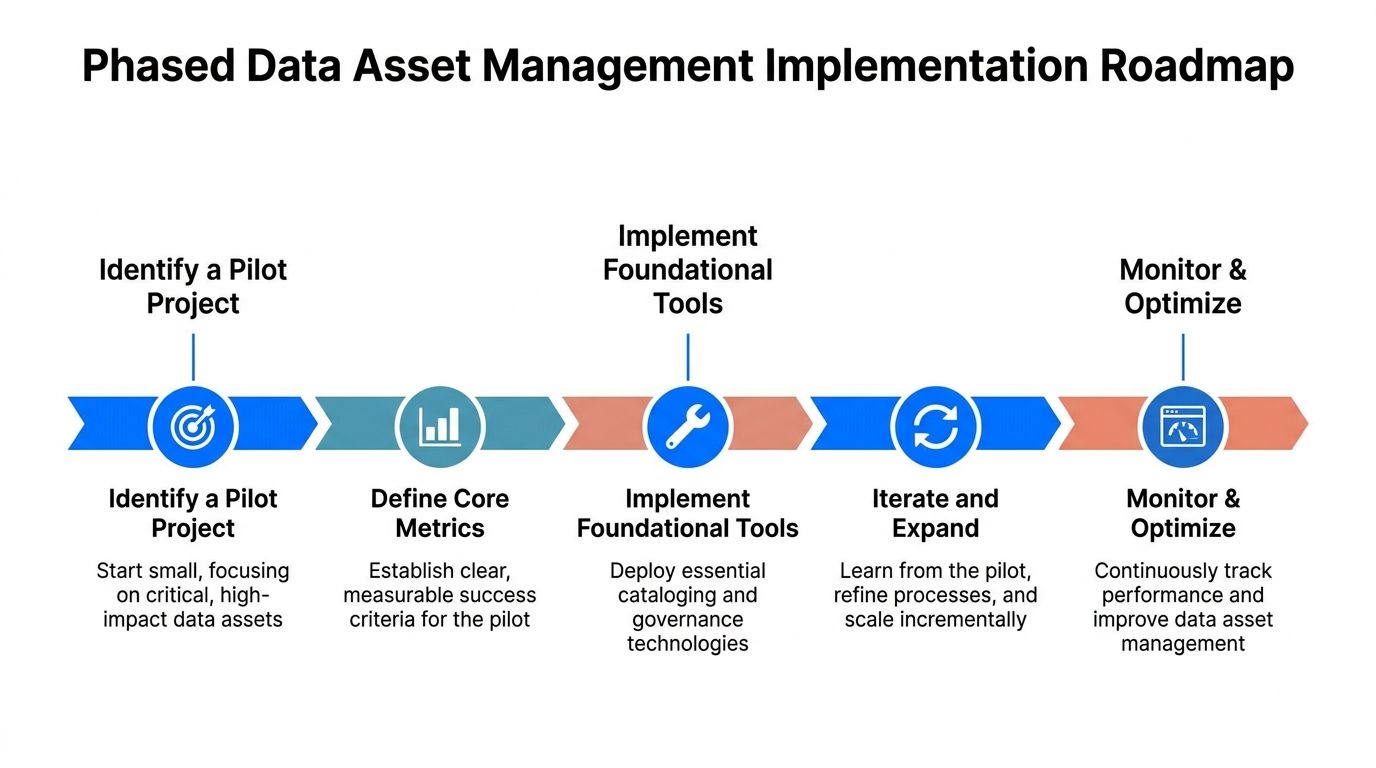
Start with a small control surface
Pick a pilot set of assets with three properties. They're business-critical, frequently consumed, and structurally connected to multiple downstream uses. In practice that might be revenue facts, customer master data, eligibility logic, claims events, order status, or the feature tables that support a production model.
A phased rollout usually works best:
Pilot one domain. Choose one domain where breakage is painful and visible.
Document expected behavior. Define refresh expectations, schema assumptions, acceptable null behavior, and business-rule constraints.
Add runtime monitoring. Watch timeliness, schema change, anomalies, and validation failures.
Connect ownership and escalation. Every alert needs a person and a response path.
Expand only after review. Scale the pattern, not the chaos.
The best early win is not “full governance coverage.” It's reducing uncertainty around a handful of assets that executives, operators, or customer-facing systems rely on every day.
Metrics that show whether the program is working
You don't need dozens of metrics. You need a few that reveal whether trust, responsiveness, and coverage are improving. A strong starting point includes:
Data downtime: The time an asset is unavailable or untrustworthy for its intended use.
Mean time to detection: How long it takes to identify a freshness, schema, or quality issue.
Mean time to resolution: How long it takes to restore trust and service.
Critical asset coverage: The share of priority assets with ownership, lineage, monitoring, and validation in place.
Change impact visibility: Whether upstream changes can be assessed before deployment.
For teams building a scorecard, these data quality metrics used in practice are a good reference point because they keep the measurement conversation tied to operational outcomes rather than vanity counts.
A few anti-patterns are worth avoiding:
Anti-pattern | What happens instead |
|---|---|
Cataloging everything first | Teams spend months describing assets nobody uses |
Defining generic quality rules | Alerts fire, but they don't map to business risk |
Measuring alert volume | Noise goes up, trust in monitoring goes down |
Treating dashboards as the asset boundary | Upstream root causes remain invisible |
Rolling out ownership without escalation paths | Incidents still bounce between teams |
Patterns that hold up in production
The implementation details vary by stack, but some patterns are consistently effective.
Use data contracts for producer-consumer boundaries. Even lightweight contracts help teams agree on schema, freshness, and semantic expectations before downstream damage shows up.
Separate platform-wide controls from domain-specific rules. Freshness and schema monitoring can be standardized. Business validity often can't.
Prioritize record-level validation where compliance or finance is involved. Aggregate checks won't catch every harmful defect.
Treat schema change as a governance event. New columns, removed fields, and type changes need review, not just technical deployment.
Include BI and ML consumers from the start. If you only design for ingestion and transformation, you'll miss the real trust failures.
One more practical point. Don't wait for perfect metadata before turning on observability. In mature environments, metadata strengthens monitoring. In messy environments, monitoring helps clean metadata because it exposes which assets are most critical.
Integrating Observability in Secure Environments
Some of the hardest data asset management problems show up in organizations that can't move production data freely. Finance, healthcare, telecom, and public sector teams often operate in private cloud or on-prem environments where data residency, access control, and vendor restrictions are mandatory.
That changes the architecture. You can't rely on a model where raw data is copied out to an external service for inspection.
Why secure deployments change the architecture
In secure environments, observability has to work with minimal data movement and strict execution boundaries. That's where many generic monitoring patterns start to crack. They assume broad extraction rights, generous network paths, or centralized copies of operational metadata that regulated teams often can't allow.
This is also why data observability as an operating discipline has become central to serious data asset management. A static record of assets doesn't help much if the platform can't detect when freshness slips, schema changes land, or learned patterns stop holding.
Observability becomes the control loop for the asset estate:
It watches whether data arrives when expected.
It detects when structure changes without coordination.
It surfaces behavior shifts that static rules miss.
It helps teams isolate where trust broke first.
What AI anomaly detection is actually doing
In production data systems, anomaly detection is useful because not every defect looks like a rule violation. A distribution can drift while staying within coarse thresholds. A table can continue loading on schedule while its content becomes semantically wrong. A dashboard can stay green while the underlying pattern has changed in a way the business didn't approve.
That's where AI-based methods help. Oracle's overview of AI anomaly detection explains the core shift well: instead of relying only on static statistical rules, the model learns normal behavior from data and becomes more precise as it processes larger volumes. In practice, that means the system can pick up non-linear or context-dependent changes that hand-written checks often miss.
Other techniques matter too. MindBridge's explanation of autoencoder-based anomaly detection describes a useful mechanism for complex transactional data. A point is flagged when the model can't reconstruct it accurately because it deviates too far from the training pattern. That's especially relevant in financial and operational datasets where a defect doesn't always break a schema or violate a simple null threshold.
In data operations, the dangerous failures are often the quiet ones. The pipeline runs, the table updates, and the meaning drifts anyway.
The in-database trade-off is real
Running observability logic inside the customer database is attractive because it keeps data resident and reduces movement. It also raises a legitimate concern: what does that computation cost in performance and warehouse spend?
That concern isn't hypothetical. According to Oliver Wyman's 2025 asset management trends analysis, 68% of data engineers cite data movement as a primary cause of stale reports, yet there's still a public data gap around the performance overhead of AI-driven baseline learning running directly inside enterprise warehouses at 100TB+ scale. That's the unresolved engineering question many platform teams are working through right now.
The right answer usually isn't “always in-database” or “always external.” It's selective execution:
Compute lightweight metrics close to the data when extraction is risky or costly.
Keep baselines and detection scoped to the assets that matter most.
Avoid full scans for every check when incremental or partition-aware logic can do the job.
Separate structural checks from heavy content analysis so you don't spend warehouse budget detecting trivial events.
This is the operational trade-off modern teams have to evaluate. Security improves when data stays under customer control. Responsiveness improves when signals are computed near the source. But careless observability design can create cost and performance friction. The teams that get this right build observability as part of the platform, not as an afterthought bolted onto already fragile pipelines.
Your Data Asset Management Implementation Checklist
The strongest data asset management programs aren't built from a single platform rollout. They're built from repeated operational habits. Teams identify what matters, assign accountability, measure trust, respond to drift, and keep refining the control surface as the platform changes.
That's why the checklist matters more than the launch deck.
What to do first
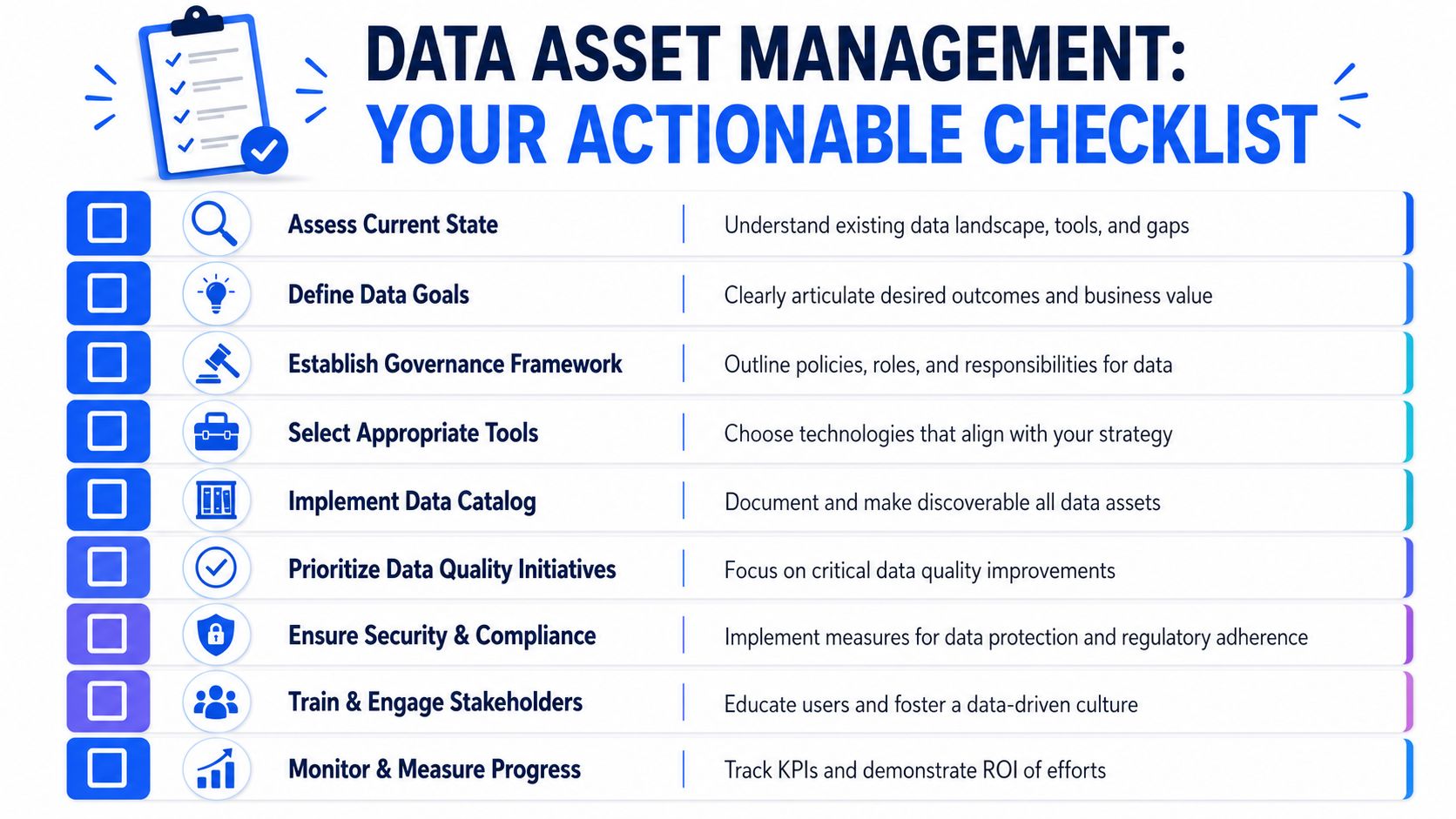
Assess the current state. List the data assets that already drive executive reporting, regulated workflows, core operations, or production models. Don't start with everything. Start with what would hurt if it failed unnoticed.
Define data goals. Decide what the program is protecting. Faster incident response, stronger auditability, fewer broken dashboards, safer model inputs, and clearer ownership are different goals and they shape different controls.
Establish a governance framework. Assign data owners, stewards, and engineers for the first wave of critical assets. If no one can approve access, define validity, or review change impact, the rest of the program won't stick.
Select appropriate tools. Favor platforms that support metadata, lineage, access control, monitoring, and validation without forcing unnecessary data movement.
What to institutionalize next
Once the first assets are under management, the next job is consistency.
Implement a catalog with context. Register assets together with lineage, refresh expectations, approved definitions, and known caveats.
Prioritize data quality initiatives. Put record-level validation where business rules matter, and anomaly detection where silent drift is more likely than obvious failure.
Ensure security and compliance. Align permissions and review flows with the actual risk profile of the asset, especially in customer-controlled environments.
Train and engage stakeholders. Analysts, BI developers, ML engineers, and business owners all need to know how to interpret alerts, request changes, and report trust issues.
Monitor and measure progress. Review detection speed, incident handling, and coverage of critical assets on a regular cadence.
A short operating checklist can keep this grounded:
Checklist item | Why it matters |
|---|---|
Identify critical assets first | Prevents low-value sprawl |
Assign named owners | Makes decisions and escalations faster |
Enable schema, freshness, and quality monitoring | Catches silent failures earlier |
Add lineage to change review | Reduces downstream surprises |
Track operational metrics | Shows whether trust is improving |
Review and retire stale assets | Keeps the estate manageable |
The main point is simple. Data asset management is not a documentation project. It's a continuous control system for the datasets, metrics, and pipelines the business depends on. Teams that treat it that way move faster because they spend less time debating whether the data can be trusted.
If your team needs that kind of control in private cloud or on-prem environments, digna is built for it. digna helps data teams detect anomalies, validate records, monitor timeliness, and track schema changes inside customer-controlled environments, so you can manage analytical data as an active business asset without moving production data outside your infrastructure.