Accuracy in Data Quality: Metrics and Monitoring
|
8
min read
Data Accuracy measures whether data correctly represents the real-world object, event, or value it is intended to represent. A 2026 industry summary reports that 55% of datasets have accuracy issues, with those issues costing companies an average of $3.1 million per year according to its summary of Talend's 2023 Data Health Barometer.
That gap between correct-looking data and reality is where many enterprise failures begin. A transaction can pass a format check while carrying the wrong amount. A patient record can contain a valid date that belongs to another person. A CRM value can be complete and well-formed yet no longer describe the customer accurately. In each case, data quality accuracy is a claim that needs evidence, not a label assigned because a field passed validation.
DAMA-DMBOK® 2.0 Revised Edition treats Accuracy as an established Data Quality dimension, and the DAMA research paper on Data Quality dimensions defines it through the closeness of data values to real values. Reliable monitoring therefore combines business rules, trusted-source comparison, anomaly signals, structural controls, timeliness checks, and traceability. The summary table later in this article compares those control methods by evidence type, best use, limitations, and enterprise deployment.
Consider a customer address copied incorrectly from a source system into a warehouse. The warehouse dashboard may aggregate it without error, while an AI workflow uses the wrong region for segmentation. A single inaccurate value can therefore move through reporting, models, and operational decisions before anyone asks whether it reflects reality.
Table of Contents
1. Data Validation Against Business Rules
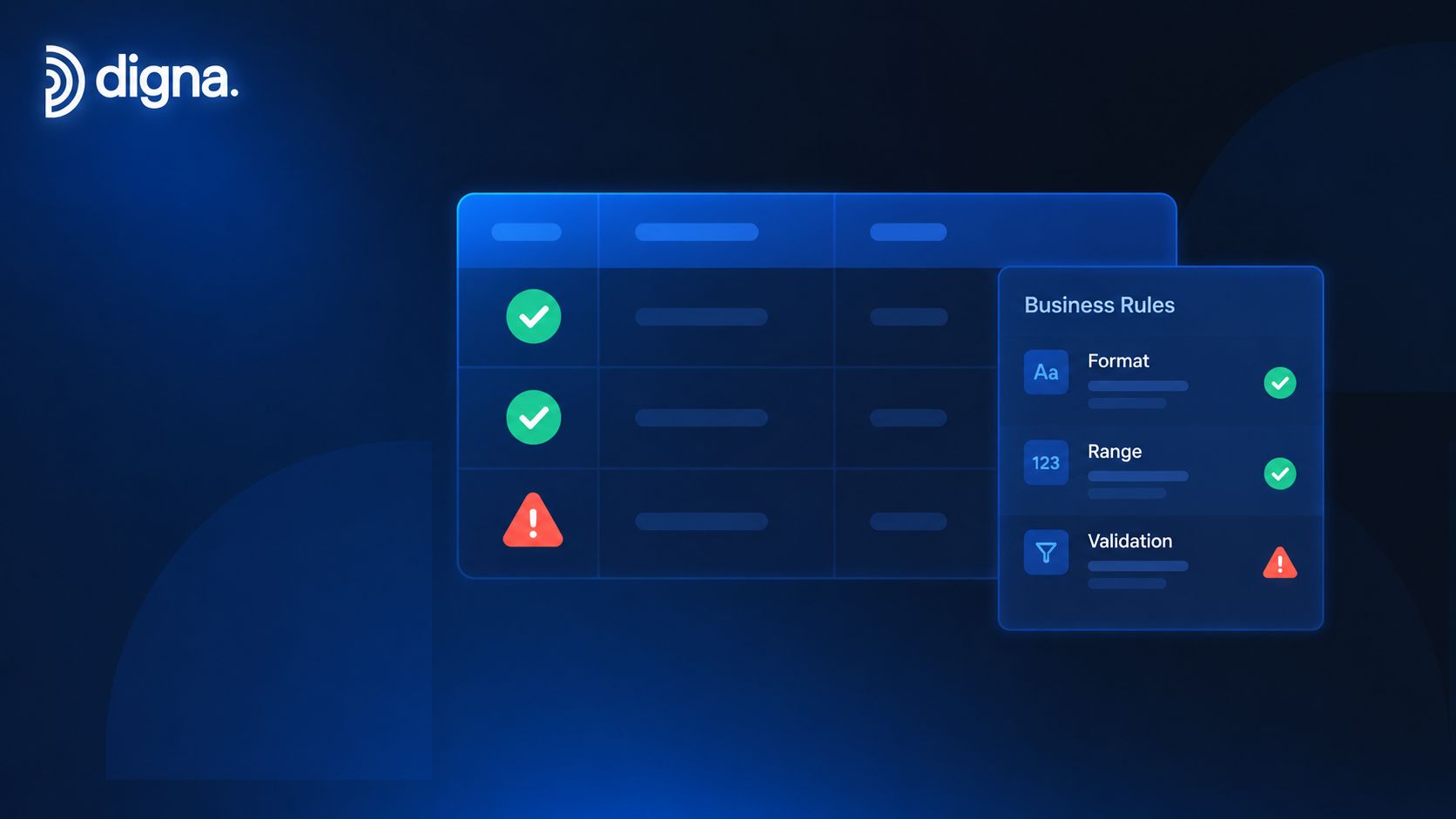
Business-rule validation provides evidence that a value meets defined conditions, not proof that it represents the event or object it describes. It applies deterministic checks to records, fields, relationships, and reference values. A rule might require a transaction amount to be positive, an admission date to precede discharge, or a customer identifier to exist in an approved reference table.
These checks are repeatable and auditable. Teams can document the rule, record the result, and investigate failed records, which supports compliance, financial controls, and operational review. Validation also separates validity from accuracy. A range check shows that a value is permitted, but cannot establish that it matches the underlying transaction or customer.
Practical rule: Start with rules tied to decisions, regulatory reporting, financial controls, or customer commitments. Do not validate every column equally before identifying its business consequence.
A financial institution might test transaction amounts against account-type conditions. A healthcare organization can check date order and confirm that clinical identifiers match approved code sets. A telecom provider can verify phone-number formats and customer IDs, while a retailer can compare product prices with catalog data and reject negative order quantities. These controls catch defined defects efficiently, but they still require investigation when the source value itself is wrong.
Make validation evidence useful
The strongest implementations combine several checks:
Business logic: Encode conditions that reflect operating policies, not only technical formats.
Reference comparisons: Use master data, lookup tables, and approved lists to confirm that values belong to the expected domain.
Failure monitoring: Track failures over time and by source, rule, and process to identify recurring defects.
Version control: Document and version rules so analysts can establish which control applied when a record failed.
Official statistical guidance from Statistics Canada distinguishes accuracy from validity-style conformance checks. That distinction should remain visible in production dashboards and issue workflows. digna Data Validation can codify record-level business rules, reference checks, thresholds, and expected conditions, with in-database execution and audit-oriented tracking.
Healthcare teams can also connect this control approach with Verifai healthcare offerings when domain-focused workflows require structured checks and review.
2. Data Reconciliation and Cross-System Comparison
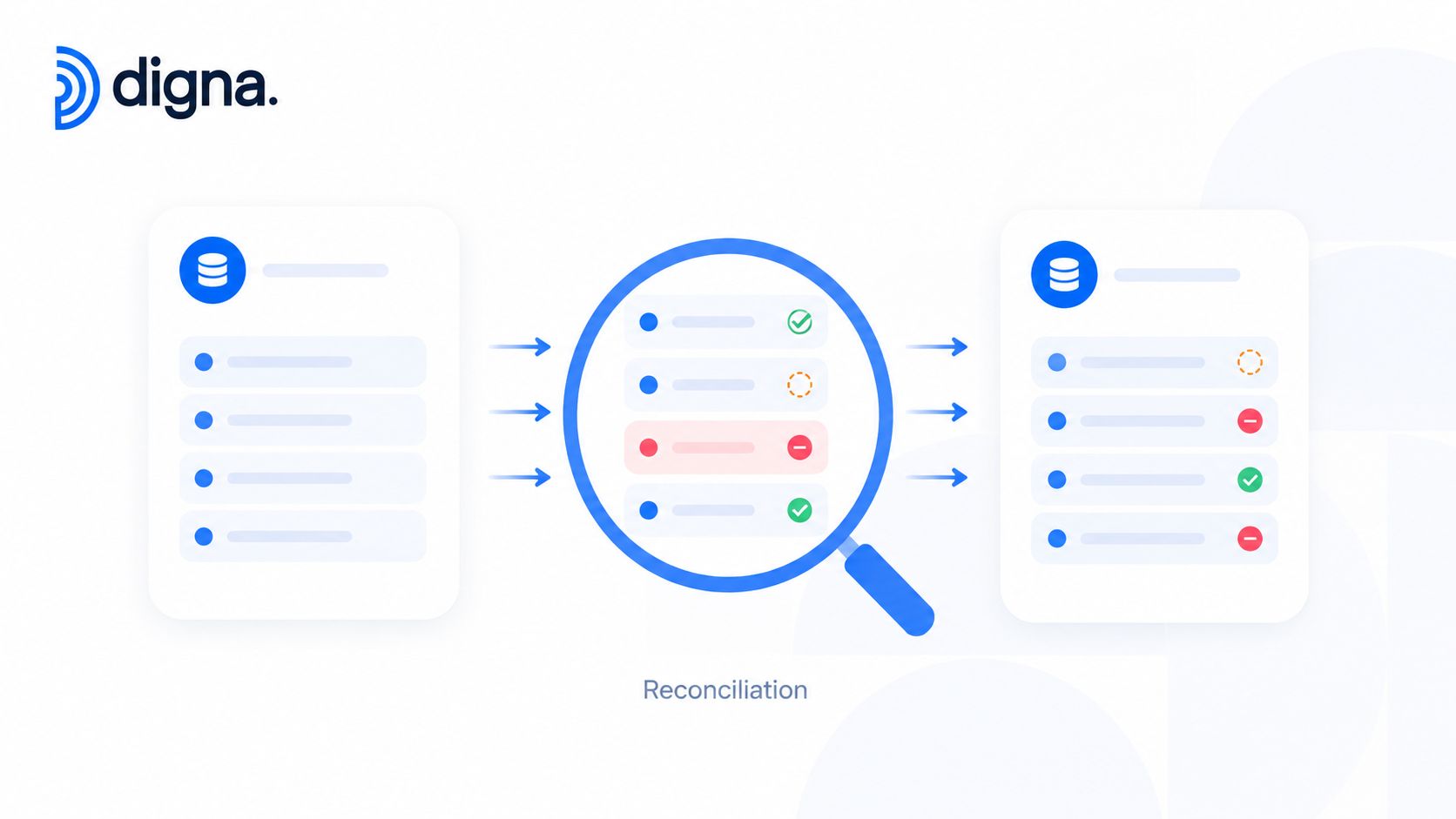
Accuracy becomes defensible when an organization can show how closely data matches the same business reality across systems. Reconciliation tests that connection by comparing a trusted source with a target, report, warehouse, or derived dataset.
A pipeline may preserve valid formats while losing records, duplicating transactions, rounding amounts incorrectly, or linking a customer to the wrong account. Replication, migration, ETL, and transformation processes create these risks. Cross-system comparison exposes them by examining whether separate representations still agree.
The comparison depends on the business context. A bank can reconcile transaction counts and amounts between a trading platform and settlement ledgers. A healthcare provider can compare source EHR records with warehouse records. A telecom operator can compare legacy billing data with a cloud warehouse after migration. A public-sector team can check benefit records across operational, reporting, and audit databases.
Set the comparison boundary before automating
Totals are useful when aggregate agreement is meaningful. They can also conceal offsetting errors, so record-level matching is required where individual discrepancies affect decisions. Natural keys, composite keys, and transformation-aware matching logic help distinguish legitimate changes from defects.
A practical control sequence includes:
Source-to-stage checks: Find ingestion loss and parsing errors before downstream processing.
Stage-to-warehouse checks: Isolate transformation and loading defects.
Value comparisons: Check amounts, statuses, dates, and classifications for mismatches.
Exception reports: Rank discrepancies by business impact and downstream use.
Reconciliation produces evidence, not truth by itself. Agreement shows that two representations match under defined rules. Disagreement starts an investigation into which source, transformation, or interpretation should be trusted.
Document the source of truth, schedule comparisons according to operational risk, and assign owners to unresolved breaks. Keep the evidence needed to reproduce each result, including the comparison grain, matching logic, run time, and affected records. digna Data Reconciliation supports in-database comparisons between trusted sources and target systems, limiting unnecessary data movement while retaining an investigation path.
3. Statistical Anomaly Detection and Baseline Learning
Accuracy is a defensible claim about how closely data represents reality. Statistical anomaly detection helps test that claim by identifying behavior that departs from an established baseline. It is useful where fixed rules cannot capture seasonality, growth, volatility, or relationships across fields.
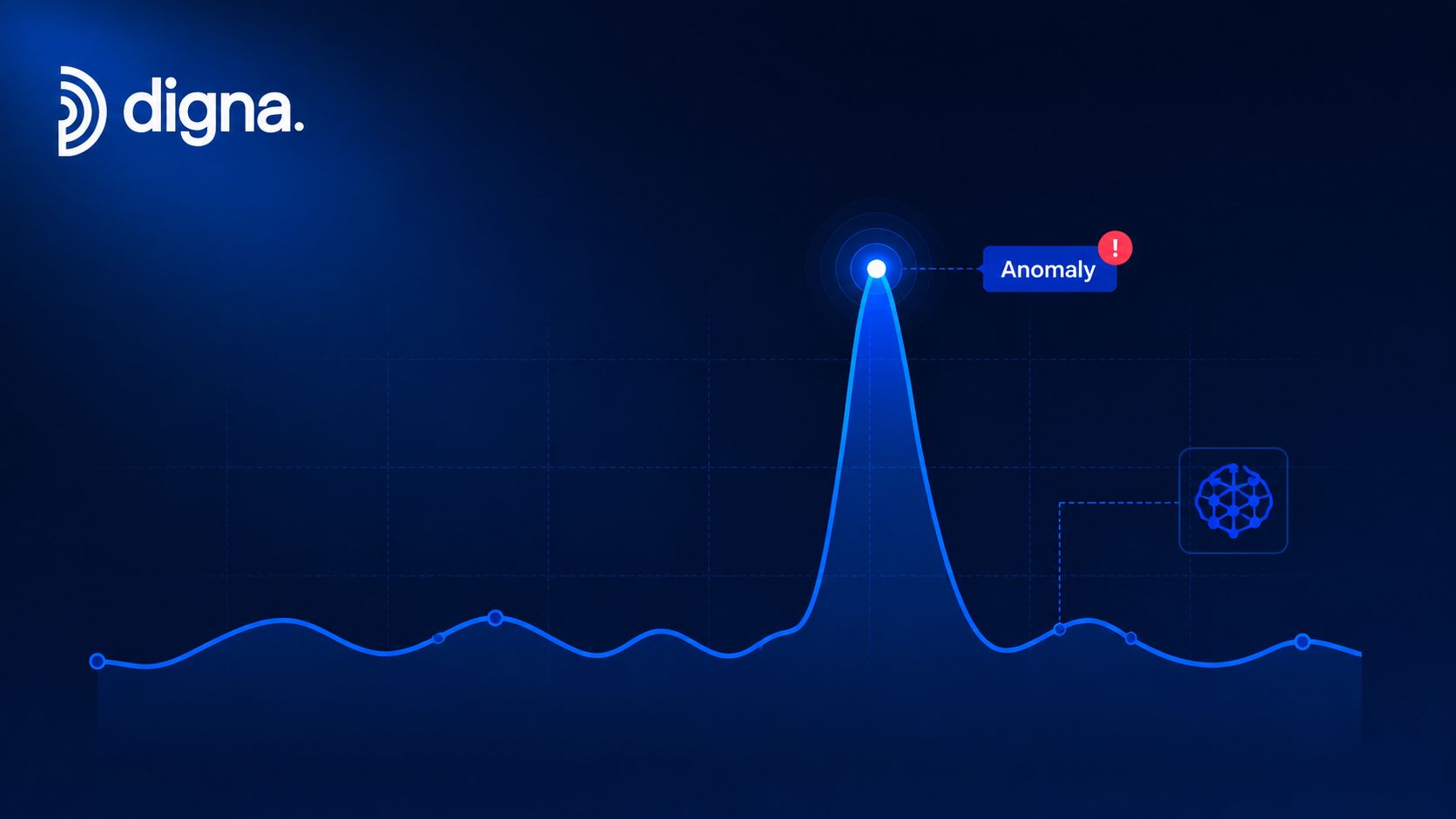
A baseline can track record volume, value distributions, delivery patterns, field relationships, and business metrics. A sharp change in trading volume, patient admissions, telecom usage, retail sales, or inventory may expose a source defect. It may also reflect a genuine operational event, so the alert is evidence for investigation, not a verdict on correctness.
A promotion can produce a legitimate sales spike. A policy change can alter healthcare admissions, while a new product launch can reshape usage. Treating every deviation as an error creates false incidents and can conceal valid business change.
Connect alerts to investigation
Use anomaly signals to direct attention, then test the underlying records and context:
Learned baseline: Model normal behavior for the dataset instead of applying one universal threshold.
Business review: Ask process owners whether the change matches a real event, planned release, or policy adjustment.
Control confirmation: Apply validation and reconciliation to determine whether affected records contain defects or diverge from trusted representations.
Pattern review: Examine recurring alerts by source, transformation, time period, and metric to identify systemic failures.
Prioritized queue: Rank investigations by anomaly magnitude, business impact, and downstream use when manual review cannot cover the full dataset.
The digna guide to detecting anomalies in time series describes how time-series signals can support this workflow. digna Data Anomalies provides AI-driven baseline learning, reducing the need to define every threshold manually. digna Data Analytics supports examination of historical trends, volatility, and recurring behavior during investigation.
Deploy baselines with versioned thresholds, documented review decisions, and owners for unresolved alerts. Monitor alert volume and recurring patterns after deployment, but do not treat observability as proof that values are accurate. It shows where evidence is needed and whether controls are behaving as expected.
4. Schema Tracking and Structural Validation
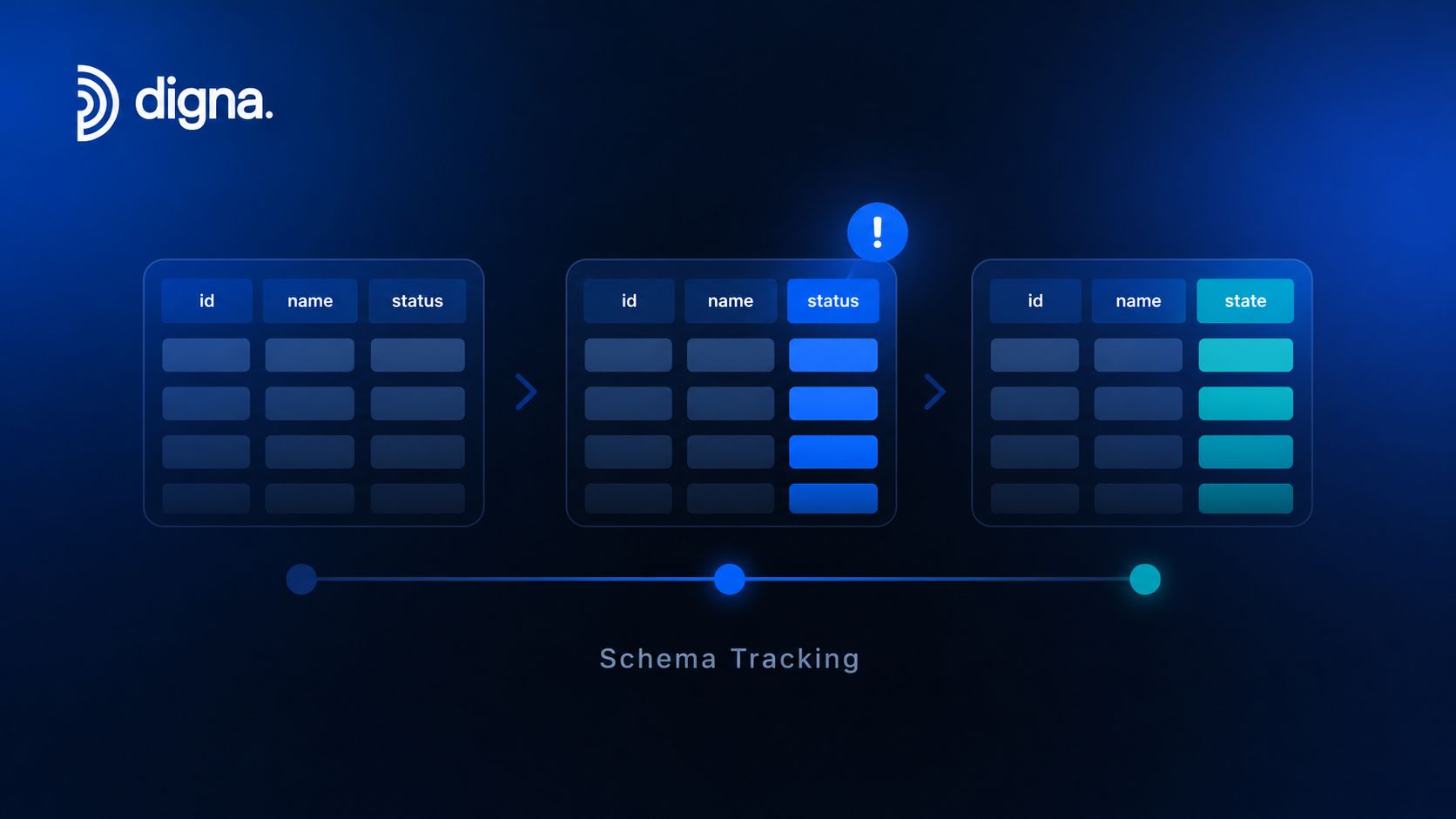
Accuracy depends on structure as well as values. A column type, field name, key, or table relationship determines how downstream systems interpret source data. Schema tracking records those structural elements and exposes changes before they distort reports, models, or operational workflows.
A new regulatory field in a financial feed may be omitted from reporting if transformations are not updated. Changing a clinical element from text to numeric can disrupt ingestion or alter its meaning. A restructured customer reference table can produce failed or incorrect joins in telecom analytics. Removing an audit column can weaken public-sector reporting while the remaining values still appear valid.
The most difficult failures are silent. Permissive ingestion may accept a changed structure, and a dashboard may continue running with incomplete fields or misjoined records. The resulting accuracy claim is no longer defensible because the data no longer represents the intended business entities and relationships.
Govern structural changes as deployment events
Schema monitoring belongs in the same control process as data catalogs, lineage, release approvals, and consumer communication. Each approved change needs an owner, effective date, compatibility decision, and version history. An unapproved change should create an incident before it reaches a critical report or model.
Use the following checks to make the control operational:
Change detection: Find added, removed, renamed, and retyped fields.
Compatibility testing: Verify that joins, transformations, and consuming applications still interpret the structure correctly.
Consumer notification: Alert affected teams before an approved change enters production.
Risk classification: Apply tighter review to schemas supporting regulatory, financial, clinical, or AI workflows.
Historical records: Retain change history for audits and root-cause analysis.
digna Schema Tracker detects structural changes, including column and data-type modifications. These checks provide evidence that the structure remains compatible. They do not establish that every value is correct, so value-level validation and reconciliation remain necessary.
5. Timeliness and Data Delivery Monitoring
Accuracy is a defensible claim about how closely data represents reality at the decision point. A value may be correct when recorded yet misleading when delivered too late. Timeliness monitoring examines whether critical data arrives as expected, whether a load is missing, and whether its freshness fits the operational use case.
The control matters in end-of-day settlement, patient discharge workflows, morning telecom reviews, and hourly retail inventory. A dashboard displaying yesterday's inventory during active sales may contain valid records, but it does not represent current stock. Stale data therefore limits what accuracy can support.
Set delivery expectations with business owners, not only with pipeline operators. A job can finish on schedule while delivering incomplete content, while a late load may be acceptable for a historical report and unsuitable for a live decision.
Use a delivery record that supports investigation:
Expected delivery: Define when each critical dataset should arrive.
Actual arrival: Record early, on-time, late, and missing deliveries.
Freshness: Compare record age with the decision's requirements.
Completeness at delivery: Confirm that the expected content arrived, rather than only a file or table.
Incident patterns: Examine recurring source, dependency, and pipeline delays.
digna's real-time data monitoring capabilities support expected-delivery calculations and schedule monitoring. The digna Timeliness module uses learned delivery patterns to flag delays, missing loads, and unexpected arrival behavior. These signals provide evidence about delivery performance and help prioritize investigation. Pair them with validation and reconciliation, because freshness alone cannot establish correctness. Deployment teams should also define alert ownership, escalation thresholds, and the point at which stale data must be withheld from operational use.
6. Reference Data Management and Master Data Governance
Accuracy depends on whether reference data represents the business reality that operational records are meant to describe. Product catalogs, customer masters, geographic taxonomies, organizational hierarchies, clinical code sets, general-ledger structures, and regulatory classifications provide the context for interpreting values and running quality controls.
A wrong product price in the catalog can cause downstream validation to approve incorrect transactions. Different provider identifiers can make a successful join associate a clinical event with the wrong entity. Reference-data defects therefore spread through dependent systems and can make other quality signals look reassuring without proving correctness.
Governance requirements vary by domain. Financial-services teams may control counterparty and regulatory entity taxonomies. Healthcare teams may manage patient identifiers, provider credentials, and clinical code sets. Telecom organizations may maintain customer hierarchies, service catalogs, and geographic classifications. Public-sector departments may govern citizen records and benefit-program codes.
Build an authoritative reference layer
Start with the domains that influence high-impact decisions. Give each one an accountable owner, approval rules, version history, effective dates, and a controlled distribution process. These controls create evidence for investigation and provide a defensible basis for deciding which values consumers should use.
Ownership: Assign responsibility for approving, reviewing, and correcting master values.
Versioning: Preserve changes so historical records remain interpretable.
Synchronization: Distribute approved values consistently across operational and analytical systems.
Validation use: Connect lookup tables to record-level controls and document the expected domain.
Freshness monitoring: Identify stale or incomplete reference values before downstream use.
“Master” is a governance status, not proof of correctness. Approval workflows, reconciliation, and periodic review remain necessary. digna Data Validation can apply reference lists and business constraints to flag values outside the intended domain. Treat those flags as evidence for review, then confirm the reference value and its effective period before changing production data.
7. Data Lineage and Impact Analysis for Accuracy Traceability
Accuracy is a defensible claim about how closely data represents reality, not a conclusion drawn from one quality signal. Lineage shows where a value originated, which transformations changed it, and which reports, dashboards, or models consumed it. Impact analysis identifies the people and processes that may need investigation after an incident.
An incorrect expense amount in an executive dashboard illustrates the difference. Investigators can trace the value from the general ledger through staging, transformation logic, and warehouse tables, then review the affected output. In healthcare, lineage can identify reports and models dependent on changed patient demographics. In retail, it can show how incorrect product data reaches inventory, forecasting, and profit-and-loss reporting.
Lineage does not establish that a value is correct. It supplies provenance evidence for examining the claim, including its source, processing history, and downstream exposure.
Make traceability operational
Map high-impact flows first. Capture source metadata, transformation logic, ownership, and dependencies, then connect lineage records to quality incidents. Repeated defects can point investigators toward a risky source or transformation, but validation and reconciliation still determine whether the value matches business reality.
Use these operating controls:
Critical-flow mapping: Prioritize regulated reporting, financial metrics, customer operations, and AI inputs.
Transformation documentation: Record what changed, why it changed, and who approved it.
Impact assessment: Identify dashboards, models, and processes requiring review.
Remediation prioritization: Correct the originating defect before repeatedly changing downstream copies.
Change maintenance: Refresh lineage after pipeline, schema, or ownership changes.
The digna perspective on combining data lineage and data quality links traceability with incident response. digna's catalog and integration capabilities can support lineage documentation alongside validation, anomaly, timeliness, and schema controls.

7-Point Data Accuracy Comparison
Item | Implementation Complexity 🔄 | Resource Requirements ⚡ | Expected Outcomes 📊⭐ | Ideal Use Cases (Best For) | Key Advantages ⭐ | Tips 💡 |
|---|---|---|---|---|---|---|
Data Validation Against Business Rules | Medium 🔄 | Medium ⚡ | Deterministic detection of rule violations; audit-ready results | Compliance, regulatory controls, record-level enforcement | High precision and repeatability; audit trails ⭐ | Start with high-impact rules; version rules and involve stakeholders 💡 |
Data Reconciliation and Cross-System Comparison | Medium–High 🔄 | High ⚡ | Identifies missing/duplicate records and value mismatches; quantifies discrepancies | Multi-system environments, migrations, regulated industries | Detects silent data loss and transformation errors; establishes accountability ⭐ | Define single source of truth; automate schedules; reconcile at multiple stages 💡 |
Statistical Anomaly Detection and Baseline Learning | Low–Medium 🔄 | Medium ⚡ | Adaptive anomaly alerts and drift detection; early warning signals | Large, complex datasets; seasonal/trending data; proactive monitoring | Detects novel/unexpected patterns without manual rules ⭐ | Allow baseline training period; combine with rule checks; use SME for interpretation 💡 |
Schema Tracking and Structural Validation | Low 🔄 | Low ⚡ | Real-time detection of schema drift (columns/types); prevents silent failures | Heterogeneous platforms; frequent schema changes; pipeline stability | Prevents downstream breaks; fast incident response; audit trail ⭐ | Integrate with catalogs; implement change-control and pre-change alerts 💡 |
Timeliness and Data Delivery Monitoring | Low–Medium 🔄 | Low–Medium ⚡ | Detects late/missing/early loads; SLA compliance and reduced discovery time | Time-sensitive reporting, SLAs, real-time operations | Reduces incident discovery latency; proactive alerts ⭐ | Set clear SLAs; monitor completeness too; handle timezone/clock skew 💡 |
Reference Data Management & Master Data Governance | High 🔄 | High ⚡ | Single source of truth for valid values; consistent downstream accuracy | Enterprise consistency, customer/product/master dimensions | Prevents cross-system inconsistencies; supports governance and audits ⭐ | Prioritize critical masters; version control and automate synchronization 💡 |
Data Lineage & Impact Analysis for Accuracy Traceability | Medium–High 🔄 | High ⚡ | Fast root-cause tracing and downstream impact assessment; provenance for audits | Regulated industries, complex pipelines, large enterprises | Accelerates remediation and risk assessment; shows provenance ⭐ | Automate metadata capture; start with critical flows; keep lineage current 💡 |
Turn Accuracy Signals Into Trusted Decisions
Accuracy asks whether data reflects reality. Validity asks whether data conforms to defined formats, domains, or rules. Reasonableness asks whether a value appears plausible in context. Those dimensions overlap, but they aren't interchangeable.
A date can be valid because it follows the required format and reasonable because it falls within a plausible period, yet still be inaccurate if it belongs to the wrong record. A phone number can pass a pattern check without connecting to the stated customer. A reported revenue figure can look plausible while omitting a source-system population. Treating every passing check as proof of accuracy creates false confidence.
Statistics Canada's guidance describes accuracy through the difference between an estimate and the true population value, with bias and variance contributing to inaccuracy. It also notes reliability thresholds based on the coefficient of variation, including values below 16.6% for general reliability, values from 16.6% to 33.3% that should carry a warning, and values above 33.3% deemed unreliable for its statistical context official guidance. Enterprise teams shouldn't copy those thresholds blindly into operational data quality. They should define fit-for-purpose tolerances based on the decision, risk, and evidence available.
A practical accuracy operating sequence
Define reality: Identify the object, event, or value and the fields that represent it.
Name authoritative evidence: Establish trusted sources, reference data, or approved comparison methods.
Apply deterministic controls: Use validation rules for business logic, domains, relationships, and constraints.
Reconcile representations: Compare source, staging, warehouse, reports, and derived datasets where appropriate.
Monitor behavior: Add anomaly detection, timeliness checks, and structural monitoring to catch unexpected conditions.
Trace and investigate: Use lineage, historical analytics, and ownership to locate causes and document decisions.
Remediate and recalibrate: Correct the source or transformation, then review whether the control still matches the intended use.
How can digna support Data Accuracy?
digna Data Validation supports deterministic checks against business rules, reference data, exact values, thresholds, ranges, and expected conditions. digna Data Reconciliation compares trusted source and target systems to identify mismatches across in-database datasets. digna Data Anomalies identifies unexpected deviations that may indicate inaccurate data, but its alerts are signals for investigation, not proof. digna Data Analytics helps teams examine historical patterns, volatility, and recurring behavior around those signals.
The platform executes metric computation and analysis inside the customer's databases, with private-cloud or on-premises deployment inside the customer's cloud, VPC, or data center. That design keeps data in place while giving engineers, analysts, and governance teams a shared view of incidents and trends. A transport operator performance dashboard illustrates the kind of operational reporting that depends on reliable underlying measures, although dashboard confidence still requires evidence about the source data.
Frequently asked questions
What is Accuracy in Data Quality?
Accuracy is the degree to which data correctly or factually represents the world, object, event, or value it intends to describe. The DAMA Data Quality dimensions paper frames it as closeness to values, often assessed against a known correct source or source of truth.
How is Data Accuracy measured?
Teams measure Data Accuracy by comparing sampled or monitored values with authoritative sources, repeated measurements, internal validation evidence, reference data, or carefully defined expectations. A common metric is the data accuracy rate, calculated as correct values divided by total sampled values, as described by this data quality metrics reference. Where no external gold standard exists, teams should document the evidence type and its limitations instead of presenting a score as absolute truth.
What is the difference between Accuracy and Validity?
Validity checks whether data conforms to a defined format, range, domain, or rule. Accuracy checks whether the value represents reality. A value may be valid and plausible while still being assigned to the wrong customer, event, product, or time period.
How can Data Accuracy be monitored continuously?
Continuous monitoring combines record-level validation, reconciliation against trusted sources, reference-data checks, anomaly signals, schema tracking, timeliness monitoring, and lineage-supported investigation. Data quality operations guidance also distinguishes accuracy checks against authoritative sources from validity checks such as regular expressions and range rules.
Which tools can monitor Data Accuracy?
Organizations commonly use data validation, reconciliation, reference-data, observability, anomaly detection, schema tracking, lineage, and historical analytics tools. digna brings these capabilities together through digna Data Validation, digna Data Reconciliation, digna Data Anomalies, digna Data Analytics, Timeliness, Schema Tracker, catalog, integrations, and in-database execution. Tooling can surface evidence and prioritize investigation, but business owners still need to confirm whether values reflect the intended reality.
A 2025 observability research release reports that 76% of organizations have formalized, implemented, or optimized programs for both data quality and data pipeline observability, while 68% use qualitative or quantitative metrics to measure success research release. That direction is practical: accuracy works best as an operating discipline with documented evidence, assigned ownership, and continuous feedback, not as a one-time cleansing project.
digna provides in-database Data Validation, Data Reconciliation, Data Anomalies, Data Analytics, timeliness, and schema monitoring for critical enterprise datasets. Visit digna to explore a modular data quality and observability platform that runs in your own environment and helps teams turn accuracy signals into investigated, traceable decisions.