Data Integrity Guide: Principles & Best Practices 2026
|
6
min read

You can feel a good data system before anyone praises it. The dashboard loads fast, the numbers line up, and the finance lead stops asking whether the report is “close enough.” Then one quiet change slips through, a field shifts shape, a load arrives late, or a key record goes missing, and the whole board pack starts wobbling in front of a room full of people who expected certainty.
That's where data integrity earns its keep. It's not just about tidy tables or valid formats, it's the assurance that data stays whole, accurate, traceable, and usable from the moment it enters a system to the moment someone relies on it. In regulated environments, that assurance is the difference between a confident decision and an expensive apology.
Why Data Integrity Is Your Most Valuable Asset
A quarterly report can fail in the most annoying way possible, not with a dramatic crash, but with one number that looks plausible enough to escape notice. The team prepares slides, the board arrives, and someone notices the margin figure no longer matches the source system. The problem often isn't the spreadsheet, it's the chain behind it.
That's why data integrity matters more than a neat definition. It's the promise that data is not only accurate at a single moment, but also preserved through movement, storage, review, and reuse. If you've ever trusted a dashboard that later turned out to be off, you've already met the cost of broken integrity.
Trust is the actual product
A business doesn't buy data for its own sake, it buys confidence. Sales wants to know the pipeline is real, finance wants the numbers to reconcile, and operations wants alerts that mean something. When integrity slips, every team starts adding private workarounds, which is just a fancy way of saying they stop trusting the shared system.
That's why integrity belongs next to revenue and risk, not in a corner with routine maintenance. If the underlying data can't be trusted, even the best analytics layer becomes a polished guessing machine. For a practical lens on the commercial damage, see this guide to the impact of poor data quality on business decisions.
Practical rule: if a report needs a human to “sanity check” it every time, the system has already lost some integrity.
The useful shift is to think of integrity as a lifecycle property. A record can be valid when it lands and still become unreliable later if metadata disappears, a schema changes, or a pipeline delay alters the meaning of the numbers. That's why the most mature teams treat integrity as operational trust, not just data hygiene.
The Three Pillars of Data Integrity
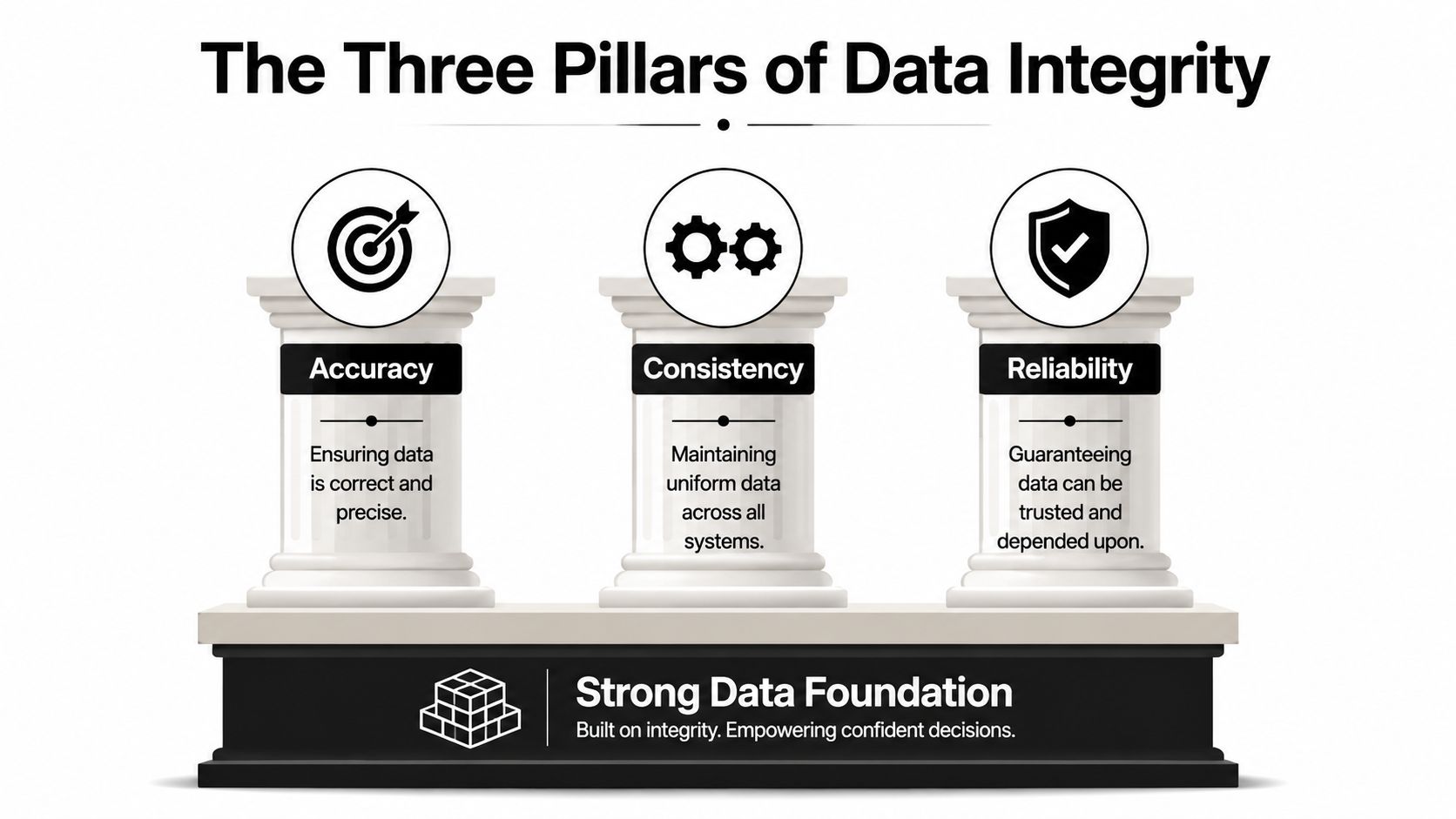
The easiest way to understand data integrity is to picture a digital library. Every book needs a unique card, every cross-reference has to point to a real item, and every entry has to follow the library's rules. If any of those three things breaks, the catalogue becomes less useful, even if most of the books are still on the shelves.
Entity integrity keeps records unique
Entity integrity means each record has a stable identity. In the library analogy, no two books should share the same card number, because then staff can't tell which copy was borrowed, returned, or misplaced. In a database, that usually means the primary key has to be unique and never ambiguous.
Identity is the anchor for everything else. If a customer row can't be distinguished from another customer row, then orders, refunds, and support history start floating without a clear owner. That's how one messy key can turn into a chain of wrong assumptions.
Referential integrity keeps links real
Referential integrity makes sure a relationship points to something that exists. A library note that says “see volume 12” is useful only if volume 12 is really there. In data terms, a foreign key pointing to a missing parent record creates an orphan, and orphaned records are where reporting gets awkward fast.
This is also where the guide to ALCOA for GxP labs is useful. It shows how regulated teams think about traceability, attribution, and trustworthy records in a more disciplined way than many general-purpose data teams do. If you work in healthcare, life sciences, or any controlled environment, that mindset is worth borrowing.
Domain integrity keeps values in bounds
Domain integrity is the rule that says a field must look and behave like the field it is. A publication year should be a year, not free text. A postal code should follow the expected pattern for the market it serves. A date should be a date, not a note somebody typed in a hurry.
For a practical breakdown of how quality dimensions support that discipline, this data quality dimensions guide is a solid companion. The reason domain rules matter is simple, bad values don't just look ugly, they break filters, joins, and downstream logic.
Here's the shortcut to remember: entity integrity protects identity, referential integrity protects relationships, and domain integrity protects meaning. Together they keep the digital library orderly enough for people and systems to trust what they find.
Understanding Transactional Integrity
A bank transfer is the cleanest way to understand transactional integrity. If you send money from one account and the debit happens but the credit fails, the system has created a problem no customer wants to discover on payday. A good transaction either completes fully or doesn't happen at all.
That all-or-nothing behaviour is the point. It protects the database from partial updates, which are far worse than obvious failures because they can sit there looking legitimate. In other words, transactional integrity keeps the system in a consistent state even when many operations are happening at once.
Why ACID matters in practice
The classic ACID model, Atomicity, Consistency, Isolation, Durability, is basically a promise to behave sensibly under pressure. Atomicity says a transaction is indivisible. Consistency says the system moves from one valid state to another. Isolation keeps transactions from stepping on each other mid-flight. Durability means committed changes stay committed.
That sounds abstract until you've seen two concurrent updates collide. Then ACID stops looking like theory and starts looking like insurance. If you're reconciling payments, inventory, or any workflow where a half-finished write is unacceptable, transactional integrity is the guardrail.
A transaction should never leave the system in a state that a human wouldn't accept on a screen review.
For teams building operational systems, data reconciliation meaning is relevant. Reconciliation is the follow-up discipline that checks whether the data at rest matches the data that should exist after a transfer, update, or batch process. It's not the same thing as integrity, but it often reveals when integrity has slipped.
The practical takeaway is simple. If a user action changes more than one related record, think transaction first, then think validation. That order helps prevent the kind of partial success that creates impossible-to-debug support tickets later.
Modern Validation and Monitoring Techniques
Traditional checks still matter. Check constraints, data type enforcement, required fields, and basic range rules catch a lot of obvious mistakes before they spread. A date field shouldn't accept alphabet soup, and a status field shouldn't accept six different spellings of the same state.
But the harder failures don't announce themselves that way. A pipeline can keep passing rows while the schema changes underneath it. A feed can arrive on time for weeks and then drift late enough to make the same report mean something different. That's why modern integrity work has moved from simple record checks to continuous observation.
The weak spot is often the pipeline, not the row
The operational question is less “Is the data correct?” and more “Did the data's meaning, shape, or arrival pattern change enough to make today's reports and models wrong?” Many teams overinvest in record-level rule checks and underinvest in change detection for pipelines and schemas, even though those upstream shifts can invalidate downstream analytics, AI training, and compliance reporting at scale without immediate detection, a risk made more urgent by initiatives like the EU's EHDS which requires cross-border data exchange by 2029. That's the part people miss because the row still looks fine.
Data observability helps. A good monitoring layer watches for anomalous values, schema drift, unexpected delays, and missing metadata, then surfaces the change before the business makes a decision on stale assumptions. That is a very different job from cleaning bad rows after the fact.
For a closer look at validation as an operating discipline, see why validity checker tools matter for modern data quality.
What modern teams watch for
A mature monitoring setup usually checks for a mix of value, structure, and timing problems. That means looking at whether columns have changed, whether records are arriving late, and whether the pattern of the feed still resembles what downstream systems expect.
One option in this space is digna, which combines data validation, anomaly detection, timeliness monitoring, and schema tracking in customer-controlled environments. That combination matters because it catches issues that a static rule set can't see, especially when the structure of a feed changes without breaking the load.
Here's the useful mindset shift. Don't ask only whether a row is valid. Ask whether the system still means the same thing it meant yesterday. If the answer is no, the problem is bigger than validation, and the fix has to start upstream.
Building a Robust Data Governance Framework
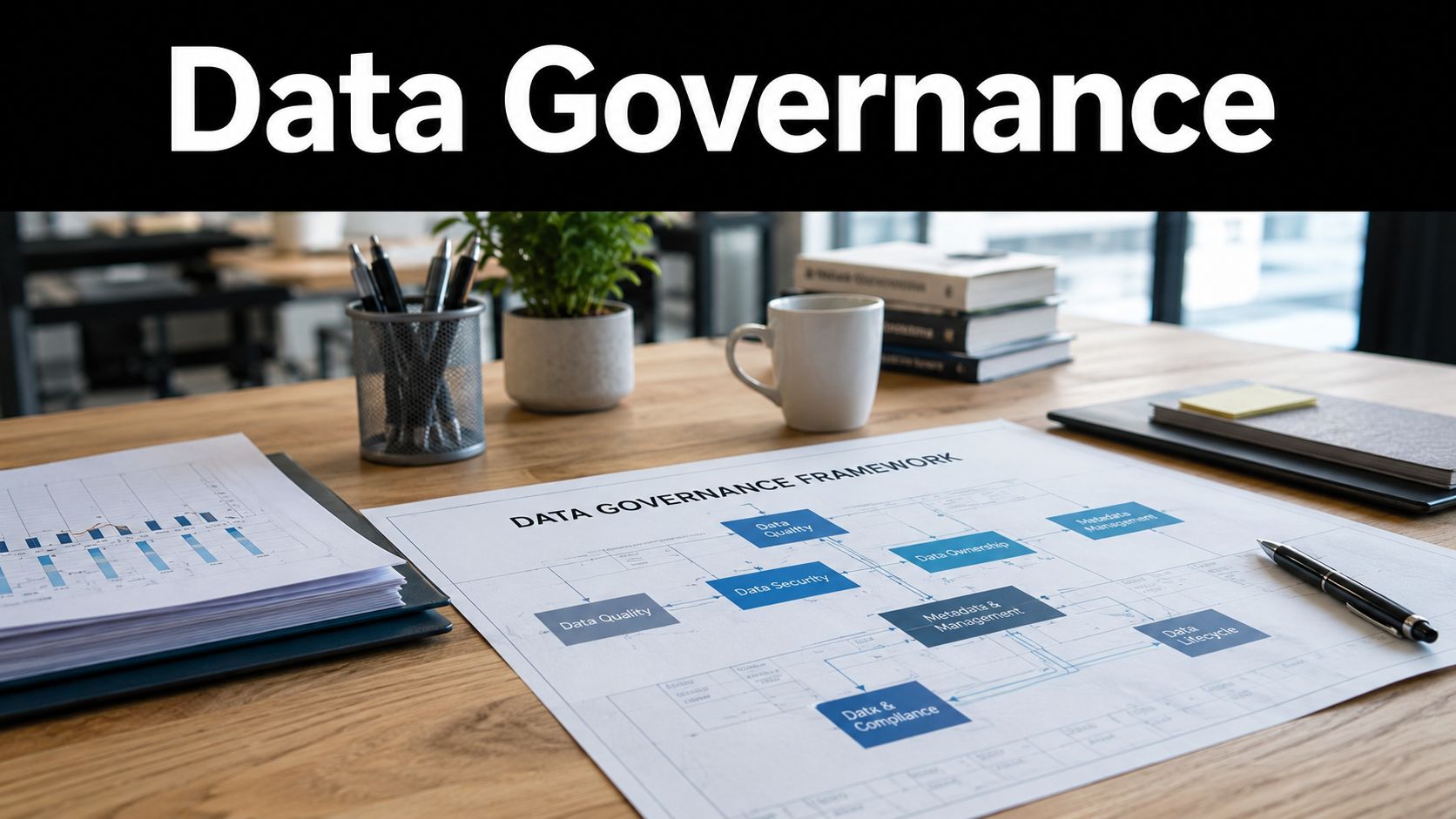
Tools can catch problems, but governance decides whether anyone owns them. Without clear ownership, a data issue becomes a round of forwarded emails, each person assuming somebody else has the fix. That's how a technical error turns into an organisational habit.
A solid governance framework gives integrity a home. It defines who owns the dataset, who approves changes, who responds to issues, and what standard “good enough” means. If those rules aren't written down, each team invents its own version, and inconsistency follows fast.
Why regulation changes the conversation
The EU's General Data Protection Regulation (GDPR) became enforceable on 25 May 2018 and pushed organisations to prove data integrity through accountability and documented controls. With fines reaching up to €20 million or 4% of global annual turnover, it turned integrity into a board-level concern rather than a technical preference. That change matters because governance now has legal weight, not just internal politeness. The European Commission's GDPR overview is a useful reference point for that shift.
Spain layered its own structure on top of that with Organic Law 3/2018, which adapted national law to the GDPR and was published on 6 December 2018. The AEPD is the supervisory authority responsible for enforcement, and in practice that means Spanish organisations need evidence, not assumptions, when they claim personal data is handled safely.
The public sector has its own strong signals too. Spain's National Security Framework was approved by Royal Decree 311/2022, and it explicitly requires integrity, authenticity, confidentiality, traceability, availability and resilience. For government systems and suppliers, that makes integrity an explicit control objective, not a nice-to-have.
Good governance doesn't remove the need for monitoring, it gives monitoring somewhere to land.
What a useful framework actually contains
A working governance programme usually includes four things. First, named data ownership. Second, quality standards that people can apply. Third, policies that are easy to find when someone needs them. Fourth, roles for escalation and remediation, so the response path is already known when something breaks.
For teams formalising that structure, this data governance implementation guide can help translate policy language into practical process. The important part is not ceremony, it's clarity. If a dataset matters to revenue, reporting, or compliance, somebody has to be accountable for its condition.
The bigger lesson is that governance and integrity are inseparable. Governance tells the organisation what trustworthy data should look like, while integrity controls prove the data still meets that standard in daily use.
Your Data Integrity Remediation Workflow
Bad data will happen. The question is whether your team has a calm process or a panic ritual. The difference shows up in how quickly you can find the issue, explain it, and stop it from repeating.
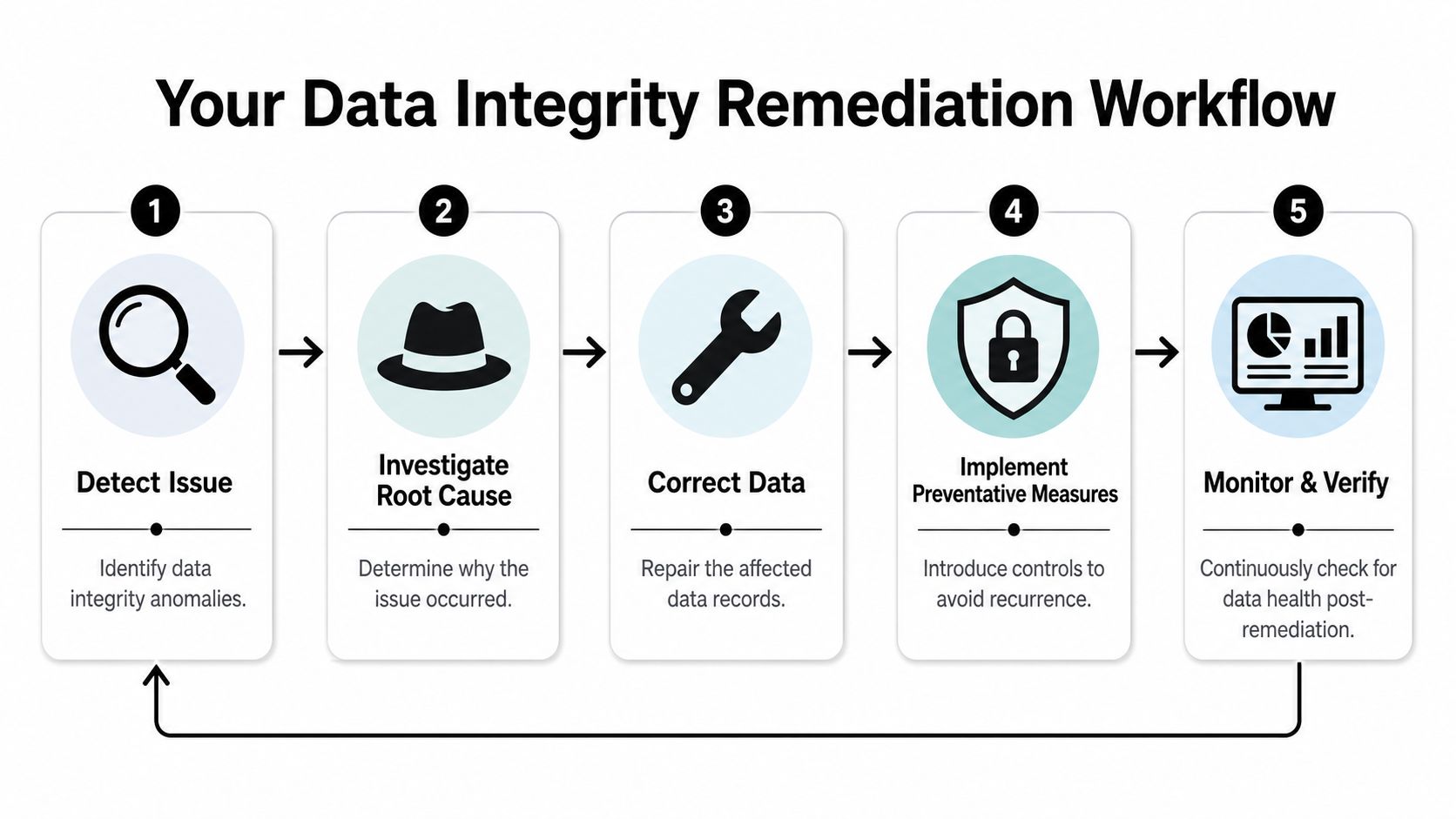
The smartest remediation flows are boring in the best way. They follow the same sequence every time, so nobody improvises under pressure. That consistency shortens outages, reduces finger-pointing, and helps teams learn from the failure instead of just patching it.
Step one is detection
The first job is to notice the problem without waiting for a user complaint. That could be an anomaly alert, a schema change flag, or a timeliness breach. If your only signal is a broken dashboard screenshot from Slack, detection is already too late.
Step two is triage
Once you've got the alert, decide how wide the blast radius is. Which reports, pipelines, or applications depend on the affected data? Which decisions were made while the issue was active? At this stage, lineage and historical context save time, because you're not guessing who used what.
Step three is root cause analysis
This is the part where audit trails matter. In EU clinical systems, detailed trails record the change, the user identity, the timestamp, and the reason for change, which gives investigators the evidence they need to trace what happened in the first place. The EMA guidance for computerised systems and electronic data in clinical trials is a strong example of that discipline.
Step four is correction
Fix the source, not just the symptom. If a feed changed shape, repair the upstream mapping. If a manual process introduced errors, tighten the process and the checks around it. If you only rewrite the bad rows, the problem will usually return with slightly different clothing.
Step five is monitor and verify
After the fix, keep watching. You want to know the issue is gone, not merely hidden. Tools with historical analysis and lineage, including platforms such as digna, can help teams verify whether the same failure pattern appears again, which is often the fastest sign that the remediation did or didn't hold.
From Data Chore to Competitive Advantage
The teams that treat data integrity as a chore usually end up paying for it twice, once in cleanup and again in missed opportunities. The teams that treat it as infrastructure get something better, they move faster with less second-guessing. That's not abstract strategy, that's how reliable reporting, safer automation, and better AI systems happen.
In the EU, the bar is rising beyond basic accuracy. For secondary use in health and finance, integrity now includes completeness, representativeness, and traceability, which turns the idea into auditability under reuse rather than just correctness at collection time. That matters because modern analytics and AI don't just need data that looks valid, they need data that stays trustworthy when reused across organisations and contexts. The EIT Health Think Tank's EHDS quality factsheet captures that shift clearly.
The business upside is straightforward. Better integrity means fewer surprises, cleaner decision-making, and a stronger foundation for automation that people can trust. It's the difference between a team that reacts to data and a team that builds on it.
If you're ready to make your dashboards, pipelines, and compliance reporting more trustworthy, take a hard look at how your organisation detects drift, validates changes, and assigns ownership. Start with a small set of critical datasets, tighten the controls around them, and use that momentum to build a broader integrity programme with digna.
Because the hardest integrity failures here are feeds that change shape without breaking the load, see how digna Schema Tracker detects added, removed and retyped columns before downstream reports drift.
Of all the integrity types, referential integrity is the one data warehouses most often leave unchecked, because they don't enforce foreign keys. Our guide to referential integrity covers definitions, examples and how to check it.
Frequently asked questions
What are the three pillars of data integrity?
The three pillars are entity, referential and domain integrity. Using a digital library analogy, entity integrity protects identity with unique primary keys, referential integrity protects relationships so foreign keys never point to missing parents, and domain integrity protects meaning by keeping values such as years, dates and postal codes in bounds.
What is transactional integrity in a database?
Transactional integrity means a transaction either completes fully or not at all. The article uses a bank transfer: if the debit succeeds but the credit fails, the system is left in a broken state. The ACID model, Atomicity, Consistency, Isolation and Durability, keeps the database consistent under concurrent operations.
Is data validation enough to guarantee data integrity?
Not on its own. Check constraints, type enforcement and range rules catch obvious mistakes, but a pipeline can keep passing valid rows while the schema changes underneath or deliveries drift late. The article recommends continuous monitoring for anomalous values, schema drift, unexpected delays and missing metadata alongside record-level checks.
How does GDPR relate to data integrity?
GDPR, enforceable since 25 May 2018, requires organisations to prove data integrity through accountability and documented controls, with fines of up to €20 million or 4% of global annual turnover. In Spain, Organic Law 3/2018 adapted national law to the GDPR, and the AEPD is the supervisory authority enforcing it.
What are the steps of a data integrity remediation workflow?
The article describes five steps: detection through anomaly, schema change or timeliness alerts; triage to size the blast radius; root cause analysis using audit trails; correction at the source rather than rewriting bad rows; and ongoing monitoring to verify the same failure pattern does not return.