Data Consistency Checks: A Complete Guide for 2026
|
7
min read

Your dashboard looked clean yesterday. Today, finance is asking why revenue appears to have fallen, operations is asking whether a load failed, and your analysts are already cross-checking spreadsheets because the warehouse doesn't agree with the source system. In a lot of teams, that kind of panic isn't caused by bad reporting logic. It's caused by a consistency break that slipped through unnoticed.
Data consistency checks are the controls that catch those breaks before they spread across dashboards, forecasts, and operational decisions. Official quality guidance treats consistency as a formal control discipline, not a loose best practice, with micro-checks for orders of magnitude, units, and changes between responses, and macro-checks for additivity, plausibility, time change, and cross-source comparison (INSEE guidance on data quality checks). In practice, the job is simple to describe and hard to do well, because modern pipelines move data across warehouses, services, replicas, and semantic layers that don't always agree at the same moment.
What matters is building checks that reflect how your data moves. A row can be syntactically valid and still be business-invalid. A metric can reconcile at the table level and still drift by region, period, or customer segment. A pipeline can be “green” and still produce outputs that no one trusts.
Table of Contents
Why Trusted Dashboards Suddenly Break
A dashboard rarely collapses because every table is empty. It usually breaks because the pipeline still moves records, but the records no longer describe the same business reality. One source says a customer is active, another says the account changed segment, and a third still assigns that account to the old region. The report renders cleanly, yet the decision built on top of it is already wrong.
A better example is a retail ledger that keeps receiving orders, refunds, and customer updates after a source system change. The row counts still look healthy, but the meaning of the fields has shifted, so revenue appears stable while the underlying transactions no longer line up. That is the failure mode consistency checks are meant to catch. They are not a last-mile formatting check, they are the control that tells you whether separate systems still agree on the same facts.
That is why consistency deserves its own place in data quality. The discipline covers both record-level agreement and wider cross-system alignment, including the kind of drift that appears after upstream changes alter field meanings or relationships. In practice, that means checking whether source systems, marts, and reporting layers still encode the same business rules, not just whether a value is present or parseable. The distinction matters because a pipeline can be technically successful and still produce a misleading dashboard.
Historical census work makes the point clearly. Consistency checks were used in U.S. IPUMS census datasets for 1850, 1880, and 1920 to surface data-entry errors and enumeration inconsistencies, which is the same operational problem teams face when modern feeds start to disagree (IPUMS census consistency documentation).

A common mistake is treating consistency as a warehouse-only concern. That view misses the places where breakage usually starts, replicated services, ETL transforms, semantic models, finance rollups, and AI features whose source definitions drift over time. A field can pass schema validation and still break downstream logic because its meaning changed, and that is where schema drift and structural changes become operational risk rather than a documentation problem.
The right mental model is contract enforcement across the whole data path. When teams apply that model well, they stop asking whether the dashboard refreshed and start asking whether the numbers still agree with the systems that produced them.
The Five Types of Data Consistency Checks
Data consistency checks are not one control. They are a set of controls, and each one catches a different kind of contradiction. Teams that treat everything as a generic validation step usually miss the actual failure mode, because a formatting issue, a broken relationship, and a drifting KPI need different rules, different owners, and different escalation paths. For teams that also need to separate reconciliation work from other quality checks, data reconciliation gives a useful operational boundary.
Syntactic consistency
Syntactic consistency asks whether the data matches the expected structure. That includes format, type, allowed values, and naming conventions. If a date field contains free text, or a code field uses mixed-case values that a downstream model cannot parse, the record may still exist, but it is not operationally consistent.
A simple example is a postal code field that has to match the country format it belongs to. If the same field alternates between numeric strings and free-form text, the problem shows up before any business rule runs.
Semantic consistency
Semantic consistency checks whether values make sense together, and cross-field logic matters here. A record can be syntactically correct and still be wrong if the entity codes, currencies, account mappings, or dates contradict the business definition. Finance teams rely on this because related records need to carry the same meanings across systems, reports, ledgers, subledgers, master data, and analytical outputs.
A practical example is a revenue record with the right numeric type but the wrong currency for the region. That record will pass a basic type check and still distort reporting.
Referential consistency
Referential consistency checks whether related records point to one another. This is the classic parent-child relationship problem. The orders table may look complete, but if some order rows reference missing customers, the reporting layer creates orphaned facts and broken rollups.
Practical rule: if a child record can exist without a valid parent, you need a referential check somewhere in the pipeline.
Temporal consistency
Temporal consistency checks whether events, periods, and timestamps line up. A transaction cannot be posted in a reporting period that has not opened yet, and a downstream aggregate should not claim to include data that arrived later than the cutoff. The issue is sequence, not just value.
A common example is a subscription renewal appearing before the original activation event in a system that expects ordered lifecycle data. That kind of mismatch can distort lifecycle reporting even when each row looks valid on its own.
Statistical consistency
Statistical consistency looks for values that fit the surrounding population and the historical baseline. That kind of analysis exposes drift, outliers, and broken distributions. A dataset can be structurally valid and still be statistically impossible for the business context, which is why teams often combine deterministic rules with anomaly detection and baseline monitoring. Atlan on data consistency and DataCamp's discussion of data consistency both reflect that broader operational view, while statistical process control methods are useful when you need a formal baseline for variation.
A useful example is a KPI series that suddenly changes shape while the source schema stays unchanged. The pipeline may still be healthy, but the business signal is not.
Check Type | Purpose | Example |
|---|---|---|
Syntactic | Confirm format, type, and allowed structure | A date field must follow the expected date format |
Semantic | Confirm fields make business sense together | Currency matches region and account mapping |
Referential | Confirm linked records exist and align | An order references a real customer |
Temporal | Confirm timing and sequence are valid | A posting date falls in the correct period |
Statistical | Confirm values fit expected patterns | A KPI deviates from its normal baseline |
The practical takeaway is straightforward. Syntactic checks catch bad shapes, semantic checks catch bad meanings, referential checks catch broken links, temporal checks catch bad timing, and statistical checks catch data that is technically valid but still wrong for the business.
Practical Implementation Techniques and SQL Patterns
The fastest way to make consistency checks matter is to place them where the data already passes through. SQL is still the most direct enforcement layer because it can compare rows, aggregates, and relationships without adding another system to maintain. A practical validation stack usually combines database constraints, transformation checks, and reconciliation queries, then routes the results into a clear monitoring and reporting path such as digna monitoring and reporting.
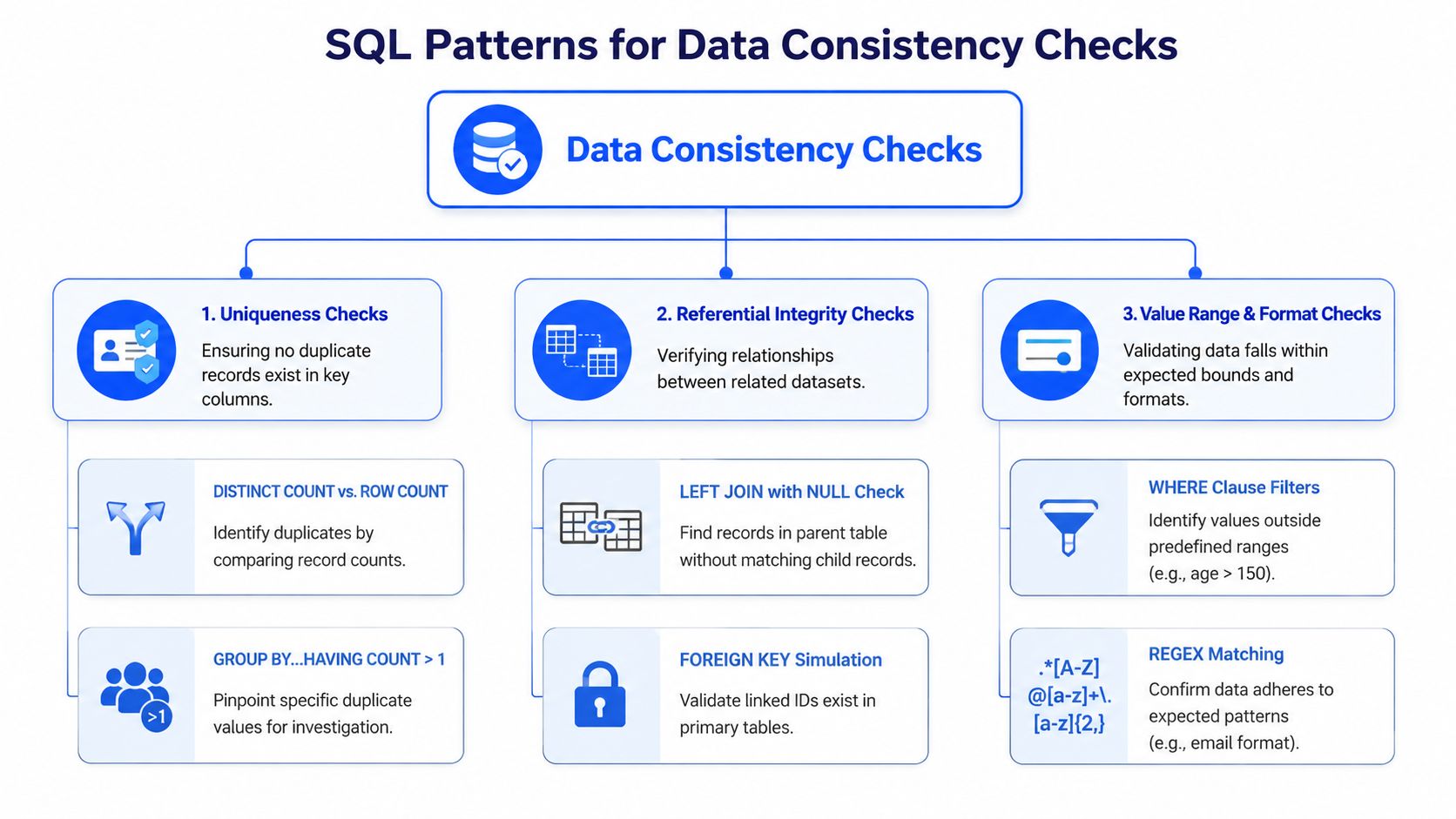
Start with counts, keys, and nulls
The first queries should be blunt. Record counts, duplicate detection, null checks, and key presence checks surface a surprising amount of damage early.
These are boring queries, and that is exactly why they work. Validation playbooks that hold up in production usually start with record count matches, duplicate checks, null value checks, referential integrity validation, and business rule compliance as core controls (LinkedIn data validation methods). They do not look impressive in a demo, but they catch the failures that create downstream confusion.
Reconcile across systems, not just within tables
Once the basic checks are in place, compare source and target data at both record and aggregate levels. That means row counts, sums, and grouped totals, not just raw equality on individual fields.
If those totals diverge, the issue is usually in lineage, transformation logic, or a timing mismatch between systems. In finance-oriented implementations, consistency checks often focus on whether account, currency, and cost center values align with master data, and whether transaction dates and reporting periods line up across ledgers and reports. That kind of control matters because finance teams need the same number to mean the same thing everywhere, especially at close and in reporting review (KAPC on designing consistency rules).
Use constraints for what should never happen
Some checks belong in the database itself. FOREIGN KEY and UNIQUE constraints stop bad data from landing where it can do harm. Application logic still helps, but it should not be the only barrier.
The design pattern is to treat consistency controls as a layered system, not a single query. Database-level enforcement, application-level validation, and UI-level validation each catch a different failure path, and teams that rely on only one layer usually discover gaps the hard way. Consistency rules work best when they are designed as part of the full pipeline, from entry to warehouse to reporting (KAPC on designing consistency rules).
Do not wait for the warehouse to be the only gate. Reject data earlier if you can.
Effective Monitoring and Alerting Strategies
A check that runs once and vanishes is just documentation with a timestamp. Consistency controls become valuable when they run on schedule, feed a monitoring layer, and route the right signal to the right team. That's especially important because a market-research case study reports error rates around 15% before systematic consistency checks and roughly 3% to 5% after they're applied, which is a strong reminder that operational control changes outcomes in a real pipeline (NumberAnalytics on critical data consistency checks).
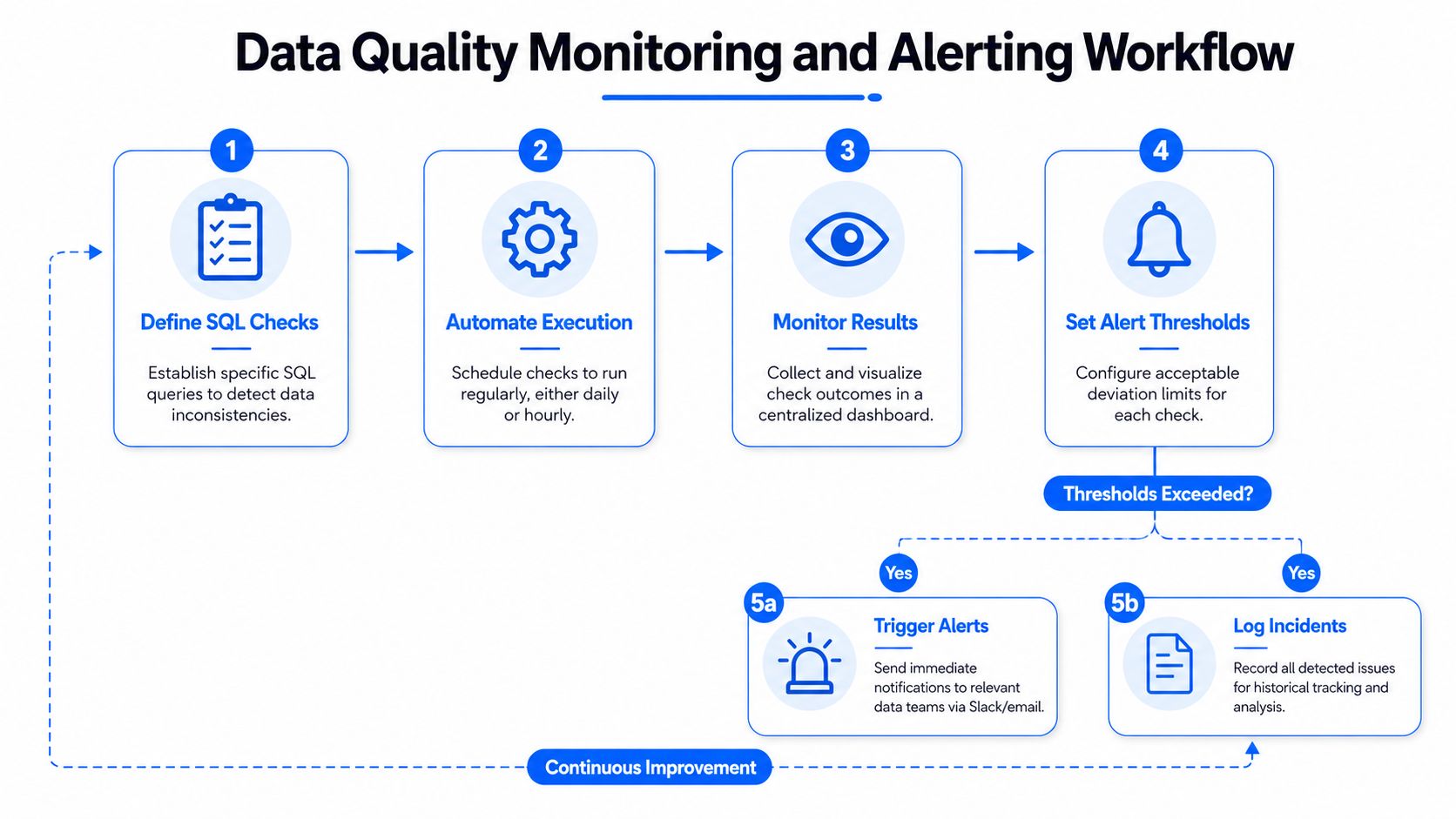
Make the alert signal actionable
Not every failed check deserves the same response. A missing critical foreign key might justify a blocked load, while a minor baseline deviation might only need investigation. Teams get into trouble when they route every failure to the same channel, because engineers stop trusting the alerts.
A practical pattern is to classify checks by severity and business impact, then define ownership before the alert ever fires. Reconciliation failures for revenue, customer identity, and compliance reporting should reach the people who can act on them immediately. Lower-severity drift should go to the analytics or data quality owner with enough context to triage quickly.
Use thresholds that reflect the system you run
Static thresholds are easy to configure and hard to trust. A count mismatch of one row might be catastrophic in a regulated ledger and trivial in an event stream that still has propagation lag. Distributed systems need a more careful approach, because eventual consistency can create temporary divergence that isn't a real failure. Guidance from distributed-systems and data-quality sources recommends checking contractual invariants and bounded staleness rather than exact equality at every moment (Slack Engineering on data consistency checks).
That's the design challenge. You need thresholds that distinguish acceptable lag from a genuine integrity break.
Centralize results and keep the history
Monitoring works best when every run is logged, compared over time, and tied to a remediation workflow. A single failed check is useful. A pattern of repeated failures is what helps you fix the upstream cause. Keep the result, the impacted dataset, the owner, the time, and the rule version together so people can investigate without reverse-engineering the incident later.
For teams building formal reporting workflows, the monitoring and reporting practices around data quality are a useful benchmark for turning checks into operational evidence.
Modernizing Checks with a Data Observability Platform
A growing pipeline does not fail in one obvious place. It starts with manual SQL checks that drift out of sync, then spreads across notebooks, dbt models, and ad hoc scripts until no one can tell which rule is authoritative. Data observability platforms help because they keep deterministic validation, statistical monitoring, and operational history in one control plane.

Use deterministic rules for known business logic
Some checks should stay explicit. If a customer's currency must match the region, if a foreign key must exist in the referenced source, or if a derived value must obey a calculation rule, a rule-based validator should enforce it. That is the role of a Data Validation module in a platform like digna, which runs inside the customer's environment and can support record-level business-rule checks, referential validation, and cross-column consistency controls.
The value is consistency of enforcement. Once the rules live in one place, teams stop rewriting them in ad hoc SQL across dbt models, notebooks, and operational scripts, and the same logic is applied the same way every time.
Add anomaly detection for the drift you didn't predict
Rule-only systems miss novel drift. A table can still satisfy every explicit check while the business shape of the data shifts in a way that no one expected. A practical consistency program combines deterministic validation with statistical anomaly detection and historical baseline analysis. Atlan on data consistency describes that broader pattern, and it is the right direction for teams that need to catch both known failures and changing behavior.
A platform approach helps because it compares current behavior to learned behavior without forcing every new signal into a hand-built rule. In digna's model, that maps naturally to Data Anomalies for baseline learning and continuous anomaly detection, plus Data Analytics for historical analysis of observability metrics. That combination matters when you need to hold the line on hard business rules while still watching for slow shifts that no validator would flag on its own.
Tie schema and timeliness into the same control plane
Schema changes and delayed delivery both break trust, even though they fail differently. A column rename can invalidate a downstream join, while late-arriving records can make a dashboard look correct at the wrong time. A good observability layer keeps Schema Tracker-style structural monitoring and Timeliness monitoring alongside consistency validation, so engineers can see whether the issue came from a shape change, a slow pipeline, or a business-rule violation.
The operational goal is clear. Use deterministic checks for rules that should never vary, use statistical methods for drift that no one encoded yet, and keep the results visible to the teams that have to act on them. That is the difference between scattered checks and a data quality program that is able to keep pace with the pipeline.
If your team needs people who can work across pipeline mechanics and business definitions, it can also recruit Data Quality professionals with the right mix of engineering, analytics, and governance experience.
Building a Proactive Data Quality Culture
Data consistency checks work best when they're treated like product infrastructure, not cleanup work. That means clear ownership, explicit rules, continuous monitoring, and a shared expectation that trust in data is something the organization maintains, not something it assumes. The strongest teams combine structural checks, cross-system reconciliation, business-rule validation, and statistical monitoring into a layered defense.
If you're staffing for that kind of program, it helps to recruit Data Quality professionals who understand both pipeline mechanics and business definitions. The skill mix matters because good consistency control sits at the intersection of engineering, analytics, and governance.
Ultimately, the payoff is simpler decisions. Analysts stop second-guessing dashboards, business leaders stop asking whether the numbers are real, and data teams spend less time firefighting broken assumptions. Consistency checks don't just protect data, they protect the pace of the entire organization.
digna gives teams a practical way to monitor data consistency checks, validate business rules, track schema changes, and catch drift before it reaches dashboards or models. If you want a platform that combines validation, anomaly detection, timeliness monitoring, and in-database execution, visit digna and see how it fits into your data quality stack.
Frequently asked questions
What do data consistency checks catch?
Breaks between systems before they spread across dashboards, forecasts and operational decisions. A dashboard rarely collapses because every table is empty; it misleads because two feeds that should agree have quietly stopped agreeing.
What does a typical consistency failure look like?
A retail ledger that keeps receiving orders, refunds and customer updates after a source system change. Nothing stops arriving, so volume and freshness checks stay green while the meaning of the records has shifted underneath.
How should checks be designed?
Around how your data actually moves rather than around a generic list. A check that does not mirror a real handoff between systems tends to pass during the incident it was supposed to catch.
Is this a new problem?
No. Historical census work makes the point: IPUMS datasets for 1850, 1880 and 1920 were used to surface data-entry errors and enumeration inconsistencies, which is the same operational problem teams face when modern feeds start to disagree.
Why does consistency deserve its own dimension?
Because the other dimensions cannot see it. A record can be complete, valid, timely and accurate within its own system and still contradict the same entity recorded elsewhere, and only a cross-system comparison reveals that.