Open Table Format: A Complete 2026 Guide
|
0
minuto de lectura

Apache Iceberg is used by 58% of organizations for business-critical analytics, while 95% are using or planning to use it for AI and machine learning workloads. An open table format is a specification layer on top of columnar files that gives engines a single, versioned view of a table's files, schema, and partitions, so different tools can read and write the same data with transactional guarantees.
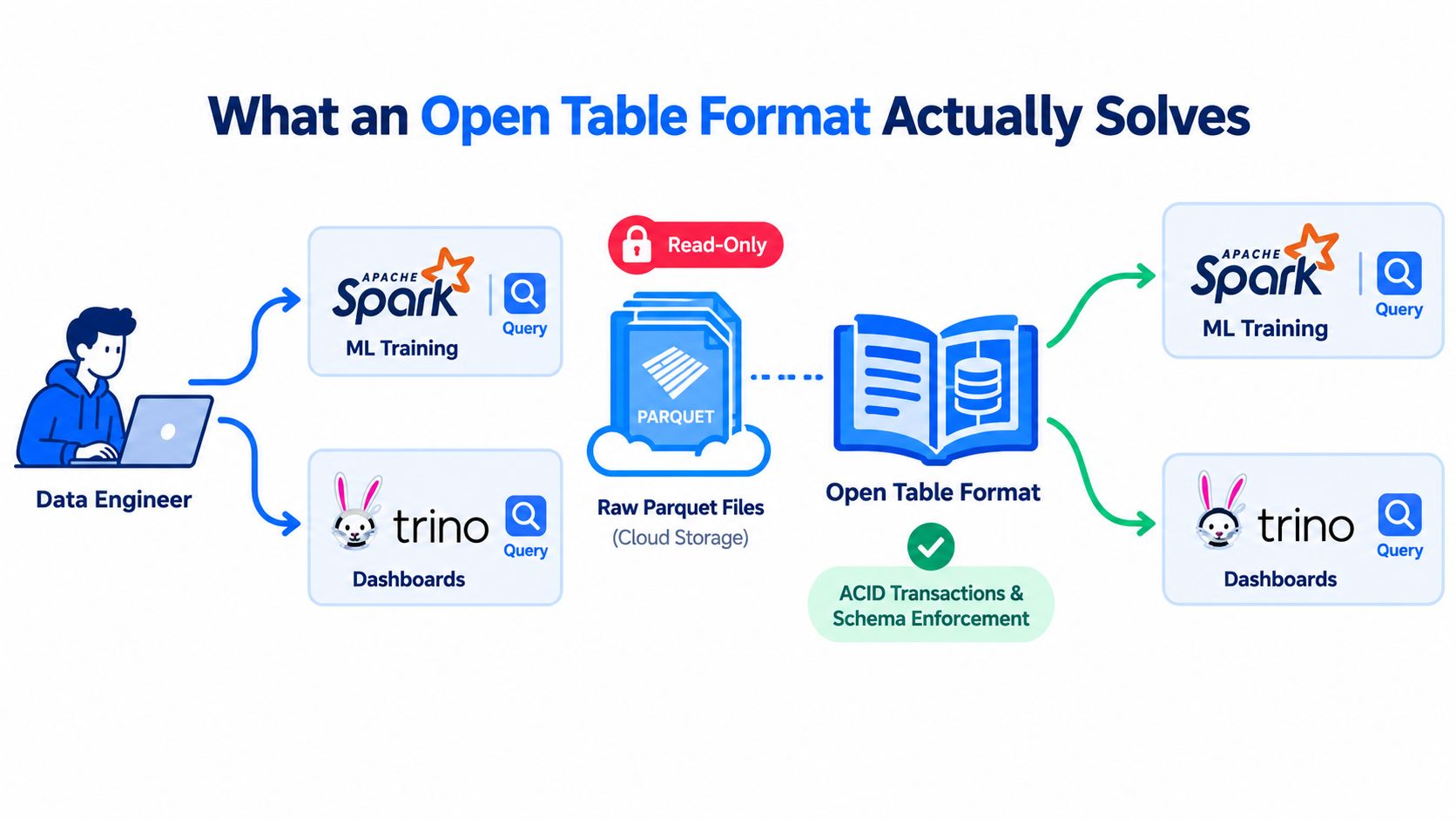
You may be in the middle of this problem already. A sales dataset sits in cloud object storage as Parquet files. Spark needs it for machine learning training, Trino needs it for dashboards, and a pipeline is still writing new partitions while analysts query yesterday's data. The files are cheap and readable, but the table itself has no dependable shared contract unless you add one.
That contract is the open table format. It doesn't replace Parquet or your query engines. It adds the metadata, transaction handling, schema rules, and table history needed to make file-based analytical storage behave like a managed table.
Table of Contents
What an Open Table Format Actually Solves
The missing contract
What it doesn't solve
The Core Concepts Behind the Specification
Transactional metadata as the master index
Partitioning as the catalog's grouping rule
Schema evolution as catalog history
Snapshots as point-in-time editions
How Iceberg, Delta Lake, and Hudi Approach the Same Problem
Benefits, Trade-Offs, and Workload-Driven Selection
Where the benefits show up
Where the trade-offs remain
Best Practices for Operating Open Table Formats at Enterprise Scale
Treat the catalog as production infrastructure
Make partitioning answer real questions
Put boundaries around snapshots
Emit operational signals at write time
Observability and Integration Patterns for Production Lakehouses
Four signals worth connecting
Integration and deployment details
Deployment and Operational Considerations in Regulated Environments
Controls to settle before production
A Practical Checklist Before You Standardize on a Format
What an Open Table Format Actually Solves
A data engineer can place partitioned sales data in object storage and point Spark at the directory. Trino can often read the same Parquet files too. The first query may work, but the operating model becomes fragile as soon as several writers, changing schemas, and concurrent readers enter the picture.
Raw files don't tell every engine which files belong to the logical table. A directory name might suggest a table identity, but it doesn't reliably record whether a file is current, superseded, incomplete, or created by an unrelated process. Partition folders also don't provide a universal history of how the table's layout changed.
The missing contract
An open table format sits beside the data files and records the information engines need to agree on a table:
Table identity: The logical table has a stable definition independent of an individual engine or directory scan.
File inventory: Metadata identifies the data files that belong to the table and the files that should no longer be read.
Partition layout: The table records how rows are organized, allowing engines to prune irrelevant data.
Schema history: Column additions, removals, renames, and compatible changes become part of the table's managed definition.
Atomic snapshots: Readers can select a consistent version while a writer commits a new version.
The result is a shared specification. Spark can use the table for ML preparation, Trino can serve interactive SQL, and both can resolve the same logical state instead of independently guessing from a folder structure.
What it doesn't solve
An open table format doesn't automatically create good data models, sensible partitions, fast queries, or trustworthy business values. It can protect table-level consistency, but teams still need to decide how data should be written, validated, compacted, governed, and monitored.
That distinction prevents a common architectural mistake. The format is the foundation beneath the operating model, not the operating model itself.
The Core Concepts Behind the Specification
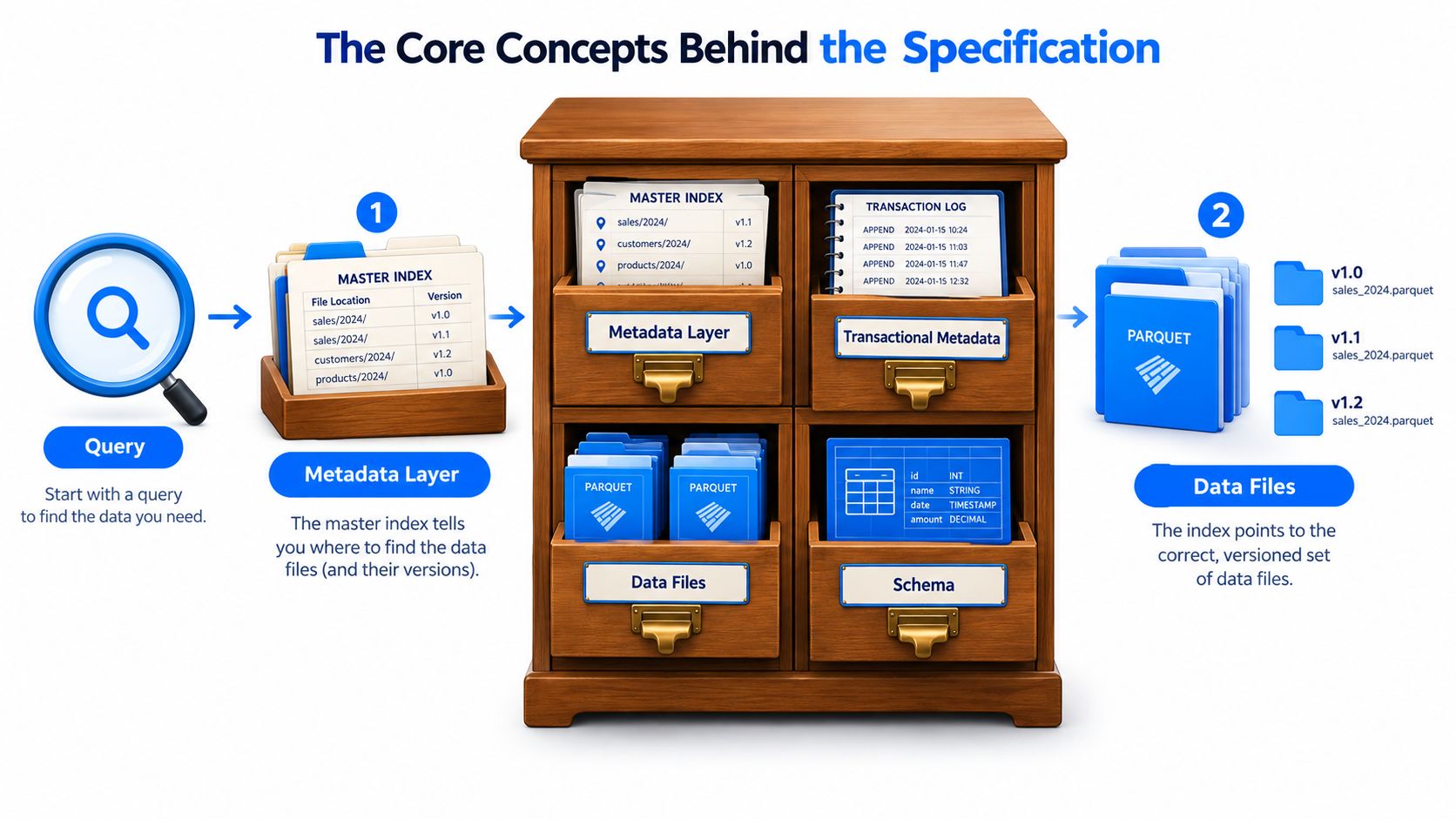
A library card catalog makes the metadata layer easier to understand. The books are your Parquet data files. The catalog is the table specification. A reader consults the cards first, then walks to the shelves that contain the requested books.
Transactional metadata as the master index
The metadata layer records which files belong to the table and how those files relate to a table snapshot. Instead of asking Spark or Trino to inspect every object-storage path, the engine follows the table's managed index.
Think of a catalog card that says, “These shelves contain the current edition of the sales collection.” If a writer replaces older files with newly compacted files, the catalog changes the active inventory as one commit. Readers don't have to infer whether they saw a complete update.
This is the practical purpose of metadata management. Metadata isn't decorative documentation. It directs planning, supports consistent reads, and gives operators a record of how the table changed.
Partitioning as the catalog's grouping rule
A partition rule groups related data so an engine can avoid scanning unrelated files. If sales data is organized around a time or regional access pattern, a query with a matching filter can narrow its scan scope.
The rule needs to match real workloads. A partition design that reflects how dashboards filter data can reduce unnecessary reads, while a design based on an unsuitable or overly granular attribute can create operational overhead and many small files.
Schema evolution as catalog history
A schema is the catalog's description of what each book contains. When a pipeline adds a column, renames one, or changes a type, the table format can record that change instead of leaving each engine to discover it independently.
That history matters when old files and new files coexist. A reader needs rules for interpreting both versions, and a pipeline needs a clear failure mode when a change is incompatible. Schema evolution reduces silent disagreement, but it doesn't decide whether a new column is semantically correct.
Snapshots as point-in-time editions
A snapshot is a consistent version of the table. It connects the table metadata to the set of data files that readers should use at that point in time. Apache Iceberg's documentation describes time travel as a way to run reproducible queries against a specific snapshot, while its specification stores snapshots in the table metadata JSON, rather than as separate serialized objects. See the Apache Iceberg documentation and Iceberg specification for the underlying model.
Together, these four concepts let Spark and Trino work from the same cataloged collection. One engine can write a new edition while another reads a stable earlier edition, subject to the format and catalog implementation's transaction behavior.
How Iceberg, Delta Lake, and Hudi Approach the Same Problem
Apache Iceberg, Delta Lake, and Apache Hudi all add table management to file-based analytical storage, but their design histories influence how teams use them. Iceberg began at Netflix in 2017, was donated to the Apache Software Foundation in 2018, and became a top-level Apache project in May 2020. Its design emphasizes engine-neutral table metadata and broad interoperability across systems such as Spark, Trino, Flink, Hive, and Impala, as described by the Apache Iceberg project.
Delta Lake uses Parquet data files alongside a transaction log in the _delta_log directory. The log contains ordered JSON records and periodic Parquet checkpoints, and a table snapshot is obtained by reading the log through a selected version, according to the Delta Lake research paper. That model makes the transaction log the central authority for table state.
Hudi is especially associated with incremental ingestion, upserts, deletes, and near-real-time data pipelines. Its copy-on-write and merge-on-read approaches represent different compromises between read simplicity and write or ingestion behavior. Hudi also places more emphasis on record-level indexing patterns for directing updates.
Dimension | Apache Iceberg | Delta Lake | Apache Hudi |
|---|---|---|---|
Design center | Engine-neutral analytical tables and portable metadata | Transactional Parquet tables centered on an ordered log | Incremental writes, upserts, deletes, and streaming ingestion |
Table state | Metadata points to snapshots, manifests, and data files |
| Timeline and metadata structures track table commits and file groups |
Partitioning | Supports partition layout evolution as query patterns change | Uses partitioned data with engine-specific optimization options | Uses partitioning alongside indexing and write-mode choices |
Schema evolution | Managed through table metadata and schema IDs | Managed through table and transaction-log rules | Managed through table metadata and writer configuration |
Snapshot isolation | Readers resolve a consistent metadata snapshot | Readers resolve a table version from the transaction log | Readers use the Hudi timeline and selected commit state |
Typical strength | Mixed-engine analytical access | Databricks-centered transactional lakehouse workflows | Frequent incremental changes and record-level ingestion |
Operational emphasis | Catalog, manifests, planning, and metadata maintenance | Log retention, checkpoints, compaction, and platform integration | Compaction, indexing, clustering, and write-mode management |
The comparison isn't a feature checklist. It's a clue about operating style. Iceberg often fits a platform where several engines must share tables. Delta can be a natural choice when Databricks and Spark-oriented workflows dominate. Hudi deserves close evaluation when continuous upserts and incremental processing are more important than broad read interoperability.
Whatever you choose, data quality remains a separate responsibility. A platform can manage commits and schema rules while still accepting incorrect values, so Databricks data quality practices belong in the architecture review rather than after deployment.
Benefits, Trade-Offs, and Workload-Driven Selection
Format selection should start with the workload, not a universal preference. In one TPC-DS-style comparison, Iceberg and Delta were close on several read-heavy queries while Hudi was slower on the same workloads. Interactive Query 19 ran in 1.45 seconds on Iceberg, 1.38 seconds on Delta, and 2.92 seconds on Hudi, while Reporting Query 27 took 8.70 seconds on Iceberg, 8.45 seconds on Delta, and 12.10 seconds on Hudi. For deep analytics, Query 64 took 184.20 seconds on Iceberg, 181.90 seconds on Delta, and 210.50 seconds on Hudi, as reported in this open table format benchmark.
Those results don't establish a permanent winner. They show why representative dashboards, joins, filters, writes, and maintenance operations matter more than a single headline benchmark.
Workload Pattern | Recommended Format | Deciding Factor |
|---|---|---|
Frequent streaming upserts and incremental changes | Apache Hudi | Record-level ingestion behavior, update handling, and merge-on-read or copy-on-write choices |
Mixed-engine analytical reads | Apache Iceberg | Portability across engines and catalog integration |
Databricks-centered lakehouse workflows | Delta Lake | Transaction-log integration and close platform alignment |
Interactive BI and SQL dashboards | Iceberg or Delta after testing | Read-path efficiency, planning overhead, and actual dashboard behavior |
AI and ML datasets shared across tools | Workload-dependent | Engine compatibility, governance, reproducibility, and training access patterns |
Where the benefits show up
Interoperability lets teams use one governed dataset from multiple engines instead of maintaining copies for every consumer. Transactional commits protect readers from partial writes and help pipelines publish complete table states. Catalog metadata supports permissions, discovery, lineage, and audit workflows when the catalog is treated as a real platform service.
Open tables can also support AI readiness. Training pipelines benefit when historical states are reproducible and when the same governed data is available to preparation, evaluation, and analytical workloads.
Where the trade-offs remain
Catalog dependency creates a real failure mode. If the catalog or metadata service is unavailable, reads and writes may stop even when the underlying files remain in object storage. Cross-table transactions and foreign-key behavior aren't equivalent to a traditional relational database, and recent coverage emphasizes that ACID guarantees are generally scoped to individual tables.
Operations also continue after the first successful write. Compaction, snapshot expiry, orphan-file cleanup, partition maintenance, and schema review all require ownership. The format reduces ambiguity, but it doesn't remove platform work or enforce business correctness.
Best Practices for Operating Open Table Formats at Enterprise Scale
The specification gives you a reliable vocabulary for table state. It doesn't provide the operating discipline required to keep that state healthy. Four practices deserve explicit ownership before production workloads arrive.
Treat the catalog as production infrastructure
The metastore, REST catalog, or unified governance catalog is a control plane. Give it availability targets, access reviews, audit trails, backup procedures, and an incident runbook. A table may live in object storage, but engines still depend on the catalog to resolve its identity, metadata, permissions, and current state.
Practical rule: If a catalog outage would stop analytical work, monitor and recover it like a database control plane, not like a configuration file.
Make partitioning answer real questions
Choose partitions from observed query filters and write behavior. Iceberg supports partition layout evolution, so teams can change the layout as data volume or query patterns change, but an evolution feature doesn't eliminate the cost of poor initial choices.
Check for small-file creation after every major pipeline change. High-cardinality partition keys can scatter data across many files, while overly broad partitions can force engines to scan more data than necessary. Sorting and compaction can improve locality, but they add maintenance work.
Put boundaries around snapshots
Historical snapshots help with reproducibility, rollback, and debugging. Unbounded retention creates more metadata to plan and more objects to manage, so define a policy based on recovery needs, audit requirements, and storage lifecycle rules.
Pair snapshot expiry with orphan-file cleanup. Removing metadata references without safely identifying unreferenced data can create a different failure, so cleanup should be deliberate, observable, and tested.
Emit operational signals at write time
Writers know when a commit starts, how many files they create, how long the commit takes, and whether compaction ran. Capture those facts as structured events instead of trying to reconstruct them later from scattered logs.

Track file counts, file sizes, commit latency, snapshot age, failed commits, and compaction health. These signals connect format operations to the symptoms users notice, such as slow dashboards, stale datasets, and incomplete loads.
Operational maturity determines whether a lakehouse behaves reliably. The open specification is necessary for shared semantics, but your catalog policies, maintenance jobs, alert routing, and ownership model determine whether those semantics survive production pressure.
Observability and Integration Patterns for Production Lakehouses
A table can be transactionally valid and still be operationally wrong. It may have a new column that breaks a downstream model, a successful commit that arrived too late for a reporting deadline, or a valid file set whose record volume differs sharply from its established baseline.
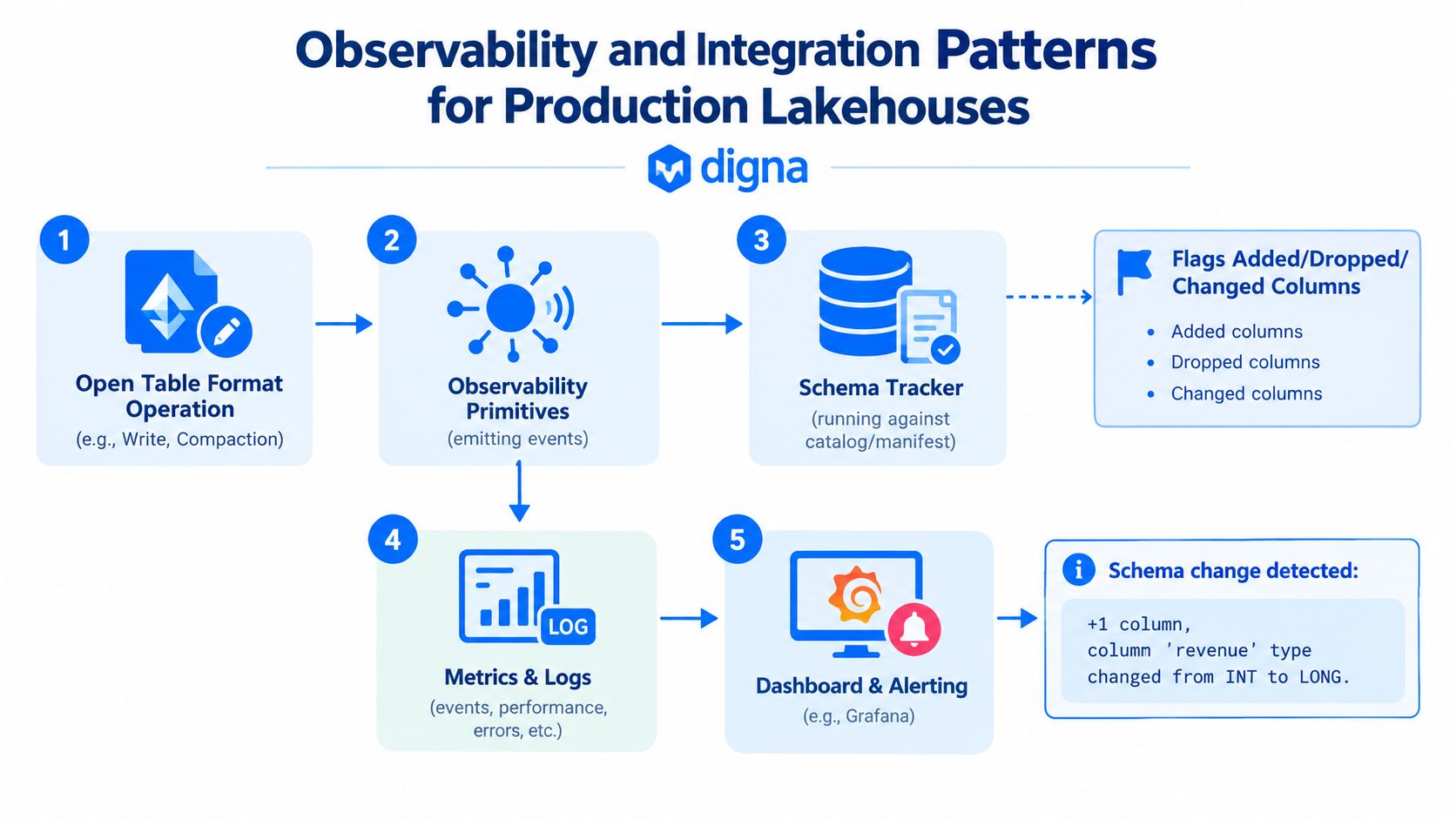
Observability should map directly to table operations. Schema tracking inspects catalog metadata or manifest information for added, removed, and type-changed columns. In-database checks evaluate records where they already live, which avoids exporting samples and allows teams to test row counts, null behavior, business rules, and selected relationships.
Four signals worth connecting
Schema change detection: Flag an added, removed, or type-changed column before a downstream consumer fails or coerces values.
Data validation: Run assertions against the table for required fields, accepted values, record-level business rules, and integrity conditions.
Anomaly baselines: Compare partition-level record counts, file sizes, commit behavior, and other metrics with the dataset's historical behavior.
Timeliness monitoring: Compare snapshot creation and data arrival against the expected delivery schedule, so a technically successful pipeline doesn't hide a freshness incident.
The useful unit of monitoring isn't only the job. It's the table state that consumers read. A successful task can still publish an incomplete business period, introduce an incompatible schema, or create a pathological file layout.
Integration and deployment details
An observability platform can connect to Iceberg REST or Unity Catalog APIs for schema and metadata access, ingest structured writer events for anomaly analysis, and send alerts to the same incident channels used for warehouse monitoring. Agent placement matters too. Teams need to decide whether monitoring components run beside the compute environment, within a private network, or in another controlled service boundary.
Permissions must align with catalog RBAC. Monitoring should see enough metadata and table content to calculate required signals without bypassing the governance layer. A platform such as digna's data observability solution can fit as one option, with capabilities for schema tracking, in-database validation, anomaly detection, and timeliness monitoring inside the customer's environment.
The broader principle is simple: every commit should produce evidence about what changed, when it arrived, and whether its behavior remains within an accepted baseline.
Deployment and Operational Considerations in Regulated Environments
Choosing Iceberg, Delta Lake, or Hudi is rarely the hardest decision in a regulated environment. The difficult questions concern where the catalog runs, how engines authenticate, how permissions map to sensitive columns, and how metadata operations appear in an audit trail.
A bring-your-own-cloud deployment keeps storage, catalog services, compute, and monitoring inside the organization's cloud boundary. The team controls network paths and retention, but it also owns availability, upgrades, key management, and recovery testing. A multi-region design adds replication and residency decisions. Operators must define which metadata and snapshots replicate, how lineage crosses regions, and which rollback procedure applies when regions diverge.
An air-gapped on-premises deployment changes the constraints again. External managed services may be unavailable, so catalog upgrades, format compatibility testing, observability, and incident evidence must operate within the isolated environment.

Controls to settle before production
Catalog location: Choose a managed service, self-hosted catalog, or unified governance platform based on recovery, residency, and audit requirements.
Identity and access: Map catalog permissions to existing RBAC or ABAC policies, including service identities used by ingestion and monitoring.
Sensitive data handling: Tag and govern PII at the catalog and platform layers rather than assuming the file format provides policy enforcement.
Runtime assurance: Continuously verify freshness, schema compatibility, data behavior, and access events instead of relying on a one-time validation exercise.
Teams should document these choices alongside data residency requirements. The format can make table history and file state more explicit, but operational maturity determines whether the lakehouse can provide durable audit evidence.
A Practical Checklist Before You Standardize on a Format
Use these sentences in your next architecture review:
Catalog fit: Verify that the catalog supports your engines, identity model, audit requirements, and recovery design.
Engine compatibility: Test the actual Spark, Trino, Flink, warehouse, and BI combinations that will read or write the tables.
Partition strategy: Match partitioning and sorting to observed access patterns and write behavior.
Snapshot policy: Define retention, rollback, compaction, and orphan-file cleanup procedures before production use.
Access control: Confirm that sensitive columns, service identities, and monitoring permissions follow existing governance policies.
Schema alerts: Monitor added, removed, renamed, and type-changed columns before downstream consumers break.
Freshness SLAs: Compare snapshot arrival with expected delivery times for batch and streaming consumers.
Anomaly baselines: Track file counts, record volumes, commit latency, and partition behavior over time.
Rollback procedure: Test how operators identify a bad snapshot and restore a safe table state.
Revisit the checklist after every major engine upgrade, regulatory change, or pipeline refactor. An open table format reduces ambiguity, but it doesn't eliminate operational responsibility.
digna helps data teams monitor schema changes, validate records in-database, detect anomalous table behavior, and track timeliness inside their own cloud or data center. Visit digna to connect those controls to the open table format operations your lakehouse already depends on.