Build a Robust Data Quality Framework for 2026
|
6
minuto de lectura
A dashboard that looked fine yesterday is suddenly wrong today. Revenue is doubled in one region, customer counts are missing in another, and no pipeline has reported a failure. Or your model still runs, still returns scores, and still passes infrastructure checks, but downstream users can tell something is off. Those are the hardest incidents because the system is “up” while trust is already down.
That's where a data quality framework stops being a documentation exercise and starts becoming operational infrastructure. It gives engineers a way to define what “good data” means, check it continuously, and catch silent failures before bad records spread into reports, models, and decisions. The part many organizations still struggle with isn't the definition. It's implementation. Specifically, how to run modern quality checks, anomaly detection, and timeliness monitoring securely and within existing data environments.
Table of Contents
Why Your Data Fails and How a Framework Can Help
Most bad data incidents don't begin with a dramatic outage. They begin with something small. A source system changes a field format. A batch arrives late. A new upstream process starts filling a previously optional field with blanks. Nothing crashes, so nobody looks until the CFO asks why a board report changed or an analyst spends half a day reconciling numbers that used to match.
That's why reactive data quality work fails. Teams wait for a dashboard complaint, then search logs, compare tables, and patch symptoms. A week later, the same class of issue shows up somewhere else because no one defined ownership, thresholds, or checks at the pipeline level.
A workable framework changes the operating model. Instead of treating quality as an after-the-fact audit, teams define what must be true before data can be trusted in production. That means deciding which datasets are critical, which dimensions matter for each one, who owns the standards, and what should happen when a check fails.
Bad data is rarely one broken table. It's usually one silent defect repeated across downstream systems.
In practice, the first win is trust. Engineers stop debating whether a problem is “real.” Analysts stop building defensive logic into every query. ML teams stop guessing whether degraded performance came from feature drift, stale inputs, or malformed records. The framework gives everyone the same control plane.
The modern wrinkle is architecture. Many teams can describe a framework on paper but still rely on extraction-heavy tooling that copies data into someone else's environment for profiling and monitoring. That creates friction for regulated workloads and private environments. A more secure operating model keeps computation where the data already lives, then pushes alerts and metrics outward instead of the data itself. Teams dealing with recurring rollout failures often recognize the same structural pattern described in why data quality projects fail and how to fix the operating model.
The Pillars of a Modern Data Quality Framework
A modern data quality framework defines what must be true for a dataset to be trusted in production, then enforces those rules where the data already lives. The foundation is stable: accuracy, completeness, consistency, timeliness, validity, and uniqueness. What changes in a modern stack is execution. Instead of exporting data to an external service for profiling, teams can run checks inside the warehouse, lakehouse, or database, keep sensitive records resident, and send out metrics, alerts, and remediation signals.
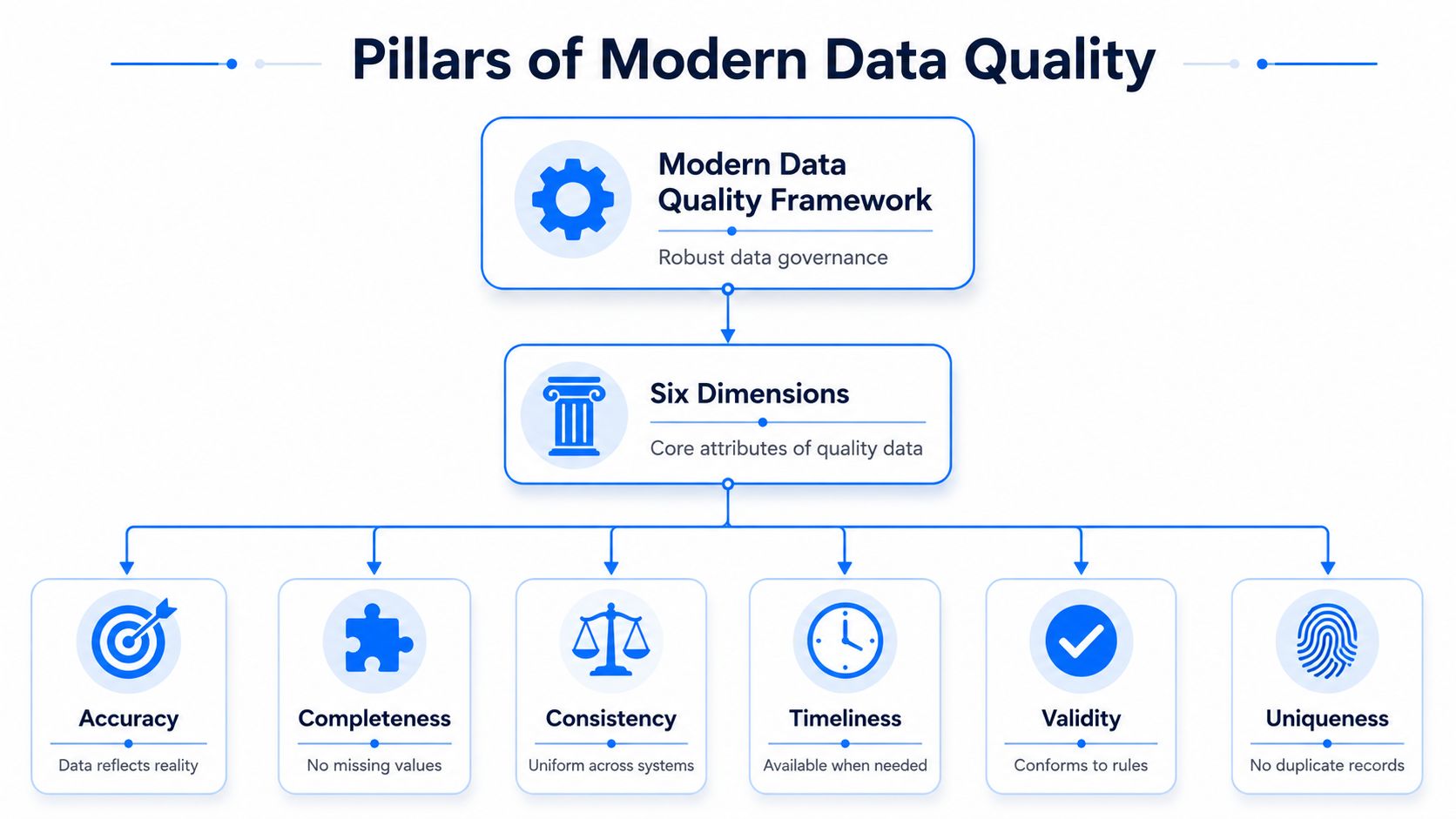
Six core dimensions
Accuracy measures whether a value matches the actual state it represents. A customer marked as active after account closure is inaccurate, even if the field is populated and formatted correctly.
Completeness checks whether the required data is present. Missing IDs, timestamps, or category values often break downstream joins, reporting logic, and model features before anyone notices the source issue.
Consistency checks whether the same entity means the same thing across systems and tables. If finance and operations assign different product codes to the same item, reconciliation turns into manual cleanup.
Timeliness measures whether data arrives within the window the business process requires. A dataset can be structurally clean and still fail the use case if it lands too late for fraud response, operational decisions, or executive reporting.
Validity checks whether values conform to expected formats, ranges, and business rules. Dates outside allowed ranges, malformed identifiers, and out-of-policy regulated codes all fail validity.
Uniqueness confirms that records appear once when they should appear once. Duplicate customers, claims, or orders distort counts, revenue, and risk metrics fast.
These dimensions are standard, but the implementation details are not. The practical work is choosing which dimensions matter most for each dataset and expressing them as checks that can run safely inside your environment. For teams building that mapping, this guide to data quality dimensions and how to measure them at scale is a useful reference.
Why thresholds belong in pipelines
Dimensions become useful only when they are measurable. Each dataset needs thresholds tied to business use, data sensitivity, and failure cost. A finance table may tolerate very little missingness but accept slower refresh. An operational event stream may accept occasional late-arriving records but not stale data beyond a short window.
Examples make the concept of quality concrete. Completeness might mean keeping null rates below an agreed threshold for a reporting table. Timeliness might mean enforcing freshness targets for a monitoring feed. Validity might mean checking that values stay inside contractual or regulatory ranges before the data is published downstream.
The trade-off is straightforward. Tight thresholds catch more issues early, but they can also block pipelines for defects that have little business impact. Loose thresholds reduce operational noise, but they let silent degradation spread. Good teams do not chase perfect data. They set tolerances that match the risk of the decision being made.
What works in practice:
Tie each check to a business use case. A customer master, feature store, and clickstream table should not share the same standards.
Define numeric or rule-based thresholds. “Good enough” cannot be enforced.
Run checks at the point of transformation and publish. That is where schema drift, join inflation, and invalid values tend to enter.
Track trends alongside failures. Slow erosion often shows up before a hard threshold breach.
Keep execution in-database when the data is sensitive. This reduces security exposure, avoids extra copy costs, and fits regulated environments better.
Practical rule: If a team cannot name the threshold, owner, and action for a failed check, the standard is not ready for production.
That operating model also changes tooling decisions. Teams evaluating platforms for governance, risk, and reporting often look for the same pattern seen in senior product leadership in Web3 compliance: controls are useful only when they fit the environment they must protect, not when they require data to leave it.
Data Governance and Key Roles in Your Framework
Tools won't save a framework with vague ownership. When nobody owns a dataset, engineers end up making business decisions in SQL, and business teams assume engineering will “just know” what counts as acceptable data.
Who owns what
Three roles matter most.
Data owners decide what quality means for a domain. They approve acceptable thresholds, define business impact, and decide whether an exception is tolerable or risky.
Data stewards translate policy into operational standards. They define valid values, reference logic, naming conventions, and issue triage priorities with the business context attached.
Data custodians or engineers implement the controls. They place checks into pipelines, wire alerting, handle failed runs, and make sure quality signals are visible where work happens.
That separation prevents a common failure mode: policy written by governance teams that never reaches execution, or technical checks written by engineers that don't reflect actual business rules. A strong reference point for this division of labor is data owner responsibilities in operational governance.
Where governance breaks down
Governance usually fails in one of four places:
Failure point | What it looks like | Result |
|---|---|---|
Undefined ownership | Everyone assumes someone else approved the standard | Long debates during incidents |
Policy without implementation | Rules live in slides or catalog entries | No enforcement |
Engineering without business context | Checks are technically neat but operationally irrelevant | Noise and missed risk |
No shared visibility | Each team sees a different version of the issue | Slow remediation |
This isn't only a data problem. Regulated digital products face the same need for crisp ownership between product, risk, and reporting functions. If you want a concrete example of how those skills are framed in another domain, the role description for senior product leadership in Web3 compliance is a useful comparison. The responsibilities map closely to what mature data programs need: clear accountability, risk thinking, and operational coordination.
A practical governance model is simple. The steward defines “valid customer type.” The engineer implements the rule. The owner decides whether a breach blocks publication, raises a warning, or triggers escalation. If one person is forced to do all three jobs, the framework won't scale.
Automating Quality with Monitoring and Validation
Manual data quality work doesn't fail because teams are careless. It fails because static rules don't keep up with living systems. New sources arrive, seasonality changes, product usage shifts, and pipelines evolve. A rules-only approach eventually turns into a brittle alert factory.
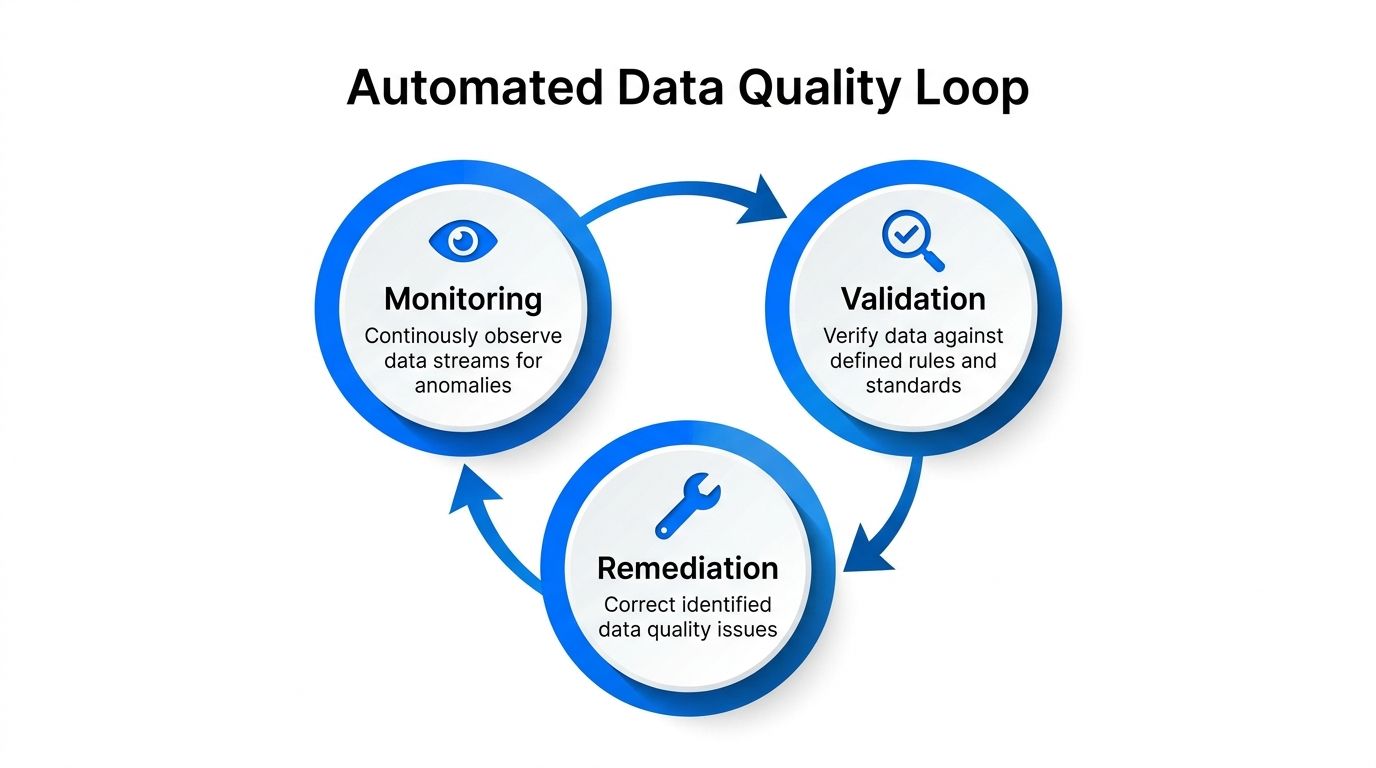
Monitoring finds what rules miss
Monitoring should answer a basic question: does this dataset still behave like itself?
That's where anomaly detection earns its place. According to digna's explanation of AI anomaly detection techniques, AI-powered anomaly detection systems replace static, rule-based thresholds with adaptive thresholds that automatically learn seasonality and trends, significantly reducing false positives while capturing true anomalies without requiring manual ML expertise or Python coding. That matters because fixed thresholds are often wrong in both directions. They miss real drift and they fire on expected variation.
FirstEigen's overview of anomaly detection for data quality describes the operational point well: anomaly detection uses machine learning and AI to continuously monitor data streams, identifying outliers that deviate from high-quality patterns and are often errors, unexpected events, or opportunities, helping maintain accuracy, completeness, and reliability in real time.
Validation enforces what the business already knows
Monitoring handles the unknown unknowns. Validation handles the known knowns.
If a claim status must belong to an approved list, validate it. If a regulated identifier must match a defined format, validate it. If a record must never be duplicated on a composite business key, validate it. These are explicit controls. They shouldn't depend on pattern learning.
A practical loop usually includes:
Adaptive monitoring for shifts in volume, distribution, freshness, and unusual change patterns.
Deterministic validation for record-level rules, required fields, allowed values, and contractual constraints.
Escalation logic so the right team gets the right alert severity.
Root-cause workflow that links an alert back to a job, schema change, upstream source, or code release.
Oracle's description of AI anomaly detection captures the broader shift: the process moves from static statistical rules to a flexible model trained on data to create a baseline for normal behavior, and that model adapts as more data is processed.
Remediation closes the loop
No framework is automated if alerts die in a queue. Remediation needs ownership and response playbooks. When an anomaly lands, someone should know whether to block downstream publishing, quarantine the data, re-run the pipeline, or accept a documented exception.
A check without a response path is just instrumentation.
This is also the right place to mention one modern implementation option. digna combines anomaly detection, timeliness monitoring, schema tracking, and record-level validation while running analyses inside the customer environment. That model fits teams that need both observability-style monitoring and enforceable quality controls without shipping production data outward.
Modern Implementation Patterns for Data Quality
Organizations don't need more theory. They need an architecture that works under real security, latency, and operational constraints.

Pattern one in-database execution
The strongest implementation pattern today is in-database execution. The important shift is where computation happens. Instead of extracting data into a vendor platform for profiling and anomaly detection, the platform sends computation to the warehouse, lake, or private environment where the data already resides.
That pattern matters for three reasons:
Security. Sensitive records stay in the controlled environment.
Performance. You avoid unnecessary movement and duplicate storage.
Operational fit. Private cloud and on-prem teams can adopt modern monitoring without redesigning data access.
The architectural direction is becoming more visible in forward-looking discussions. The PMC reference on localized validation and resident-data execution describes an emerging 2025 to 2026 trend toward in-database execution, where AI models run directly against resident data to detect anomalies such as distribution shifts or schema changes without extraction. It also notes that this remains underserved because vendors rarely explain the shift clearly enough for engineers to implement it confidently.
Pattern two split adaptive monitoring from explicit controls
Teams get better results when they separate two jobs that often get mixed together.
Use adaptive methods for behavior-based detection. That includes changing distributions, volume drops, suspicious spikes, evolving seasonality, or late-arriving partitions.
Use explicit controls for contractual and business rules. That includes null limits, enum membership, referential checks, regulatory value ranges, and duplicate prevention.
When a team tries to solve both with only static rules, maintenance expands fast. When it tries to solve both with only anomaly detection, it loses hard guarantees the business still needs.
Pattern three watch structure and arrival not just values
A modern data quality framework should monitor more than row contents.
Schema changes can break downstream logic without immediate detection. Added columns, removed columns, type changes, and renamed fields often pass infrastructure health checks while breaking transformations or BI logic later. Timeliness failures do the same. A table can be valid and complete when it finally lands, but still be too late for the use case.
A practical implementation blueprint is straightforward:
Compute metrics in the resident platform across priority tables.
Learn baselines for normal behavior on selected signals.
Track schema and timeliness alongside content quality.
Expose only metrics, alerts, and diagnostics to the operational interface.
That design gives engineering teams the benefits of modern AI-driven monitoring without accepting the security and movement costs of extraction-heavy tooling.
Setting Meaningful Data Quality SLAs and SLOs
Monday at 8:05 a.m., the dashboard is green, the pipeline finished, and the business still made the wrong call because the data arrived forty minutes late. That is the gap SLAs and SLOs need to close. They should define what failure looks like for the business, not just what passed in the pipeline.
An SLA is the promise to a consumer. An SLO is the internal target that gives the team enough margin to keep that promise. A KPI tracks whether the program is improving over time.
Teams get into trouble when they write targets that are easy to report and hard to use. “Availability” sounds good until a table is present but stale. “Completeness” sounds good until every required field is filled in after the decision window has passed. For AI and analytics workloads, those gaps matter because quality is tied to whether the data was fit for the decision at the moment it was used.
Set SLOs from the consumption point backward. Start with the report, model, workflow, or customer commitment. Then define the quality condition that must hold for that use case. A regulatory filing and a fraud scoring pipeline should not share the same timeliness target. One can tolerate delay and almost no validity errors. The other can tolerate small gaps but not late data.
This is also where implementation discipline matters. In a modern stack, the best way to enforce these objectives is to evaluate them where the data already lives, then expose only results, exceptions, and audit detail to the teams who need them. That avoids copying sensitive data into another service just to measure whether it met a contract.
Example Data Quality SLOs by Dimension
A practical way to define targets is to tie each one to an operational decision and an owner. This guide on measuring data reliability for real operating conditions is a useful reference for turning broad quality goals into measurable thresholds.
Dimension | Example SLO | Business Impact |
|---|---|---|
Accuracy | Critical reference values must match approved source logic before publication | Prevents decisions based on incorrect facts |
Completeness | Required identifiers in financial reporting datasets must stay below the accepted null threshold for the reporting use case | Keeps reports usable and auditable |
Consistency | Shared business entities must use aligned definitions across reporting systems | Reduces reconciliation work |
Timeliness | Real-time analytics inputs must be refreshed within 15 minutes of source update for use cases that depend on current data | Protects time-sensitive decisions |
Validity | Values subject to regulatory or contractual rules must conform to defined ranges and formats | Lowers compliance and downstream processing risk |
Uniqueness | Business keys intended to represent one entity must remain duplicate-free within the accepted tolerance for the domain | Prevents double counting and identity confusion |
Good SLOs also have response logic behind them. Who gets paged. Which breach blocks publication. Which breach creates a warning but allows downstream use. Without that, teams end up arguing about severity during an incident instead of acting on a pre-agreed contract.
The test is simple. A useful SLO tells the on-call engineer what to do next and tells the data consumer what risk they are accepting.
A Phased Roadmap for Implementing Your Framework
A rollout usually fails the first time a team tries to apply every rule to every table at once. The practical path is narrower. Start with data that can break a report, delay a customer workflow, or trigger a bad operational decision. Prove that the framework works under production pressure, then expand.
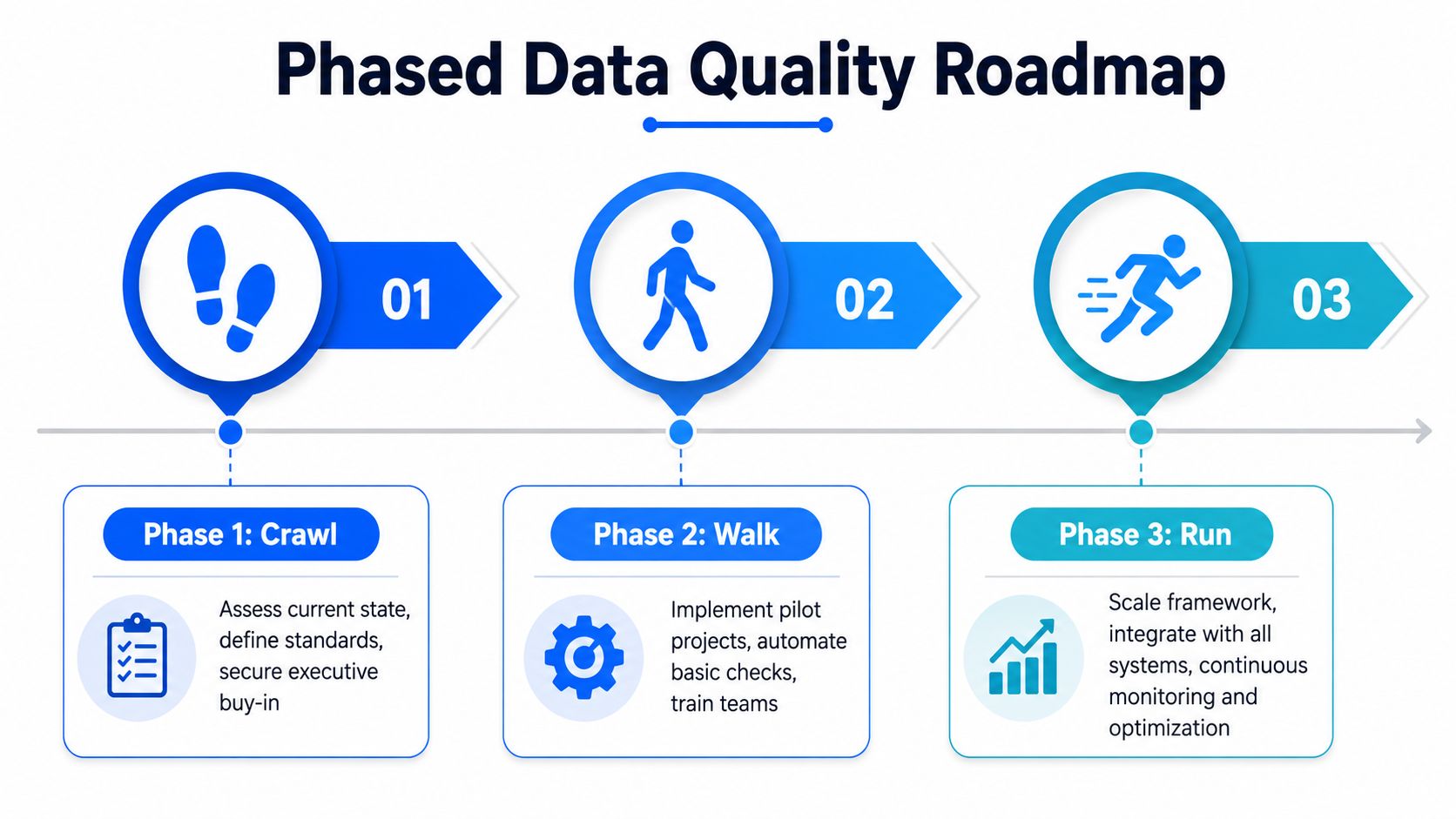
Phase 1 crawl
Begin with one or two critical datasets tied to a real business process. That boundary matters. Small scope makes it easier to identify the data owner, define acceptable thresholds, and see whether alerts lead to action or just create noise.
Use this phase to answer a few operational questions. Which checks belong in the warehouse or lakehouse, where the data already lives? Which failures should block publication? Who reviews a breach during business hours, and who gets paged after hours? A framework becomes useful when those decisions are made early.
Focus on a short list of controls that expose risk fast:
Timeliness checks for scheduled loads, freshness windows, and missed arrivals
Completeness checks on required fields that downstream models or reports cannot tolerate as null
Validity rules for business-critical attributes such as status codes, dates, and regulated values
Keep execution close to the data from day one. Running checks in-database avoids copying sensitive records into another service, reduces setup friction with security teams, and keeps compute aligned with the platform your engineers already manage.
Phase 2 walk
Expand after the pilot produces alerts that people trust and act on. At this stage, the goal is not broad coverage. The goal is repeatable operation across more pipelines, teams, and release cycles.
The process either hardens or falls apart at this stage. Data owners approve thresholds. Stewards refine business rules that were too vague in the pilot. Engineers attach validation to orchestration, CI pipelines, and publish steps so quality checks run as part of delivery instead of as a separate review. Dashboards help, but response paths matter more than visuals.
The implementation pattern also starts to matter more. External scanners can work for sampled or replicated data, but they add movement, permissions work, and another place to store sensitive information. In-database execution avoids that trade-off. Teams can run anomaly detection, schema checks, and rule-based validation where the governed data already sits, which usually makes security review simpler and remediation faster.
Phase 3 run
Now optimize.
Static rules still matter, but they stop being enough once volumes grow and source behavior changes. Add adaptive monitoring for distribution shifts, late-arriving data, schema drift, and patterns that break existing thresholds without violating a simple rule. Review false positives with the same discipline you apply to real incidents. A noisy system gets ignored. A silent one fails in more expensive ways.
This phase is also where teams connect quality to engineering economics. Some checks belong on ingestion because they catch bad records before they spread. Others belong before publication because the business only cares about the curated output. Good frameworks use both. The right placement depends on where a failure is cheapest to detect, easiest to explain, and safest to contain.
When the roadmap is working, quality stops being a side project. It becomes part of how the platform ships data safely.
If your team wants a way to implement a modern data quality framework without moving sensitive data into an external environment, digna is one option to evaluate. It supports anomaly detection, validation, timeliness monitoring, and schema tracking with in-database execution in customer-controlled environments.