Enterprise Data Warehouses: Guide to Architecture And
|
7
min read

You can usually spot the moment a warehouse becomes mission-critical before anyone says the words. A dashboard that looked fine on Monday gets challenged in a steering meeting on Thursday, the revenue number doesn't match finance's spreadsheet, and the room goes quiet while data teams start tracing refresh jobs, joins, and definitions that should've been locked down months ago.
That's the job of enterprise data warehouses. They're not just storage, and they're not just a reporting layer. They're the place an organization expects to find a consistent answer, even when source systems change, business rules shift, and dashboards keep running long after the original build team has moved on.
For a practical framing of what business users see on top of that layer, the Power BI dashboard guide UK is a useful companion piece. The harder question, though, is what keeps the warehouse trustworthy after go-live, because that's where the pain is often felt.
Table of Contents
The Moment a Trusted Dashboard Stops Being Trusted
What an Enterprise Data Warehouse Actually Is
EDW versus the other systems people confuse it with
The Four Deployment Patterns That Actually Matter
Cloud EDWs and lakehouse hybrids
How Data Actually Flows Through an EDW
Four stages that create four control points
Why compute and storage are separated
The Four Capabilities That Decide Whether an EDW Survives
Scalability and latency
Schema management and governance
Data Warehouses, Data Lakes, and Lakehouses in Practice
Why lakehouses don't erase the warehouse
The governance implication
Keeping the EDW Reliable After Go-Live
The checks that catch silent breakage
Why in-database execution matters
Choosing and Operating an Enterprise Data Warehouse
A practical decision framework
A short FAQ that teams usually ask late
The Moment a Trusted Dashboard Stops Being Trusted
A CFO opens a quarterly revenue dashboard, sees a number that doesn't feel right, and asks where it came from. The visual is still green, the pipeline ran, and no alert fired. The problem isn't that the warehouse failed loudly, it's that it failed without warning enough to make everyone question the entire reporting stack.
That's the trust problem enterprise data warehouses are built to solve. An EDW is supposed to be the organization's governed source for BI, analytics, and compliance reporting, which means it has to keep producing consistent answers after the launch celebration is over. If the warehouse can't survive source changes, delayed loads, or schema drift, then the “single source of truth” turns into a single place to argue.
The part teams often underestimate is day-2 operations. A dashboard can look healthy while the data behind it is stale, incomplete, or subtly reinterpreted by a schema change upstream. A warehouse that only works when the original builders are watching is a project, not a platform.
The better mental model is simple. Treat the EDW like a living system with ingestion, quality checks, business logic, and consumer layers that all need monitoring. That's why architecture decisions on day 1 matter so much, because they decide how visible failure will be later, and how hard it will be to isolate the break before leadership starts asking questions you can't answer.
Practical rule: if the data team can't explain when a number last changed, the warehouse isn't trustworthy yet.
What an Enterprise Data Warehouse Actually Is
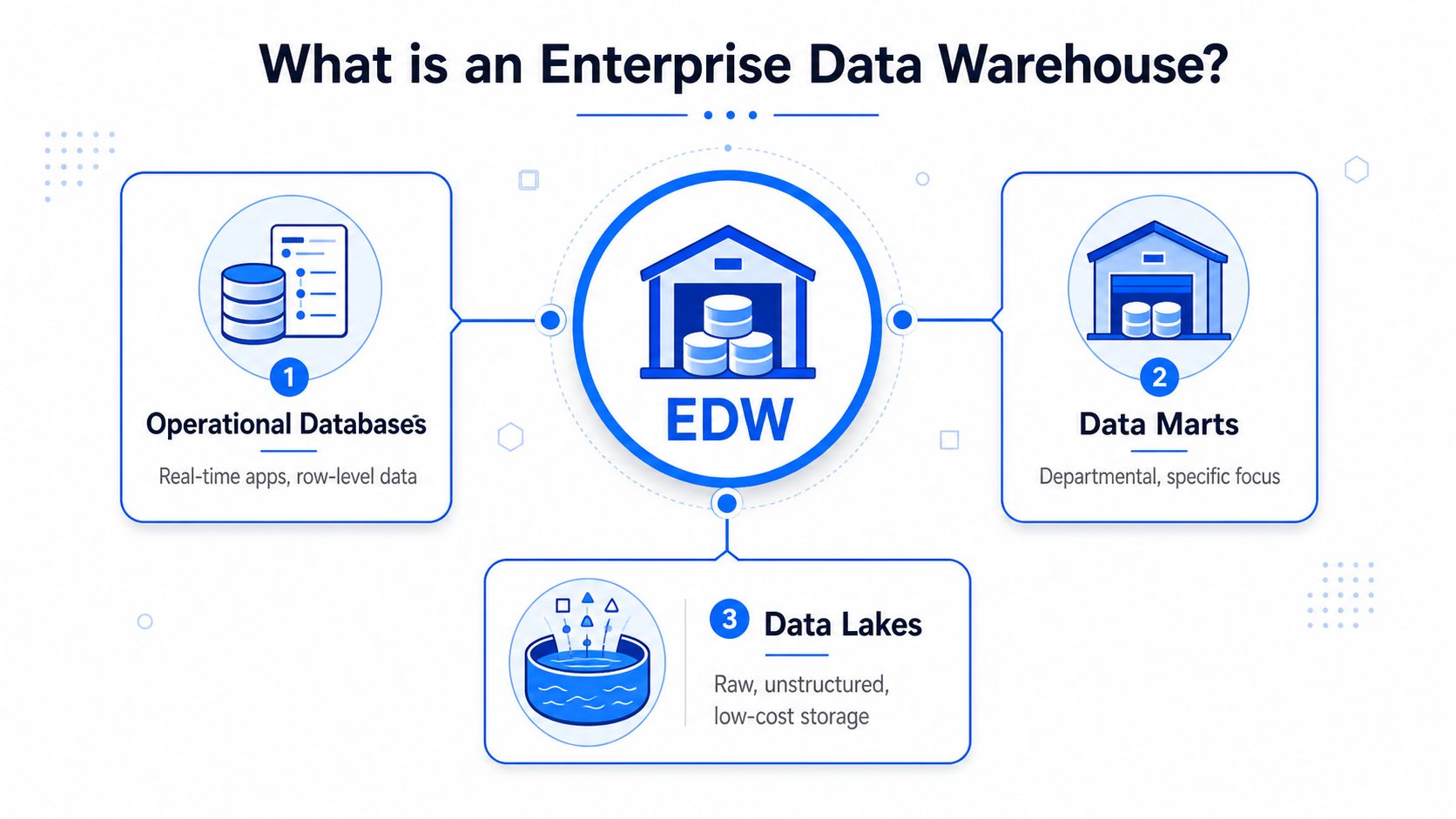
An enterprise data warehouse is a central analytics repository built for the whole organization, not for one team's reporting needs. IBM describes a data warehouse as a central store optimized for querying and analysis, and says an enterprise data warehouse services the entire enterprise while using ETL or ELT to prepare data for BI and analytics IBM's data warehouse overview. Databricks makes the scope distinction even sharper, saying an EDW covers the entire organization, while a data mart serves a single department or function Databricks on data warehouse types.
That scope difference matters more than people expect. A departmental warehouse can answer a narrow business question quickly, but an EDW has to reconcile sales, finance, operations, and whatever else the business wants to compare across teams. It's the system you use when one department's metric has to agree with another department's metric, and when executives want historical reporting they can defend in a meeting.
EDW versus the other systems people confuse it with
An operational database is built to process transactions, not to absorb lots of cross-functional analytical queries. A data mart is smaller and narrower, usually focused on one subject area. A data lake is typically the raw, flexible storage layer for logs, files, and semi-structured data, which is useful for experimentation but not the same as a governed analytics warehouse.
The easiest way to say it is this. A warehouse is for structured, trusted answers. A lake is for raw material. A mart is for a specific audience. An EDW is the version of the warehouse that spans the whole business.
The reason this definition matters is practical. If the warehouse is supposed to support strategic analytics and compliance reporting, then every upstream choice, schema design, retention policy, and access rule has to be made for that level of scrutiny. Otherwise, you don't get a shared enterprise view, you get a large database with a logo on it.
The Four Deployment Patterns That Actually Matter
The deployment choice is really a control question disguised as an infrastructure question. On-premises gives you the most direct control over where data lives and how the stack is managed, which is why it still matters in regulated environments. The trade-off is that scale, elasticity, and maintenance all sit with your team, not with the platform.
Private cloud inside a customer VPC sits in the middle. You keep the environment inside a defined perimeter, which can help with residency and governance requirements, while still picking up some of the elasticity and operational convenience that cloud teams want. It's a common compromise when the organization wants a tighter boundary without giving up all modern platform features.
Cloud EDWs and lakehouse hybrids
Cloud data warehouses, including platforms like Snowflake, BigQuery, Redshift, Synapse, and Databricks SQL, change the equation by separating the infrastructure burden from the analytics workload. That's valuable, but it also shifts the burden toward access design, cost discipline, and workload governance, because compute can expand quickly if no one is watching usage patterns.
Lakehouse hybrids try to combine warehouse semantics with object-storage flexibility. That can reduce duplication and make AI-oriented data sharing easier, but it also adds complexity around ownership, modeling, and who is responsible for the trusted metrics layer.
Intermountain Healthcare is a good reminder that architecture isn't academic. Its EDW integrated data from numerous inpatient and outpatient facilities and supported operational alerting at scale, including 30,694 unique patients in one data mart with prior MRSA, 2,401 with VRE, 194,658 MRSA email alerts, 22,160 VRE email alerts, and coverage across 22 hospitals clinical EDW case. The lesson isn't that every warehouse should look like a hospital system, it's that multi-site, operationally critical data needs a design that can keep working when the business is noisy and demands are critical.
How Data Actually Flows Through an EDW
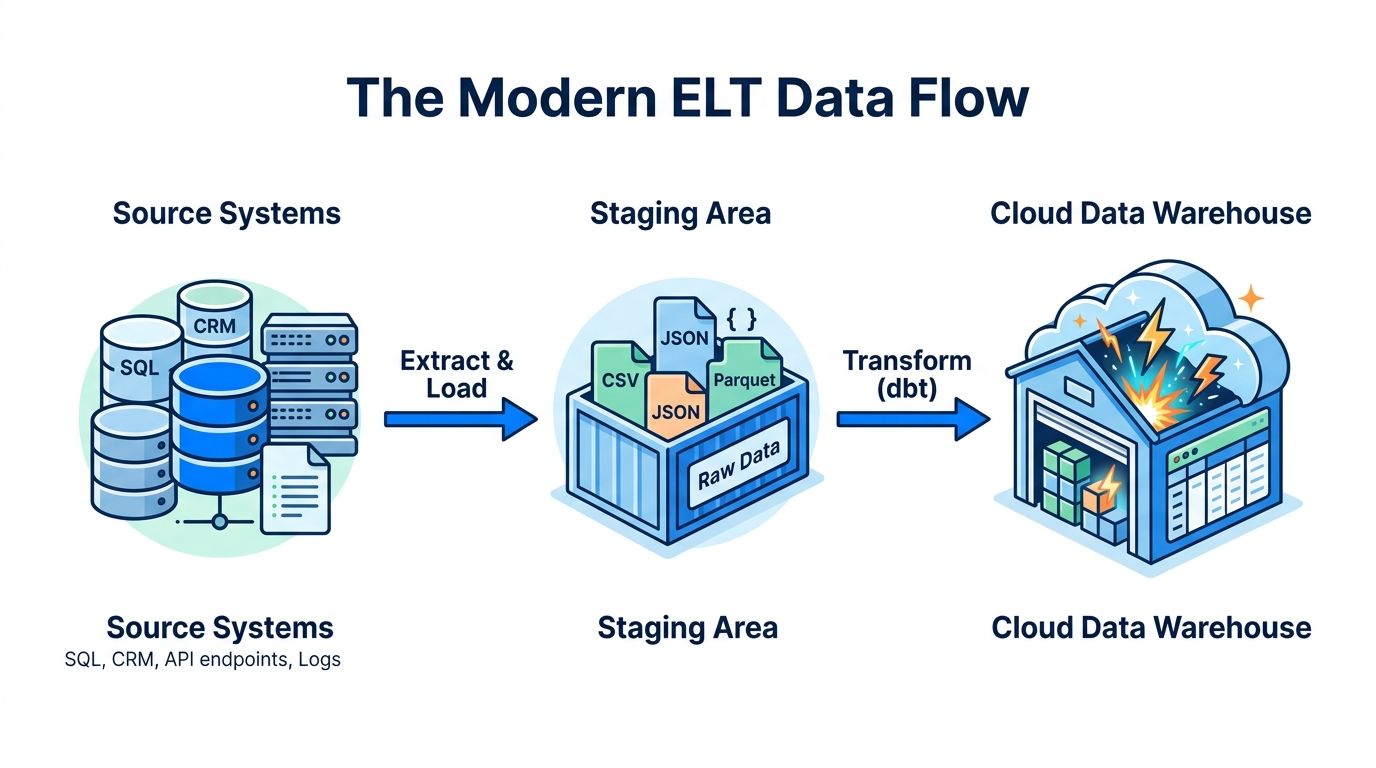
Modern warehouses usually work better when the raw data lands first and the transformation happens inside the warehouse engine. That's the ELT pattern, and it's a better fit for cloud systems because it preserves the original data for replay, audit, and backfills while giving engineers a place to apply business logic after storage. Fivetran's enterprise EDW guide describes this flow clearly, including support for CDC and streaming paths for event data Fivetran guide.
Four stages that create four control points
Think of the flow as ingest, transform, model, serve. Ingest gets the data into the warehouse environment. Transform applies cleansing and business rules. Model turns the data into facts and dimensions or another analytic shape. Serve exposes standardized metrics to BI tools and downstream consumers.
That sequence matters because each stage gives you a different place to catch failure. Freshness checks belong near ingestion. Record validation belongs near transformation. Schema drift becomes visible when new columns or type changes hit the staging layer. Consumer-facing metric definitions belong at the serving layer, where users should see one governed version of the KPI.
Why compute and storage are separated
Cloud EDWs often separate compute from storage, which changes capacity planning in a useful way. Storage can grow for historical retention without forcing you to resize the whole processing layer, and compute can be temporarily expanded for month-end reporting or heavy transformations without moving the data.
If you can't scale processing independently from retained history, you're going to overpay somewhere, either in performance or in hardware.
Architecture guides also describe layered EDWs with source, staging, warehouse, and presentation or semantic layers, plus query-management functions that help multiple users share the system Stripe's EDW architecture guide. That layering isn't decoration. It's how access policies, optimization, and standardized business definitions stop fighting each other.
For a closer look at integration design choices, see digna's data warehouse integration page.
The Four Capabilities That Decide Whether an EDW Survives
Scalability, latency, schema management, and governance decide whether an EDW keeps earning trust. Each one maps to a real operating problem, and if one is weak, the warehouse may still run, but users will stop believing it.
Scalability and latency
Scalability is where the separation of compute and storage pays off. It lets you grow analytical capacity without redesigning the whole environment every time the business adds another dashboard, another region, or another reporting workload.
Latency is the next trade-off. Some EDWs are still fine with batch updates measured in hours, especially for strategic reporting and compliance use cases. Others need nearer to real-time arrival using CDC or streaming, but only when the business needs that freshness. Not every question deserves a live pipeline.
Schema management and governance
Schema management becomes a day-2 problem the moment upstream systems change column names, add fields, or alter types. If the warehouse doesn't catch that quickly, downstream models start drifting, and consumers see subtle mismatches before anyone understands the cause.
Governance is what makes the warehouse useful across a large enterprise. When the presentation layer enforces access policy and the semantic layer standardizes metrics, different teams stop inventing their own version of the same KPI. That's also how audit-ready reporting stays believable instead of becoming a pile of screenshots.
A customer-insight platform like Call Loop's customer insights approach is a good example of why governed data definitions matter. If the underlying customer profile is inconsistent, every downstream segmentation, alert, and BI dashboard inherits the same uncertainty.
Capability | What it really protects | Typical failure if it's weak |
|---|---|---|
Scalability | Workload growth and concurrency | Slow dashboards and overloaded jobs |
Latency | Freshness expectations | Stale numbers and missed decisions |
Schema management | Consumer compatibility | Broken models and silent drift |
Governance | Shared definitions and access control | Conflicting KPIs and audit risk |
Data Warehouses, Data Lakes, and Lakehouses in Practice
The “warehouse versus lake” debate usually starts from the wrong assumption. Most enterprises don't pick one and stop. They run both, because the jobs are different.
A data lake is optimized for raw, varied, machine-learning-ready data. A data warehouse is optimized for governed, queryable analytics. That split is why the lake is often where experimentation starts, while the EDW remains the place executives trust for recurring reports and financial or operational comparisons.
Why lakehouses don't erase the warehouse
A lakehouse tries to layer warehouse-style semantics on top of open table formats. That can be attractive because it reduces duplication and makes data easier to share across BI and AI teams. It also introduces new skills, new tooling choices, and more responsibility for keeping the semantic layer stable.
The practical question isn't which architecture is trendy. It's which workload belongs where, and who owns the data definitions that business users rely on. If data science needs raw history and the finance team needs controlled reporting, forcing both into a single pattern usually creates friction instead of clarity.
An internal comparison like digna's data lake versus data mart page fits that reality well, because the warehouse stack often sits between raw storage and departmental consumption.
The governance implication
Hybrid architectures make governance more important, not less. The EDW has to stay the trusted BI layer even when a lake feeds AI work, because model training data and reporting data don't need the same shape or the same operating rules.
The cleanest enterprise setup is rarely a single platform. It's a set of layers with clear ownership.
Keeping the EDW Reliable After Go-Live
Most EDW content stops at architecture diagrams. The failures usually start later, when a source team renames a column, a pipeline delays by a few hours, or a dashboard keeps loading while the numbers underneath go stale. That's why data observability belongs inside the warehouse operating model, not outside it.
The checks that catch silent breakage
A reliable day-2 posture usually needs four controls. Anomaly detection learns normal behavior for each dataset, so unusual volume or distribution shifts stand out. Timeliness monitoring watches for delayed, missing, or unexpectedly early loads and can estimate expected delivery. Schema tracking catches added, removed, or changed fields before consumers hit broken logic. Record-level validation checks whether data still follows business rules.
Those controls align with the failures teams encounter. Stale dashboards result from missed arrivals. Drifting KPIs often stem from subtle schema or rule changes. Broken pipelines surface as missing records or unexpected formats. Inconsistent rule enforcement appears when the same business logic isn't checked everywhere it matters.
Why in-database execution matters
Running observability inside the customer's own databases keeps data in place, which reduces movement and keeps security and governance simpler. That's especially useful in environments where warehouse data can't just be copied into a separate monitoring stack without creating new risk or new operational overhead.
digna is one platform that follows that pattern. It runs inside the customer's environment and combines data quality management, business monitoring, and data platform observability with in-database checks, including anomaly detection, timeliness monitoring, schema tracking, and validation. It's the kind of setup teams reach for when they want one control layer across warehouse tables, KPI layers, and pipelines without turning observability into another data movement problem.
Operational rule: if a warehouse alert arrives after users notice the issue, the alerting system is part of the problem too.
For teams evaluating reliability, the core question is simple. Do you want a warehouse that just stores data, or one that continuously tells you when that data stopped being safe to trust?
Choosing and Operating an Enterprise Data Warehouse
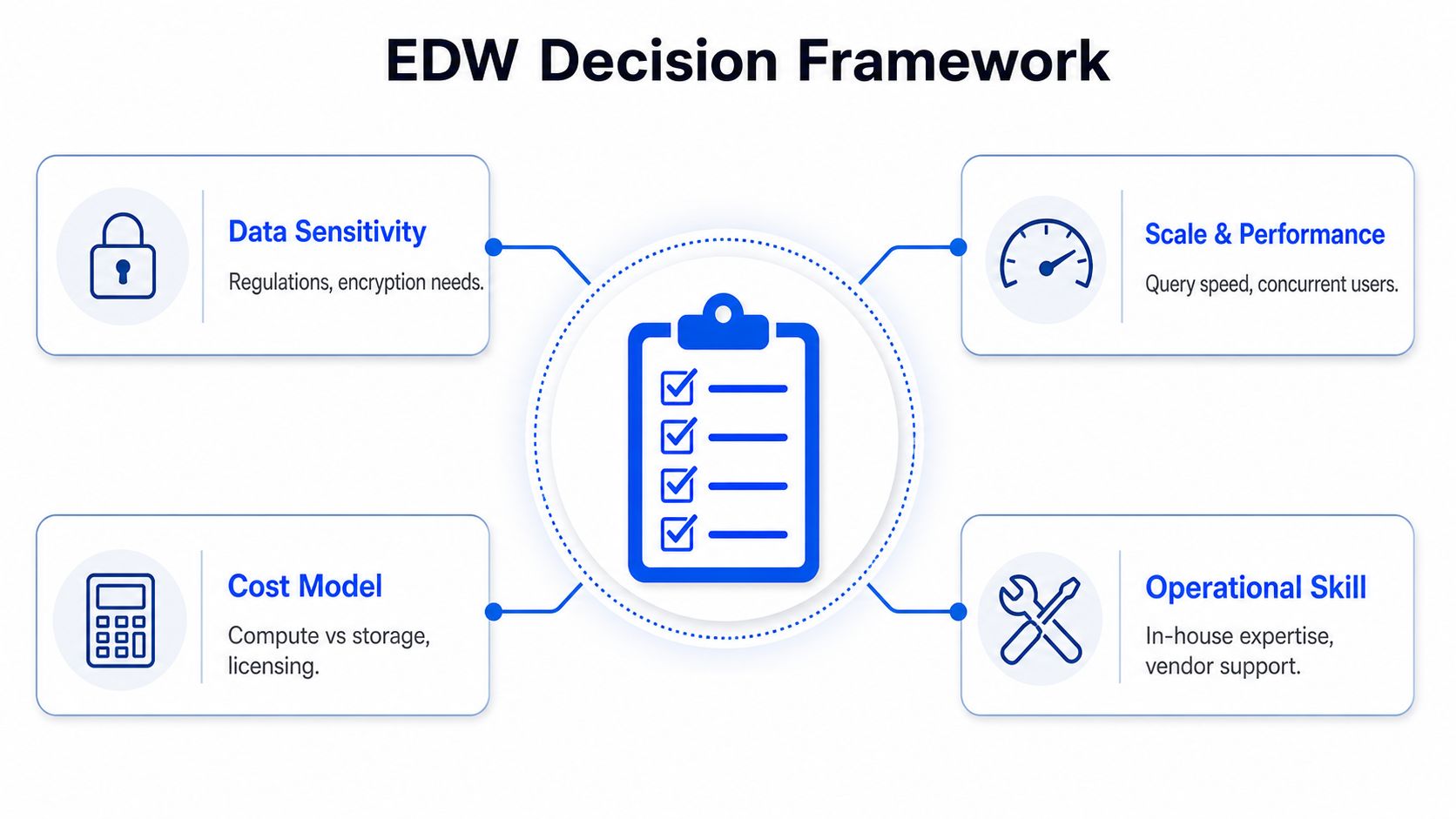
The right EDW choice usually comes down to five filters, data sensitivity, scale trajectory, existing skills, integration ecosystem, and how much the organization can invest in day-2 operations. The first two shape deployment. The next two shape implementation risk. The last one decides whether the warehouse stays healthy after the launch team has moved on.
A practical decision framework
If the data is highly sensitive or tightly regulated, on-prem or private cloud usually deserves a closer look. If the business needs elastic analytics and the team can live with cloud governance overhead, cloud-native EDWs are usually the easier operating model. If the organization already has a lake and wants to preserve raw history for science and AI, a hybrid approach may fit better, as long as the trusted reporting layer remains explicit.
The three operational questions that matter most are worth asking before anyone signs anything.
How will you detect anomalies before stakeholders do? If the answer depends on manual checking, the warehouse is already fragile.
How will you track freshness across hundreds of pipelines? If no one owns timeliness, “successful load” won't mean “usable data.”
How will you catch schema drift without writing a rule for every column? If every field needs custom monitoring, the operating model won't scale.
A short FAQ that teams usually ask late
How are EDWs different from data lakes? EDWs are governed analytic stores for trusted reporting, while lakes hold raw data for experimentation and machine learning.
How long does implementation really take? It depends on scope and integration complexity, but the initial build is only part of the work. Day-2 monitoring and governance are what keep the platform useful.
Why does in-database observability reduce risk? Because the checks run where the data already lives, so you avoid unnecessary movement and keep control aligned with the warehouse environment.
What makes modular licensing useful? It lets teams start with the highest-risk datasets first, then expand monitoring as the warehouse footprint grows.
An internal reference point for operating the broader stack is digna's enterprise data platform page. If you're deciding what to standardize, start with the reliability bar, then choose the warehouse pattern that can sustain it.
If your EDW is already in production and the problem is silent breakage, not go-live, digna is built to monitor data quality, schema changes, timeliness, and business behavior inside your own environment. Visit digna to see how in-database observability can help your warehouse stay trustworthy after launch.