Create Data Set
|
8
min. Lesezeit

You can ship a data set that looks clean in staging, passes every unit test, and still break the business two weeks later. I've watched that happen when a quiet timezone normalization changed revenue totals in one dashboard and a marketing job kept ingesting null user IDs because nothing at build time treated that field as critical. The painful part is that the team had already called the dataset “done.”
That's the mistake most guides leave untouched. Create data set work isn't a delivery milestone, it's the first step in an ongoing control process, the same way the National Institute of Standards and Technology frames data quality as a capability shaped by accessibility, relevance, timeliness, metadata, documentation, user capabilities, context, and cost, with generation, evaluation, and improvement forming a cycle rather than a finish line (NIST perspective paper). In production, the dataset isn't real until someone owns it, monitors it, versions it, and knows what should happen when it drifts.
Table of Contents
When a Finished Data Set Is Only the Beginning
The real failure was control, not construction
Designing the Schema Before You Write a Single Query
Start with grain, keys, and time semantics
Use names that survive real operations
Sourcing Data Without Losing Provenance
Match the intake method to the use case
Version the contract, not just the data
Validation Checks That Catch Real Problems
Validate at the record level first
Add distribution and timeliness checks
Partitioning, Versioning, and Schema Drift
Choose layout based on how the table is used
Make drift a pipeline failure, not a surprise
Governance and Discoverability From Day One
Write the minimum metadata before publish
Make reuse safe, not accidental
How to Know When Your Data Set Is Good Enough
Use acceptance gates tied to the decision
Promote in stages, not in one jump
When a Finished Data Set Is Only the Beginning
The team thought the customer events dataset was solid. It had typed columns, a clean build, and the usual null checks, so they published it and moved on. Two weeks later, finance noticed revenue totals drifting, and marketing found that a segmentation job had accepted records with missing user IDs.
The root cause wasn't dramatic. A timezone normalization rule changed upstream, and nobody treated that as a breaking change because the schema hadn't changed. At the same time, the dataset allowed nulls in a field downstream consumers assumed was mandatory, so the bad records flowed through until a campaign segment looked larger than it should have. That's the trap, a dataset can be syntactically correct and still be operationally wrong.
The real failure was control, not construction
A production dataset needs more than a successful build. It needs acceptance thresholds, drift detection, ownership, and a rollback path, because the definition of “good” changes once real consumers depend on it. That idea lines up with the enterprise reality that poor data quality is expensive, and that only a small share of company data is considered to meet basic quality standards in widely cited industry research (Gartner figure and related summary).
Practical rule: if a downstream dashboard, model, or workflow can fail silently, the dataset isn't finished yet.
The rest of the work is about preventing the exact kind of breakage that shows up after launch. One guardrail would have caught the timezone change. Another would have flagged the null user IDs before the marketing team relied on them. The rest of this article is the prevention playbook.
Designing the Schema Before You Write a Single Query
Schema mistakes are expensive because they harden fast. Once teams start loading and modeling around a table, changing the grain or reinterpreting a column becomes a migration project, not a tidy refactor. The safest move is to decide the shape before the first extract, then document the choices so nobody has to reverse-engineer intent later.
Start with grain, keys, and time semantics
Pick the grain explicitly. If one row represents a user event, say so in the design doc and in the table description, because that decision drives deduplication, aggregation, and downstream joins. Use surrogate keys where stable natural identifiers aren't guaranteed, and freeze timestamps to UTC with a documented source offset so later consumers can reconstruct local time without guessing.
A sloppy user_events table usually shows its problems in the column names. You see mixed casing, ambiguous booleans like is_active, free-text event_type values that drift into near-duplicates, and timestamps whose meaning changes depending on who loaded them. A disciplined version looks boring in the best way, with enums or controlled categories for event types, nullable flags that have explicit meaning, and stable IDs that don't depend on whatever the upstream app happened to emit that week.
Use names that survive real operations
Warehouse and lake naming should tell people where a table sits in the pipeline. Prefixes like raw_, stg_, and dim_ make that visible, which matters when someone is trying to understand whether a table is ingest-ready, transformation-ready, or consumption-ready. If you want a deeper taxonomy of structural options, the internal guide on types of schema is a useful reference point.
Document every column before the first row lands. A schema.yml file, or comments in information_schema, forces the team to state type, meaning, allowed values, and ownership while the design is still easy to change.
Decision Area | Anti-Pattern | Production-Ready |
|---|---|---|
Grain | Implicit, inferred later | Explicitly declared before build |
Primary identifier | Composite natural key from unstable sources | Surrogate key or stable durable ID |
Timestamps | Mixed local times, no offset note | UTC with documented source offset |
Booleans |
| Nullable flag with written semantics |
Event types | Free-text strings | Controlled categories or enum-like values |
Documentation | Added after launch | Written before first load |
Sourcing Data Without Losing Provenance
The source matters as much as the shape. A batch API pull, a file drop, CDC, and synthetic data each solve a different problem, and they fail in different ways. If you choose the wrong source pattern, you'll spend months compensating for missing lineage instead of improving the dataset.
Match the intake method to the use case
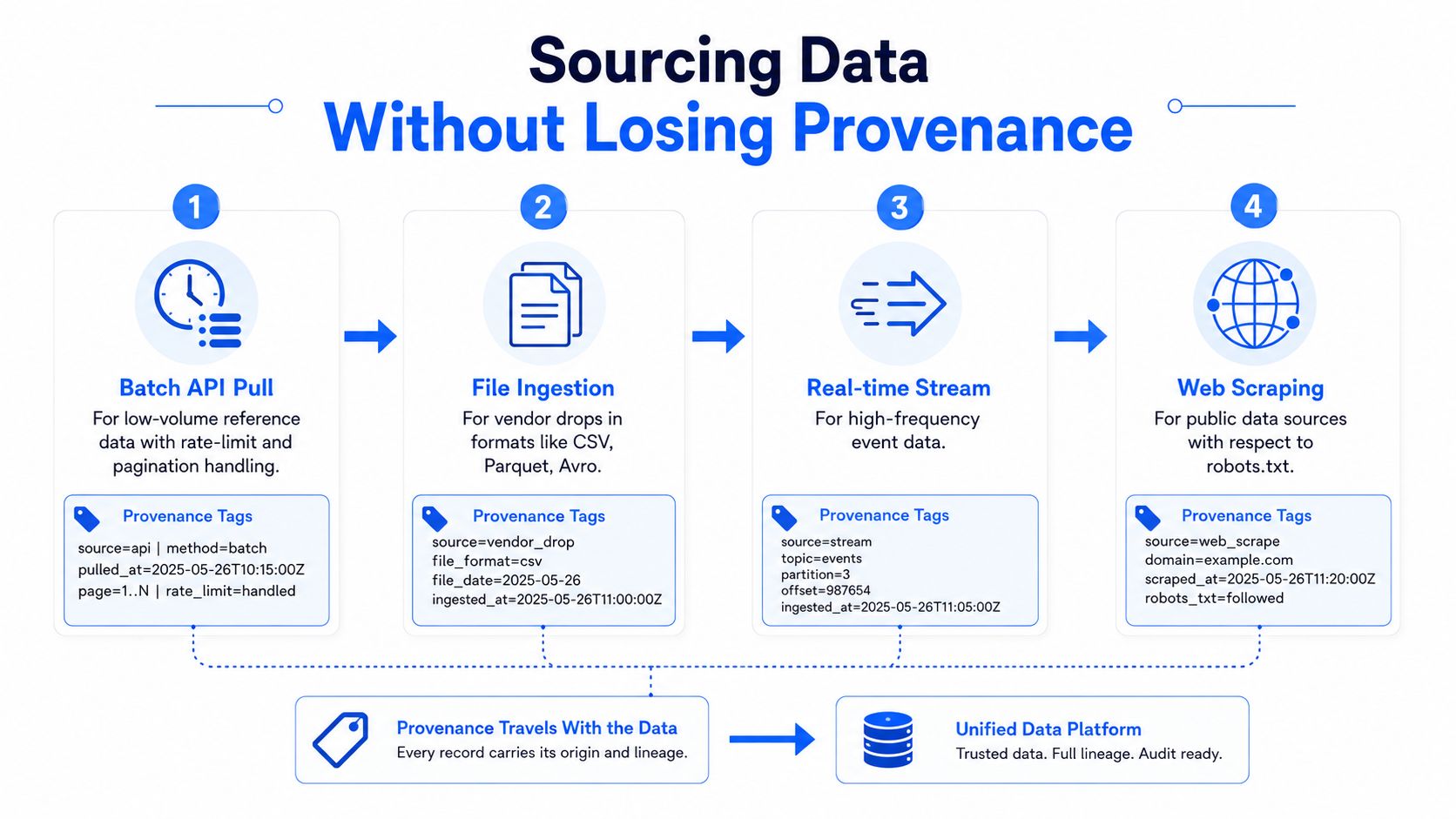
Use batch API pulls for low-volume reference data, where pagination and rate limits are the main constraints. Use file ingestion for vendor drops in CSV, Parquet, or Avro when schema contracts matter most, because files make versioning and replay easier to reason about. Use change data capture when you need near-real-time warehouse loads from operational databases, and use synthetic data when you need to test pipelines before production feeds exist.
The essential part is provenance. Capture source_system, source_loaded_at, source_record_hash, and ingestion_run_id at read time, not later in the transformation layer. Lineage added downstream is always a reconstruction, and reconstruction is where teams start inventing certainty they never had.
Write provenance at the point of read. Anything else turns into a guess under pressure.
For public web sources or scraping workflows, the same rule applies, and the intake method should be chosen only after you've checked the upstream constraints and failure modes. A practical primer on what to look for in APIs is a good reminder that availability, pagination, and contract behavior shape the dataset as much as the rows do. If you want the conceptual distinction between lineage and provenance, the internal explainer on data provenance vs data lineage is worth keeping close.
Version the contract, not just the data
External APIs and vendor feeds should be treated like dependencies. Pin the contract version, document what fields are required, and make a schema change show up as a visible pull request instead of a silent breakage. That way, when a provider changes a field name or type, the team sees the diff before the pipeline absorbs it.
Validation Checks That Catch Real Problems
A dataset can look complete and still fail the moment someone uses it. Null checks catch only one class of issue. Broken references, out-of-range values, late-arriving rows, and inconsistent keys can all leave a table technically populated and operationally useless.
Validate at the record level first
Start with the checks that protect downstream assumptions. Use uniqueness on natural identifiers where duplicates would double count records, referential integrity between dimension and fact keys, approved value lists for categorical fields, and precision rules for monetary columns. If a revenue field must always carry two decimal places, write that into the rule instead of trusting every source system to comply.
Reusable allowed-value sets help here, especially for countries, states, and status codes. If you build a rule library, the data validation module approach in digna follows that pattern, with checks scoped to the table or to a filtered subset as needed. The point is not the tool. It is making common rules explicit instead of burying them in one-off notebooks.
The part you cannot skip is provenance. Capture source_system, source_loaded_at, source_record_hash, and ingestion_run_id at read time, not later in the transformation layer. If those fields are added after ingestion, they stop being facts and become guesses under pressure.
Add distribution and timeliness checks
Once the row-level rules are stable, watch the table as a whole. Row counts that swing too far from the recent baseline, null rates that creep upward in critical fields, and categorical cardinality drift all point to problems that a single-row rule will miss. For timeliness, set a clear service-level target tied to the table's purpose, such as a short lag window for near-real-time feeds and a longer one for batch.
The hard part is tuning. Anomaly baselines need a warm-up period before they mean anything, because a brand-new dataset has no stable shape yet. Separate hard failures from soft warnings, route warnings to triage, and make sure every check has an owner, a runbook, and a bypass path. Unowned checks age into noise, and noisy checks stop getting read.
Treat acceptance thresholds as a governance decision, not a technical detail. If a feed can tolerate a small amount of missing optional data but cannot tolerate broken keys, say that plainly in the checks and in the sign-off process. That keeps the team from arguing about every alert as if all failures carry the same weight.
Validation Layer | Example Check | Suggested Threshold | Owner + Escalation |
|---|---|---|---|
Record integrity | Natural key uniqueness | No duplicates allowed | Data engineering, page on breach |
Relationship integrity | Fact keys match dimension keys | No orphan rows | Pipeline owner, quarantine bad batch |
Value domain | Country, status, or enum list | Only approved values | Domain owner, triage queue |
Numeric precision | Monetary scale | Required decimal precision | Analytics engineer, block publish |
Volume trend | Row count drift | Within normal baseline | On-call data engineer, investigate |
Null stability | Critical column null rate | Low and stable for the table | Dataset owner, soft alert first |
Timeliness | Lag between event and load | Match the feed SLA | Platform owner, page if overdue |
For a tighter view of how checks fit together across a dataset lifecycle, see data validation rules, checks, and continuous data quality.
Partitioning, Versioning, and Schema Drift
Partitioning decides more than storage layout. It affects query cost, backfill speed, and how easily retention rules can be enforced. Teams often pick a partitioning scheme to make one dashboard faster, then discover later that it complicates reprocessing or hides historical data they still need.
Choose layout based on how the table is used
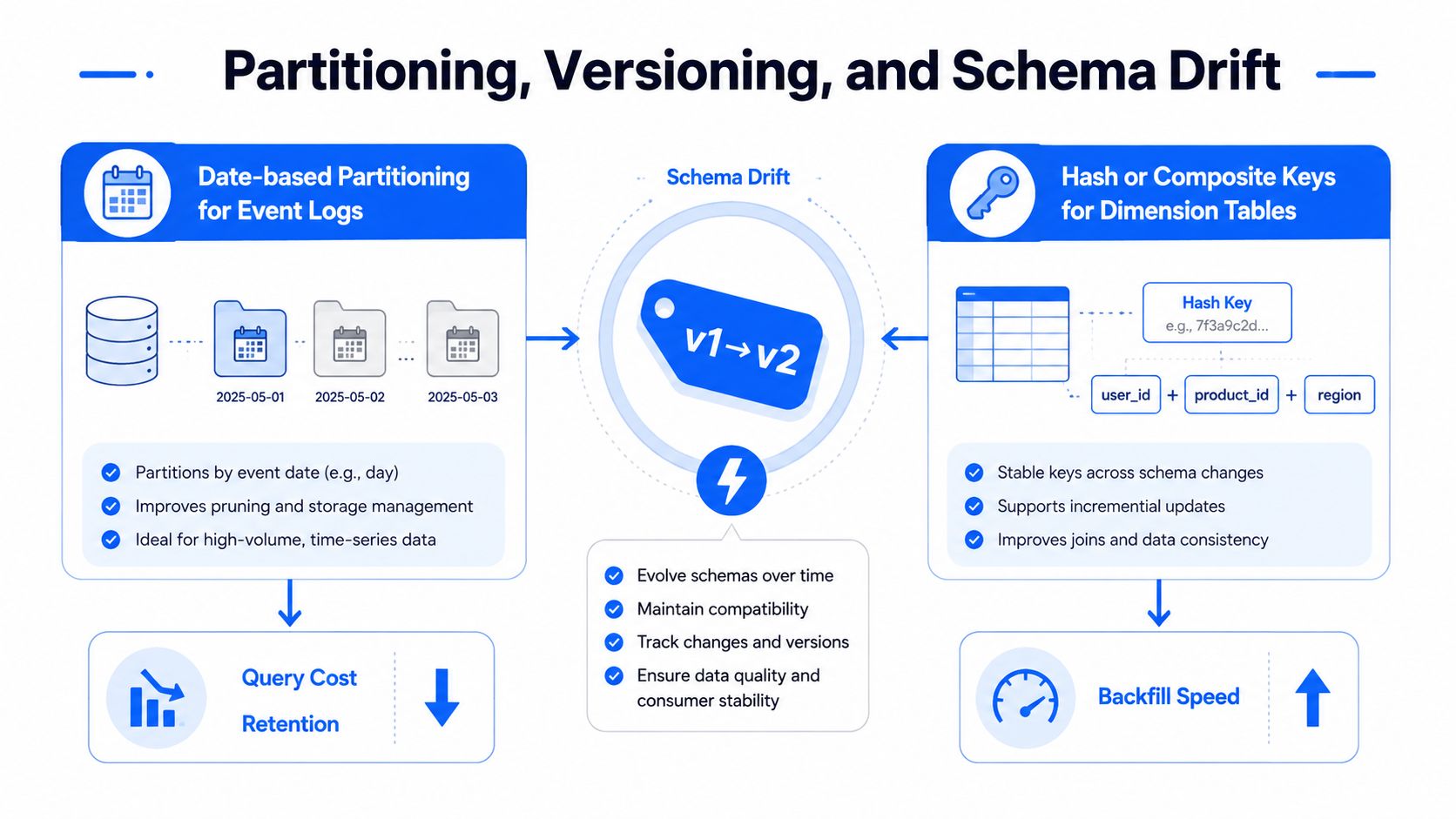
Use date-based partitioning for event logs and append-heavy fact tables. That gives you a clean unit for retention, incremental backfills, and time-bounded queries. For dimension snapshots or slowly changing structures, hash or composite keys can make lookups and rebuilds more predictable, especially when the table isn't naturally organized by time. In systems like BigQuery, Snowflake, and Apache Iceberg, the exact syntax differs, but the operational principle doesn't.
Treat the dataset as versioned from day one. Semantic versions in metadata, immutable tags per release, and a deprecation window for old consumers keep the team from pretending that every release is interchangeable. When a version changes, the old one should stay available until consumers have migrated, because the worst time to remove a table is when a report is still pinned to it.
Make drift a pipeline failure, not a surprise
Schema drift is the silent killer. New columns appear, required columns disappear, and type widths narrow just enough to break a downstream join or cast. The cleanest pattern is permissive ingestion in the landing zone, followed by profiling, strict validation at the next boundary, and staging tests that fail the pipeline if the schema has changed in an incompatible way.
That logic belongs in code, not in a notebook review comment. If a transformation layer can see the schema diff, it can stop the rollout before consumers get surprised. Versioned documentation and a change log finish the loop by telling the next analyst why the current table looks the way it does.
A practical version control guide for compliance teams from DPP Grid is useful here because it frames versioning as a governance problem, not just a storage habit. If you're already dealing with schema drift in production, the internal explainer on schema drift and structural changes that break data pipelines helps make the failure modes concrete.
Governance and Discoverability From Day One
Governance usually gets treated as a review step at the end, but it's really a discoverability problem with compliance attached. If people can't tell what a dataset is for, who owns it, and what data it contains, they'll either misuse it or avoid it. Both outcomes are expensive.
Write the minimum metadata before publish
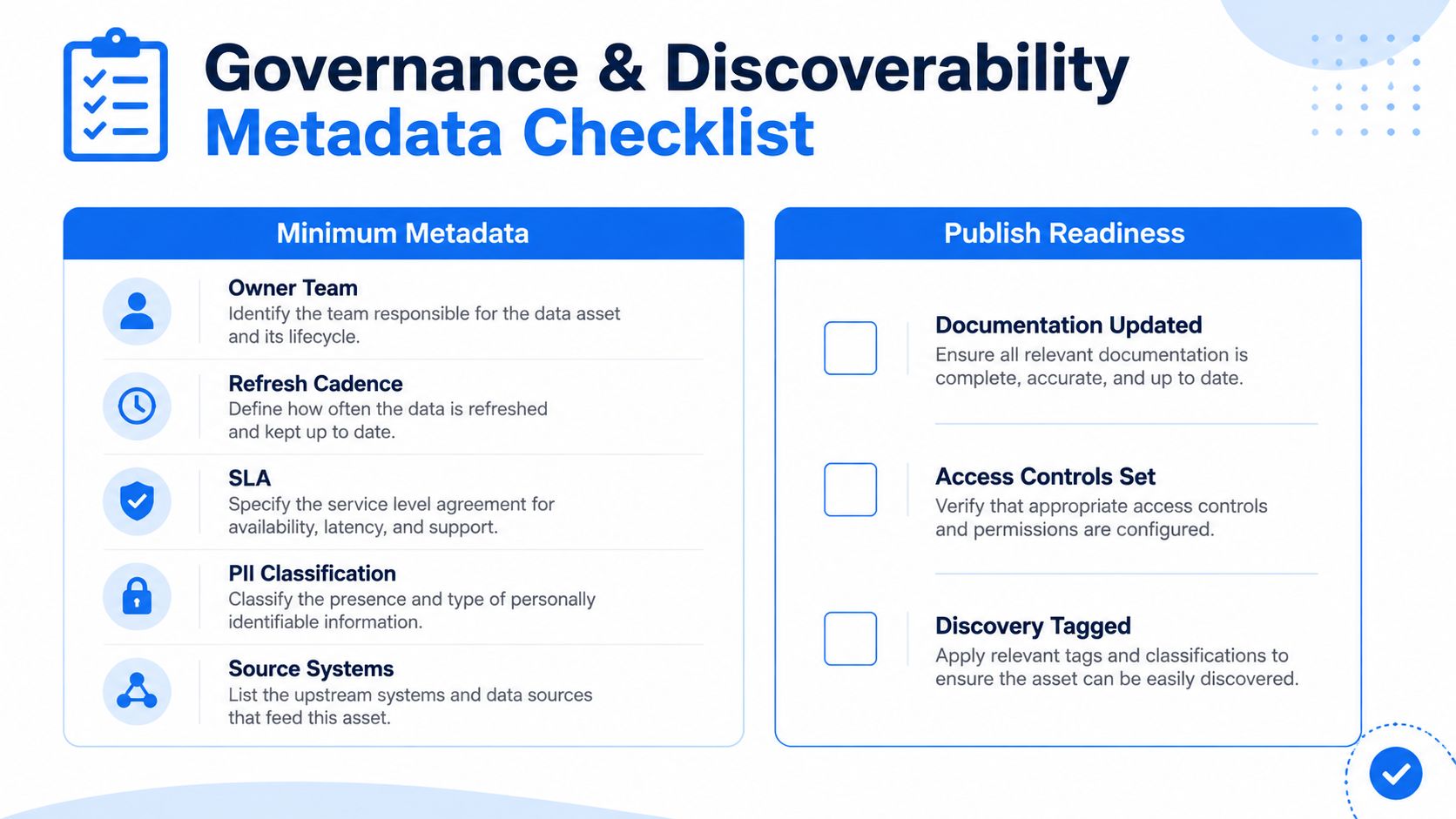
Every dataset should ship with an owner team, refresh cadence, SLA, PII classification, source systems, and a short intended-use statement that also says what the dataset is not for. Those six fields sound basic because they are, and basic is exactly what keeps the table usable when audits, handoffs, and new consumers show up.
Tie access controls to the classification. Mask restricted PII, apply row-level policies where regional rules matter, and keep production and sandbox roles separate so exploratory access doesn't leak into operational use. If the dataset includes personal data, preserve consent lineage by linking back to the lawful basis and the retention schedule that governs it.
The catalog is where all of this becomes visible. The internal overview of what is a data catalog is a good reminder that discovery only works when metadata and access policy are aligned.
Make reuse safe, not accidental
A dataset that's easy to find but hard to trust creates more work, not less. The goal is to make the publish step feel complete only when the dataset is tagged, documented, and mapped to the policy engine that controls access. That way, classification doesn't drift from permissions over time.
If the catalog entry is vague, the dataset will be reused badly.
That's why the practical checklist is short: owner, classification, SLA, intended use, refresh, and contact. Fill those in at creation, and you'll save weeks of audit back-and-forth later.
How to Know When Your Data Set Is Good Enough
“Good enough” isn't a feeling, it's a contract. The mistake is waiting for perfect coverage before the dataset is allowed into production, because that reflex usually turns into indefinite delay. Better to define the gate, then let the data earn its way through it.
Use acceptance gates tied to the decision
A useful first gate is completeness. If a required field has a high null rate, the dataset isn't fit for the decision it's supposed to support. A second gate is recency, because stale data can be clean and still wrong for operational use. A third gate is representation, which checks whether key segments are skewed enough to distort a downstream model or report.
Bias checks belong in that third gate. Look for class imbalance, geographic gaps, demographic gaps, and survivorship in joined sources, then decide what to do with the result. Some datasets should be accepted as-is, some should be oversampled or supplemented, some should exclude certain uses, and some should be documented as partial by design.
Acceptance Gate | Metric | Threshold Example | Decision If Failed |
|---|---|---|---|
Completeness | Null rate on required fields | Low enough for the use case | Block publish or backfill |
Recency | Freshness against decision latency | Within the allowed window | Hold until updated |
Representation | Segment coverage across key groups | No critical skew | Oversample, exclude, or document |
Stability | Repeated quality results over time | Passes across multiple cycles | Keep in shadow mode |
Promote in stages, not in one jump
The cleanest rollout is gradual. Instrument quality metrics first, compare against a control dataset next, and only make the new dataset the default after it holds up through repeated cycles. That keeps the team honest about whether the data is ready or just recently built.
Good enough means the dataset supports the decision without forcing hidden compensations elsewhere.
The create-data-set conversation is really about control, not collection. If you want a platform that monitors validation, timeliness, schema change, and anomaly behavior inside your environment, digna does that across warehouse and pipeline data without moving the data out of place. Visit digna to see how that fits into a dataset lifecycle that needs ownership, thresholds, and continuous checks, not just another one-time build.