Data Quality Management Jobs: The Complete Career Guide
|
7
min read

Data quality management jobs are hybrid roles combining SQL and Python engineering, governance, and analytics monitoring, with closely related U.S. database roles paying median salaries of $104,620 to $135,980. Demand is also being pushed by AI and big-data adoption through projected changes to 2030.
You may already be doing part of this work without holding a data quality title. A dashboard fails after a warehouse load, a model's output starts drifting, or a finance team disputes a number that looked correct yesterday. The investigation rarely ends with finding a null value. Someone has to determine whether the source changed, a transformation introduced the defect, a schema shifted, or the business process itself evolved.
That operational reality is reshaping the career. Modern data quality professionals sit between engineering, analytics, governance, and risk. They build controls, investigate incidents, assign ownership, and explain consequences to people who don't work with pipelines every day.
Table of Contents
Why Data Quality Jobs Matter Right Now
Reliability has become infrastructure
The work is broader than compliance
What Data Quality Management Jobs Actually Involve
The incident lifecycle
Judgment beats rule volume
Core Skills Employers Want in 2026
Build a technical foundation
Add the engineering controls
Develop the human skills
Common Job Titles and Career Paths
Match the title to the operating model
Plan a path that fits your background
Salary Ranges and Labor Market Outlook
Read the benchmark correctly
Demand is global and embedded
How to Land a Data Quality or Observability Role
Build a credible work sample
Prepare for operational questions
Evaluate the employer as carefully as it evaluates you
Why Data Quality Jobs Matter Right Now
A reporting team discovers that a revenue dashboard has dropped sharply overnight. The first assumption is a business downturn. The data quality analyst checks delivery times, compares the latest distribution with historical behavior, and traces the metric through the warehouse. The root cause turns out to be a changed source field that still loaded successfully but no longer matched the transformation logic.
That incident illustrates why data quality management jobs are operational roles, not back-office checklist positions. The person responsible must identify the symptom, test competing explanations, establish business impact, preserve evidence, and coordinate remediation. A rule that flags the bad record without indicating who must act is not enough, since it is critical to know whether the source owner, platform engineer, analytics engineer, or business steward should handle the issue.

Reliability has become infrastructure
The World Economic Forum's Future of Jobs Report 2025 identifies Big Data Specialists among the fastest-growing roles globally, alongside FinTech Engineers, AI and Machine Learning Specialists, and Software and Application Developers. The same report says 86% of surveyed employers expect AI and information-processing technologies to transform their businesses by 2030.
That technology shift makes data reliability a prerequisite for analytics, artificial intelligence, and automated decisions. A model can be technically well designed and still produce poor outcomes when training data drifts, business definitions change, or upstream records arrive late. Quality specialists provide the controls that expose those failures before they become trusted outputs.
The work is broader than compliance
A mature team connects each control to a purpose. A timeliness check protects a daily risk process, a validity rule protects a regulatory field, and a schema alert protects downstream consumers. This is the practical value described in digna's overview of the benefits of data quality, where reliability supports decisions rather than existing as an isolated technical metric.
The strongest candidates understand both sides of the problem. They can query the affected records, but they can also explain why the defect matters, who owns the correction, and what control prevents recurrence. That combination is why employers increasingly treat data quality as business infrastructure.
What Data Quality Management Jobs Actually Involve
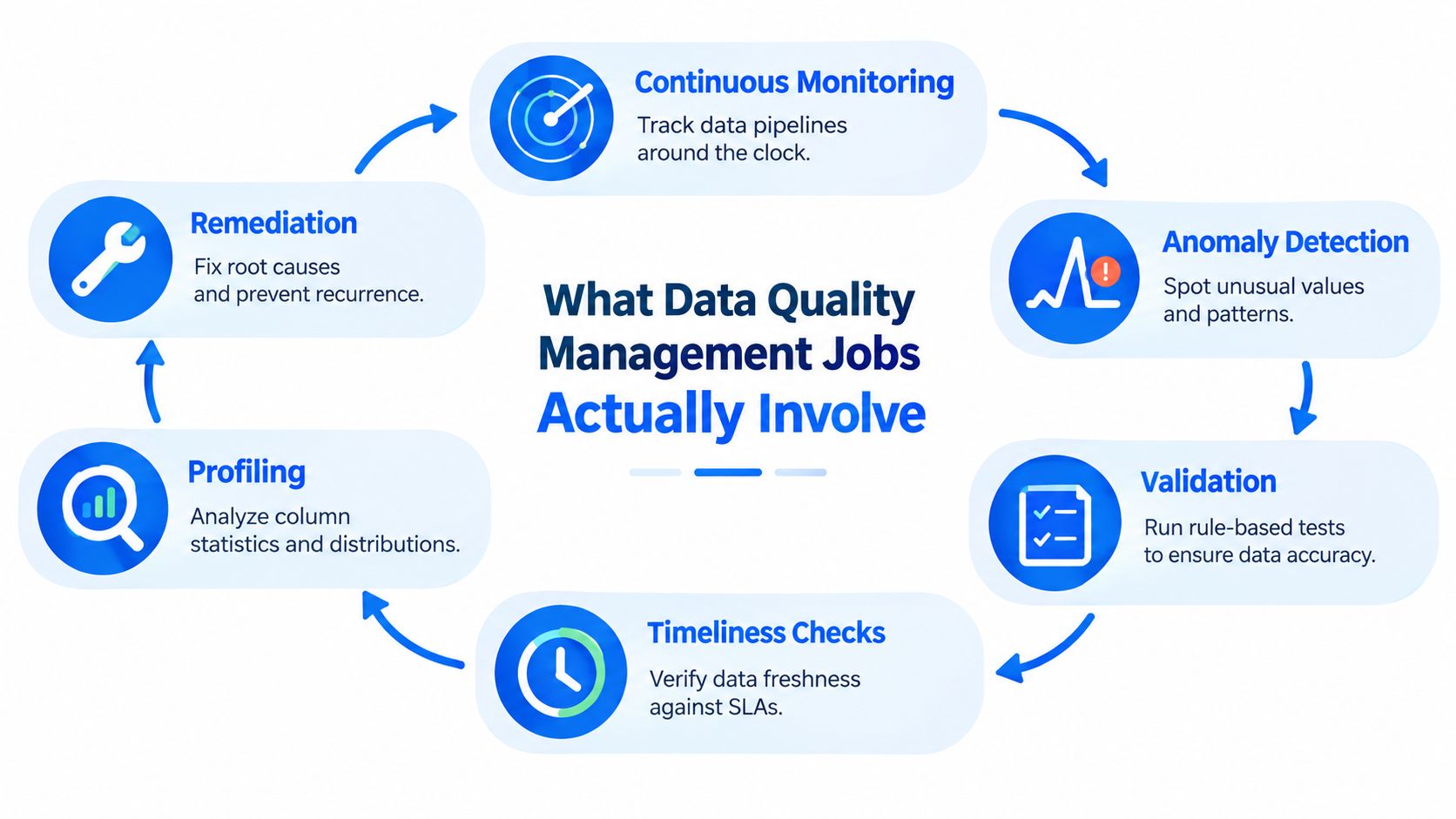
The modern role follows a continuous control cycle. It begins with understanding how data is supposed to behave, continues through automated checks and investigation, and ends with remediation plus evidence that the fix worked. Manual cleansing still has a place, but it can't scale as the primary operating model across warehouses, lakes, pipelines, and downstream products.
A data quality analyst typically develops and implements organization-wide standards, policies, and procedures, monitors quality over time, reports issues to management, and applies analytical, communication, and problem-solving skills to large datasets and data-management tools, as described in NATO's role description.
The incident lifecycle
A useful operating sequence looks like this:
Profile the dataset: Inspect distributions, distinct values, null patterns, relationships, and historical behavior before deciding what a defect looks like.
Monitor continuously: Track volume, freshness, business metrics, and pipeline behavior rather than waiting for a monthly review.
Detect anomalies: Separate unusual observations from expected seasonal or operational variation.
Validate records: Apply business rules at ingestion or transformation points, with failures routed to an owner.
Investigate causes: Trace the issue through source systems, code changes, schemas, joins, and downstream models.
Remediate and learn: Correct the root cause, preserve original and corrected values where appropriate, and add a control that catches recurrence.
The difficult part is classification. A sudden increase in missing customer identifiers might indicate a broken extraction, a new legitimate source process, or a downstream join that filters records incorrectly. The analyst has to gather evidence before escalating, because a noisy alert damages trust just as surely as a missed defect.
Judgment beats rule volume
Teams often measure progress by the number of checks they deploy. That can create the wrong incentives. Hundreds of low-value rules generate alert fatigue, while a small set of controls tied to critical data products can guide fast decisions.
A practical quality control specifies the expected behavior, the affected process, the tolerance or threshold, the accountable owner, the response path, and the evidence retained after resolution. The job therefore includes negotiation. Engineering may want a permissive pipeline, compliance may require stronger evidence, and business users may need a metric available despite a partial load.
The modern practitioner also watches schema changes, delivery schedules, lineage, and model inputs. What data quality management means in practice is continuous maintenance of fitness for use, not a one-time cleansing project.
Core Skills Employers Want in 2026
A candidate who lists SQL and Python but can't explain incident ownership will struggle in a mature data quality interview. Technical fluency gets you into the investigation. Judgment, communication, and evidence-based prioritization determine whether you can operate effectively once the pipeline breaks.
CompTIA reports that employers identify data analysis as an improvement priority for 77% of organizations, followed by data visualization at 75%, data architecture at 74%, data infrastructure at 72%, and data security at 70% in its IT Industry Outlook 2025. Those priorities explain why job descriptions combine quality with engineering, analytics, and platform responsibilities.
Build a technical foundation
SQL remains the diagnostic language. You should be able to compare partitions, inspect join behavior, identify duplicate keys, test referential assumptions, and reconcile source and target counts. Python helps with profiling, statistical checks, repeatable analysis, and integration with testing or orchestration workflows.
You also need working knowledge of relational systems and cloud platforms. A quality issue can originate in an operational database, appear during an ELT transformation, and surface in a warehouse or BI semantic layer. Understanding how those components interact is more useful than memorizing a particular vendor's interface.
Add the engineering controls
Automated testing is where quality becomes part of delivery rather than a late-stage inspection. Learn to define tests for completeness, validity, uniqueness, consistency, and timeliness, then place them at points where failures can be isolated. Metadata, lineage, and schema-change tracking let you answer the question stakeholders ask: what changed, and which outputs are affected?
Observability adds another layer. A rule tells you that a condition failed. Observability helps connect that failure to freshness, volume, distribution, workload, and upstream or downstream dependencies. Tools differ, but the reasoning pattern is consistent: establish a baseline, detect deviation, investigate the path, and route the issue.
Develop the human skills
Data quality specialists translate technical evidence into business decisions. That means writing an incident summary that states what happened, what is affected, how confident you are, and what action is required. It also means challenging an assumption without turning a quality review into a blame exercise.
A strong portfolio should show:
A traceable investigation: Start with a broken KPI and follow it to a source, transformation, schema, or ownership issue.
A control design: Explain why you chose a validation, freshness, anomaly, or schema check and what failure it prevents.
A communication artifact: Include an incident report, quality contract, lineage note, or remediation plan written for non-engineers.
A measurable operating decision: Show how you prioritized defects by business impact, risk, or urgency without inventing performance claims.
A useful data steward definition also clarifies the governance side of the career. The best practitioners don't treat governance as paperwork. They use definitions, ownership, and evidence to make technical controls enforceable.
Common Job Titles and Career Paths
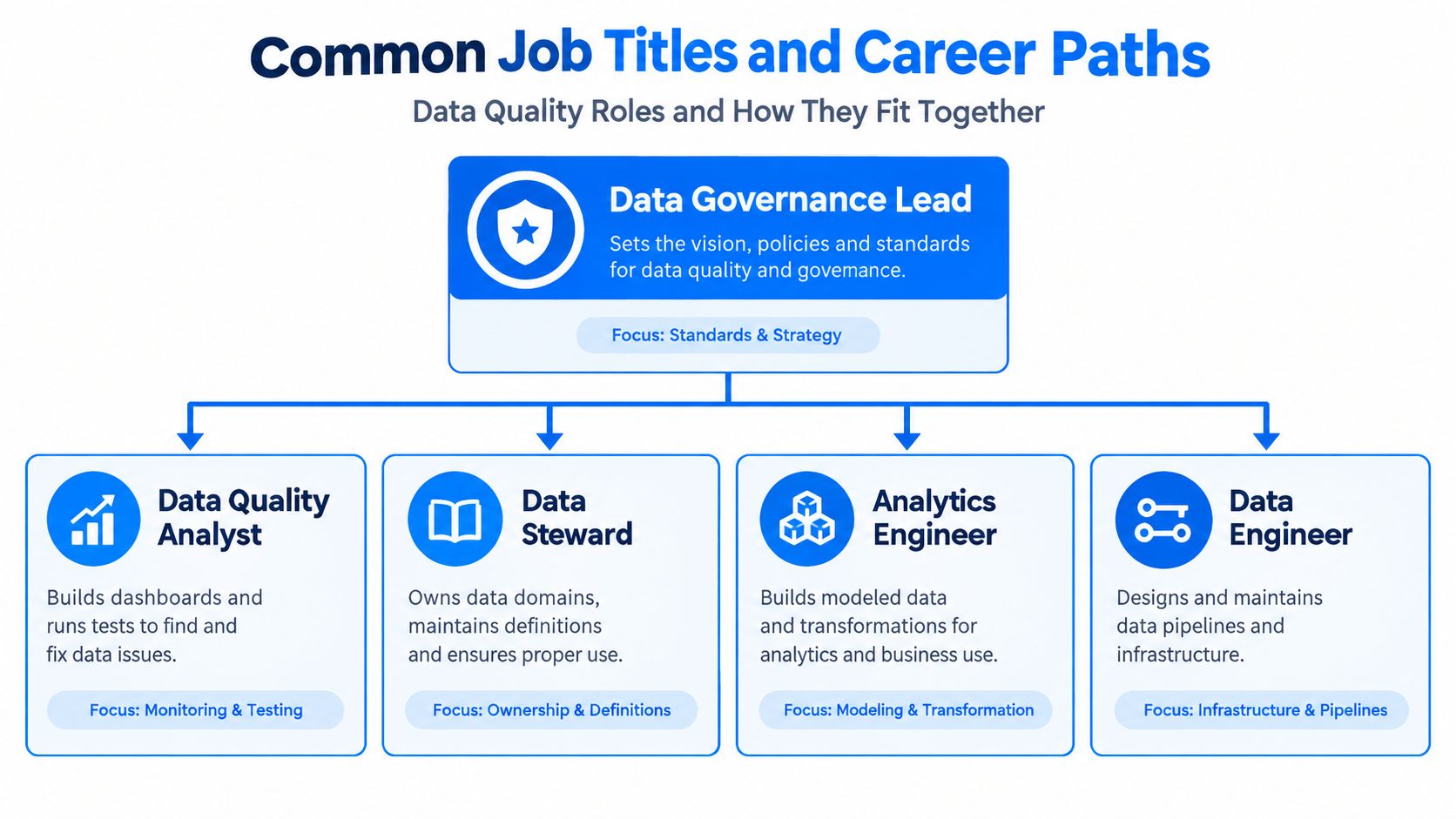
Data quality responsibilities rarely appear under one standardized title. The same work may sit in a data office, platform team, analytics function, risk group, or application-support organization. A 2024 analysis found 15,801 openings listing data-quality skills, spanning data-warehouse consultants, complaint-evaluation officers, and data-management associates, with reported annual salary figures of up to $91,441 for data-warehouse consultants and approximately $119,281 for data-management associates, according to Zippia's analysis of data quality skills.
Match the title to the operating model
Role | Primary emphasis | Best fit for |
|---|---|---|
Data quality analyst | Profiling, monitoring, issue analysis, and reporting | BI, reporting, operations, or analytical backgrounds |
Data steward | Definitions, ownership, policy adoption, and business context | Domain experts, business analysts, and governance practitioners |
Analytics engineer | Transformation quality, semantic models, and reusable tests | Analysts who have moved into SQL-based engineering |
Data engineer | Ingestion, pipelines, schemas, and remediation at source | Engineers comfortable with distributed data systems |
Platform engineer | Reliability, infrastructure, workloads, and observability | Infrastructure or cloud engineers |
Governance lead | Standards, accountability, risk, and operating policy | Senior practitioners who can influence across functions |
A data quality analyst usually starts closest to the records and incidents. An analytics engineer works closer to modeled outputs. A data engineer or platform engineer has more influence over root causes, but that influence comes with greater responsibility for deployment, reliability, and architecture. Governance leads may write fewer queries while spending more time resolving ownership disputes and defining acceptable risk.
The title matters less than the authority written into the job description. Look for language about changing pipelines, defining acceptance criteria, partnering with engineering, and tracking remediation. Be cautious when a role only asks you to produce defect reports without access to the teams or systems that can fix them.
Plan a path that fits your background
A BI developer can move into analytics engineering by formalizing tests around models and metrics. An auditor can move toward governance by translating control requirements into data ownership and evidence trails. A software tester can transfer skills in test design, defect triage, and release discipline. An operations professional can bring incident management and service-level thinking.
Organizations are also hiring analytics engineers as data teams formalize transformation ownership. That path often contains substantial quality work even when the job title doesn't mention it.
Progression isn't necessarily a straight ladder from analyst to manager. It can branch toward engineering, governance, AI trust, platform reliability, or data product ownership. The useful question is whether each next role increases your ability to prevent defects, not merely your responsibility for recording them. A broader map of data quality roles and responsibilities helps compare those directions before you apply.
Salary Ranges and Labor Market Outlook
Salary data for data quality management jobs is difficult to standardize because the work is distributed across occupations. A dedicated analyst, a data engineer with quality ownership, and a database architect may all improve reliability while appearing in different labor-market categories. That makes adjacent benchmarks more useful than a single generic salary table.
In the United States, the Bureau of Labor Statistics reports median annual pay of $104,620 for database administrators and $135,980 for database architects in May 2024. The combined category represented approximately 144,900 jobs, with about 7,800 projected openings per year, according to the BLS database administrators and architects outlook.
Read the benchmark correctly
The BLS outlook shows a structural shift inside the category. Database-administrator employment is projected to decline by roughly 1% from 2024 to 2034, while database-architect employment is projected to grow by about 9%. Together, the occupations are expected to grow 4%.
That contrast matters for candidates. Employers still need people who can protect and operate data systems, but higher-value work increasingly involves architecture, security, modernization, and cross-platform design. Quality controls must function across warehouses, lakes, pipelines, and consumers, so the market rewards people who can place controls into the platform rather than inspect isolated tables.
Demand is global and embedded
The European Commission projects more than 10 million data professionals in the EU27 by 2030, with a skills gap of approximately 500,000 in 2024 rising to 631,000 by 2030 under its baseline scenario, as documented in its report on facts and figures. This points to opportunity, but it doesn't mean every employer will create a job called data quality manager.
Many organizations are embedding quality responsibilities in AI, analytics engineering, platform engineering, risk, and governance teams. That makes job searching more deliberate. Search for terms such as data observability, data governance, reliability, lineage, validation, platform quality, and AI readiness alongside the exact phrase data quality management jobs.
Compensation should also be interpreted through scope. A role with authority over architecture, security, and remediation generally carries a different market position from a role limited to spreadsheet cleansing. Ask what systems you own, which teams act on your findings, and whether the company funds automated controls.
How to Land a Data Quality or Observability Role
Start with evidence, not certifications. Hiring managers need to see that you can take an ambiguous data failure and turn it into a controlled incident. A portfolio project can use a public dataset, but it should still demonstrate production-style thinking: source assumptions, profiling, tests, lineage, alert handling, root-cause analysis, and a clear remediation decision.
Leaders prioritize data-driven decision-making at 84%, data analysis and manipulation at 81%, and dashboard interpretation at 80%, according to the Job Skills Report 2025. The report also identifies data governance as one of the fastest-growing employee and student skills, linked to obligations to manage customer data accurately and securely.
Build a credible work sample
Create a small pipeline with an intentional failure. Change a field type, delay a partition, introduce duplicate identifiers, or alter a business rule. Then document:
The symptom: Which dashboard, model, or process became unreliable?
The investigation: Which queries, logs, metadata, and comparisons narrowed the cause?
The decision: Why was this a defect rather than a legitimate business change?
The ownership: Which team had the authority to remediate the source or transformation?
The prevention: Which automated check, schema control, or operating agreement would catch it earlier?
Don't hide uncertainty. A strong incident report separates confirmed facts from hypotheses and states what evidence is still missing. Interviewers notice that discipline.
Prepare for operational questions
Expect to explain how you'd trace a failed KPI to a pipeline or schema change, distinguish an actual anomaly from seasonal variation, and define ownership plus remediation service levels. Practice discussing trade-offs. A strict validation rule may protect downstream consumers but reject legitimate new records, while a permissive rule may preserve availability at the cost of questionable outputs.
Candidates from BI, audit, software testing, support, and operations should make their transfer explicit. BI experience maps to metric interpretation, audit maps to evidence and control design, testing maps to defect lifecycle management, and operations maps to incident response. If you're comparing distributed teams or assessing engineering capacity, guidance on how to hire developers in Latin America can also help you evaluate the technical context around a quality function.
Evaluate the employer as carefully as it evaluates you
Ask who owns critical datasets, how incidents are escalated, whether engineers receive time to fix upstream causes, and how the team measures escaped defects or detection speed. A role that only reports problems can leave you accountable without giving you influence.
Review relevant career paths at digna, then compare each opportunity by its systems, authority, and operating maturity. The right role will let you combine technical investigation with governance and stakeholder judgment, rather than reducing data quality to repetitive manual cleanup.
digna provides a data quality and data observability platform that runs inside a customer's environment, with anomaly detection, record-level validation, timeliness monitoring, and schema-change tracking for data platforms. Visit digna to see how continuous controls can support the operational work behind reliable analytics and AI.
If you are weighing a quality-focused role against an observability-focused one, our guide to data observability vs data quality explains where rule-based checks end and baseline monitoring begins, which is often where those job descriptions differ.
Frequently asked questions
What does a data quality analyst do day to day?
A data quality analyst profiles datasets, monitors volume, freshness and business metrics, investigates incidents and routes defects to the owner who can fix them. A typical case is tracing a sudden revenue dashboard drop through the warehouse to a changed source field that still loaded but broke the transformation logic.
How much do data quality management jobs pay?
Pay depends on scope, but close U.S. benchmarks are strong: the BLS reports median annual pay of $104,620 for database administrators and $135,980 for database architects in May 2024. Roles with authority over architecture, security and remediation usually pay more than roles limited to cleansing spreadsheets.
What skills do I need for a data quality job?
Start with SQL, the diagnostic language for comparing partitions, finding duplicate keys and reconciling source and target counts, plus Python for profiling and statistical checks. Employers also expect automated testing, lineage and schema-change awareness, and the ability to write incident summaries that non-engineers can act on.
Which job titles include data quality work?
Data quality work appears under many titles, including data quality analyst, data steward, analytics engineer, data engineer, platform engineer and governance lead. A 2024 analysis found 15,801 openings listing data quality skills, so search for terms like data observability, lineage and validation, not just the exact title.
How can I get a data quality job without direct experience?
Build a work sample rather than collecting certifications. Create a small pipeline with an intentional failure, such as a changed field type or duplicate identifiers, then document the symptom, investigation, decision, ownership and prevention. BI, audit, testing and operations backgrounds transfer well when you make the link explicit.