How to Build Data Warehouse for Lasting Production Success
|
7
min read

You're probably staring at a warehouse that's already half-built, or at least half-discussed. Someone wants dashboards, someone else wants “one source of truth,” and the engineering team is stuck deciding between cloud services, a star schema, or another round of spreadsheet cleanup. The fastest way to get this wrong is to start with tools instead of the business questions the warehouse has to answer.
A data warehouse only earns its keep when analysts trust it, owners understand it, and the operating team can keep it healthy after launch. That means the build has to be treated as a living system from day one, with observability, schema tracking, and validation designed in rather than bolted on later. The practical path is boring in the right way, because boring systems survive production.
Table of Contents
Starting the Build With Real Business Goals
The first mistake is obvious once you've lived through it. A team spends weeks debating Snowflake versus Fabric versus another platform, then discovers the warehouse doesn't answer the finance questions, the sales questions, or the operational questions that triggered the project in the first place. IBM's description of a modern warehouse as a centralized data store optimized for querying and analytics is useful here, because it reminds you that the warehouse exists for reporting and business intelligence, not for transaction processing (IBM).
Start with the decisions people actually need
The opening move is to list the decisions the warehouse will support, then map those decisions to the people who need them. Executives want trusted KPIs, analysts want drill-down paths, and operational managers want a clean read on exceptions and trends. That stakeholder mapping is the part people skip, and it's the part that prevents a technically elegant build from going unused.
Practical rule: if you can't name the decision, the owner, and the cadence, the source doesn't belong in the first release.
Inventory the source systems after that, not before. In messy organizations, the “source system” is sometimes a spreadsheet on a shared drive, a departmental export, or a manual reconciliation workbook, and pretending otherwise only delays the essential work. The pragmatic move is to start with a low-effort staging layer, keep departments in the tools they already know, and deliver features from real business demand instead of trying to force a perfect enterprise model up front.
Scope the first release to build trust
A first warehouse release should be narrow enough to validate quickly and broad enough to matter. Finance, sales, and other high-interest domains are common starting points because the questions are concrete and the owners are easy to identify. A phased approach works because it creates a feedback loop, and it gives the team room to learn where definitions conflict before those conflicts spread through every downstream report.
Use a one-page objective document, not a slide deck full of architecture nouns. The document should name the first business questions, the source systems involved, the ownership for each source, and the first set of users who'll rely on the outputs. That's enough structure to build something useful without locking the team into a model that can't survive the next round of organizational change.
Choosing Cloud, On-Premises, or Hybrid Architecture
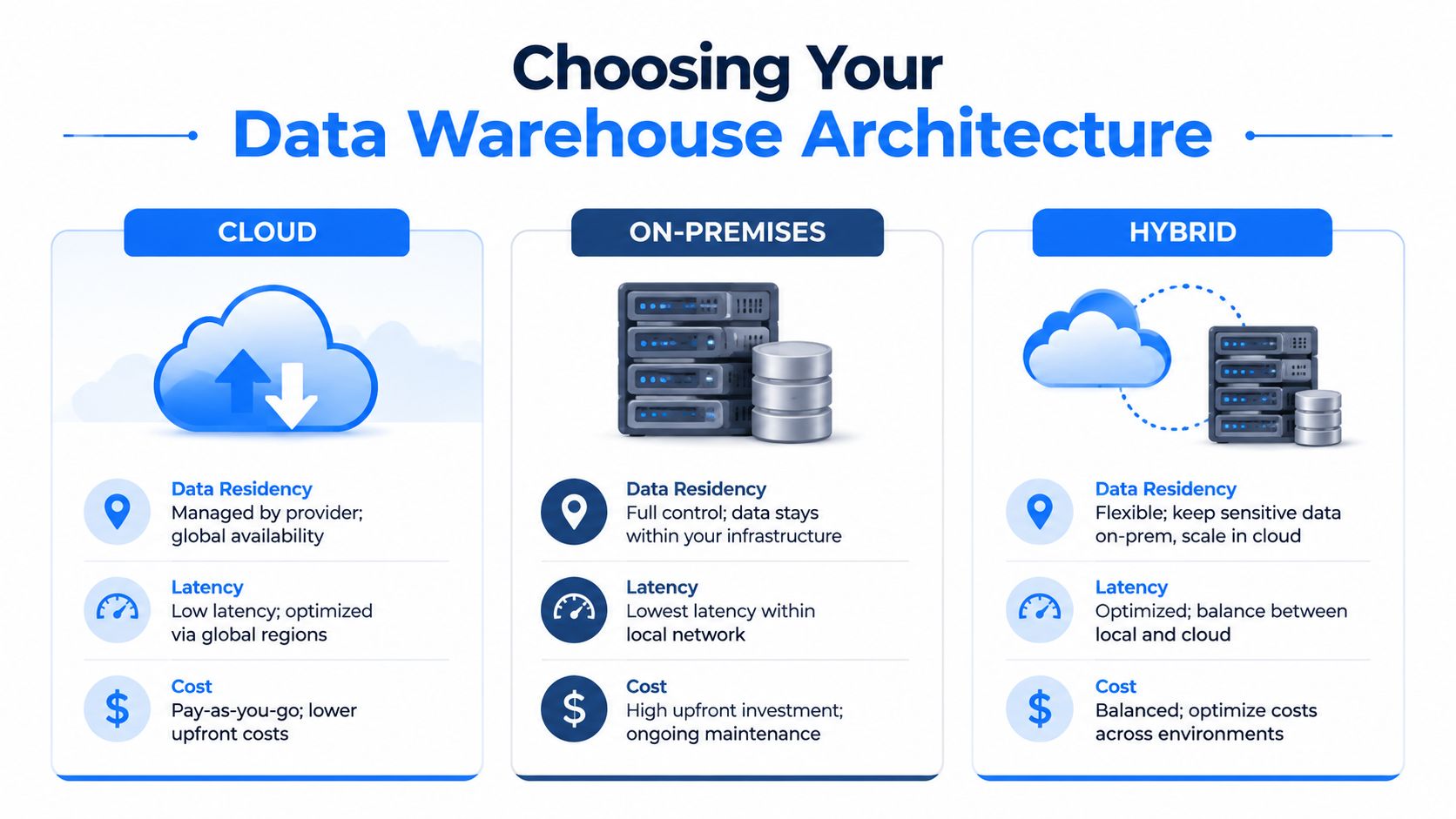
Once the business scope is clear, architecture stops being a matter of preference and becomes a set of operating constraints. The right choice depends on where the data is created, where it needs to be processed, who needs access, and what residency or compliance rules apply. In practice, the same warehouse program can end up in cloud, on-premises, or hybrid form depending on those requirements.
Treat architecture as an operating decision
Cloud works well when elasticity and integration matter more than local control. IBM describes the modern warehouse as built around ETL or ELT processes and supporting pieces such as metadata, a data layer, and access tools, which matches the common cloud pattern where compute and storage can scale independently (IBM). That separation matters when analytics demand is uneven, because storage planning should not be tied to short-term query spikes. Once analysts start depending on the warehouse every day, you also need observability, schema-drift detection, and quality checks baked into the operating model from the start, not added after the first incident.
On-premises still makes sense where the environment needs tighter control over data residency, latency, or long-standing integration patterns. Finance, healthcare, telecom, and public-sector teams often land here because their governance bar is stricter or because their source systems are not ready to move. Hybrid is the practical compromise when some data has to stay close to its origin while analysts still need a shared analytical layer. That mix is common in real programs, because the warehouse usually has to serve both controlled systems and fast-moving reporting needs.
Make the hidden design calls explicit
The architecture choice is not complete until the rest of the operating model is written down. Decide the data cleansing policy, the security policy, the warehouse pattern, and the model that will sit on top before implementation starts. Fresh Consulting's implementation guidance calls out these decisions directly, along with deployment options like cloud, on-premises, or hybrid (Fresh Consulting).
If a vendor can run analytics inside the customer's database or customer-controlled environment, that can reduce data movement risk in regulated settings. That does not remove governance work, but it changes how the program is operated day to day. For teams that must keep sensitive data in private cloud or on-premises environments, that control can matter more than the feature list on a demo page. It also affects how you design monitoring, access review, and incident response, because the warehouse has to stay healthy after go-live, not just look good during procurement.
Choose the architecture that matches your data boundaries, not the one that looks easiest in a presentation.
Designing the Storage and Data Model
The warehouse shape matters because analysts feel every modeling choice later. Bill Inmon's sizing approach starts with the minimum and maximum row counts for a 1-year horizon, key sizes in bytes, and total space as row size times row count plus index space. That's a concrete reminder that warehouse design should be driven by retention, growth, and forecasted volume, not by whatever space happens to be available that week (Inmon PDF).
Choose a model that matches the query pattern
For most reporting teams, the star schema wins because it keeps the reporting path simple. A fact table holds measurable events, and dimension tables provide context like product, customer, or date. IBM's warehouse definition, plus the broader industry history of subject-oriented, integrated, time-variant, and nonvolatile storage, points in the same direction, the warehouse is built to support analysis over time, not operational writes (IBM).
An Inmon-style normalized model has a different purpose. It can be a better fit when you want tighter control over structure and a more centralized enterprise view before you expose subject-area marts. The trade-off is usually more joins and more modeling discipline, which is fine if the team is prepared to enforce it.
Make column-level rules part of the design
A star schema isn't finished when the tables are named. A conceptual guide for star-schema design says that if a column references a foreign key, the modeler has to specify the dimension table and column name, plus the source and any calculations or transformations needed (Sarah Rylie Gasparini). That level of detail matters because it forces transformation logic into the model instead of leaving analysts to re-create business rules in every dashboard.
Keep the transformation rules traceable. If a metric is derived, document where the source field lives, what filters apply, and whether any date handling, currency handling, or deduplication logic changes the number. Analysts don't need more prose, they need fewer mysteries.
Size storage with partitioning in mind
Physical design is part of the model, not a cleanup task. Modern warehouse guidance emphasizes handling terabytes or petabytes of data, with incremental loading and partitioning to support large-scale analytics (Inmon PDF). Indexing, partitioning, and caching should be planned alongside table structure so query patterns don't force a redesign later.
For warehouse modeling, the best habit is to decide what has to be queryable fast, what can be rolled up, and what should be retained for history. That keeps the storage layer aligned with the way the business will consume the data.
Warehouse data modeling guidance fits naturally here because the model and the operational rules have to be designed together, not in separate silos.
Building ETL and ELT Pipelines That Stay Maintainable
Pipelines are where good plans turn into fragile systems if the team gets sloppy. The common failure mode is not “bad SQL,” it's a lack of restartability, lineage, and clean incremental logic. The warehouse might look fine in development, then drift once source systems change shape or a load misses its window.
Load data in layers
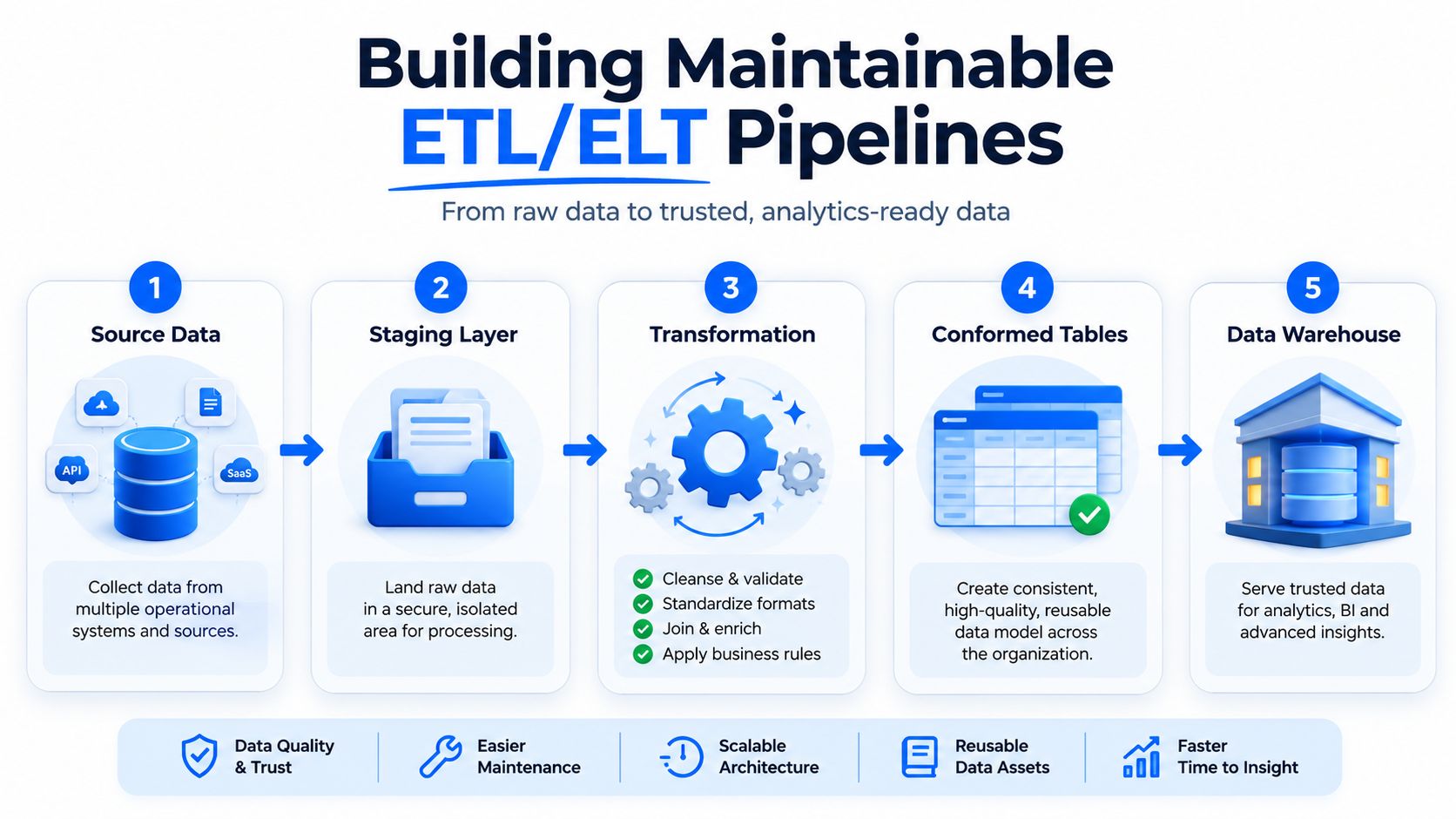
A maintainable flow usually starts with source data landing in a staging area, then moves through transformation into conformed tables and finally into the warehouse. Matillion's implementation flow, defining business objectives, assessing source systems, choosing architecture, designing the model, implementing ETL or ELT, and then testing before launch, lines up with that sequence (Matillion). The point is to keep raw intake separate from business logic so failures are easier to isolate.
ETL and ELT are both valid, but they solve different problems. ETL pushes transformation earlier, which can help when source cleanup is expensive or compliance requires stricter handling before load. ELT lands data first and transforms inside the warehouse, which often fits elastic cloud environments better because compute can scale with demand.
Prefer incremental loads over repeated full reloads
A warehouse that reloads everything every time usually doesn't stay pleasant to operate. One implementation guide recommends change data capture, watermarks, and merge logic for incremental loads because they reduce reprocessing and make the pipeline easier to keep current (ISM WS). The same guidance also warns that source data needs to be checked for missing values, inconsistencies, and duplicates before build-out, which is exactly where incremental logic tends to fail if teams skip validation.
Use the smallest reliable increment you can trust, then make the pipeline restartable around that unit.
That means every job should be idempotent enough to rerun safely and observable enough to tell you what changed. If a run fails halfway through, the next run should know whether it can resume, replace a partition, or reprocess a batch without corrupting history.
Keep lineage visible to humans
Lineage is the difference between fixing a broken metric in minutes and spending half a day tracing a bad column through six jobs. The warehouse should preserve a visible path from source fields to conformed tables, including mappings and transformations. When a downstream analyst asks why a value changed, the answer should come from metadata and job logs, not from someone's memory.
Pipeline architecture guidance belongs in the same conversation because pipeline structure and operational visibility have to be designed together. A pipeline that can't be explained is usually a pipeline that can't be trusted for long.
Embedding Observability and Data Quality From Day One
The strongest warehouse programs don't treat monitoring as a post-launch add-on. They design for it early, because silent failures are the ones that hurt most. A warehouse can be technically up while dashboards are wrong, source files are late, or a schema change has broken the meaning of a field without tripping a hard error.

Monitor the things that actually break trust
Recent warehouse guidance increasingly includes freshness monitoring, schema-drift detection, and source-total reconciliation as part of the build lifecycle, not just operations after launch (Qrvey). That shift matters because late-arriving data, missing rows, and structural changes don't always cause job failures. They often show up later as “why does this dashboard look off?” conversations.
A practical observability setup checks three layers. It verifies load timeliness, watches for unexpected statistical shifts, and checks whether the schema changed in a way that could alter downstream meaning. Digna is one option that does this with in-database metric computation, anomaly detection, timeliness monitoring, data validation, and schema tracking in customer-controlled environments, which is a useful pattern for teams that can't move production data out of private cloud or on-prem systems.
Build validation into the load path
Validation shouldn't live in a separate notebook or an after-the-fact audit. One implementation guide explicitly recommends record counts, null thresholds, and referential integrity checks as part of warehouse validation (ISM WS). Those checks are simple, but they catch a lot of expensive mistakes before analysts see them.
Historical observability metrics matter too. Once you have baselines, you can detect fast-moving signals and outliers instead of staring at a dashboard after someone complains. That's especially useful in warehouses that support AI and operational analytics, where a silent drift can damage downstream decisions even if the load technically completed.
Treat schema change as a first-class event
Schema changes are not just deployment noise. A column added, removed, or retyped can invalidate metric logic, break joins, or alter business meaning in a way that looks small in version control and large in production. The right response is to detect it automatically, route it to the right owner, and compare it against historical behavior before downstream consumers absorb it.
If a warehouse looks stable but nobody is checking freshness or drift, the team is borrowing trust it hasn't earned.
That's why observability belongs in the initial design. The alternative is a warehouse that appears reliable until the first serious source change lands.
Hardening Security, Governance, and Pre-Launch Testing
Security is cheaper to design than to retrofit, and governance is the same way. If access rules, lineage, and ownership are vague at launch, every downstream team ends up making their own interpretation of what the data means. That creates trust problems that are hard to unwind once users have already built workflows around the warehouse.
Lock down access before users arrive
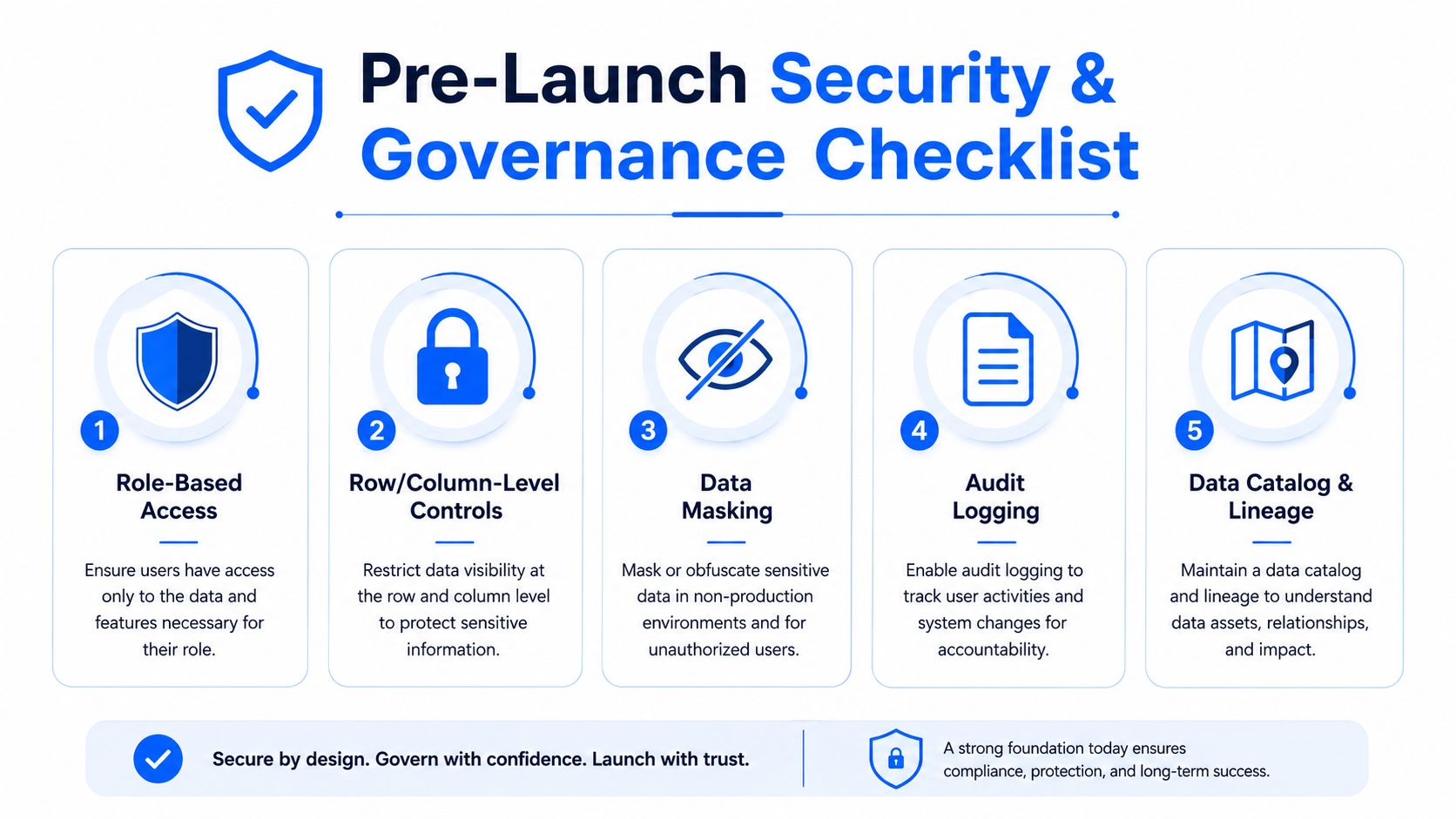
Role-based access control is the base layer, but serious warehouses go further with row-level and column-level controls, masking, audit logging, and a usable catalog. The goal is not just restriction, it's predictable enforcement across tools and personas. IBM's warehouse definition already implies centralized access to analytical data, and that centralization only works when permissions are explicit (IBM).
A catalog and lineage layer makes governance workable at scale because it tells users what a dataset means, who owns it, and where it came from. Without that, every permission review turns into a detective job. With it, teams can resolve access questions and change-impact questions faster.
Prove the warehouse before cutover
Pre-launch testing has to include reconciliation reports against source systems, freshness assertions, and performance benchmarks against representative query workloads. Where possible, tune indexing, partitioning, and caching before production users log in, because waiting until after launch usually means the first complaints become the tuning plan. WhereScape's guidance specifically recommends reconciliation, automated validation, freshness checks, and performance tuning before users rely on the warehouse (WhereScape).
The benchmark standard should be simple. If the warehouse can't match source totals where it should, doesn't refresh on time, or can't handle the expected query patterns, it isn't ready. The same applies if a user requirement is still ambiguous, because ambiguity almost always turns into support tickets after go-live.
Production readiness is a test result, not a calendar date.
That means the launch checklist should force a yes or no on access, data correctness, performance, and owner accountability. If any one of those is still soft, the cutover should wait.
Rolling Out, Operating, and Evolving the Warehouse
Go-live is the start of the operating model, not the finish line. A warehouse that stays trusted is one that keeps learning from users, keeps checking itself, and keeps adapting as source systems and business definitions change. The most successful programs treat the warehouse like a product with internal customers, not like a project that ends at deployment.
Roll out in waves, not all at once
A staged rollout is easier to support than a big-bang launch because it gives analysts, engineers, and domain owners a chance to catch issues early. Domain ownership matters here, because each subject area needs someone accountable for refresh cadence, schema evolution, and communication when definitions change. That's how the warehouse keeps its meaning when the organization changes around it.
Feedback loops need to be short. Analysts should be able to flag broken logic, late data, or confusing definitions quickly, and the engineering team should have a clear path for fixing them without turning every request into a one-off exception. If you've already put observability and validation in place, those conversations stay factual instead of speculative.
Keep the warehouse honest over time
Operations are where the culture question comes back. If the team still treats the warehouse like a one-time implementation, it'll drift into distrust as soon as source systems, spreadsheets, and metrics evolve. The better pattern is continuous quality monitoring, schema-drift detection, and regular cost and performance reviews, because those are the signals that tell you whether the warehouse is still fit for purpose.
The discipline is simple, but not easy. Keep ownership visible. Keep change requests versioned. Keep validation running after launch. Keep the shared definitions in a place the business can inspect.
A warehouse earns its status through repeated reliability, not through architecture diagrams. When the system keeps delivering clean, timely, explainable data, teams stop arguing about whether to use it and start asking how to extend it.
If you're building or repairing a warehouse and want the operational side treated as seriously as the architecture, digna gives teams data anomaly detection, timeliness monitoring, validation, and schema tracking inside customer-controlled environments. Visit digna to see how that fits a production warehouse that needs to stay trusted after launch.