10 Best Data Quality Tools for 2026: An Expert Guide
|
7
min read

A board packet is due at 8:00 a.m. At 7:15, the revenue dashboard shifts. A pipeline job still shows green, but a schema change upstream dropped a field finance depends on. By the time someone traces the issue, executives already have conflicting numbers in their inboxes.
That pattern is common. An AI model drifts after an unnoticed source change. A customer health report pulls duplicate accounts. Analysts stop trusting the warehouse and start validating outputs by hand. These are not isolated reporting mistakes. They are operational failures caused by data that arrived late, broke unnoticed, or no longer matched the business logic downstream.
Data downtime is expensive because it spreads through systems faster than teams can inspect it manually. Precisely's 2025 planning insights, as summarized in Alation's review of the findings, show how high data quality ranks among data integrity concerns for organizations planning the year ahead.
The tooling market has responded, but feature lists alone do not help much during evaluation. Fit is the primary consideration. Some platforms are strongest at warehouse-native monitoring and in-database checks. Others are better for enterprise governance, MDM-heavy environments, or broad observability across pipelines, BI, and machine learning systems. Trade-offs show up quickly in implementation. Alert quality, lineage depth, rule maintenance, privacy constraints, and how much metadata a vendor needs to ingest all matter more than a polished demo.
The best data quality tools now sit closer to production operations than traditional after-the-fact QA. They watch freshness, schema, volume, distributions, lineage, and business rules early enough for teams to act before an executive, analyst, or customer finds the issue first.
This guide is built for that decision process. It goes beyond vendor summaries to give you a practical evaluation framework, a comparison matrix, use case-specific recommendations such as privacy-first versus startup-friendly options, and an integration checklist you can use with engineering, analytics, and governance stakeholders. For a broader view of how platforms are evolving, see this comparison of automation and data quality tools platforms.
Table of Contents
1. digna
Why digna stands out
Where it fits best
2. Monte Carlo
What Monte Carlo does well
3. Anomalo
Where Anomalo earns its place
4. Soda
Why Soda works well in engineering-led stacks
5. Metaplane
6. Acceldata
Where Acceldata makes sense
7. IBM Data Observability by Databand
Where Databand fits
8. Ataccama ONE
Why Ataccama is different
9. Informatica Data Quality
When Informatica is the right call
10. Qlik Talend Data Quality
Where Qlik Talend fits best
Top 10 Data Quality Tools, Feature Comparison
Making the Right Choice From Evaluation to Action
1. digna

digna is one of the few tools in this category that takes privacy-first architecture seriously without giving up modern observability. It combines anomaly detection, timeliness monitoring, schema tracking, record-level validation, and historical metric analysis in one platform, while executing inside the customer environment rather than depending on broad data movement to a vendor-controlled SaaS stack.
That matters more than most comparison pages admit. One of the biggest gaps in the market is support for in-database execution in regulated environments, especially where teams need observability and quality controls without exposing production data to an external vendor, as highlighted by lakeFS on the privacy gap in data quality tooling. If you work in finance, healthcare, telecom, or the public sector, this isn't a nice-to-have. It often determines whether a tool is even deployable.
Why digna stands out
The strongest part of digna's design is that it doesn't force a false choice between observability and classic data quality. Many teams end up stitching together one product for anomaly detection, another for rules, and a third for reporting. digna keeps those workflows in one interface, which reduces handoff friction when a metric goes bad and someone needs to answer three questions quickly: what changed, when did it start, and which records are affected.
Its in-database metric computation and baseline learning also align with enterprise data platforms more effectively than pure SaaS approaches. You keep data resident. You reduce movement. You can support private cloud or on-prem deployment. For teams under strict residency or compliance mandates, that architectural choice is often more important than flashy AI claims.
A detailed vendor comparison is available in digna's own guide to automation data quality tools and platforms in 2026.
Practical rule: If security review is likely to dominate your buying cycle, shortlisting in-database platforms early saves months of wasted evaluation time.
Where it fits best
digna is a strong fit for teams that need one operational layer for silent failures such as late loads, schema drift, volatile metrics, and record-level business rule violations. It's also a strong fit when the data platform team wants usable dashboards for both engineers and business stakeholders instead of yet another specialist console.
Pros and cons look like this in practice:
Best for private environments: It runs in customer-controlled infrastructure, which helps teams that can't accept vendor data access.
Broad functional coverage: Timeliness, validation, anomaly detection, schema tracking, and analytics live in one product.
Good for regulated operations: It suits organizations that need strong privacy controls without losing observability depth.
No public pricing: You'll need a sales conversation to understand packaging.
Less ideal for SaaS-only buyers: Teams that want a purely public, fully managed tool may prefer a different model.
2. Monte Carlo
Monte Carlo is still one of the most recognizable names in data observability, and for good reason. It's built for teams that want broad, automated monitoring across warehouses, ETL, BI, and increasingly AI workflows, with lineage and incident triage at the center of the product experience.
Its biggest strength is operational breadth. Monte Carlo works well when the problem isn't one bad table, but a tangled estate of pipelines, dashboards, and downstream dependencies where blast-radius analysis matters as much as initial detection.
What Monte Carlo does well
Monte Carlo is usually at its best inside larger data organizations that already have enough complexity to justify centralized incident workflows. Freshness, schema, volume, and distribution monitors are table stakes now, but Monte Carlo's practical value comes from lineage-assisted debugging and coordinated response across teams.
The trade-off is weight. Smaller teams often find enterprise packaging, implementation coordination, and sales-led procurement heavier than they want. If you only need lightweight checks on a narrow slice of your warehouse, Monte Carlo can feel like buying a command center when you really needed a smoke detector.
Use Monte Carlo when the cost of not knowing downstream impact is higher than the cost of operating an enterprise platform.
A few practical considerations:
Strong fit for enterprise incident management: It helps teams standardize monitoring and escalation.
Lineage is a real differentiator: It improves root-cause analysis when dashboards and models depend on many upstream assets.
Less friendly for lean teams: Startups and compact analytics groups may find the scope too broad.
Expect a formal sales cycle: Pricing isn't public.
3. Anomalo
Anomalo is built around a simple promise that appeals to overstretched data teams: detect bad data without requiring people to hand-author endless rules. That's why it tends to stand out in environments where table counts are high, change is constant, and engineering time is already committed elsewhere.
This is the category of tool I'd shortlist when a team says, “We know we need better monitoring, but we don't have the bandwidth to define thresholds for everything.”
Where Anomalo earns its place
Anomalo emphasizes unsupervised monitoring, automated root-cause support, and integrations with modern data stack components. In practice, that means it can reduce the maintenance burden that comes with rule-heavy programs, especially when datasets evolve faster than documentation or governance does.
That said, self-driving monitoring isn't magic. Teams still need ownership, triage discipline, and clarity on which anomalies matter to the business. A tool can surface issues. It can't decide whether a late-arriving retail feed is urgent, acceptable, or expected in quarter close week. You still need operational context.
What works well with Anomalo:
Low rule-authoring burden: Useful when teams don't want to maintain checks table by table.
Enterprise-friendly integrations: It's geared toward larger modern data stacks.
Good fit for fast-changing data: Automated detection helps where static thresholds break down.
Pricing requires vendor engagement: Budget clarity comes later in the process.
Not the lightest option: Small teams may prefer simpler or open-source paths.
4. Soda

Soda fits teams that want data quality to behave like part of the engineering system, not a separate oversight layer. It is a strong option when the evaluation criteria favor in-database checks, version-controlled rules, and clear ownership inside data engineering or analytics engineering.
That distinction matters during tool selection. Some platforms optimize for broad anomaly detection with less setup. Soda takes the opposite route. Teams define the checks, decide where they run, and manage them the same way they manage dbt models, tests, and deployment changes.
Why Soda works well in engineering-led stacks
Soda's core appeal is control.
Soda Core and SodaCL give teams a checks-as-code model that fits naturally into pull requests, CI pipelines, and release workflows. For organizations already reviewing transformations through Git and promoting changes through environments, that architectural fit usually matters more than a long feature list. The benefit is reproducibility. The trade-off is upkeep.
That trade-off becomes clearer as the scope expands. A small set of business-critical datasets is usually straightforward to cover. Hundreds of tables across domains can create rule sprawl, ownership gaps, and noisy failures unless teams standardize templates, severity levels, and review processes early.
Soda is usually a good fit when the team wants:
Checks defined in code: Strong fit for dbt-centric workflows and CI/CD enforcement.
In-database execution options: Useful for teams that want to keep validation close to the warehouse.
A phased adoption path: Open source first, then managed collaboration if the program matures.
Clear operational ownership: Best when engineers are prepared to maintain rules over time.
Quote-based managed pricing: Budget evaluation takes more work once the team moves beyond the open-source layer.
Teams with mature engineering discipline often get value from Soda quickly. Teams looking for low-touch monitoring usually prefer a tool with more automation and less rule authoring.
In a comparison matrix, Soda tends to score well on transparency, workflow fit, and implementation control. It scores lower on hands-off coverage. That is not a flaw. It is a design choice, and for the right team, it is the right one.
5. Metaplane
A common scenario looks like this. The warehouse is healthy enough to support reporting, but trust is slipping because tables break unnoticed, freshness drifts overnight, and nobody sees the issue until a dashboard goes red in front of the business. Teams in that position usually are not asking for a full governance program first. They want early warning, fast setup, and enough context to route incidents to the right owner.
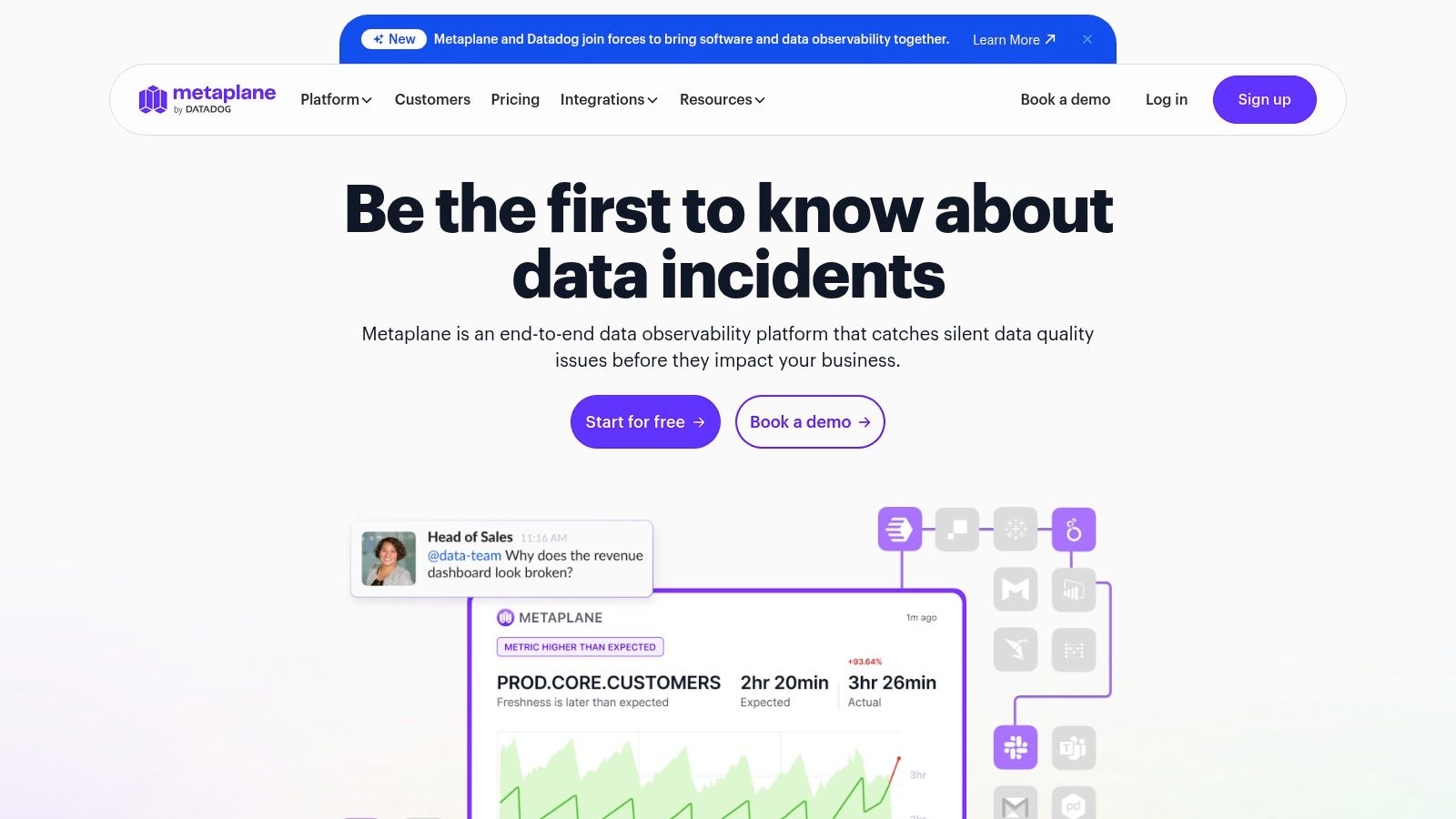
Metaplane fits that need well. It is an observability-first product aimed at modern data teams that want coverage quickly, especially in warehouse and dbt-heavy environments. That focus matters. Metaplane is trying to reduce time-to-signal, not replace every surrounding function in the data management stack.
That distinction shapes the evaluation. If the goal is broad stewardship, policy management, and organization-wide data governance, Metaplane will feel narrow. If the goal is to detect freshness, schema, volume, or distribution issues before stakeholders notice them, the narrower scope can be an advantage because implementation is usually faster and ownership is clearer.
Teams often choose Metaplane for a few practical reasons:
Fast onboarding: A good fit for teams that need monitoring in place without a long platform rollout.
Observability before governance: Strong for detecting issues in production data, less suited to catalog, lineage governance, or stewardship-heavy programs.
Modern stack alignment: Works well in analytics environments built around cloud warehouses and dbt workflows.
Incremental rollout: Supports a sensible adoption path where teams start with revenue-critical or executive-facing assets.
Trade-off on depth: You get speed and focus, but larger enterprises may still need separate tooling for broader data management functions.
In a comparison matrix, Metaplane usually scores well on implementation speed, usability, and modern observability coverage. It scores lower when the evaluation criteria favor all-in-one governance breadth or deep rule-driven control. For many midmarket teams, that is an acceptable trade-off. The right question is not whether Metaplane does everything. It is whether your team needs fast incident detection inside the warehouse, or a broader system that spans quality, governance, and stewardship from the start.
6. Acceldata
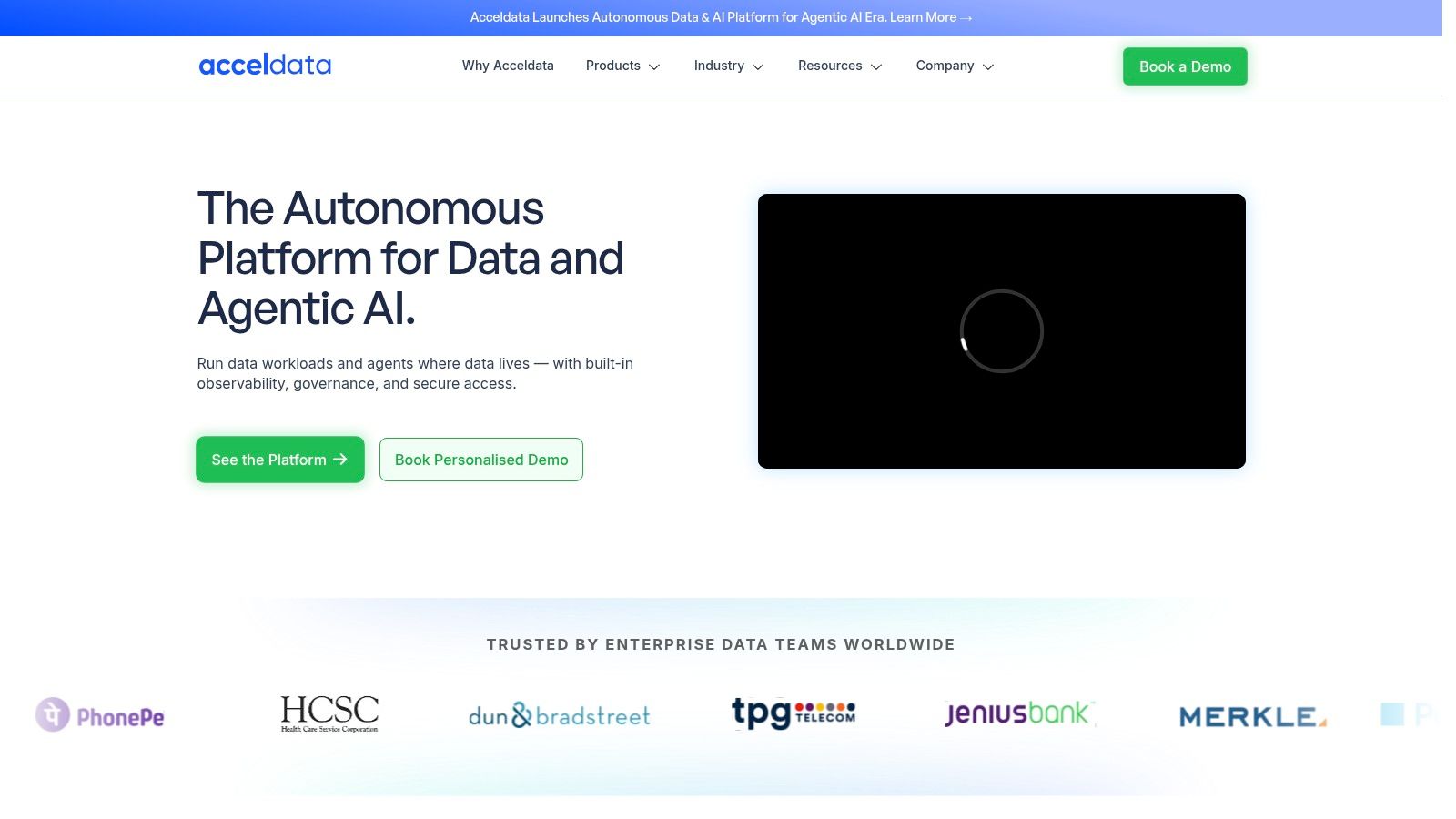
Acceldata is what I'd call a broad operations platform rather than a narrow data quality point solution. It spans data reliability, pipeline observability, infrastructure visibility, and cost or performance oversight. That's a lot of surface area, which can be exactly right in large environments and completely wrong in smaller ones.
The key question isn't whether Acceldata has enough features. It's whether your organization needs one product to connect quality, compute efficiency, and service-level expectations.
Where Acceldata makes sense
Acceldata works best in large hybrid or cloud estates where incidents often involve both data symptoms and infrastructure causes. In those settings, splitting tooling across data quality, platform observability, and cost governance can create blind spots and ownership confusion. Acceldata's broader footprint helps close that gap.
The downside is complexity. Teams with a relatively clean modern warehouse stack may not need this much platform surface area. They may be better off with a more focused observability or validation tool.
Practical trade-offs:
Useful for hybrid complexity: It suits organizations with layered infrastructure concerns.
Good for SLA-minded operations: Reliability and performance sit close together in the product.
Can reduce vendor sprawl: If you need data and infrastructure observability together.
Usually too heavy for small teams: Scope and procurement skew enterprise.
Sales-led buying motion: Expect formal evaluation and stakeholder involvement.
7. IBM Data Observability by Databand
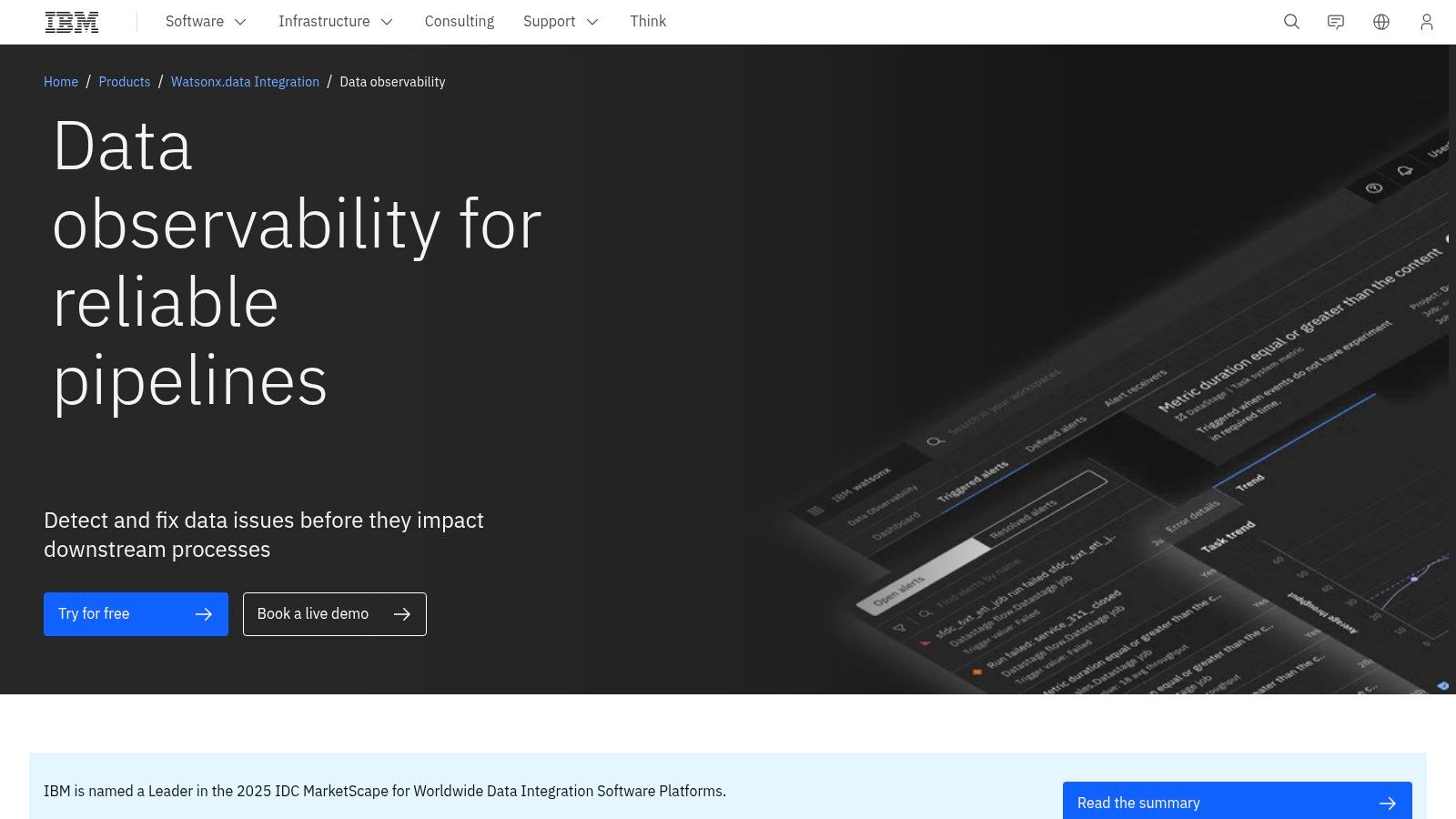
IBM Data Observability by Databand is a strong option for organizations that want data incident management under a large enterprise umbrella. It focuses on pipeline reliability, anomaly detection, alerting, and metadata-based baselining, with the added comfort of IBM documentation, onboarding structure, and support channels.
That last part matters more than product marketers usually admit. Some teams don't buy the technically coolest tool. They buy the one procurement, security, and operations can support.
Where Databand fits
Databand tends to make the most sense in enterprise environments already aligned with IBM or with strong preferences for established vendors. It's especially relevant when pipeline health, job orchestration, and operational alerting matter as much as table-level quality checks.
It's less compelling for teams seeking a nimble, developer-first product they can trial and scale with minimal process. IBM's strengths are governance, support, and enterprise readiness. Those are valuable, but they come with a heavier motion.
A grounded assessment:
Good fit for enterprise operational control: Strong for incident prevention and managed support.
Works well in formal IT environments: Helpful where process and documentation matter.
Integrates with code-based workflows: Useful for engineering teams inside large enterprises.
May feel heavyweight for small groups: Better suited to broad organizational rollouts.
Commercial details aren't fully public: Plan for a vendor-led sales process.
8. Ataccama ONE
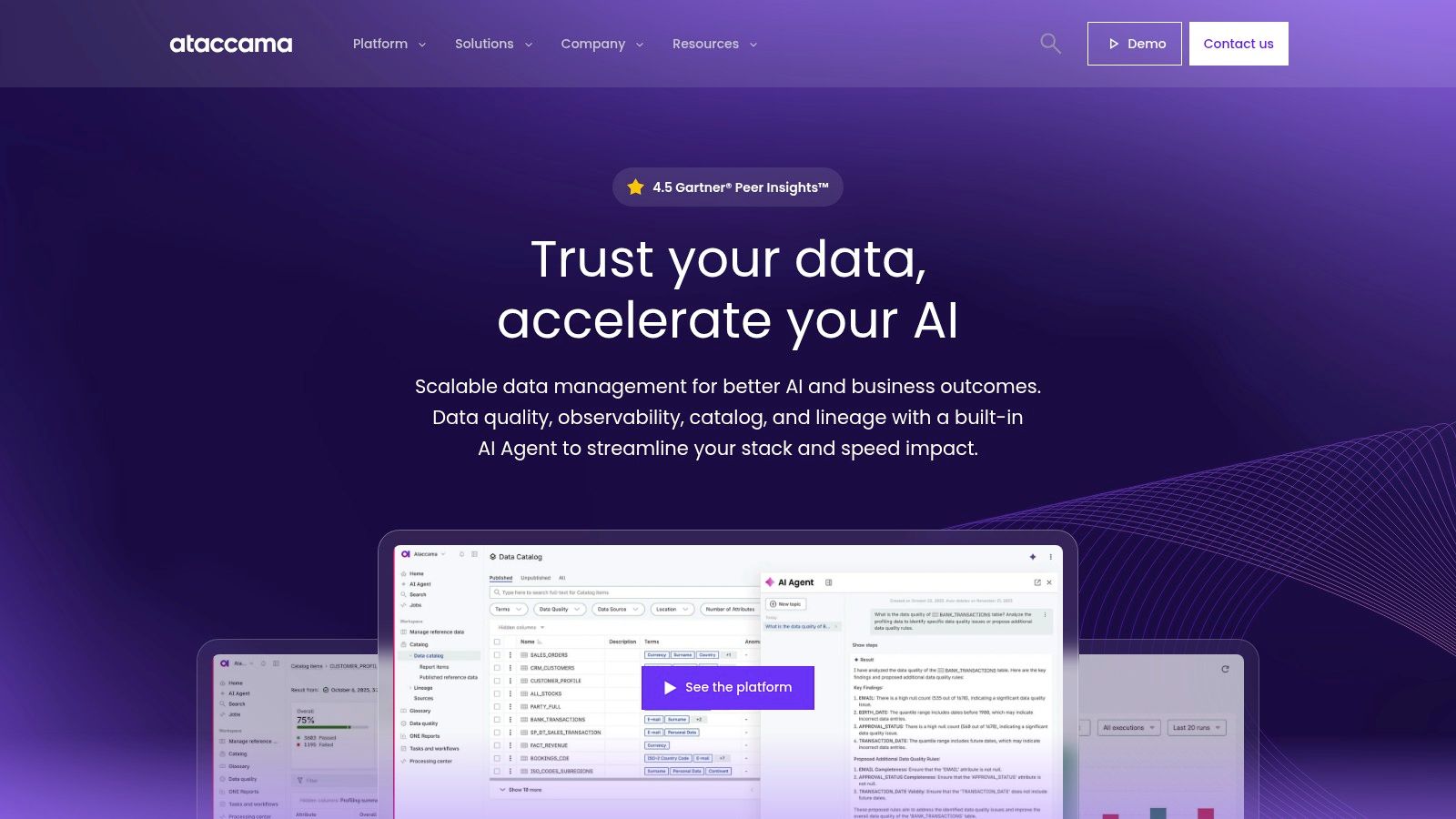
Ataccama ONE isn't just a data quality tool. It's a wider data trust platform that brings together profiling, rules, scorecards, observability, catalog capabilities, lineage, and MDM-style concerns. That positioning makes it attractive to enterprises that are tired of running separate initiatives for governance and quality.
This is a different buying motion from tools like Metaplane or Soda. You're not just solving monitoring. You're choosing a broader operating model.
Why Ataccama is different
Ataccama is strongest when the organization wants quality tightly coupled to catalog, stewardship, and reference data management. If your governance team and engineering team are both stakeholders, a unified suite can reduce overlap and avoid the handoff problem where one team sees issues and another team owns the definitions.
The trade-off is implementation weight. Broad suites usually take longer to roll out and require more alignment on ownership, metadata, and workflow design. They often pay off in regulated or multi-domain enterprises. They often disappoint teams that only wanted fast anomaly detection.
What to expect with Ataccama:
Broad platform coverage: Quality, governance, lineage, and related disciplines fit together.
Good for regulated sectors: Especially where ownership and auditability matter.
Flexible deployment options: Useful for cloud, hybrid, and on-prem patterns.
Longer implementation curve: Breadth increases setup and change management work.
Enterprise pricing model: Commercials are quote-based.
9. Informatica Data Quality
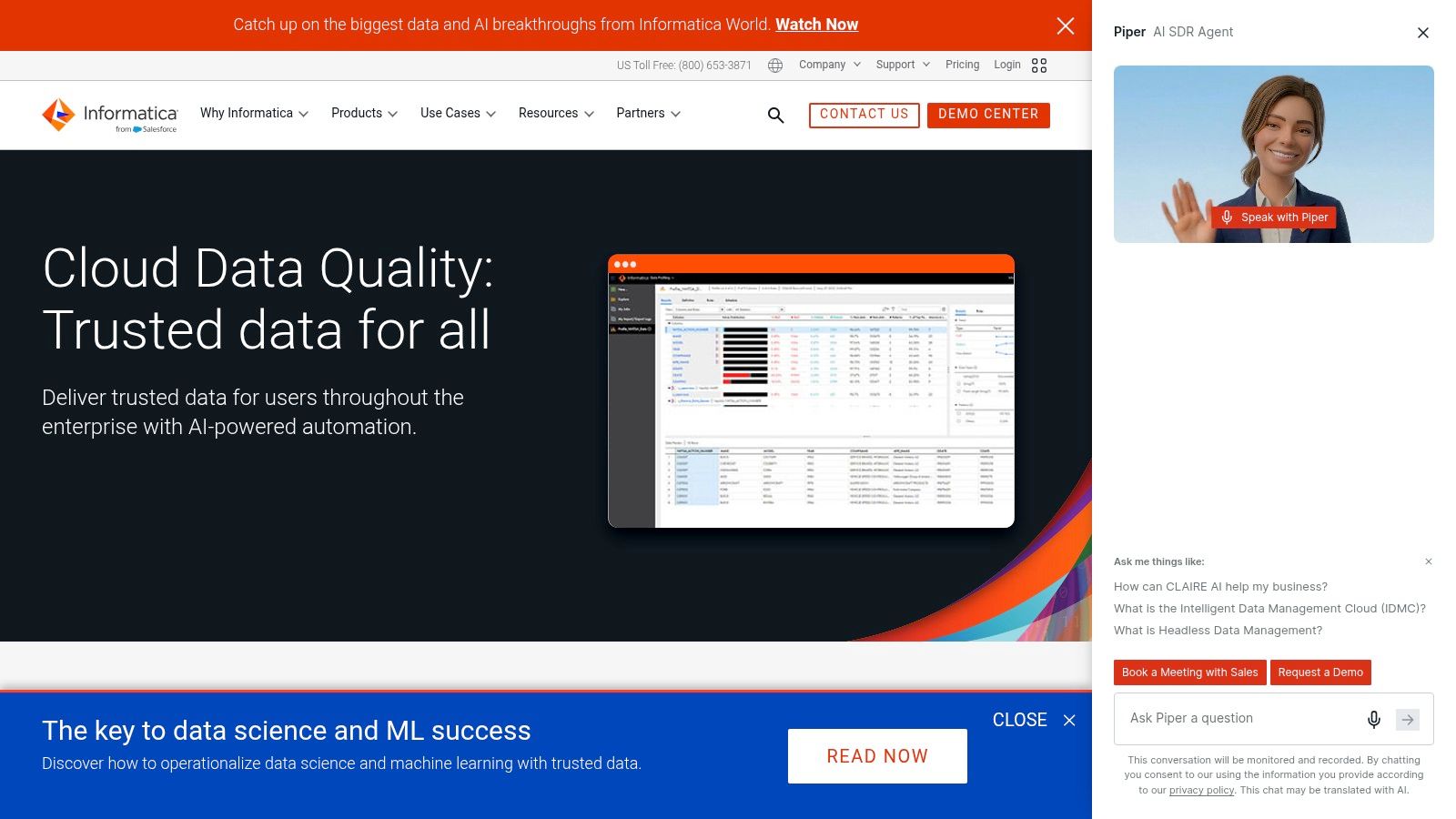
Informatica Data Quality remains one of the most established names in enterprise data quality. It offers profiling, rule authoring, scorecards, exception handling, and cloud execution within the wider Informatica ecosystem.
For many enterprises, the appeal isn't novelty. It's familiarity, depth, and the ability to align with existing Informatica integration, governance, or master data investments.
When Informatica is the right call
Informatica is usually the safe choice when an organization needs deep feature coverage, broad enterprise support, and integration with a mature data management stack. It's especially relevant when quality work is tied to compliance, stewardship, and exception management rather than just anomaly alerts.
The caution is straightforward. Informatica can be a heavier lift than more focused tools, both operationally and commercially. Consumption-based packaging and enterprise licensing can also make cost modeling less intuitive for teams used to simple per-seat or per-table pricing.
If your organization already trusts Informatica for adjacent workflows, buying Informatica Data Quality is often easier than introducing a new platform category entirely.
Here's the practical view:
Deep enterprise functionality: Strong on profiling, rule management, and exception workflows.
Good ecosystem fit: Best when Informatica is already part of the stack.
Useful cloud scaling options: Serverless execution can help with elastic workloads.
Complex packaging: Pricing and consumption models need close review.
Not ideal for lean teams: There are easier tools to stand up if your needs are narrow.
10. Qlik Talend Data Quality
Qlik Talend Cloud brings data quality into a broader integration and analytics platform. That's the key lens for evaluating it. If you want a standalone specialist tool, this probably isn't your first stop. If you already run Qlik or Talend, it becomes much more interesting.
This kind of platform fit matters because many organizations don't want yet another vendor for quality if they can reasonably extend an existing integration estate.
Where Qlik Talend fits best
Qlik Talend Data Quality is most compelling when profiling, rules, stewardship, and integration workflows need to live together. Teams that already rely on Talend for pipelines can often move faster by extending what they have rather than deploying a separate observability layer with separate administration and procurement.
The drawback is modular independence. Because quality lives within the broader platform, it may not feel as specialized or lightweight as dedicated data observability products. For some buyers, that's perfectly fine. For others, it means they're paying for a platform shape they didn't intend to buy.
A realistic summary:
Best for existing Qlik or Talend customers: Platform alignment is the main reason to shortlist it.
Strong DI plus DQ combination: Useful when integration and quality belong together operationally.
Good enterprise enablement: Documentation and broader vendor support are mature.
Not a pure standalone quality tool: Buyers should want the wider platform.
Pricing is bundled and enterprise-oriented: Expect sales involvement.
Top 10 Data Quality Tools, Feature Comparison
Product | ✨ Key Differentiator | 🏆 Strengths | ★ Quality/UX | 💰 Pricing / Value | 👥 Best For |
|---|---|---|---|---|---|
digna | In‑database AI anomaly detection + on‑prem/private cloud | Privacy-first, unified DQ+observability, fast install | ★★★★☆ | 💰Quote; high value for secure estates | 👥 Security‑conscious enterprises, data engineers & analysts |
Monte Carlo | End‑to‑end lineage + AI observability (incl. agents/LLMs) | Category leader; strong incident triage & blast‑radius analysis | ★★★★★ | 💰Quote; enterprise focus | 👥 Large enterprises standardizing incident ops |
Anomalo | Unsupervised / “self‑driving” anomaly detection | Reduces rule maintenance; proven at scale (finance/retail) | ★★★★☆ | 💰Quote; enterprise sales | 👥 Enterprises needing automated anomaly coverage |
Soda | Open‑source core (SodaCL) + managed Cloud | Checks‑as‑code, CI/CD friendly, governance fit | ★★★★ | 💰Core free; Cloud by quote | 👥 Data engineers, DevOps & governance teams |
Metaplane | dbt‑native, per‑table pricing & fast onboarding | Easy setup; transparent pricing; per‑table monitoring | ★★★★ | 💰Usage‑based; free tier available | 👥 Small/mid teams and dbt shops |
Acceldata | Observability + compute/cost/perf optimization | Broad pipeline + infra coverage; SLA & spend controls | ★★★★ | 💰Enterprise quote; heavy‑scope value | 👥 Large, complex hybrid data estates |
IBM Data Observability (Databand) | IBM‑backed SaaS for pipeline reliability | Enterprise support, documentation, pipeline integrations | ★★★★ | 💰SaaS/quote; IBM enterprise motion | 👥 IBM customers and enterprise ops teams |
Ataccama ONE | Unified “data trust” (DQ + catalog + MDM) | Comprehensive governance, catalog & MDM integration | ★★★★ | 💰Quote; higher TCO for full suite | 👥 Regulated industries needing integrated governance |
Informatica Data Quality | Mature DQ with profiling & serverless options | Deep enterprise features; scalable execution models | ★★★★ | 💰Consumption‑based; complex packaging | 👥 Large regulated organizations, heavy DQ needs |
Qlik Talend Data Quality | DQ embedded with data integration (Talend) | Integrated DI+DQ; stewardship & remediation features | ★★★★ | 💰Bundle/quote via Qlik Talend Cloud | 👥 Teams invested in Qlik/Talend integration stacks |
Making the Right Choice From Evaluation to Action
A real evaluation usually starts the same way. A dashboard breaks, the business asks whether the number is wrong or the pipeline is late, and the team realizes three different tools can each catch part of the problem but none fits the operating model cleanly.
That is why tool selection should start with constraints, not feature grids. The first question is where checks run and who can access production data. For regulated teams, that decision removes a large part of the market immediately. If data cannot leave your environment, in-database execution and customer-controlled deployment are baseline requirements. digna fits that model with anomaly detection, validation, timeliness monitoring, and schema tracking that can run without sending production data to a vendor-controlled environment.
The next question is ownership. Teams with strong analytics engineering practices often prefer checks-as-code, version control, and CI/CD alignment. Observability-led teams usually care more about automated detection, lineage context, alert tuning, and incident response. Neither model is better in the abstract. The wrong model creates dead monitors, ignored alerts, and rules nobody maintains after the pilot.
Implementation tolerance matters just as much. Large suites such as Ataccama ONE, Informatica, and IBM Data Observability by Databand can fit organizations where data quality is tied to stewardship, compliance, and formal operating processes. They also come with longer rollout cycles, more stakeholder coordination, and higher total cost. Smaller teams often get more value from products that solve a narrower problem well, especially when the immediate pain is freshness failures, schema drift, or broken downstream dashboards.
Use cases should shape the shortlist.
If privacy review is the main blocker, prioritize tools that run inside your warehouse or your infrastructure. If startup speed matters more than governance breadth, favor products with fast setup, clear pricing, and low rule-management overhead. If the environment is already standardized on dbt, Airflow, Databricks, Snowflake, or a major enterprise integration stack, weight native integrations heavily. Integration friction is one of the fastest ways to turn a promising proof of concept into shelfware.
Benchmarks can still help. The 6Sigma overview of data quality benchmarks is useful as a reminder that quality needs measurable targets for accuracy, completeness, consistency, and duplicate control. The exact thresholds will vary by domain. A finance pipeline and a product analytics event stream should not be held to the same tolerance. What matters is that the tool supports monitoring, alerting, remediation, and trend reporting against standards your business accepts.
Modern detection is also changing the evaluation process. Automated anomaly detection now catches classes of issues that static rules miss, especially gradual drift and unexpected changes in distribution or timing. That does not replace deterministic checks. Business logic still needs explicit validation. In practice, the strongest setups combine both: hard rules for known failure modes, adaptive monitoring for the problems nobody thought to encode.
Run a proof of concept like an operations exercise, not a sales exercise. Choose a small set of business-critical tables and test six things: freshness, schema change detection, volume shifts, field-level validity, alert routing, and root-cause workflow. Include security, platform, and the people who will own incidents after launch. If approval stalls on data access, deployment pattern, or maintenance burden, that is not a side issue. It is the result.
The right choice is the tool your team can run every week without heroics. Sometimes that is an enterprise suite. Sometimes it is a lighter observability layer. Sometimes it is a privacy-first product built for in-database execution.
As a separate operations reminder for teams managing customer communication workflows alongside data hygiene, it's also worth learning how to prevent bounced emails.
If your team needs a privacy-first approach to data quality and observability, digna - forum - English is worth a close look. It's built for teams that need anomaly detection, record validation, timeliness monitoring, and schema tracking inside customer-controlled environments, without giving vendors access to production data.
If your shortlist hinges on native support for your warehouse and pipeline stack, the digna integrations overview shows which data platforms digna connects to before you commit to a proof of concept.
Frequently asked questions
What are the best data quality tools in 2026?
The guide compares ten platforms: digna, Monte Carlo, Anomalo, Soda, Metaplane, Acceldata, IBM Data Observability by Databand, Ataccama ONE, Informatica Data Quality and Qlik Talend Data Quality. None wins outright; the right pick depends on where checks run, who owns them, and how much implementation weight your team can absorb.
Which data quality tool is best for regulated or privacy-sensitive environments?
Look for tools that run inside your own infrastructure. The guide positions digna as the privacy-first option because it computes metrics and learns baselines in-database, on-prem or in private cloud, without sending production data to a vendor. In finance, healthcare, telecom or the public sector, this often decides whether a tool is deployable at all.
How is Soda different from Monte Carlo?
Soda follows a checks-as-code model: teams write SodaCL checks, version them in Git and run them in CI/CD, which gives control but requires upkeep as tables multiply. Monte Carlo focuses on broad automated monitoring with lineage-assisted incident triage and blast-radius analysis, suiting large organizations with complex pipeline estates.
How do I run a proof of concept for a data quality tool?
Treat it as an operations exercise, not a sales exercise. Pick a small set of business-critical tables and test six things: freshness, schema change detection, volume shifts, field-level validity, alert routing and root-cause workflow. Involve security, platform and the people who will own incidents after launch.
Should I use rule-based checks or automated anomaly detection?
Both, according to the guide: the strongest setups combine hard rules for known failure modes with adaptive monitoring for problems nobody thought to encode. Anomaly detection catches gradual drift and unexpected changes in distribution or timing, while explicit validation remains necessary for business logic that must hold on every record.