Data Trend Analysis: A Practical Guide for 2026
|
0
min. czyt.

A dashboard shows a clean upward line. Revenue looks up, usage looks healthy, and the weekly review turns optimistic. Then someone checks the pipeline logs and finds a duplicated load, a shifted schema, or a late-arriving batch that made the trend look real when it wasn't.
That situation is common enough that data trend analysis can't be treated as a charting exercise. If the underlying data is unstable, the trend is unstable too. Teams don't just need methods for spotting movement over time. They need a way to verify that the movement comes from the business, not from the pipeline.
Most guides skip that distinction. They explain smoothing, forecasting, and anomaly detection as if the data is already trustworthy. In practice, trend analysis starts earlier. It starts with validating records, tracking structure, and confirming timeliness before anyone interprets a line.
Table of Contents
Why Data Trend Analysis Often Fails
A failed trend analysis usually starts with a believable story. Orders surge after a campaign. Churn drops after a product release. Support volume falls after a workflow change. The chart matches the narrative people want to hear, so nobody challenges the inputs hard enough.
The problem isn't the idea of trend analysis. The problem is that teams often run it on data that hasn't been proven stable. A duplicated ingestion job can create a fake spike. A changed column type can zero out a metric undetected. A late load can make healthy activity look like a collapse for half a day.
The hidden failure mode
Data trend analysis should answer a time-based question with enough statistical and operational discipline that the answer survives scrutiny. That means more than plotting points over time. It means separating real movement from seasonality, random variation, and pipeline defects.
Practical rule: If you can't explain whether a shift came from business behavior, data arrival, or schema change, you don't have a trend insight yet. You have an unresolved signal.
Organizations are investing heavily in the systems around this work. The global big data analytics market reached USD 41.05 billion in 2022 and is projected to reach USD 279.31 billion by 2030, with a 27.3% CAGR according to big data analytics market projections. That growth makes one thing clear. Trend analysis is now core operational infrastructure, not a specialist side task.
Why teams misread charts
A few patterns show up repeatedly:
They trust dashboards too early. A chart gets reviewed before anyone checks freshness, completeness, or structural changes.
They confuse visibility with validity. Seeing a metric in BI doesn't mean the metric is correct.
They over-index on business context. If the line fits the expected story, teams stop asking whether the data pipeline introduced the change.
A lot of quality programs fail for structural reasons long before the analysis step. This breakdown is well captured in three structural fixes for failing data quality efforts, especially the point that controls have to be built into operating workflows, not added after damage appears.
Understanding Foundational Concepts
Trend analysis gets easier when people stop treating a line chart as one thing. It's not. A time series is usually a mix of several forces layered together.

What a trend actually contains
Use a simple analogy. Think about daily foot traffic in a coffee shop.
The level is the general baseline. If the shop usually serves a steady stream of customers each day, that's the starting point. The trend is the longer movement over time, like a gradual rise as the neighborhood grows. Seasonality is the repeating pattern, such as weekday commuter peaks, weekend brunch traffic, or holiday slowdowns. Noise is everything messy and short-lived, like a rainy Tuesday or a local event changing one day's pattern.
That decomposition matters because each component calls for a different response. A level shift might indicate a pipeline issue or a real operational change. Seasonality should usually be modeled, not investigated as an incident. Noise should be tolerated unless it persists.
For teams that work with campaign, web, or attribution data, this actionable marketing insights guide is useful because it grounds analysis in operational questions instead of treating metrics as abstract output.
Reporting versus analysis
Simple reporting answers, "What happened today?" Trend analysis answers, "What is changing over time, and is the change real?"
Here's the difference in practice:
Approach | Example question | Typical output | Main limitation |
|---|---|---|---|
Reporting | How many visitors did we have today? | A point-in-time KPI | Doesn't control for repeating patterns or data defects |
Trend analysis | Is average traffic rising after adjusting for weekly cycles and noisy days? | Direction, strength, and confidence of movement | Requires stronger data preparation and validation |
A team can report yesterday's totals from a BI dashboard in minutes. Proper data trend analysis takes more care because you're making an inference, not just showing a value.
A trend isn't "more than yesterday." A trend is persistent direction after you account for cadence, context, and bad data.
When teams struggle with that distinction, they often need a stronger mental model for time-series quality itself. For this purpose, time-series analytics for hidden patterns and data quality is useful. It frames trend work as a joint problem of pattern detection and data trust.
Methods for Detecting Trends
A trend method is only as good as the data feeding it. If event timestamps shift, records arrive late, or a metric definition changed last week, the method will still produce a line. The line may be wrong.
That is why method selection starts with failure modes in the data, not with model sophistication. Choose a technique based on two questions: what pattern are you trying to detect, and what data defects could mimic that pattern?

What simple methods do well
Traditional statistical methods still carry a lot of production work because they are interpretable, fast to implement, and easy to challenge when something looks off.
Moving averages reduce day-to-day noise and make operational dashboards easier to read. They work well for baseline visibility, but they lag real change. If a feed has intermittent late arrivals, a moving average can smooth the defect into a fake recovery or fake decline.
Linear regression gives a clean summary of direction when the series is stable enough for that assumption to hold. Many operational metrics are not. They have missing intervals, deployment-driven jumps, backfills, and outliers caused by system behavior rather than business behavior. In those cases, the slope can be technically correct and operationally misleading.
Exponential smoothing gives more weight to recent observations, which is useful when the latest data should matter more than older values. It is often a better fit than a plain average for monitoring fresh activity, but it still assumes the incoming series is coherent enough to smooth rather than structurally broken.
For observability-heavy environments, Cumulative Sum (CuSum) is often a better early warning tool than a threshold alert. Snowflake describes CuSum in trend analysis as a way to aggregate small deviations from a baseline so slow drift becomes visible before it turns into an obvious spike or drop.
CuSum is a good fit for metrics that degrade gradually, such as validation failure rates, ingestion latency, or partial pipeline loss. Small daily shifts can accumulate for days before a dashboard threshold fires.
Where advanced methods earn their keep
Advanced methods help when the series has real structure that simple smoothing will flatten or miss.
Seasonal decomposition separates recurring patterns from the underlying direction. It is useful for traffic, demand, and usage data with strong weekly or monthly cycles. It is less useful if your calendar effects are inconsistent because reporting cutoffs or source delays move around.
ARIMA-style models help when recent history strongly influences the near future and autocorrelation matters. They can be effective for stable operational series, but they require more discipline around stationarity, parameter tuning, and retraining than many teams expect.
Neural and other machine learning approaches can model non-linear behavior across many metrics at once. The trade-off is maintenance. They need cleaner training data, clearer retraining rules, and stronger monitoring because they can learn source instability as if it were a real business pattern.
For skewed operational data, quantile regression is often more informative than mean-based methods. It shows whether the tails are changing even when the median looks steady. That matters for pipeline runtimes, delivery delays, and defect rates where the worst slice of events drives user impact. The guidance on this method was noted earlier, so I would use that reference there rather than repeat the same source here.
For readers comparing broader modeling options, this overview of data analysis techniques is a helpful companion because it places trend methods alongside diagnostic and predictive approaches.
Choosing the method by data risk
Method choice should map to the kind of error you can tolerate.
Use moving averages or exponential smoothing when the goal is readable monitoring and you trust the metric definition and arrival pattern.
Use regression when you need a defensible summary of direction and the series has already been checked for outliers, gaps, and structural breaks.
Use CuSum when slow drift matters more than sudden spikes.
Use quantile-focused methods when averages hide operational pain in the tail.
Use automated detectors when you need coverage across many tables, columns, and metrics at once.
In production, teams usually combine these methods. A simple trend line supports communication. A stronger statistical test supports investigation. An observability layer validates whether the signal is safe to interpret in the first place. Tools built for automated anomaly detection for data operations help scale that pattern by monitoring many metrics continuously and surfacing shifts that warrant a deeper trend review.
A Practical Workflow for Trend Analysis
At 9:00 a.m., the dashboard shows a sharp drop in signups. By 9:20, product thinks a release broke conversion. By 10:00, the actual issue turns out to be a delayed pipeline and a silent schema change in the event stream. That sequence is common. Trend analysis fails less often because teams chose the wrong model, and more often because they trusted unstable inputs.
The workflow that holds up in production starts with data validity, not charting. It gives analysts a baseline they can defend and engineers a fast path from suspicious movement to the system change that caused it.
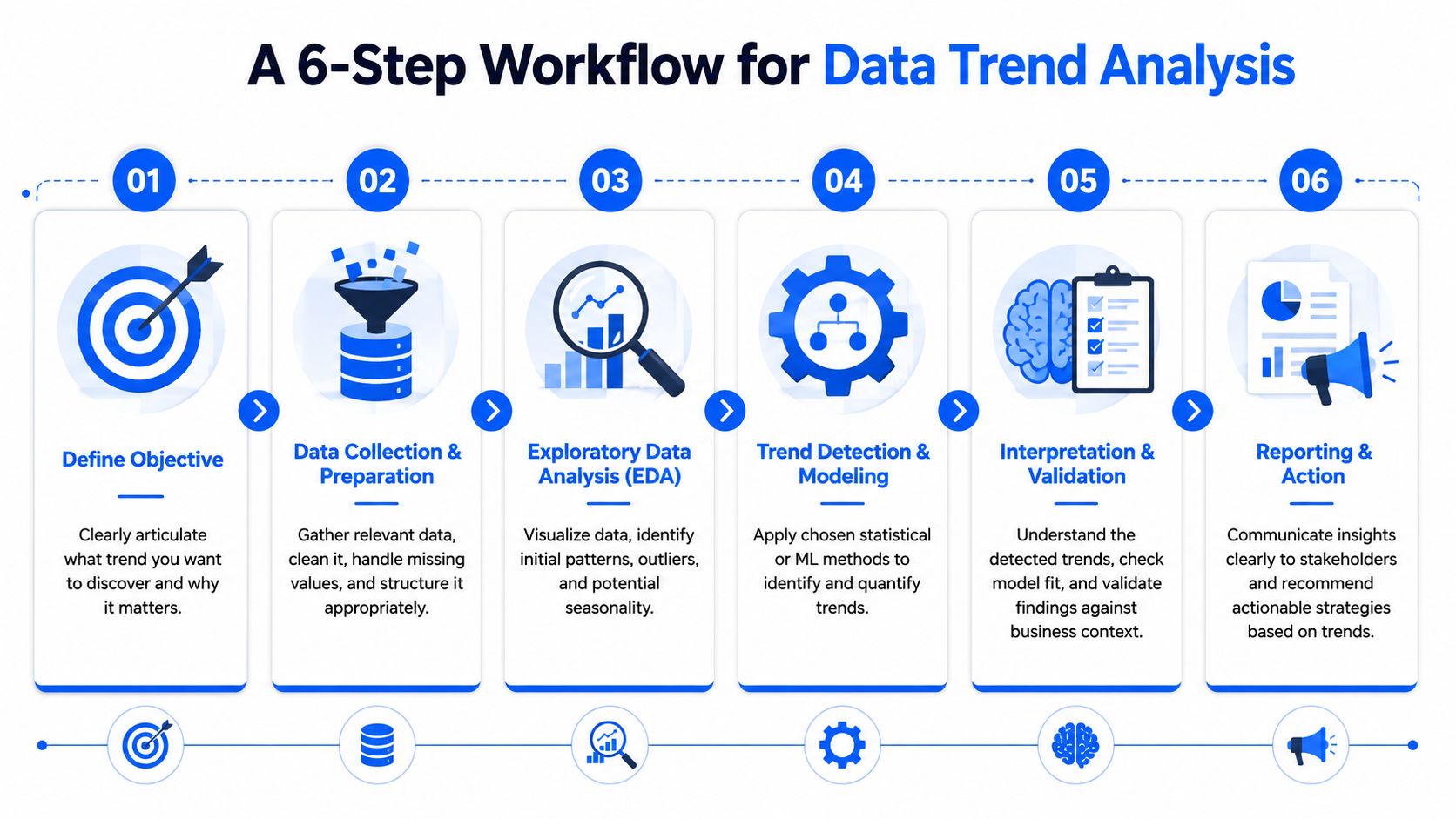
Start with validity not modeling
Define the question in terms the pipeline can support. "Are customer signups increasing?" is too loose to test well. "Is the daily signup baseline shifting after accounting for weekday seasonality, attribution lag, and known ingest delays?" is specific enough to validate.
Then check whether the source data is safe to interpret. I look for three failure modes first:
Record validity. Do the rows still satisfy the business rules behind the metric?
Schema stability. Did a field disappear, change type, or start carrying a different meaning?
Timeliness. Did the data arrive within its normal latency window?
If any of those checks fail, stop the trend readout and mark the series as untrustworthy. A clean chart built on late, partial, or redefined data creates false confidence.
Later in the workflow, video walkthroughs can help teams standardize this process across engineering and analytics roles:
Build a baseline that operations can trust
After the inputs pass validation, establish a baseline for normal behavior. In practice, that means choosing a historical window that reflects current operations, separating recurring patterns from real drift, and defining what range of variation is still acceptable.
A single average is rarely enough. It hides the exact problems that show up first in messy systems, especially when delays or partial failures only affect one slice of the distribution. In volatile environments, I prefer methods that examine the distribution, not just the center. Quantile-based baselines are useful here because they can show that the slowest ingestion jobs, longest processing times, or highest-value transactions are deteriorating even when the average still looks stable.
That matters during schema migrations and delivery incidents. A mean trend can stay flat while upper-percentile latency, null rates, or reconciliation gaps get worse. The method is not the issue. The benchmark is too coarse for the operating conditions.
Investigate shifts with evidence
Once a shift is detected, the investigation should narrow quickly and follow the system in the order it can fail.
Start with pipeline timing. Late-arriving data explains many apparent drops and rebounds. Then inspect structural changes such as renamed columns, changed event payloads, or modified joins. After that, review record-level quality rules for broken constraints, missing values, duplicate events, or invalid states. Only when those checks pass should the team treat the change as a business trend.
This order saves time because it matches how production metrics break. Commercial teams often ask for interpretation first. Engineering teams often start with logs. A better practice is to connect the metric, the pipeline, and the quality checks in one investigation path.
Integrated observability tooling helps because the analyst does not have to jump between warehouse queries, orchestrator logs, validation reports, and BI dashboards. Digna is one example. It combines anomaly detection, historical analysis, timeliness monitoring, record-level validation, and schema tracking while executing analysis inside the customer's database environment.
The fastest incident review happens when the trend, the delay, and the schema event are visible together.
Visualizing and Communicating Trends
Strong analysis still fails if the chart answers the wrong question. A stakeholder doesn't need every decomposition component or model detail. They need the right visual evidence for the decision in front of them.
Match the chart to the question
Use a line chart when the main point is direction over time. It's the default for a reason. People can see slope, inflection, and sustained change quickly. But line charts are weak when the main story is concentrated in specific time slots or recurring cycles.
Use a heatmap when seasonality matters. If a metric behaves differently by hour, weekday, or month, a heatmap shows recurring patterns faster than a stack of line charts. It's especially useful for timeliness and latency views where operational windows matter.
Use small multiples when you need comparison without overlap. Multiple entities on one chart often turn into spaghetti. Separate panels preserve shape and let readers compare trends without guessing which line belongs to which source.
Use annotations aggressively. If a shift aligned with a deployment, a schema revision, or a delay event, mark it. People interpret unannotated charts too freely.
Design for the audience using the trend
Technical peers usually want uncertainty, diagnostics, and context. Business stakeholders usually want significance, likely cause, and required action.
A useful handoff structure is:
State the signal. What changed, in plain language.
State the confidence. Is it stable, emerging, or under review because of input quality concerns?
State the likely driver. Business event, timeliness issue, validation failure, or structural change.
State the action. Monitor, investigate, or decide.
A chart should reduce argument, not create more of it.
Teams also save effort when they don't build every visualization from scratch. Unified observability interfaces help because they already organize anomalies, trend views, timeliness signals, and health indicators around operational investigation rather than static reporting.
Governing Trend Analysis to Avoid Common Pitfalls
Monday morning. Revenue is down 18 percent on the weekly dashboard, Slack is full of escalation messages, and the first question in the exec meeting is whether demand has softened. An hour later, the root cause is a late batch and a silent field mapping change.
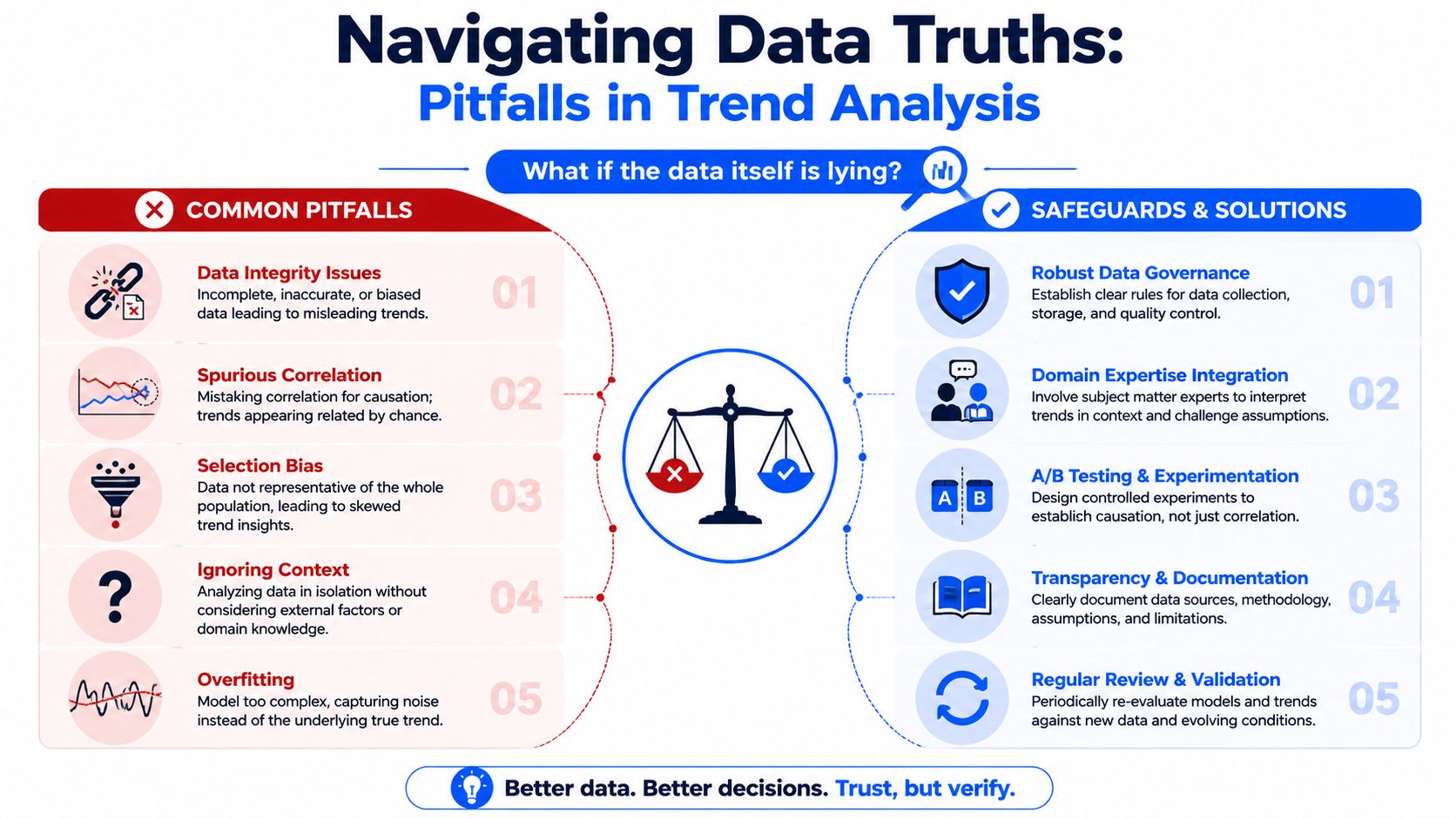
That scenario is common because governance usually starts after someone spots a bad chart. Reliable trend analysis starts earlier. Before anyone interprets a slope, the team needs evidence that the inputs are complete, current, and structurally consistent.
The first governance question
The first governance question is not whether a trend is statistically significant. It is whether the underlying data was fit for analysis at the time the trend was produced.
That sounds basic, but it changes how teams operate. If source freshness failed, if null rates jumped after a deployment, or if a join started dropping records, the trend output should be treated as conditional evidence, not decision-ready insight. I have seen teams spend days explaining a market shift that turned out to be an ingestion defect.
Trend analysis fails in predictable ways when governance is weak. The methods are usually not the problem. The missing control is a release gate between data production and data interpretation.
Controls that keep bad data from becoming a false trend
A workable governance model is operational. It defines what must pass before a chart, metric, or model output is trusted.
Pitfall | What it looks like | Governance control |
|---|---|---|
Pipeline defect mistaken for business movement | Sharp spike or drop with no matching business event | Block publication until freshness, volume, and row-count checks pass |
Structural change hidden inside a valid-looking metric | Trend shifts after a field rename, type change, or new enum value | Track schema changes and map them to affected datasets, dashboards, and models |
Regular seasonality treated as an incident | Teams open investigations every weekend or month-end | Maintain baselines by hour, weekday, month, or other known operating cycle |
Correlation presented as cause | Two metrics move together and the write-up implies causation | Require domain review, experiment evidence, or a documented causal rationale |
Stable averages masking localized failure | Mean stays flat while a region, customer tier, or long-tail segment degrades | Review distributions and segmented trends before sign-off |
These controls are simple to describe and harder to enforce. Enforcement is the point.
What governance should require before trend interpretation
Use a pre-analysis checklist that systems can evaluate automatically:
Validation status: Required record-level rules passed, or the output is labeled untrusted.
Freshness status: Source tables arrived within the expected window for the reporting period.
Schema status: No unreviewed structural changes affected fields used in the metric.
Completeness status: Row counts, null rates, and key coverage stayed within tolerance.
Context status: Known incidents, backfills, and business events are attached to the analysis record.
Data observability becomes part of trend analysis rather than adjacent platform hygiene. If observability signals live in a separate tool that analysts never check, governance exists on paper and fails in practice. The trend review surface needs freshness, schema history, validation failures, and anomaly context next to the metric itself.
Set ownership before incidents happen
Governance breaks down fastest at handoff boundaries. Data engineering assumes analytics will catch bad inputs. Analytics assumes the platform team monitors source quality. Product or finance assumes the dashboard owner verified everything upstream.
Assign explicit ownership for four decisions:
who defines quality rules for each source metric
who approves baseline changes
who can publish a trend with known quality exceptions
who investigates when a trend and a quality signal diverge
Without that model, every incident turns into a routing problem.
Keep the output honest
Good governance does not suppress analysis. It attaches confidence to it.
A practical policy is to classify trend outputs as trusted, provisional, or blocked. Trusted means quality checks passed and no unresolved structural issues are open. Provisional means the signal may be real, but one or more input conditions need review. Blocked means the data failed required checks and should not support decisions yet.
That discipline prevents a familiar failure mode. A chart looks clean, gets copied into a planning deck, and acquires more authority than the underlying pipeline ever earned.
Conclusion Putting It All Together
Reliable data trend analysis isn't mainly an algorithm choice. It's an operating model.
The sequence that works is consistent. Validate records and structure first. Confirm timeliness. Establish a baseline that reflects real behavior rather than a simplistic average. Detect shifts with methods that fit the failure mode. Then investigate the signal with enough operational context to separate business change from data change.
Teams that skip those steps usually end up debating charts instead of resolving issues. Teams that build them into the workflow can move faster because they trust the evidence earlier.
The practical shift is to treat observability and quality controls as part of analysis, not as separate hygiene work. When trend detection, schema awareness, validation, and timeliness monitoring live in the same practice, the organization stops reacting to broken dashboards and starts making decisions on data that has earned trust.
If you're building a quality-first trend analysis workflow, digna is worth evaluating as one option. It focuses on data observability and data quality together, including anomaly detection, historical analytics, timeliness monitoring, record-level validation, and schema tracking in customer-controlled environments.