AI Ready Data Explained from Raw Inputs to Trusted AI
|
0
minute de lecture

An AI project often looks healthy right up to the moment it touches production data.
The team has a model idea, budget, a cloud environment, and people who know how to build pipelines. Then the work slows down. Fields mean different things in different systems. Yesterday's schema change broke a feature table. Labels came from a manual process nobody fully trusts. The data exists, but nobody can say with confidence whether it's safe for retrieval, prediction, or automated action.
That's the point where many teams realize they weren't blocked by model choice. They were blocked by data readiness.
A 2024 global survey captured this gap clearly. Only 12% of organizations said their data was of sufficient quality and accessibility for effective AI implementation, even though 60% said AI had become a key influence on data programs, up 46% from 2023. The same survey found that 64% identified data quality as their top data integrity challenge, while 77% rated their data quality as average or worse (global AI readiness research).
Table of Contents
Introduction Why AI Projects Stall Before the Model
A familiar pattern plays out in many data teams. Product wants a support copilot. Risk wants anomaly detection. Operations wants forecasts. Engineering can assemble the stack quickly enough, but the first serious test exposes the problem. Nobody agrees which table is authoritative, whether the latest load is complete, or whether the labels reflect the business outcome the model is supposed to learn.
That's why AI-ready data is a more useful phrase than “clean data.” Cleanliness sounds like a one-time hygiene task. Readiness is stricter. It asks whether a dataset is fit for a specific AI job, under current operating conditions, with enough trust to support decisions.
If you've seen model experiments perform well in a notebook and fail when connected to live systems, you've already met this problem. The failure usually isn't mysterious. It sits in duplicate entities, stale inputs, undocumented transformations, or brittle handoffs between teams. A practical foundation starts with understanding why data quality matters to an organization, but AI pushes the standard higher because the data has to work for both people and machines.
The stall usually starts upstream
Many teams don't begin by asking the wrong question. They ask a question that's too broad: “Is our data ready for AI?” That sounds sensible, but it hides the important details. Ready for search over documents is different from ready for demand forecasting. Ready for a human-in-the-loop assistant is different from ready for an agent that triggers actions.
AI projects rarely stall because data is absent. They stall because the available data isn't trustworthy enough for the exact workflow being built.
That distinction changes how you evaluate readiness. You stop treating volume as proof. You start checking fitness, traceability, and runtime safety.
Trust has to survive contact with live systems
Historical quality checks matter, but they aren't enough. A training dataset can look well prepared and still become unsafe once schemas change, loads arrive late, or upstream logic shifts without notice. In practice, AI readiness lives in two places at once:
Preparation quality means the dataset is defined, validated, and documented well enough to use.
Runtime trust means you can detect when that status no longer holds.
That's the lens worth using. Not “Do we have lots of data?” but “Can this data support this AI behavior, today, with controls that catch drift before the model acts on it?”
What AI Ready Data Really Means
AI-ready data isn't just data with fewer nulls and cleaner values. It's data that a machine can interpret, trace, and use correctly for a defined workflow.
A kitchen analogy helps. Raw ingredients in a fridge are not the same as ingredients prepped for a recipe. You may have onions, tomatoes, and spices, but that doesn't mean dinner is ready. Someone still has to wash, chop, measure, label, and organize everything for the exact dish being cooked. Data works the same way. Storage is not readiness. Readiness means the dataset has been prepared for a specific kind of computation.
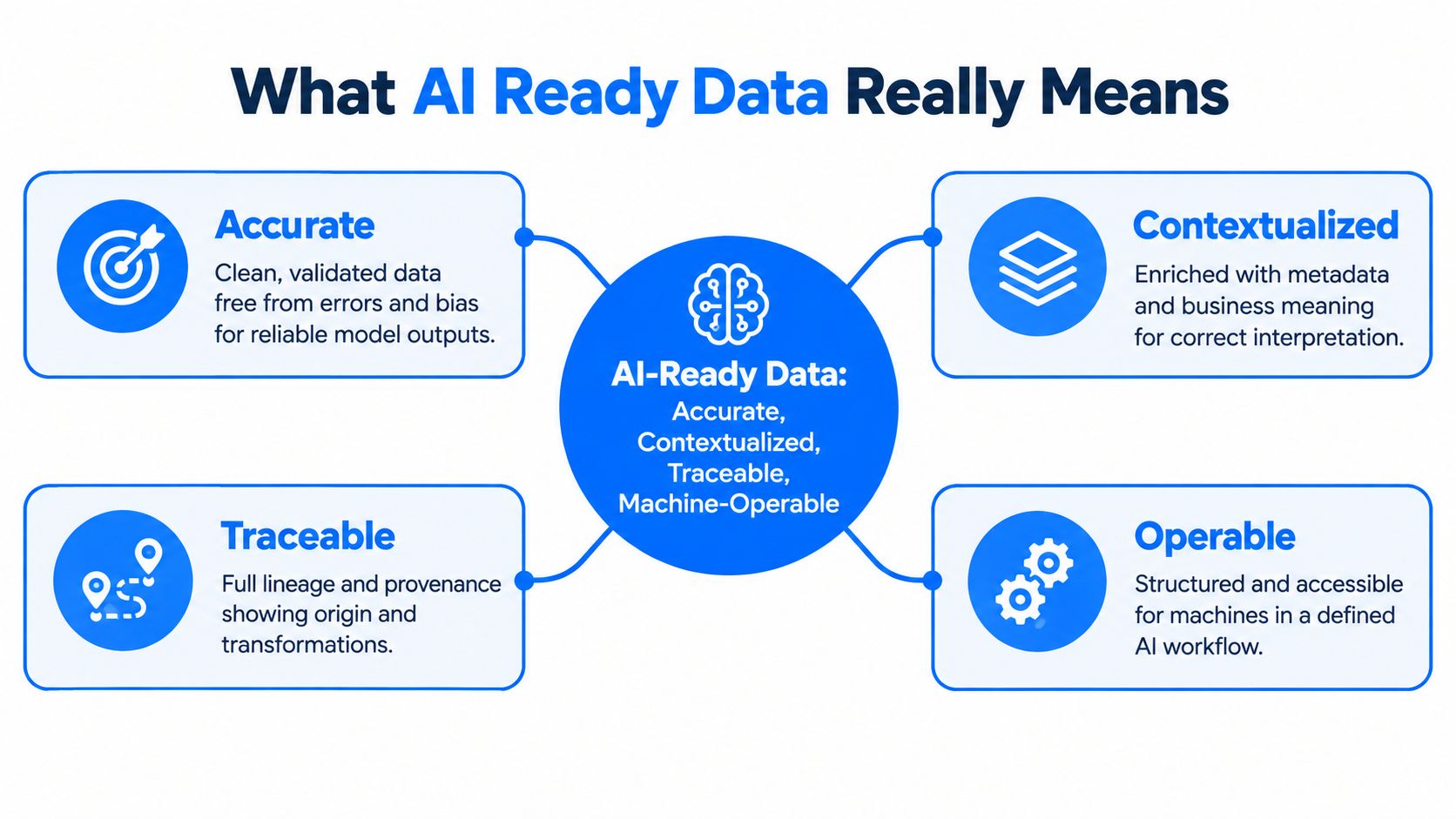
Accurate is only the first layer
Start with value quality, and you should. Bad values break models in obvious ways. Wrong timestamps distort sequence features. Duplicate customers inflate exposure. Inconsistent labels poison training targets. If you need a solid refresher on the components behind this, the dimensions of data quality are the right foundation.
But accuracy alone doesn't make data AI ready. A perfectly valid column still fails if the model can't tell what it means, where it came from, or whether it applies to the current task.
Context turns values into usable signal
Data becomes more useful when it carries metadata that machines can parse, not just comments that humans can read. Independent guidance from the United Nations statistics community and the UK government emphasizes that AI-ready datasets need machine-readable metadata, quality assurance, interoperable formats, and governance controls. The UN framework highlights machine-actionable metadata, quality control, open licensing, responsible AI-enabled access, and structured collaboration. The UK's 2026 guidance says an AI-ready dataset must meet standards for technical optimization, accuracy, completeness, consistency, metadata, live quality monitoring, and legal compliance (UN and UK AI-ready data guidance).
That sounds abstract until you map it to engineering work:
Business meaning tells the modeling team what a field represents.
Technical metadata tells systems how to parse and join it.
Usage context tells downstream users when it is appropriate to use.
Traceable and machine-operable means production-safe
A 2026 expert article describes AI-ready data as data supported by structured metadata that enables automated discovery, semantic alignment, provenance tracking, and reproducible computational use. It also notes that dataset-level metadata must be attached and parseable by machines, because interoperability and traceability depend on it (expert discussion of structured metadata and provenance).
Practical rule: Treat metadata, lineage, and provenance as part of the model input contract, not as optional governance paperwork.
That's the core definition I use in platform work: AI-ready data is accurate, contextualized, traceable, and machine-operable for a specific AI task. If any of those pieces are missing, the model may still run. It just won't be dependable.
The Six Pillars That Make Data AI Ready
A practical checklist goes beyond “clean and governed.” Six pillars are useful because they cover both model performance and operational trust.
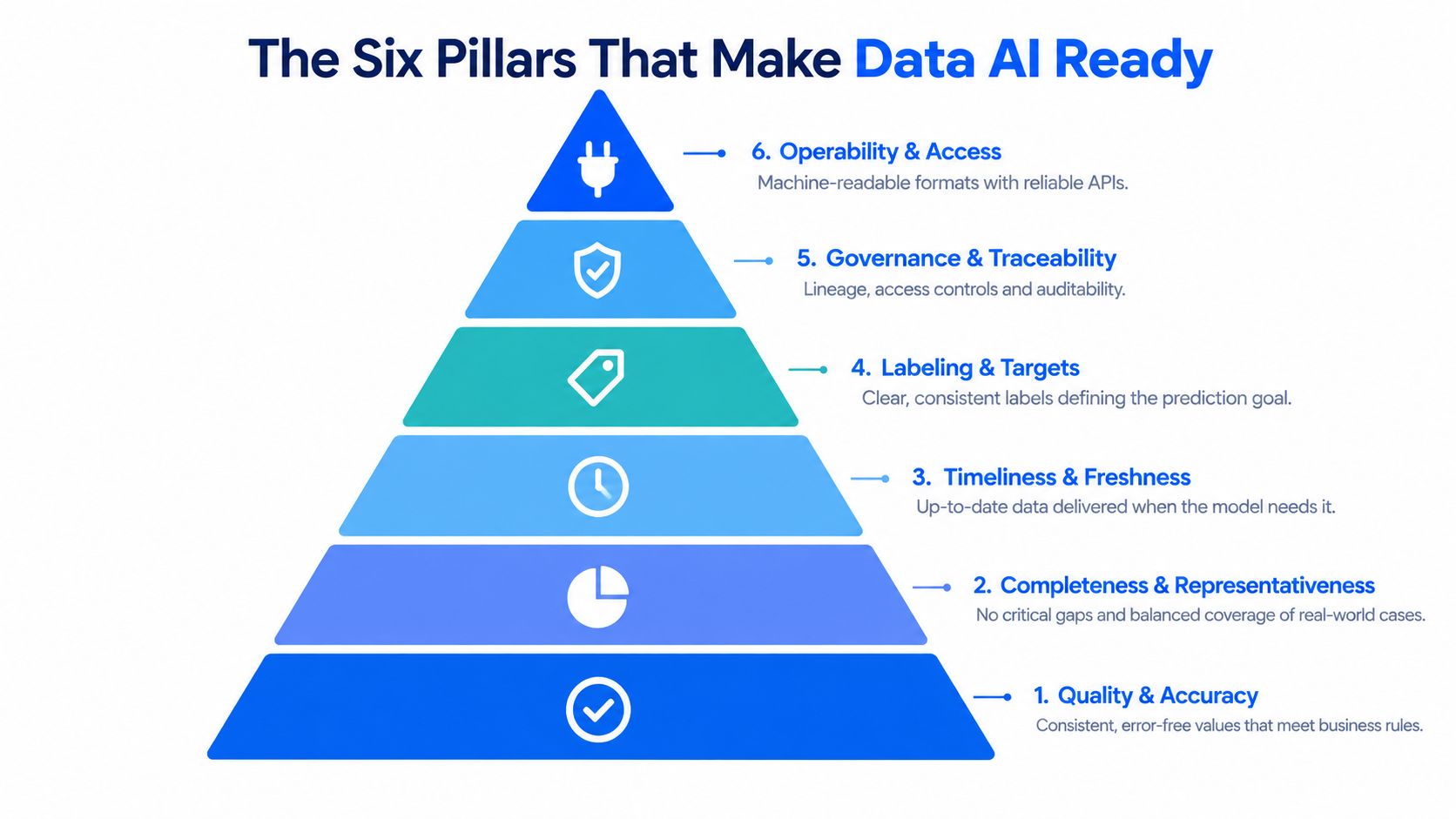
Quality and accuracy
Start with the values themselves. Are records valid? Are formats consistent? Do dates, identifiers, and categorical fields obey business rules?
This isn't just data management orthodoxy. Empirical research examined six data-quality dimensions across 19 popular machine learning algorithms for classification, regression, and clustering, specifically to explain performance through data quality. A later data-centric AI paper revisited six dimensions: consistent representation, completeness, feature accuracy, target accuracy, uniqueness, and target class balance (research on data quality dimensions and ML outcomes).
The practical implication is simple. Duplicates, mislabeled targets, and inconsistent representations change model behavior.
Completeness and representativeness
A complete dataset still might not represent the world your model will face. That's where teams often get tripped up. They validate row counts and null rates, then discover the model underperforms on rare but important cases.
Representativeness asks whether the data includes the events, users, edge cases, and operational conditions the AI system must handle. If you train a support classifier on well-formed tickets but production includes abbreviations, copied logs, and multilingual text, your clean sample isn't representative enough.
A useful enterprise checklist often includes:
Coverage of edge cases that matter to the business, not just the common path
Balanced examples when class imbalance would distort training
Source diversity when the same entity appears across fragmented systems
Timeliness and freshness
Some data is correct and still unusable because it's late. That matters more for AI than many teams expect.
A recommendation model built on yesterday's inventory may suggest unavailable items. A fraud signal built on delayed transactions becomes less useful precisely when speed matters. For retrieval systems, stale knowledge can be more dangerous than missing knowledge because the output still sounds confident.
Freshness is not an SLA footnote. For many AI workflows, it is part of correctness.
Labeling and target integrity
Training labels deserve their own pillar because they define what the model learns to optimize. If teams disagree on what “churned,” “approved,” or “high risk” means, the model will encode that ambiguity.
Good labeling isn't only about consistency. It's also about operational alignment. The target must reflect the decision the business wants to support. Otherwise the model gets excellent at predicting a proxy nobody should use.
Governance and traceability
When a model output needs explanation, teams need lineage fast. Which source system supplied the value? What transformations changed it? Who approved the dataset for this use?
An enterprise data quality framework is useful here because governance becomes practical when it is attached to concrete controls: ownership, access rules, validation evidence, and lineage history. Without traceability, even a strong dataset is hard to audit and hard to trust.
Operability and access
The last pillar is often underappreciated. Data can be high quality and still fail because it's trapped in awkward formats, poorly documented storage patterns, or brittle handoffs.
Operability means the data is available in machine-readable formats, accessible through stable interfaces, and structured so pipelines can consume it reliably. In production terms, schemas, APIs, tables, and metadata services stop being plumbing and become part of AI readiness itself.
Ready for What Defining Fitness for Your AI Use Case
A generic readiness checklist breaks down the moment you compare different AI jobs.
A retrieval system needs searchable documents, chunking strategy, metadata tags, and provenance. A forecasting model needs stable time series, consistent granularity, and trusted timestamps. An autonomous workflow needs stronger controls still, because it may act on the data without human review.
Gartner makes this point directly. Leaders must first define what counts as AI-ready data, and that data must be representative of the use case, including edge cases, outliers, and unexpected patterns needed to train or run the model. The same discussion notes that organizations often confuse scale with fit-for-purpose signal quality, while current guidance emphasizes searchable, contextual, and trusted data across structured, unstructured, and streaming assets (Gartner on defining AI-ready data by use case).
More data doesn't answer the right question
Teams often say, “We have plenty of data.” That may be true and still irrelevant.
The better question is: what failure would hurt this AI system most? If the system summarizes policy documents, stale versions are a major risk. If it scores credit events, provenance and approval status matter more than sheer text volume. If it powers an operational agent, runtime freshness and permission boundaries move to the center.
AI Use Case | Most Critical Readiness Criteria | Common Failure If Missing |
|---|---|---|
Retrieval over documents | Searchable metadata, provenance, versioning, access controls | The system retrieves outdated or context-poor content |
Predictive modeling | Representative coverage, target integrity, consistency, completeness | The model learns distorted patterns and misses important cases |
Real-time decision support | Freshness, timeliness, stable schemas, low-latency access | The output reflects late or incomplete events |
Autonomous workflows | Governance, traceability, policy controls, change detection | The system takes unsafe actions based on untrusted inputs |
Use critical data elements to weight the checklist
Many teams benefit from defining critical data elements before they start tuning models. Not every field deserves the same controls. Customer ID in a deduplication workflow matters differently than a descriptive comment field in a semantic search workflow.
A practical way to score fitness is to ask three questions:
What exact decision or output depends on this data?
What failure mode is least acceptable?
Which fields, metadata, and update paths drive that risk?
Once you answer those, readiness stops being a slogan and becomes an engineering specification.
How to Prepare Data for AI in Practice
Preparation works best as a connected workflow, not a pile of isolated cleanup tasks. The order matters because early design choices determine how much trust you can preserve later.
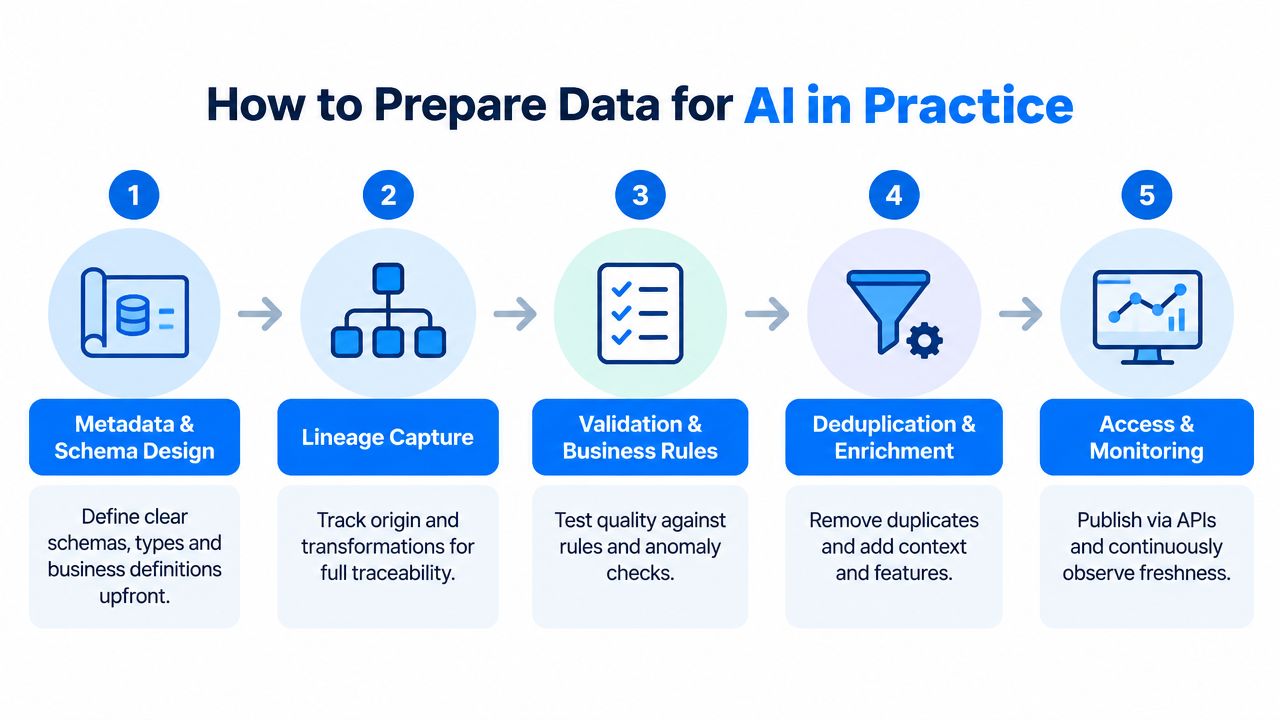
Start with schemas and metadata
Before validating values, define what the dataset is supposed to be. That means field names, types, business definitions, ownership, approved use, and refresh expectations. If a field changes meaning without changing name, every downstream model is now operating on silent risk.
Good metadata should answer both human and machine questions. A person should understand the business meaning. A pipeline should be able to parse structure, relationships, and usage constraints automatically.
Capture lineage while transformations are still visible
Lineage is easiest to record at the moment data moves, not months later during an audit. Track where the data came from, what joins and filters touched it, and which job or person promoted it into an AI-serving layer.
The fastest way to lose trust in a model is to discover a suspicious output and have no clean path back to the source records.
This doesn't require a huge governance program. It requires discipline in pipeline design, transformation logging, and dataset registration.
Validate business rules before scaling training
Once definitions and lineage exist, apply rule-based checks. Validate IDs, enforce allowed ranges, confirm referential integrity, and inspect labels against source truth where possible.
Then handle the issues that often have outsized impact on models:
Deduplication: Remove or reconcile records that describe the same entity in conflicting ways.
Missingness review: Separate acceptable nulls from nulls that signal a broken feed.
Label verification: Check whether target values match the operational outcome you care about.
Class balance review: Inspect whether important categories are absent, rare, or skewed.
Enrich the dataset without hiding the source truth
Feature enrichment is useful, but it can also blur provenance if teams don't label derived fields clearly. Keep raw fields, standardized fields, and engineered features distinct. That makes debugging easier when model behavior becomes hard to explain.
Publish access paths and monitoring hooks
A prepared dataset should be discoverable and consumable. That usually means a stable table, an API, or a documented serving path with clear ownership.
It also means instrumenting the dataset before deployment, not after the first incident. If you can't observe changes in timeliness, structure, or value behavior, the dataset isn't ready for production AI.
How Observability Platforms Keep Data AI Ready at Runtime
Preparation gets a dataset to the starting line. Observability keeps it there.
This matters most in regulated or privacy-sensitive environments where teams can't export data to external AI tools. Independent industry coverage increasingly frames AI-ready data as data that is discoverable, governed, secure, and usable across fragmented systems, with runtime trust becoming central for enterprise AI scaling, especially in finance, healthcare, telecom, and the public sector (IBM on trusted and governed AI-ready data).

What runtime trust looks like in practice
At runtime, you're no longer asking whether the historical dataset looked good during preparation. You're asking whether today's input still matches the conditions under which the model or agent is considered safe.
That usually requires several different controls working together:
Freshness monitoring to catch late, missing, or unexpectedly early loads
Schema tracking to catch structural changes before downstream systems fail
Validation checks to enforce business rules on live records
Behavior monitoring to detect unusual shifts in value distributions or row patterns
A platform such as digna's data observability software is one example of this pattern. It runs inside the customer's environment, computes checks in-database, and combines anomaly detection, timeliness monitoring, validation, and schema tracking without requiring the vendor to access production data. That deployment model matters when data can't leave the organization's own infrastructure.
The operational metrics are concrete
Schema drift isn't a vague concern. One reference design defines a counter for schema changes per table, including column add, drop, rename, type, and nullability changes, and pairs that with statistical drift signals such as null ratio and distinct-value counts to separate structural from distribution change (schema and attribute drift metrics).
Freshness is also measurable. One observability design tracks drift detection latency as the average time between a schema change occurring and the system detecting it. It also tracks data loss rate and pipeline failure rate as percentages of malformed or lost records, or failed jobs (monitoring drift latency and pipeline quality signals).
AI-assisted monitoring reduces manual threshold work
Manual thresholds don't scale well across hundreds of datasets. Bigeye states that its anomaly detection learns a dataset's historical behavior and automatically determines thresholds for every data quality attribute, using standard deviation thresholds based on historical mean to generate alerts with zero manual effort (Bigeye anomaly detection approach).
Databricks describes a similar enterprise direction. Its monitoring automatically analyzes historical patterns to detect anomalies in table freshness and completeness, while also monitoring statistical trends and anomalies over time in a unified system (Databricks lakehouse monitoring).
Historical cleanliness helps with training. Runtime observability decides whether live AI outputs remain trustworthy.
That's the shift many teams are making now. AI readiness is no longer just a data-prep milestone. It's an operating condition.
Conclusion Your Path to Trusted AI Ready Data
AI-ready data isn't a bigger pile of records. It's data that is fit for a specific use case and still trustworthy when live systems start changing around it.
That means two disciplines have to meet. First, prepare datasets so they are accurate, contextualized, traceable, and machine-operable. Second, maintain that status with runtime controls that catch stale inputs, schema changes, missing records, and behavioral anomalies before they reach a model, agent, or decision flow.
If you're assessing your own environment, keep the first pass practical:
Define the use case clearly: retrieval, prediction, decision support, or autonomous action
Identify the critical fields and labels: especially the ones tied to business risk
Check duplicates, missingness, and label integrity: those often break model quality faster than teams expect
Verify freshness and schema stability: particularly for live or near-real-time systems
Require lineage and machine-readable metadata: so teams can trust and audit what the model consumes
Prefer in-environment observability when data can't move: especially in regulated settings
The biggest mistake is treating readiness as a one-time cleanup project. It's closer to reliability engineering. You establish controls, define acceptable operating conditions, and keep watching. That's how raw inputs become trusted AI.
digna provides an enterprise data quality and data observability platform that helps teams keep AI data trustworthy inside their own environment, with in-database checks for anomalies, timeliness, validation, and schema changes. If your AI workloads depend on runtime trust as much as initial preparation, visit digna to see how that operating model works in practice.